Category: Research

  • Chrome Data: Hindi GECs only gainers in week 5

    Chrome Data: Hindi GECs only gainers in week 5

    MUMBAi: The opportunity to see (OTS) collated by Chrome Data Analytics & Media is out for week five.


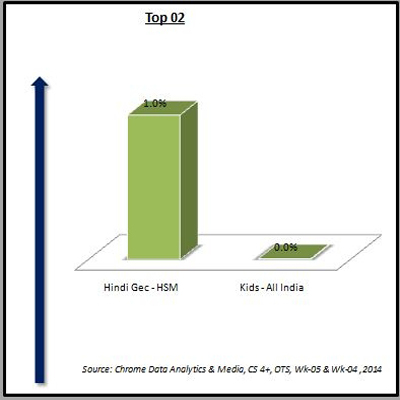
    As per the data collected, the Hindi GECs in the Hindi speaking markets (HSM) was the only genre to see gains in the week. It jumped by one per cent with DD National topping the ranks with 97.9 per cent OTS.


    As for the bottom four, Business News channels in the eight metros saw the highest dip with 2.9 per cent fall. Zee Business was the number one channel in the genre with 76.5 per cent OTS.


    English News channels too had a drop of 2.8 per cent. As usual, Times Now raked in all the viewers with 87.1 per cent OTS.


    English movies and English entrainment channels in the eight metros saw a fall of 2.4 and 2.1 per cent, respectively. In the movie genre, Pix garnered 76.8 per cent OTS.


    AXN got 70.8 per cent OTS in the English entrainment genre.

  • Chrome Data: AAP helps English News genre to claim the top slot in week 4

    Chrome Data: AAP helps English News genre to claim the top slot in week 4

    MUMBAI: After a lull period in week three, the viewers are back in form as the viewership of the idiot box has gone up considerably.


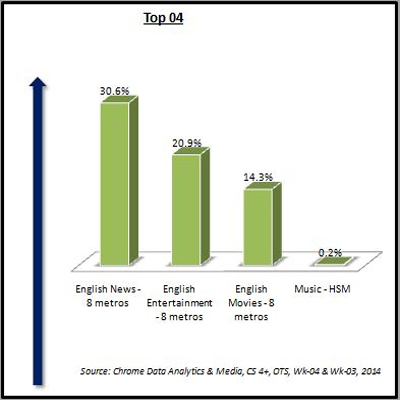
    It seems the AAP tactics worked well for the news channels as the English news genre garnered 30.6 per cent opportunity to see (OTS) collated by Chrome Data Analytics & Media for week four of the year.


    As expected, Times Now in the eight metros once again ruled the genre with 87.8 per cent OTS.


    English entertainment channels also got a grip over its loyal viewers and bounced back with 20.9 per cent to be at the second position in the eight metros. Star World took over AXN to be at the top in the genre with 71.9 per cent OTS.


    English movie channels also got back on track with the telecast of new and interesting movies that got the viewers hooked on to the genre. It gained 14.3 per cent in the eight metros. Pix continued to rule the genre in the eight metros with 78.5 per cent OTS.


    Music genre was at the fourth position with a marginal jump of 0.2 per cent. MTV, thanks to its popular property – Roadies that came back with its eleventh season, over took Sony Mix to be on the top of the chart with 88.6 per cent OTS.


    As for the bottom four, the kids genre saw the highest dip with 18.3 per cent in the all India segment. Cartoon Network remained the most popular among the kids with 85.9 per cent OTS.


    Infotainment channels too witnessed a dip of 13.7 per cent across India. However, Discovery got the highest  OTS among the genre. The channel scored 90.8 per cent.


    Hindi news and religious channels saw a dip of 9.4 per cent and 6.4 per cent in the Hindi speaking market (HSM). In the Hindi news genre, ABP News gained 93.1 per cent, while Aastha channel continued to show viewers their philosophical side and garnered 98.5 OTS.

  • AsiaPac leads global ad growth: Nielsen

    AsiaPac leads global ad growth: Nielsen

    MUMBAI: Global advertising expenditures were up 3.2 per cent in the third quarter of 2013 for year-over-year period, driven largely by Asia Pacific’s expanding powerhouse ad market, as well as a bottoming out of Europe’s contracting ad market.


    According to Nielsen’s latest Global AdView Pulse report, Asia Pacific ad revenues surged seven per cent in the first nine months of 2013. China was up 16.7 per cent, Indonesia 22.1 per cent and Malaysia 15.7 per cent. The gains offset declines in Australia and South Korea.


    Television continues to be the favourite medium through which advertisers attempt to reach their consumers, commanding a 57.6 per cent share of all spending and growing 4.3 per cent. Display Internet, though representing a smaller share of spends at 4.5 per cent grew significantly by 32.4 per cent.


    Macro sectors contributing to the growth include FMCG, which saw a 5.9 per cent increase in ad spending for the year-to-date, and Industry & Services, which grew 11.3 per cent.


    The period also saw a slight improvement in Europe, with the market down just 0.4 per cent in Q3. Nielsen notes that the region’s ad market appears to be bottoming out. Indeed, Italy and Spain, among the hardest hit, may have the worst behind them, the report notes, and Greece saw its ad revenues gain 10.3 per cent.


    In the US the market was up 1.7 per cent by the end of September, even though it fell 1.3 per cent in the third quarter itself. And in Latin America, the year-on-year change was 13 per cent.

  • Chrome Data: Week 3 of nothingness

    Chrome Data: Week 3 of nothingness

    MUMBAI: It looks like that TV viewers are taking a break for a while. In the week three of opportunity to see (OTS) collated by Chrome Data Analytics & Media, no major changes were witnessed.


    As per the data provided by the media advisory consultancy, only music channels in the Hindi speaking market (HSM) saw a rise of 1.3 per cent. MTV took over Sony Mix with a small margin as it garnered 98.1 per cent OTS.


    Hindi News genre in the HSM continued to be where it was last week with Aaj Tak leading the way with 93.1 per cent OTS.


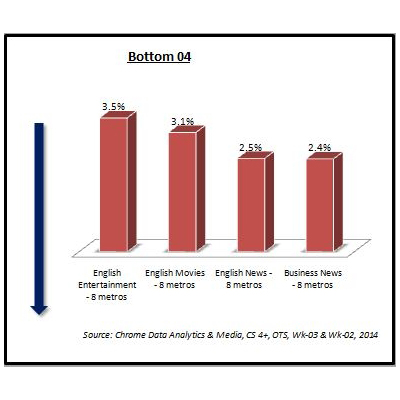
    As for the bottom four genres, English entertainment in the eight metros saw a fall of 3.5 per cent. However, AXN continued to rule with 76.6 per cent OTS.


    The genre was closely followed by English movie channels which fell by 3.1 per cent. In the eight metros, Pix remained on top with 88.1 per cent OTS.


    English and business new channels, both in the eight metro region, witnessed a drop of 2.5 per cent and 2.4 per cent respectively.


    Nevertheless, Times Now continued its winning streak with 88.1 per cent while CNBC Awaaz garnered 82.8 per cent OTS.

  • Music, Hindi news genre on top in OTS week 2

    Music, Hindi news genre on top in OTS week 2

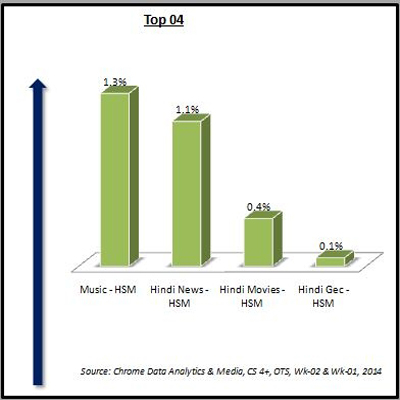
    MUMBAI: It seems the New Year celebrations are not going to fade away so easily. The TV viewers gave thumbs up to the music channels as they claimed the first position in the week two of the opportunity to see (OTS) as per Chrome Data Analytics & Media. Either too many good songs were released that kept the adrenalin-pumping of the music lovers, or they couldn’t get enough of the older songs. The genre rose by 1.3 per cent with MTV toppling over Sony Mix to top the charts with 89 per cent OTS.


    In fact, the genres catering to the Hindi speaking market (HSM) were on a roll this week.


    Call it the AAP effect or something else; the Hindi news channels too turned tables. From being in the bottom four, last week, the genre in the HSM took the second place in the top four with 1.1 per cent. Aaj Tak remained the undisputed king of the genre as week after week it has topped the ranks. This week, the channel garnered 93.9 per cent OTS.


    Hindi movies too saw a marginal rise with 0.4 per cent in the HSM with Sony Max being the blockbuster with 96.5 per cent OTS. Hindi GECs also didn’t stay behind and rose 0.1 per cent with DD National showing who is the boss when it comes to entertaining with 97.6 per cent.


    As for the bottom four, English entertainment channels failed to impress its viewers even after launching new shows. The genre saw the maximum drop with 3.5 per cent in OTS with AXN continuing to rule the roost with 79.4 per cent OTS.


    English movies channels too didn’t do well. The genre saw a drop of 3.1 per cent with Pix again topping the charts with 86.1 per cent OTS in the eight metros.


    English news as well as Business news in the eight metros were in the bottom four by registering a drop of 2.5 per cent and 2.4 per cent OTS respectively.


    Arnab’sTimes Now, however, never fails to impress its viewers. This time too it topped the list in the genre with 91.2 per cent OTS. As for the business news, CNBC Awaaz garnered 85 per cent OTS to be ranked one in the genre.

  • Pay TV households may increase to one billion by 2018

    Pay TV households may increase to one billion by 2018

    NEW DELHI:  The growing pay TV subscriber market is set to drive further investment into the technology underpinning multi-screen and OTT TV services as the global multi-screen landscape continues to evolve.


    Digital TV Research predicts that the number of households that subscribe to pay TV will reach almost one billion by 2018. 

    Combined with the trend of consumers watching more long-form content on tablets and smartphones, this growth in pay TV customers will signal a further surge in multi-screen offerings as operators look to capitalise on demand, offering added value to keep and attract new subscribers.

    With competition increasing in the online video market, operators are often trapped by the complexity and pressure of implementing a successful multi-screen strategy.


    International entertainment broadcasting company Modern Times Group (MTG) recently reported a 25 per cent reduction in direct-to-home subscriptions; but increased subscriptions to their OTT services such as Viaplay more than compensated for this. With increasingly high consumer expectations of a quality user experience, new devices continually coming to market, evolving piracy threats and stringent content owner security requirements, many are still struggling to deliver a compelling, revenue-generating multi-screen experience.

    However, operators can no longer afford to view multi-screen as a defensive play or an experiment. Multi-screen fundamentally changes the way consumers experience media, and an offensive strategy actually propels business forward and provides a compelling alternative to new market entrants and pirated content.


    With all of these pressures and challenges, a report by the Europe-based Irdeto quoted by Convergence Plus sees four key building blocks to making multi-screen work successfully.


    The first is the need to increase customer loyalty with a personalised user experience: While many solutions focus on just “getting on a device,” the real challenge is making a personalised experience across devices that keep consumers wanting more. An intuitive design, coupled with recommendation technology and consistency of user interface and experience across devices is key.


    The second is to reduce risk, cost and time to market: With the fierce race to offer multi-screen services, operators must remove the risk and delay inherent in complex integration projects. Using a reference architecture that is pre-configured, templated and ready for branding will achieve these goals. In addition, cloud-based services can instantly scale and provide the high level of availability and redundancy that in-house implementations cannot match without massive investment in infrastructure.


    Thirdly, there is need for uncompromising content protection on any device: To ensure the success of the service, an operator must enable consumers to securely access premium content from any device of choice, including devices of tomorrow. In addition, operators must provide uncompromising security on any device to satisfy content owners and to enable them to maximise the return on their investment in premium content


    There is also need for monetising using different business models: Having the freedom to test market preferences and pricing is a powerful tool for operators to fine-tune their commercial models. Advertising in particular provides major opportunities for networks. Monetisation of long-form video distribution has been the purview of OTT players such as Netflix, Hulu and Amazon. Now, with the aggressive strategies of companies like Google, the monetisation curve is sure to keep climbing.


    Today, a successful multi-screen strategy is more than just content distribution on multiple devices if you want to compete for consumers, and indeed revenue. A more proactive approach to delivering multi-screen services is required, and elevating this service to must-have status for consumers will require development of a personalised experience that engages the viewers, provides tailored recommendations, interacts with their social networks and enhances the existing pay TV experience. 

    A truly great multi-screen solution will propel business in the right direction and give the freedom to focus on the core strength – delivering a compelling user and content experience. An offensive multi-screen strategy can help you take advantage of the opportunities in the market and drive up content consumption. Pay TV operators must look for a solution provider which will enable them to incorporate the most appropriate and effective personalisation, social connectivity and monetisation functionalities they deem appropriate to service goals. This can be achieved by leveraging managed services, cloud-based infrastructure, innovative technologies, pre-configured workflows and intuitive interfaces. Having the right technology and partners in place is what will separate those who embark on multi-screen, and those who transform this into a successful offering. 
  • Chrome Data: Week 1 meant business

    Chrome Data: Week 1 meant business

    MUMBAI: Money isn’t thought to be the biggest cause of worry for no reason. At least it seems so in this case. As the New Year ushered in, it was the news about money and the ups and downs that it saw in the last year that kept the TV viewers glued to their TV sets in the first week of the year. As various channels presented the yearly round-up, the business channels took away the largest share of audiences. The business channels topped the chart in the Week 1 of opportunity to see (OTS) as per Chrome Data Analytics & Media.


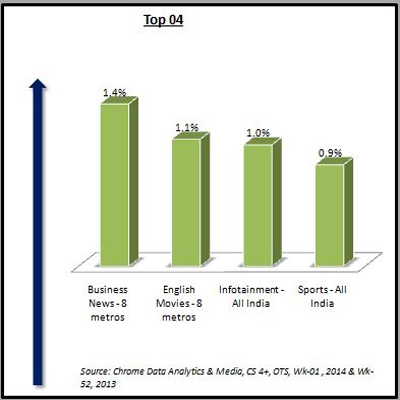
    The business channels across eight metros saw an increase of 1.4 per cent with the Hindi business channel, CNBC Awaaz, leading with 83.0 per cent OTS.


    And considering it was the holiday season, the second on the list were the English movie channels that fared really well in the eight metros. The genre saw a rise of 1.1 per cent. Pix reclaimed its first position, pushing behind Star Movies that had climbed to the first position in Week 52. The channel got 89.4 per cent OTS.


    Infotainment channels across India too saw an increase of 1 per cent with Discovery gaining 91.6 per cent. Sports channel claimed the fourth place in the OTS list with 0.9 per cent grow across India. Looks like the Ashes kept cricket fans occupied as Star Sports 1 was ahead of others in the genre with 77.9 per cent OTS.


    As for the bottom four, Hindi news channel in the Hindi speaking market (HSM) saw a fall of 1.4 per cent. Aaj Tak continued to be the popular one in the genre and garnered 94 per cent. English entertainment too didn’t get many viewers and fell by 0.9 per cent in the eight metros. Star World, however, toppled AXN which premiered the much-awaited season three of Sherlock. The channel from the Star bouquet scored 82.5 per cent OTS.


    In the HSM, music channels saw a slight dip of 0.1 per cent, whereas the religious channels didn’t see any change. Sony Mix with 89.2 per cent and Aastha channel with 98.3 per cent topped their respective genres.

  • TRAI releases its 2013 report card

    TRAI releases its 2013 report card

    MUMBAI: The year 2013 saw the Telecom Regulatory Authority of India (TRAI) cracking its whip on the broadcasters as well as every other party within the industry for its betterment. It released several papers and regulations in order to do so. The Regulator that released its activity report for the year gone by as the New Year kicked off, said that consumer interest has been one of its main mandates.

    To ensure good consumer experience, in 2013, TRAI amended ‘standards of quality of service (duration of ads in TVs)” of 2004. And what came into effect was the regulation that restricts advertising air time to 12 minutes for a clock hour. The regulator says that this practice is not uncommon in several countries and also goes along with the provisions of the Cable TV Network Rules (1994). “Excessive advertisement adversely affects the quality of viewing experience of the consumer. The objective behind the issue of these regulations was to ensure a better quality of experience for the consumer,” says the TRAI’s activity paper.

    But even after this amendment, not all the broadcasters have been following it and the current fate of the ad cap is in a limbo. Several broadcasters have even challenged it in the Delhi High Court including the News Broadcasters Association (NBA). When channels openly did not follow the rule, TRAI started prosecuting them for it. Complaints were filed against 14 broadcasters for non compliance with the regulation. With this, TRAI disappointed many channels as the regulation came at a time when advertising rates were dipping and digitisation had not even entered phase II.

    TRAI also came up with The Telecommunication (Broadcasting and Cable) Services Tariff Orders for cable TV and DTH services that provides standard tariff packs for supply and installation of STBs to consumers in DAS areas and Customer Premises Equipment (CPE) to DTH consumers.

    When India’s oldest DTH operator, Dish TV went to the regulator for extension of its 10 year licence that was to expire on 30 September, it woke up to the fact there were no guidelines/rules on  extension. The new consultation paper is reportedly coming out this month and meanwhile Dish TV has been allowed to continue on its existing terms and conditions.

    The issue of media ownership was also addressed with the Regulator coming out with a consultation paper that discussed points related to ownership of a media outlet, disqualification from the media sector and rules for mergers and acquisitions in the sector. Media monopoly issues were also taken up when the Ministry of Information and Broadcasting (MIB) asked TRAI to examine whether there was a requirement of restrictions on MSOs and LCOs to prevent them from monopolising cable TV markets.

    The TAM brouhaha that saw adamant broadcasters unsubscribe to its ratings system led to the TRAI coming up with its guidelines defining parameters for ratings agencies and ratings systems.

    Major steps were taken to strengthen the process of digitsation. Multi-system Operators (MSOs) and Local Cable Operators (LCOs) were ordered to bring a proper subscriber management system (SMS) in place and disconnect signals for those whose details were not entered.

    Pay TV channels were asked to have written interconnect agreements with MSOs. One of the provisions that protected broadcasters was that an MSO could not demand signals for a particular channel under the ‘must provide’ clause and ask for carriage fee.

    As India is progressing towards digitisation, a la carte channels should also be available along with packages, so that subscribers can opt for either a la carte or bouquets or a combination of both. 14 LCOs and a MSO were also taken to court for not following DAS regulations.

  • Chrome Data: Infotainment genre sees a rise

    Chrome Data: Infotainment genre sees a rise

    MUMBAI: While we thought it’s the news stories that the masses are interested in, the fact seems to be something different. While the TV viewers want to munch on news, it seems they also want it to be packaged in a way that’s entertaining and insightful. That’s the reason we assume that the infotainment genre is becoming popular by the day. At least that is what the data in week 51 of Chrome opportunity to see (OTS) reveals.

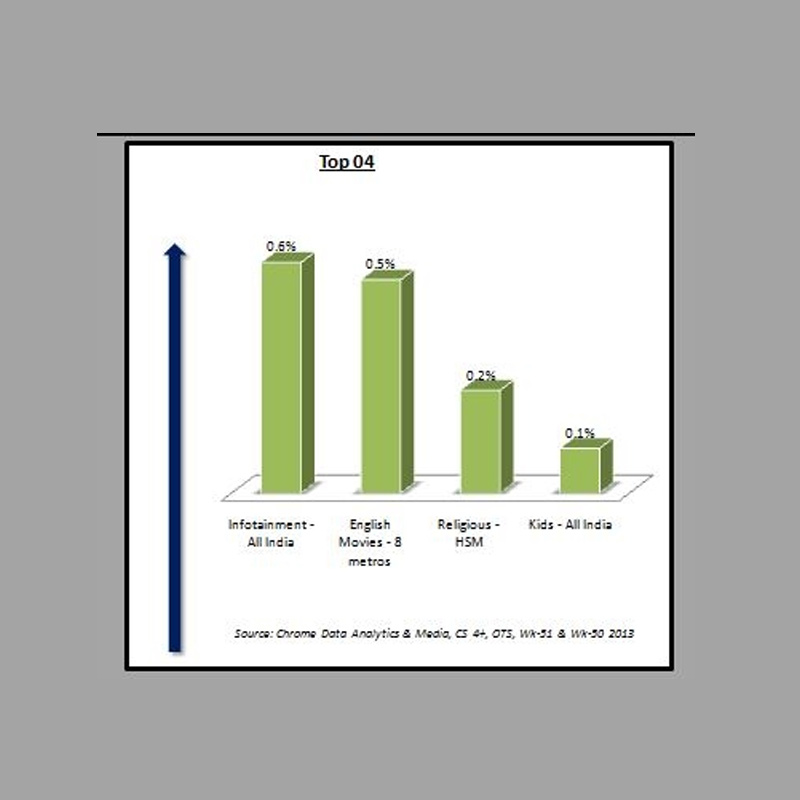
    For the second consecutive week in a row, the infotainment channels have seen a rise. According to the data provided by Chrome Data Analytics & Media, the genre witnessed a 0.6 per cent rise with Discovery Channel garnering the highest OTS among the players in the segment with 88.2 per cent OTS on a national level.

    While last week we thought it was the demise of Nelson Mandela that pulled viewers to the infotainment channels that were airing special features on this magnificent leader, this time there seems to be no specific reason for the genre to be popular. However, the genre is on a roll even at a time when a lot of interesting things are unfolding in the news space. Possibly, the launch of new and interesting shows and new seasons of popular shows is the reason behind bringing audience’s attention to the genre.

    However, movies still seem to be an enticing genre with English movie channels being the second in the list. The genre witnessed a 0.5 per cent rise in the eight metros as Sony Pix continued to woo its target audience and once again remained on top by getting 89.3 per cent OTS.

    The performance of religious channels also bettered as from being in the bottom four, the genre rose up and came at the third position in the Hindi speaking market (HSM). It rose by 0.2 per cent. Spirituality, it seems, is the way to the viewers’ heart; Aastha with its diverse line-up on spiritual shows topped the chart with 98.1 per cent OTS.

    The charm of the holiday season on kids is also reflective in this week’s data as the kid’s genre has witnessed a 0.1 per cent gain on an all India basis. One of the oldest channels in the genre, Cartoon Network, got 87.7 per cent OTS on an all India basis.

    As for the bottom four, English entertainment genre saw a drop of 5.4 per cent in the eight metros. AXN registered 82.9 per cent OTS while others lagged behind.

    Music channels also saw a drop of 0.8 per cent with Sony Mix garnering 87.7 per cent in the HSM. 

    Both English news channels as well as Hindi movie channels witnessed a decline of 0.6 per cent in eight metros and HSM respectively. Times Now ruled among the news channels with 91.6 per cent OTS, while Star Gold got 96.8 per cent OTS. 

  • Satellite & cable pay-TV subs slow down: Study

    Satellite & cable pay-TV subs slow down: Study

    MUMBAI: The satellite and cable pay-TV market is slowing down due to the emergence of new technology platforms.
     

    Net subscriber addition in the global pay-TV market increased by two per cent in the third quarter of the year over the prior quarter, according to ABI Research’s recent pay-TV market data.

    ABI Research practice director Jason Blackwell said, “The global number of pay-TV subscribers reached 692 million in the third quarter of 2010. Pay-TV subscriber growth is holding steady in a number of world regions.”
     

    Pay television markets have experienced many changes due to the entry of a number of new television platforms. These new platforms, such as digital terrestrial TV and online video, are stimulating more competition to the traditional pay-TV services. As a result, there is slower subscriber growth in satellite and cable television services.
     

    The slow growth in subscribers is notable especially in Western Europe and North America where the penetration rate is high. However, satellite and cable TV growth is expected to remain strong in the regions such as Eastern Europe and Latin America.
     

    Pay digital terrestrial television has seen success in countries such as France, Italy and Spain. Italian pay terrestrial television provider Mediaset is the leader in the pay terrestrial TV market. Mediaset added nearly 300,000 subscribers in 2Q-2010 to reach a total subscriber base of 4.4 million.
     

    ABI research associate Khin Sandi Lynn said, “At this moment Western Europe, with a comprehensive 99 per cent of the terrestrial pay-TV market, holds the largest terrestrial television market share”.
     

    There was strong growth in worldwide IPTV subscriptions in the third quarter of 2010, with more than 2.7 million IPTV subscribers added. Global broadband penetration is increasing, as well as the broadband speed. High-speed broadband opens an opportunity for operators to offer IPTV services. Western Europe remains the largest IPTV market, followed by the Asia-Pacific region and North America.
     

    ABI Research expects that the worldwide IPTV subscriber base will exceed 53 million at the end of 2011.