Category: Research

  • Culinary tourism redefines Indian vacations, reveals Godrej Food Trends Report

    Culinary tourism redefines Indian vacations, reveals Godrej Food Trends Report

    MUMBAI: Food and travel are officially the ultimate power couple.

    As National Tourism Day approaches, the Godrej Food Trends Report 2024 has spotlighted culinary tourism as the driving force behind a revolution in Indian travel. No longer a side dish to the main event, food has claimed centre stage, transforming vacations into unforgettable, flavour-filled journeys.

    In 2024, Indians travelled more frequently and for longer durations, with vacation spending surging nearly 25 per cent. A significant chunk of this increase was fuelled by travellers seeking unique and immersive culinary experiences that connected them to local cultures. Whether exploring bustling spice markets or learning time-honoured recipes from community experts, food became the heartbeat of modern Indian vacations.

    The Godrej Food Trends Report 2024, curated by Godrej Vikhroli Cucina with insights from over 190 food experts, revealed the top culinary trends shaping Indian travel:

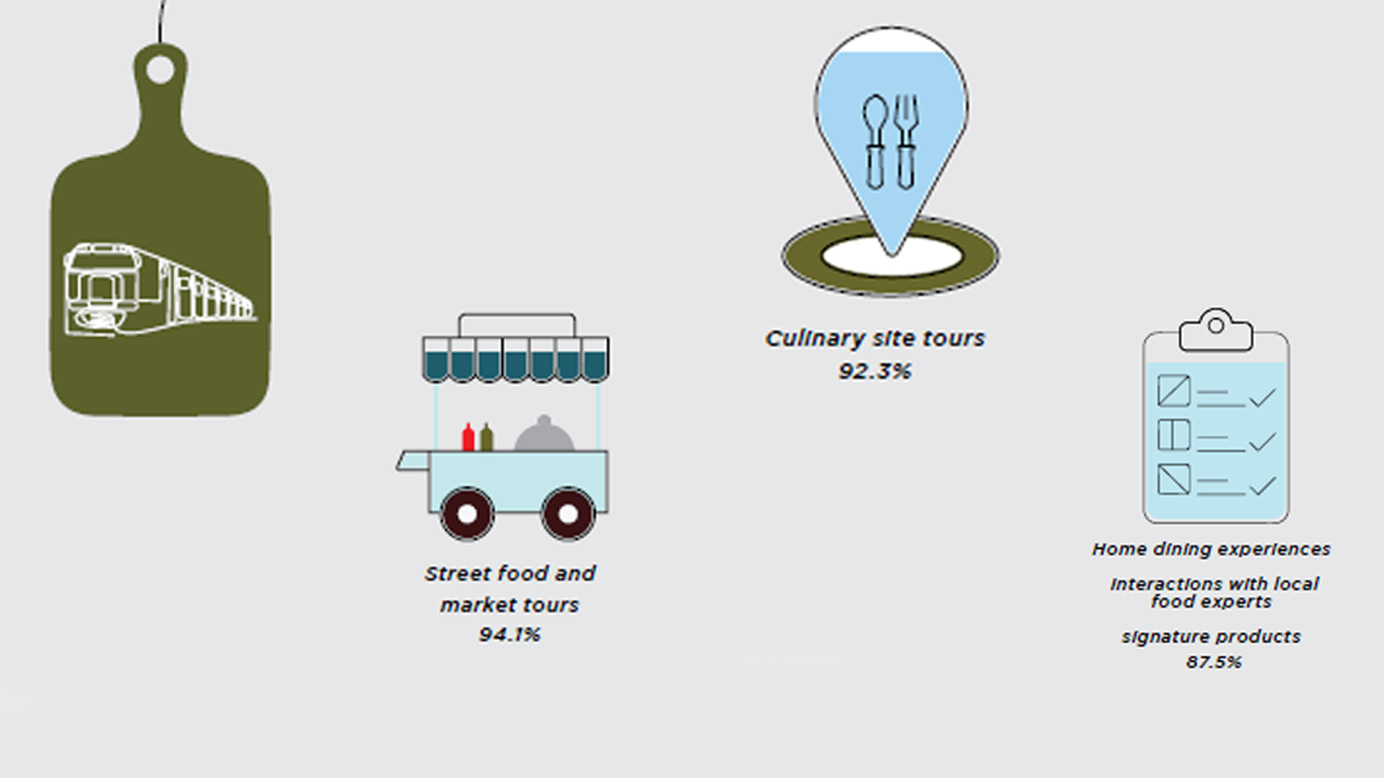
    1. Street food and market tours

    With 94.1 per cent of experts highlighting their popularity, vibrant food streets and spice markets emerged as must-visit attractions. From the zesty flavours of pani puri to the aromatic whiffs of garam masala, travellers immersed themselves in the diverse culinary fabric of India.

    2. Culinary site tours

    Nearly 92.3 per cent of experts predicted continued interest in these immersive experiences, where travellers visited tea estates, artisanal cheese hubs, and other production sites. These tours offered behind-the-scenes glimpses into the craft of food making, adding an educational edge to the journey.

    3. Home dining experiences and local expertise

    Around 87.5 per cent of experts noted a surge in travellers booking home dining experiences. These intimate interactions with local experts allowed visitors to learn traditional cooking techniques, taste signature regional products, and gain a deeper appreciation for India’s culinary heritage.

    “Food is no longer just a part of the travel experience, but its very essence,” said A Perfect Bite Consulting MD & the annual report editor Rushina Munshaw Ghildiyal. “Today’s travellers are not just seeking destinations but connections—immersive, authentic experiences that allow them to explore the heart of a place through its culinary heritage. Whether it’s walking through vibrant spice markets, learning traditional recipes from local experts, or savouring unique regional flavours, food has become the bridge that links people to cultures and stories,” she elaborated.

    This surge in culinary tourism isn’t just reshaping Indian vacations; it’s creating opportunities for local communities and small brands to showcase their culinary culture. From bustling street vendors to small-scale producers, the movement is helping amplify India’s rich food heritage on a global stage.

    As the country celebrates National Tourism Day, travellers are invited to embrace the fusion of food and travel—a blend that promises to redefine how people experience culture and destinations in the years to come.

    The Godrej Food Trends Report 2024 is available for download at www.vikhrolicucina.com.

  • Zee TV & Sun TV: the Elara Capital view

    Zee TV & Sun TV: the Elara Capital view

    NEW DELHI: Television has seen a tremendous rise in its viewership during the ongoing lockdown induced by Covid2019 but it is not doing much for the ad revenues. As per Mumbai-based investment bank Elara Capital findings, ad growth may remain weak for broadcasters as several brands look to cut discretionary spend and new product launches get delayed.

    The report put a negative stance on broadcasters due to structural risks, such as disruptions over TV channel monetisation due to Jio pushing it TV offerings free-of-cost to Jio subscribers, implementation of NTO 2.0, and the threat from digital offerings.

    However, Elara added that subscription revenue can get an upswing in the time, balancing their cash registers. It stated, “On the other hand, if NTO 2.0 gets delayed and is not implemented this year, we may see healthy growth in subscription revenue, given activation of the second TV and viewers flocking to TV, which is a win-win situation as subscribers revenue contributes 35-40 per cent of revenue.”

    According to the findings, factors like expected longer-term consumer stickiness, a sharp increase in ad spends by e-commerce and hygiene brands, and subscription revenue growth due to the addition of new consumers and reactivation of the second TV will work in the favour of broadcasters in these times.

    However, there are certain impending threats too, including increased use of mobile phones, shooting not happening for premium properties like reality shows, cutting of ad spends by global advertisers in CY20, and money not being diverted to GEC and entertainment genres. Also, if the NTO2.0 is implemented this year, the expected increase in subscription revenue will be marred.

    The report also analysed the impact of the current situation on two big broadcasters Zee and Sun TV.

    “Zee and Sun TV together have a strong proposition in the movie segment, which has grown 66 per cent in terms of consumption as per recent BARC report, which too will support ad growth. Even after the lockdown ends, we expect TV consumption to rise sharply as consumers continue to adhere to social distancing norms and prefer to remain indoors.”

    It added, “Zee has corrected ~38 per cent since the lockdown and is trading at a historically low valuation of 8.2x FY22E P/E (vs a 10-year average low of 19.0x) after factoring in concerns over promoter holding. Sun TV has fallen nine per cent and is trading at 11.4x FY22E P/E (vs a 10-year average low of 16.5x).

    Elara also revised its rating to Buy from Accumulate on Zee with a lower TP of Rs 270 from Rs 350 based on 15x (from 17x) one-year forward P/E. It also upgraded its rating to Accumulate from Reduce on SUNTV with a lower target price of Rs 440 from Rs 510 based on 13.5x (unchanged) one-year forward P/E.

    The report added that these stocks can get to perform better in the near term until the lockdown is lifted if they are able to innovate by providing their own digital content on TV; doing an effective selection of old catalogue; and by enhancing their movie offerings.

    Follow Tellychakkar for the consumer facing news & entertainment

  • Hotstar rules as SonyLiv and Netflix witness doubling of installs

    Hotstar rules as SonyLiv and Netflix witness doubling of installs

    MUMBAI: Guess which video streaming app is seeing rapid growth in installs in India? Well, according to Jana, the largest provider of free internet in emerging markets, the two video streamers are Netflix and SonyLiv. This was revealed by it in its Mobile Majority report, which takes a close look at the latest payment  trends in emerging markets. The research was conducted in India from 1 January  2018 through 31 March 31 2018, during which data around streaming app installs and usage was anonymously observed from users of Jana’s mCent browser.

    http://www.indiantelevision.com/sites/drupal7.indiantelevision.co.in/files/styles/large/public/Screenshot%202018-05-30%2012.30.46_1.png?itok=CQFaz6gx

    According to the report, Netflix and SonyLiv accounted for 0.5 per cent and five per cent of the installs on 1 January 2018. By 31 March, their share of installs had gone up to 1.4 per cent and 13 per cent respectively. Amazon saw the install of its Prime Video service go up from four per cent to 5 per cent in the same period, even as the Viacom18 owned Voot watched as its share was shaved 13 per cent to 10.7 per cent.

    http://www.indiantelevision.com/sites/drupal7.indiantelevision.co.in/files/styles/large/public/Screenshot%202018-05-30%2012.30.37_1.png?itok=lLQuzJlY

    YuppTV which accounted for 0.6 per cent of the installs in January saw the number get whittled down to 0.5 per cent. Of course, the monster, which was ruling the app install marketshare sweepstakes was Hotstar which notched up a colossal 69.4 per cent. But this down almost 10 per cent as compared to the  76 per cent at the beginning of the year.

    However, these numbers probably will only skyrocket in  Jana’s next report – especially for Hotstar which saw heightened install activity during the Vivo Indian Premier League.  The finals saw the Star India-owned service serve more than  10.3 million concurrent streams, which was for it and its cloud services partner Akamai a new world record.


  • Despite roadblocks, India attains 48% digital pay-TV penetration in 8 years: MPA

    Despite roadblocks, India attains 48% digital pay-TV penetration in 8 years: MPA

    MUMBAI: Following a blitzkrieg of cable set-top box (STB) deployment, the digitisation process is taking a breather as operators shift focus from deployment to monetisation in order to ensure growth with profitability. 


    As per a recent Media Partners Asia (MPA) report, the pace of India’s pay-TV growth story may appear to be in trouble. However, the report also points out that the process of profitable digitisation typically takes 15-20 years. “In this context, for a market characterised by low average revenue per user (ARPUs), absence of tiering and fragmented last mile cable distribution, India has done well to attain 48 per cent digital pay-TV penetration in eight years,” the report highlights. 


    As the industry consolidates and regroups, the current phase of India’s pay-TV industry offers significant opportunities for value creation across various business segments. The key opportunities and levers, according to MPA are as follows:


    Cable


    Initial STB seeding by cable operators has improved subscriber declarations. Accordingly, with the transition from analog to digital, net ARPUs to multi system operators (MSOs) have grown 10x, to Rs 100 per subscriber per month. However, the current balance sheet position of most MSOs does not justify market expansion. MSOs are therefore compelled to drive operational efficiencies through prepaid services and packages. This helps improve yields from existing digital subscribers. Operators successful in executing such moves will attract refinancing (of existing debt) to expand their consumer offerings with bundled broadband and HD services. Over time, MSOs will also gain more operational control of their networks through majority ownership of joint ventures, and eventually acquire primary points at affordable prices.


    At each stage of cable’s evolution, the operating margin for MSOs will grow multifold. The business will remain capital-intensive but as operators grow to become full-service providers, they hold the potential to generate significant returns on capital employed (RoCE). Cable assets should not just be evaluated on reach and the digital subs base but also on their ability to cross-sell high value services such as HD and broadband. Also important is their effective economic interest in the last mile business. As the approach for MSOs shifts from width to depth, structurally, cable platforms will remain concentrated in the top 50 cities. This could change dramatically, however, with the entry of deep-pocketed players such as Reliance Jio and the growth of Headend-in-the-Sky (HITS) platforms, which seek to digitise rural markets.


    Several international and long-term financial strategics have also been eyeing partnerships with India’s cable and broadband players. This would help expedite capital as well as technical, operational expertise.


    DTH


    Since its inception, the DTH sector has made cumulative investments of Rs 275 billion and has been primarily responsible for driving penetration of digital pay-TV. With a base of more than 41 million active subscribers, DTH is poised to benefit from greater economies of scale. In 2014, the DTH industry reported an average EBITDA of Rs 38 per sub per month, with margins at 16 per cent. Moreover, two of the leading operators, Dish TV and Airtel Digital, have already started generating positive free cash flow (FCF). 


    Over time, MPA expects the DTH industry at large to generate meaningful FCF through: 


    (1) EBITDA margin expansion, as operating leverage starts to play out with subscriber acquisitions in Phase III and Phase IV DAS markets; and 


    (2) The composition of incremental revenue becoming driven more by ARPU growth rather than subscriber volumes. Leading players will be able to self finance future growth as well as consolidate the market, creating significant value in the process.


    Broadcasting


    India’s $3.5 billion broadcast industry remains in a sweet spot. The dual revenue stream of advertising and subscription is expected to benefit from a resurgent economy as well as improved structural dynamics anchored to steady growth in the number of TV households (TVHH) and higher digital pay-TV penetration.


    At 60 per cent TVHH penetration, India continues to add seven million new TV homes each year. In other words, at an average family size of 4.5 members, TV is gaining more than 30 million potential viewers each year. Television will continue to offer the highest reach to advertisers, relative to other media. As a result, advertisements will remain the major revenue stream for broadcasters, while an increase in affiliate sales will help stabilise the business and drive profitability.


    As of end-2014, total affiliate sales for broadcasters reached $1.1 billion, according to MPA. Significantly, 80 per cent of affiliate revenues were derived from digital subscribers (cable DAS + DTH), while India’s digital pay-TV penetration stood at 48 per cent for the same period. Digitisation has therefore improved subscription yields for broadcasters.


    In 2014, an average broadcaster’s yield from digital subscribers stood at Rs 74 per sub per month, against Rs 18 per sub per month from analog. There is therefore upside on affiliate sales, as analog subscribers in Phases III and IV convert to digital.


    Besides leading to greater addressability, digitisation has also improved channel distribution economics by lowering the cost of distribution and allowing multiple modes on content delivery (SD, HD SVoD, TVE etc). Although cable continues to account for more than 80 per cent of the carriage and placement (C&P) market in India, since the roll-out of DAS in 2012, the cable net distribution income (or NDI, which is essentially subscription income minus C&P costs) for broadcasters has grown by 137 per cent, to $218 million. 


    Going forward, the growth of the broadcasting industry will be driven by:


    (1) Expansion in advertising through sub-segmentation and identifying new genres


    (2) An increase in the addressable subscriber base with more digital homes


    (3) Growth in subscription yields: MPA projects total pay-TV channel revenues for broadcasters to grow from $3.5 billion in 2014 to $6.1 billion by 2019, and to $7.9 billion by 2023.


    Based on the relative growth for other markets in Asia- Pacific (ex-China), India is expected to contribute more than one-third of the total channel revenue business in the region by 2023. India’s strategic importance in the region cannot be ignored. For major international networks,

    India already contributes a significant part of their overall APAC business.


    Broadband to sow seeds for new digital assets


    Significant investments are also being made in India’s fixed and wireless broadband infrastructure. This will help boost internet penetration and improve average broadband download speeds. To address the challenge of last mile connectivity, the Department of Telecom (DoT) is considering joining forces with cable MSOs and local cable operators to help boost broadband penetration in smaller cities and towns. The above proposal, if implemented, can open new avenues for cable broadband.


    MSOs have already increased their investments in broadband. As of end-2014, cable broadband subscribers stood at one million, or only 0.3 per cent penetration of total households in the country. However, the entry of new players such as Reliance Jio could dramatically change the fixed broadband landscape. Having recently secured a pan-India MSO license, the company claims to have built the capacity to serve 20 million fiber-to-the-home (FTTH) customers.


    Traditional broadcasters are looking to capitalise on the emerging digital opportunity by investing to create long-term assets. For instance, incumbent broadcasters Zee, Star and Sony have started to aggressively invest in delivering branded OTT services. The belief is that online video consumption will complement the existing linear pay-TV business. Eventually, subscription OTT services will take off as bandwidth costs become more affordable and compelling exclusive content is made available for online audiences. Nonetheless, revenue monetisation will require more scalability, as online video revenues are projected to account for not more than 10 per cent of total video industry revenues over the next decade.

  • What spells success for Indian sports leagues?

    What spells success for Indian sports leagues?

    MUMBAI: The sports industry in emerging markets is changing rapidly today. Amongst the various changes that is impacting sports and its allied businesses, is the emergence of sports leagues.


    According to a white paper released in collaboration between GroupM ESP and IIM –Ahmedabad, the success of the league is dependent on factors such as the sport and its fan base, the performance of the national team for the sport, design of the league, initiatives to build the fan experience, relationship of the league with relevant sports associations and the involvement of celebrities in the league.


    By studying what worked and what didn’t, the report brings to light best practices in the formation and running of sports leagues in a manner that will make them successful.


    Sports – The game is changing


    Over the past 10 years, the sports firmament has changed fundamentally. There has been an increase in the marketing of sports as well as a rise in the use of sports marketing purposes.


    Research indicates that there has been a sharp increase in the governmental support to sports as it is believed to increase societal and economic welfare of the country as well as promote the nation on the global front.


    Increased economic activity has also contributed to the growth of sports and its following. Today, sports serves two purposes: One, to be a platform to create marketing opportunities for brands and secondly, to actually create value for sports fans.


    These twin purposes go hand in hand, and serve the business and industry as well as the sports fans. For brands and advertisers, it is a win-win situation, in so much as when they pay to sponsor or promote a sport; the sporting event offers them a platform to reach their audience.


    As per an industry study report, sports industry in both mature and emerging economies has been growing at a rate faster than the GDP. As of 2011, the size of the industry was estimated at $620 million, growing at a rate of 6 per cent. While the sports economy has always been strong in North America and Europe; in the recent past, it is experiencing a major push in emerging markets.


    The report further states that all the BRIC nations have shown impressive growth in sports (India – 17 per cent, China – 20 per cent, Brazil – 7 per cent and Russia – 53 per cent).The growth of sporting events in emerging markets has been accompanied with the rise of several sports leagues.


    Professional sports leagues like the Major League Baseball (MLB), National Basketball Association (NBA), National Football League (NFL), English Premier League (EPL) etc have achieved great success in North America (US and Canada) and Europe.


    The report states that these leagues have gained worldwide popularity and fan following and in turn has inspired the setting up of similar sport leagues in emerging countries such as India, South Africa, and Sri Lanka.


    With a number of new sports leagues being formed in the recent past, the report highlights interesting set of differences.  Some of these leagues are in infancy, a few others are already defunct, and there are a few which seem to have attained some degree of maturity.


    As per an industry study, it is estimated that in India, the proportion of spending by average household on education and recreation will rise from 5 per cent in 2005 to 9 per cent in 2025. This, coupled with the rise in middle-class segment (from 4 per cent to 41 per cent from 2005 to 2025) will present a huge opportunity for business of sports to cater to recreational needs of such a large population.


    Interest in sports has increased with economic, educational and social advancement of the society. These trends underlie the development and popularity of sports leagues. A brief overview of the various leagues operating within sports in India was analysed as follows:


    Hockey – Federation rivalry stymies the initial leagues


    There have been several attempts to set up Hockey Leagues in India. The first such attempt was with The Premier Hockey League which started in 2005, but folded up by 2008. Then came the World Series Hockey in 2012. These leagues have been able to attract fans as they presented a more exciting format of the game through minor modification of the rules. However, they failed to sustain interest in the game. Reason: existence of two rival national hockey federations which were involved in disputes. This impacted the participation of players in the leagues.


    The country currently has Hockey India, a national federation, which has started the Hockey India League (HIL) that has run two seasons and has performed better than the two earlier avatars.


    Cricket – Success after a false start


    The professional league trend in cricket began with the launch of the Indian Cricket League (ICL), which was started by Zee Group, a television broadcast company. The BCCI in its wisdom did not endorse ICL and banned players contracted with BCCI from playing in ICL matches. It also exerted pressure on the International Cricket Council, the international cricket federation to stop other national federations from supporting ICL.  With this concerted denial of support, ICL folded up in 2008, three years after it opened shop.


    BCCI then launched Indian Premier League (IPL) in 2008, which forever changed the face of professional leagues in the country. IPL has attracted the best of the international players from across the globe.


    Kabaddi – The Indian contact sport that has touched the heart of millions


    The Pro Kabaddi League (PKL) was started in 2014 with eight teams from different cities. The league is supported by the national and international Kabaddi federations. The teams follow the system of salary caps and its owners are personages from the industry, movies, and sports business. The first season of PKL enjoyed unprecedented viewership and fan following. Another league – The World Kabaddi League which began at around the same time as PKL could not duplicate the success of the latter, even though it had a number of film stars as owners of teams in their league.


    Badminton – Shuttling towards increased popularity


    Badminton started becoming increasingly popular in India and attracted huge following with the emergence of some world-class players. The Indian Badminton League (IBL) is managed commercially by a sports management firm and has the backing and support of the Badminton Association of India. It started the competitive games in 2013, and was fairly popular as it was able to attract some foreign players, including the world’s number one. It failed though to get some of the best Chinese players. Indian Badminton League has recently been facing issues related to scheduling due to other international tournaments.


    Findings

    • Fan acceptability of Leagues – Rather than financial viability, fan acceptability seems to be a better measure of predicting future success of leagues.  To sports leagues and businesses, sportsmen and others who are investing their time, effort and money in sports leagues, this is an important parameter to track and follow-up with concerted action to improve the chances of success.
    • Choice of Sports – The choice of sports can impact the success of a league. Higher the fan base of a sport, the more the fan base of the leagues in that sport. Also, better the performance of the national team, in a particular sport, the higher is the acceptability of the league in that sport. Managers, sports persons and sponsors investing in a league will benefit from analysing the two factors mentioned above, even as they analyse the probable future of the sporting league. Starting a league for a sport that has a large fan following and a national team that is performing at par may be a way to ensure its early survival and growth.
    • Design of the League – The design of the league, more specifically the salary structure can impact the success of the league. Salary caps tend to distribute talent across teams, and lead to more intense competition which has a positive effect on the success.
    • Team Location – Regional teams can help in building team character. Thus, regional team locations enable association with fans of that particular region resulting in a captive fan base, while providing a competitive spark with respect to other regional teams.
    • Game Format and Scheduling – Fans respond positively to minor changes in the game format, but are alienated by major changes. The timing and scheduling of games can impact the success of the league.
    • Fan Experience – The more the social media initiatives by the league, the more the fan acceptability.  Improve the TV viewing experience through engaging broadcast and improve fan acceptability. Employ greater in-stadia engagement for higher fan acceptability of the league.
    • Players – When top regional players, famous foreign players and world class sportsmen participate in the league games, what happens is a cascading of their respective following into the league following. So each of these people are stakeholders in enhancing fan engagement and acceptance.
    • League – Federation Leadership -The relationship between the league and the federation can impact the success of the league. Starting a league in harmony and full cooperation with the federation that controls the game is almost a hygiene factor for the success of the league.
    •  

    Celebrity involvement


    Celebrity involvement is a key factor in increasing acceptability and marketability of the league. Stars in the game and stars outside the game are a good combination for league success.


  • Authentic brand promoters are far more rare and influential than sharers: Research

    Authentic brand promoters are far more rare and influential than sharers: Research

    MUMBAI: Brands often boast about the number of “likes”, “followers” and “tweets” they garner, but are these measures of brand advocacy too crude? Are people that “like” and “follow” everything true brand promoters?


    As companies grapple with the meaning and impact of social media on brands, Social@Ogilvy and SurveyMonkey join forces for a second year to study how to transform supporters into real, long-lasting advocates, who carry on the brand voice and promote it to others.


    Just as last year’s study showed that brands producing high quality content is critical to engage with social media users, this year’s global, 11-country online survey of more than 5,000 social media users shows that just because people are saying positive things about your brand, doesn’t mean they are real brand advocates. But, if one uses the right approach and techniques, they can be, and this global research sheds light on how.


    “Sharers”, “followers” and “retweets” are crude measures of true brand advocacy


    Majority of users are actively noticing and engaging with brands via social media, with the research showing that 84 per cent of respondents across the 11 markets say they had “liked” or “followed” a brand, product or service. Of those that have “liked” or “followed” a brand, 58 per cent have interacted directly with a brand and 79 per cent received a response back (shout out to social media managers everywhere!).


    The research did not observe any shortage of “social sharers” who not only follow a brand, but who proactively share their experiences: 58 per cent of respondents have communicated either positive or negative opinions about a brand with others.


    These social addicts, who typically stay glued to the likes of Facebook, YouTube and Twitter on a daily basis, exhibit similar behaviors but there are still key differences and steps to transforming “sharers” into brand promoters – those respondents who self-identified as being extremely likely to recommend brands and products to friends.


    While 58 per cent respondents are “sharers”, only 19 per cent are true brand promoters


    Authentic brand promoters are far more rare and influential than sharers, with the global research revealing notable differences to watch out for between them when looking to identify the profile of a promoter. 


    How do promoters interact via social media?


    .   They are intrinsically more active followers: 66 per cent follow brands on a regular basis, compared to only 52 per cent of sharers.

    .    Promoters follow brands in order to interact directly with them. 42 per cent of sharers do this compared to 52 per cent of promoters.


    Why do promoters interact with brands?


    .    A prime reason they follow brands is to be associated with them which 39 per cent do, versus only 28 per cent of sharers

    .    46 per cent also believe a brand’s reputation is important, compared to only 36 per cent of sharers

    .     They prefer to link a brand to their own personal identity, with 45 per cent saying they feel better about themselves after using a brand; only 35 per cent of sharers say the same


    What action do they evoke?


    .   The friends of promoters talk about brands much more: 59 per cent of promoters see their networks regularly mention brands and products, while only 47 per cent of sharers do the same

    .   They are much more likely to respond to their friends’ interaction with brands; 35 per cent would purchase a product if it was mentioned by a friend, compared to just 24 per cent of sharers


    Globally, these promoters share broadly similar characteristics


    True promoters have similar reasons for liking or following a brand, for example: 77 per cent want to hear about products, offers, or news, followed closely by 53 per cent who want to give direct feedback and 52 per cent who want to interact directly with an organisation. Promoters tend to surround themselves by like minds when it comes to their attitude towards brand interaction on social media: 91 per cent say their friends’ mentions of brands are largely positive.


    Quality is paramount with virtually everyone (91 per cent) saying this is why they would be extremely likely to recommend a particular brand or product to friends or colleagues. And, it’s the main reason why 61 per cent promoters would not recommend a brand or product.


    What brands should be careful of


    While both sharers and promoters have posted about a great brand experience on social media, 71 per cent of sharers and 60 per cent of promoters have also discussed terrible brand experiences online.


    Emerging economies breed a higher percentage of promoters


    Countries with the highest percentage of promoters live in emerging economies, like Brazil and India, where 42 per cent and 33 per cent respectively, fall into this category. Japan revealed the smallest percentage by far with just 1 per cent of promoters, followed by Germany and France (14 per cent each), and UK, Indonesia and Australia (15 per cent each).


    However, important cultural nuances are likely to be at play. For instance, Indonesia has a low number of promoters despite 70 per cent of respondents saying they’ve shared great brand experiences on social media. This could suggest that the more passive approach of advocacy via social sharing may be more popular in Asian countries. Equally, a low number of Japanese promoters could be attributed to the formal, more private culture – making them less willing to make personal recommendations online. To that effect, the majority of Japanese respondents (43 per cent) report in-person brand or product recommendations are most trustworthy.


    While it is clear people are more connected than ever – demonstrated by the sheer breadth of networks available to us – the research from SurveyMonkey and Ogilvy shows that it is the depth of connections that change our lives and the world around us.  


    Ultimately, brands need to build relevance and trust through content and connections if they wish to use social media to transform their brand, business and reputation. 


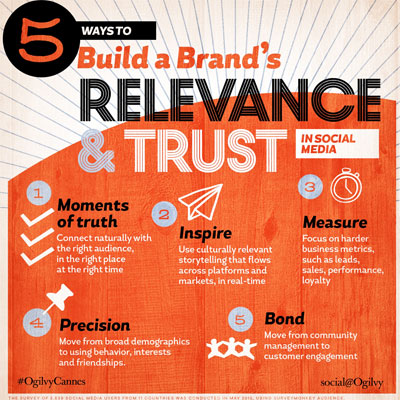
    5 steps that the research insists to garner brand relevance and trust in social media 


    1 .  Precision: Move from broad demographics to using behaviour, interests and friendships


    2.   Moments of truth: Connect naturally with the right audience, in the right place at the right time


    3.   Inspire: Use culturally relevant storytelling that flows across platforms and markets, in real-time


    4.   Bond: Move from community management to customer engagement


    5.   Measure: Focus on harder business metrics, such as leads, sales, performance, loyalty 


    “Companies need to move beyond collecting likes and retweets with meaningless content. Through genuine interaction and content designed to connect with true advocates, companies can drive forward their brand, business and reputation in ways not possible before this era of social media,” said Social@Ogilvy global managing director Thomas Crampton. 


    “Social media addicts may look like your most engaged consumers, but marketers need to stop looking at their data in silos to find their true advocates, By applying the Net Promoter Score methodology to social media users across the globe, we better understand the profile of a brand promoters: those who are extremely likely to recommend brands to friends and colleagues. To appeal to promoters, brands need to not only focus on quality but also reputation among friends or colleagues and that sense of worth that comes from being associated with a brand,” added SurveyMonkey vice president of marketing communications Bennett Porter. 

  • Digital fallout: DTH cos set to lose, broadcasters poised to reap benefits

    Digital fallout: DTH cos set to lose, broadcasters poised to reap benefits

    MUMBAI: Change is constant and change is good…. however, it seems like change isn’t good for all. While the proliferation of digital platforms giving an impetus to online videos, will turn out to be a boon for broadcasters, direct to home (DTH) operators however, are set to lose out.


    According to a research report by Bank of America-Merrill Lynch, just like in the West, online video content will disrupt India’s Pay TV market. While broadcasters will benefit because of ad supported content monetisation, DTH players will suffer because of pressure on ARPUs. Moreover DTH companies are also poised to lose most as the price-sensitive Indian consumers will refrain from paying premium for content on live television when they have online alternatives.


    Broadcasters are well placed to monetise content on digital platforms as it only increases the opportunities. As a result, ad revenues are expected to improve following a pick up in economy. The report states that broadcasters will be able to improve their content monetisation through increased ad revenues and better declaration of subs in a digitised environment.


    For DTH companies, despite digitisation delay, there will be improvements in the average revenue per user (ARPU) driven by the following factors: 1) HD channel penetration increase; 2) Differential tariff hikes; and 3) MSOs hiking tariffs to maintain profitability – offering DTH players more headroom to raise tariffs.


    Creating a scenario comprising Zee TV (broadcaster) and Dish TV (DTH), Bank of America-Merrill Lynch’s analysis suggests that the overall risks are skewed to the upside for broadcaster Zee and to the downside for DTH operator Dish TV.


    According to the report, Zee has underperformed the markets by eight per cent year-to-date (YTD) on concerns about the loss in market share due to channel fragmentation and investments in new channels. “Post the share-price underperformance, we see the risk-reward as favourable since, in our view, the market is now factoring in all the risks, but not giving full benefits of strong ad growth, monetisation of new content and digitisation benefits,” the report states.


    Factoring in the positives for Dish TV, the report says that though digitisation is inevitable, the expectations on timelines are optimistic and complete benefits of digitisation will be seen only by FY2020-21. However, over the next 12 months, ARPU improvements are expected due to: 1) MSOs hiking tariffs to maintain margins; 2) Increased penetration of HD channels; and 3) Differential price hikes in urban areas. “However, Dish TV has outperformed the market by 65 per cent YTD, and we see most of the positives are priced in,” says the report.


    The upside of digitisation will be gradual. Citing risks and benefits of digitisation, the report says that it sees the risk of distributors (MSOs and DTH players) not realising the full potential of digitisation as the pace of roll out is slower than what the market is anticipating. Moreover, by the time the full benefits of digitisation are realised, the new-age video disruptors, internet-enabled smart devices like mobile, TV and PC will start eating into the revenues of Pay TV and MSOs like they have done in the West. Additionally, though phase-I and II of digitisation is complete, the expected benefits have not flowed to the players because of issues like MSOs/LCOs tussle and absence of customer billing. “There has been some progress on resolving the issues but it has been slow. These problems will only increase with roll out in phase-III and IV areas,” the report states.


    In the next few years, the Indian media sector is expected to evolve as digitisation gradually picks up, fragmentation of channels increases and all companies (broadcasters, DTH and MSOs) evolve their business models in face of online content proliferation.


    Positive on broadcasters: Content still the king


    According to the report, companies like Zee will benefit from an improvement in ad growth (led by GDP uptake) and expect to benefit from content fragmentation as it is one of the better companies leveraging this trend. “Over time, as traffic will shift to smart devices, we expect consumption of video content to increase. This presents increasing opportunities for broadcasters to monetise content. With improving economic activities, digitisation rollout and pressure on distributors’ P&L, we expect both advertisement and subscription revenues of broadcasters to increase. On the other hand, we believe that given the reluctance of Indian consumers to pay for online consumption, content on smart devices (smartphones, PCs, tablets) will be monetised primarily through advertisements,” the report states.


    DTH: Digitisation is gradual; ARPU improvement to flow in


    Despite slow digitisation, companies like Dish TV are likely to improve their ARPUs and EBITDA margins over next 12-18 months. The ARPU improvement will be led by the following factors: 1) MSOs facing some pressure from broadcasters to hike tariffs allowing DTH operators to follow them; 2) Increased penetration of HD channels; and 3) Players like Dish TV implementing differential pricing across cities to improve realisations and monetising on its “Zing” offering.


    MSOs: Broadband push is the next big story


    With the ongoing tussle between MSOs and LCOs, the full benefits of digitisation will come gradually for MSOs. As a result, MSOs are likely to focus on other revenue streams like broadband subs. According to checks carried out by Bank of American-Merrill Lynch, there’s increasing focus by MSOs to improve their broadband coverage, which would help cross-sell services overtime and have direct control over subs. The major MSOs have already started experimenting with high-speed broadband in high-density urban areas, and slowly they will start rolling out in Tier-2 and Tier-3 cities.


    Key risks:


    1) Economy not picking up: Any slower-than-expected economic uptake may lead to material downgrades to our consensus ad revenue numbers for Zee. 


    2) LCOs/MSOs tussle unable to reach a solution: Continued tussle between LCO and MSO (LCOs are unwilling to share consumer details with MSOs in order to guard their turf) will impact ARPU improvements for the sector. 


    3) Rise in piracy: With the proliferation of online content and new mediums of consumption, we may see a rise in piracy. In such a scenario, it will impact the entire industry negatively as it would be difficult to monetise the content effectively.

  • What’s in store for the Indian broadcast industry?

    What’s in store for the Indian broadcast industry?

    MUMBAI: The Indian media and entertainment industry is on the cusp of growth with phase-III and IV digitisation underway. However, even as the government is optimistic about meeting digitisation deadlines, multiple stakeholders are of the opinion that to meet the 2016 yearend deadline is unrealistic and far-fetched to say the least.

    Reiterating the sentiment is a research report by Bank of America-Merrill Lynch, which says that digitisation will be a slow process and will be complete only by FY2020-21. 

    The Bank of America-Merrill Lynch lists out four things that the Indian media industry should watch out for. They are as follows:  

    1) Digitisation: A Slow Process

    Even though the government has mandated full digitisation by December 2016, the research says that digitisation will be a slow process as on-ground checks show that it is nearly impossible for stakeholders to stick to the deadline. Bank of America-Merrill Lynch expects the entire roll out to be complete only by FY2010-21, with bulk of the benefits flowing in FY’18-19.

    Larger MSOs don’t have a local presence: In phase-I and II DAS-mandated areas, the large MSOs already had their infrastructure laid out and had knowhow of the local conditions. However, phase-III and IV are more remote areas where the MSOs do not have an established network, and hence will take time to rollout their network. These areas have been dominated by the local/ smaller MSOs, who may not have the wherewithal to invest capex and fund set-top-boxes (STB) for consumers. The report says that if digitisation happens slowly, the local MSOs will be able to capture this market (wherever analog cable is present), thus limiting the land grab of DTH operators.

    Government has reasons to be ambivalent on digitisation: The government benefits from digitisation in way of increased tax collections. At the same time, it will be vary of making voters pay a higher tariff for Pay TV bills. The ARPUs for phase-III and IV areas are lower; and a move to digital TV will entail a significant rise in their pay TV bills. Considering that TV is the main source of entertainment for Indians, the government may look to ease the digitisation roll-out slowly, rather than sticking to tight deadlines.

    ARPUs are lower: The phase-III and IV DAS-mandated areas have a lower ARPUs compared to phase-I and II geographies, which would make it difficult for MSOs and DTH companies to push through a premium ARPU product. As per the research, more innovations like Dish’s low-ARPU Zing proposition (focusing on low-cost local content), lower price points and differential geographical pricing to drive adoption are likely to be seen.

    2) Ad revenue growth to be strong in FY2016

    Advertisement revenues strong: Ad revenue growth is expected to be strong in FY16, on back of: 1) A pick up in economy and the resultant rise in ad spends; 2) Increased ad spending by e-commerce companies; and 3) Television maintaining its share of the advertisement pie. Ad spends have a strong correlation with nominal GDP. Considering that the economy is expected to pick up going forward, the Bank of America-Merrill Lynch report forecasts 13 per cent ad revenues growth for the industry, which is in line with industry estimates. (Source: KPMG-FICCI Annual report 2015).

    Implementation of BARC: The prevalent industry TV rating data (TAM) has often been cited for inconsistencies by broadcasters and advertisers. Hence, the industry bodies representing the three key stakeholders – broadcasters, advertisers, and advertising and media agencies – launched a new rating system – BARC India. Since it has the support of the industry, the report suggests that it will eventually replace TAM as the industry standard for determining TV ratings. Given that the new rating uses different methodology and sample set, the status quo TV ratings is at a risk of being upset. Though Zee has managed to hold on to third spot among Hindi GECs in the recently released data, as BARC moves towards a countrywide coverage, volatility in future ratings will remain a concern.

    Smart devices will lead to increasing viewership and ad revenues: With increasing penetration of smart devices, overall video consumption will increase. Since Indians are quite willing to watch ad-supported free content, the ad revenues will increase with the rise in online viewership.

    3) DTH: Factoring ARPU hike for 2-3 years

    Impending move to RIO to increase ARPUs: Star India has made the first move by completely moving its channel bouquets to RIO pricing, without materially impacting its viewership. Even as other broadcasters are still debating on whether to move to RIO, according to the Bank of America-Merrill Lynch report, Star’s successful move makes it only a matter of time before other broadcasters move to RIO pricing as well. Moving to RIO will increase the content cost for MSOs, necessitating an increase in tariffs to protect profitability. This does not factor in the RIO sing-ups in the base case. As per the report, an upside to subscription revenue estimates will be seen for both broadcasters and DTH operators in case market moves to RIO pricing.

    Subscribers in low-ARPU areas may opt for ala carte subscription: Unlike in the West, regulation in India mandates broadcasters to make available their channels on a piece meal basis. Since the average Indian watched just 17 channels, there is a risk of consumers in the low ARPU phase-III and IV DAS- mandated areas shifting to subscribe on a per-channel basis to reduce their monthly bills.

    Reduction in carriage and placement fees: Digitisation of Pay TV will reduce the carriage and placement fees (C&P fees) that are paid to MSOs for beaming their content. Digitisation mandates complete removal of the placement fees. Additionally, digitisation of the channel signals has resulted in a 3-4x decrease in the bandwidth needed to broadcast individual channels, allowing MSOs to beam as many as 2,000 channels within the allotted bandwidth, and thus weakening the case for MSOs to charge for a non-existent constraint. While the broadcasters are still paying carriage charges, the charges on a per-channel basis have been reducing. According to the report, this trend is expected to continue in the future.

    HD channels to increase ARPUs: Subscription to HD channels have increased in recent months, due to: 1) HD content being made available; 2) Costs of HD STBs have fallen and the non HD boxes point that distributors have stopped procuring non-HD boxes; and 3) Penetration of HD-enabled television sets have increased. As per the estimates by Bank of America-Merrill Lynch, HD subscribers on an average have ARPUs higher by about Rs 100. And with the HD take-up increasing up to 22 per cent for the DTH operators, HD is expected to positively drive up ARPUs.

    4) Fragmentation of channels & content costs

    Ad cap and the fragmentation of channels: The government has recently implemented the 12-minute ad cap (per hour). As a result, the sector has seen a slew of new channel launches and increase in ad rates to offset the impact. The report expects that investment in new channel launches will continue in the near term.

    Content to become increasingly more important: In a digitised world, quality content is going to be increasingly more important. With the likely kicking in of RIO pricing, and possible move to ala carte packages, broadcasters will need the content “hook” to lure the subscriber to pay a higher price for the same content.

    Content costs to rise: As more channels compete for the revenue pie, and channels move to RIO pricing, broadcasters are likely to increase their investments to produce quality content. In this context, the larger broadcasters will be in a better place to cope with the change with them having deeper pockets to invest in new content.

  • Rural India pips urban India in social media usage with 100% growth

    Rural India pips urban India in social media usage with 100% growth

    MUMBAI: Internet and Mobile Association of India [IAMAI] and IMRB International report depicts 100 per cent growth in usage of social media in rural India during the last one year with 25 million users in rural India. 

    On the other hand, urban India registered a relatively lower growth of 35 per cent with the total number of users at 118 million as on April 2015. According to the report there are 143 million social media users in India as on April 2015. 

    The report also finds that the top four Metros continue to account for almost half of the social media users in urban India.

    According to the latest report, the largest segment accessing social media consists of college going students with 34 per cent followed by young men at 27 per cent. School going children constitute 12 per cent of social media users. College going students and young men still form 60 per cent of the social media users in urban India.

    The report further finds that 61 per cent of these users access social media on their mobile device. The fact that almost two thirds of the users are already accessing social media through their mobile is a promising sign. With the expected increase in mobile traffic the number of users accessing social media on mobile is only bound to increase.


    The report further finds that 61 per cent of these users access social media on their mobile device. The fact that almost two thirds of the users are already accessing social media through their mobile is a promising sign. With the expected increase in mobile traffic the number of users accessing social media on mobile is only bound to increase.

    According to the report, maintaining a profile on social networking sites is a top activity of users followed by updating status. On the other hand, commenting on a blog site is the third most popular activity among users in social networking sites. 

  • India most aware about global affairs, 52% tune in to social media for news: BBC Survey

    India most aware about global affairs, 52% tune in to social media for news: BBC Survey

    MUMBAI: Close to 84 per cent Indians are aware about world events amongst all the countries as per a British Broadcasting Corporation (BBC) global survey. The percentile secured by India is way over the global average of 69 per cent.


    On average, in the countries polled, the main areas of concern were news stories about terrorism with 70 per cent, war or conflict 59 per cent of the surveyed population whereas health was an issue for 55 per cent and the environment had 52 per cent followers. Terrorism was the main concern in five of the eight countries, including India, where 71 per cent of people surveyed saying it is something they are concerned about. People from India were more likely than any of the other nations polled to be concerned about the environment (62 per cent). Health (63 per cent), corruption 60 (per cent) and human rights (52 per cent) also scored strongly in the country. Only one per cent of respondents in India said they were not concerned about any global news stories.


    Nearly 64 per cent of respondents globally said that news stories from other parts of the world felt more relevant to them than they had in the past. In India this rose to more than 76 per cent.


    The study suggests that global news plays an important role in making people feel informed about what’s going on in the world (68 per cent) and understanding it (62 per cent). It shows that Indians feel particularly strongly about the importance of global news, with figures considerably higher than the global average – 73 per cent and 70 per cent respectively.


    Globalisation is driving interest and behavioural change, with more than half of those surveyed globally saying that they pay more attention to global news (55 per cent) and that they discuss international news with friends and family as a result of seeing global news stories (58 per cent). Again, India polled higher with 69 per cent saying they had spoken to friends and family about a global news story, considerably higher than the all market average.


    Across all markets, around a third of people (36 per cent) use global news coverage to make decisions about how to protect their family but, in India, this rose to more than half (58 per cent), which was more than any other country surveyed. Globally, around a quarter (28 per cent) find it useful for making financial choices but 46 per cent of Indians use it for this purpose.


    Globally, over 26 per cent said that they have given advice to others as a result of seeing coverage of global stories but the figure was doubled in India 51 per cent. Close to 52 per cent of Indians said they have turned to social media to read about news stories, compared to a global average of just 38 per cent.


    BBC Global News CEO Jim Egan said, “These results show the increasing impact and relevance of news events to people across the world. At a time when many news providers are cutting their international coverage and opinion and propaganda are being touted as fact, audiences want to cut through the noise in search of information they can use to inform their understanding and decisions. As the world becomes increasingly interconnected, access to accurate, impartial news, whether on TV, radio, online or social media, is more important than ever.”