Category: TRAI

  • TRAI tariff order withdrawal: Star India joins ZEEL in appeal

    TRAI tariff order withdrawal: Star India joins ZEEL in appeal

    NEW DELHI: Star India Pvt Ltd has been impleaded as a party in two appeals challenging the withdrawal by the Telecom Regulatory Authority of India of two inflation-linked Tariff Amendment Orders issued by it in 2014 and set aside by the Telecom Disputes Settlement and Appellate Tribunal.

    Observing that the adjudication in the matter will affect the whole sector especially broadcasters and distributors, Tribunal Member B B Srivastava said in his order of 28 September 2016 gave Star one week to file its affidavit and asked TRAI to reply within ten days of that.

    The Tribunal listed for 9 November 2016 the further hearing of the two appeals filed by Zee Entertainment Enterprise Ltd against the withdrawal of the TRAI tariff orders of 9 May this year.

    Earlier, Star counsel Gopal Jain said the Secvtion 8A of the Civil Procedure Code was clear that any party or parties that may be affected by a court decision could be impleaded and heard.

    However, TRAI counsel Kirtiman Singh said that Section 14A (3) of the TRAI Act provides a period of thirty days for filing an appeal. But he noted that a proviso says that the Tribunal can take note if there is sufficient reason for this.

    Observing that there is healthy growth in the industry with rise in revenues outstripping the increasing inflation over the years, TRAI had decided that two inflation-linked Tariff Amendment Orders issued by it in 2014 and set aside by the Tribunal are not required at present.

    Earlier, the Supreme Court had on an appeal from the Indian Broadcasting Foundation and another party also upheld the TDSAT order setting aside the amendments in two tariff orders which had sought to put an inflation-linked hike of 27.5 per cent on addressable and non-addressable systems.

    Holding the Telecommunication (Broadcasting & Cable) Services (Second) Tariff (Eleventh Amendment) Order 2014 of March 2014 and ‘The Telecommunication (Broadcasting & Cable) Services (Second) Tariff (Thirteenth Amendment) Order 2014 of December that year were ‘untenable’, the Tribunal had said it thought TRAI “will be well advised to have a fresh look at the various tariff orders in a holistic manner and come out with a comprehensive tariff order in supersession of all the earlier tariff orders.”

    In its directives withdrawing the orders, TRAI said: “During analysisof relevant data and the impact of various factors on the issue ofinflation linked hikes in tariff ceilings at the wholesale levels”, it had observed that the “annual revenues that actually accrued to the broadcasters had surpassed the estimated revenues that should have accrued to them after taking into account the year-on-year inflation as calculated using the GDP deflator. The compounded annual growth rate of the revenues accruing year-on-year to the broadcasters has also witnessed a positive growth. More importantly, this growth has kept well ahead of the estimate revenues compensated for the year-on-year change in the inflation using the GDP deflator.”

    The tariff hike had been challenged by Home Cable Network and the Centre for Transforming India, with Lucknow 9 Cable Network, Good Media News India Pvt Ltd, Sikkim Digital Network and Cable Combine Communication Siliguri as intervenors. Later, Indian Broadcasting Federation (IBF) supported the order as intervener while the other interveners who were Direct to Home (DTH) operators, Multi System Operators (MSOs), Association of Cable Operators/Cable Operators opposed the order on the same grounds as the Appellants.

  • TRAI tariff order withdrawal: Star India joins ZEEL in appeal

    TRAI tariff order withdrawal: Star India joins ZEEL in appeal

    NEW DELHI: Star India Pvt Ltd has been impleaded as a party in two appeals challenging the withdrawal by the Telecom Regulatory Authority of India of two inflation-linked Tariff Amendment Orders issued by it in 2014 and set aside by the Telecom Disputes Settlement and Appellate Tribunal.

    Observing that the adjudication in the matter will affect the whole sector especially broadcasters and distributors, Tribunal Member B B Srivastava said in his order of 28 September 2016 gave Star one week to file its affidavit and asked TRAI to reply within ten days of that.

    The Tribunal listed for 9 November 2016 the further hearing of the two appeals filed by Zee Entertainment Enterprise Ltd against the withdrawal of the TRAI tariff orders of 9 May this year.

    Earlier, Star counsel Gopal Jain said the Secvtion 8A of the Civil Procedure Code was clear that any party or parties that may be affected by a court decision could be impleaded and heard.

    However, TRAI counsel Kirtiman Singh said that Section 14A (3) of the TRAI Act provides a period of thirty days for filing an appeal. But he noted that a proviso says that the Tribunal can take note if there is sufficient reason for this.

    Observing that there is healthy growth in the industry with rise in revenues outstripping the increasing inflation over the years, TRAI had decided that two inflation-linked Tariff Amendment Orders issued by it in 2014 and set aside by the Tribunal are not required at present.

    Earlier, the Supreme Court had on an appeal from the Indian Broadcasting Foundation and another party also upheld the TDSAT order setting aside the amendments in two tariff orders which had sought to put an inflation-linked hike of 27.5 per cent on addressable and non-addressable systems.

    Holding the Telecommunication (Broadcasting & Cable) Services (Second) Tariff (Eleventh Amendment) Order 2014 of March 2014 and ‘The Telecommunication (Broadcasting & Cable) Services (Second) Tariff (Thirteenth Amendment) Order 2014 of December that year were ‘untenable’, the Tribunal had said it thought TRAI “will be well advised to have a fresh look at the various tariff orders in a holistic manner and come out with a comprehensive tariff order in supersession of all the earlier tariff orders.”

    In its directives withdrawing the orders, TRAI said: “During analysisof relevant data and the impact of various factors on the issue ofinflation linked hikes in tariff ceilings at the wholesale levels”, it had observed that the “annual revenues that actually accrued to the broadcasters had surpassed the estimated revenues that should have accrued to them after taking into account the year-on-year inflation as calculated using the GDP deflator. The compounded annual growth rate of the revenues accruing year-on-year to the broadcasters has also witnessed a positive growth. More importantly, this growth has kept well ahead of the estimate revenues compensated for the year-on-year change in the inflation using the GDP deflator.”

    The tariff hike had been challenged by Home Cable Network and the Centre for Transforming India, with Lucknow 9 Cable Network, Good Media News India Pvt Ltd, Sikkim Digital Network and Cable Combine Communication Siliguri as intervenors. Later, Indian Broadcasting Federation (IBF) supported the order as intervener while the other interveners who were Direct to Home (DTH) operators, Multi System Operators (MSOs), Association of Cable Operators/Cable Operators opposed the order on the same grounds as the Appellants.

  • IDOS 2016: TRAI tariff framework coming next fortnight

    IDOS 2016: TRAI tariff framework coming next fortnight

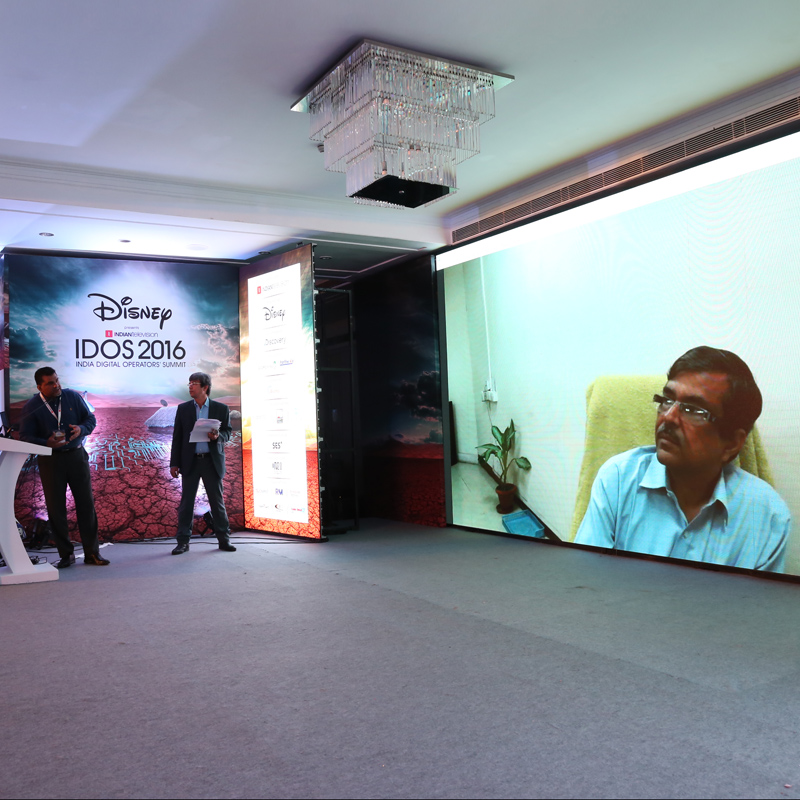
    GOA: The draft tariff framework of the Telecom Regulatory Authority of India (TRAI) is set to be released in a fortnight. This was declared by TRAI principal advisor (telecom services) Sunil Kumar Gupta in a Skype video conference with indiantelevision.com’s founder, CEO and editor-in-chief Anil Wanvari at IDOS 2016 here on Friday evening.

    “We have taken the views of all the stakeholders while drawing up the framework. It is based on the following four major planks — non-discriminatory pricing, transparency, consumer protection and overall growth of the industry,” he said.

    Gupta was clear that the sunset date for Phase IV was unshiftable. “Both MIB and we are very committed to this,” he said. “31 December 2016 is the sunset date for DAS Phase IV.”

    He cautioned that no one should take shelter around the fear that someone may try and scuttle phase IV by approaching the court. “There are enough set top boxes in the country today,” he said. “There is no shortage. Hence there can be no delay.”

    He reiterated that progress on digitisation and DAS has been good. “Revenues from the ground are going up in phase I and phase II,” he said. “According to MIB, 93 per cent of phase III has been digitised and in phase IV, there has been some good seeding too.”

    Gupta also warned that unless interconnection agreements are signed between MSOs and LCOs, the parties would not get any recourse from TDSAT as that is the direction that has been given. “It is important that the agreements are signed,” he said. “We have gone around the country and spoken to LCOs around the country. Often times they have been apprehensive about some of the agreements. But when we have explained to them, many of them have not read them properly, and hence the apprehension. When they have been explained and read it, they have gone ahead and done the shining.”

    He also expected a decisive verdict from the Delhi High Court in the first week of October around the Phase III litigation. Gupta urged the cable community to focus and keep the consumer aware of what was happening through their own networks and encourage him/her about DAS. “It is in the industry’s own interest,” he stated.

    On being asked whether TRAI would intervene and hasten the process on the infrastructure consultation paper, Gupta said there are some people who want to share infrastructure and some who don’t. On being prodded if the regulator would intervene if those who don’t want it to go through outweigh the ones who want it to, Gupta said, the consultation process would follow its due course. “Infrastructure sharing is between two private players, they can go ahead and do it. I don’t see why we need to intervene and mandate infrastructure sharing.”

    He also insisted that the entire industry – including the cable operators – need to tweak business models and the cable ops need to look at broadband seriously. “There is a lot of upside to broadband,” he said. “ARPUs are good over there, they can offer value to the consumer. Change is upon the industry and it needs to embrace this change and drive themselves forward. No telco can offer the kind of services, cable TV can offer, say 40 GB at a price of Rs 700-800 a month. The entire cable TV sector holds a lot of potential. Now the industry needs to realise it.”

  • IDOS 2016: TRAI tariff framework coming next fortnight

    IDOS 2016: TRAI tariff framework coming next fortnight

    GOA: The draft tariff framework of the Telecom Regulatory Authority of India (TRAI) is set to be released in a fortnight. This was declared by TRAI principal advisor (telecom services) Sunil Kumar Gupta in a Skype video conference with indiantelevision.com’s founder, CEO and editor-in-chief Anil Wanvari at IDOS 2016 here on Friday evening.

    “We have taken the views of all the stakeholders while drawing up the framework. It is based on the following four major planks — non-discriminatory pricing, transparency, consumer protection and overall growth of the industry,” he said.

    Gupta was clear that the sunset date for Phase IV was unshiftable. “Both MIB and we are very committed to this,” he said. “31 December 2016 is the sunset date for DAS Phase IV.”

    He cautioned that no one should take shelter around the fear that someone may try and scuttle phase IV by approaching the court. “There are enough set top boxes in the country today,” he said. “There is no shortage. Hence there can be no delay.”

    He reiterated that progress on digitisation and DAS has been good. “Revenues from the ground are going up in phase I and phase II,” he said. “According to MIB, 93 per cent of phase III has been digitised and in phase IV, there has been some good seeding too.”

    Gupta also warned that unless interconnection agreements are signed between MSOs and LCOs, the parties would not get any recourse from TDSAT as that is the direction that has been given. “It is important that the agreements are signed,” he said. “We have gone around the country and spoken to LCOs around the country. Often times they have been apprehensive about some of the agreements. But when we have explained to them, many of them have not read them properly, and hence the apprehension. When they have been explained and read it, they have gone ahead and done the shining.”

    He also expected a decisive verdict from the Delhi High Court in the first week of October around the Phase III litigation. Gupta urged the cable community to focus and keep the consumer aware of what was happening through their own networks and encourage him/her about DAS. “It is in the industry’s own interest,” he stated.

    On being asked whether TRAI would intervene and hasten the process on the infrastructure consultation paper, Gupta said there are some people who want to share infrastructure and some who don’t. On being prodded if the regulator would intervene if those who don’t want it to go through outweigh the ones who want it to, Gupta said, the consultation process would follow its due course. “Infrastructure sharing is between two private players, they can go ahead and do it. I don’t see why we need to intervene and mandate infrastructure sharing.”

    He also insisted that the entire industry – including the cable operators – need to tweak business models and the cable ops need to look at broadband seriously. “There is a lot of upside to broadband,” he said. “ARPUs are good over there, they can offer value to the consumer. Change is upon the industry and it needs to embrace this change and drive themselves forward. No telco can offer the kind of services, cable TV can offer, say 40 GB at a price of Rs 700-800 a month. The entire cable TV sector holds a lot of potential. Now the industry needs to realise it.”

  • TRAI may moot MRP for bouquet TV channels; no price cap on unbundled premium products

    TRAI may moot MRP for bouquet TV channels; no price cap on unbundled premium products

    MUMBAI: Broadcast carriage regulator Telecom Regulatory Authority of India (TRAI) has lined up a slew of draft guidelines relating to tariff, quality of service and interconnections, including proposing maximum retail price (MRP) for channels being bundled in genre-wise bouquets, freeing unbundled premium channels of  price caps and reining in the last mile cable operator (LCO) from breaching revenue-gravy trail.

    The draft recommendations, outcome of several consultation papers issued by TRAI over the last 12 months, could be discussed in a meeting that the regulator likely to have on Wednesday with stakeholders. Representatives of organisations like All-India Digital Cable Federation (AIDCF), Indian Broadcasting Foundation (IBF) and Ministry of Information and Broadcasting (MIB) are likely to be part of the meeting.

    Other topics for discussion at this meeting may revolve aroundanalogue tariffs to be levied in phase III and phase IV areas until sunset dates.

    Sources in TRAI indicated the regulator is in favour of introducing MRP for TV channels that broadcasters offer in a bouquet to MSOs so the prices could be conveyed to a consumer in a transparent manner for him to make an empowered choice.

    Though broadcasting companies do submit annually a-la-carte rates of their respective channels to TRAI, the regulator is of the opinion that a consumer doesn’t ultimately get to choose the channel of his choice transparently.

    How will the MRP be fixed? TRAI feels that the broadcasters should convey the price themselves as they were the best judge of their products and the same would be conveyed to the consumer. Or, the regulator could moot a formula for fixing the MRP.

    Fully aware that such measures could be termed restrictive and intrusive by industry players, TRAI is likely to dangle sops and suggest that broadcasters were free to price a premium channel at any level, but such channels cannot be part of any bouquet or bundling.

    The draft proposals, being fine-tuned by TRAI officials, are likely to be put out in public domain over the next 7-10 days. As these guidelines pertain to carriage services, the regulator can notify them itself. The likely date from which they would come into effect is April 2017. Unless, of course, somebody moves the court challenging the guidelines.

    Apart from these, TRAI is also toying with the idea of introducing an app with the help of which a consumer can get a TV channel from his distribution platform operator (DPO) after furnishing details like area of residence and area service provider’s name. The details will be get forwarded to the DPO concerned for further action.

    TRAI feels that with over 90 per cent of the areas in Phase 1, II and III already receiving digitised TV services, there would be no dearth of opportunities even if the sunset date of December 2016 for Phase IV or complete digitisation gets pushed by few months into 2017.

    In its consultation paper, issued in January 2016, TRAI had stated broadcast industry in India had been driven largely by satellite TV distribution business and unorganized growth of cable TV. During the early days, broadcasters were directly dealing with the cable operators who aggregated and carried broadcast TV services to end users. The distribution model was, according to the regulator, heavily skewed towards advertisement-driven revenues due to difficulties in maintaining transparency in the flow of subscription revenues across the analog value chain, which have become more transparent with the rollout of digital services or digitisation pushed by MIB andTRAI.

    Though TRAI had mandated a-la-carte availability of broadcast TV channels across the value chain, including subscribers, the a-la-carte tariff is presently structured in such a manner that makes it devoid of value proposition vis-à-vis bundled offerings,TRAI highlighted in its January paper (available at http://www.trai.gov.in/WriteReadData/ConsultationPaper/Document/CP_Tariff_issues_29_Jan_2016_final.pdf ), adding consumer was the “ultimate sufferer” ending up receiving hundreds of TV channels many of which remain confined to his STB and never viewed.

    ALSO READ: TRAI releases consultation paper on tariff issues for TV services

    ALSO READ: TRAI allows more time for reactions on QoS methodology under DAS

  • TRAI may moot MRP for bouquet TV channels; no price cap on unbundled premium products

    TRAI may moot MRP for bouquet TV channels; no price cap on unbundled premium products

    MUMBAI: Broadcast carriage regulator Telecom Regulatory Authority of India (TRAI) has lined up a slew of draft guidelines relating to tariff, quality of service and interconnections, including proposing maximum retail price (MRP) for channels being bundled in genre-wise bouquets, freeing unbundled premium channels of  price caps and reining in the last mile cable operator (LCO) from breaching revenue-gravy trail.

    The draft recommendations, outcome of several consultation papers issued by TRAI over the last 12 months, could be discussed in a meeting that the regulator likely to have on Wednesday with stakeholders. Representatives of organisations like All-India Digital Cable Federation (AIDCF), Indian Broadcasting Foundation (IBF) and Ministry of Information and Broadcasting (MIB) are likely to be part of the meeting.

    Other topics for discussion at this meeting may revolve aroundanalogue tariffs to be levied in phase III and phase IV areas until sunset dates.

    Sources in TRAI indicated the regulator is in favour of introducing MRP for TV channels that broadcasters offer in a bouquet to MSOs so the prices could be conveyed to a consumer in a transparent manner for him to make an empowered choice.

    Though broadcasting companies do submit annually a-la-carte rates of their respective channels to TRAI, the regulator is of the opinion that a consumer doesn’t ultimately get to choose the channel of his choice transparently.

    How will the MRP be fixed? TRAI feels that the broadcasters should convey the price themselves as they were the best judge of their products and the same would be conveyed to the consumer. Or, the regulator could moot a formula for fixing the MRP.

    Fully aware that such measures could be termed restrictive and intrusive by industry players, TRAI is likely to dangle sops and suggest that broadcasters were free to price a premium channel at any level, but such channels cannot be part of any bouquet or bundling.

    The draft proposals, being fine-tuned by TRAI officials, are likely to be put out in public domain over the next 7-10 days. As these guidelines pertain to carriage services, the regulator can notify them itself. The likely date from which they would come into effect is April 2017. Unless, of course, somebody moves the court challenging the guidelines.

    Apart from these, TRAI is also toying with the idea of introducing an app with the help of which a consumer can get a TV channel from his distribution platform operator (DPO) after furnishing details like area of residence and area service provider’s name. The details will be get forwarded to the DPO concerned for further action.

    TRAI feels that with over 90 per cent of the areas in Phase 1, II and III already receiving digitised TV services, there would be no dearth of opportunities even if the sunset date of December 2016 for Phase IV or complete digitisation gets pushed by few months into 2017.

    In its consultation paper, issued in January 2016, TRAI had stated broadcast industry in India had been driven largely by satellite TV distribution business and unorganized growth of cable TV. During the early days, broadcasters were directly dealing with the cable operators who aggregated and carried broadcast TV services to end users. The distribution model was, according to the regulator, heavily skewed towards advertisement-driven revenues due to difficulties in maintaining transparency in the flow of subscription revenues across the analog value chain, which have become more transparent with the rollout of digital services or digitisation pushed by MIB andTRAI.

    Though TRAI had mandated a-la-carte availability of broadcast TV channels across the value chain, including subscribers, the a-la-carte tariff is presently structured in such a manner that makes it devoid of value proposition vis-à-vis bundled offerings,TRAI highlighted in its January paper (available at http://www.trai.gov.in/WriteReadData/ConsultationPaper/Document/CP_Tariff_issues_29_Jan_2016_final.pdf ), adding consumer was the “ultimate sufferer” ending up receiving hundreds of TV channels many of which remain confined to his STB and never viewed.

    ALSO READ: TRAI releases consultation paper on tariff issues for TV services

    ALSO READ: TRAI allows more time for reactions on QoS methodology under DAS

  • TRAI to play peacemaker on telecoms interconnect issues

    NEW DELHI: Telecom Regulatory Authority of India (TRAI) chairman R S Sharma yesterday said it will facilitate a meeting of telecoms companies soon with an aim to resolve the raging debate regarding interconnection issues between operators.

    Addressing an inter-active meeting of the FICCI-ICT and Digital Economy Committee here on Tuesday, Sharma said that issues can be resolved through an across-the-table discussion with the CEOs of telecom companies.

    It is learnt that the meeting was held in the backdrop of recent changes in different telecom plans after Reliance Jio unveiled a slew of disruptive marketing initiatives. The new entrant has also been claiming its subscribers were experiencing massive call-drops as incumbents were not providing adequate points of interconnect.

    As to why the industry finds itself in this position, and whether it was due to lack of proper regulation and certain licensing issues, the chief regulator refused to comment. However, he added regulations do not leave scope for ambiguity.

    Sharma spoke on a range of issues, including the 20 consultation papers released in the last 18 months, and that were in various stages of study. These, according to Sharma, were necessary for removing ambiguity in the telecoms sector, and allowing stakeholders to function in harmony.

    TRAI felt the need for consultation papers in order to bring about a comprehensive regulatory framework that will plug gaps in the system and facilitate the industry to grow seamlessly.

    Sharma told the members that, with the advent of technology such as cloud computing and internet of things (IOT), ICT was transforming every sector and telecoms players should leverage the opportunities. Earlier, technology was on the periphery, but, in the last decade, with disruptive technologies coming in, it had become a central tool, Sharma said, adding that ICT also brough with it efficiency and cost-effectiveness.

    Speaking on competition issues in general in the telecoms sector, Sharma said TRAI promoted healthy competition while safeguarding interest of the consumers as it was “paramount”.

    India, he said, already had a world-class telecom network, and with new technologies coming in, services too should become world class. India should strive for next-generation network by employing new technologies such as Loons, Solar Planes and White Spaces, he said emphasising that there was a need to harmonize issues of business interest with disruptive technologies.

    To achieve this, it was necessary to put down licensing rules, norms and quality aspects through regulation, Sharma asserted.

    Responding to queries raised by industry regarding restrictions on experimentation, innovations and use of new technologies, Sharma said TRAI was in favour of new technologies with appropriate permissions. However, he added that these technologies should be interoperable without being in silos.

  • TRAI to play peacemaker on telecoms interconnect issues

    NEW DELHI: Telecom Regulatory Authority of India (TRAI) chairman R S Sharma yesterday said it will facilitate a meeting of telecoms companies soon with an aim to resolve the raging debate regarding interconnection issues between operators.

    Addressing an inter-active meeting of the FICCI-ICT and Digital Economy Committee here on Tuesday, Sharma said that issues can be resolved through an across-the-table discussion with the CEOs of telecom companies.

    It is learnt that the meeting was held in the backdrop of recent changes in different telecom plans after Reliance Jio unveiled a slew of disruptive marketing initiatives. The new entrant has also been claiming its subscribers were experiencing massive call-drops as incumbents were not providing adequate points of interconnect.

    As to why the industry finds itself in this position, and whether it was due to lack of proper regulation and certain licensing issues, the chief regulator refused to comment. However, he added regulations do not leave scope for ambiguity.

    Sharma spoke on a range of issues, including the 20 consultation papers released in the last 18 months, and that were in various stages of study. These, according to Sharma, were necessary for removing ambiguity in the telecoms sector, and allowing stakeholders to function in harmony.

    TRAI felt the need for consultation papers in order to bring about a comprehensive regulatory framework that will plug gaps in the system and facilitate the industry to grow seamlessly.

    Sharma told the members that, with the advent of technology such as cloud computing and internet of things (IOT), ICT was transforming every sector and telecoms players should leverage the opportunities. Earlier, technology was on the periphery, but, in the last decade, with disruptive technologies coming in, it had become a central tool, Sharma said, adding that ICT also brough with it efficiency and cost-effectiveness.

    Speaking on competition issues in general in the telecoms sector, Sharma said TRAI promoted healthy competition while safeguarding interest of the consumers as it was “paramount”.

    India, he said, already had a world-class telecom network, and with new technologies coming in, services too should become world class. India should strive for next-generation network by employing new technologies such as Loons, Solar Planes and White Spaces, he said emphasising that there was a need to harmonize issues of business interest with disruptive technologies.

    To achieve this, it was necessary to put down licensing rules, norms and quality aspects through regulation, Sharma asserted.

    Responding to queries raised by industry regarding restrictions on experimentation, innovations and use of new technologies, Sharma said TRAI was in favour of new technologies with appropriate permissions. However, he added that these technologies should be interoperable without being in silos.

  • Prasar Bharati responds to TRAI consultation paper; open to sharing DTT infrastructure

    Prasar Bharati responds to TRAI consultation paper; open to sharing DTT infrastructure

    NEW DELHI: Pubcaster Prasar Bharati has sent its viewpoints  to the Telecom Regulatory Authority of India (TRAI)’s consultation paper on the involvement of the private sector in digital terrestrial broadcasting (which has been its forte, so far).

    In its response, it has stated that, even as it supports the move, it feels that the potential of available distribution options need to be critically analysed to fulfill their requirements (for example coverage, capacity, reception mode, type of service etc).

    The public broadcaster has also said that the terrestrial broadcast platform will be relevant in the long term if its usage offers veritable benefits to the broadcasters, the audiences and the society as a whole. Even in countries where cable, satellite or broadband hold a significant market share, terrestrial broadcasting is usually regarded as an essential, flexible and reliable way of delivering broadcast content to a mass audience.

    In its response to 11 questions asked by TRAI in its Consultation Paper on ‘Issues related to Digital Terrestrial Broadcasting in India,’ the pubcaster says that the terrestrial platform must be digital to remain viable in the long term.

    Prasar Bharati CEO Jawhar Sircar had told indiantelevision.com in an interview earlier that it had cleared DTT for the private sector more than a year ago.

    Given the vast landscape of the country, Prasar Bharati says DTT is absolutely vital. It is thus crucial to ensure that, in the long term, the terrestrial distribution networks should be capable of delivering the current and future, advanced linear broadcast services, and fulfilling the  ever-increasing  requirements for quality and  choice  of services, including non-linear broadcast services.

    The benefits offered by DTT according to the pubcaster are:

    •         Near-universal coverage,

    •         Ability to provide for fixed, portable and mobile reception,
                Ability to efficiently provide regional and local content

    •         It is flexibility and content format agnostic. The newer formats of TV channels such as HD TV, 3D TV, UHD TV, data and radio services etc. can thus be delivered.

    •         Technical and cost efficiency,

    •         Efficient  use  of  spectrum  as  multiple  program channels  can  be transmitted using one TV spectrum channel of 8 MHz

    •         Network has ruggedness and not prone to catastrophic failure and sabotage from enemies

    •         Terrestrial broadcasting has strategic importance along the borders

    •         A potential for further development.

    Even with the presence of huge number of DTH and cableTV channels, a strong terrestrial platform is critical to healthy competition in the TV and radio market and to the realisation of a wide range of social and cultural benefits and most essentially an all-weather reliable platforms for the distribution of radio and TV signals, says the pubcaster.

    As indicated in the consultation paper, there are 247 million households in India as per the 2011 census, and a large number of these, particularly in rural and remote areas, depend completely on the FTA (free-to-air) terrestrial broadcasting TV services provided by the public broadcaster.

    Thus, in order to meet consumer expectations and ensure optimum utilization of resources, a digital terrestrial TV service having suitable bouquet of TV channels and nationwide coverage is very essential, says the pubcaster.

    It stresses that DTT is being provided in FTA mode in most of the countries. Its capability to provide local content will facilitate in providing social benefits of promoting local talent, local culture and music, generating employment, catering to local self-governance information needs, etc.

    This powerful combination would be difficult to replicate by any single alternative technology. DTT secures greater plurality in platform ownership, ensuring that no single platform owner is so powerful that it can exert undue influence on public opinion, and hence is the need for every country.

    DTT broadcasting has emerged as one of the popular digital television platforms in countries such as the UK, the US, Japan, Germany, France and Australia as it turns out to be one of the most economical broadcast transmission systems. In the DTT broadcasting process, everybody watches the same content at the same time, and it guarantees everybody the same high level of service, since they are all bathed in the same signal, and that too free to air, whereas, in OTT, the received signal quality depends upon number of viewers watching it, simultaneously.

    By the end of 2015, DTT constituted the second highest user base worldwide among the digital TV broadcast platforms next only to that of digital cable TV services.

    The pubcaster feels that, to optimise the time and resources, DTT can be started with two multiplexes at each location, and can be enhanced to three/four in due course of time, may be after analogue switchoff (ASO). Nation-wide coverage plan may further be implemented in time-bound phased manner as has been done in the case of implementation of DAS cable system.

    Infrastructure sharing will be essential for easy and cost-effective implementation of DTT service in India. Sharing would be essential so as to minimise the cost of implementation and faster roll-out. The experience sharing during implementation of FM expansion may be considered as an input for DTT roll-out.

    Deciding a national standard for DTT service is quintessential to have a volume of scale in terms of DTT ecosystem.  Doordarshan has already adopted DVB-T2 for itsDTT service, and it would be beneficial for the nation to adopt DVB-T2 as the national standard. Besides volume of scale, it may eliminate interoperability issues. Most of the countries are following a single national standard for DTT.

    The television viewer needs variety in programming content which may be possible when private channels are allowed on terrestrial platform. This is also required to make attractive and competitive bouquet.

    Prasar Bharati, however, says that it has to be ensured that the consumers are not impacted or charged heavily for private services. Issues regarding quality of service, grievance redressal etc. are also important.

    Doordarshan also needs to see that it continues to be the public service provider while providing wholesome content. The faster roll-out of DTT would require support from every stakeholder (government/private) for creating nation-wide network.

    Prasar Bharati already has huge infrastructure such as land, building, towers, trained manpower, networks, etc, for its terrestrial transmission. It has also initiated setting up of DTT transmitters. Doordarshan has already installed 23 DVB-T2 transmitters at 19 locations and services have been started at 16 locations. Also, it is in the process of expanding this to 63 locations.

    Doordarshan has gained enough experience and has good expertise in the field of DTT implementation including coverage and frequency planning, design of DTT network, procurement, execution, measurement and testing, field  surveys  etc.  It  is , therefore, a  better-placed  entity  for setting  up Integrated DTT Broadcasting network that includes private broadcasters as well.

    In this scenario, Prasar Bharati may also become a content aggregator for sharing transmitter capacity with private service-providers to give variety of content while the platform remains with it.

    This will ensure public service broadcasting can be strengthened in the country and reach of services from public broadcaster will enhance immensely; dissemination of social, educational programmes to masses; no new regulatory framework required for implementation of DTT; existing infrastructure will be optimally utilized; and introduction of a variety of services making DTT more competitive.

    Doordarshan has already got funds from government to pioneer DTT, and it is seeking additional funds from it to complete it.  Private broadcasters may be charged a suitable fee for using this infrastructure. This has already been implemented in the DD DTH service.

    For DTT expansion plan phase 1 and 2, one option could be that Prasar Bharati  (Doordarshan) gets government funds and charges a fee from private broadcasters as in the case of the pioneer plan; or Doordarshan (Government) and private broadcaster can share the capital expenditure in a suitable sharing model. Revenue may also be shared using the same model.

    Considering the present situation in India and to optimise  time and resources, DTT can be started with two multiplexes at 63 locations and can be enhanced to three/four in due course, may be after ASO.  A suggestive model for integrated DTT broadcasting network could be:

    i)      DTT may be implemented at 630 locations almost immediately where Doordarshan (Prasar Bharati) has already started implementation of DTT and infrastructure is almost ready. Private operators may be allowed to share this infrastructure by paying a suitable fee to Doordarshan as is being done in the case of DD DTH service. [This may be called DTT Pioneer Plan]

    ii)      Of the remaining 567 locations, wherever Doordarshan has sufficient requisite infrastructure, DVB-T2 multiplexes may be established and private  broadcasters can  share  those  exactly  in  the  same  way. [This may be called DTT Expansion Plan-Phase1]

    iii)     A new CTI (common transmission) infrastructure may be established at all other places where Doordarshan infrastructure is not available. These CTIs may be established by an experienced separate entity (e.g., BECIL). However, the ownership may be with Doordarshan (or a consortium). The process for this may be started in parallel to phase-1 but may have a different target date as establishment of new CTI will take more time. [This may be called DTT Expansion Plan-Phase2]

    It will be difficult to earmark exclusive spectrum for DTT as Doordarshan is already using the UHF band-IV for analog TV service. Besides, Doordarshan is also using band-IV for DTT and has planned utilization of band-IV and band-V frequencies for already approved DVB-T2 transmitters. It has also planned a DTT transmitter network at 630 locations with 2 MUXs, in Band-IV and Band-V.

    For the simulcast period, additional spectrum is required for the parallel transmission of TV services in analogue and digital mode. The required amount of spectrum will heavily depend on the introduction strategy adopted for DTT. ITU-R studies have concluded that 224 MHz spectrum would be required in UHF band for implementation of four to five DTT Multiplex at each location. Whereas, in India, practically only 176 MHz (470-646MHz) spectrum is available in UHF band. It would be appropriate that the entire broadcasting band 470-698 MHz may be made available.

    In a statement that may help the private sector, Prasar Bharati said that countries boosted switching to digital by giving subsidy on STBs; mandatory DTT tuner in all TV receivers after a certain date; awareness campaign regarding ASO; incentives to broadcasters in terms of spectrum charges for providing simulcast, and dialogue and incentives to manufacturer/importer of DTT receiving equipment.

    India would certainly need such concerted efforts to popularize digital reception and achieve ASO. With the concerted effort, India may think of a simulcast period of at least 6-12 months before switching off analogue transmitters. As the digitization is proposed to be implemented in a phased manner, ASO will also happen in a phased manner. However, the situation will have to be reviewed before actually switching off.

    The pubcaster has suggested that provision of DVB-T2 Tuner can be made mandatory on all TVs imported/manufactured in India after 1 April 2018. Similarly, embedding of DVB-T2/T2 Lite tuner in mobile phones should also be mandated on the same date.

    Also read: http://www.indiantelevision.com/television/tv-channels/terrestrial/prasar-bharati-ceo-prasar-bharati-not-opposed-to-private-players-entry-in-dtt-160620
     

  • Prasar Bharati responds to TRAI consultation paper; open to sharing DTT infrastructure

    Prasar Bharati responds to TRAI consultation paper; open to sharing DTT infrastructure

    NEW DELHI: Pubcaster Prasar Bharati has sent its viewpoints  to the Telecom Regulatory Authority of India (TRAI)’s consultation paper on the involvement of the private sector in digital terrestrial broadcasting (which has been its forte, so far).

    In its response, it has stated that, even as it supports the move, it feels that the potential of available distribution options need to be critically analysed to fulfill their requirements (for example coverage, capacity, reception mode, type of service etc).

    The public broadcaster has also said that the terrestrial broadcast platform will be relevant in the long term if its usage offers veritable benefits to the broadcasters, the audiences and the society as a whole. Even in countries where cable, satellite or broadband hold a significant market share, terrestrial broadcasting is usually regarded as an essential, flexible and reliable way of delivering broadcast content to a mass audience.

    In its response to 11 questions asked by TRAI in its Consultation Paper on ‘Issues related to Digital Terrestrial Broadcasting in India,’ the pubcaster says that the terrestrial platform must be digital to remain viable in the long term.

    Prasar Bharati CEO Jawhar Sircar had told indiantelevision.com in an interview earlier that it had cleared DTT for the private sector more than a year ago.

    Given the vast landscape of the country, Prasar Bharati says DTT is absolutely vital. It is thus crucial to ensure that, in the long term, the terrestrial distribution networks should be capable of delivering the current and future, advanced linear broadcast services, and fulfilling the  ever-increasing  requirements for quality and  choice  of services, including non-linear broadcast services.

    The benefits offered by DTT according to the pubcaster are:

    •         Near-universal coverage,

    •         Ability to provide for fixed, portable and mobile reception,
                Ability to efficiently provide regional and local content

    •         It is flexibility and content format agnostic. The newer formats of TV channels such as HD TV, 3D TV, UHD TV, data and radio services etc. can thus be delivered.

    •         Technical and cost efficiency,

    •         Efficient  use  of  spectrum  as  multiple  program channels  can  be transmitted using one TV spectrum channel of 8 MHz

    •         Network has ruggedness and not prone to catastrophic failure and sabotage from enemies

    •         Terrestrial broadcasting has strategic importance along the borders

    •         A potential for further development.

    Even with the presence of huge number of DTH and cableTV channels, a strong terrestrial platform is critical to healthy competition in the TV and radio market and to the realisation of a wide range of social and cultural benefits and most essentially an all-weather reliable platforms for the distribution of radio and TV signals, says the pubcaster.

    As indicated in the consultation paper, there are 247 million households in India as per the 2011 census, and a large number of these, particularly in rural and remote areas, depend completely on the FTA (free-to-air) terrestrial broadcasting TV services provided by the public broadcaster.

    Thus, in order to meet consumer expectations and ensure optimum utilization of resources, a digital terrestrial TV service having suitable bouquet of TV channels and nationwide coverage is very essential, says the pubcaster.

    It stresses that DTT is being provided in FTA mode in most of the countries. Its capability to provide local content will facilitate in providing social benefits of promoting local talent, local culture and music, generating employment, catering to local self-governance information needs, etc.

    This powerful combination would be difficult to replicate by any single alternative technology. DTT secures greater plurality in platform ownership, ensuring that no single platform owner is so powerful that it can exert undue influence on public opinion, and hence is the need for every country.

    DTT broadcasting has emerged as one of the popular digital television platforms in countries such as the UK, the US, Japan, Germany, France and Australia as it turns out to be one of the most economical broadcast transmission systems. In the DTT broadcasting process, everybody watches the same content at the same time, and it guarantees everybody the same high level of service, since they are all bathed in the same signal, and that too free to air, whereas, in OTT, the received signal quality depends upon number of viewers watching it, simultaneously.

    By the end of 2015, DTT constituted the second highest user base worldwide among the digital TV broadcast platforms next only to that of digital cable TV services.

    The pubcaster feels that, to optimise the time and resources, DTT can be started with two multiplexes at each location, and can be enhanced to three/four in due course of time, may be after analogue switchoff (ASO). Nation-wide coverage plan may further be implemented in time-bound phased manner as has been done in the case of implementation of DAS cable system.

    Infrastructure sharing will be essential for easy and cost-effective implementation of DTT service in India. Sharing would be essential so as to minimise the cost of implementation and faster roll-out. The experience sharing during implementation of FM expansion may be considered as an input for DTT roll-out.

    Deciding a national standard for DTT service is quintessential to have a volume of scale in terms of DTT ecosystem.  Doordarshan has already adopted DVB-T2 for itsDTT service, and it would be beneficial for the nation to adopt DVB-T2 as the national standard. Besides volume of scale, it may eliminate interoperability issues. Most of the countries are following a single national standard for DTT.

    The television viewer needs variety in programming content which may be possible when private channels are allowed on terrestrial platform. This is also required to make attractive and competitive bouquet.

    Prasar Bharati, however, says that it has to be ensured that the consumers are not impacted or charged heavily for private services. Issues regarding quality of service, grievance redressal etc. are also important.

    Doordarshan also needs to see that it continues to be the public service provider while providing wholesome content. The faster roll-out of DTT would require support from every stakeholder (government/private) for creating nation-wide network.

    Prasar Bharati already has huge infrastructure such as land, building, towers, trained manpower, networks, etc, for its terrestrial transmission. It has also initiated setting up of DTT transmitters. Doordarshan has already installed 23 DVB-T2 transmitters at 19 locations and services have been started at 16 locations. Also, it is in the process of expanding this to 63 locations.

    Doordarshan has gained enough experience and has good expertise in the field of DTT implementation including coverage and frequency planning, design of DTT network, procurement, execution, measurement and testing, field  surveys  etc.  It  is , therefore, a  better-placed  entity  for setting  up Integrated DTT Broadcasting network that includes private broadcasters as well.

    In this scenario, Prasar Bharati may also become a content aggregator for sharing transmitter capacity with private service-providers to give variety of content while the platform remains with it.

    This will ensure public service broadcasting can be strengthened in the country and reach of services from public broadcaster will enhance immensely; dissemination of social, educational programmes to masses; no new regulatory framework required for implementation of DTT; existing infrastructure will be optimally utilized; and introduction of a variety of services making DTT more competitive.

    Doordarshan has already got funds from government to pioneer DTT, and it is seeking additional funds from it to complete it.  Private broadcasters may be charged a suitable fee for using this infrastructure. This has already been implemented in the DD DTH service.

    For DTT expansion plan phase 1 and 2, one option could be that Prasar Bharati  (Doordarshan) gets government funds and charges a fee from private broadcasters as in the case of the pioneer plan; or Doordarshan (Government) and private broadcaster can share the capital expenditure in a suitable sharing model. Revenue may also be shared using the same model.

    Considering the present situation in India and to optimise  time and resources, DTT can be started with two multiplexes at 63 locations and can be enhanced to three/four in due course, may be after ASO.  A suggestive model for integrated DTT broadcasting network could be:

    i)      DTT may be implemented at 630 locations almost immediately where Doordarshan (Prasar Bharati) has already started implementation of DTT and infrastructure is almost ready. Private operators may be allowed to share this infrastructure by paying a suitable fee to Doordarshan as is being done in the case of DD DTH service. [This may be called DTT Pioneer Plan]

    ii)      Of the remaining 567 locations, wherever Doordarshan has sufficient requisite infrastructure, DVB-T2 multiplexes may be established and private  broadcasters can  share  those  exactly  in  the  same  way. [This may be called DTT Expansion Plan-Phase1]

    iii)     A new CTI (common transmission) infrastructure may be established at all other places where Doordarshan infrastructure is not available. These CTIs may be established by an experienced separate entity (e.g., BECIL). However, the ownership may be with Doordarshan (or a consortium). The process for this may be started in parallel to phase-1 but may have a different target date as establishment of new CTI will take more time. [This may be called DTT Expansion Plan-Phase2]

    It will be difficult to earmark exclusive spectrum for DTT as Doordarshan is already using the UHF band-IV for analog TV service. Besides, Doordarshan is also using band-IV for DTT and has planned utilization of band-IV and band-V frequencies for already approved DVB-T2 transmitters. It has also planned a DTT transmitter network at 630 locations with 2 MUXs, in Band-IV and Band-V.

    For the simulcast period, additional spectrum is required for the parallel transmission of TV services in analogue and digital mode. The required amount of spectrum will heavily depend on the introduction strategy adopted for DTT. ITU-R studies have concluded that 224 MHz spectrum would be required in UHF band for implementation of four to five DTT Multiplex at each location. Whereas, in India, practically only 176 MHz (470-646MHz) spectrum is available in UHF band. It would be appropriate that the entire broadcasting band 470-698 MHz may be made available.

    In a statement that may help the private sector, Prasar Bharati said that countries boosted switching to digital by giving subsidy on STBs; mandatory DTT tuner in all TV receivers after a certain date; awareness campaign regarding ASO; incentives to broadcasters in terms of spectrum charges for providing simulcast, and dialogue and incentives to manufacturer/importer of DTT receiving equipment.

    India would certainly need such concerted efforts to popularize digital reception and achieve ASO. With the concerted effort, India may think of a simulcast period of at least 6-12 months before switching off analogue transmitters. As the digitization is proposed to be implemented in a phased manner, ASO will also happen in a phased manner. However, the situation will have to be reviewed before actually switching off.

    The pubcaster has suggested that provision of DVB-T2 Tuner can be made mandatory on all TVs imported/manufactured in India after 1 April 2018. Similarly, embedding of DVB-T2/T2 Lite tuner in mobile phones should also be mandated on the same date.

    Also read: http://www.indiantelevision.com/television/tv-channels/terrestrial/prasar-bharati-ceo-prasar-bharati-not-opposed-to-private-players-entry-in-dtt-160620