Category: TRAI

  • Bharat Net project to provide 1gbps broadband bandwidth in villages

    Bharat Net project to provide 1gbps broadband bandwidth in villages

    NEW DELHI/MUMBAI: The Indian government’s proposal of providing hi-speed broadband services to rural areas seems to be on track. It said that in the second phase of the ambitious Bharat Net project, covering approximately 150,000 gram panchayats, it has been proposed to provide 1gbps bandwidth in case of wired media (optical fibre cable) and minimum 100 mbps bandwidth scalable up to 1 gbps in case of wireless media (radio).

    The Bharat Net project, aimed at providing broadband and related services, including TV, is being implemented in a phased manner for providing connectivity to all the approximately 250,000 gram panchayats or village administrations in the country, Communications Minister Manoj Sinha on Friday told the Rajya Sabha or the upper house of parliament.

    In phase I of the project, 100,000 gram panchayats are envisaged to be connected on 100 mbps speed, the minister said. In a separate suggestion, telecoms and broadcast regulator TRAI has said that cable operators and satellite companies could be roped in to provide broadband services as part of the Bharat Net project.

    Sinha further stated that Rs 40,660 million has been approved for providing last mile connectivity through wi-fi or any other suitable broadband technology to the gram panchayats of the country.

    The strategy to provide last mile connectivity, the minister stated, has been approved by the Telecom Commission in September 2017 and a tender to select the implementing agency for provision of last mile connectivity has been prepared by Bharat Broadband Network Limited.

    According to the communications minister, as on 24 December 2017 optical fibre connectivity has been provided to 1,08,237 village administrations by laying 2,52,547 km optical fibre cable and 96,039 gram panchayats are service-ready.

    ALSO READ:

    Bharat Net first phase nears completion, provides b’band to village admin

    Rural India gets e-commerce & TV ready via optic fibre network

    TRAI chief pushes for b’band over cable TV, BharatNet for upping penetration
  • TRAI considers independent auditors for DAS audits

    TRAI considers independent auditors for DAS audits

    MUMBAI: In a bid to improve transparency, the Telecom Regulatory Authority of India (TRAI) is mulling the virtue of having on board independent auditors for the technical and subscription audit of the digital addressable system (DAS) of distribution platform operators (DPOs).

    In a consultation paper titled ‘Empanelment of Auditors for Digital Addressable Systems,’ the regulator is seeking views of stakeholders on various audit-empanelment related issues, such as scope of audit, eligibility criteria and experience, length of empanelment, audit fee and payment terms, time period for completion of audit work, de-empanelment, and reporting requirements of auditors. The consultation process will enable the TRAI to prepare a comprehensive document to seek proposals from auditors in line with the industry requirement and formulate guidelines to auditors.

    Written comments on the paper have been invited from the stakeholders by 22 January 2018 and counter-comments by 7 February 2018. The TRAI clarified that the empanelment of the auditors and other related activities would be done only after the ongoing matter pending before the Madras and Delhi high courts was decided.

    The interconnection regulations that form a part of the regulatory framework for DAS have provisions relating to technical audit and subscription audit, wherein it has been provided that the authority may empanel auditors for this purpose. Distributors such as multi-system operators (MSO), direct-to-home (DTH) operators, headend in the sky (HITS) and IPTV operators are required to install digital headends, including Subscriber Management System (SMS) and Conditional Access System (CAS) for distributing signals of TV channels through digital addressable systems. To have a level playing field amongst all the distributors, the authority has prescribed minimum technical specifications for addressable systems.

    Also read:

    TRAI seeks better accessibility for persons with disabilities

    Trai paper seeks to streamline uplinking, downlinking norms

    Trai paper seeks to streamline uplinking, downlinking norms

  • TRAI seeks better accessibility for persons with disabilities

    TRAI seeks better accessibility for persons with disabilities

    MUMBAI: The Telecom Regulatory Authority of India (TRAI) has turned the spotlight on one of India’s ignored sections of the society–persons with disabilities (PwD). The regulator is prodding companies to make information and communication technology more accessible to differently abled people. It notes that such people are unable to use the services either because they lack the necessary accessibility features or are incompatible for usage by them.

    The TRAI has released a consultation paper seeking the broadcast sector’s views on identifying and eradicating areas that are pain points for them and where policies are required to be frame so that PwDs don’t feel discriminated. Aids and assistive devices have been made for them but a similar change in services and content is yet to take place. The TRAI states that the law must also consider the various segments within PwDs.

    From 2.13 per cent of the population in 2001, the number of PwDs in India grew to 2.21 per cent, which is 2.68 crore of the total. The consultation paper points out that though set-top boxes (STBs) have been made accessible to them, there is a lack of content that can justify its usage. Certain additions need to be made for the visually impaired such that they can access STBs via audio. The functions they need to access without vision include channel/programme selection, display of programme information, setup options, closed captioning control and display options, video description control, current configuration information, playback controls, and input source selection.

    Similarly, people with visual impairment cannot see screens and find it difficult to navigate the keypad and menu of a TV remote. Buttons on a remote are also not designed while keeping in mind people who are unable to use their limbs or flex their fingers. Special measures, such as giving captions for those who can’t hear and audio descriptions for the blind, need to be taken.

    One section of the Rights of Persons with Disabilities (RPWD) Act 2016 states that government and local authorities must work to ensure that those with hearing impairment can enjoy TV content via subtitles or sign language. The Accessible India campaign aims to ensure that at least 25 per cent of TV shows on government channels are suited for PwDs.

    The TRAI suggests actions such as creating well-designed remote controls with legible buttons, a wireless connection between a television and the viewer’s hearing aid as ways to help them.

    India’s corporate social responsibility (CSR) laws have a provision to help PwDs. Broadcast companies that are required to undertake CSR have a fine way to spend the minimum requirement of at least 2 per cent of the average net profits in the immediate three preceding financial years. This can include developing applications, devices and services for their benefit.

    The US FCC mandates that devices used for watching TV must be accessible to PwDs and a similar case is for the UK as well.

    Also read:

    Trai paper seeks to streamline uplinking, downlinking norms

    TRAI’s final recommendations on net neutrality likely by September

    TRAI open house to discuss ease of doing broadcast biz

  • Trai paper seeks to streamline uplinking, downlinking norms

    Trai paper seeks to streamline uplinking, downlinking norms

    MUMBAI: Following a prod from the ministry of information and broadcasting (MIB) additional secretary Jayashree Mukherjee, the Telecom Regulatory Authority of India (TRAI) on 19 December issued an industry consultation paper which seeks to update guidelines related to uplinking, downlinking, of TV channels and the setting up of teleports.

    Mukherjee had sought the TRAI’s recommendations on these issues keeping in mind changes in technology, market scenarios and lessons learnt over the past six years since the guidelines were passed.  

    In its paper, Trai has asked stakeholders, such as broadcasters, if there was any need to redefine news and current affairs TV channels and non-news and current affairs TV channels more specifically.

    Pointing at a possible hike in the net-worth requirement of Rs 5 crore for obtaining a licence for uplinking or downlinking of TV channels, and an increase in process fees for applicants, the paper states that non-serious players were able to obtain licenses, which were either traded or leased to a different entity.

    “To  ensure  that  only  serious  players,  who  are  interested  in  the business of satellite TV channels, apply for obtaining license for  uplinking  or downlinking of TV channels, one way could be to increase the entry barriers. The other way could be to eliminate the incentives, which encourage trading and/or sub-leasing of licenses. Further, sub-leasing or trading of channels can also be controlled by putting in place certain checks, which discourage such practices,” the release stated.

    The paper argues that an increase in entry barriers for uplinking of TV channels from India may encourage diversion of such business opportunities to outside India. Moreover, Trai has raised the question of auctioning satellite TV channels as a complete package similar to FM radio channels. Or if industry thinks that it is possible to auction individual legs of satellite TV broadcasting – uplinking space spectrum, transponder capacity?

    And it has opened up an issue which has been a sore point for the industry: if it is advisable to restrict the use of foreign satellites for satellite TV broadcasting or uplinking of satellite TV channels to be downlinked in India from foreign soil? And also whether it is possible to auction channels without restricting the use of foreign satellites and uplinking of signals of TV channels from foreign soils. The paper appeals to stakeholders if there could be a better way to grant a licence for a TV satellite channel then what is presently followed in order to simply the procedure.

    Other issues the TRAI is seeking industry’s input on is whether encryption of all satellite TV signals – whether free to air or pay TV and what timeline should be given to licensed broadcasters to launch their channels from the date of issue of a licence and the penalties that should be levied on them in case they fail to restore their disrupted channels within a specified period. The consultation paper also approaches sensitive issues such as terms of  the tradeability of licences by a licencee.  

    On the teleport side, the TRAI is seeking to get industry’s understanding of what a teleport should be defined as in a new digital era, the licensing norms, fee structures for processing a licence, if there is a need to restrict the number of teleports in India, and their location like say in a park.

    The industry watchdog has requested that industry sends in its inputs by 18 January 2018.

    Also Read: TRAI sees merit in using satcom for broadband delivery

    TRAI’s Consultation Paper on VoIP can affect mobile TV, IPTV

    MSOs move Madras HC seeking relief on inter-connect pacts


  • Jio continues leading broadband subs addition while wireline internet loses subs in Oct

    Jio continues leading broadband subs addition while wireline internet loses subs in Oct

    BENGALURU: Mukesh Dhirubhai Ambani’s Reliance Infocomm Limited (Jio) closed the month with 145.96 million wireless broadband subscribers having added 7.34 million subscribers during October 2017. Since 1 January 2017, the new telecom behemoth has added 129.91 million subscribers between 1 January 2017 and 31 October 2017 according to data released by the Telecom Regulatory Authority of India (Trai). In terms of growth, however, Jio had to accede to third place–it grew by 5.30 percent as compared to 7.69 percent growth by the Sunil Mittal-led Bharti Airtel Limited and 5.31 percent growth by Vodafone in October 2017.

    India’s wireline broadband internet subscriber base has been declining over the past few months. Overall, the number of wired broadband internet subscriber base declined by 0.33 percent month-on-month in October 2017 to 17.98 million from 18.04 million. Among the top-five wired broadband service providers, the three private players gained subscribers while the public sector service providers lost them.

    Overall broadband internet service providers

    The top-five service providers (across wired, mobile wireless and fixed wireless, such as Wi-fi, Wi-Max, point-to-point, radio, and V-Sat) constituted 92.17 percent share of the total broadband subscribers at the end of October 2017. These service providers were Jio (145.96 million), Bharti Airtel (66.92 million), Vodafone (48.42 million), Idea Cellular (31.03 million), and BSNL (21.21 million).

    Top-five wireless broadband internet service providers

    In October 2017, the wireless broadband internet subscriber base in India grew by 15.34 million. Jio numbers have been mentioned above. Airtel reported the second largest addition of wireless subscribers in the month with 4.63 million additions to reach a subscriber base of 64.8 million. Vodafone added 2.44 million subscribers in the month under review and reached a subscriber base of 48.41 million followed by Idea Cellular which added 1.42 million subscribers with a subscriber base of 31.03 million as on 31 October. Anil Dhirubhai Ambani-led Reliance Communications Limited (RCom) had a stable wireless broadband subscriber base in October 2017 of 8.98 million.

    According to Trai data, as on 31 October 2017, the top-five wireless broadband service providers were Jio (145.96 million), Bharti Airtel (64.80 million), Vodafone (48.41 million), Idea Cellular (31.03 million), and Reliance Communications (8.98 million).

    Top-five wireline broadband internet service providers

    As on 31 October 2017, the top-five wired broadband service providers were BSNL (9.48 million), Airtel (2.13 million), Atria Convergence Technologies or ACT(1.26 million), MTNL (0.94 million), and Hathway Cable & Datacom (0.68 million). As mentioned above, Airtel, ACT and Hathway gained 0.01 million, 0.02 million and 0.01 million subscribers, respectively, in October 2017 while BSNL and MTNL lost 0.06 million and 0.1 million subscribers, respectively.

    Other broadband internet service providers

    MSOs and (LCOs) or cable video service providers also offer wired broadband internet services in the country. These cable service providers have a number of subsidiaries and alliances, hence broadband numbers are split as applicable. The consolidated subscription numbers of these entities could be larger than the numbers of some of the wired internet services providers mentioned above. However, it must be noted that some of these MSOs and LCOs could have lost subscribers in October 2017 considering that the top-five wired broadband internet services providers have lost only 0.03 million of the 0.06 million wireline internet subscribers in during the month.

  • TRAI sees merit in using satcom for broadband delivery

    TRAI sees merit in using satcom for broadband delivery

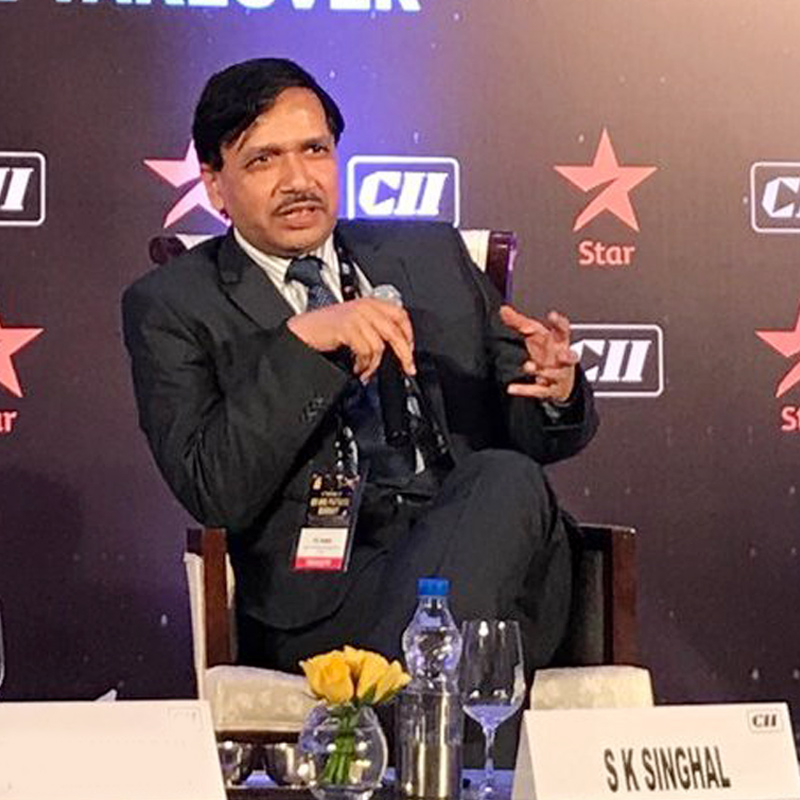
    NEW DELHI: India needs to create digital platforms, pushed by government policies and private sector entrepreneurship, which are specific to India and address its specific needs, telecom and broadcast regulator TRAI advisor SK Singhal said on Wednesday, adding that affordable broadband and allied services like television form the backbone of NTP 2018.

    “We need to create policies (including those pertaining to the digital world) that address our specific needs,” Singhal said at the CII Big Picture Summit 2017, adding that optimal usage of capacity created by cable networks is a must to deliver broadband services to every corner of India as envisioned by PM Modi.

    Singhal, along with Broadcast Engineering Consultant India Ltd (BECIL) CMD George Kuruvilla were speaking on the theme of `Connected India is Digital India’ and how for digital India to be truly implemented broadband access had to be made affordable, including all mediums of delivery like satellite communications (satcom) and cable.

    Pointing out that a stronger ‘collaboration’ is needed between operators of cable networks and those who use the pipe to deliver services, Singhal said that TRAI has already recommended to the government to use cable networks’ broadband delivery potential to fulfil the goals of the New Telecom Policy 2018.

    However, he officially admitted that to fully realise the digital potential of cable networks, some “policy hiccups” also need to be ironed out along with proper guidance in entrepreneurial skills of people who operate such networks.

    Economic Times, in September, had quoted telecoms minister Manoj Sinha as saying that the NTP 2018, expected by March 2018, will focus on providing affordable internet access to 1.3 billion Indians and facilitate domestic manufacturing to curb dependence on imports. He had added that NTP will address sector issues and make them future-proof with the onset of disruptive technologies such as fifth-generation (5G) and AI.

    Dwelling further on building broadband capacity and fully “unleash the potential” of cable networks, Singhal said set top boxes too need to be unbundled or made interoperable. TRAI has an interaction going on with all stakeholders on the issue and some field tests have also been conducted on interoperable boxes.

    Asked how the draft space policy, presently being reviewed by various stakeholders, could facilitate increased use of satellite communications to give a fillip to delivery of broadband services, Singhal skirted a direct answer as space related policies were handled by ministries of telecoms and space (department of space falls within the ambit of prime minister’s office).

    ALSO READ: MIB, TRAI allay industry fears on sat capacity leasing & content regulations

    Prasar Bharati, Dish TV, Star, Zee and BES bat for KU-band open-sky policy

    ISRO stresses on indigenization; TRAI for Open Sky policy

  • TRAI orders broadcasters to remove analogue RIOs from website

    TRAI orders broadcasters to remove analogue RIOs from website

    MUMBAI: The Telecom Regulatory Authority of India (TRAI) has ordered cable TV service providers to stop displaying any reference interconnect offers(RIO) for analogue platforms.

    Broadcasters have been warned not to show any analogue RIO on its site and also refrain from making direct or indirect offers to allow their TV signals to be shown on analogue cable TV networks. MSOs have been told not to entertain any unencrypted signals on their cable TV networks.

    The TRAI has taken note of some broadcasters who have been avoiding this and continue to display analogue RIOs. “TRAI has written letters to such broadcasters individually whose analogue RIOs were found on websites,” it said.

    The necessity of the order is because 31 March 2018 is the last date for implementing Phase IV of the digital addressable cable TV systems (DAS) after which only digital encrypted signals can be carried in the country. Carrying unencrypted signals after this date will be a violation of Section 4A of the Cable Television Network (regulation) Act 1995.

  • Guest column: Net neutrality – ensuring an open internet

    Guest column: Net neutrality – ensuring an open internet

    At a time when the US Federal Communications Commission is to vote on a rollback on the Net Neutrality Rules notified during the Obama administration, the Telecom Regulatory Authority of India (TRAI) has published its recommendations on the subject. Making headlines during the days of Zero Rating and products of the kind, and coming after nearly three years of setting up of a committee by the TRAI to make recommendations in this regard (January 2015), the document attempts to balance the interest of the general public by including ‘internet access services’ within the regulation of net neutrality and excluding “specialised services” that are “optimised for specific content, protocols or user equipment where optimisation is necessary in order to meet specific quality requirements.’’

    Net neutrality, in theory, is a laudable concept. It also finds mention in the UL, VNO and ISP licensing terms notified by the Department of Telecom. The specific mention is absent from the UASL and CMTS licenses. However, this principle can nevertheless be read into the obligation to provide non-discriminatory access even by the telecom service providers. In this background, what is to be considered is whether net neutrality, with its basic principle already enshrined in the law and some contours such as specialised services yet to be clearly defined, is even required to be separately regulated.

    First, net neutrality is, as stated in the recommendations, primarily to address and ensure “public internet access”. Importantly, what has not been considered is how much of this “public” of the country actually has access to broadband. The answer would be in the vicinity of 15 per cent. Of this “preferred public population,” many would be multiple connection/access holders and, hence, the effective penetration of broadband would be less than 12 per cent. With this background, the debate, rather than focusing on net neutrality, should focus on access to broadband for all. It is only when such a objective is achieved that the issue of whether or not we have a neutral internet would really need to be studied.

    Second, OTT, which is one of the aspects central to the debate on net neutrality, has been currently left out for separate consideration. It is unclear, therefore, as to what position is taken vis-à-vis this very important piece of the net neutrality puzzle.

    Third, it is strange that the document should pluck out internet of things, a concept and technology so nascent in India that even its mention in this document makes it conspicuous by its presence. Why is there a need for identification of such detail of a technology still under development, not only in India but in most parts of the world?

    Having said the above, all the right words have been used in the recommendations–non-discriminatory access, non-provision of fast lanes, etc. All or most of these recommendations are great in theory. However, and especially with the carving out for specialised services, the workability of these recommendations, if they are to be accepted and converted into regulations, is suspect. We need to have enough cars (population access to broadband) before we can deride the provision of fast lanes.

    (Abhishek Malhotra is a partner at Bharucha & Partners)

  • TRAI releases recommendations on net neutrality

    TRAI releases recommendations on net neutrality

    MUMBAI: The Telecom Regulatory Authority of India (TRAI) has released its recommendations on net neutrality. These recommendations are the result of a long, multistage consultation process.

    On 27 March,2015, TRAI had issued a consultation paper titled ‘Regulatory Framework for Over-The-Top Service.’ Apart from issues relating to Over-The-Top (OTT) service, this consultation paper also touched upon issues related to net neutrality.

    TRAI first decided to deal with the issue of differential pricing of data access. Accordingly, after following a public consultation process, TRAI issued the “Prohibition of Discriminatory Tariffs for Data Services Regulations, 2016” on 8 Feb,2016. Subsequently, Department of Telecommunications (DoT) vide letter dated 3 March, 2016 sought TRAI’s recommendations on net neutrality including traffic management and economic, security and privacy aspects of OTT services, apa1i from other relevant standpoints as covered in the consu ltation paper dated

    27 March, 2015. TRAI considered the matter and decided to deal with the issue of Net Neutrality first. The recommendations released by TRAI today are an outcome of this decision.

  • Trai to make recommendations on net neutrality today

    Trai to make recommendations on net neutrality today

    New Delhi: The Telecom Regulatory Authority of India (Trai) will issue its much-awaited recommendations on net neutrality today.

    “We will issue the recommendations on net neutrality tomorrow,” Trai chairman RS Sharma told reporters on Monday.

    Trai, which has so far adopted a pro-net neutrality stand, is expected to stick to its stand of ensuring a free and open internet for all.

    Net neutrality requires telecom service providers to treat all internet traffic equally, without regard for the type, origin, or destination of the content or the means of its transmission.

    The recommendations are expected to include the definition of what constitutes reasonable traffic management practices by ISPs. A likely negative list of non-reasonable traffic management practices could also emerge.

    The issue has been debated upon globally as well as in India, with activists arguing the case for an open internet without any restrictions on speed.

    The recommendations that the regulator releases on Tuesday will assume significance, especially at a time when the US plans to repeal its existing rules on net neutrality, which will essentially allow telecom companies in the US to restrict broadband speeds and favour their own services if they want.

    Trai had in January floated a consultation paper on the topic, seeking views on issues such as how to ensure non-discriminatory access to content on internet, among others.

    This was followed up by an open house discussion in August which saw participation by representatives from telecom and ISPs, consulting firms, activists, and policy experts.