Category: TRAI

  • Broadcasters to TRAI: No further regulation of OTT communication services

    Broadcasters to TRAI: No further regulation of OTT communication services

    MUMBAI: Major broadcasters including Star India, Sony Pictures Networks India (SPN) and Times Network are clear they do not favour any further regulatory intervention on over-the-top (OTT) communication services. All three players have argued that OTTs should not be seen as a substitute for TSPs. While submitting their feedback comments on the TRAI consultation paper, the broadcasters have highlighted that although some of the services provided by OTTs may seem similar to TSPs, they have highly dissimilar nature especially when it comes to technology and revenue model. The major focus area of the TRAI paper is the issue regarding the relationship between OTTs and TSPs.

    Star India point of view

    Apart from suggesting TRAI to not regulate OTT communication services, Star India has also highlighted that OTTs are licensed under Section 4 of the Indian Telegraph Act, 1885 and hence the regulator does not have the authority to regulate them.

    The broadcaster feels that TRAI’s concerns around “Privacy, Security and Interception” are valid but the provisions under Information Technology Act, 2000 are already in place to address those. Moreover, the Justice BN Srikrishna committee is also working towards reinforcing the provisions under Draft Personal Data Protection Bill, 2018.

    “The consultation paper assumes certain applications of OTTs (‘OTT Communication Services’) as substitutes to TSP services. This assumption appears unfounded and there is no discernible rationale in keeping with any existing legal criteria or technical parameters, such as those outlined in basic competition law on substitutability, for TRAI to have concluded so in the consultation paper,” the broadcaster points out with respect to “Substitutability” as the basis for regulating OTT ecosystem.

    SPN’s take on the issue

    SPN has strongly advocated for the forbearance of OTTs as it will ensure the growth of the sector. According to the broadcaster, any additional regulation could have an adverse impact on the growth of internet applications and platforms.

    SPN has pointed out that the consultation paper mentions OTT players do not have licensing and regulatory obligations while TSPs incur license fees and have to meet regulatory obligations. The broadcaster, in its submission, has argued that the operation of OTT platforms is not dependent on TSPs but on the internet. In addition to that, the services being provided by the OTT platforms are free of cost, although consumers do bear the cost of data charges/internet which are accrued by TSPs and the revenues are not passed on to the streamers.

    “We believe that no regulatory intervention is required since it could stifle innovation and straitjacket technological innovation and the development of this sunrise sector. A policy of forbearance on regulation [as has been the case so far] should be continued in order to avoid hampering growth in the sector,” SPN said in the submission.

    At the same time, the broadcaster has also added that telcos should be given opportunities to avail fair market pricing as well as sufficient policy-backed impetus to enable them to invest in infrastructure and upgradation of technology.

    Times Network bats for forbearance

    On a similar note, the Times Network has also highlighted the differences between OTTs and TSPs. While voice calling and text messaging are the primary services of TSPs, the same are secondary services for OTTs. Moreover, there is an inherent difference in the technology used by OTTs and TSPs for calls and messaging. Hence, Times Network thinks the services cannot be classed as “similar services” from a licensing perspective.

    “Further, TSPs as ISPs are access providers who control the underlying broadband access infrastructure, with few market players due to high barriers to market entry. By contrast, OTTs do not control the underlying broadband access point, have significantly lower barriers to market entry and are faced with many competing services, unlike TSPs. Consumers can add or stop using OTTs at will whereas switching between TSPs involves incurring the cost for the consumer and generally involves a longer relationship,” the broadcaster added in the submission.

    Due to the palpable differences between TSPs and OTTs, Times Network believes OTT platforms should not be regulated on the lines of TSP. The broadcaster is also of the view that inter-operability of the OTT services with the services provided by the TSPs may promote competition and benefit the end users.

    “We also recommend non-introduction/ non-imposition of any unwarranted regulations which may impede the growth of this buzzing as well as budding industry which has given a huge push to the start-up entrepreneurial spirit in the country. Also, interoperability of OTT apps with traditional network-based services may lead to a loss of innovative features and functions available on OTT services,” the submission also read.

    As per Times Network’s outlook, any licensing norm for OTT would affect consumer welfare, individuals, companies and entire industries. It could also create entry barriers in the industry, especially for startups.

    ZEEL also against the regulatory framework

    ZEEL submitted its response to TRAI on behalf of its digital arm ZEE5. The growing online video player has also advocated complete forbearance on any kind of regulatory framework by the authority. It has also been added that OTT service providers are intrinsically distinct from network providers like TSPs and ISPs. Like other players, ZEE5 also thinks substitutability should not be treated as the primary criterion for comparison of regulatory or licensing norms applicable to TSPs and OTT service providers. It has also added that there is no issue of a non-level playing field between OTT service providers and TSPs providing same or similar services as both OTT providers and TSPs complement each other.

    “The future of digital product offerings and growth of OTT services will depend on a robust environment which does not stifle technology-based innovation and provide a competitive market environment. Low entry barriers for new entrants, minimal regulatory barriers and technological advancement will be the cornerstone of such growth of the sector for investments, innovation, and consumer interest. Therefore, we urge the Authority that a policy of forbearance is best suited,” ZEE5 stated.

    Most of the above-mentioned players agree that OTTs have helped in the growth of TSPs. As all the OTTs require high-speed internet, data usage increases among users which in turn help TSPs’ revenue. The decline in voice calls and messaging is being complemented by high data use helping telcos to recover the loss.
  • Tata Sky vs. TRAI: Case, argued partly by DTH operator, adjourned to 23 January

    Tata Sky vs. TRAI: Case, argued partly by DTH operator, adjourned to 23 January

    MUMBAI: DTH operator Tata Sky’s ongoing court battle with the TRAI and its new tariff regime, in which Bharti Telemedia-owned Airtel Digital TV and Sun Direct are a part, has been adjourned by the Delhi High Court to January 23 with arguments being inconclusive.

    The matter was argued partly by senior lawyer Kapil Sibal on behalf of the direct-to-home operator on Tuesday who focussed on two points of 15 per cent discount cover (or the lack of it) and micromanagement attempt by TRAI of how business should be conducted.

    The hearing in the case started at around 2:45 pm and continued till almost 90 minutes during which Sibal argued that with the Madras HC setting aside the 15 per cent discount cap, the main aim of the tariff order had been frustrated and that attempt to micromanage a business, especially moves relating to pricing, etc., some of the provisions of the regulation were not in the interest of the DTH operator, which follows a different cost model compared to MSOs.

    The TRAI counsel’s interjection, according to industry sources, was minimal except seeking some technical clarifications relating to issues being argued by the Tata Sky lawyer and the actual content of the writ petition.

    Though this essentially means the regulator is unlikely to take any coercive action against the DTH operator and Discovery (that has already published new rates in compliance with the TRAI tariff order) until the next hearing, during the 10 January 2019 hearing of the case the court had verbally observed that Tata Sky could remain non-compliant at its own peril.

    At the earlier hearing Sibal had impressed upon the judges to ask TRAI to produce all documents on how it arrived at the decision to implement the new tariff regime. He had also stated that implementing the present order will have an adverse impact on business.

    The TRAI lawyer had countered saying while Tata Sky felt aggrieved, a big DTH operator like Dish TV and all other MSOs seemed satisfied and had complied with the new tariff framework.

    The court had then asked the regulator to file the documents and the data that was the basis for arriving at the new tariff regime.

    Tata Sky is unlikely to upload its RIO for now, unlike Discovery, which has already published the same on its website, under protest.

    In 2017, Bharti Telemedia, Tata Sky and Discovery Communication India had filed petitions against TRAI, challenging its tariff order and the interconnect regulations.

    Unlike the position adopted by Star India wherein it questioned the regulatory powers of TRAI, the matter in the Delhi HC questions the regulator’s power to wipe out deals that operators enter into to fix commissions and rates for customers.

    While the Delhi HC case outcome could have implications on Tata Sky, Sun Direct, other distribution platform operators (DPOs) continue to be bound by the tariff order and most of them have complied too.

  • Prasar Bharati to TRAI: OTTs streaming live TV should mandatorily carry all Doordarshan channels

    Prasar Bharati to TRAI: OTTs streaming live TV should mandatorily carry all Doordarshan channels

    MUMBAI: Public broadcaster Prasar Bharati has suggested to the Telecom Regulatory Authority of India (TRAI) that certain norms be made mandatory for OTT providers, in order to bring them on a level playing field with TV broadcasters and not just limit their comparison to telecom service providers (TSPs). OTT providers should abide by certain rules including one that OTT platforms streaming live TV should mandatorily carry all Doordarshan channels like DTH, MSOs or cable operators do.

    Under these regulations, Prasar Bharati is of the view that those OTT services should be included that provide audio/video content or broadcast services such as live, delayed or on-demand content. Such apps ‘should comply’ with basic regulatory and legal conditions which could be a subset of those that currently exist for TV broadcasters.

    Prasar Bharati made these suggestions as part of its comments to a recent TRAI consultation paper. While the consultation paper only looks at comparing OTTs to TSPs, Prasar Bharati feels that since several OTTs are providing content that is parallel to linear TV, it is only fair that when rules are made, it is taken into account that they not only substitute TSPs but even traditional broadcasters. After this, the type of service provider should also be made a criterion for creating regulatory and licensing norms.

    Prasar Bharati feels that currently, OTTs have a free reign but if OTT providers are relaying news content then they should register with the Ministry of Information and Broadcasting (MIB). The need for regulation, in this case, is especially high given the rising incidences of fake news and mischievous reporting. The regulations will also make OTT providers accountable and responsible especially if some content could be deemed to be ‘against national security’.

    It also brought into focus the system of audience measurement that has been established for linear TV and the same should also be applicable when these channels are shown live on OTT platforms.

    Prasar Bharati also sees the positive side of OTTs being helpful during calamities and natural disasters where it could prove as an important tool for broadcast. For this, it says that there needs to be synergy between various stakeholders.

    TRAI released a consultation paper on regulatory framework for OTT communication services in November. “The authority has chosen in this consultation to focus only on regulatory issues and economic concerns pertaining to such OTT services as can be regarded the same or similar to the services provided by TSPs,” TRAI said in the release. The paper mainly focused on issues regarding the relationship between OTTs and TSPs.

    The pubcaster has strongly advocated for basic regulatory and legal conditions to be applied to OTT providers offering broadcast services through internet.

  • TRAI reminds consumers they can pick a-la-carte channels

    TRAI reminds consumers they can pick a-la-carte channels

    MUMBAI: In its latest missive the Telecom Regulatory Authority of India (TRAI) has taken note that broadcasters are only advertising bouquets of their channels and not informing customers about a-la-carte options. As per the new regulatory framework, consumers must be given the choice of picking individual channels too.

    “Now it has been noticed that several broadcasters are advertising their channels in the form of bouquets only. However customer may note that they have option to choose channels on a-la-carte also,” TRAI said in the release.

    It went on to state, “Consumer has complete freedom to choose their desired 100 standard definition (SD) channels within the network capacity fee of maximum Rs 130. The desired channels could be in a-Ia-carte free to air channels or pay channels or bouquet of pay channels or any combination thereof. The choice completely rests with the consumers.”

    TRAI has also mentioned that the maximum retail price (MRP) of a channel on a-la-carte can be viewed in the Electronic Programme Guide (EPG) or Menu of the TV screens of customers. However, Distribution Platform Operators (DPO) such as cable operators, DTH operators may provide discount on the MRP.

    For informing consumer properly, DPOs have been requested to run Consumer Information channel preferably on channel number 999 wherein consumer-related information including the prices of channels on a-la-carte and bouquets are made available.

    LCOs, MSOs, DTH operators are coming up with various options to consumers so that they can exercise their choice conveniently. LCOs can be reached by personal contact while the option of calling on call centre number is also available for many DPOs. Along with the website facility, many DPOs are also providing the option of apps.

    It once again reminded subscribers to make their picks in advance to avoid last minute hassles.

  • TRAI tariff order: Topline projections for broadcasters, MSOs

    TRAI tariff order: Topline projections for broadcasters, MSOs

    MUMBAI: In what is probably the acting collaboration of the year, Aamir Khan teamed up with Pankaj Tripathi for an infomercial for broadcasting behemoth Star. The 1 minute 22-second video, available both on TV and digital platforms, is an ad for Star’s new bouquet of channels, with the tagline“#Sachmein?”.Created to take the new TRAI tariff order ruling head-on, the ad seems to sum up the urgency broadcasters must be feeling to be ahead of the curve on this issue.

    The ad also starkly displays customers being at the mercy of cable and DTH providers for a fair offer. The new tariff order, however, will change this by favouring consumer choice and bringing in transparency, equitable distribution and parity. That the broadcaster had to call out the big guns (Khan, Tripathi) to make their point is a fair reflection of how seriously they expect the TRAI order to affect the television industry. And, all things considered, this might be the next revolution in the industry, one that will put consumers firmly at the centre of the ecosystem.

    The background

    In the past, negotiation took place between the rates channels agreed upon with the DPO and those that reached the consumers. The customers were never clear how much they were paying for which channels. Now, broadcasters will be creating fair bouquets, which the distributors have to package attractively in order for customers to subscribe to them.

    What the tariff order is all about:

    ·         All channels are offered on an a-la-carte basis.

    ·         Channels must be declared as pay channels or FTA-free to air channels and cannot be mixed in a single bouquet.

    ·         Distributors have to offer a base pack consisting 100 FTA channels in which 26 channels from Doordarshan are mandatory.

    ·         A bouquet of pay channels cannot contain a pay channel exceeding MRP Rs19.

    ·         The prices of bouquets and a-la-carte channels will be uniform across distribution platforms. No regional pricing is allowed.

    All stakeholders will finally be at par

    1. For the broadcaster: An obstacle to be worked around

    The broadcaster will now have to announce the MRP of each channel individually and set reasonable a la carte prices.

    They have to decide how much they can corner from advertising, subscription revenue and engage in intelligent pricing. They are even allowed to indulge in promotional pricing twice a year for up to 180 days in total. For broadcasters, opportunities need to be identified within the given framework. Those displaying good content will benefit while those used to bundling channels with no demand will take a hit.

    Our research shows that broadcasters may take a substantial hit, but strictly only in an ideal a la carte scenario. If we accept the ideal scenario, the Chrome Content Consumption Index shows that consumers will choose, on a national average, six pay channels. So apart from the basic cost of Network Capacity Fee (Rs 130), plus one flagship channel (~Rs 19) and five secondary channels (5*Rs 3), the new ARPUs stand at Rs 164, down from the current average of Rs 208.

    However, this needs to be tempered by the fact that most consumers will go for bouquets instead of ordering a la carte channels, largely due to the ease of ordering in one go, and if this is the case, the numbers need to be reworked. Broadcasters will sell their first bouquet for Rs 49 (led by driver/mass entertainment channel), the second for Rs 25 (led by a secondary driver/mass entertainment channel) and the 4 remaining channels (4*Rs 3), which will together amount to 86 rupees. In addition to the existing network capacity fee of Rs 130, the new ARPU is placed at Rs 216, an increase in the current ARPUs.

    Over the next few months, how it plays out, remains to be seen.

    2. Distributors and last mile operators (LMOs)

    Broadcasters will now be directly linked to end consumers and the intermediaries have the most to lose. In the past, they used to gain out of leakages and from money, which was not accountable. With the tariff order bringing in transparency, money can be tracked and the government will receive its due taxes.

    On the other hand, broadcasters will no longer coerce the distributors either. Rather than fixed deals between the two, which occurred in the past, the order will bring in objective, transparent deals based on content. They will now be able to create bouquets from different broadcasters at prices declared by them and can incentivise customers to purchase the same.

    Distributors and LMOs have to sign an agreement for revenue sharing on a mutually agreeable percentage share. If they both do not reach an agreement then recommended revenue share will be distributor at 55 per cent and LMO at 45 per cent.

    3. The audience: empowering consumers across the nation

    The belief is that the customer is the same everywhere.

    Overall prices are to be brought down through transparency of the pricing structure. The unfair advantage held by broadcasters will finally be dismantled as the consumers gain freedom to cherry pick their content and pay for the same. Not only is the price of each channel known, but viewers can also pro-actively, economically choose content from a wide range of choices. 

    What remains to be seen…

    Many have hailed the new regime as the right way forward where service providers and consumer interests are balanced. A fair deal is negotiated between broadcasters, distributors and the consumers as per the tariff regulations. However, its successful implementation remains to be seen and operational difficulties are being predicted.

    In terms of advertising, that second revenue pillar of broadcasting, the new order should render sampling quite obsolete, especially with more than 50,000 variations in packages. This will be the time when distribution data will become ‘oil’ for the industry. Channel availability, and not sampling, will drive media buying in the short to middle term.

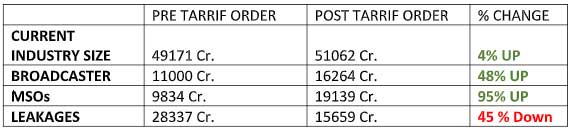
    Industry topline projections

     The conclusion

    In the end, this is a much-needed step in the right direction, although the ideal scenario of 100 per cent a-la-carte channels might still be an improbability. The tariff order promotes transparency, empowers the audience, and plugs the revenue leakages, thereby increasing accountability of the key industry stakeholders. 

    (The author is chief executive officer and co-founder, Chrome DM. The views expressed here are his own and Indiantelevision.com may not subscribe to them) 

  • Tata Sky vs TRAI: Delhi High Court lists matter for 15 January, asks regulator to produce documents

    Tata Sky vs TRAI: Delhi High Court lists matter for 15 January, asks regulator to produce documents

    MUMBAI: Tata Sky got a breather from the Delhi High Court today as the Telecom Regulatory Authority of India (TRAI) assured that it will not take any coercive action against the direct to home (DTH) operator until 15 January, which is when the matter will be heard next.

    Bharti Telemedia-owned Airtel Digital TV and Discovery Communication India, petitioners in the matter, too were handed a respite.

    Interestingly, another leading DTH operator Sun Direct impleaded itself in the matter.

    Kapil Sibal impressed upon the judges to ask TRAI to produce all documents on how it arrived at the decision to implement the new tariff regime. He also stated that implementing the present order will have an adverse impact on business.

    The TRAI lawyer countered saying that while Tata Sky feels aggrieved, a big  DTH operator like Dish TV and all the MSOs seem satisfied and have complied with the new tariff framework.

    Sibal went on to explain how the new tariff order is going to be cumbersome for subscribers to exercise their so-called options.

    The court has now asked the regulator to file the documents and the data based on which the new regime is based. 

    Tata Sky is unlikely to upload its RIO for now unlike Discovery, which has already published the same on its website.

    Discovery, however, has complied with TRAI’s tariff order and regulations under protest.

    In 2017, Bharti Telemedia, Tata Sky and Discovery Communication India had filed petitions against TRAI, challenging its tariff order and the interconnect regulations.

    Unlike the position adopted by Star India wherein it questioned the regulatory powers of TRAI, the matter in the Delhi HC questions on the regulator’s power to wipe out deals that operators enter into to fix commissions and rates for customers.

    While the fate of the two DTH operators hangs in the balance in this matter, all other distribution platform operators (DPOs) continue to be bound by the tariff order.

  • TRAI says no postponement of tariff order implementation in fresh clarification

    TRAI says no postponement of tariff order implementation in fresh clarification

    MUMBAI: The Telecom Regulatory Authority of India (TRAI) has clarified that it won't be giving any more extensions to the implementation of the new tariff regime beyond the deadline of 31 January. It has given an additional month for customer migration to new tariff regime after which there have been speculations that the authority may be further postponing or stopping or revising the rule. Quashing rumours, TRAI has issued a press release and clarified that the new framework has come into effect on 29 December itself.

    TRAI also states that  it has been monitoring the progress in regards to availability of consumer corner, choices to the consumers, provision of consumers care channel, percentage of consumers whose choice has been obtained etc. on day to day basis. It even noted that almost all the service providers have started providing consumer care channel on channel number 999.

    The authority further added that the schedule of activities has been properly communicated to all the service providers for reaching out to the consumers and obtaining choices. In addition to that, TRAI is conducting review meetings regularly to monitor the progress.

    TRAI has again advised all the service providers to strictly observe the timelines as provided in the migration plan.

    It has also asked subscribers to exercise their options without waiting for the last minute to avoid any inconvenience and to ensure that they continue to view their favourite channels.

    As the date for implementation of tariff order was nearing, stakeholders were highly concerned how the transition would pan out for consumers. Bringing relief to them, TRAI gave time till 31 January for consumers to opt for channels of their choice under the new regime. Customers will be migrated to new plans as per their choice from 1 February.

    Earlier there were speculations about a complete blackout of TV channels in December as the system allegedly is not ready for such a big move. Then too TRAI asserted in a release that it has advised all the broadcasters, DPOs, and LCOs to ensure there is no disruption of TV services.

    Left with less than one month in hand, DPOs have also started updating new channel prices and packages on their websites to inform consumers. Many large MSOs like Hathway, DEN Networks, Siti Cable have come up with "suggestive packs" bundling the popular channel of all major broadcasters.

    As per TRAI, the new tariff order will give consumers the power to choose and will also lower the prices for TV channels. This new framework allows them to select and pick channels that they like to watch and pay accordingly. It also requires the TV broadcasters to disclose maximum retail price (MRP) of their respective channels and also of the channel bouquets.

  • DPOs say TRAI tariff order lacks value without 15% bouquet discount cap

    DPOs say TRAI tariff order lacks value without 15% bouquet discount cap

    MUMBAI: With TRAI’s petition seeking clarity on the 15 per cent bouquet discount cap being dismissed as withdrawn in the Supreme Court, distribution platform operators (DPOs) are of the opinion that the entire value chain is now bound to function like it did before the new tariff order came into existence.

    Last month, the regulator had filed a petition in the top court on the issue of 15 per cent cap on discount on a bouquet price of TV channels to consumers that had been set aside by Madras High Court while upholding TRAI’s right to regulate the broadcast sector.

    Highlighting the delay, the Supreme Court was of the opinion that the TRAI should have sought clarification on the clause while arguments were being presented in the matter last year.

    With the court’s latest act, CEO of the Chandigarh-headquartered MSO Fastway Peeush Mahajan believes that the DPOs will not be in a position to package their product, thereby being reduced to just passing on to consumers the offerings broadcasters have prepared.

    “Basically what I’m seeing is, we are back to stage one. 15 per cent clause, as per me, is the gist of the entire tariff order. With 15 per cent gone, there will now be predatory pricing. Broadcasters will keep the rates higher for a-la-carte channels and give a discount of 50-60 per cent on the bouquets,” Mahajan told Indiantelevision.com.

    Maharashtra Cable Operators’ Federation (MCoF) committee member Asif Syed concurs with Mahajan. According to him, the 15 per cent clause was in the interest of consumers as well as the MSOs.

    “If the capping is not allowed now, the problem would be MSOs won't be able to bundle all the packages. If someone wants to watch a Marathi GEC, right now there is no option wherein you can get Star Pravah and Zee Marathi in the same package. MSOs could have done that had there been a 15 per cent cap. We won't market the pay channels. Since we are not getting a good share why should we help the broadcasters? Let them advertise, let them do the hard work. There would be resistance from our side,” Syed further added.

    The DPOs point out that the problem with the pre tariff order period was that the a-la-carte pricing was very high and bouquet pricing was extremely low. In a sense, that’s the direction the industry will now be headed in.

    “As on today, we basically have an LCO and subscriber contact programme where we are reaching to the LCOs and they are further reaching the subscribers. Now there is a big resistance from the cable operators, so let’s see how this will shape up. We are trying to convince the cable operators that we have to implement the order but the actual number of consumers registered by the LCOs is unknown,” Mahajan stated.

    While the regulator failed to get a written assurance on whether the court would entertain similar pleas in the future, there’s little doubt of it seeking further amendments to the order going forward.

    “To my understanding, TRAI has withdrawn the petition. In my belief, TRAI will definitely take steps to bring about whatever amendments are required in the tariff order so that it meets the objectives. In the meanwhile, it would be better if broadcasters review their negative approach and make it friendly to consumers as well as DPOs,” Kerala Communicators Cable Limited (KCCL) CEO Shaji Mathews highlighted.

    A section of the DPOs believes that broadcasters have acted, by adopting an unrealistic pricing model, against the spirit of the TRAI order. This, they feel, has been done in order to pressurise TRAI as well as DPOs. The regulator’s objective was to ensure that rates are realistic. Broadcasters not adhering to realistic pricing models amounts to deliberately defeating the purpose of the tariff order, says an MSO CEO who did not wish to be quoted.

    The TRAI is now set to meet major MSOs and broadcasters to discuss the implementation of the tariff order on 4 January. That is when there will be further clarity on what lies ahead for the entire content distribution value chain.

  • TRAI’s SLP on 15% bouquet discount cap dismissed as withdrawn in SC

    TRAI’s SLP on 15% bouquet discount cap dismissed as withdrawn in SC

    MUMBAI: The special leave petition (SLP) filed by the Telecom Regulatory Authority of India seeking clarifications on the 15 per cent bouquet discount cap last month was today dismissed as withdrawn in the Supreme Court.

    Pointing to the delay, the court was of the opinion that the clarification should have been sought while the matter was being argued.

    The regulator also failed to obtain a written assurance from the court on the possibility of the latter entertaining similar clarifications in the future. 

    Last month, the regulator had filed a petition in the top court on the issue of 15 per cent cap on discount on a bouquet price of TV channels to consumers that had been set aside by Madras High Court while upholding TRAI’s right to regulate the broadcast sector.

    On a matter that’s complicated, TRAI’s petition, in layman’s language, exhorts the Supreme Court to set aside that portion of the high court judgment that frowns on the 15 per cent cap on discounts on bouquet prices of TV channels.  

    The Madras High Court, while upholding most of the TRAI tariff order — issued middle of 2016 and challenged by Star India and Vijay TV later that year on grounds of overstepping of jurisdiction — had struck down as arbitrary almost 18 months later the 15 per cent cap on bouquet prices.

    With the case finally disposed of by the Supreme Court earlier this year, upholding the high court’s views, TRAI had issued a notification stating that India’s broadcast and cable industry stakeholders implement its tariff regime in phases and report on compliance.

  • TRAI extends deadline for comments on TV audience measurement overhaul

    TRAI extends deadline for comments on TV audience measurement overhaul

    MUMBAI: Earlier this month Telecom Regulatory Authority of India(TRAI) came out with a public consultation on various facets of TV audience measurement and how the existing system could be made more robust. The regulatory body has now extended the deadline for receipt of comments and counter comments based on a request from stakeholders.

    The last date for receipt of written comments and counter-comments from the stakeholders has been extended to 2 February and 16 February respectively. At the time of the release of the consultation paper, the last dates were 2 January and 16 January.

    Television audience measurement in India continues to remain one of the key subjects that evoke reactions from stakeholders. Given that advertising expenditures are typically guided by such data and, in the wake of the matter being raised at various fora, TRAI came out with the consultation paper.

    Telecom Authority of India (TRAI)’s move gains importance as stakeholders during meetings with the regulator, leading up to the present consultation, had conveyed that the present measurement system, spearheaded by a joint industry body Broadcast Audience Research Council India (BARC India), has done a credible job till now, but additional improvements could be made, including making data collection more robust and finding ways to curb panel infiltrations leading to possible manipulations. More so as the industry has already invested in the present system over the past three years and it would be improper to try find alternate mechanisms at this juncture.

    Keeping such views in mind, TRAI has raised issues relating to RPD(return path data) and whether set-top-boxes deployed in the country were technically adept at catching such figures — initiatives that would add to data robustness. The specific questions asked is: What percentage of STB supports transferring viewership data through establishing a reverse path/connection from STB? What will be the additional cost if existing STBs without return path are upgraded?

    Asking whether regulatory tweaks were needed to reduce the impact of manipulation of measurement panels — an issue red-flagged by BARC India itself in an earlier consultation — TRAI has sought comments on the country-wide panel size and also the size of the individual panels in rural and urban areas.

    The consultation paper highlights several such issues, including if BARC India, the organisation presently doing audience measurement, has been able to accomplish its purpose.

    Industry observers said though the regulator may have raised pertinent issues, some of them could be answered by the stakeholders only if they decide to take a firm view on them. For example, TRAI asks whether the present sample size of bar-o-meters employed to collect data is adequate. The answer is, maybe no. But to increase the sample size, the stakeholders need to commit more financial investments and give BARC India the go-ahead — though annually some boxes are added to live up to promises made at the time Ministry of Information and Broadcasting green-lighted the BARC project.

    The TRAI paper also seeks inputs from the stakeholders regarding shareholding/ownership pattern of BARC India and whether its credibility and neutrality can be enhanced further, while highlighting various methods of collating such data in other countries, including the US, the UK and France.

    Some of the other issues highlighted in the TRAI paper are the following:

    # Is there a need to promote competition in television rating services to ensure transparency, neutrality and fairness to give TAM rating?

    # What regulatory initiatives/measures can be taken to make TV rating services more accurate and widely acceptable?

    # Is the current audience measurement technique used by BARC apposite?

    # Does broadcasting programmes that are out of their category or in different languages for some time during the telecast affect the TAM (TV audience measurement) rating? If so, what measures should be adopted to curb it?

    # Can TV rating, based on limited panel homes, be termed as truly representative?

    # What should be done to reduce the impact of manipulation of panel home data on overall TV ratings?

    # What should be the panel size both in urban and rural India to give true representation of audience?

    # What method/technology would help to rapidly increase the panel size for television audience measurement in India? What will be the commercial challenge in implementing such solutions?

    # Should DPOs be mandated to facilitate collection of viewership data electronically, subject to consent of subscribers to increase data collection points for better TRPs?

    # What percentage of STB supports transferring viewership data through establishing a reverse path/connection from STB? What will be the additional cost if existing STBs without return path are upgraded?

    # What method should be adopted for privacy of individual information and to keep the individual information anonymous?

    # What should be the level/granularity of information retrieved by the television audience measurement agency from the panel homes so that it does not violate principles of privacy?

    # What measures need to be taken to address the issue of panel tampering/infiltration?

    # Should BARC be permitted to provide raw level data to broadcasters? If yes, how secrecy of households, where the people meters are placed, can be maintained?

    BARC India, set up in 2015, is a joint venture amongst broadcast and advertising industry bodies IBF, AAAI, ISA with Indian Broadcasting Foundation or IBF being a majority shareholder. India’s public broadcaster Prasar Bharati also sits on the BARC India board. Apart from TV audience data, BARC India is also exploring rolling out similar figures for digital platforms.