Category: TRAI

  • India adds 3.2 million phone users in May, total hits 1.2 billion

    India adds 3.2 million phone users in May, total hits 1.2 billion

    MUMBAI: Dialling up its digital growth, India’s telecom sector added 3.24 million new telephone subscribers in May 2025, pushing the country’s total subscriber base to a staggering 1.207 billion. While urban India remained saturated with 131.76 per cent tele-density, rural areas rang in gains too, growing 0.14 per cent month-on-month to hit 537.39 million subscribers.

    The data, released by the Telecom Regulatory Authority of India (TRAI), also showed a strong wireline comeback with 1.25 million new connections pushing wireline growth to 3.34 per cent, led by aggressive additions from Jio and Airtel.

    India’s broadband base surged 3.37 per cent to reach 974.87 million subscribers, thanks largely to mobile broadband (up 2.92 per cent) and a 60 per cent spike in fixed wireless (5G FWA, Wi-Fi, satellite) subscriptions. However, 5G FWA itself dipped slightly from 7.50 million to 7.40 million users, indicating early volatility in the still-nascent category.

    Jio led the broadband brigade with 494.47 million subscribers, followed by Airtel (302.15 million) and Vodafone Idea (126.68 million), together accounting for a whopping 98.47 per cent of the market.

    Overall wireless subscriptions grew modestly by 0.17 per cent to 1.168 billion, with rural India contributing 0.38 million new users. Urban wireless teledensity climbed to 124.91 per cent, while rural teledensity inched up to 58.90 per cent. Wireline adoption in rural India saw a sharper surge of 10.44 per cent, albeit from a much smaller base.
    Who’s Winning the Race?

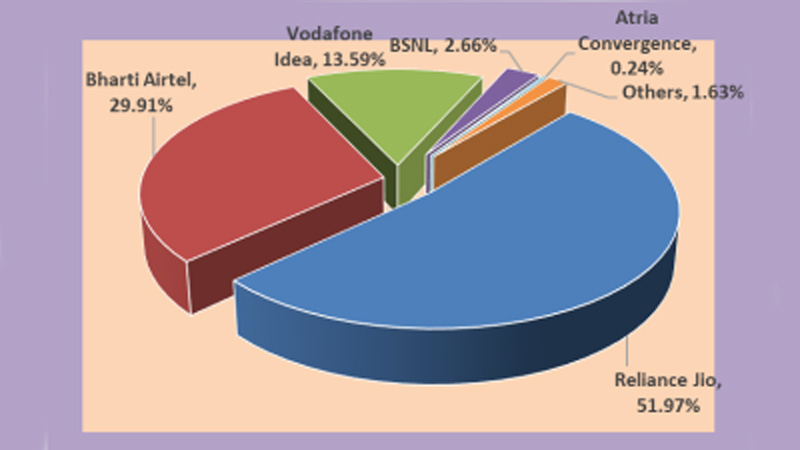
    .  Reliance Jio: 494.47 million broadband subs, 40.92 per cent mobile market share.

    .  Bharti Airtel: 302.15 million broadband subs, 33.61 per cent mobile market share.

    . Vodafone Idea: 126.68 million broadband subs, 17.61 per cent mobile market share.

    Jio also led wireline subscriber additions with 1.28 million new connections, while Vodafone Idea continued to see a decline of over 1.35 lakh users in the wireline segment.

    Indians are clearly still keen to keep their digits. 14.03 million MNP requests were made in May alone. Uttar Pradesh (East) topped the chart with 115.77 million cumulative porting requests, followed by Maharashtra at 92.72 million.

    Out of the total 1.161 billion mobile subscribers, 1.08 billion were active as per VLR (Visitor Location Register) data about 93 per cent. BSNL had the lowest active subscriber rate (63.73 per cent), while Reliance Communications registered a perfect 100 per cent, albeit on a very small base.

    With over 85.36per cent teledensity nationwide and close to a billion broadband users, India’s telecom story continues to evolve rapidly. But the future lies beyond just numbers, rural wireline expansion, M2M growth (now at 73.91 million connections), and the true test of 5G fixed wireless adoption could be the next chapters in this digital saga.

    So, whether it’s smartphones in metros or landlines in tier-3 towns, India’s telecom tune is still playing and the country’s clearly not hanging up any time soon.

    (If you are an Anime fan and love Anime like Demon Slayer, Spy X Family, Hunter X Hunter, Tokyo Revengers, Dan Da Dan and Slime, Buy your favourite Anime merchandise on AnimeOriginals.com.)

  • TRAI rings in Q1 with Rs 92,637 crore telecom revenue and rising usage

    TRAI rings in Q1 with Rs 92,637 crore telecom revenue and rising usage

    MUMBAI: India’s telecom sector is ringing loud and clear with growth in both reach and revenue. The Telecom Regulatory Authority of India (TRAI) has released its Q1 2025 Indian Telecom Services Performance Indicator Report, offering a snapshot of India’s ever-evolving communications landscape. Covering the period from January to March 2025, the report reflects an expanding user base, robust revenue growth, and a surge in average mobile usage despite a slight dip in internet subscriptions.

    India’s total telephone subscriber base crossed 1.2 billion (1,200.80 million), with a 0.91 per cent increase over the previous quarter. Wireless subscribers (including 5G FWA) now stand at 1,163.76 million, while wireline numbers declined to 37.04 million, a drop attributed to the reclassification of some 5G Fixed Wireless Access users.

    Here’s what’s trending in the sector:

    ●    Mobile ARPU (Average Revenue Per User) rose to Rs 182.95 in Q1 2025 up 0.64 per cent from the previous quarter and a whopping 19.16% year-on-year.

    ●    Minutes of Usage (MOU) per subscriber also ticked up to 1,026/month.

    ●    Total wireless data usage during the quarter hit 59,447 PB, with average consumption at 22.19 GB per user.

    ●    Tele-density improved to 85.04 per cent, with rural areas seeing a jump to 59.06 per cent.

    ●    Internet subscribers marginally dipped by 0.11 per cent to 969.10 million, largely driven by a slight broadband fall.

    ●    Pay DTH subscribers dropped to 56.92 million, down from 58.22 million in Q4 2024.

    ●    FM radio still has its groove, with 388 private stations across 113 cities generating Rs 466.63 crore in ad revenue.

    On the broadcasting front, India now has 918 permitted private satellite channels and 531 operational community radio stations.

    While rural wireline teledensity remains low at 0.39 per cent, wireless penetration continues to be India’s telecom backbone, with private players commanding a 91.47 per cent market share.

    As India prepares for deeper digital adoption, TRAI’s indicators reveal that the sector is not just surviving, it’s thriving. Whether it’s screen time, call time or data time, Indians are clearly making the most of their mobile moment.

  • TRAI telecom data:  India’s rural surge, internet binge and DTH downfall ring loud in March

    TRAI telecom data: India’s rural surge, internet binge and DTH downfall ring loud in March

    MUMBAI: India’s telecom scene in March 2025 was a tale of two Indias—rural Bharat rising on data dreams and legacy players like BSNL and MTNL gasping for bars. According to TRAI’s fresh data, it was a month of gains for mobile and broadband, and growing static for DTH.

    The total number of wireless subscribers climbed slightly to 1,160.65 million, with rural India accounting for nearly 80 per cent of new additions. Villages added 1.1 million users, urban India added just 296,000—proof that the real action is beyond city limits.

    Reliance Jio was on fire, gaining 2.15 million wireless users and reinforcing its market leadership with 39.6 per cent share. Bharti Airtel added 1.03 million, keeping pace. Vodafone Idea lost nearly 700,000 subscribers, and BSNL continued its freefall with a 1.25 million loss.

    India’s broadband subscriber base touched 946.32 million, a monthly growth of 0.21 per cent. Unsurprisingly, 4G/5G mobile broadband accounted for 921.4 million of those connections—soaring on reels, reels, and more reels.

    On the wireline broadband front, Jio continued to hustle, adding over 320,000 subscribers, bringing its fixed-line share to 33.6 per cent. Airtel stayed solid with over 100,000 adds, while government dinosaurs BSNL and MTNL lost tens of thousands more. Between sluggish service and vanishing relevance, they’ve become the landline’s last rites.

    In the home entertainment arena, the direct-to-home (DTH) sector saw a slide. Total active DTH subscribers dropped to 64.17 million from 64.45 million—a fall of over 278,000 users in just one month.

    Cord-cutting is no longer a western trend; it’s happening across Indian homes as OTT apps and smart TVs eat into satellite’s share. Operators like Tata Play and Airtel Digital are still holding their ground, but the writing is on the (living room) wall.

    The big takeaway? Rural India is dialling up, streaming more, and finally enjoying digital parity. Jio’s aggressive expansion is paying off across both mobile and fibre, while BSNL’s steady subscriber bleed raises existential questions.

    DTH is beginning to look like the landline of television. The OTT wave is here, and it’s pulling viewers—and revenue—away from satellite.

    With spectrum auctions around the corner and AI-fuelled data demands skyrocketing, India’s telecom race is less about who picks up the call—and more about who controls the cloud.

  • TRAI gives buildings a digital reality check with connectivity rating reboot

    TRAI gives buildings a digital reality check with connectivity rating reboot

    MUMBAI: In a country obsessed with skyscrapers, the Telecom Regulatory Authority of India (TRAI) is more interested in what’s inside the walls—signal strength. On 22 May, TRAI issued a formal response to the department of telecommunications (DoT), which had sought clarifications on the regulator’s earlier recommendation for a new system to rate buildings and areas based on digital connectivity.

    The recommendations in question—first proposed on 20 February 2023—aim to address the gnawing issue of poor signal penetration in buildings, despite India’s heady digital growth. While rooftop towers and fibre lines have made it to headlines, indoor connectivity has lagged, often trapped behind concrete, bureaucracy, and dated building codes.

    TRAI pointed out that despite several policy nudges over the years, in-building connectivity continues to be a digital blind spot. With the fusion of IoT and smart workplaces on the rise, there is an urgent need to bake digital connectivity infrastructure (DCI) into the design of new buildings—much like water, electricity, or fire exits.

    The 2023 recommendations call for a rating system embedded within local building bye-laws and municipal approvals. TRAI argues this will not only prepare buildings for the 5G era but also avoid a repeat of the signal dead zones plaguing 4G users. And with 6G already on the horizon, the Authority warns that the higher frequency bands used will face even steeper resistance from walls and materials.

    TRAI’s formal response, now uploaded on its website, comes in reply to the DoT’s back-reference dated 19 March 2025. For those seeking fine print or footnotes, the advisor (QoS-I), Tejpal Singh, remains available for clarifications.

  • TRAI dials up a united front as regulators join forces to fight digital spam

    TRAI dials up a united front as regulators join forces to fight digital spam

    MUMBAI: If spam calls and scam messages are the villains of our digital age, India’s top regulators are teaming up like superheroes. On 25 April 2025, TRAI hosted a meeting of the Joint Committee of Regulators (JCoR) at its New Delhi headquarters, bringing together heavyweights from RBI, IRDAI, PFRDA, SEBI, MoCA, MeitY, and special invitees from DoT and MHA to chart a stronger, cross-sector response to unsolicited commercial communication (UCC) and fraudulent activities.

    Opening the session, TRAI Chairman Anil Kumar Lahoti stressed the urgent need for a collaborative approach. Highlighting the mounting threat to citizens, particularly senior citizens, Lahoti praised the JCoR’s progress but warned that “the challenges ahead demand even greater synergy and vigilance.”

    Key issues topping the agenda included the nationwide rollout of 1600 series numbers for transactional and service calls from government and financial entities. Members agreed to push for swift onboarding within their respective sectors and monitor progress closely. The Council of Administered Telecommunications (CoAT) also presented a solution offering a unified 1600-series CLI for seamless call identification across networks.

    Another major move discussed was the onboarding of commercial communication senders onto the Digital Consent Acquisition (DCA) platform. Regulators pledged to work with principal entities to ensure compliance, aiming to empower consumers with more control over who contacts them.

    Fraudulent communications and the rise of “digital arrest” scams were a serious point of concern. I4C proposed measures including deletion of unused SMS headers, swift action on fraudulent SMS identifiers, and blocking of mobile numbers and IMEIs used for scam messages. Members pledged to develop clear modalities for rapid action.

    Emerging threats from OTT and Rich Communication Services (RCS) platforms also grabbed attention. Recognising that spammers are shifting to newer communication channels, the committee decided that MeitY would engage with stakeholders to roll out spam mitigation strategies mirroring those in traditional telecom.

    The session closed on a determined note, with JCoR members agreeing to intensify collaboration across sectors. The goal? A safer, more secure digital communication ecosystem for India’s consumers, one where fraudsters find it harder to hide and trust travels faster than spam.

  • TRAI warns public against scam calls threatening mobile disconnection

    TRAI warns public against scam calls threatening mobile disconnection

    MUMBAI: The Telecom Regulatory Authority of India (TRAI) has issued a public warning over a rise in fraudulent calls and messages from scamsters posing as TRAI officials, falsely claiming users’ mobile connections will be disconnected due to alleged illegal activity.

    “There have been several media reports in the recent times that the consumers are being targeted through telephonic calls or messages by fraudsters posing as TRAI officials threatening disconnection of mobile connection for being involved in illegal activities and for extraction of money,” TRAI noted in an official statement.

    The regulator clarified that TRAI does not contact consumers regarding mobile disconnections, nor has it authorised any third-party agency to do so. Any such calls or messages should be treated as potentially fraudulent and ignored.

    The responsibility for disconnection of mobile numbers whether due to billing issues, KYC non-compliance, or misuse rests solely with the respective Telecom Service Providers (TSPs).

    Citizens are strongly advised not to panic, and to verify any suspicious calls by reaching out directly to their telecom provider’s official customer care.

    To curb cybercrime and financial fraud, the Department of Telecommunications encourages users to report such scam attempts through the Chakshu facility available on the Sanchar Saathi platform.

  • TRAI defends key recommendations on telecom service authorisations framework

    TRAI defends key recommendations on telecom service authorisations framework

    Department of Telecommunications (DoT) regarding several aspects of its September 2024 recommendations on the framework for service authorisations under the Telecommunications Act, 2023.

    The response follows a back-reference from the DoT dated 14 January 2025, in which the government indicated several of TRAI’s original recommendations from September 2024 may require modification or might not be accepted.

    The regulatory exchange began in June 2024 when the DoT requested TRAI’s input on terms, conditions and charges for telecommunications service authorisations under the new Act. After consultations with industry stakeholders, TRAI submitted its initial recommendations in September last year.

    Having examined the government’s concerns, TRAI has now finalised its reconsidered position. The complete response has been published on the TRAI website.

    In a detailed document, TRAI has stood firm on several key recommendations that the DoT had expressed reservations about, particularly regarding the structure of service authorisations.

    The regulator defended its position on introducing separate authorisations for satellite-based telecommunications and Machine-to-Machine (M2M) services, rejecting the DoT’s suggestion to integrate these within broader service categories. TRAI argued that separate authorisations would better promote investment and operational focus in these niche segments.

    “To attract business entities to enter the relatively underdeveloped satellite-based telecommunication service segment in the country, and to preserve the business focus of such entities, a separate service authorisation is necessary,” TRAI stated in its response.

    The authority also reiterated its recommendation that for any substantive changes to authorisation terms and conditions, the Central Government should seek TRAI’s recommendations, emphasising the importance of regulatory stability in a capital-intensive sector.

    Additionally, TRAI maintained its position on the need for sub-circle level authorisations to enable smaller service providers to operate efficiently within limited geographic areas.

    To read the full TRAI rebuttal please click here.


  • TRAI recommends major overhaul of broadcasting services framework

    TRAI recommends major overhaul of broadcasting services framework

    MUMBAI: India’s telecoms regulator the Telecom Regulatory Authority of India (TRAI) has recommended  comprehensive reforms in  broadcasting service authorisations, marking the most significant regulatory change recommended in the sector since the original Broadcasting Act. The new framework, aligned with the Telecommunications Act 2023, aims to modernise and streamline the industry’s regulatory landscape.

    The industry watchdog has recommended the introduction of a simplified two-tier authorisation framework. The first tier governs initial authorisation requirements for new entrants, while the second establishes compliance parameters for ongoing service provision.

    It has recommended that financial requirements be substantially revised. Direct-to-Home (DTH) operators must now maintain bank guarantees of either Rs 5 crore or 20 per cent  of two quarters’ licence fees, whichever is higher. For Head-end in the Sky (HITS) services, the regulator has reduced initial bank guarantee requirements from Rs 40 crore to Rs 5 crore, with validity periods extended from 10 to 20 years.

    In a significant move towards technological advancement, TRAI has recommended the introduction of  provisions for ground-based television channel broadcasting and low-power small-range radio services. The framework makes radio broadcasting technology-agnostic, paving the way for digital adoption.

    The regulator has also recommended the mandatory  development of interoperable set-top boxes, tasking the Telecom Engineering Centre with creating standards for both standalone devices and integrated television sets. This move aims to reduce electronic waste and enhance consumer choice.

    The new recommended framework removes mandatory co-location requirements for radio broadcasters and encourages voluntary infrastructure sharing between broadcasting and telecom providers. Radio broadcasting authorisations will be delinked from frequency assignments, with spectrum to be auctioned separately.
    Existing licence holders can voluntarily migrate to the new regime without incurring processing or entry fees. The validity period for new authorisations will commence from the migration date, regardless of existing licence periods.

    Future amendments to authorisation terms, except those related to national security, will require TRAI’s recommendations, providing regulatory stability for service providers. The reforms represent a significant step towards modernising India’s broadcasting sector while enhancing ease of doing business.

    The changes are expected to facilitate growth in both traditional and digital broadcasting services, potentially attracting new investors to the sector. Industry observers note that the reforms could particularly benefit smaller operators and new entrants, while encouraging technological innovation across the broadcasting landscape.

    To download the entire Recomended Framework for Service Authorisations for provision of Broadcasting Services under the Telecommunications Act, 2023 click  here

  • TRAI overhauls network authorisations, boosting structure and revenue in telecom

    TRAI overhauls network authorisations, boosting structure and revenue in telecom

    MUMBAI: The Telecom Regulatory Authority of India (TRAI) has shaken up the telecom sector with fresh recommendations that redefine network authorisations under the Telecommunications Act, 2023. The much-anticipated Recommendations on the Terms and Conditions of Network Authorisations were unveiled on 17 February 2025, setting the stage for a more structured and revenue-driven industry.

    This isn’t just a policy tweak—it’s a game-changer. With a range of new authorisation categories and a pricing framework that demands commitment, TRAI is making it clear that the industry’s future lies in structured, competitive, and investment-heavy territory. From satellite gateways to cloud-hosted telecom networks, the revised framework is a playbook for businesses looking to thrive in India’s fast-evolving telecom landscape.

    Key among the updates is the introduction of a mix of infrastructure and service provider authorisations, each carrying its own set of fees. Notably, the Mobile Number Portability (MNP) Provider authorisation comes with a whopping Rs 40,00,000 guarantee fee, ensuring only serious players enter the market. But it’s not all about higher costs—TRAI has focused on streamlining processes, reducing bureaucratic hurdles, and fostering innovation while prioritising security.

    Companies eyeing infrastructure investments—think dark fibres, towers, and ducts—will now need an Infrastructure Provider (IP) authorisation. Meanwhile, digital connectivity firms can explore the Digital Connectivity Infrastructure Provider (DCIP) authorisation, which encompasses everything from wireline access networks to expansive Wi-Fi systems.

    One of the most forward-thinking recommendations includes enabling Cloud-hosted Telecom Networks (CTN), marking a significant step toward the sector’s cloud-powered future. TRAI has also planned for a smooth transition, allowing existing entities to voluntarily shift to the new framework under the Telecommunications Act, 2023, ensuring continuity without disruption.

    While the fee hikes may raise eyebrows, TRAI’s ultimate goal is to fortify India’s telecom ecosystem, making it robust, competitive, and future-ready. By enhancing the ease of doing business, fostering investment, and securing the sector’s digital backbone, the regulatory body is charting a course for long-term industry growth.

    For those keen to dive into the details, TRAI’s full set of recommendations is available on its website. Whether it’s satellites or fibre optics, India’s telecom landscape is gearing up for a more structured and lucrative future.

  • TRAI puts a ‘stop’ to unsolicited calls and messages

    TRAI puts a ‘stop’ to unsolicited calls and messages

    Mumbai: The Telecom Regulatory Authority of India (TRAI) is taking a firm stance on unsolicited commercial communication (UCC) with its amended Telecom Commercial Communications Customer Preference Regulations (TCCCPR), 2018. In a bid to protect consumers from spam calls and messages, TRAI has introduced a series of tightened regulations aimed at strengthening consumer privacy and improving transparency in the world of telecom communications.

    Since the introduction of the TCCCPR in 2018, the framework has already made headway in fighting spam with its blockchain-based regulatory system. However, with spammers evolving their tactics and adopting new methods, TRAI’s latest regulatory tweaks aim to close loopholes, enhance consumer complaint processes, and strengthen enforcement mechanisms. The newly-amended regulations seek to bolster the fight against spam, ensure quicker action on complaints, and enforce higher accountability for telemarketers.

    The latest amendments by TRAI introduce a streamlined complaint process, allowing consumers to file complaints against spam calls and messages without the need to register their preferences in advance. Additionally, the time window for lodging complaints has been extended from three days to seven days, making it more convenient for users. To ensure faster action, telecom providers must now resolve complaints within five days, a significant reduction from the previous 30-day timeframe. Moreover, the threshold for action has been lowered, requiring just five complaints in 10 days instead of the earlier 10 complaints in seven days, making it easier to clamp down on repeat offenders.

    Strengthening consumer control, telecom operators will now be required to provide a mandatory opt-out option for promotional messages, ensuring customers have a hassle-free way to reject unwanted communications. Additionally, financial disincentives have been introduced for telecom providers found misreporting UCC instances, with escalating penalties for repeat violations, reinforcing strict accountability within the industry.  

    Moreover, TRAI has implemented stringent rules to curb the misuse of telecom resources for telemarketing. This includes banning normal 10-digit numbers for promotional messages and encouraging telemarketers to use dedicated number series (such as the 1600 series for transactional messages). Violators of these regulations now face severe penalties, including suspension of telecom services for up to a year for repeat offenders.

    Additionally, physical verification and biometric authentication for telemarketers and senders will further ensure accountability and traceability in the industry. Telecom providers are also required to implement honeypots to help identify spam calls early, thus preventing widespread misuse.

    As digital communications continue to play an essential role in business and personal interactions, these new measures will go a long way in ensuring a cleaner, safer telecom environment. TRAI’s latest reforms aim to create a balance between consumer protection and the need for legitimate commercial communication, marking a new chapter in India’s telecom regulatory landscape.