Category: Regulators

  • Comment: TRAI uplinks progressive recommendations; now MIB, others need to downlink them

    Comment: TRAI uplinks progressive recommendations; now MIB, others need to downlink them

    The approximately Rs 1,400 billion Indian broadcasting and cable sectors, reeling under the impact of a slow economy and hemmed in by erratic policy-making, would be breathing a bit easy after TRAI’s recommendations on issues related to uplink and downlink of TV channels and teleports.

    And, why not?  When the consultation paper on uplinking and downlinking guidelines was released by TRAI in December last year, the concept paper had sent alarm bells ringing in the media industry. Reason? The consultation paper had references about auctioning of satellite spectrum and TV channel permissions, introduction of AGR (adjusted gross revenue) sharing based licence fee (the concept of licensing itself was a debatable issue) and introduction of other changes.

    Most media houses sensed that an auction and AGR-based licensing and spectrum regime could have an irreparable impact on the industry, a la telecom sector, where winding down of businesses and pink slips are becoming common. Even more worrying for the sector was the assertion by TRAI — probably egged on by the Ministry of Information and Broadcasting (MIB)’s reference letter on the issue — that the administrative permissions received by TV channels under the existing norms were licences under Section 4 of the Telegraph Act, 1885, which in itself is an antiquated piece of legislation harking back to the 19th century.

    Though TRAI may not have been directly responsible for suggesting in the consultation paper, issues that rankled the industry, it did experience a rare united and collective views of the industry. Though consensus among stakeholders is rare, on this matter there was no such hesitation. And, an open house forum organised by TRAI on the issue to get further feedback could be cited as an example of this rare unity of views.

    Most attendees to the open forum conveyed loud and clear that concepts like auctioning of TV channels’ permission and AGR-based annual revenue sharing (with the government) would do more harm to the industry than any good. What’s more, some of the industry representatives reminded TRAI of its recommendations for National Telecom Policy 2018 where it had suggested “review” of all levy and fees imposed on telecom service providers.

    In the final recommendations issued earlier this week, TRAI has categorically struck down the possibility of either auctioning of permissions and/or spectrum and steered clear of AGR altogether. Rather, it has taken a highly progressive stance, which if accepted by MIB and other government organisations can inject the much-needed fuel in the industry for it to propel forward faster over the next decade.

    By not increasing any substantial financial burden on media companies in this sector, TRAI has enabled the capex to go into creating newer ventures, innovative products and business models, and other expansionary activities, rather than simply paying fees and levies. Though the suggested framework has been left mostly untouched from the perspective of administrative fees, there are a few notable changes.

    The annual licence fee for uplinking of a TV channel has been enhanced from Rs 200,000 to Rs 300,000. Similarly, the annual fee for downlinking of a TV channel has been increased to Rs 750,000 from Rs 500,000. Also, the fee for downlinking of channels uplinked from abroad has been increased to Rs 22,50,000 per annum.

    TRAI, while exhorting the likes of MIB, Department of Space and DoT to streamline processes, has interestingly suggested transfer of permissions between two companies be permitted only in the case of mergers and acquisitions as recognised under applicable laws. However, free transfer has been recommended for permission of a TV channel to its subsidiary company or holding company or a subsidiary company of the holding company. The caveat being such a company should have a valid uplinking and downlinking permission.

    A time period of only one year has been given for operationalisation of a TV channel and a lock-in period of one year from the date of operationalisation of a channel for the transfer of permission of such a channel too has been introduced.

    As for teleports, no change in the amount of one- time non-refundable processing fee levied for seeking permission for establishing a teleport has been suggested. Similarly, it has been suggested that no entry fee is levied for granting permission for establishing a teleport. However, for each antenna, a fixed annual license fee of Rs 300,000 has been recommended.

    What will also come as a relief to the teleport industry is that TRAI has refrained from restricting the number of teleports in India.

    And, once again TRAI has nudged Department of Space and Department of Telecoms to take time-bound and liberalised policy decisions relating to satellite capacity. Though not said upfront and in so many words, the regulator has pitched in for foreign satellites too. “The issue of open sky policy for Ku band frequencies may be taken up by MIB in INSAT Coordination Committee (ICC) meeting and the open sky policy should be adopted.”

    Any regulator would vouch that it’s hard to please the core constituency and stakeholders don’t always agree with its stand, but on the uplink/downlink matter the industry would agree with most of the suggestions of TRAI — and also breathe a little easy.

    Hang on, don’t pop the champagne yet. TRAI can only make suggestions — it admitted so in an open forum — and it’s up to MIB, DoT and Department of Space to accept the suggestions and implement them. And, therein lies the catch because quite a few other sets of TRAI recommendations have been gathering dust in various corridors of power.

    Also Read :

    Uplink, downlink issue: TRAI pushes for a liberal regime keeping most existing norms unchanged

    TRAI extends dates for comments on uplinking/downlinking consultation paper
  • Uplink, downlink issue: TRAI pushes for a liberal regime keeping most existing norms unchanged

    Uplink, downlink issue: TRAI pushes for a liberal regime keeping most existing norms unchanged

    NEW DELHI: The Telecom Regulatory Authority of India today stuck with most of the existing guidelines and norms for uplink and downlink permissions for TV channel and teleports, refusing to recommend auction of TV channels — flagged as a contentious issue by stakeholders. However, it suggested enhancing of annual permission fees from the present levels, amongst some other changes.

    The TRAI recommendations on uplink and downlink of TV channels and teleports had been awaited eagerly by the industry, already reeling under pressures from various sides, including economic.

    The regulator also said that mandating encryption of broadcast of FTA TV channels was not a good idea, while suggesting that various processes for various government clearances should be streamlines done within stipulated time-frame.

    Some of the major recommendations of the TRAI are as follows:

    Issues related to uplinking and downlinking of satellite TV channels

    i) No change in the existing definitions of ‘News and Current Affairs TV channels’, and ‘Non-News and CurrentAffairs TV channels’ mentioned in   the   existing uplinking and downlinking guidelines dated 05.12.2011.

    ii) No change in the amount of minimum net-worth of an applicant company seeking permissions for uplinking anddownlinking of TV channels.

    iii) Auction not feasible for grant of permissions for uplinking and downlinking of TV channels.

    iv) Existing administrative system for grant of permissions for uplinking and downlinking of TV channelsshould be continued and should be streamlined.

    v) TRAI reiterated its recommendations on “Ease of Doing Business in Broadcasting Sector” dated 26th February 2018 sent to the Government wherein several measures have been recommended for streamlining the existingprocess of granting permissions for uplinking and downlinking of TV channels.

    vi) No change in the permission fee and entry fee for uplinking and downlinking permissions.

    vii) Annual license fee for uplinking anddownlinking permissions should be enhanced as follows:

    public://list_14.jpg

    viii) Encryption of broadcast of FTA channels should not be mandated and it should be left to the broadcasters providingFTA channels.

    ix) Transfer of permissions should not be permitted between two different companies. In case of mergerand acquisition as recognized under the Companies Act, 20 13 or any other applicable law(s), transfer of permissionsshould be permitted after following the   due process. Transfer of permission of TV channels to its subsidiarycompany or holding company or subsidiary company of the holding company should be allowed freely, provided such company has a valid uplinking and downlinking permission.

    x)A lock-in period of one year from the date of operationalization of a channel for the transfer of permission of such channel.

    B. Issues related to Teleports

    i) No change in the amount of onetime non-refundable processing fee levied for seeking permission for establishing a teleport.

    ii) No Entry fee for granting permission for establishing teleport.

    iii) For each antenna a fixed annual license fee of Rs 3 lakh should be charged.

    iv) No need to restrict the number of teleports in India.

    v) Location of teleports should be left to the teleport operators subject to site clearance from WPC wing of DoT.

    Also Read:

    TRAI extends dates for comments on uplinking/downlinking consultation paper

    TV channels’ uplinking / downlinking procedure simplified

    MIB reminds TV channels, teleport ops about timely online payments

    MIB bumps up TV channel processing fee

  • TRAI, European regulator BERC sign net neutrality MoU

    TRAI, European regulator BERC sign net neutrality MoU

    MUMBAI : Telecom Regulatory Authority of India (TRAI) and The Body of European Regulators for Electronic Communications (BEREC) on Thursday signed a “Memorandum of Understanding” (MoU) on net nuetrality. The MoU, signed by TRAI chairman Ram Sewak Sharma and BEREC chair Johannes Gungl, also adopted a “Joint Statement for an Open Internet”, pledging to work together to ensure that the internet remains an open and non-discriminatory platform.

    “Net neutrality is a vital principle and an open internet crucial for people around the globe. We are very happy to have TRAI as a partner to ensure a univocal protection of net neutrality principles for internet access services,” said Gungl.

    Last year, TRAI, post a consultation process,  issued recommendations to protect net neutrality. However, those recommendations haven’t yet been enacted by the telecom department.

    The joint statement not only highlighted the regulators’ common understanding of net neutrality rules but also their intention to protect them. TRAI and BEREC have also decided to work together in implementing these rules.

    The  MoU has been designed to faciliatate effective electronic communications regulation. Its aim is to build a mutual relationship between the two parties to identify and tackle current and future regulatory issues. This effort is also aimed at nurturing a sound working partnership between the experts from both regulators.

    “We consider that the intemet will continue to be an enabler of growth and innovation for countries like India who can use technology to leapfrog to the next stage of development. Therefore, it is important that the intemet is kept as an open and non-discriminatory platform. Our MoU with BEREC gives us an opportunity to not only work closely together in areas like net neutrality, but also to collaborate in other areas where the EU has adopted a very effective regulatory framework like consumer protection, broadband development and promotion of Next Generation Access roll-out ” said Sharma.

    Also Read:

    Third Madras high court judge gives TRAI tariff order thumbs up

    Madras HC gives split verdict in Star India versus TRAI case

  • ISRO/DoS relent on use of foreign satellites; MIB starts processing applications

    ISRO/DoS relent on use of foreign satellites; MIB starts processing applications

    MUMBAI: India’s Department of Space, overseeing the Indian Space Research Organisation (ISRO), has eased up on its hitherto hard stance on Indian TV channels and teleports using foreign satellites’ capacity — if the Indian customer has a long-term contract.

    In a communication to Ministry of Information and Broadcasting (MIB), DoS/ISRO combine has advised that applications may be processed — for the time being — without insistence on migration to an Indian satellite or asking the time frame for doing it. 

    According to government sources, it has been suggested to MIB that it could start granting permissions to TV channels proposing to use foreign satellites for uplinking purpose if they are going in for a contract of three years or more. If an applicant company, having existing government permissions, has long-term capacity contract on foreign satellites, it too should be allowed to continue with its services.

    However, there’s a caveat to ISRO/DoS’ latest softening of stance. Any company that has existing permission from MIB to start a TV channel or communications service (like teleports) and is using foreign satellites should give the Indian space agency at least three-month notice for space on an Indian satellite when its contract with a foreign satco is ending. Same holds true for all fresh permissions for TV channels given by the government.

    The DoS/ISRO communication referred to over 35 applications that were kept pending by MIB as Department of Space had been insisting on migration to Indians satellites. MIB had also issued letters earlier this year asking companies seeking name change, for example, as to when they proposed to shift to an Indian satellite. Out of these cases highlighted by ISRO/DoS, at least 10 have long-term contracts for capacity on foreign satellites.

    Last month MIB cleared applications of three new TV channels in Indian languages under Aastha brand name. The Aastha channels are owned by a company controlled by Balkrishna, a close associate of yoga-guru-turned-entrepreneur Ramdev who’s Patanjali FMCG venture is giving even multinational companies sleepless nights, if revenues and sales growth are to be believed.

    Government nods recently were also given for name and logo change to some big broadcasting companies. Incidentally, some of the Aastha TV channels use foreign satellites for uplinking activity.

    In recent times, ISRO has been facing minor setbacks regarding launch of communications satellites, including Gsat-11, which returned to India just few days before launch from a European launchpad. 

    Still, it needs to be seen how long the government continues allowing Indian customers facilities of foreign satellites.

    MIB Expands Areas for Online Applications

    In a new advisory put out yesterday, MIB has expanded the services for which applications could be made online, something that the government has been insisting on in an effort to reduce processing time.

    The online module for submitting applications on www.broadcastseva.gov.in extends to cases relating to change in details of a company, annual permission fee for teleport companies and company-specific changes being sought to be made by teleports.

    The government has also reiterated an earlier stand of accepting online payments for various processing and annual permission fee, adding such payments should be made on time failing which action could be taken against companies concerned under existing regulations.

    Also Read :

    MIB clears TV channel applications; Rathore calls for stakeholder meets

    MIB, DoS nudge TV channel to use Indian satellites

    MIB says ISRO upping capacity to facilitate migration from foreign satellites

    Comment: 3 areas that new MIB minister Rathore needs to target

  • RS Prasad launches Wi-Fi choupal project

    RS Prasad launches Wi-Fi choupal project

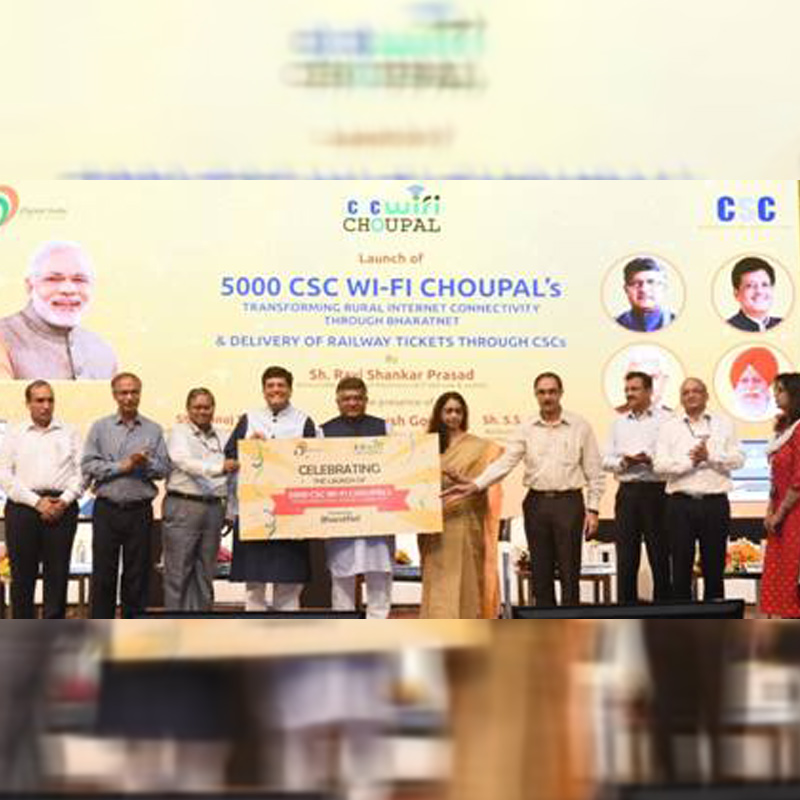
    NEW DELHI: The Indian government on Monday said that 5,000 villages would be turned into digital villages where Internet services would be offered the Wi-Fi Choupal project, which would go a long in empowering people as also expose them to a host of e-governance and entertainment services.  

    “Delighted to launch 5000 Wi-Fi choupal services. People in these villages will be able to use high speed public WiFi at low cost, Minister of Electronics and Information Technology Ravi Shankar Prasad said in a tweet yesterday flagging off a host of digital initiatives being developed by the government using the ambitious Bharat Net optical fiber that promises to connect all villages in India.

    “We all know about the person who worked as coolie (porter) at a Railway Station in Kerala (and) who cleared state Public Service Commission exam by using Rail WiFi. I will be happy if such inspiring stories through use of @wifichoupal also come to our notice in future,” Prasad said another tweet.

    Department of Telecoms Secretary Aruna Sundararajan said the digitization of villages will not only create a common services centers, which can develop into a powerful content delivery network, but rural India will benefit from technology advancement and the BharatNet project. The infrastructure created under Wi-Fi choupal will be a “national asset” that will be accessible to various service providers. 

    Choupal can be described in English as a common meeting place for people in villages.

  • MIB & Prasar Bharati make up, sign agreement on funds’ release

    MIB & Prasar Bharati make up, sign agreement on funds’ release

    NEW DELHI: After lot of heartburning and media statements, the Ministry of Information and Broadcasting Ministry and Prasar Bharati, which runs Doordarshan and All India Radio (AIR), have inked an agreement that was required for the release of financial allocation to the pubcaster, PTI reported today quoting an unnamed source.

    The agreement or the memorandum of understanding (MoU) was signed between the broadcaster and the ministry in the last week of May, the source added.

    Autonomous bodies getting grants-in-aid from the government are required to sign a memorandum of understanding (MoU) with the ministry concerned for the release of the financial allocations made in the Union Budget by the federal government.

    Besides Prasar Bharati, MIB has also signed MoUs with the Indian Institute of Mass Communication (IIMC), Film and Television Institute of India (FTII) and Satyajit Ray Film and Television Institute in the last week of May, the source added.

    In April, the ministry released Rs 365 crore (Rs. 3,650 million) to Prasar Bharati after it signed the MoU following months of standoff between the two sides on various contentious issues during the time when Smriti Irani was the senior minister. Subsequently she was shifted out of the ministry.

    The ministry releases an amount of around Rs 200 crore (Rs. 2 billion) to Prasar Bharati every month and a major share of it goes to payment of salaries.

    The MIB had earlier released Rs 1,989 crore (Rs. 19.89 billion) to Prasar Bharati as grants-in-aid for payment of salaries to its employees.

    In early March, Prasar Bharati CEO S S Vempati, in response to media reports, had said that Rs 208 crore released by the public broadcaster towards payment of salaries to its staff on 28 February 2018 were from its own reserves.

    Reacting to the news report, the ministry had issued a statement saying that the Prasar Bharati had not signed an MoU as required by autonomous bodies for getting grants-in-aid.

    Also Read:

    MIB calls for ‘fiscal prudence’ in Prasar Bharati

    Prasar Bharati’s policy on DD Free Dish to be out soon

    Prasar Bharati’s main role is of pubcaster, not revenue generator, says Rathore

  • TRAI stands up to DoT on use of foreign satellites for comms services on aircrafts

    TRAI stands up to DoT on use of foreign satellites for comms services on aircrafts

    NEW DELHI: India’s telecoms and broadcast regulator Telecom Regulatory Authority of India today stood up again for the lawful right of satellite industry stakeholders. It reiterated that the nation’s policies and guidelines for on- board aircraft communications services like broadband should also allow use of foreign satellites despite Department of Telecoms raising objections on the matter.

    “If we do not allow the foreign aircrafts to provide the MCA (mobile on-board aircraft) services using their satellite and gateways over the Indian airspace, other countries will also not allow the Indian aircrafts to provide

    MCA services while over-flying their jurisdictions,” TRAI justified its stance to DoT as part of clarifications sought by the latter on the regulator’s recommendations on in-flight connectivity services.

    TRAI pointed that though a government panel may have suggested use of Department of Space-approved satellites only with Indian gateways, the in-flight connectivity or IFC services are technically complex withservice providers handling the logistics do so in partnership with foreign mobile service providers having created on-ground facilities for provisioning of MCA.

    “Even if it is assumed that such a facility is created on Indian soil, aircrafts will need to be fitted with pico cell/equipment, which are compatible with one of the Indian TSP (telecom service provider)’s core network. There are several countries where IFC services are already operational and, accordingly, their aircrafts are equipped with pico cell which is connected to the core network of partnering foreign mobile service provider. These airlines certainly won’t be willing to carry out any modification due to the downtime and costs involved. Therefore, for such aircrafts, MCA over the Indian airspace seems feasible only with the existing arrangements in which partnering mobile service provider would be a foreign entity. It may require the use of foreign satellites and gateway, and traffic from aircraft may not be routed through gateway in Indian soil,” TRAI explained, adding that its recommendations have enough in-built safeguards to take care of concerns on India’s security.

    If that was not enough, TRAI, at present helmed by chairman RS Sharma who’s due to superannuate in a few months’ time, categorically said in its response to DoT clarifications that the government panel’s decision to use only satellites approved by DoS with Indian gateways for MCA service was “not implementable”.

    “If the use of foreign satellites and gateways are not permitted for MCA services, it would make the recommendation infructuous”, the regulator emphasized, though admitting that it’s role is recommendatory and the final decision would have to be taken by the government. “With this perspective, the Authority recommended that `use of foreign satellites and gateway would be permitted for the establishment of satellite backhaul links only for the provisioning of MCA services’,” TRAI added.

    On several other objections raised by DoT on suggestions on providing communications services on aircrafts within India airspace, TRAI has stood its ground, reiterating that such bans on foreign satellites and non-Indian gateways could be against international laws and may make the service unviable.

    The full text of TRAI reply to DoT can be found at http://www.trai.gov.in/sites/default/files/RecommendationIFC05062018_0.pdf.

    Also Read:

    TRAI clears path for broadband, voice services aboard planes

  • MIB social media monitoring cell tender deadline extended

    MIB social media monitoring cell tender deadline extended

    NEW DELHI: The Big Brother has arrived? Well the Indian government, being accused of proposing to unleash a surveillance of citizens, has gone in for another extension of the deadline seeking vendors for technical and logistics help to set up such a center.

    The new date for submitting proposals for Ministry of Information and Broadcasting (MIB)’s Social Media Communications Hub is now 18 June 2018, which is the third revision of the deadline since tender was floated earlier this year inviting proposals, enumerating wide-ranging deliverables.

    Under criticism from a section of the civil society and online journalists and activists for this proposed over Rs. 400 million surveillance project, both MIB and BECIL (a unit under the ministry) have maintained a stoic silence.

    The project, first reported by Indiantelevision.com in January 2018 and being undertaken under a seemingly harmless name of Social Media Communications Hub, however, has aims to monitor in real times not only the social media and online activities of Indian citizens, but also seeks to deploy technology to predict behavior and possible future actions of people. This, at a time when India doesn’t have strong data protection laws.

    Amongst the many listed objectives of the media hub is this: “What would be the headlines and breaking news of various channels and newspapers across the globe— could be done with knowledge about their leanings, business deals, investors, their country policies, sentiment of their population, past trends etc. NYT, Economist, Time etc. are good examples, what would be the global public perception due to such headlines and breaking news, how could the public perception be moulded in positive manner for the country, how could nationalistic feelings be inculcated in the masses, how can the perception management of India be improved at the world for a how could the media blitzkrieg of India’s adversaries be predicted and replied/neutralized, how could the social media and internet news/discussions be given a positive slant for India.”

    One of the many critics of this project is the Internet Freedom Foundation (IFF), which has sent a notice to the MIB to stop the project, failing which the organization would take legal action. Its concerns? “Social Media Communication Hub will also have the ability to broadcast content without any legal authority or guidance through 20 central and 716 district level social media executives. In sum, this is a system of control through surveillance and a capacity to spread propaganda,” the Foundation said in an online campaign.

    The Foundation’s letter to MIB minister Rajyavardhan Rathore, sent last week, criticizes the government move on the ground that“the wider project to surveil social media is illegal and unconstitutional, being contrary to the right to privacy and freedom of speech and expression”.

    Urging the ministry to withdraw the requests for proposal invited by BECIL, the IFF said, “The RFP document clearly indicates that the proposed Social Media Communication Hub seeks to create a technology architecture that merges mass surveillance with a capacity for disinformation. It is a perilous expense on the exchequer, given that an exorbitant amount of [Rs] 42.4833 crores (approximately Rs. 42 million) is being earmarked for a project that will undermine our fundamental rights.”

    Meanwhile, MIB is also seized of the fate of a committee set up by former minister Smriti Irani to propose regulations for online media. Though Rathore in recent times has spoken of self-regulation of media, in general, he hasn’t yet articulated the government view on the committee, which critics say was beyond the remit of the MIB.

    Indiantelevision.com learns from government sources that the online regulation committee has already held few informal meetings, though non-governmental organisations, seeking to be part of it, were not invited.

    While some media industry organisations were named by the government to be part of this online regulation committee, many others like the internet and mobile association of India, Broadband Forum India and Asian media body CASBAA have, reportedly, sent in formal requests to be made part of this government committee, which, interestingly, doesn’t include a single online venture or body.

    Also Read :

     MIB to collect data on satellite capacity needs, digital chatter

  • MIB’s new secy Amit Khare joins office

    MIB’s new secy Amit Khare joins office

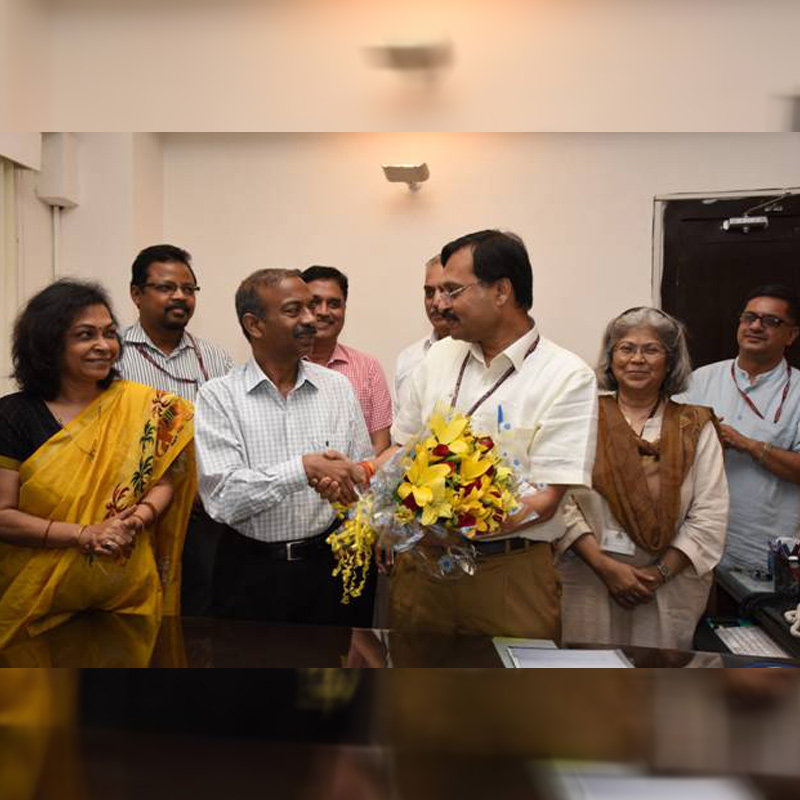
    NEW DELHI: In what could be termed as challenging times, Amit Khare (third from left in the pix) yesterday assumed charge as secretary in the Ministry of Information & Broadcasting on superannuation of Narendra Kumar Sinha.

    Khare is a 1985 batch Indian Administrative Service officer and was posted at a senior level in the state of Jharkhand before he was nominated to take over from Sinha at MIB. Considered an upright civil servant, he is credited for unearthing the multi-million-dollar fodder scam two decades ago in Bihar for which some powerful politicians, including former Bihar chief minister Lallu Yadav, and senior officials have been handed jail sentences of varied time period.

    Some of the issues that would need Khare’s immediate attention, as also his boss MIB minister Rajyavardhan Rathore, include putting in motion the process of quick decision-making at this important ministry, which is responsible for policy-making and their implementation for multi-billion dollar sectors of television, radio, films and advertising.

    With the media and entertainment industry undergoing changes with the arrival of newer technologies, like online distribution of content of all types, MIB needs to keep pace without upsetting the ecosystem that has been reeling under the impact of a sluggish economy and after effects of several other financial policies taken over the last 24 months by the government.

    To give some momentum, Khare would need to hit the road running working along with sector regulator TRAI that has made several recommendations relating to policies, which are yet to be acted upon by MIB, apart from working with the regulator on guidelines that could be in the offing, including uplink and downlink guidelines, DTH licencing norms, online content regulation, removal of bottlenecks in the film sector on opening up more screens and cajoling sister government organisations like Department of Space to have a more liberal approach. Not to mention soothe ruffled feathers at pubcaster Prasar Bharati.

    Media reports have indicated that in the last nine months, inaction had come to such a head at MIB that inter-departmental power games stalled a decision on over 100 applications for new TV channels. It was only about 10 days back that some channel permissions were processed and conveyed to stakeholders.

    During a career span of more than 33 years, Khare has held various field postings and worked at both the state and federal levels.

  • Star files caveat in Supreme Court on TRAI tariff order

    Star files caveat in Supreme Court on TRAI tariff order

    MUMBAI: So the slugfest on the pricing of digital television in India is entering the next round. And, it is Star India now that has approached the Supreme Court and filed a caveat with it on the Telecom Regulatory Authority of India’s (TRAI) tariff regulations and more specifically on the 15 per cent discount issue.

    According to sources, TRAI too had filed earlier a caveat at the apex court. A caveat is a notice given by a person or an organisation, informing the court that another person/company may file a suit or application against him/them and that the court must give the caveator – person/company filing the caveat – a fair hearing before deciding any matter brought before it in the relevant case.

    Last week, the third judge of the Madras High Court had upheld the regulator TRAI’s order on channel tariffs and dismissed the petitioners’ (Star India and Vijay TV) plea that pricing of content is not under the jurisdiction of the TRAI.

    Even as the high court upheld all the proposed regulations, it disallowed one that puts a cap of 15 per cent on the discount that can be offered by broadcasters or TV channels to distributors on the maximum retail price.

    Another observation of the high court relating to broadcast re-transmission rights or BRR too hasn’t gone down too well with the petitioners and that could be an issue too behind an appeal at the Supreme Court. Though, it is still not clear whether the petitioners or respondent would appeal the Chennai court order.

    Meanwhile a similar case is pending against the TRAI in the Delhi High Court. It involves Bharti Airtel Telemedia, Tata Sky and Discovery Communication India, which had filed petitions against the tariff order in 2017. The TRAI had then informed the court that the issues raised in the petitions were the subject matter of two writ petitions already filed in the Madras High Court and requested that it may await the outcome of those proceedings.

    The Delhi high court had accepted the request but had directed TRAI that it should inform it and the petitioners about the judgment before effectuating the orders. Additionally, earlier the Supreme Court too had ordered the maintenance of status quo as far as the pricing regulations were concerned.  

    The Madras HC has suspended its decision for two weeks to give time to parties involved to appeal to a higher court or seek further clarifications from it.

    Also Read:

    Madras HC gives split verdict in Star India versus TRAI case

    SC could take up TRAI-Star case on tariff regulations

    TRAI-Star case back to Madras HC with SC rider