Category: Regulators

  • Tata Sky vs TRAI: Delhi High Court adjourns matter to 28 January

    Tata Sky vs TRAI: Delhi High Court adjourns matter to 28 January

    MUMBAI: The next instalment of DTH major Tata Sky’s ongoing legal tussle with the TRAI and its new tariff regime, in which Bharti Telemedia-owned Airtel Digital TV and Sun Direct are a part, will play out on 28 January. The Delhi High Court, on Wednesday, adjourned the matter as the judge was on leave.

    On 15 January, the matter was argued partly by senior lawyer Kapil Sibal on behalf of the direct-to-home operator on Tuesday who focussed on two points of 15 per cent discount cover (or the lack of it) and micromanagement attempt by TRAI of how business should be conducted.

    The hearing in the case started at around 2:45 pm and continued till almost 90 minutes during which Sibal argued that with the Madras HC setting aside the 15 per cent discount cap, the main aim of the tariff order had been frustrated and that attempt to micromanage a business, especially moves relating to pricing, etc., some of the provisions of the regulation were not in the interest of the DTH operator, which follows a different cost model compared to MSOs.

    The TRAI counsel’s interjection, according to industry sources, was minimal except seeking some technical clarifications relating to issues being argued by the Tata Sky lawyer and the actual content of the writ petition.

    Though this essentially means the regulator is unlikely to take any coercive action against the DTH operator and Discovery (that has already published new rates in compliance with the TRAI tariff order) until the next hearing, during the 10 January 2019 hearing of the case the court had verbally observed that Tata Sky could remain non-compliant at its own peril.

    At the earlier hearing, Sibal had impressed upon the judges to ask TRAI to produce all documents on how it arrived at the decision to implement the new tariff regime. He had also stated that implementing the present order will have an adverse impact on business.

    The TRAI lawyer had countered saying while Tata Sky felt aggrieved, a big DTH operator like Dish TV and all other MSOs seemed satisfied and had complied with the new tariff framework.

    The court had then asked the regulator to file the documents and the data that was the basis for arriving at the new tariff regime.

    Tata Sky is unlikely to upload its RIO for now, unlike Discovery, which has already published the same on its website, under protest.

    In 2017, Bharti Telemedia, Tata Sky and Discovery Communication India had filed petitions against TRAI, challenging its tariff order and the interconnect regulations.

    Unlike the position adopted by Star India wherein it questioned the regulatory powers of TRAI, the matter in the Delhi HC questions the regulator’s power to wipe out deals that operators enter into to fix commissions and rates for customers.

    While the Delhi HC case outcome could have implications on Tata Sky, Sun Direct, other distribution platform operators (DPOs) continue to be bound by the tariff order and most of them have complied to.

  • MIB gives licences to 5 new channels

    MIB gives licences to 5 new channels

    MUMBAI: The Ministry of Information and Broadcasting (MIB) gave licenses to five new channels up until 31 December 2018. The channels are P Plus, PTunes, Living Travelz, Star Movies Kids and Star Movies Kids HD.

    Graphisads Private Ltd got the permission for uplinking and downlinking P Plus and PTunes (non-news) on GSAT-17 satellite in Hindi, English and all Indian scheduled languages on 27 December 2018.

    Essel Group-owned Living Entertainment Enterprises (LEEPL) got the permission for uplinking and downlinking Living Travelz (non-news) on Intelsat-20 in Hindi and English language on 9 December 2018. Going by the name, Living Travelz, mostly will be a lifestyle channel which will compete against FYI TV18, TLC, Fox Life. The teleport operator of the channel will be Dish TV India.

    Surprisingly, Star India is planning to target the kids' audience and got the permission for Star Movies Kids and its HD version on Asiasat-7 satellite. The competitors for the broadcaster in the kids industry are Nick, CN, Pogo, Hungama, Disney and Discovery Kids.  

    The number of private satellite TV channels having valid permission in India stands at 883 as on 31 December 2018. 497 channels are non-news channels and the remaining 386 are news channels.

    Of the 883 permitted private satellite channels, TV channels permitted for uplinking from India and also to downlink into India are 785. Nine non-news channels and five news channels are permitted for uplinking from India but not downlink into the country. 84 TV channels are uplinked from abroad which only have downlinking permission in India. This category includes 15 news and 69 non-news channels.

  • TRAI asks Tata Sky to submit status report on tariff order implementation

    TRAI asks Tata Sky to submit status report on tariff order implementation

    MUMBAI: Telecom Regulatory Authority of India (TRAI) has asked direct-to-home operator Tata Sky to file a comprehensive status report on the implementation of its new tariff regime. The regulator's direction came after it received complaints from several Tata Sky consumers.

    The new regulatory framework puts the power in hands of consumers to pay for channels they want to watch.

    According to a PTI report, TRAI also said Tata Sky is misleading its subscribers by suggesting that the regulator has extended the date of implementation of the new regulatory framework.

    The regulatory body in its letter to Tata Sky has described this act of the DTH operator as “patently false and misleading ".

    TRAI has further stated that it has given consumers time until 31 January to choose television channels, thereby enabling a smooth migration to the new regulatory framework.

    According to TRAI, it has received complaints from its subscribers suggesting that Tata Sky has "not made any provision in their system to obtain the choice of subscribers as per the new regulatory framework."

    It is important to mention here that a petition filed by Tata Sky against the new tariff order is pending before the Delhi High Court.

    Tata Sky’s ongoing court battle with the TRAI and its new tariff regime, in which Bharti Telemedia-owned Airtel Digital TV and Sun Direct are a part, was adjourned by the Delhi High Court on Thursday to January 23 with arguments being inconclusive.

    The matter was argued partly by senior lawyer Kapil Sibal on behalf of the direct-to-home operator on Tuesday who focussed on two points of 15 per cent discount cover (or the lack of it) and micromanagement attempt by TRAI of how business should be conducted.

    The hearing in the case started at around 2:45 pm and continued till almost 90 minutes during which Sibal argued that with the Madras HC setting aside the 15 per cent discount cap, the main aim of the tariff order had been frustrated and that attempt to micromanage a business, especially moves relating to pricing, etc., some of the provisions of the regulation were not in the interest of the DTH operator, which follows a different cost model compared to MSOs.

    The TRAI counsel’s interjection, according to industry sources, was minimal except seeking some technical clarifications relating to issues being argued by the Tata Sky lawyer and the actual content of the writ petition.

  • Broadcasters to TRAI: No further regulation of OTT communication services

    Broadcasters to TRAI: No further regulation of OTT communication services

    MUMBAI: Major broadcasters including Star India, Sony Pictures Networks India (SPN) and Times Network are clear they do not favour any further regulatory intervention on over-the-top (OTT) communication services. All three players have argued that OTTs should not be seen as a substitute for TSPs. While submitting their feedback comments on the TRAI consultation paper, the broadcasters have highlighted that although some of the services provided by OTTs may seem similar to TSPs, they have highly dissimilar nature especially when it comes to technology and revenue model. The major focus area of the TRAI paper is the issue regarding the relationship between OTTs and TSPs.

    Star India point of view

    Apart from suggesting TRAI to not regulate OTT communication services, Star India has also highlighted that OTTs are licensed under Section 4 of the Indian Telegraph Act, 1885 and hence the regulator does not have the authority to regulate them.

    The broadcaster feels that TRAI’s concerns around “Privacy, Security and Interception” are valid but the provisions under Information Technology Act, 2000 are already in place to address those. Moreover, the Justice BN Srikrishna committee is also working towards reinforcing the provisions under Draft Personal Data Protection Bill, 2018.

    “The consultation paper assumes certain applications of OTTs (‘OTT Communication Services’) as substitutes to TSP services. This assumption appears unfounded and there is no discernible rationale in keeping with any existing legal criteria or technical parameters, such as those outlined in basic competition law on substitutability, for TRAI to have concluded so in the consultation paper,” the broadcaster points out with respect to “Substitutability” as the basis for regulating OTT ecosystem.

    SPN’s take on the issue

    SPN has strongly advocated for the forbearance of OTTs as it will ensure the growth of the sector. According to the broadcaster, any additional regulation could have an adverse impact on the growth of internet applications and platforms.

    SPN has pointed out that the consultation paper mentions OTT players do not have licensing and regulatory obligations while TSPs incur license fees and have to meet regulatory obligations. The broadcaster, in its submission, has argued that the operation of OTT platforms is not dependent on TSPs but on the internet. In addition to that, the services being provided by the OTT platforms are free of cost, although consumers do bear the cost of data charges/internet which are accrued by TSPs and the revenues are not passed on to the streamers.

    “We believe that no regulatory intervention is required since it could stifle innovation and straitjacket technological innovation and the development of this sunrise sector. A policy of forbearance on regulation [as has been the case so far] should be continued in order to avoid hampering growth in the sector,” SPN said in the submission.

    At the same time, the broadcaster has also added that telcos should be given opportunities to avail fair market pricing as well as sufficient policy-backed impetus to enable them to invest in infrastructure and upgradation of technology.

    Times Network bats for forbearance

    On a similar note, the Times Network has also highlighted the differences between OTTs and TSPs. While voice calling and text messaging are the primary services of TSPs, the same are secondary services for OTTs. Moreover, there is an inherent difference in the technology used by OTTs and TSPs for calls and messaging. Hence, Times Network thinks the services cannot be classed as “similar services” from a licensing perspective.

    “Further, TSPs as ISPs are access providers who control the underlying broadband access infrastructure, with few market players due to high barriers to market entry. By contrast, OTTs do not control the underlying broadband access point, have significantly lower barriers to market entry and are faced with many competing services, unlike TSPs. Consumers can add or stop using OTTs at will whereas switching between TSPs involves incurring the cost for the consumer and generally involves a longer relationship,” the broadcaster added in the submission.

    Due to the palpable differences between TSPs and OTTs, Times Network believes OTT platforms should not be regulated on the lines of TSP. The broadcaster is also of the view that inter-operability of the OTT services with the services provided by the TSPs may promote competition and benefit the end users.

    “We also recommend non-introduction/ non-imposition of any unwarranted regulations which may impede the growth of this buzzing as well as budding industry which has given a huge push to the start-up entrepreneurial spirit in the country. Also, interoperability of OTT apps with traditional network-based services may lead to a loss of innovative features and functions available on OTT services,” the submission also read.

    As per Times Network’s outlook, any licensing norm for OTT would affect consumer welfare, individuals, companies and entire industries. It could also create entry barriers in the industry, especially for startups.

    ZEEL also against the regulatory framework

    ZEEL submitted its response to TRAI on behalf of its digital arm ZEE5. The growing online video player has also advocated complete forbearance on any kind of regulatory framework by the authority. It has also been added that OTT service providers are intrinsically distinct from network providers like TSPs and ISPs. Like other players, ZEE5 also thinks substitutability should not be treated as the primary criterion for comparison of regulatory or licensing norms applicable to TSPs and OTT service providers. It has also added that there is no issue of a non-level playing field between OTT service providers and TSPs providing same or similar services as both OTT providers and TSPs complement each other.

    “The future of digital product offerings and growth of OTT services will depend on a robust environment which does not stifle technology-based innovation and provide a competitive market environment. Low entry barriers for new entrants, minimal regulatory barriers and technological advancement will be the cornerstone of such growth of the sector for investments, innovation, and consumer interest. Therefore, we urge the Authority that a policy of forbearance is best suited,” ZEE5 stated.

    Most of the above-mentioned players agree that OTTs have helped in the growth of TSPs. As all the OTTs require high-speed internet, data usage increases among users which in turn help TSPs’ revenue. The decline in voice calls and messaging is being complemented by high data use helping telcos to recover the loss.
  • MIB may nod in favour of self-regulation code for online video streamers

    MIB may nod in favour of self-regulation code for online video streamers

    MUMBAI: An upswing in online streaming platforms in India has drawn attention of authority as well as stakeholders on regulation. As per industry sources, most of the major players have agreed to a code of self-regulation that may receive an endorsement from the Ministry of Information and Broadcasting (MIB).

    While Netflix, Star India’s Hotstar, Reliance Jio, Zee5, AltBalaji, SonyLiv and Times Internet Limited-owned MX Player are ready to follow the codes, giant international players Amazon Prime Video, Google and Facebook are not in agreement. According to sources, there are some differences over details of grievance redressal mechanisms among the players who are ready to accept the code.

    Indiantelevision.com has learnt of the existence of a document called “Code of best practices for curated online video platforms” which depicts the principles, objectives as well as the codes of the self-regulation.

    The key objectives of the code is to empower consumers to make informed choices and protect the interests of consumers. It also looks at the creative freedom of content creators and artists. Providing mechanism for grievance redressal in relation to content made available by the platforms has also been highlighted under the objectives.

    As per the said draft, the code properly defines prohibited content and age-inappropriate or sensitive content. Any content showing disrespect to the national emblem or national flag, child engaged in sexual activities, outrages religious sentiments, promotes terrorism will be prohibited.

    “The signatories to this code seek to protect the consumers’ ability to choose the content that is appropriate for themselves and their families. The objective is to use information and technological tools to equip consumers with requisite knowledge and awareness, to enable informed decisions on the consumption of content,” the draft is said to mention.

    Discussions on grievance redressal mechanism have also acquired an important place in the document. There is suggestion to internally institute as part of their operational systems an independent Standards and Practices (S&P) department to receive, objectively address any online consumer related concerns and complaints in relation to content made available.

    There are also suggestions that the signatories of the code shall establish a grievance redressal body – the Content Committee, which shall address grievances from users on violations of the code. The detailed process, functioning and powers of the Content Committee will be institutionalised in due course. However, ZEE5 and Netflix have not agreed to complaint redressal codes yet.

    Although the voluntary censorship code is aimed at maintaining creative freedom, the rules under the code highly reflect the model of TV content censorship. According to earlier reports, The Internet and Mobile Association of India (IAMAI) has supposedly drafted the code.

  • Tata Sky vs. TRAI: Case, argued partly by DTH operator, adjourned to 23 January

    Tata Sky vs. TRAI: Case, argued partly by DTH operator, adjourned to 23 January

    MUMBAI: DTH operator Tata Sky’s ongoing court battle with the TRAI and its new tariff regime, in which Bharti Telemedia-owned Airtel Digital TV and Sun Direct are a part, has been adjourned by the Delhi High Court to January 23 with arguments being inconclusive.

    The matter was argued partly by senior lawyer Kapil Sibal on behalf of the direct-to-home operator on Tuesday who focussed on two points of 15 per cent discount cover (or the lack of it) and micromanagement attempt by TRAI of how business should be conducted.

    The hearing in the case started at around 2:45 pm and continued till almost 90 minutes during which Sibal argued that with the Madras HC setting aside the 15 per cent discount cap, the main aim of the tariff order had been frustrated and that attempt to micromanage a business, especially moves relating to pricing, etc., some of the provisions of the regulation were not in the interest of the DTH operator, which follows a different cost model compared to MSOs.

    The TRAI counsel’s interjection, according to industry sources, was minimal except seeking some technical clarifications relating to issues being argued by the Tata Sky lawyer and the actual content of the writ petition.

    Though this essentially means the regulator is unlikely to take any coercive action against the DTH operator and Discovery (that has already published new rates in compliance with the TRAI tariff order) until the next hearing, during the 10 January 2019 hearing of the case the court had verbally observed that Tata Sky could remain non-compliant at its own peril.

    At the earlier hearing Sibal had impressed upon the judges to ask TRAI to produce all documents on how it arrived at the decision to implement the new tariff regime. He had also stated that implementing the present order will have an adverse impact on business.

    The TRAI lawyer had countered saying while Tata Sky felt aggrieved, a big DTH operator like Dish TV and all other MSOs seemed satisfied and had complied with the new tariff framework.

    The court had then asked the regulator to file the documents and the data that was the basis for arriving at the new tariff regime.

    Tata Sky is unlikely to upload its RIO for now, unlike Discovery, which has already published the same on its website, under protest.

    In 2017, Bharti Telemedia, Tata Sky and Discovery Communication India had filed petitions against TRAI, challenging its tariff order and the interconnect regulations.

    Unlike the position adopted by Star India wherein it questioned the regulatory powers of TRAI, the matter in the Delhi HC questions the regulator’s power to wipe out deals that operators enter into to fix commissions and rates for customers.

    While the Delhi HC case outcome could have implications on Tata Sky, Sun Direct, other distribution platform operators (DPOs) continue to be bound by the tariff order and most of them have complied too.

  • MIB restricts eligibility for temporary uplinking for non-news events

    MIB restricts eligibility for temporary uplinking for non-news events

    MUMBAI: In a fresh notice, the Ministry of Information and Broadcasting (MIB) has laid out a new norm for temporary uplinking applications for live coverage of non-news and current affairs TV channels. Now, only those channels and teleport operators that are already permitted by the MIB will be eligible to apply for temporary permits. This notification comes into effect immediately.

    It reiterated that no other entity apart from permitted broadcasters and teleport owners will be given permissions for uplinking in the case of temporary live events.

    The Telecom Regulatory Authority of India (TRAI) had suggested its recommendations to ease norms for uplinking and downlinking of TV channels. The MIB later stated that these suggestions were under consideration but did not give any time frame for making them into regulations. These norms last came into effect in 2011.

  • Prasar Bharati to TRAI: OTTs streaming live TV should mandatorily carry all Doordarshan channels

    Prasar Bharati to TRAI: OTTs streaming live TV should mandatorily carry all Doordarshan channels

    MUMBAI: Public broadcaster Prasar Bharati has suggested to the Telecom Regulatory Authority of India (TRAI) that certain norms be made mandatory for OTT providers, in order to bring them on a level playing field with TV broadcasters and not just limit their comparison to telecom service providers (TSPs). OTT providers should abide by certain rules including one that OTT platforms streaming live TV should mandatorily carry all Doordarshan channels like DTH, MSOs or cable operators do.

    Under these regulations, Prasar Bharati is of the view that those OTT services should be included that provide audio/video content or broadcast services such as live, delayed or on-demand content. Such apps ‘should comply’ with basic regulatory and legal conditions which could be a subset of those that currently exist for TV broadcasters.

    Prasar Bharati made these suggestions as part of its comments to a recent TRAI consultation paper. While the consultation paper only looks at comparing OTTs to TSPs, Prasar Bharati feels that since several OTTs are providing content that is parallel to linear TV, it is only fair that when rules are made, it is taken into account that they not only substitute TSPs but even traditional broadcasters. After this, the type of service provider should also be made a criterion for creating regulatory and licensing norms.

    Prasar Bharati feels that currently, OTTs have a free reign but if OTT providers are relaying news content then they should register with the Ministry of Information and Broadcasting (MIB). The need for regulation, in this case, is especially high given the rising incidences of fake news and mischievous reporting. The regulations will also make OTT providers accountable and responsible especially if some content could be deemed to be ‘against national security’.

    It also brought into focus the system of audience measurement that has been established for linear TV and the same should also be applicable when these channels are shown live on OTT platforms.

    Prasar Bharati also sees the positive side of OTTs being helpful during calamities and natural disasters where it could prove as an important tool for broadcast. For this, it says that there needs to be synergy between various stakeholders.

    TRAI released a consultation paper on regulatory framework for OTT communication services in November. “The authority has chosen in this consultation to focus only on regulatory issues and economic concerns pertaining to such OTT services as can be regarded the same or similar to the services provided by TSPs,” TRAI said in the release. The paper mainly focused on issues regarding the relationship between OTTs and TSPs.

    The pubcaster has strongly advocated for basic regulatory and legal conditions to be applied to OTT providers offering broadcast services through internet.

  • SC upholds licence cancellation of Digi Cable Network, SCOD 18 Networking

    SC upholds licence cancellation of Digi Cable Network, SCOD 18 Networking

    MUMBAI: Cancellation of licences granted to two MSOs Digi Cable Network and SCOD 18 Networking has been upheld by the Supreme Court on security ground. Before moving to apex court the petitioners had approached the Bombay High Court where their pleas challenging the cancellation order by Ministry of Information & Broadcasting (MIB) were dismissed.

    Earlier, the licences issued to these cable TV service providers were cancelled by the MIB on the ground that the Ministry of Home Affairs denied issuance of "security clearance" to them.  The apex court bench comprising Justice Abhay Manohar Sapre and Justice Indu Malhotra security agreed that security clearance is a mandatory requirement as per Cable Television Network (Amendment) Rules.

    The Union of India filed the copy of the reasons in a sealed cover which was made basis to deny security clearance to the appellant. Referring to the document, the bench observed that the order of cancellation was passed in conformity with the requirements of Rule 11C.

    “It is clear from mere reading of the Rule 11C (1) that grant of permission is subject to issue of security clearance from the central government to the applicant… Since the grant of permission was subject to obtaining of the security clearance from the concerned ministry, the competent authority was justified in cancelling the conditional permission for want of security clearance," the court said.

    The appellant also argued that they were not afforded any opportunity of hearing before cancelling the permission. They added that the order was passed without following the principle of natural justice and fair play.

    “In a situation of national security, a party cannot insist for the strict observance of the principles of natural justice. In such cases, it is the duty of the court to read into and provide for statutory exclusion, if not expressly provided in the rules governing the field. Depending on the facts of the particular case, it will, however, be open to the court to satisfy itself whether there were justifiable facts, and in that regard, the court is entitled to call for the files and see whether it is a case where the interest of national security is involved. Once the State is of the stand that the issue involves national security, the court shall not disclose the reasons to the affected party,” the judgement read.

    The bench also observed that the principles of natural justice were not violated in this case. The appeal has been dismissed finally as it was found to be devoid of any merit. 

  • Delhi HC orders Zee Hindustan to stop using Rajat Sharma’s name in ads

    Delhi HC orders Zee Hindustan to stop using Rajat Sharma’s name in ads

    MUMBAI: Delhi HC has restrained Zee Hindustan from using the name of India TV editor-in-chief Rajat Sharma in any of its advertisements, stating that its latest ad campaign is prima facie illegal. It has directed the channel to remove any hoardings or ads that use Rajat’s name.

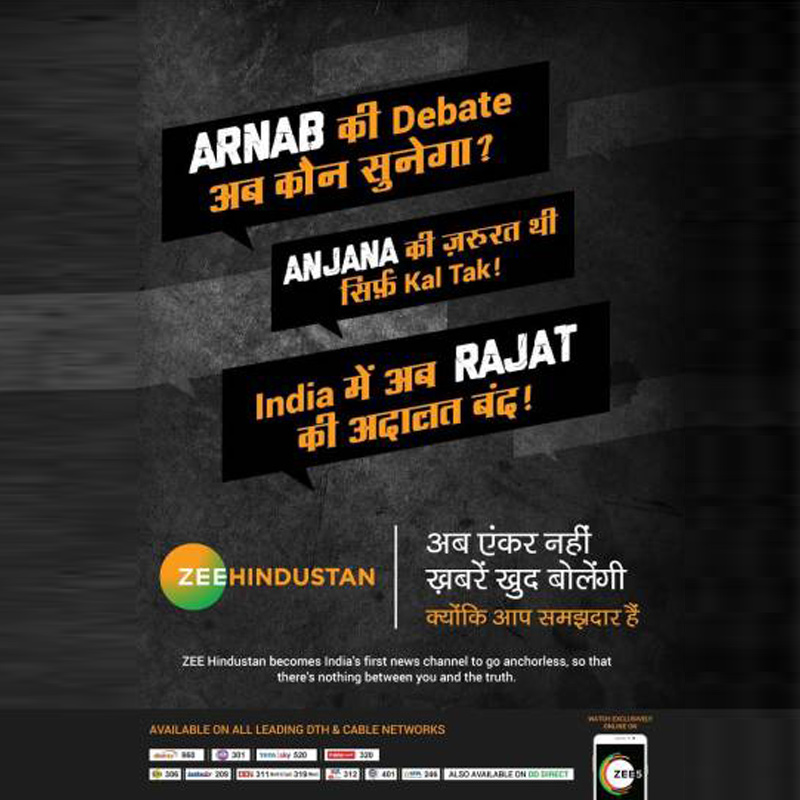
    Zee Hindustan, to promote its anchorless news channel, had started an advertisement campaign that made reference to some of the popular news anchors including Sharma and Republic’s Arnab Goswami using slogans like “India mein ab Rajat ki Adalat band!” (Rajat’s Adalat is now shut in India!), and “Ab Anchor nahin khabarein khud bolengi, Kyunki aap samjhdaar hain” (Since you are intelligent, news would speak for itself, without any news anchor).

    Sharma and his channel India TV filed a suit for an injunction against Zee,  claiming that the advertisement is being used to deliberately and maliciously misrepresent and disparage the image of India TV and Rajat Sharma, who has been running the show Aap Ki Adalat on different channels since 1993.

    Justice Jayant Nath of Delhi High Court impugned the advertisement saying, “The Hon’ble Court while granting the injunction in favour of Sharma and India TV, refrained Zee from using Rajat Sharma’s name in their advertisements in the electronic and print media or in any other form. The Hon’ble Court has further directed Zee to take down all hoardings containing the impugned advertisements.”