Category: Regulators

  • MIB grants Viacom18 nine TV channel licenses; Star Gold 2 HD gets nod

    MIB grants Viacom18 nine TV channel licenses; Star Gold 2 HD gets nod

    MUMBAI: The Ministry of Information and Broadcasting (MIB) has issued eleven new TV licenses in the non-news category.

    While Viacom18 received nine of those, the other two licenses were bagged by Star India and Hare Krsna Content Broadcast.

    BDM, Connected, Eco-lution, Hawa Mahal, IMIX, My Tube, Pick-a-trick, Story City and Treble are the names of the Viacom18 channels, which in all likelihood are bound to be renamed when they are launched.

    From the Star India stable, Star Gold HD 2 was the beneficiary of the MIB license while Hare Krsna from Hare Krsna Content Broadcast too got the ministry’s nod.

    Earlier this month, the MIB had approved two Star India and two Sun TV Network name change applications.

    While Star India got the ministry approval to rename its licenses Star Movies Kids and Star Movies Kids HD to Star Sports 1 Bangla and Star Sports 1 Marathi, the Sun TV Network was allowed to rename Udaya News and Gemini News to Sun Marathi and Sun Bangla respectively. 

  • TRAI’s new tariff order has made ecosystem transparent: RS Sharma

    TRAI’s new tariff order has made ecosystem transparent: RS Sharma

    MUMBAI: The new tariff order has been rolled out aiming transparency in the cable and broadcasting sector of India. Telecom Regulatory Authority of India (TRAI) chairman RS Sharma reiterated that the new regulatory framework has brought transparency in the ecosystem along with non-discrimination and fair play. Sharma also asserted that it has reduced the bills of the average TV watcher.

    "The implementation of the new broadcast tariff regime is working out very well. The monthly bills of thousands of consumers have also been reduced. The consumer's bill is a function of how much he watches, if he or she watches hundreds of channels obviously the bills will go up. If someone watches 25 channels, the bill will come down to one-third," Sharma told as quoted by IANS.

    "The objective of the regulations is to essentially bring out a regime of transparency and allow the customers to choose channels which they want to watch, and then allow the market forces which were not in play earlier," he added.

    Earlier the market was only focused on distributors and broadcasters but consumers were not actively participating.

    He also added that the implementation of the new tariff regime has removed the difference between the small operator and a large operator, as they both get the channels at the same rate from the broadcasters. Moreover, he asserted that the basic objective of the new regime to create a buffet of channels where everyone is charged the same rather than reducing or increasing the bills.

    Sharma’s comment comes at a time when several reports, as well as surveys, have indicated that there has been a hike in the monthly bill under the new price regime. Due to the change in pricing, many experts predicted that consumers would shift to OTT platforms eventually. To decrease the churn rate, some of the DTH players have removed network capacity fee for long duration packs.

    Earlier, the regulatory body in February extended the deadline to pick new channels under the new regime till 31 March as well as gave a directive of Best Fit Plans. The subscribers that don’t opt for new channels would be moved to ‘Best Fit Plans’, which would be developed as per usage pattern, language and channel popularity, the sector regulator said in its statement.

  • TRAI hands DPOs, broadcasters 2 additional months to implement landing page directive

    TRAI hands DPOs, broadcasters 2 additional months to implement landing page directive

    MUMBAI: The Telecom Regulatory Authority of India (TRAI) has extended the deadline for implementation of landing page direction from 31 March to 31 May. As per a release from the authority, the move has been taken following a request from All India Digital Cable Federation (AIDCF).

    Back in last December, the regulatory body directed all broadcasters and distributors to restrain from placing any registered satellite television channel, whose TV rating is released by TV rating agency, on the landing LCN or landing channel or the boot-up screen.

    The reason behind this order, according to TRAI, was to protect the interest of service providers and consumers while ensuring “orderly growth of the sector”.

    TRAI received a representation from AIDCF requesting the authority to extend the implementation for a further period of two months. The latter made the request in view of the appeal against the direction pending TDSAT and its hearing and pronouncement of order may go beyond the 31 March deadline.

    AIDCF also pointed out that the matter being under judicial consideration, any action on the said direction will not only be prejudicial to their right and contentions but also against the principle of natural justice. As the regulatory body of the sector found merit in the request, the deadline has been pushed further.

    Landing channel or landing page or landing logical channel number (LCN) refers to the default LCN that is displayed whenever a STB is switched on. Any TV channel placed on this page is available to all STBs connected to the network of a distributor and is regarded as a prized real estate by DPOs.

    During a consultation process on the issue, many broadcasters had admitted that placing a TV channel on the landing page could influence the audience data or TV rating points (TRPs), while MSOs and other distributors had stated there were no such influence on ratings or if any, they were minimal.

  • Arguments in DTH operators’ petition against TRAI tariff order to resume on 4 April

    Arguments in DTH operators’ petition against TRAI tariff order to resume on 4 April

    MUMBAI: The Delhi High Court on Thursday adjourned the petition of Tata Sky Discovery India Communication, Airtel Digital TV and Sun Direct challenging Telecom Regulatory Authority of India (TRAI) and its new tariff regime to 4 April. According to sources close to the development, the next date of hearing was granted after the matter was partly argued by Discovery counsel Gopal Jain. The next hearing will commenced with arguements from the broadcaster's counsel.

    It must be noted that the extended deadline for consumer migration under the new regime will expire on 31 March.

    While the TRAI has repeatedly said most consumers have moved to the new regulatory framework, with a reduction in cable bills, several reports have claimed otherwise.

    Earlier, the regulatory body in February extended the deadline to pick new channels under new regime till 31 March as well as gave a directive of Best Fit Plans. The subscribers that don’t opt for new channels would be moved to ‘Best Fit Plans’, which would be developed as per usage pattern, language and channel popularity, the sector regulator said in its statement.

    Chief Justice of Delhi High Court Rajendra Menon on 13 February questioned TRAI for altering the implementation process of its new tariff regime without informing the court. The chairperson of the sector regulator had also been directed to file an affidavit within a week explaining these changes.

    On 4 February, after senior lawyer Kapil Sibal, representing Tata Sky, concluded his arguments including legal submissions, Jain laid the foundation for his arguments.

    While the regulatory body has continuously declined that cable bills would go up under the new regime, several reports, as well as surveys, have indicated the hike in the monthly bill. Due to the change in pricing, many experts predicted that consumers would shift to OTT platforms eventually. To decrease the churn rate, some of the DTH players have removed network capacity fee for long duration packs.

    TRAI chairman RS Sharma claimed on Wednesday that almost all TV customers have been migrated to the new tariff regime. “Most of them have subscribed to the new regime or some of them have been put to a ‘best fit’ package. As the deadline of 31st March approaches, everybody will come onto the new platform,” he said as quoted by news agency IANS.

    In 2017, Bharti Telemedia, Tata Sky and Discovery Communication India had filed petitions against TRAI, challenging its tariff order and the interconnect regulations.

    Unlike the position adopted by Star India wherein it questioned the regulatory powers of TRAI, the matter in the Delhi HC questions the regulator’s power to wipe out deals that operators enter into to fix commissions and rates for customers.

  • TRAI chairman RS Sharma says STB portability possible by yearend

    TRAI chairman RS Sharma says STB portability possible by yearend

    MUMBAI: Telecom Regulatory Authority of India (TRAI) chairman RS Sharma has said that by the end of the year, set top box interoperability’s is likely to become functional.

    Speaking to news agency PTI, Sharma said, "Since last two years we have been trying to make STBs interoperable. Large part of problem has been resolved. There are some business challenges (which) remain… we are looking at this to happen by end of this year."

    He added that interoperability in a product should not come as an "after thought" but should be in place at the product planning stage itself. “Open systems are going to be the future. The entire back-end of Aadhaar has been developed on open source software except biometric de-duplication system," he said.

    Those who want to change their provider currently have to buy a new STB but soon they will only have to change the sim card, like mobile phones, for which the government is working on standard STB features.

    He released a study on open ecosystem for devices in India, prepared by the Indian Cellular and Electronics Association (ICEA) and consultant firm KPMG, which showed that 89 per cent of mobile phones in the country work on open source operating systems.

    Sharma further cited interoperability as one of the key factors behind the success of the Indian mobile phone industry where no subscriber is required to buy a new phone if he wants to change his service provider.

    The report found that Open OS mobile operating systems have expanded the smartphone market in India by reducing barriers to entry. The regulator has been working for quite some time, to introduce a similar system in the broadcasting sector. This will provider STB ownership to the consumer.

  • TRAI tariff order has reduced monthly TV bills: RS Sharma

    TRAI tariff order has reduced monthly TV bills: RS Sharma

    MUMBAI: TRAI chairman RS Sharma has said that the implementation of the new tariff scheme has reduced monthly TV bills. This is because people have the power to choose channels of their choice. 
    Speaking to news agency ANI, Sharma said that TRAI is collating data which will demonstrate that monthly bills do not increase. "On average, 90 per cent of people watch less than 50 channels. Even my monthly TV bill has come down from Rs 700 to Rs 236 per month."

    He also said that TRAI is getting complaints against some service providers for not activating select channels for viewers, or taking too much time in doing so."We show cause defaulting service providers once we get a complaint against them. Customers can register their complaints on our call centre as well," he said.

    Viewers will get to pay only for the channels they want to watch from 1 April, as TRAI’s new rules to curb the practice of bundling unwanted channels into bouquets come into effect.

    According to new pricing regime by TRAI, broadcasters, distributors and cable television operators must price each channel separately with the rate capped at Rs 19 each. The deadline was extended thrice to create awareness among subscribers.
     

  • MIB permits Sun TV, Star India to rename channels

    MIB permits Sun TV, Star India to rename channels

    MUMBAI: The Ministry of Information and Broadcasting (MIB) has approved a total of four applications from Star India and Sun TV to rename their channels.

    The newly renamed channels are Star Sports 1 Bangla, Star Sports 1 Marathi, Sun Marathi and Sun Bangla.

    In a bid to showcase animated movies to the viewers, Star India had earlier planned to launch Star Movies Kids SD and HD, which has now been renamed to Star Sports 1 Marathi.

    Star Sports 1 Bangla launched on 5 March with an MRP of Rs 19. Apart from this, the broadcaster had launched three more channels—Star Sports 3, Star Sports 1 Telugu and Star Sports 1 Kannada.

    Likewise, Sun TV got the nod from MIB to rename Udaya News and Gemini News to Sun Marathi and Sun Bangla respectively. Earlier, it was reported that Sun TV Network will be investing Rs 300 crore in the coming years to launch regional channels in Bengali and Marathi. While the Bengali channel was to go on air from February onwards, the Marathi channel will be up in a year's time.

    So far, Sun TV has been focused on the five South Indian states — Tamil Nadu, Karnataka, Kerala, Andhra Pradesh, and Telangana — and has 33 channels.

    Sun TV group CFO S L Narayanan said, "After the launch of the Bengali channel, the Marathi channel is expected to be launched in the next one year. Both of these channels are expected to achieve their break-even in two years of operations."

  • Delhi High Court orders release of all seized Tata Sky STBs

    Delhi High Court orders release of all seized Tata Sky STBs

    MUMBAI: The Delhi High Court directed the centre on Monday to release all the Tata Sky set-top boxes, barring five pieces, which were seized by the government for not displaying the maximum retail price.

    A bench of Chief Justice Rajendra Menon and Justice AJ Bhambani, in an interim order, directed the Ministry of Consumer Affairs to release the over six lakh STBs it had seized in January but allowed it to keep five of those for continuing with its probe.

    Issuing the direction, the bench said the government's decision was "prima facie arbitrary" and resulted not only in a financial loss to the direct broadcast satellite television provider, but also affected consumers who could not shift to the new STBs.

    "Here, the arbitrariness is writ large on the face of it," the bench added.

    It said the proceedings initiated by the government might go on in accordance with law and the company would participate in it.

    With the directions, the bench listed the matter for further hearing on 27 July.

    According to PTI reports the interim order came on Tata Sky's plea challenging the seizure of its STBs for not displaying the MRP.

    The company, in its petition, has also challenged the constitutional validity of a rule, which makes it mandatory to display the MRP on STBs.

    Besides seeking setting aside of the 17 January seizure report, Tata Sky has also requested that Rule 4 of the Legal Metrology Rules, which makes declaring the MRP on STBs mandatory, be quashed.

    It has also sought quashing of a 9 August 2018 circular by which the rule was made applicable to STBs.

    The company has contended that it is not required to declare the MRP on STBs as those fall under the definition of "industrial-consumer" according to the Legal Metrology (Packaged Commodities) Rules 2011.

    It has also said that since the STBs are not for sale, there is no need to indicate the MRP on those.

  • MIB secy Amit Khare says national broadcast policy in the works

    MIB secy Amit Khare says national broadcast policy in the works

    MUMBAI: MIB Secretary Amit Khare did some plain talking here while addressing industry and said bowing to needs of the stakeholders, a national broadcast policy is in the offing.

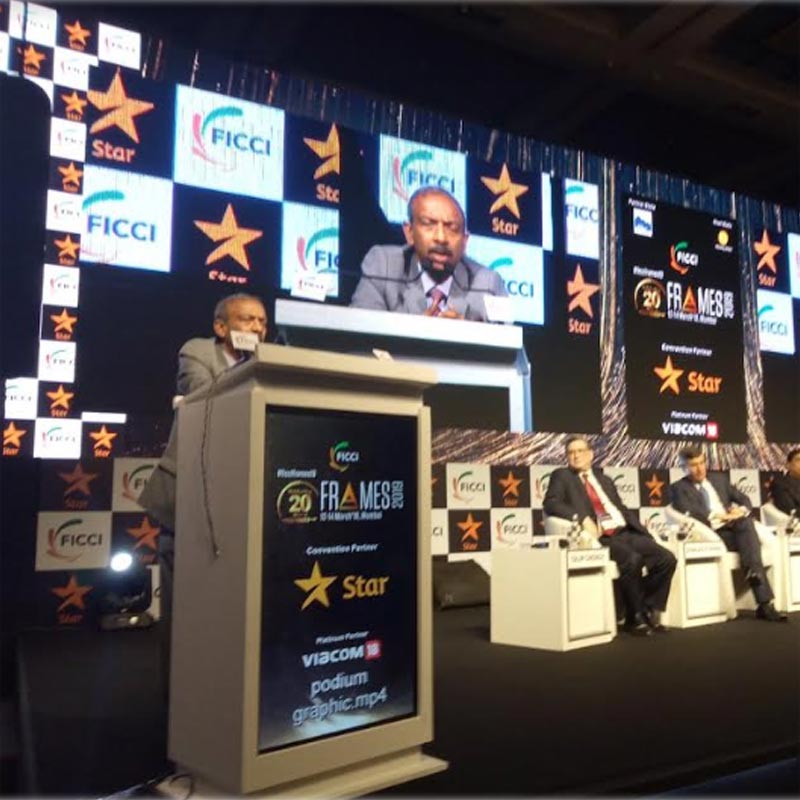
    “We have thought of having a national broadcast policy. The draft is being prepared and we are working with FICCI and other stakeholders so that Indians can have that national broadcast policy,” Khare said at a session on the opening day of the 20th edition of FICCI Frames.

    The government official did not reveal much details, but said the policy could be in place within a few years.

    He also spoke of a strategic paper that is being prepared for the film and entertainment industry which will focus on issues like what incentives should be given by the central or the state government and the type of regulatory changes which are required for improving the screen density.

    “The way we develop, particularly in India or in other Commonwealth countries, it was platform-wise. We have different regulations for print, for online, for films and for broadcasts. But now with the technological change and the convergence that has taken place, there is a need to rethink, there is a need to beat this challenge and also which is a great opportunity in terms of the content which is viewed by the customer,” he commented while talking about the importance of change in technology for the sector.

    The  secretary also spoke about the importance of the conversations that will take place during the FICCI Frames. According to him, it will be very helpful for the government to know the views of the private sector, the stakeholders and then taking a considerate view about regulations or the type of policies that the authority wishes to have for this sector in 2025 or 2030.

  • MIB grants 4 TV channel licences to ABP News Network

    MIB grants 4 TV channel licences to ABP News Network

    MUMBAI: The Ministry of Information and Broadcasting (MIB) has given ABP News Network four new TV channel licences in the month of February. The company has received uplinking and downlinking licences under the names ABP Andhra, ABP Ganga, ABP Kannada and ABP Tamil.

    One of the licences could be used to launch an Uttar Pradesh centric news channel that the company is planning to launch. The company also operates a Punjabi digital news channel ABP Sanjha, which was then launched as ABP Asmita in 2016. ABP News Network currently owns and operates four news channels ABP News (Hindi), ABP Majha (Marathi), ABP Ananda (Bengali) and ABP Asmita (Gujarati).

    Recently, the news broadcaster had converted its pay channels to free to air (FTA) under the Telecom Regulatory Authority of India’s (TRAI) new regulatory framework. ABP Ananda and ABP Majha went FTA from 8 February.

    In the month of January and February, MIB gave licenses to other six new channels. The channels were Skystar Bangla, Skystar Telugu, PTC Music, PTC Punjabi, PTC Simran and Zee Classic. All the six channels are under non-news category.

    G-Next Media got the permission for uplinking and downlinking PTC Music, PTC Punjabi and PTC Simran on Intelsat-20 satellite in Punjabi, Hindi, and English on 7 February 2019.

    Zee Entertainment Enterprises got the permission for uplinking and downlinking Zee Classic on Asiasat-7 in Punjabi, Hindi and all regional languages on 13 February 2019. Skystar Entertainment Pvt Ltd got the permission for uplinking and downlinking Skystar Bangla and Skystar Telugu on Intelsat-20 in Hindi, English, all India scheduled languages and world language on 15 January 2019.