Category: Regulators

  • TRAI extends deadline for feedback on review of interconnection framework

    TRAI extends deadline for feedback on review of interconnection framework

    MUMBAI: Telecom Regulatory Authority of India (TRAI) on Tuesday extended the last date for receipt of written feedback on its consultation paper titled "Review of the Regulatory framework for Interconnection".

    According to a notification from the regulator, the last date for receipt of written comments has been modified to 4 July and counter-comments, if any to 18 July.

    The regulator’s decision came after a request from some of the stakeholders. However, it has been decided that no request for any further extension of time will be entertained.

    TRAI had floated the consultation paper in May to asses means of removing entry barriers for new companies and reduce the operational cost of existing operators by handing them greater flexibility.

  • MIB permits Star India to rename Movies OK as Star Gold 2

    MIB permits Star India to rename Movies OK as Star Gold 2

    MUMBAI: The Ministry of Information and Broadcasting (MIB) has granted Star India permission to rename Movies OK as Star Gold 2.

    In March, Star India bagged the licence for its Star Gold 2 HD channel. Earlier, it had also got the approval to rename Star Movies Kids and Star Movies Kids HD to Star Sports 1 Bangla and Star Sports 1 Marathi.

    Also, in the month of May, MIB approved two applications from NGC Network India. NGC Network got the MIB nod to rename its licences NAT GEO MUSIC HD and NAT GEO PEOPLE HD to National Geographic Tamil and National Geographic Telugu.

  • MIB cancels licences of 4 STV Enterprise channels

    MIB cancels licences of 4 STV Enterprise channels

    MUMBAI: The Ministry of Information and Broadcasting (MIB) recently cancelled the licences of STV Enterprises’ four channels Punjab Today, STV Haryana News, STV Jammu-Kashmir News and STV UP News (STV-Rajasthan) that were mentioned under the news category.

    A while ago, it had also cancelled the licence of V6 ENT channel from VIL Media that was earlier called Nikit Investment Pvt Ltd and was mentioned under the news category.  

    During the month of January 2019, cancellation of licences to two MSOs Digi Cable Network and SCOD 18 Networking was upheld by the Supreme Court on security grounds. Before moving the apex court, the petitioners had approached the Bombay High Court where their pleas challenging the cancellation order by the MIB were dismissed.

    Earlier, the licences issued to these cable TV service providers were cancelled by the MIB on the ground that the Ministry of Home Affairs denied issuance of "security clearance" to them.  The apex court bench comprising Justice Abhay Manohar Sapre and Justice Indu Malhotra security agreed that security clearance is a mandatory requirement as per Cable Television Network (Amendment) Rules.

    Up until August 2018, MIB was strict in giving channel licences, even cancelling some. 14 channels, whose licences were cancelled by the MIB due to security denial by Ministry of Home Affairs (MHA), challenged the decision and had got a stay order from the High Court.

    Out of these fourteen channels, twelve channels were news channels and two were non-news channels. Mahua Media Private Ltd, Mavis Satcom Ltd, STV Enterprises Ltd and Alliance Broadcasting Private Ltd were the concerned parties.

  • TRAI may look at “finetuning” new tariff order

    TRAI may look at “finetuning” new tariff order

    MUMBAI: The Telecom Regulatory Authority of India (TRAI) may look at “finetuning” the new tariff order for cable and broadcasting sector to address any “aberrations”, as per a news report by Economic Times. However, the regulatory body won’t rush into this without adequate data backup.

    “When a new thing is put in place, you always notice that in some areas, things are not working out the way you had imagined, or in some areas some finetuning is required,” TRAI chairman RS Sharma told ET. Sharma also added that the new regime marked a “paradigm shift,” giving customers transparency and choice as well as providing a level playing field for operators.

    “Finetuning will require some data and we don’t want to get into that on the basis of anecdotes, ARPU (average revenue per user), number of litigations, etc. We’re looking at this carefully and collecting data and will finetune (the regulation) at the right time,” Sharma said. He said that the regulatory body is looking at if there are any aberrations in the implementation of the tariff order and they would rectify accordingly.

    However, it was not clear if the finetuning will also consider looking at ways to reduce monthly cable and DTH (direct-to-home) bills of consumers. The new tariff order reduced the cable bill for users who use fewer channels but it increased it for many. Even, some subscribers found the new regime complicated.

    He also clarified that subscribers will have the freedom to select separate channels on their second set-top box like they can do for their first box. He also noted that the industry agreed to give discounts for the second box.  While he acknowledged that adapting to the new regime is taking time with people learning along the way, he said consumers need to have complete control over choosing and paying for channels.

    “We’ve issued show-cause notices, etc. So, we’re very proactive to ensure that aberrations that take place are set right before they become the regular practice,” Sharma said while mentioning that in some places broadcasters are not doing it.

  • I&B Ministry advises TV channels to show caution with children in reality shows

    I&B Ministry advises TV channels to show caution with children in reality shows

    MUMBAI: The Ministry of Information and Broadcasting (MIB) has issued an advisory to TV channels that show dangerous stunts via reality shows. The MIB said it noticed that several dance-based reality TV shows portray young children performing dance moves originally done by adults in movies and other popular modes of entertainment. These moves are often suggestive and age-inappropriate. Such acts may also have distressing impact on children, impacting them at a young and impressionable age.

    All private satellite TV Channels are expected to abide by the provisions contained in Programme and Advertising Codes prescribed under the Cable Television Networks (Regulation) Act, 1995 and rules framed. As per the rules, no programme should be carried on TV which denigrates children, and further that programmes meant for children should not contain any bad language or explicit scenes of violence.

    The ministry has accordingly issued an advisory to all private satellite TV channels to avoid showing children in an indecent, suggestive and inappropriate manner in dance reality shows or other such programmes. The channels have been further advised to exercise maximum restraint, sensitivity and caution while showing such reality shows and programmes.

  • Russian delegation visits I&B ministry to discuss cooperation in the sphere of media

    Russian delegation visits I&B ministry to discuss cooperation in the sphere of media

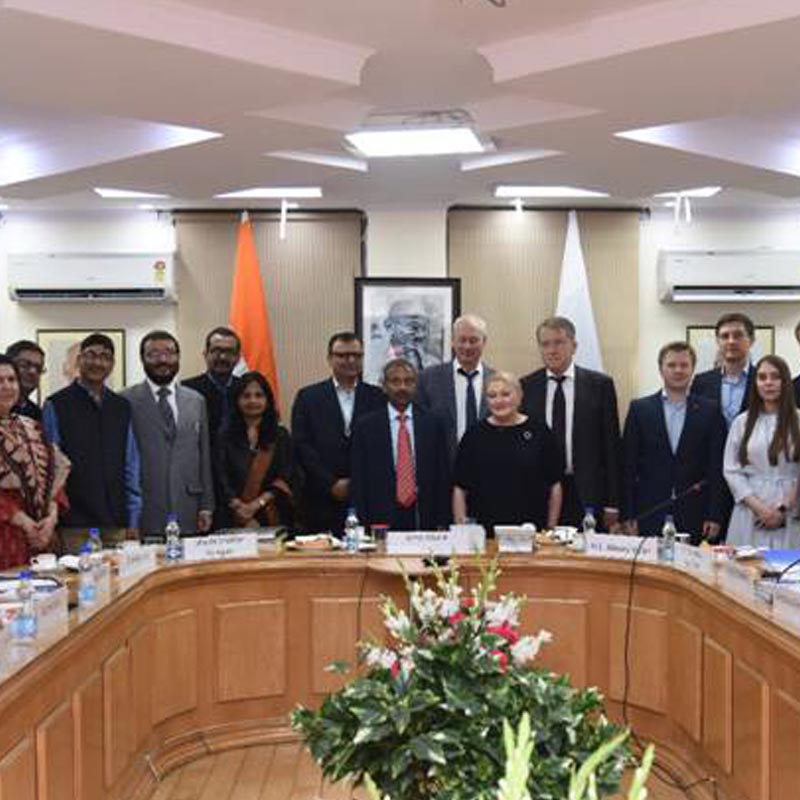
    MUMBAI: A Russian Delegation led by the Russian Deputy Minister of Digital Development, Communications and Mass Media, H.E Alexey Volin, including the Ambassador of Russian Federation to India, H.E. Nikolay Kudashev and other delegates met Ministry of I&B secretary Amit Khare on Friday.

    It was mutually agreed during the meeting that an Annual Indo-Russian Forum for Media Cooperation be organized alternately in India and Russia in order to institutionalize the process of cooperation between the two countries in the media and entertainment sector. Television, news agencies, digital distribution platforms, new media, news gathering, co-production of programmes, sharing of content and exchange of professionals were identified as possible areas of collaboration.

    The need to forge strong connections between the young journalists of the two countries was also highlighted in the meeting.

    During the discussion, Amit Khare stated that the Golden Jubilee edition of the International Film Festival of India scheduled to be held later this year offers an opportunity to countries to showcase their creativity and cinematic excellence on a global platform. He extended an invitation to the Russian Delegation to participate in the Festival.

    H.E. Alexey Volin talked about the immense popularity of Indian films in Russia and mentioned about a 24-hour channel dedicated solely to Indian films, currently operational in Russia.

    The meeting was also attended by Shashi Shekhar Vempati, CEO, Prasar Bharati; Sitanshu Kar, Principal DG, PIB; Vikram Sahay, Joint Secretary, Ministry of I&B; Supriya Sahu, DG, Doordarshan; F. Shehryar, DG, All India Radio; Mayank Agrawal, DG, DD News; Chaitanya Prasad, Addl. DG, Directorate of Film Festivals and JP Mattu Singh, Addl. DG, AIR News.

  • Tata Sky vs TRAI: Discovery concludes arguments, Delhi High Court lists matter for 11 April

    Tata Sky vs TRAI: Discovery concludes arguments, Delhi High Court lists matter for 11 April

    MUMBAI: The Delhi High Court has adjourned the petition of top DTH operators Tata Sky, Discovery India Communication, Airtel Digital TV and Sun Direct challenging Telecom Regulatory Authority of India (TRAI) and its new tariff regime to 11 April. According to a source close to the development, Discovery India concluded its arguments, which commenced on 4 February, on Thursday. The long-running court battle is likely to conclude by the end of this month, as TRAI and all interveners in support of the regulatory body will commence their arguments during the next hearing. The matter is being heard by Chief Justice Rajendra Menon and Justice V Kameswar Rao.

    Notably, the extended deadline for consumer migration under the new regime expired on 31 March. While the TRAI has repeatedly said most consumers have moved to the new regulatory framework, with a reduction in cable bills, several reports have claimed otherwise.

    Earlier, the regulatory body in February extended the deadline to pick new channels under new regime till 31 March as well as gave a directive of Best Fit Plans. The subscribers that don’t opt for new channels would be moved to ‘Best Fit Plans’, which would be developed as per usage pattern, language and channel popularity, the sector regulator said in its statement.

    Chief Justice of Delhi High Court Rajendra Menon on 13 February questioned TRAI for altering the implementation process of its new tariff regime without informing the court. The chairperson of the sector regulator had also been directed to file an affidavit within a week explaining these changes.

    While the regulatory body has continuously declined that cable bills would go up under the new regime, several reports, as well as surveys, have indicated the hike in the monthly bill. Due to the change in pricing, many experts predicted that consumers would shift to OTT platforms eventually. To decrease the churn rate, some of the DTH players have removed network capacity fee for long duration packs.

    In 2017, Bharti Telemedia, Tata Sky and Discovery Communication India had filed petitions against TRAI, challenging its tariff order and the interconnect regulations. Unlike the position adopted by Star India wherein it questioned the regulatory powers of TRAI, the matter in the Delhi HC questions the regulator’s power to wipe out deals that operators enter into to fix commissions and rates for customers.

  • In TRAI-BARC India stand-off, flashes of regulatory overreach

    In TRAI-BARC India stand-off, flashes of regulatory overreach

    MUMBAI: One of the most intriguing side acts during the implementation of the Telecom Regulatory Authority of India's (TRAI) new tariff order has been the sector regulator's face-off with TV audience measurement firm BARC. The latest flashpoint in this impasse involved TRAI issuing a show-cause notice to BARC.

    At the core of this issue is TRAI’s insistence on BARC publishing its weekly findings on its website and the latter's sustained inaction on that front.

    While BARC continues to supply data to advertisers, broadcasters and agencies, it has stopped publishing weekly ratings of shows and channels on its website due to vagaries linked to the rollout of the new regulatory framework for the broadcast sector. 

    The decision was taken after due and appropriate deliberations to protect the interest of trade, subscribers and consumers, BARC had said.

    TRAI’s argument, however, is that data at any given point in time reflects ground realities and there’s no valid reason for not putting it out in the public domain. TRAI, according to sources, believes consumers will use the ratings on the BARC website to make channel selection.

    With this stand-off now stretching into its third month, it’s important to understand what really is at centre of this controversy. Is TRAI right in directing BARC to publish the data or is the TV ratings agency justified in taking the position it has on the issue?

    To answer these questions, one must look at what BARC and TRAI have been entrusted to do as industry watchdog and TV audience measurement body respectively 

    Like any regulator, TRAI’s mandate is to devise and implement policies factoring in market realities for growth of the sectors it oversees. Ensuring free and fair regulation that is pro-consumer and aimed at sending positive signals to the investment community should be hallmarks of any policy it conceives. The new tariff order and consultation paper on improving BARC’s measurement system are two fine examples of responsible regulatory behaviour. These initiatives are aimed at benefiting consumers and growth of the TV broadcasting and distribution business at large.

    Encroaching into the operational domain of an independent and self-regulatory body, or even privately held entities for that matter, is a measure any regulator should try and avoid. Therefore issuing multiple directives and a show-cause notice to BARC could be categorised as a regulatory misstep by TRAI.

    BARC is a joint industry body founded by stakeholder bodies that represent broadcasters, advertisers and media agencies.

    Its job is to own and manage a transparent, accurate, and inclusive TV audience measurement system. It is mandated to ensure efficient media spends and content decisions in a highly dynamic and growing television sector. Hence, publishing weekly web data (for non-subscribers) isn’t actually a deviation from its standard operating procedures or a move away from conducting business as usual.

    In fact, publishing ratings on the website found no mention in the Amit Mitra committee’s recommendations, endorsed by TRAI post consultations with the industry, to form joint industry body (BARC) in 2013. These guidelines were then notified by the MIB in 2014, resulting in the formation of BARC.

    BARC India had registered itself with the MIB and was to conduct its operations on a self-regulatory model. Applying this fundamental tenet to the current scenario, BARC is well within its rights to not publish the weekly data on its website as long as it continues to service its subscribers.

    Based on evidence in the public domain, BARC neither seems to have flouted any norms nor hampered the seamless functioning of the broadcast or advertising sector in any manner. In short, BARC not publishing its weekly data on its website, pre or post the tariff order implementation, bears no impact on the operations of industry stakeholders. TAM, BARC’s predecessor for 15 years, too, did not follow the practice of publishing web data.

    Prima facie, BARC’s stance on the matter cannot be termed as a violation of the guidelines and/or the TRAI Act as the former does not come under the purview of the said act.

    BARC is yet to confirm the date from when it intends to publish the weekly data. In both its statements so far, the company has cited reasons behind applying restrictions to public consumption of its data without offering a clarification as to how it intends to tackle the regulator’s constant questions.

    It now remains to be seen what approach both parties adopt in breaking this deadlock. With both sides not backing off at the moment, the matter could soon take a serious legal turn.
  • Delhi HC rules in favour of Emami in case against HUL

    Delhi HC rules in favour of Emami in case against HUL

    MUMBAI: The Delhi High Court has upheld the right of Emami’s Fair and Handsome to run its advertisement that state that women’s fairness creams aren’t suitable for men’s tough skin. Rival Hindustan Unilever (HUL) had taken Emami to court claiming its commercial is disparaging to its own brand Fair & Lovely.

    HUL claimed in its complaint that brand endorser Vidyut Jammwal’s dialogue “Ab to ladkiyon ki cream chodo” is aimed at its own product Fair & Lovely and that the ad showed a white and pink tube which is its distinctive feature.

    The judgment dated 27 March, the Delhi High Court said that it cannot be said that the statements regarding men using women’s cream is false. It even added that the dialogue in question can’t be claimed to be false, misleading, unfair or deceptive and does not amount to generic disparagement.

    An Emami spokesperson said, “The ruling by the Delhi High Court reinforces the fact that Fair and Handsome is built on a foundation of truth and trust. We thank the High Court for upholding the truth and the right to free speech. Fair and Handsome has earned immense consumer trust and is among India’s Top 50 Most Trusted Health and Personal Care brands (Brand Equity Most Trusted Brands 2019 study). We take this consumer trust with humility and acknowledge the brand’s huge responsibility to our consumers. We are not surprised by the consistent strategy adopted by HUL to target Fair and Handsome on frivolous grounds across forums. We will endeavour to do everything in our realm to safeguard the best interests of consumers, by empowering them with the right information.”

    In June 2018, HUL aired a commercial for Men’s Fair & Lovely and Emami’s Fair and Handsome, claiming their own to be original. The High Court gave the verdict in favour of Emami and restrained HUL from circulating the displaying the commercial.

  • TRAI show-cause notice to BARC India for not publishing TV viewership data on website

    TRAI show-cause notice to BARC India for not publishing TV viewership data on website

    MUMBAI: The Telecom Regulatory Authority of India (TRAI) has reportedly issued a show-cause notice to Broadcast Audience Research Council India (BARC India) for not having adhered to the regulator’s directive of publishing weekly TV viewership data on its website during the new tariff order rollout.

    According to a report by news agency PTI, the sector regulator has, yet again, asked the TV audience measurement firm to explain why action should not be taken against it for contravention of sections of the TRAI Act. Earlier, the industry watchdog asked BARC to publish ratings and TV viewership data for the week ending 8 February and subsequent weeks with immediate effect.

    TRAI’s directive came in the wake of the latter's decision to release the weekly data only to its subscribers as opposed to publishing it on the website.

    The show-cause notice dated 29 March also noted that BARC India did not comply with TRAI’s 22 February directive seeking the release of viewership data with immediate effect.

    Following the show-cause notice, BARC issued a statement reiterating its position on the matter.

    “BARC India is a joint industry body, and operates under self-regulation model, in compliance with Ministry of I&B Guidelines. In the NTO transition period, due to distribution disruptions (which have been well documented in media reports), there is significant volatility in data.  Due to this, and the fact that data in this period does not truly reflect viewers’ choice, BARC India Technical Committee and Board took a decision to temporarily suspend placing the limited set of data our website,” a BARC spokesperson said.

    “Putting such misleading data on the website would be against public interest and could be misused by vested interests. BARC is constantly monitoring the ground situation on this.  We have made detailed submissions to TRAI and MIB, backed by data, on several occasions. Also, we would like to re-iterate that there has been no stoppage of data to our subscribers. Every week, our clients have been receiving weekly data without any disruption,” the spokesperson added. 

    An earlier TRAI directive read, "BARC India has modified its Fair and Permissible Usage Policy in February 14, 2019, even after being repeatedly asked by the authority to not stop publishing of rating data and viewership data on its website during the migration to new regulatory framework until and unless explicitly permitted by the authority and are thus, in contravention of the direction of the authority dated December 21, 2018 and January 14, 2019.”

    According to the TRAI, BARC has ignored its previous directives of publishing ratings and viewership data for television channels. The regulator said that the audience measurement company had argued that disruption due to migration to a new regulatory framework could prevent consumers from gaining access to channels of their choice, thereby running the risk of an inaccurate portrayal of TV consumption trends in the country.

    The TRAI, however, is opposed to the idea of not publishing the data, which, it feels, is a true reflection of the market changes. BARC’s decision to "withhold" the data is not justified, the regulator pointed out.

    The TRAI also highlighted that BARC "failed to furnish any cogent reason for not publishing the rating and viewership data" and that "such action on part of BARC India reflects poorly on the creditworthiness of the data published by them."

    "Now…the authority…hereby directs Broadcast Audience Research Council to immediately release and publish viewership data for the week ending February 8, 2019 and weeks subsequent to it, on its website without any further delay and not to stop it in future also without explicit instruction/direction from the authority or Ministry of Information and Broadcasting…," said the previous TRAI directive.