Category: Regulators

  • IndiaCast withdraws contempt application against Dish TV in TDSAT

    IndiaCast withdraws contempt application against Dish TV in TDSAT

    NEW DELHI: The deal between IndiaCast and Dish TV over the DTH operator’s ‘on request channels’ scheme has come into effect with the latter providing IndiaCast channels on an a la carte basis from 1 January 2014.

    However, even before the previous agreement could end, the aggregator once again had approached the Telecom Disputes Settement Appellate Tribunal (TDSAT), last year, claiming that Dish TV was in violation of the 19 December TDSAT order that had brought about a ceasefire between the two.

    The petitioner (IndiaCast) had filed an application about its apprehension regarding compliance of the TDSAT order by Dish TV and that its channels will be visible in its packs even after the deal terminates. However, during the hearing that came up on New Year’s eve, the aggregator’s counsel withdew the application after the TDSAT observed that there was no non-compliance on the part of Dish TV in following its previous order.

    The bench also stated that the application was premature as the agreement will only come into effect from 1 January when the deal ends for 22 IndiaCast channels which will now only be provided on an a la carte basis above the packages. It also mentioned that Dish TV had modified its scroll to say the same. The application was dismissed as withdrawn by the petitioner.

    The order passed on 19 December noted that no legal objection can be taken to the arrangement proposed to be made by Dish TV to take out IndiaCast channels out of its packs and provide them only on a la carte basis to subscribers who want to view the channels. One deal comes into effect from 1 January for 22 channels and the second comes into effect from 1 April 2014 for 16 channels after the fixed deal agreement expires. IndiaCast counsel Ramji Srinivasan had given an undertaking that the ads published by its client against the respondent shall stop forthwith.

  • TV’s leading ladies get into the CAF act

    TV’s leading ladies get into the CAF act

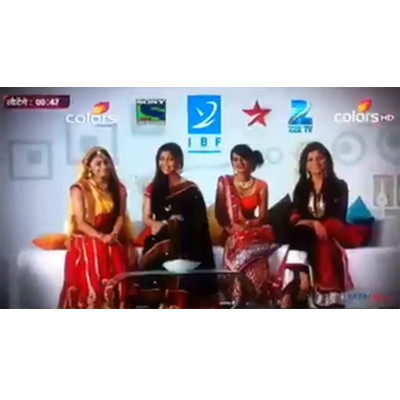
    MUMBAI: In an attempt to speed up the filling of consumer application forms (CAFs), the Indian Broadcasting Foundation (IBF), along with major broadcasters, has relaunched its on-air promo campaign urging cable TV subscribers to fill them at the earliest as mandated by Telecom Regulatory Authority of India (TRAI).


    The campaign features television’s leading ladies like Sakshi Tanwar, Toral Rasputra, Rubina Dilaik and Nia Sharma. It urges consumers to fill their details and hand over the CAFs to their cable TV operators, failing which they will have their cable TV connection snipped off.  The deadline for the submission for the forms was 15 December which again wasn’t met and extended to 31 December.


    Says an IBF official, “From the time the campaign was launched first, we have been playing it across channels. And for a few weeks that it was taken off the screens, a scroll/ticker ran, reminding subscribers about the imperative to fill up CAFs.  We have started airing it again so that concerned parties take a note of it and help us achieve the goal.”


    However, he isn’t optimistic about the procedure winding up by the end of the year as well. “And if MSOc and LCOs don’t do it, they will get in trouble, this time,” he says firmly.


    The channels have been told to show the campaign as many times as possible throughout the day.


    In the earlier phase of the campaign in 2012, actresses (Shweta Tiwari, Pooja Gaur, Ragini Khanna) educated and sensitised DAS subscribers about the issue. As per the Digital Addressable Cable TV Systems Regulations, 2012, the MSOs can transmit digital signals and activate the set top boxes only after receiving the CAF from the consumer with his/her preference. If there is no form, the MSOs were obliged under law not to transmit the signals and deactivate the cable connection. However, no such switch off took place in the first phase of digitisation. On the contrary, the deadlines of various phases have been extended time and again.


    So what is the reason for this delay? The official feels that the delay in the process is either from the consumers’ side or the local cable operators who have not taken the form collection seriously.  “We still can’t figure out what is the reason for this blockage?,” he says.


    The agenda is that by end-2014, India’s 100 million-odd cable TV homes will phase out the analog version, and switch on digital TV.


  • IndiaCast vs DishTV: The final TDSAT order says it all

    IndiaCast vs DishTV: The final TDSAT order says it all

    MUMBAI: Last week, there was a lot of brouhaha about the IndiaCast vs DishTV round of fisticuffs on the DTH operator’s “on request channel service” and the former’s flurry of ads in newspapers and on TV. Both sides claimed victory, saying the Telecom Disputes Settlement Appellate Tribunal (TDSAT) had ruled in their favour. But there was no order in sight.


    Today the TDSAT posted it on its web site, with he verdict pronounced by its chairman Aftab Alam. And here are the highlights: 


    * The tribunal says that a legal objection cannot be taken to Dish TV’s arrangement of ‘on request channels’ which its counsel said would imply that from1 January 2014, 22 IndiaCast channels will be available only as a-la-carte out of its package. The deal with the other 16 channels shall come to an end on 31 March and from 1 April, they would also be treated similarly.


    * The Dish TV counsel also clarified that the scroll running on IndiaCast channels shall from now on only say that those channels will be available on a-la-carte basis and people shall be asked to communicate through the SMS number mentioned on it in case they want to subscribe to any of them.


    * IndiaCast counsel was requested to give an undertaking to the court that the ads published by its client against Dish TV shall stop. 


    And with these statements, the TDSAT disposed off both the petitions. 


    Who really won? It looks like each got its way, in some way, and the tribunal told them to cease firing.  But is it the last that we have seen of them bashing each other? Will they come together on the table and negotiate a deal? 


    After all, the seven million subs of Dish TV are not to be sniffed away. And the absence of channels such as Colors on Dish TV pack can lead to customer attrition. History has shown that very few Indian customers go for a-la-carte channels. This will continue to be the case unless customers miraculously have a change in their consumption habits. Both IndiaCast and Dish TV might hold out for a while but we at indiantelevision.com  are betting on the duo reaching a settlement – sooner, than later. 


    Click here for the full order

  • The Year of Rapid Change

    The Year of Rapid Change

    By Ranjan Thakur

    The year 2013 witnessed a large number of activities in Prasar Bharati and Doordarshan.  A major achievement of Doordarshan was in rebranding its Free-to-Air DTH services as ‘DD Freedish’ which highlights its USP of being Free-to-Air.  Earlier, the name DD Direct Plus did not catch on because the rural audience could not connect with the name.  The name ‘DD Freedish’ now adequately conveys the USP of the product and the DTH service which is quite popular and far ahead of its paid rivals, is likely to increase its popularity further.

    The project of commissioning of enhanced capacity to 120 channels up from the present 59 channels is likely to be completed by March, 2014 and will substantially enhance the popularity of the product.  It is expected that given the background of the ongoing digitisation process in the country, a large number of cable users will shift to the DD’s Freedish in 2014 especially during the Phase III and Phase IV of the digitisation process when it will start touching the semi-urban and rural viewers.

     A matter of great satisfaction for Doordarshan has been the successful auction of the channel slots for the private channels on the DD’s Freedish platform.  A series of steps, including staggering of the auction process, enhanced the revenue of DD by nearly 40 per cent from the previous rounds of auction.  Presently, the platform is commanding an annual carriage fee of Rs 6 crore per channel due to its large reach.

    DD looks forward to the conclusion of the process of launching its international channel, DD India in the territory of Europe.  DD has received a very lucrative offer from one of the major operators in Europe for placement of DD India w.e.f. January, 2014, which is likely to be accepted with the approval of the Prasar Bharati Board soon.  DD India has already been launched in Canada and will be launched in the territories of Korea, Middle East and Central Asia in Early 2014. 

    The availability of DD India over the entire Europe including northern parts of Africa will substantially enhance the popularity of DD India globally.  As the stakeholders are aware that a global channel requires substantial investment, DD proposes to expand the global footprint of DD India in a phased manner after analysing the experience in Europe, Korea, Canada and Central Asia.

    Doordarshan is in the process of finalising its FPC for the expansion of its international channel which will be a mix of news and general entertainment.

    Doordarshan also successfully upgraded the four regional channels of Bihar, Uttar Pradesh, Madhya Pradesh and Rajasthan during 2013.  These channels were working in four hour terrestrial mode only while substantial investment in infrastructure, equipment and manpower had already been made.  In order to effectively utilise the investment made in these locations, a decision to upgrade these channels to 24 hour cable and satellite channel was taken and implemented within a period three months without any major investment. 

    The current TAM data indicates that while DD-Bihar and DD-Uttar Pradesh are already No 1, DD- Madhya Pradesh is No 2 while DD-Rajasthan is No 3, in their respective states in terms of popularity.  The upgradation of these four state channels is a major step forward to tap the regional television market.  DD now proposes to move on to upgradation of DD-Jharkhand, DD-Uttarakhand, DD-Chattisgarh and DD- Himachal Pradesh on the same pattern of the four channels.  It was our experience that the viewership of terrestrial channels was adversely affected in cable and satellite territories which needed to be addressed.  Given the success of the four regional channels upgradation, Doordarshan is confident that this process will be completed shortly and these channels are likely to be quite popular in their territory.

    We (at DD) expect the next year to be an exciting year when a number of these initiatives will start yielding results for DD with substantial enhancement of revenue besides sourcing of quality software.

    DD has enhanced its role in the industry’s body namely Indian Broadcasting Federation and has a place on the Board of Directors after quite some years.  DD expects to play its rightful role being the only public broadcaster in the country and share its experiences while lending its strength to the industry body.

    DD is on the Board of Directors of the Broadcast Audience Research Council (BARC), an initiative of the industry to develop alternative TV ratings.  DD has substantially increased its role in BARC and as the industry is aware, an alternate television rating system based on the audio watermarking technology is likely to be initiated by June, 2014.

    Doordarshan has set up a professional Audience Research Unit to analyse the available data related to the television rating points.  In the process, Doordarshan has shut down its Doordarshan Audience Research Team (DART), an in-house system.  The present practice of a professional Audience Research Unit has now brought DD at par with its private counterparts.

    Amongst several other major initiatives, Doordarshan is in the process of finalisation of external partners for monitoring its channel’s popularity of various networks, especially cable as there have been concerns that the law of the land is not being followed in this regard.  DD expects to partner with professional agencies in order to monitor the violations of the law which is likely to improve its viewership as in absence of any carriage fee being paid by DD, cable operators tend to put DD channels in the difficult to watch remote places.  DD has finalised the process to appoint a professional agency to provide electronic programming guide to its channels on all cable and DTH platforms besides upgrading its own EPG system on DD’s Freedish.

    Doordarshan is in the last stages of finalising the process of outsourcing its corporate advertisement sales of DD News which has faced some difficulties in the recent past.  The hiring of a professional agency is likely to improve its marketing of commercial time.  DD has also floated an RFP to improve its billing system which would network the entire Doordarshan Kendras for effective marketing, monitoring and billing of the commercial ad time.  DD has also focused on the Government business through its Development Communication Division and it is expected that a record increment of 40 per cent in Government revenue received by DD will be registered in this current financial year.

    DD has finalised its new commissioning guidelines which are based on the industry accepted practices of Advertisement Funded Programme, revenue sharing and simulcast.  These new guidelines are expected to source better quality programming for DD while allowing outside producers to share the positive revenue gained from quality products.  This policy will also not require DD to commit itself to funding low quality and low cost programming.

    DD is working towards the amendment of the mandatory sharing of Sports Signals Act, 2007 as the present Act requires all sporting events of national importance to be carried on DD National only, where the opportunity cost makes the present arrangement financially unviable.  DD was proud to have won the exclusive broadcast rights for the recently concluded World Chess Championship in Chennai.  DD has won some major legal battles for the transmission of sports in India as the entire validity of the mandatory sharing of sports Signals Act, 2007 has been questioned in courts.  The recent legal victory of Doordarshan in regard to ICC T-20 World Cup Championship in June, 2013 was a shot in the arm for DD.

    DD has decided to e-auction its film slots in order to bring in transparencies to the entire system and also enhance revenue by allowing the bidders to buy slots on the best prices as deemed fit.

    We expect the next year to be an exciting year when a number of these initiatives will start yielding results for DD with substantial enhancement of revenue besides sourcing of quality software.

    (Ranjan Thakur is additional director general – programmes, Doordarshan. The views expressed in the above article are the author’s personal views)

  • Chennai & DAS: Madras High Court puts I&B, TRAI in a tough spot

    Chennai & DAS: Madras High Court puts I&B, TRAI in a tough spot

    MUMBAI: It seems like deja vu. It was around this time last year that Information and Broadcasting (I&B) Minister Manish Tewari was urging the Telecom Regulatory Authority of India (TRAI) to move fast on deciding on the issue whether the Tamil Nadu Arasu Cable TV Corp should be given a digital addressable system (DAS) licence. The TRAI had responded with a paper issued on 28 December 2013 on “Issues related to entry of certain entities into broadcasting and distribution activities.”

    It had recommended that the Central Government, State Governments and their entities should not be permitted to enter into the business of broadcasting and distribution of TV channels. Based on that, a DAS licence was not issued to Arasu, despite continued pressure from the Centre’s allies AIADMK and Tamil Nadu chief minister Jayalalithaa.

    Now the ball has landed back with the I&B Ministry over the weekend, with the Madras High Court reportedly telling it to once again take a stand on the MSO’s DAS licence. The court also directed the TRAI not to take any coercive action against it even if it continues to deliver analogue signals to its six million odd subscribers in the state. And it also said the case was adjourned for four weeks.

    “..it is not known to this court why the Centre has not taken any decision on the application of Arasu. When the authorities of the Union of India and the state instrumentality are not in a position to take any decision on granting or receiving the DAS licence, as the case may be, the ultimate sufferers are the subscribers. Therefore, I am of the considered opinion that the subscribers cannot be put to hardship. As such, there cannot be any disconnection of signals to the subscribers by the authorities,” said Justice V Dhanapalan on Friday.

    The Madras High Court issued these orders based on a petition that Arasu cable had filed with it. Arasu, on its part, had taken a decision to move the courts following TRAI’s announcement, earlier this month, that Chennai’s cable TV operators, broadcasters, and MSOs should take positive steps towards complete DAS in Chennai – one of the initial phase I metros – or face its wrath.

    Clearly, the I&B Ministry is in a catch 22 situation. The TRAI in its recommendations has been clear on disallowing state control in cable TV and DAS.

    With the Madras High Court now telling the Ministry to reconsider its earlier stance on it, could the court’s direction provide it with a parachute? With the current government at the Centre appearing to be on shaky ground following the Congress (I) debacle in four states, it might well use this as a trump card to win some points with the AIADMK in what appears to be building up as a tough battle for it in the 2014 elections. Additionally, the ministry and the TRAI also wants tardy Chennai to move full steam on digitisation and licensing the largest player Arasu – albeit it being state owned – might well help it achieve that objective.

    But should the I&B Ministry continues to hold on to its position that it will not issue the licence, digitisation might not really progress as Arasu will not take things lying down as it is a tour de force in the state and in the city of Chennai. With the court ruling in its favour, Arasu is well within its rights to continue with its analogue feed now, no matter how much the TRAI cracks the whip. And that’s something which will make the government’s digitisation diktat look incomplete, with one major metro abstaining from it, as it has been doing for nearly a year or so now.

    Meanwhile, local cable TV in Chennai continues to be pained by what’s being going on in the state. Some cable TV operators who are not part of Arasu’s network in Chennai went on a hunger strike yesterday to protest against the analogue signals being transmitted by it.

    “First and foremost a call needs to be taken on Arasu’s licence but more importantly TRAI needs to caution broadcasters who are giving these analog signals to them. They should be asked to sign official deals with MSOs for giving digital signals only,” says Chennai Metro Cable TV Operators Association General Secretary M.R. Srinivasan.

    Clearly, it seems as if the I&B ministry and the TRAI are caught between a rock and a hard place. Where will the two go from here now is anyone’s guess!

  • Prasar Bharati to be upgraded as MIB plans to invest Rs 3,500 crore in it

    Prasar Bharati to be upgraded as MIB plans to invest Rs 3,500 crore in it

    MUMBAI: The government broadcaster, Prasar Bharati is set to see a major advancement. Reportedly, the Ministry of Information and Broadcasting (MIB) is planning to invest close to Rs 3,500 crore on upgrading the pubcaster’s broadcast infrastructure and network development, especially in the border areas of Jammu and Kashmir and the North-Eastern states.

    According to a report by The Hindu Business Line, the proposal has been recommended by the Expenditure Finance Committee and is up for approval from the Cabinet Committee on Economic Affairs (CCEA). “The funds are expected to be used to strengthen the transmission in border areas by augmenting the broadcast infrastructure so as to counter anti-terrorist activities, among other initiatives,” reveals the daily.

    Apart from this, the fund is also expected to be used for digitisation of transmitters and studios of All India Radio (AIR) and Doordarshan, High Definition TV, expansion of DD Direct to Home and modernisation of DD and AIR. 

    Reportedly, the Ministry is already monitoring this project through inter-ministerial meetings with representatives from the Ministries of Home Affairs, External Affairs, Defence, and the Cabinet Secretariat, among others.

    Currently, 273 TV transmitters are operational in the border districts. “In J&K, five high power TV transmitter projects are under implementation, while plans are afoot to put in more transmitters in the Indo-Nepal border,” reports the daily.

  • TRAI ad cap: Broadcasters’ appeal dismissed by TDSAT

    TRAI ad cap: Broadcasters’ appeal dismissed by TDSAT

    MUMBAI: The highly awaited Telecom Regulatory Authority of India (TRAI) ad cap appeal in the Telecom Disputes Settlement Appellate Tribunal (TDSAT) has been dismissed by the tribunal as not maintainable by it, as predicted by indiantelevision.com earlier.

    Apparently, what influenced the TDSAT decision was the recent Supreme Court verdict stating that TDSAT does not have the authority to hear cases challenging TRAI regulations.


    The next course of action for the News Broadcasters Association et al, likely lies in approaching the High Court for relief. 

  • TRAI asks DTH operators to provide interoperability of STBs

    TRAI asks DTH operators to provide interoperability of STBs

    MUMBAI: In September this year, the licence of India’s oldest DTH provider Dish TV was to expire after a period of 10 years and then there was no provision for an extension. On 1 October the regulator came out with a consultation paper and on 14 November it issued a supplementary paper. 

    With the last date to provide feedback approaching, TRAI had an open house discussion (OHD) on 9 December with the leading DTH providers give suggestions on the consultation and supplementary papers released by TRAI.

    During the OHD, TRAI chairman Rahul Khullar said that set top boxes (STBs) should be inter-operable for the end consumer, either commercially or technically. He also told operators that the viewers should have the option to use the same STBs if they wished to change their service provider. But if operators found it to be a challenging prospect then they should be given an option of returning the STBs to their provider in exchange for money that could help them buy a new one.

    The Information and Broadcasting (I & B) Ministry had directed TRAI to set up new guidelines for obtaining DTH licenses in India. The OHD between TRAI and DTH players was to frame new recommendations regarding the same.

    During the OHD, DTH operators were asked to give views on issues such as entry fee and quantum thereof, licence fee, conditions governing cross holdings and period of extension. Representatives from the industry said that new licences should be given for a reasonably long duration and the government should have the power to cancel these if operators violate rules.

    Khullar conveyed to operators that once the new licence rules come into effect, they will have two options: one, to either continue under their earlier terms and conditions till their licence expires or two, to change to the new system.

    Khullar has told DTH operators that they can submit any additional points till Friday.

  • The SC court judgement & TDSAT’s powers

    The SC court judgement & TDSAT’s powers

    MUMBAI: The broadcasting industry that has been fiercely fighting the ad cap regulation by the Telecom Regulatory Authority of India (TRAI) got a jolt last Friday when the news emerged  that the Supreme Court, in a separate case, had declared that the Telecom Disputes Settlement Appellate Tribunal (TDSAT) does not have power to deal with appeals over regulations framed by the authority.

    The judgment in BSNL vs TRAI and others case came out on the Supreme Court web site today. It had some crucial points regarding what can be termed as ‘regulations’ and whether TDSAT has the authority to hear appeals against them. 

    According to the judgment, the powers under Section 36 of the TRAI act are legislative and not administrative and by virtue of Section 37 of the Act, they are at par with rules framed by the Central Government thereby mandating them to be laid before both houses of Parliament. Thereafter, Parliament has the power to annul or modify the same. But there is ambiguity on what happens if it is not laid in parliament. Does it stand void? Or can it still be taken as a regulation?

    The bench stated that ‘the Tribunals are competent to hear matters where the vires (read: powers) of statutory provisions are questioned. However, in discharging this duty, they cannot act as substitutes for the High Courts and the Supreme Court’ meaning that they cannot hear cases which go into legislative laws.  Although the Tribunal will have the power to test the vire of subordinate legislation the exception would be questions regarding the vires of its parent statute. ‘A Tribunal which is a creature of an Act cannot declare that very Act to be unconstitutional’ reads the judgment.

    This makes the Tribunal incapable of deciding the fate of the ad cap case as it is a challenge to the validity of one of its parent statute.  

    The TRAI Act, amended in the year 2000 brought judicial functions under the TDSAT and kept the legislative and administrative powers under the regulator.

    The BSNL vs TRAI and others case verdict states: ‘In exercise of the power vested in it under Section 14(b) of the Act, TDSAT does not have the jurisdiction to entertain the challenge to the regulations framed by the Authority under Section 36 of the Act.”

    Now, if anyone wants to challenge the validity of the regulation framed under section 36, such as the ad cap regulation, the party has to file a petition before the High Court and not TDSAT. However, cases regarding the application of a regulation can still be taken to the TDSAT.


    The ad cap regulation that has been challenged by the News Broadcasters Association (NBA) and others has now come under a cloud. The contention of the broadcasters is that regulation is not valid and TRAI does not have the authority to regulate content, let alone prosecute it. However, the TRAI claims that advertisements form a part of content and by the contract between licensor and licensee; it had come out with the Standards of Quality of service (Duration of advertisements in TV channels) (amendment) regulation 2013 under section 36 and section 11 of the TRAI act.

    The judgement in the case has been reserved and according to lawyers from both sides, TDSAT will have to take into consideration this SC verdict and then give its final verdict on the case. Legally speaking, TRAI says it came out with an ad cap ‘regulation’ but the NBA says that TRAI has not fulfilled the laying requirement.

    If the TDSAT’s verdict says that the case is dismissed then the next step for the NBA would be to challenge TRAI in the High Court, which seems to be most likely one. 

    But it could also lead to some furrowed brows amongst the TV channel executives as  the stay order on TRAI not to take any coercive actions against channels that are not following the ad cap would be annulled and from then till the time the HC does not give a stay, TRAI could go back to taking its aggressive stance against broadcasters

    Click here for the Supreme Court Verdict

  • TRAI asks Kolkata MSOs to start gross billing by next week

    TRAI asks Kolkata MSOs to start gross billing by next week

    KOLKATA: It was just last week that indiantelevision.com reported that Kolkata multi-system operators (MSOs) are likely to start the gross (consumer) billing process from 10 December following a directive by Telecom Regulatory Authority of India (TRAI).

    Now, TRAI met the MSOs again on 6 December and has asked them to start the billing process by 15 December.

    Kolkata has around 30 lakh cable television homes. As of now, an informal billing process is in place, but with effect from November, customers may have to pay the bill as per the package. “Collection may come in the next two-three months,” said Siticable Kolkata director Suresh Sethia.

    “Billing for the November package will start by 15 December. We will also advertise in newspapers and on our local channels to make our consumers aware about this development,” added Sethia.

    Siticable has around 10-11 lakh STBs in Kolkata Digital Addressable System-I (DAS-I) area.

    Explaining the details of the bill payment process, one of the MSOs informed that if a customer has chosen a package of Rs 180, he will have to pay Rs 180 + Rs 10 (amusement tax) + 12.36 per cent of Rs 180 (service tax) in the coming time.

    The billing system will bring transparency and organise the business, however, some operators are opposing it.

    But, the view of the majority is that only digitalisation can bring uniformity and a system in the so-called unorganised sector. Manthan Broadband director Sudip Ghosh said, “Billing is the first step to inform consumers of the changed ecosystem in a digitised environment.”