Category: Regulators

  • India adds 3.2 million phone users in May, total hits 1.2 billion

    India adds 3.2 million phone users in May, total hits 1.2 billion

    MUMBAI: Dialling up its digital growth, India’s telecom sector added 3.24 million new telephone subscribers in May 2025, pushing the country’s total subscriber base to a staggering 1.207 billion. While urban India remained saturated with 131.76 per cent tele-density, rural areas rang in gains too, growing 0.14 per cent month-on-month to hit 537.39 million subscribers.

    The data, released by the Telecom Regulatory Authority of India (TRAI), also showed a strong wireline comeback with 1.25 million new connections pushing wireline growth to 3.34 per cent, led by aggressive additions from Jio and Airtel.

    India’s broadband base surged 3.37 per cent to reach 974.87 million subscribers, thanks largely to mobile broadband (up 2.92 per cent) and a 60 per cent spike in fixed wireless (5G FWA, Wi-Fi, satellite) subscriptions. However, 5G FWA itself dipped slightly from 7.50 million to 7.40 million users, indicating early volatility in the still-nascent category.

    Jio led the broadband brigade with 494.47 million subscribers, followed by Airtel (302.15 million) and Vodafone Idea (126.68 million), together accounting for a whopping 98.47 per cent of the market.

    Overall wireless subscriptions grew modestly by 0.17 per cent to 1.168 billion, with rural India contributing 0.38 million new users. Urban wireless teledensity climbed to 124.91 per cent, while rural teledensity inched up to 58.90 per cent. Wireline adoption in rural India saw a sharper surge of 10.44 per cent, albeit from a much smaller base.
    Who’s Winning the Race?

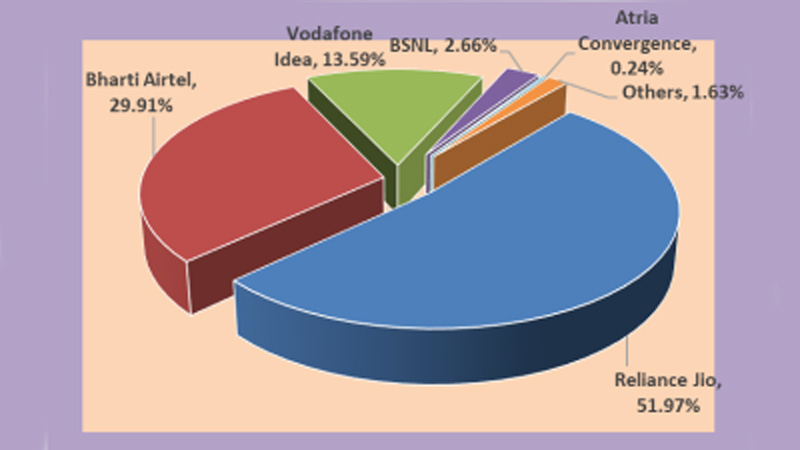
    .  Reliance Jio: 494.47 million broadband subs, 40.92 per cent mobile market share.

    .  Bharti Airtel: 302.15 million broadband subs, 33.61 per cent mobile market share.

    . Vodafone Idea: 126.68 million broadband subs, 17.61 per cent mobile market share.

    Jio also led wireline subscriber additions with 1.28 million new connections, while Vodafone Idea continued to see a decline of over 1.35 lakh users in the wireline segment.

    Indians are clearly still keen to keep their digits. 14.03 million MNP requests were made in May alone. Uttar Pradesh (East) topped the chart with 115.77 million cumulative porting requests, followed by Maharashtra at 92.72 million.

    Out of the total 1.161 billion mobile subscribers, 1.08 billion were active as per VLR (Visitor Location Register) data about 93 per cent. BSNL had the lowest active subscriber rate (63.73 per cent), while Reliance Communications registered a perfect 100 per cent, albeit on a very small base.

    With over 85.36per cent teledensity nationwide and close to a billion broadband users, India’s telecom story continues to evolve rapidly. But the future lies beyond just numbers, rural wireline expansion, M2M growth (now at 73.91 million connections), and the true test of 5G fixed wireless adoption could be the next chapters in this digital saga.

    So, whether it’s smartphones in metros or landlines in tier-3 towns, India’s telecom tune is still playing and the country’s clearly not hanging up any time soon.

    (If you are an Anime fan and love Anime like Demon Slayer, Spy X Family, Hunter X Hunter, Tokyo Revengers, Dan Da Dan and Slime, Buy your favourite Anime merchandise on AnimeOriginals.com.)

  • TRAI rings in Q1 with Rs 92,637 crore telecom revenue and rising usage

    TRAI rings in Q1 with Rs 92,637 crore telecom revenue and rising usage

    MUMBAI: India’s telecom sector is ringing loud and clear with growth in both reach and revenue. The Telecom Regulatory Authority of India (TRAI) has released its Q1 2025 Indian Telecom Services Performance Indicator Report, offering a snapshot of India’s ever-evolving communications landscape. Covering the period from January to March 2025, the report reflects an expanding user base, robust revenue growth, and a surge in average mobile usage despite a slight dip in internet subscriptions.

    India’s total telephone subscriber base crossed 1.2 billion (1,200.80 million), with a 0.91 per cent increase over the previous quarter. Wireless subscribers (including 5G FWA) now stand at 1,163.76 million, while wireline numbers declined to 37.04 million, a drop attributed to the reclassification of some 5G Fixed Wireless Access users.

    Here’s what’s trending in the sector:

    ●    Mobile ARPU (Average Revenue Per User) rose to Rs 182.95 in Q1 2025 up 0.64 per cent from the previous quarter and a whopping 19.16% year-on-year.

    ●    Minutes of Usage (MOU) per subscriber also ticked up to 1,026/month.

    ●    Total wireless data usage during the quarter hit 59,447 PB, with average consumption at 22.19 GB per user.

    ●    Tele-density improved to 85.04 per cent, with rural areas seeing a jump to 59.06 per cent.

    ●    Internet subscribers marginally dipped by 0.11 per cent to 969.10 million, largely driven by a slight broadband fall.

    ●    Pay DTH subscribers dropped to 56.92 million, down from 58.22 million in Q4 2024.

    ●    FM radio still has its groove, with 388 private stations across 113 cities generating Rs 466.63 crore in ad revenue.

    On the broadcasting front, India now has 918 permitted private satellite channels and 531 operational community radio stations.

    While rural wireline teledensity remains low at 0.39 per cent, wireless penetration continues to be India’s telecom backbone, with private players commanding a 91.47 per cent market share.

    As India prepares for deeper digital adoption, TRAI’s indicators reveal that the sector is not just surviving, it’s thriving. Whether it’s screen time, call time or data time, Indians are clearly making the most of their mobile moment.

  • NBDSA cracks the whip: news channels caught in a spin over sensationalism

    NBDSA cracks the whip: news channels caught in a spin over sensationalism

    MUMBAI: The News Broadcasting & Digital Standards Authority (NBDSA) has been rather busy, doling out a series of rulings that have left several prominent Indian news channels with a bit of egg on their faces. It appears some broadcasters have been playing fast and loose with the facts, prompting the watchdog to flex its regulatory muscles.

    In a decision that’s got everyone talking, ABP News found itself in the NBDSA’s crosshairs over one 7 September 2024, interview with the former BJP MP, Brij Bhushan Sharan Singh. The complainant, Indrajeet Ghorpade, wasn’t chuffed about the alleged “character assassination” of olympic wrestler Vinesh Phogat. The NBDSA, clearly not amused by the chuckles at Phogat’s expense, closed the complaint with an “observation to take care of the issue,” effectively telling ABP to mind its manners. It seems some interviews are more of a grapple than a chat.

    Not to be outdone in the “oops” stakes, Times Now Navbharat received a stern talking-to for a broadcast from 5-6 September 2024, titled ‘अवैध मस्जिद’ पर महिलाओं ने मुसलमानों पर खुलकर सब बता दिया ! (Women openly tell everything about illegal mosques). Ghorpade, a busy chap indeed, also lodged this complaint, citing misleading thumbnails and a rather leading line of questioning about Shimla’s Muslim population. The NBDSA, advising broadcasters to ensure “tickers and thumbnails should conform to the actual version of the discussions/interviews,” has told Times Now Navbharat to snip, snip, snip that thumbnail from the video, if it’s still lurking online. A case of “don’t judge a broadcast by its cover,” perhaps.

    Meanwhile, Zee News felt the heat over a quartet of programmes aired on 15 and 16 October 2024, all revolving around the rather unsavoury (and frankly, bizarre) concept of “thook jihad” and “urine jihad”. Utkarsh Mishra’s complaint highlighted how a perfectly sensible UP law about CCTV cameras in eateries was spun into a battle against “thook jihad,” seemingly legitimising “state-sponsored and legislative targeting based on one’s religious identity”. The NBDSA, clearly unimpressed by this “spitting image” of sensationalism, issued a warning to Zee News not to “repeat such violations.” They’ve also been told to scrub the offending videos from their digital presence. Looks like Zee News got a bit of a sticky wicket there.

    Finally, Citizens for Justice & Peace landed Times Now Navbharat in hot water again, this time for 19 August 2024, programmes dissecting “teaching in Madrasas in Bihar”. The complaint alleged inflammatory language and selective reporting surrounding claims about “Pakistan-Published books” and “non-Muslims as ‘Kafir’”. The NBDSA, after a good long chinwag with both parties, concluded that the broadcasts had indeed fallen short of journalistic standards. They’ve directed the broadcaster to take down the objectionable segments and, in a polite but firm tone, told them to get their house in order.

    In all four cases, the NBDSA emphasised the importance of factual integrity, responsible language, and a strong editorial spine. The verdicts serve as a wake-up call to India’s noisy newsrooms: shock and sensationalism may fetch eyeballs, but they won’t go unchecked.

    For some broadcasters, it’s clearly time to trade outrage for oversight — or risk a growing pile of takedown notices. 

  • Mihir Rale plugs into Cyril Amarchand Mangaldas, electrifying its digital practice

    Mihir Rale plugs into Cyril Amarchand Mangaldas, electrifying its digital practice

    MUMBAI: Mumbai’s legal landscape just got a jolt. Mihir Rale, a seasoned legal wire with over two decades of experience spanning technology, data, telecoms, and media, has plugged into Cyril Amarchand Mangaldas (CAM) as a partner and co-head of its shiny new digital+ practice.

    Based in the firm’s bustling Mumbai office, Rale’s arrival is set to amplify CAM’s capabilities in the ever-evolving digital ecosystem.

    Until 2024, Rale was the general counsel for Star and Disney India, completing a remarkable 15-year tenure that saw him tackle industry challenges where tech, regulation, competition, and intellectual property frequently short-circuited. He has also co-chaired the Ficci, Ipr committee and the CII digital media committee, clearly no stranger to policy and regulatory currents.

  • TRAI telecom data:  India’s rural surge, internet binge and DTH downfall ring loud in March

    TRAI telecom data: India’s rural surge, internet binge and DTH downfall ring loud in March

    MUMBAI: India’s telecom scene in March 2025 was a tale of two Indias—rural Bharat rising on data dreams and legacy players like BSNL and MTNL gasping for bars. According to TRAI’s fresh data, it was a month of gains for mobile and broadband, and growing static for DTH.

    The total number of wireless subscribers climbed slightly to 1,160.65 million, with rural India accounting for nearly 80 per cent of new additions. Villages added 1.1 million users, urban India added just 296,000—proof that the real action is beyond city limits.

    Reliance Jio was on fire, gaining 2.15 million wireless users and reinforcing its market leadership with 39.6 per cent share. Bharti Airtel added 1.03 million, keeping pace. Vodafone Idea lost nearly 700,000 subscribers, and BSNL continued its freefall with a 1.25 million loss.

    India’s broadband subscriber base touched 946.32 million, a monthly growth of 0.21 per cent. Unsurprisingly, 4G/5G mobile broadband accounted for 921.4 million of those connections—soaring on reels, reels, and more reels.

    On the wireline broadband front, Jio continued to hustle, adding over 320,000 subscribers, bringing its fixed-line share to 33.6 per cent. Airtel stayed solid with over 100,000 adds, while government dinosaurs BSNL and MTNL lost tens of thousands more. Between sluggish service and vanishing relevance, they’ve become the landline’s last rites.

    In the home entertainment arena, the direct-to-home (DTH) sector saw a slide. Total active DTH subscribers dropped to 64.17 million from 64.45 million—a fall of over 278,000 users in just one month.

    Cord-cutting is no longer a western trend; it’s happening across Indian homes as OTT apps and smart TVs eat into satellite’s share. Operators like Tata Play and Airtel Digital are still holding their ground, but the writing is on the (living room) wall.

    The big takeaway? Rural India is dialling up, streaming more, and finally enjoying digital parity. Jio’s aggressive expansion is paying off across both mobile and fibre, while BSNL’s steady subscriber bleed raises existential questions.

    DTH is beginning to look like the landline of television. The OTT wave is here, and it’s pulling viewers—and revenue—away from satellite.

    With spectrum auctions around the corner and AI-fuelled data demands skyrocketing, India’s telecom race is less about who picks up the call—and more about who controls the cloud.

  • TRAI gives buildings a digital reality check with connectivity rating reboot

    TRAI gives buildings a digital reality check with connectivity rating reboot

    MUMBAI: In a country obsessed with skyscrapers, the Telecom Regulatory Authority of India (TRAI) is more interested in what’s inside the walls—signal strength. On 22 May, TRAI issued a formal response to the department of telecommunications (DoT), which had sought clarifications on the regulator’s earlier recommendation for a new system to rate buildings and areas based on digital connectivity.

    The recommendations in question—first proposed on 20 February 2023—aim to address the gnawing issue of poor signal penetration in buildings, despite India’s heady digital growth. While rooftop towers and fibre lines have made it to headlines, indoor connectivity has lagged, often trapped behind concrete, bureaucracy, and dated building codes.

    TRAI pointed out that despite several policy nudges over the years, in-building connectivity continues to be a digital blind spot. With the fusion of IoT and smart workplaces on the rise, there is an urgent need to bake digital connectivity infrastructure (DCI) into the design of new buildings—much like water, electricity, or fire exits.

    The 2023 recommendations call for a rating system embedded within local building bye-laws and municipal approvals. TRAI argues this will not only prepare buildings for the 5G era but also avoid a repeat of the signal dead zones plaguing 4G users. And with 6G already on the horizon, the Authority warns that the higher frequency bands used will face even steeper resistance from walls and materials.

    TRAI’s formal response, now uploaded on its website, comes in reply to the DoT’s back-reference dated 19 March 2025. For those seeking fine print or footnotes, the advisor (QoS-I), Tejpal Singh, remains available for clarifications.

  • Double trouble for broadcasters as Supreme Court green-lights twin tax hit

    Double trouble for broadcasters as Supreme Court green-lights twin tax hit

    MUMBAI: The Supreme Court has delivered a one-two punch to India’s broadcasters, ruling on Thursday that they must cough up both service tax and entertainment tax on their activities. The decision ends years of legal wrangling over whether television companies could dodge the double whammy.

    A bench led by justice B V Nagarathna and justice N K Singh declared that parliament and state legislatures both have the constitutional chops to levy their respective taxes. The 321-page judgment—longer than most television programmes—essentially told broadcasters they cannot have their cake and eat it too.

    “The two taxes target different aspects of the same activity,” the court explained, rather like taxing both the recipe and the meal. Parliament’s service tax under the Finance Act hits the broadcasting service itself, whilst states’ entertainment tax treats television as a luxury under Entry 62 of the Constitution’s List II.

    The judges were having none of the broadcasters’ arguments that they should pay only service tax to the central government. “No entertainment can reach viewers unless broadcasters transmit signals,” justice Nagarathna noted. “There are two aspects: transmitting signals and providing entertainment through set-top boxes that decrypt them.”

    This legal drama began with a clutch of cases from various high courts, with Kerala versus Asianet Satellite Communications taking the starring role. Broadcasters had argued they were merely in the signal-transmission business, not the entertainment game. The Supreme Court was not buying this technicality.

    The ruling overturns a 2012 Kerala high court decision that had favoured cable operators over DTH (direct-to-home) providers, calling such discrimination unconstitutional. The Supreme Court said this earlier judgment got it wrong—both cable and DTH operators are in the entertainment business and should be taxed accordingly.

    For India’s broadcasting industry, already grappling with cord-cutting and streaming competition, this represents yet another headache. The ruling makes clear that technological differences in how entertainment is delivered do not exempt anyone from the taxman’s reach.

    The court’s message is unambiguous: whether you beam signals from satellites or snake cables through neighbourhoods, if you are in the business of keeping Indians glued to their screens, you will pay through the nose for the privilege.

  • TRAI dials up a united front as regulators join forces to fight digital spam

    TRAI dials up a united front as regulators join forces to fight digital spam

    MUMBAI: If spam calls and scam messages are the villains of our digital age, India’s top regulators are teaming up like superheroes. On 25 April 2025, TRAI hosted a meeting of the Joint Committee of Regulators (JCoR) at its New Delhi headquarters, bringing together heavyweights from RBI, IRDAI, PFRDA, SEBI, MoCA, MeitY, and special invitees from DoT and MHA to chart a stronger, cross-sector response to unsolicited commercial communication (UCC) and fraudulent activities.

    Opening the session, TRAI Chairman Anil Kumar Lahoti stressed the urgent need for a collaborative approach. Highlighting the mounting threat to citizens, particularly senior citizens, Lahoti praised the JCoR’s progress but warned that “the challenges ahead demand even greater synergy and vigilance.”

    Key issues topping the agenda included the nationwide rollout of 1600 series numbers for transactional and service calls from government and financial entities. Members agreed to push for swift onboarding within their respective sectors and monitor progress closely. The Council of Administered Telecommunications (CoAT) also presented a solution offering a unified 1600-series CLI for seamless call identification across networks.

    Another major move discussed was the onboarding of commercial communication senders onto the Digital Consent Acquisition (DCA) platform. Regulators pledged to work with principal entities to ensure compliance, aiming to empower consumers with more control over who contacts them.

    Fraudulent communications and the rise of “digital arrest” scams were a serious point of concern. I4C proposed measures including deletion of unused SMS headers, swift action on fraudulent SMS identifiers, and blocking of mobile numbers and IMEIs used for scam messages. Members pledged to develop clear modalities for rapid action.

    Emerging threats from OTT and Rich Communication Services (RCS) platforms also grabbed attention. Recognising that spammers are shifting to newer communication channels, the committee decided that MeitY would engage with stakeholders to roll out spam mitigation strategies mirroring those in traditional telecom.

    The session closed on a determined note, with JCoR members agreeing to intensify collaboration across sectors. The goal? A safer, more secure digital communication ecosystem for India’s consumers, one where fraudsters find it harder to hide and trust travels faster than spam.

  • Lavin Hirani launches Hirani & Associates in Mumbai

    Lavin Hirani launches Hirani & Associates in Mumbai

    MUMBAI: Lavin Hirani, a seasoned name in India’s media and entertainment law circles, has rolled out his own banner—Hirani & Associates—a boutique firm set up in Bandra, Mumbai. With a script honed over years in the legal trenches, the new firm promises bespoke solutions across media, entertainment, sports, trademarks and tech law.

    Hirani, best known for his stints as head of legal at Red Chillies Entertainment and media practice head at MDP Legal, brings heavyweight experience and a high-profile clientele. He has represented marquee names like Shah Rukh Khan, Sunny Deol, Shraddha Kapoor, Raveena Tandon, Rana Daggubati, Rishabh Pant and Samantha Prabhu, as well as leading production houses and streaming platforms.

    “Media and tech are just getting warmed up—there’s massive potential ahead,” said Hirani. 

    Backed by a tight-knit team of legal talent—Anjana Menon (principal associate), Varun Gopala Krishnan (senior associate), and associates Ishan Puranik, Niharika Tiwari, Karisma Shah, Prachiti Joshi and Suhavi Arya—Hirani & Associates aims to blend personalised legal counsel with deep sector insight.

    And yes, in true Bollywood style, Hirani couldn’t resist a cinematic sign-off: “Starring a talented cast, directed by yours truly.”

  • Information and broadcasting minister Ashwini Vaishnaw highlights growth of creator economy

    Information and broadcasting minister Ashwini Vaishnaw highlights growth of creator economy

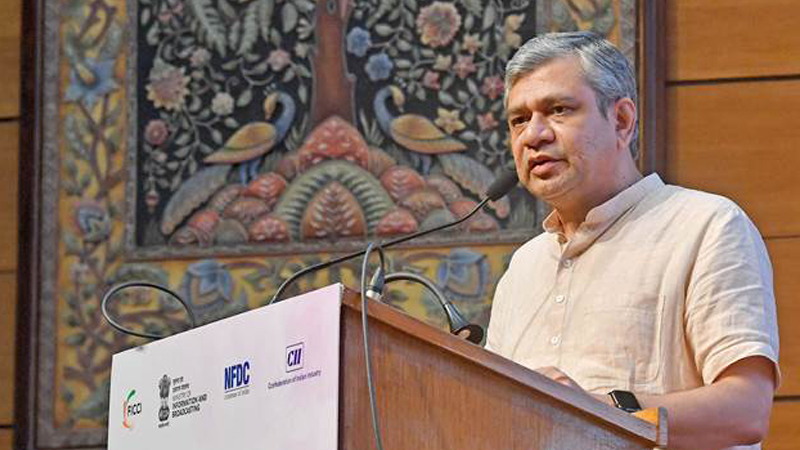
    MUMBAI: Union minister of information & broadcasting Ashwini Vaishnaw stated that the media landscape is undergoing a significant shift due to the exponential growth of the creator economy. Speaking to representatives from approximately 20 national and regional media outlets on Saturday, he emphasised the fundamental changes occurring in content creation and its associated economy.

    “The world of creators and their economy is going through a fundamental change. With the advent of technology, the old model is giving way to the new model, creating opportunities as well as challenges,” said Vaishnaw.

    He highlighted how technology has enabled broader participation in content creation, noting, “Gone are the days when a large studio was necessary for producing content. Today, a creator from a remote village in Jharkhand or Kerala can produce high-quality content and garner millions of views.”

    Vaishnaw mentioned the World Audio Visual & Entertainment Summit (Waves), scheduled to take place in Mumbai from 1-4 May, which has already received over 100,000 registrations. He explained that Waves aims to establish itself as a global platform for media and entertainment, similar to the role of Davos for economic policies. The summit will also recognize top innovators with awards for their contributions to the evolving global media and entertainment sector.

    Leaders from various media organisations expressed their appreciation for the government’s initiative in conceptualizing Waves as a platform to connect policymakers, creators, industry leaders, technology companies, and start-ups.

    Information and broadcasting secretary Sanjay Jaju welcomed the participants and emphasised the importance of collaborative dialogue in shaping the future of the media landscape. He underscored the ministry’s commitment to engaging with stakeholders across different platforms and acknowledged the active participation of media organizations in the lead-up to Waves 2025.

    Vaishnaw reiterated that the creator economy is experiencing rapid growth and that prime minister Narendra Modi has acknowledged the contributions of creators to the economy and in promoting India’s soft power globally. He stated that Waves is intended to become a global connector for creators, buyers, and markets, facilitating scalable creative solutions.

    Secretary Sanjay Jaju emphasized the significance of collective discussion in determining the future direction of the media industry and the ministry’s commitment to engaging with stakeholders.