Category: Regulators

  • Hathway delayed agreement on signals of Zee and Turner: Taj Television

    Hathway delayed agreement on signals of Zee and Turner: Taj Television

    NEW DELHI: In today’s hearing in the Telecom Disputes Settlement Appellate Tribunal (TDSAT), Taj Television counsel contended today and blamed Hathway Cable & Datacom for the delay in an agreement to Zee and Turner channels. She also claimed that Hathway had falsely written in its letter to Taj TV on 23 July that no negotiations were held and presented to TDSAT the dates on which meetings were held between the parties with regard to Zee TV signals.


    Counsel Pratibha Singh told the TDSAT today that Hathway had admitted that it had not paid for the Zee TV channels distributed between 1 April and 23 July.


    In the ongoing hearing before the Tribunal in the cases linked to Taj TV signals for Turner and Zee, Singh said three meetings had been held to sort out the issue, the last being on 16 June after which Taj TV had sent a copy of the agreement under the reference interconnection offer (RIO) to Hathway. A letter was also sent to Hathway in this connection on 26 June.


    Earlier, the Tribunal had fixed for final disposal from 25 August the ‘deep-rooted’ dispute between Hathway and Taj TV, noting that this would require interpretation of certain clauses of some of the statutory regulations.


    TDSAT chairman Aftab Alam and member Kuldip Singh had said: ‘unfortunately, the dispute between the two sides is playing out in highly aggressive way and one may add in a rather unpleasant manner. It seems to be affecting a large number of people in viewing their favourite TV channels. The disputants themselves are approaching the Tribunal on a weekly basis complaining against the actions of each other and seeking some interim directions of the Tribunal consuming a lot of time on arguments on miscellaneous applications.  It is, therefore, in the larger interest to finally dispose of these cases after hearing all sides at an early date.’


    The Tribunal noted that the dispute had arisen at a stage when the earlier fixed fee agreement between the parties has come to end and they are unable to come to agreed terms for a fresh agreement and under the circumstances the MSO has no option but to take the broadcasters’ channels on their RIO terms.


    When talks between the two parties failed, he said the RIO was forwarded on 25 January and was to be effective from February.


    Further arguments will continue tomorrow with counsel for Zee expected to conclude her arguments and Hathway responding to them.
  • 112 MSOs get 10 year licence under DAS for specified areas

    112 MSOs get 10 year licence under DAS for specified areas

    NEW DELHI: A total of 112 multi system operators (MSOs) all over the country have been granted permanent registration for 10 years to operate the digital addressable system (DAS).


    The MSOs had been given provisional permission earlier. The latest list is as on 22 August.


    Those who have got permission include IndusInd Media and Communications, Hathway, Manthan Broadband, Den Network, Home Cable, Digicable Network, Delhi Distribution Company and Asianet Satellite Communications.


    According to a list issued in late July, 16 MSOs had been refused permission. It also said that Kolkata based Digicable Communications had been denied permission after the break-up of the joint venture with Digicable Networks of Mumbai, which has received permission for Greater Mumbai, National Capital Territory of Delhi and Greater Kolkata.


    MSO sources, however, said that the approved list was in addition to the 140 whose names had been approved in March last year.


    The Ministry website mib.nic.in has listed the areas and the date from which the MSOs have been given permission.

  • RIO forms basis for final deal, agree Taj and Hathway

    RIO forms basis for final deal, agree Taj and Hathway

    NEW DELHI: Taj Television contended before the Telecom Disputes Settlement and Appellate Tribunal today that though initial signals can be given by the broadcaster or distributor to the multi system operator initially on the basis of mutual negotiation, but this ultimately has to translate into an agreement under the Reference Interconnection Offer (RIO).


    Responding to an argument by Taj Television that the RIO had to be signed within 30 days, counsel for Hathway said that the date limit applies to modifications in existing RIO agreements, but the deal between Taj and Hathway had to be a new one since MediaPro had stopped distribution of Zee TV and Turner channels.


    Earlier, the Tribunal had fixed for final disposal from 25 August the ‘deep-rooted’ dispute between Hathway and Taj, noting that this would require interpretation of certain clauses of some of the statutory regulations.


    TDSAT chairman Aftab Alam and member Kuldip Singh had said: ‘Unfortunately, the dispute between the two sides is playing out in highly aggressive way and one may add in a rather unpleasant manner. It seems to be affecting a large number of people in viewing their favourite TV channels. The disputants themselves are approaching the Tribunal on a weekly basis complaining against the actions of each other and seeking some interim directions of the Tribunal consuming a lot of time on arguments on miscellaneous applications.  It is, therefore, in the larger interest to finally dispose of these cases after hearing all sides at an early date.”


    The Tribunal noted that the dispute has arisen at a stage when the earlier fixed fee agreement between the parties has come to end and they are unable to come to agreed terms for a fresh agreement and under the circumstances the MSO has no option but to take the broadcasters’ channels on their RIO terms.


    Hathway counsel Arun Kathpalia who concluded his initial arguments today said Hathway has only 10 per cent of the total collections that Taj Television makes from different MSOs. Hathway was paying Rs 85 crore for all channels including Turner (while the figure excluding Turner was Rs 62 crore).


    He also said that Hathway had been wrongly accused of making changes in the composition of the packages. In any case, the MSO was not offering the channels on a standalone basis and so the provision under the Quality of Services regulations did not apply to them.


    When talks between the two parties failed, he said the RIO was forwarded on 25 January and was to be effective from February.


    However,Star Sports Counsel Rakesh Dwivedi said the RIO had been accepted by Hathway in November last year which was revised by Hathway in January this year. Dwivedi wanted to know why the RIO should be made effective from February 2014 when the Subscriber Register had been supplied by Hathway in December last year.  Furthermore, no facts had been shown by Hathway to show the end of pleadings.

    Further arguments will continue tomorrow with counsel for Star expected to conclude his arguments and Hathway responding to them.
  • I&B Ministry issues new deadlines for DAS phase III and IV

    I&B Ministry issues new deadlines for DAS phase III and IV

    NEW DELHI: It is official now. The new dates for digitisation of cable television in the entire country have been announced. While indiantelevision.com was the first to write about the extension in the date given for digitisation of phase III and IV, Information and Broadcasting Ministry officials have said that while phase III has been postponed to December 2015, phase IV can be completed by December 2016. The move has been taken to allow great indigenisation of production of Set Top Boxes (STB) to meet the demands of digital addressable system (DAS).


    Earlier, the government had set 31 December 2014 as the date by which the cable sector across the country would be completely digitised.


    In the first two phases of digitisation, which included cable TV households in the four metros and other major cities, most of the STBs that were installed had been imported from other countries.


    After he took over as Information and Broadcasting Minister, one of the major areas of focus of Prakash Javadekar has been indigenisation of the digitisation drive and Ministry sources said the new dates are in keeping with inputs supplied to the Minister in this connection.


    The Ministry has made efforts to get STBs declared as Telecommunication Network Equipment which will enable domestic manufacturers to get exempted from certain taxes, an official said.


    Nearly 110 million STBs are required to be installed in cable TV households in the remaining two phases of digitisation and the extended deadline will ensure that the domestic manufacturers prepare themselves and meet this demand, officials said. 

  • Contribution of filmmakers from north east appreciated globally: Julka

    Contribution of filmmakers from north east appreciated globally: Julka

    NEW DELHI: Information and Broadcasting secretary Bimal Julka has lauded the role played by cinema in the cultural integration of the country with the north-eastern states and said it is the rich cultural legacy of the north east cinema from renowned film personalities which creatively impact the young minds of the country.


    Tracing the journey of films from the region, Julka said story lines, professional and technological expertise of the industry of films from the region have been appreciated at the global stage.


    Speaking at the closing ceremony of the north east film festival fragrances, Julka said the participation of stakeholders associated with the film industry was critical. He invited suggestions from the people for the approach, methodology and philosophy regarding the future roadmap of convening such festivals. 


    Appreciating the efforts and initiative of the I&B Ministry, Meghalaya Governor K K Paul said it is the fragrances from north east which brought the diverse culture of the region to the centre stage. Dr Paul added that the perceived gaps among the cultures could be filled with the appropriate and positive messaging from radio, TV and films.


    The three-day long film festival concluded with the screening of Pradip Kurbah’s film RI. The screening of the closing film was preceded by a cultural event that saw classical pianist Nise Meruno’s performance and rendition of Naga folk-based choir by ‘Nagaland Singing Ambassadors’. 

  • Rare peep into the fragrant culture and traditions of the north east

    Rare peep into the fragrant culture and traditions of the north east

    NEW DELHI: Inaugurating the three day North East Film Festival, Information and Broadcasting Minister Prakash Javadekar said that the Government is fully committed to mainstream new initiatives in the North Eastern region in all sectors including the film industry.


    He also added that there was need to harness the rich potential of the region with regards to its geographical and cultural diversity. The initiatives outlined in the budget reiterated the commitment of the Government in mainstreaming the North East region.


    The theme of the three day North East Film Festival was ‘Fragrances from the north east.’


    Speaking at the event, the I&B Minister said, “The film festival would be a memorable cultural experience in showcasing the potential of the region in the Media and Entertainment sector of the region. A testimony to this fact was the increasing number of awards won by the films from the north east at the National Film Awards every year. The Ministry would always be supportive in providing all possible support for promoting films in the region. The Satyajit Ray Film and Television Institute at Kolkata provided a platform to the students of the north eastern region to harness their talent in the domain of film making.”

    On the occasion, Meghalaya Chief Minister Mukul Sangma also highlighted the different initiatives undertaken by the State Government to build a strong base for film making in the region. He specifically referred to the policies being developed to provide infrastructure to host any international film festival, and also to help filmmakers who wanted to come to the region to shoot their films. 
     

    The inaugural function was attended by actors and directors from the region, including Manju Borah, Geetanjali Thapa, Oinam Gautam Singh, Mapuia Chawngthu, Alex Lalchhuankima, Abdul Muzid, Tashi Lhamu, Leishangthem Tonthoingambi Devi and Meena Debbarma.


    The function was followed by a cultural evening by Papon, singer and composer along with his band ‘The East India Company’.


    While Khawnglung Run (Mizoram), directed by Mapuia Chawngthu was the opening film of the festival, the closing film of the three-day Festival concluding on 24 August will be RI: Homeland of Uncertainty, directed by Pradip Kurbah.


    Directorate of Film Festival director Shankar Mohan stated, “This festival was in continuation of a focus on films from the north east during the last International Film Festival of India in November last year, and the Festival of Indian Panorama films held in Shillong in March this year.”
     

    The festival will also include an exhibition of paintings, exhibition-cum-sale of handicrafts and artifacts from the north east organised by the Culture Ministry and special north east food stalls representing cuisines from all eight states of north-east. It will be curated by veteran journalist and filmmaker Utpal Borpujari. 


    Other films being screened at the event includes Yarwng in Kokborok by Joseph Pulinthanath; Phijigee Mani in Manipuri by O Gautam Singh; Sonam in Monpa by Ahsan Muzid, Ajeyo in Assamese by the renowned Jahnu Barua etc.


  • Pay for content and not channel say broadcaster legal counsels

    Pay for content and not channel say broadcaster legal counsels

    MUMBAI: Regulation in India, unlike the US, is very static. Not only this, any regulation that comes out, does not address the future, but the past. New technology is proving to be a remarkable challenge, not only for the industry, but for the regulators as well.


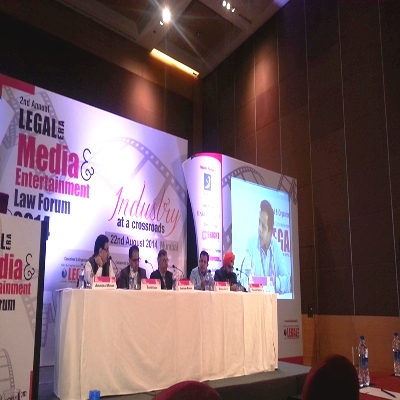
    These were the major points of discussion at the 2nd Legal Era Media & Entertainment Law Forum, where legal counsels for various broadcasters, emphasised on how the regulatory regime in India is very backward. A normal broadcaster today has to go through the tedious task of applying to the Ministry of Information and Technology (MIB), Department of Space (DoS) and WPC approvals. As per statistics, at present approximately 800 files for channel licence is pending with the MIB and some 600 with the DoS.


    Stressing on the rise of technology, Zee Entertainment Enterprises Limited (Zeel) director corporate Amitabh Kumar said that by the year 2020 linear transmission of channels will be replaced by video on demand (VoD). Kumar also stressed on the need for change in the way licences are given to broadcasters. “The broadcasters’ licence should have provision for VoD, VOIP etc. There should also be a provision, as per which the licence services should be allowed to expand, with no entry fee. The regulatory body must have scope for widening the ambit of services for lifetime,” opined Kumar.


    For Kumar, the regulators need to be pro-active rather than reactive to the new technology advancements.


    Content consumption is undergoing change. “Content cannot be controlled, it can be self regulated, which is working beautifully,” informed Viacom 18 Media group general counsel Sujeet Jain. He also brought to the fore how the functioning of Broadcast Content Complaints Council (BCCC) had forced even the I&B to retract from interfering in the content. “Government should completely take its hands off content,” he added.


    Agreeing with Jain was Singh and Singh Law Firm LLP partner Tejveer Bhatia who said that tariff of the VoD content should not be regulated. “If consumer is demanding a particular kind of content, the media industry should have the freedom to decide the tariff. There cannot be a benchmark on the demanded content,” informed Bhatia.


    According to Star India president and general counsel, legal and regulatory affairs Deepak Jacob the quality of content is directly proportional to the money spent on it. “If we want to produce high quality content for linear TV, there is cost that is attached to it. While in the past 15 years, the ARPUs have remained flat at Rs 150 to Rs 200 and the broadcasters’ fair share of this has also remained the same, the content cost has increased 20 times. So Rs 1 lakh per episode expense, 15 years ago, has today gone up to Rs 15 lakh to Rs 20 lakh per episode,” informed Jacob.


    Jacob also questioned the whole ‘must provide’ clause that was introduced by the Telecom Regulatory Authority of India (TRAI). “All this will kill broadcasters. What is the incentive that a broadcaster is getting for creating content for mobile devices or other platforms?” questions Jacob.


    Another important point raised during the panel discussion was that unlike in the US and UK, where channels are sold as events, in India, this arrangement doesn’t exist. “We should be moving towards a regime, where consumers can subscribe to events and not channels. And the subscription should allow one to view the content not only on TV but mobile, tablet or computer also. Content, not channel should be highlighted and consumers should be able to pay for content,” said Kumar.


    According to Jain, while with change in technology, the format and consumption pattern of the content will change, but the content will remain the same.  “The regulation has to incorporate this aspect and there should be a level playing field,” he opined.


    The panelists also suggested that a lot of licencing should go away and what the government should really look at, while moving towards convergence is providing ease of access. “The Prime Minister is talking about making broadband available across the country, but for this access will be needed,” said Jain.  He also highlighted the need for strict laws against piracy. “Taxation needs to be rationalised in order to give fillip to the sector. That apart, ministries will have to merge so that entire ecosystem can merge,” opined Jain.


    The session also touched upon the issue of carriage fees and if there was any end to it. According to Jacob, while carriage fee, which is an artificially created monster needs to vanish, placement fee is something which will not cease to exist. “Placement is an individual choice that broadcasters make. It will be unfair of broadcasters to expect a certain number of LCN, without incentivising the MSO,” he concluded. 

  • Meeting of expert committee on WIPO early next month

    Meeting of expert committee on WIPO early next month

    NEW DELHI: The first meeting of the expert committee constituted earlier this year for the protection of broadcasting organisation at the World Intellectual Property Organisation (WIPO) will be held on 2 September.


    The aim is to discuss with members from broadcasting organisations and broadcasters to examine and articulate the stand being taken by India.


    The meeting will discuss the text of the broadcasting treaty and proposals submitted by India during the 26th SCCR; discussion on the informal proposal submitted by Japan; discussion on the proposal submitted by European Union and discussion on the formats circulated by WlPO secretariat. 


    The members of the committee include representatives of all the concerned Ministries, representatives of the News Broadcasters Association and Indian Broadcasting Foundation, the radio industry, the film industry, Prasar Bharati, Amit Shukla who is Director (Copyright) in the Registrar of Copyrights (copyright division) of the Department of Higher Education; BECIL; the Advertising Standards Council of India (ASCI); Centre for Media Studies (CMS); Community Radio Forum; Community Radio Association; Association of Regional Television Broadcasters of India; School of Legal Studies in Cochin; Cine & TV Artistes Association; the Film Federation of India; the Indian Music Industry and the Film & TV producers Guild of India.

  • Only pay TV channels to facilitate feed to EMMC by 25 August

    Only pay TV channels to facilitate feed to EMMC by 25 August

    NEW DELHI: The Government has clarified that free to air television channels are not required to provide one set of professional IRD for each TV channel which can give SD-SDI output (in case the channels are HD then HD-SDI output) along with one spare IRD per bouquet to the electronic media monitoring cell (EMMC) by 25 August.


    Issuing a second reminder to the broadcasters, the Information and Broadcasting (I&B) Ministry said that pay TV broadcaster / service provider should provide viewing card (VC) with matching CAM module for interface with demodulators to decrypt and demodulate the channels over lP.


    This reminder by the I&B Ministry is in furtherance of the earlier letter of 22 July and letter of 14 August.


    The Ministry informed all TV channels that any failure to provide the module to EMMC within the time schedule will be viewed seriously.


  • DAS deadline extended to December 2015

    DAS deadline extended to December 2015

    NEW DELHI: The deadline for the digitisation of cable television systems in the entire country has been put off to December 2015.


    While Phase I of digital addressable system (DAS) came into effect in March last year and Phase II later in the year, the entire process was supposed to be completed by December this year.


    Information & Broadcasting Ministry secretary Bimal Julka speaking exclusively to  indiantelevision.com said that the government had decided to delay the digitisation deadline by a full year in order to give all those involved enough opportunity to overcome all the unseen hurdles that had come up after the UPA government mandated  DAS and the various analogue sunset dates.


    He said that the previous UPA  government had failed to complete all the required work with regard to regulations, licences, permissions etc and so the current NDA government’s  I&B Minister Prakash Javadekar – after consulting all the stakeholders – has decided to put off the final date by one year.


    Julka was confident that digitisation would be completed  well before the end of 2015, but said the new last date had been set keeping in mind the various issues that need resolution.


    Earlier, the Ministry had said Phase III covering all urban areas (Municipal Corporations/Municipalities) would be digitised by 30 September 2014 and Phase IV covering the rest of India would be digitised by 31 December 2014.


    The DAS process had led to several problems including court cases in various parts of the country. In the first phase for the four metros, Chennai could not be covered because of a stay by the Madras High Court. The second phase covered 38 cities with populations of more than one million. However, reports say that analogue systems are still working not only in the metros but also in these cities.


    Furthermore, cable operators feel that the set top boxes being imported are of inferior quality with very few facilities for servicing. The MSOs went to the Telecom Disputes Settlement & Appellate Tribunal (TDSAT) challenging the ratio of profit sharing between the various stakeholders. And TDSAT has been flooded with litigation involving broadcasters, MSOs, LCOs and DTH operators over the past year and a half – coinciding with the government’s thrusting digitisation down the throats of those involved in India’s relatively unorganised cable TV ecosystem. 


    Julka said that all these issues had been taken into consideration before taking the decision to put off DAS by a year.