Category: Regulators

  • Jaitley launches mobile app of the GoI calendar 2015 for the first time

    Jaitley launches mobile app of the GoI calendar 2015 for the first time

    MUMBAI: Two of the biggest initiatives taken by the new government since it took charge in June this year have been – Swachch Bharat and Digital India.

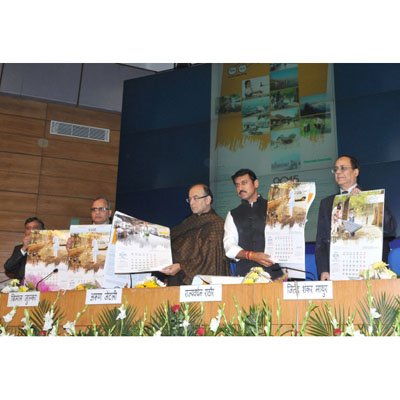
    And taking the philosophy forward in the coming years will be the new calendar launched by the government. The calendar was unveiled by Union Minister for Finance, Corporate Affairs and Information and Broadcasting Arun Jaitley.

    The calendar combines the conventional and technological modes of communicating the initiatives of the government. While the theme of ‘Swachh Bharat’ is portrayed visually in the conventional mode, the mobile application of the calendar reiterates the government’s vision of taking the idea of ‘Digital India’ forward.

    Jaitley said, “The digital version of the calendar 2015 reflects the vision of the government in taking forward the benefit of technology in information dissemination as no one could defy the growth and movement of technology. Technology today was operating on a real time basis.”

    The Minister also lauded the efforts of Directorate of Advertisement and Visual Publicity, DAVP, for developing the digital version of the calendar with socially relevant messages which would be accessible on real time basis through mobile phones.

    The mobile app of the calendar provides access to the latest tweets from the PMO, the YouTube channel of the Ministry of Information and Broadcasting, and the news/updates on PIB website. In addition to being a window for all websites of government of India, this informative application would serve as a planner to the users bringing news updates from AIR and DD News. The app was developed for android platforms initially which would be made available on other mobile platforms also in due course of time.

    The calendar has been developed on the theme of “Clean India Green India” with focus on “Swachhta” and environment issues. For instance, the January page of the calendar displays the launch of the “Swachh Bharat Mission by Prime Minister Narendra Modi.”

    Minister of State for Information and Broadcasting Rajyavardhan Rathore, and Ministry of I&B secretary  Bimal Julka along with senior officials of the I&B Ministry were also present at the unveiling.
     

  • I&B issues reminder to TV channels on format for Home Ministry Security clearance

    I&B issues reminder to TV channels on format for Home Ministry Security clearance

    NEW DELHI: The Information and Broadcasting Ministry has reminded television channels to apply by 26 December for fresh security clearance for 10 years.

    In view of new clearances and those who need fresh security clearance for next 10 years, the Government last month set out the format in which applications should be sent by news and non-news television channels seeking Home Ministry security clearance to uplink or downlink.

    The applications have to be sent to the Information and Broadcasting Ministry.

    The companies owning channels have to furnish the details of the company and its Board of Directors (in four additional sets) in the prescribed format listed out in the Ministry’s website mib.nic.in.

     The details required are of the company/firm for whom clearance is sought; names of firms/bidders, registered office address, date of incorporation, details of the Directors/Key Executive in respect of whom clearance is sought, name/parentage, date of birth, present position held and complete address including e-mail and websites etc.


  • 400 cable operators demonstrate outside I&B Ministry

    400 cable operators demonstrate outside I&B Ministry

    NEW DELHI: Senior officials of the Information and Broadcasting Ministry met members of the Indian Broadcast Foundation (IBF) and the News Broadcasters Association (NBA) along with other stakeholders to discuss hurdles in the way of digitisation of cable television.

    The discussion primarily centered on carriage fee and the format of agreements between the various stakeholders including subscribers.

    The broadcasters were emphatic that carriage fee should be done away with it. Senior officials including joint secretary (broadcasting) Sanjay Murthy agreed to consider the various issues that were raised at the meeting.

    A ministry source told indiantelvision.com that the meeting was part of a series that was being organised to ensure smooth switch over to digital addressable systems.

    Around 400 local cable operators, who are members of Cable Operators Welfare Federation (COWF) demonstrated outside Shastri Bhavan, which houses the ministry, to gain entry and express their point of view at the meeting. Around 150 of them were later detained by the police and taken to Parliament Street police station where they were later let off.

    The ministry source, however, said that local cable operators (LCOs) who are the members of the taskforce had been invited to the meeting but only one of them had attended.


  • Commercial and non-commercial subscribers should have different tariff under DAS: IBF

    Commercial and non-commercial subscribers should have different tariff under DAS: IBF

    NEW DELHI: The Indian Broadcasting Foundation (IBF) has said that the Digital Addressable System (DAS) tariff order was violative of Article 14 of the Constitution as it equated ‘equals with unequals.’

     
    Abhishek Malhotra told the Telecom Disputes Settlement and Appellate Tribunal (TDSAT) that the stand taken by the Telecom Regulatory Authority of India (TRAI) was also contrary to the stand taken by it over the last 10 years.
    He said that commercial subscribers could not be charged at the same rate as other subscribers who received television signals in their homes.

     
    The bench was hearing the petition by IBF challenging the DAS tariff order issued in July by TRAI relating to commercial subscribers.

     
    In the tariff order, TRAI had said that commercial establishments who do not specifically charge its clients/guests on account of providing/showing television programmes and offer such services as part of amenities are to be treated like ordinary subscribers wherein the charges would be on per television basis.

     
    In cases where commercial subscribers specifically charge its clients/guests on account of providing/showing television programmes the tariff would be as mutually agreed between the broadcaster and the commercial subscriber.

     
    TRAI had also said that the commercial subscriber was to obtain television service only from a distribution platform operator (MSO/DTH Operator/IPTV operator/HITS operator).

     
    The tariff order amendment has been brought out as per the directions of the Supreme Court. It is expected that with the coming into force of these changes in the regulatory framework, the distribution of TV services to the commercial subscribers would be streamlined and the services would be available to them at competitive rates.


  • I&B Ministry invites ideas for National Centre of Excellence in Animation, Gaming and Visual Effects

    I&B Ministry invites ideas for National Centre of Excellence in Animation, Gaming and Visual Effects

    NEW DELHI: Stakeholders wanting to invest in the National Centre of Excellence in Animation, Gaming and Visual Effects have been requested to submit proposals based on which a detailed project report would be prepared for further action.


    Information and Broadcasting Ministry sources told indiantelevision.com that the Centre is to be set up under the 12th Plan scheme.


    The Planning Commission has given in-principle approval to the project. The objective of the scheme is to impart quality education and to ensure availability of skilled manpower.


    The scheme would also ensure increasing ownership of Intellectual Property by Indians in animation/gaming/visual effect sector leading to increased revenues, employment generation, cultural pay-off and a subtle leveraging of India’s soft power in the global arena.


    The size of animation, visual effects and post production industry in India, according to FICCI-KPMG Report 2014, is Rs 39.7 billion in 2013, with a growth of 12.4 per cent in the year 2014.


    Out of this, the share of animation services and animation production comes to Rs 12.7 billion in 2013. It is projected that the Cumulative Annual Growth Rate (CAGR) in animation services and animation production for the period 2013-2018 would be 7.1 per cent.


  • Electronic Media Monitoring Centre to go up to 1500 channels by 2017: Rathore

    Electronic Media Monitoring Centre to go up to 1500 channels by 2017: Rathore

    NEW DELHI: The government hopes to increase the capacity of the state-of-art Electronic Media Monitoring Centre (EMMC), which currently monitors around 300 television channels, to 1500 by 2017.

     
    Minister of State for Information and Broadcasting Rajyavardhan Singh Rathore told Parliament that these 300 channels are chosen randomly out of the 839 channels beaming into Indian homes.

     
    He said that the aim was to first achieve the target of monitoring 600 channels within the next few months, while answering a question about reality shows playing with the sentiments of the people.

    In a reply to a supplementary question about young children being used in dance shows, Rathore said that there are a large number of channels and there is undoubtedly a race to attract as many eyeballs as possible. Therefore, most of these channels, no doubt, are walking a very thin line and working in that grey area. However, there is a freedom of expression. Therefore, the government does not want to impinge on the freedom of expression. Keeping in mind the morality, decency and various levels of acceptance on television, certain guidelines have been issued. “What the Ministry can say is that we will issue advisories and we will also take into account any complaint that comes,” he said.


    He also said that a Task Force had earlier been set up to work on a regulatory body but the channels had opposed this and wanted self-regulation.

     
    Answering the main question, I&B Minister Arun Jaitley said no fact had been brought to the notice of the government alleging shows playing with sentiments of the people. However, the content carried on private satellite TV channels is regulated according to the provisions of the Programme and Advertising Codes contained in the Cable Television Network Rules 1994 and the Cable Television Network (Regulation) Act 1995. The rules provide for a whole range of parameters to regulate programme and advertisements on TV channels including the reality shows.

     
    The programme code says that no programme should be carried which (a) offends good taste or decency (b) contains anything obscene, defamatory, deliberate, false and suggestive innuendos and half truths (c) criticizes, maligns or slanders any individual in person or certain groups, segments of social, public and moral life of the country (d) denigrates women through the depiction in any manner of the figure of a woman, her form or body or any part thereof in such a way as to have the effect of being indecent or derogatory to women, or is likely to deprave, corrupt or injure the public morality or morals (e) denigrates children (f) is not suitable for unrestricted public exhibition (g) is unsuitable for children.


    Action is taken against defaulting channels whenever any violation of the said codes is noticed or brought to the notice of the Ministry.


    The Ministry also has an Inter Ministerial Committee (IMC) to look into the violations of the Programme and Advertisement Codes. IMC has representatives from the Ministry of Home Affairs, Defence, External Affairs, Law, Women and Child Development, Health and Family Welfare, Consumer Affairs and a representative from the industry in Advertising Standards Council of India (ASCI). IMC meets periodically and recommends action against violations.


    Besides, as part of self-regulation by industry, Indian Broadcasting Foundation (IBF), which is a representative body of non-news and current affairs TV channels, has set up Broadcasting Content Complaints Council (BCCC) to examine the complaints about television programmes.


  • Issue on surrogate advertising of liquor brands in print media pending  with I&B Ministry

    Issue on surrogate advertising of liquor brands in print media pending with I&B Ministry

    NEW DELHI: There have been nine complaints including four in the electronic media since 2011 relating to advertisements of tobacco and liquor, Parliament was told today.

     
    Minister of State for Information and Broadcasting Rajyavardhan Singh Rathore said warnings were issued to two channels – ET Now and Star Cricket in 2012 and an advisory was issued to FTV in January last year, all relating to liquor advertisements.

     
    In the fourth case, the advertisement being aired on several channels in 2011 was taken off after an advisory by the Advertising Standards Council of India.

     
    While four cases were closed by the Press Council of India with regard to the print advertisements, one matter relating to surrogate advertisements has been under the consideration of the government since March 2013.

     
    The Press Council of India has formulated ‘Norms of Journalistic Conduct’ for adherence by the media and the relevant norm 36(ii) relating to ‘Advertisements’ prescribes that no advertisement shall be published, which promotes directly or indirectly production, sale or consumption of cigarettes, tobacco products, wine, alcohol, liquor and other intoxicants. The PCI takes cognizance, suo motu or on complaints, of the contents in print media which are in violation of the ‘Norms of Journalistic Conduct’.


    In so far as private satellite TV channels are concerned, all advertisements telecast on such channels are regulated in accordance with the Advertising Code prescribed in Rule 7 of the Cable Television Network Rules, 1994. As per Rule 7(2)(viii)(A) thereof, no direct or indirect advertisements of liquor or tobacco products are permissible on TV channels. The detailed provisions of the Rule are available on Ministry of Information and Broadcasting website www.mib.nic.in.


    An Inter-Ministerial Monitoring Committee has been constituted in the Ministry of Consumer Affairs, Food and Public Distribution to monitor misleading advertisements appearing in print and other outdoor media.


  • Govt does not have details of revenue generated by sale of CAS, DAS: Rathore

    Govt does not have details of revenue generated by sale of CAS, DAS: Rathore

    NEW DELHI: The Government has said that there was no provision under the present digital addressable system regulations or the Cable Television Networks (Regulation) Act 1995 for any assistance or relief to cable TV subscribers to buy set top boxes (STBs).

     
    Minister of State for Information and Broadcasting Rajyavardhan Singh Rathore has told the Parliament that the Ministry had assessed the requirement of STBs to be installed at the customer premises, based on Population Census 2011.

     
    Thus, a total of 140 million STBs were required to implement cable TV digitisation in the country. Out of this, 30 million STBs had already been installed under phase I and phase II and the balance 110 million are required to be installed in the remaining two phases which are under implementation.

     
    He said the Ministry does not make any assessment with regard to quantum of revenue generation arising out of sale of CAS and DAS.

     
    He said according to a notification issued on 11 November 2011 issued by the Ministry, digitisation of cable TV in India is to be completed in four phases. Phase I and phase-II of digitisation have already been completed.

     
    Phase III is to be completed by 31 December 2015 whereas phase IV is to be completed by 31 December 2016.


  • TRAI to levy financial disincentives for violating QoS norms for DAS

    TRAI to levy financial disincentives for violating QoS norms for DAS

    NEW DELHI: The Telecom Authority of India (TRAI) plans to levy financial incentives on non-compliant multi-system operators and local cable operators by amending the Standards of Quality of Service (Digital Addressable Cable TV Systems) Regulations.

    Information and Broadcasting Ministry sources told indiantelevision.com that the aim was to ensure transparent business practices and promote efficiency in order to help the consumer.

     TRAI had released a consultation paper in August for amending the QoS Regulations of 2012, and the replies received by stakeholders and consumers is currently under examination.

     The sources said that the government’s decision to digitise the cable TV network is an enabler to protect the interests of the consumers and for the government to realise designated revenue from the sector.   

     The QoS Regulations lay down quality of norms to be adhered to by the service providers, which include the norms for billing of subscribers of DAS Cable TV systems, issue of receipt for every payment made by a subscriber etc.


  • Petition challenging TRAI tariff on DAS to be heard on 8 December

    Petition challenging TRAI tariff on DAS to be heard on 8 December

    NEW DELHI: The Telecom Disputes Settlement and Appellate Tribunal (TDSAT) will hear the petition by the Indian Broadcasting Foundation (IBF) challenging the DAS tariff order issued in July by the Telecom Regulatory Authority of India (TRAI) relating to commercial subscribers on 8 December.

    The matter was to be heard in the Tribunal on 5 December but was pushed for next week because the bench was busy dealing with another part-heard case.

     In the last hearing in October, Counsel Abhishek Malhotra, who represents the IBF, had wanted time to file a rejoinder to the reply filed by TRAI following a notice in this regard in September.

     In the tariff order, TRAI had said commercial establishments, who do not specifically charge its clients/guests on account of providing/showing television programmes and offer such services as part of amenities, are to be treated like ordinary subscribers wherein the charges would be on per television basis.

     In cases where commercial subscribers specifically charge its clients/guests on account of providing/showing television programmes, the tariff would be as mutually agreed between the broadcaster and the commercial subscriber.

     TRAI had also said that the commercial subscriber was to obtain television service only from a distribution platform operator (MSO/DTH Operator/IPTV operator/HITS operator).

     The tariff order amendment has been brought out as per the directions of the Supreme Court. It is expected that with the coming into force of these changes in the regulatory framework, the distribution of TV services to the commercial subscribers would be streamlined and the services would be available to them at competitive rates.