Category: Regulators

  • JS Mathur promoted as special secretary in I&B Ministry

    JS Mathur promoted as special secretary in I&B Ministry

    NEW DELHI: Senior Indian Administrative Service (IAS) officer Jitendra Shankar Mathur has been promoted as Special Secretary in the Information and Broadcasting Ministry.


    Mathur was until now serving as additional secretary in the same Ministry and was also heading the Task Force for the Digital Addressable System (DAS) for the final two phases. He was also overseeing the auction of the first stage of FM Phase III.


    An officer from Madhya Pradesh cadre in the 1982 batch, Mathur now joins the Selection Grade.


    His tenure on deputation to the Centre ends on 30 October this year.


    The post of special secretary is often referred to as officer-in-waiting for appointment as secretary in the Union Government.

  • FM Phase III 1st stage comes to a close with bids for 97 channels in 56 cities

    FM Phase III 1st stage comes to a close with bids for 97 channels in 56 cities

    NEW DELHI: Clocking just one round as compared to four daily rounds on the 33rd day, the first stage of the FM Phase III channel allocation stage has been closed with 97 channels in 56 cities became provisional winning channels with cumulative provisional winning price of about Rs 1156.9 crore against their aggregate reserve price of about Rs 459.8 crore.


    While there were no bids for FM channels in 13 cities, there was no activity even the smaller 31 cities that have so far got bids of Rs 1 – 9 crore.


    However, the government, which had said the e-auction would continue as long as there was even one bidder – claimed that over 71 per cent channels of the first batch were provisionally won by bidders.


    Thus, the summation of provisional winning prices surpassed the cumulative reserve price of the corresponding 97 channels by Rs 697.05 crore or 151.58 per cent.


    Overall, cumulative provisional winning price exceeded the total reserve price of the first batch – Rs 550.18 crore – by Rs 606.72 crore or 110.27 per cent. 


    At the top are three cities namely Delhi at Rs 169.16 crore for one channel, Mumbai at Rs 122.81 crore for two channels and Bengaluru at Rs 109.25 crore for one channel.


    The position is the same for other cities having got bids of more than Rs 10 crore with Chennai at Rs 53.38 crore, Ahmedabad at Rs 42.68 crore, Pune at Rs 42.03 crore, Jaipur at Rs 28.34 crore, Chandigarh at Rs 19.04 crore, Hyderabad at Rs 18 crore, Patna at Rs 17.89 crore, Varanasi at Rs 17.49 crore, Cochin at Rs 15.04 crore, Nasik at Rs 14.66 crore, Lucknow at Rs 14 crore and Jodhpur at Rs 11.44 crore. Kolhapur was not very far behind with a bid above Rs 9 crore at Rs 9.44 crore.


    Cities like Guwahati, Bhubaneshwar and Jodhpur witnessed robust bidding activity with provisionally won price being as high as 800 per cent over the reserve price for their channels. Overall, 18 cities got provisionally won bidders for their channels at prices more than double the respective reserve prices. The winning price rose by more than 100 per cent above their respective reserve prices in Ahmedabad, Amritsar, Aurangabad, Bengaluru, Jaipur, Jodhpur, Kolhapur, Nasik, Patna, Pune, Rourkela and Varanasi, all of which got provisional winning bidders at prices more than double the respective reserve prices.


    The cumulative winning price is exclusive of the migration fee, which will take the total revenue even higher, sources in the Information and Broadcasting Ministry said.


    The government said e-auction of the first batch consists of two stages – channel allocation stage, and frequency allocation stage. After the channel allocation stage, the frequency allocation stage will commence tomorrow.


    During this stage, the provisional winning bidders will be allowed to select FM frequency for the winning channel from the frequencies already identified in the respective city and as mentioned in the notice inviting applications of 2 March, 2015 read with its subsequent amendments.


    Frequency selection preference would be based upon the rank of the bidders: that is, Rank 1 bidder would have the first preference to choose from the frequencies already identified. It may be noted that all the identified frequencies were made available for selection and included in the NIA.


    After the e-Auction process is over, the government will notify the list of successful bidders.


    The Auction Activity Requirement rose to 100 per cent after the 59th round on 14 August, after being 90 per cent after the 37th round on 7 August.


    The 13 cities that eluded bidders are Asansol, Gulbarga, Mangalore, Mysore, Puducherry, Rajahmundry, Siliguri, Tiruchy, Tirunveli, Tirupati, Tuticorin, Vijaywada and Warangal.


    The demand in most cities fell by up to three per cent and by four per cent below the excess demand at the price in the 124th round in Hyderabad.
  • TRAI issues separate tariff for commercial subscribers under DAS & non-DAS areas

    TRAI issues separate tariff for commercial subscribers under DAS & non-DAS areas

    NEW DELHI: The Telecom Regulatory Authority of India (TRAI) today issued separate tariff orders for commercial subscribers under digital addressable systems (DAS) and non-DAS areas.


    TRAI described a “commercial subscriber” as one “who causes the signals of TV channels to be heard or seen by any person for a specific sum of money to be paid by such person.” 


    The definition is contained in two Tariff Amendment Orders (TAO) relating to TV services for commercial subscribers, one applicable for TV services being provided through analogue cable TV systems (Non-CAS areas) and the other one applicable for TV services being provided through Digital Addressable cable TV systems were notified today.


    The amendments are to the Telecommunication (Broadcasting and Cable) Services (Second) tariff (Twelfth Amendment) order & the Telecommunication (Broadcasting and Cable) Services (Fourth) (Addressable Systems) Tariff (Fourth Amendment) order.


    For definition of ordinary subscriber, the notification simply says anyone who is not a commercial subscriber under its definition is an ordinary subscriber. 


    Total forbearance has been prescribed both at the wholesale and retail level with respect to tariffs for commercial subscribers and broadcasters have the option to enter into tripartite agreements with the Distribution Platform Operators (DPOs) and the commercial subscribers, if so desired.


    The order says that a broadcaster will offer all its pay channels, for commercial subscribers on a-la-carte basis to distributors of TV channels, and may specify separate a-la-carte rate for each pay channel.


    This is provided the broadcaster may also offer all its pay channels as part of bouquet consisting of pay channels or both pay and free to air (FTA) channels and specify the rate for each such bouquet of channels offered by it; and a broadcaster may enter into a tripartite agreement with the distributors of TV channels and the commercial subscribers for supply of signals of TV channels to the commercial subscribers.


    Broadcasters have been mandated to offer their channels or bouquet of channels for commercial subscribers on non-discriminatory terms and conditions. 


    Broadcasters have also been mandated to file their tripartite agreements, if such agreement is done with commercial subscribers, with TRAI within 30 days of entering into such agreement.


    TV signals to commercial subscribers have to be provided by DPOs only in accordance with policy guidelines for up-linking and down-linking of television channels.


    Following directions by the Telecom Disputes Settlement and Arbitration Tribunal (TDSAT) on 9 March that there was need for a fresh look at tariff orders, TRAI had issued a new paper on “Tariff issues related to Commercial Subscribers.” Stakeholders had been asked to give their comments by 31 July and counter-comments by 7 August and had then held an Open House on 18 August.


    The case in TDSAT had been filed by Indian Broadcasting Foundation (IBF) and others last year. The tariff orders challenged by IBF were issued on 16 July last year following the Supreme Court’s order of 16 April, 2014.


    TRAI said in a press release that it “expected that with the coming into force of these changes in the regulatory framework for commercial subscribers, distribution of TV services to commercial subscribers would be streamlined and would be available to them at competitive rates. It is also envisaged that it would balance the interests of all the stakeholders in the value chain and bring in complete transparency in the business transactions.”


    In the consultation paper, TRAI had asked commercial subscribers whether there is need to define and differentiate between domestic and commercial subscribers for provision of TV signals and the basis for such classification. TRAI wanted to know how it can be ensured that TV signal feed is not misused for commercial purposes wherein the signal has been provided for non-commercial purpose.


    It had also asked if there is a need to have a different tariff framework for commercial subscribers (both at wholesale and retail levels) and what should be the suggested tariff framework for commercial subscribers (both at wholesale and retail levels).

  • Ad cap case to be heard on 23 September, news channels seek clarity on MIB stand

    Ad cap case to be heard on 23 September, news channels seek clarity on MIB stand

    NEW DELHI: The challenge to the advertising cap of 12 minutes per hour by the News Broadcasters Association (NBA) and others in the Delhi High Court will be heard on 23 September.

    The NBA sought adjournment on the ground that it wanted to discuss the issue with the Information and Broadcasting (I&B) Ministry to seek certain clarifications.

    According to information available with Indiantelevision.com, this comes in the wake of a statement made by I&B Minister Arun Jaitley in January this year that there should be no ad cap in the print or electronic media.

    The order that the Telecom Regulatory Authority of India (TRAI) will not take action against any channel pending the petition will continue. In an earlier hearing, the Court had, at the regulator’s instance, directed that all channels keep a record of the advertisements run by them.

    The NBA had challenged the ad cap rule, contending that TRAI does not have jurisdiction to regulate commercial airtime on television channels.

    Apart from the NBA, the petition has also been filed by Sarthak Entertainment, Pioneer Channel Factory, E24 Glamoru, Sun TV Network, TV Vision, B4U Broadband, 9X Media, Kalaignar, Celebrities Management, Eanadu Television and Raj Television.

    The news and regional broadcasters fear that the capping of commercial airtime will curtail their ad revenues. They also argue that the ad cap must be brought only after the benefits of cable TV digitisation start showing. 

    Meanwhile, TRAI recently released results of their records, which show that around 36 news channels apart from 105 General Entertainment Channels (GECs) have violated the ad cap by telecasting ads for more than 12 minutes an hour.

  • Complete Works of Mahatma Gandhi e-version prepared by Publications Division

    Complete Works of Mahatma Gandhi e-version prepared by Publications Division

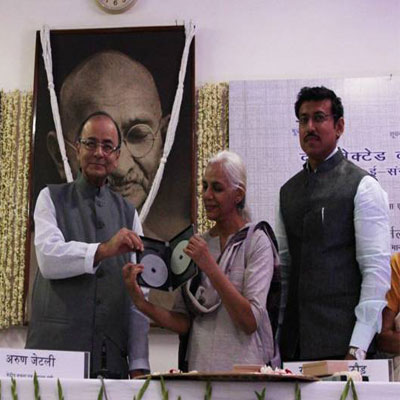
    NEW DELHI: The electronic version of the Collected Works of Mahatma Gandhi (CWMG), a monumental document of Gandhi’s words as he spoke and wrote day after day beginning from 1884 till 30 January, 1948 was released today by Information and Broadcasting Minister Arun Jaitley at Gandhi Peace Foundation.


    The e-version was also uplinked on the Gandhi Heritage Portal, a comprehensive repository of authentic Gandhiana. The portal hosts e-CWMG in a searchable PDF format to ensure easy and free accessibility of the CWMG for people across the world.


    Jaitley announced that the Hindi version of the monumental work CWMG (Sampoorna Gandhi Vangmaya) would be digitised soon. Minister of State (I&B) Rajyavardhan Rathore, Secretary (I&B) Sunil Arora and members of the Expert Committee were present on the occasion. 


    Speaking on the occasion, Jaitley said the intrinsic and heritage value of the e-CWMG Project had the collaboration and partnership of institutions that have been founded and nurtured by Gandhiji himself. Jaitley said that this digitised version of the CWMG would be instrumental in preserving the valuable national heritage and disseminating it for all humankind. 


    Arora said in order to preserve the invaluable heritage of Gandhi and make it available to future generations for all times to come, the Publications Division had taken up the task of preparing the e-version of the 100 volumes of GWMW in 2011. He added that in order to maintain the authenticity of this important work, it was decided to have a facsimile-based version in electronic form for preservation. It was also decided to make it into a searchable master copy in PDF format so that people could benefit of Gandhi’s life and thought in a simple and easy manner.


    The CWMG, published by the Publications Division, is a monumental document of Gandhi’s words, which he spoke and wrote in the period 1884 to 1948. In this series, his writings, scattered all over the world, have been collected and constructed ethically and with stringent academic discipline and loyalty.


    The CWMG took about 38 years in the making (1956-1994). They are a series of one hundred volumes, running into over 55,000 pages, intricately connected across the series, as an integrated whole. The CWMG-original-KS-edition volumes were published in the years 1956 to 1994.The Electronic Master Copy (Volumes 1 to 100) recently prepared is in the form of a searchable PDF beta version, matched with the original-KS-edition fully verified with the original source-documents. It retains the original architecture – volume structure, font structure, line structure, page structure – including its visual look – fully and loyally.


    The task of preparing the Electronic Master Copy of the CWMG-original-KS-edition has been accomplished by the Gujarat Vidyapith, Ahmedabad, India on behalf of DPD.  Execution of the task involved an intensely focused, organic, and stringently supervised effort over a period of four years.  A Committee of three experts constituted for the purpose of supervising this work had the following eminent Gandhian scholars: Gujarat Vidyapeeth former VC Prof. Sudarshan Iyengar, Sabarmati Ashram Preservation & Memorial Trust director Prof. Tridip Suhrud and renowned Gandhian Schola Dinaben Patel.

  • Day 31: All top winning cities show bids lower than clock round price in FM Phase III

    Day 31: All top winning cities show bids lower than clock round price in FM Phase III

    NEW DELHI: There was virtually no activity on the 31st day in the FM Phase III e-auctions with the cumulatve winning price at the end of the 124th round rising by just Rs 10 lakh to Rs 1156.9 crore.


    The smaller 31 cities that have so far got bids of Rs 1 – Rs 9 crore will call the shots as there appear to be no bidders for the larger cities.


    The overall cumulative provisional winning price has risen over the total reserve price of the first batch of 135 FM channels in 69 existing cities – Rs 550.18 crore – by Rs 606.72 crore or 110.27 per cent.  


    However, apart from the fact that 13 cities have not got a single bidder despite a month having passed, it is interesting that all the cities whose prices have remained static for a long period have in fact got bids lower than the clock round price (given in brackets in each case): Delhi – Rs 169.16 crore (Rs 170.86 crore) for one channel; Mumbai – Rs 122.81 crore (Rs 124.04 crore) for two channels; and Bengaluru – Rs 109.25 crore (Rs 110.34 crore). 


    The same also stands true for other cities having got bids of more than Rs 10 crore namely: Chennai at Rs 53.38 crore (Rs 53.92 crore), Ahmedabad at Rs 42.68 crore (Rs 43.11 crore), Pune at Rs 42.03 crore (Rs 42.45 crore), Jaipur at Rs 28.34 crore (Rs 28.63 crore), Chandigarh at Rs 19.04 crore (Rs 19.23 crore), Hyderabad at Rs 18 crore (Rs 18.18 crore), Patna at Rs 17.89 crore (Rs 18.07 crore), Varanasi at Rs 17.49 crore (Rs 17.66 crore), Cochin at Rs 15.04 crore (Rs 15.80 crore), Nasik at Rs 14.66 crore (Rs 14.80 crore), Lucknow at Rs 14 crore (Rs 14.14 crore) and Jodhpur at Rs 11.44 crore (Rs 11.55 crore). 


    The number of channels remained the same – 97 channels in 56 cities, and the bids showed a minor rise in the cumulative reserve price by Rs 697.05 crore or 151.58 per cent against the aggregate reserve price of about Rs 459.8 crore. The Percentage Price Increment applicable for the Next Clock Round remained nil in all cities. 


    Cities expected to enter the Rs 10 crore club in the next few days appear to be Jodhpur, Kanpur, Rajkot, Amritsar, Madurai, and Aurangabad which have all got above Rs 6 crore each.


    The 13 cities eluding bidders are Asansol, Gulbarga, Mangalore, Mysore, Puducherry, Rajahmundry, Siliguri, Tiruchy, Tirunveli, Tirupati, Tuticorin, Vijaywada and Warangal.


    The demand in most cities fell by up to three per cent and by four per cent below the excess demand at the price in the 124th round in Hyderabad.
     

    The winning price has risen by more than 100 per cent above their respective reserve prices in Ahmedabad, Amritsar, Aurangabad, Bengaluru, Bhubaneshwar, Chennai, Delhi, Guwahati, Jaipur, Jodhpur, Kolhapur, Mumbai, Nasik, Patna, Pune, Rourkela and Varanasi, all of which got provisional winning bidders at prices more than double the respective reserve prices.

  • Day 30: 120 bidding rounds completed in FM Phase III e-auction

    Day 30: 120 bidding rounds completed in FM Phase III e-auction

    NEW DELHI: Activity was seen in just one small city – Bareilly – and there was virtually no bidding on the 30th day in the FM Phase III e-auctions with the cumulative winning price at the end of the 120th round rising by just Rs 20 lakh to Rs 1156.8 crore.


    Clearly the bids for all the big cities appear to be over and it is now the smaller 31 cities that have so far got bids of Rs 1 – 9 crore that will call the shots.


    The number of channels remained the same as yesterday – 97 channels in 56 cities, but the bids took the cumulative reserve price up to by Rs 696.8 crore or 151.5 per cent against the aggregate reserve price of about Rs 459.8 crore. 


    The cumulative provisional winning price has thus risen over the total reserve price of the first batch of 135 FM channels in 69 existing cities – Rs 550.18 crore – by Rs 606.6 crore or 110.2 per cent.


    Cities expected to enter the Rs 10 crore club in the next few days appear to be Jodhpur, Kanpur, Rajkot, Amritsar, Madurai, and Aurangabad, which have all got above Rs 6 crore each.


    Even after 30 days of bidding, 13 cities elude bidder. The demand in most cities fell by up to three per cent and by four per cent below the excess demand at the price in the 120thround in Hyderabad.


    The Percentage Price Increment applicable for the Next Clock Round rose to five in Bareilly, which had a bid of Rs 47,23,425. It remained nil in the other cities. 


    The e-auction will now re-commence on Monday, 7 September.

  • Siticable resumes inadvertently disconnected signals to Bhopal LCOs

    Siticable resumes inadvertently disconnected signals to Bhopal LCOs

    NEW DELHI: Siticable Networks has apprised the Telecom Disputes Settlement and Arbitration Tribunal (TDSAT) that it had resumed signals, which were inadvertently disconnected, to 119 local cable operators (LCOs) from Bhopal.


    Siticable Networks counsel Tejveer Singh Bhatia assured the Tribunal that the supply had been resumed.


    The Tribunal had two days earlier directed Siticable Networks not to disconnect the supply of signals to 119 cable operators represented by the Bhopal Cable Operators’ Association.


    TDSAT chairman Aftab Alam and members Kuldip Singh and BB Srivastava had passed the order after a statement made by the LCO association’s counsel Nittin Bhatia that all due payments had been made.


    Bhatia had said the LCOs have made up-to-date payments as per the invoices issued by Siticable and continue to make payment at the rate at which invoices of June 2015 was issued.


    Bhatia told the Tribunal that he had the authorisation from 67 cable operators but would get these from the remaining 52 operators within a week.


    The Tribunal had said the status of any cable operator who is in dues will be determined on the basis of reconciliation of accounts and dues if any would be cleared within two weeks from the ascertainment of the said amount.


    The Tribunal had also said that the parties would be well advised to resolve their disputes through the process of mediation and directed both sides to appear before the Mediation Centre on 7 September.


    As was previously reported by Indiantelevision.com, the primary grievance of the Association was that the respondent was unilaterally and steadily increasing the monthly subscription fees payable by them. According to Bhatia, the cable operators paid the monthly subscription at the rate of Rs 30 per STB up to March 2013 and thereafter at Rs 60 per STB. Now the invoices being raised by the respondent are at the rate of Rs 83.11 (excluding taxes) for the package of channels supplied by it.

  • TDSAT adjourns Star India-Chennai LCO case following stay by Madras HC

    TDSAT adjourns Star India-Chennai LCO case following stay by Madras HC

    NEW DELHI: The Information and Broadcasting (I&B) Ministry has been spared the onus of explaining denial of digital addressable system (DAS) licence to the Tamil Nadu Arasu Cable TV Corporation Ltd (TACTV) following a Madras High Court order.


    The Telecom Disputes Settlement and Arbitration Tribunal (TDSAT) has adjourned sine die the hearing of the LCO Thamizhaga vs Star India case in which the Arasu question had arisen.


    The order by TDSAT chairman Justice Aftab Alam and members Kuldip Singh and BB Srivastava came on being informed by the Government counsel that a single judge of the High Court had on 28 August stayed the proceedings pending before the Tribunal.


    The Tribunal however gave liberty to the parties to bring to its notice any further development in the matter.


    On 14 August, TDSAT had asked the I&B Ministry to file an affidavit in a matter where the root issue was about the denial of DAS licence to TACTV. It also directed the Indian Broadcasting Foundation (IBF) to get impleaded in the case.


    At that time, TDSAT also said Star India, a respondent in the case filed by cable operator Thamizhaga Cable TV Communication, New Delhi, was free to negotiate with Arasu and other multi-system operators (MSOs) for areas in Chennai for DAS and outside Chennai for analogue transmission.


    At the same time, it said that there would be no disconnection of signals until the next date.


    However, the Tribunal had held that Arasu (TACTV) was guilty of transmitting television signals in Chennai – which had adopted DAS in the first phase – in analogue mode, and at the same time guilty of using Star signals in the metropolis without any authorization inter-connect agreement with Star India.


    The Tribunal was told by TACTV that it had applied for a DAS licence as far back as July 2012 but the government had failed to take a decision despite an order of the Madras High Court of December 2013 asking the Centre to take a decision on the application of TACTV for grant of its license “in the soonest possible time.”


    Noting that there is no compliance with the direction of the Court even after more than a year and half, the Tribunal had felt it was imperative to know the stand of the Government for a proper adjudication of the matter. 


    The Tribunal had not accepted the argument by TACTV in the last hearing that it had negotiated with Star India for the entire state since the Letter of Intent (LoI) was only for the rest of Tamil Nadu barring Chennai.

  • Day 29: One month on, focus stays on smaller cities in FM Phase III bidding

    Day 29: One month on, focus stays on smaller cities in FM Phase III bidding

    NEW DELHI: With virtually no bidding on the 29th day in the FM Phase III e-auctions with the cumulative winning price at the end of the 116th round to rising by just Rs 4 lakh from yesterday to Rs 1156.6 crore today, the focus now appears to be shifting to the 31 cities that have so far got bids between Rs 1 – 9 crore.


    Even this minuscule rise could be attributed to the fact that the number of channels went up by one to 97 channels in 56 cities, though the total bids remained the same as yesterday being above the cumulative reserve price by Rs 696.7 crore or 151.5 per cent against the aggregate reserve price of about Rs 459.8 crore.


    The cumulative provisional winning price has thus risen over the total reserve price of the first batch of 135 FM channels in 69 existing cities – Rs 550.18 crore – by Rs 606.4 crore or 110.2 per cent.  


    Cities in the corridors leading to the Rs 10 crore club appear to be Kanpur, Rajkot, Amritsar, Madurai, and Aurangabad, which have all got above Rs 6 crore each. 


    After almost one month of bidding, thirteen cities still continue to elude bidders. They are: Asansol, Gulbarga, Mangalore, Mysore, Puducherry, Rajahmundry, Siliguri, Tiruchy, Tirunveli, Tirupati, Tuticorin, Vijaywada and Warangal.


    The demand in most cities fell by up to three per cent and by four per cent below the excess demand at the price in the 116th round in Hyderabad.


    The Percentage Price Increment applicable for the Next Clock Round rose to five in Bareilly but was one in Jalgaon. There was no change in other cities.