Category: Regulators

  • ‘M&E industry’s $100 billion dream remains elusive with choking of investment:’ Star India COO Sanjay Gupta

    ‘M&E industry’s $100 billion dream remains elusive with choking of investment:’ Star India COO Sanjay Gupta

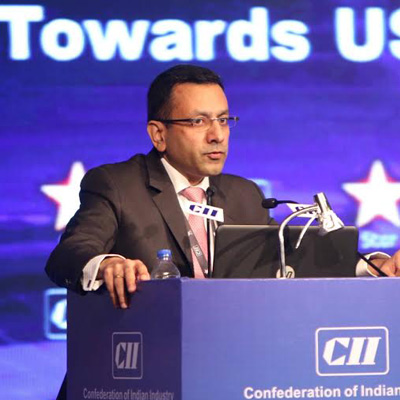
    MUMBAI: Despite the India Shining and Digital India waves that the country has been witnessing, the $100 billion dream has remained elusive for the Indian media and entertainment (M&E) industry.

    Speaking at a CII conclave in New Delhi today, Star India COO Sanjay Gupta lamented this fact that saying that from 0.8 per cent of GDP three years ago, the industry had resolved to grow to 1.5 per cent within a decade. However, in the past three years, media as a percentage of GDP has instead fallen by two basis points and the $100 billion dream has continued to remain distant.

    “The biggest hurdle has been the choking of investment. To meet ambitious targets, a business either needs to generate large profits internally, which are then invested back into the business or they grow on the back of external investments – national or international. But the M&E industry boasts of neither,” he said

    CII National Committee on Media and Entertainment and Group CEO, Viacom 18 Group CEO and CII National Committee on Media and Entertainment chairman Sudhanshu Vats, Prasar Bharati CEO Jawahar Sircar, Information and Broadcasting Ministry special secretary JS Mathur and Minister of State for Information and Broadcasting Rajyavardhan Singh Rathore were among those present at the summit.

    During the past 15 years, the M&E sector has barely seen any new entrants and only around $4 billion in foreign direct investment (FDI). To garner $100 billion, the industry needs to invest at least $50 billion over the next decade – something that seems farfetched, given the present circumstances. “With M&E remaining an unattractive destination for investments, investors have no interest to invest in a fragmented and unprofitable business. Despite the 12 per cent year-on-year growth touted for the industry, the sector is paradoxically riddled with a host of unprofitable verticals. For example, sports is a $2 billion industry that could easily grow to around $10 in the next five years. Be it Hockey, Football, Kabaddi or Badminton, the new sporting leagues are being lapped up by the audiences,” Gupta said.

    Yet, the M&E industry has been unable to take off on the back of these investments. “Although Star India has been investing almost Rs 200 crore every season for the past two years, dividends are not commensurate. For this to happen, one needs to scale up the volume of content. In other words, more teams, more players and more days of Kabaddi are required annually to capitalize on this opportunity,” Gupta added.

    “A bizarre challenge confronts us here, however. Although Punjab and Haryana contribute large numbers of Kabaddi players, one cannot add more teams based in either of these two states because they do not have a single indoor stadium that could host a Kabaddi match. In Mumbai, the game is hosted at the NSCI Dome, but the biggest constraint is the availability of this facility for a reasonably long period of time. One venue for a city with more than 1,000 Kabaddi clubs simply does not make sense. In this case, consumer interest and the ability to invest are no hurdles, but the fact that the sporting infrastructure required is simply non-existent. Worse, there are no plans to address this situation,” Gupta continued.

    The movie business is no different. With around 7,000 screens, India has one of the world’s lowest screen densities. Despite breakthrough movies such as Queen, PK or Bajrangi Bhaijaan, revenues are stagnant, although the cost of producing these movies has soared dramatically in the past decade. Therefore, a $2 billion industry that sets a billion hearts racing earns zero profits.

    Even news channels fare no better. Without a robust business model, news channel have no money to invest in their business. Whether English or regional, number one channel or last, none of the channels make any money because none earn any money from subscription. Globally, subscription contributes as much as 60-70 per cent of the total earnings of a news channel.

    Television distribution is roughly a third of the total value of the media industry. In the past few years, immense investments have been made in both direct to home (DTH) and the cable business. But the tragedy of this sector is that even after many years of continued investment not a single company or business makes any money. Since the sector is considered a basic need from a consumer viewpoint, the prices at which content is sold by creators to platforms is regulated – prices frozen in 2003 haven’t changed in the past 12 years. In the same 12-year period, even the price of milk has jumped from Rs 12-15 a litre to Rs 35-40 a litre. 

    “Such anomalies are making the sector bleed. But no one seems to care,” Gupta lamented. “In Delhi, for example, the new government has doubled entertainment tax. Consequently, almost 30 per cent of revenue is paid as entertainment tax. The lack of political alignment and consistency of policy in the sector makes it impossible to plan a sustainable business model.”

    In 2015, where millions across the country receive their daily dose of news from Facebook feed, radio broadcasters can only air news snippets from All India Radio (AIR). “In the US, radio has gone hyper local and people spend an hour daily listening to radio. This gives a fillip to local brands since a quick and cheap platform is available to build their business. In India, conversely, there are a limited number of radio stations and limited content that can be aired – and without any news. It is no surprise then that even in large cities where FM exists, the time spent on radio per person is five minutes. Can any industry on Earth make money in such circumstances?” he asked.

    Gupta concluded by asserting, “Unless we unblock minds, we cannot unblock capital.”

    Accordingly, there is an urgent need to make distribution profitable, position animation as the next wave of export-oriented growth, support a serious scale-up of exhibition screens and sports stadiums and allow content innovation in radio. A hugely attractive pitch for domestic and international investors is required, giving them clarity on the policy environment for the next 10 years and confidence of generating sizeable returns on the investments.

    All stakeholders, businesses, policymakers and regulators need to stop being happy with the status quo and incrementalism. In the new era backed by technology, every sector from automobiles to financial institutions and even grocery shopping have witnessed dramatic growth and serious disruptions on the back of serious flow of capital.

    “M&E too needs to see brave new entrepreneurs, disruptive ideas and unconventional business models but this will only happen if we unblock the capital,” stressed Gupta.

  • Government plans to increase funds for M&E industry: CII

    Government plans to increase funds for M&E industry: CII

    MUMBAI: Minister of State for Information & Broadcasting (I&B) Rajyavardhan Singh Rathore assured the media and entertainment (M&E) industry that the government policies would be supportive and calibrated to enhance the modernisation and monetisation of the sector.


    Addressing the fourth edition of the CII Big Picture Summit 2015 in New Delhi, Rathore said, “In phase II of the auction of the frequencies for the radio, there was no provision for broadcasting news. This was changed during the phase III auction, when private radio was allowed to broadcast the news of the All India Radio (AIR) for a specified time.”


    Rathore mentioned that a lot of initiatives were being taken by the government to support the M&E industry in the country, such as channelising more advertisements to the digital media like YouTube, outsourcing some of the creative works of Doordarshan and AIR to the industry. More such steps would be taken in due course.


    In this regard, plans are underway to revamp the terrestrial broadcast of DD to couple it with internet and DTH so that there would be opportunities for making local programs based on events happening in smaller towns and rural areas. This would also give a boost to creation of contents, which have local flavour and relevance. 


    Acknowledging the industry demand that the monetisation of the M&E segment had not kept pace with the requirements, Rathore disclosed that the government had proposed to set up a university to develop soft skills needed for the industry.


    This university would specialise in providing skills to students in areas like gaming, animation and other avenues of creative pursuits relevant to the industry. He wanted industry to take a lead in this endeavour and create centers of excellence, which would enable the M&E industry to reach $100 billion by 2025. He also said that industry support was imperative to improve the content and appeal of the programs and for training media professionals.


    Responding to a suggestion made by the industry to bring down high incidence of tax levied on the M&E industry, the Minister said that the Good and Services Tax (GST), which the Government wanted to enact would have subsumed various taxes incidental on the industry. He hoped that the bill would be passed soon in the interest of the nation.


    Rathore observed that the Government was keen to create a single window clearance for shooting films in India, which could enhance the monetisation and profitability of the industry. He wanted CII to come out with a plan for creating a dynamic eco system for the film industry to flourish. At the same time, he said that inadequate number of cinema halls in India as compared to countries like the US and China could be more to do with real estate prices.


    Ministry of I&B special secretary J S Mathur said, “The process of digitisation in the M&E sector was at a higher pace and would show results in the coming years. He was of the opinion that smart phones, which could carry large quantum of data including films, news bulletins etc. would redefine the digital space in India.”


    He also mentioned that the Government was in the process of finalising the draft of the Intellectual Property Rights (IPR), which would enable more and more people to invest in India in various segments like content creation, production, animation, and gaming. 


    Prasar Bharati CEO Jawhar Sircar opined that a consortium approach should be followed by the industry and the Government to promote the convergence in the M&E industry to realise its potentials. He suggested that a shared approach should be there among the players to make use of the vast infrastructure of the government through innovative schemes that would put to use smart phones as carriers of innovative contents.


    CII National Committee on Media and Entertainment and Group CEO, Viacom 18 Group CEO and CII National Committee on Media and Entertainment chairman Sudhanshu Vats pitched for easing of doing business and greater application of convergence of technology to tap the potentials of the industry. Monetisation of the industry can be enhanced through proper government support to the industry.


    Narrating the problems being faced by the M&E sector, Star India COO Sanjay Gupta said that bandwidth problems, high cost, high taxes etc were adversely affecting the growth of M&E industry. He wanted a supportive policy regime to help the industry reach $100 billion mark by 2025.

  • Government issues regulations for spectrum trading

    Government issues regulations for spectrum trading

    NEW DELHI: Spectrum trading will be allowed only between two access service providers, holding Cellular Mobile Telephone Service (CMTS) License, Unified Access Service License (UASL), Unified License (Access Services)(UL(AS)) and Unified License (UL) with authorization of Access Service in a licensed service area.


    All access spectrum bands earmarked for Access Services by the licensor will be treated as tradable spectrum bands, according to the Communications and Information Technology Ministry.


    The decision of the government has been announced after considering the recommendations of the Telecom Regulatory Authority of India (TRAI) in this connection.


    Only outright transfer of right to use the spectrum from the Access Service Provider who is transferring the right to use the spectrum is (seller) to Access Service Provider who is acquiring the right to use spectrum (buyer) will be permitted. Leasing of spectrum is not permitted.


    Spectrum trading will be permitted only on a pan-LSA (Licensed Service Area) basis. In case the spectrum assigned to the seller is restricted to part of the LSA by the Licensor, then, after trading, the rights and obligations of the seller for the remaining part of the LSA with regard to assignment of that spectrum shall also stand transferred to the buyer. Further, relevant provisions of NIA with respect to spectrum assignment in part of the LSA, which were applicable to seller before the spectrum trade, will apply to buyer subsequent to the spectrum trade.


    The National Telecom Policy envisages to move at the earliest towards liberalisation of spectrum to enable use of spectrum in any band to provide any service in any technology as well as to permit spectrum pooling, sharing and later, trading to enable optimal utilisation of spectrum through appropriate regulatory framework.


    The spectrum trading leads to greater competition provides incentives for innovation, better services being available to consumers at cheaper tariffs, better choice to consumer, etc. This also facilitates ease of doing business in India by allowing free play in the commercial decisions and leads to optimisation of resources apart from improving the spectral efficiency and quality of service.


    Spectrum trading shall be permitted only in the following block sizes (band wise):


    Spectrum band

    Block Size

    800 MHz

    2×1.25 MHz

    900 MHz

    2×200 KHz

    1800 MHz

    2×200 KHz

    2100 MHz

    2×5 MHz

    2300 MHz

    20 MHz in TDD

    2500 MHz

    20 MHz in TDD and 2×10 in FDD


    Spectrum trading will not alter the original validity period of spectrum assignment as applicable to the traded block of spectrum.


    Only the spectrum specified in the table is permissible to be traded which has either been assigned through an auction in the year 2010 or afterwards, or on which the Telecom Service Provider (TSP) has already paid the prescribed market price as per para 24 below. In such a case, entire spectrum would be tradable. In respect of spectrum in 800 MHz acquired in the auction held in March 2013, trading of spectrum shall be permitted only if the differential of the latest auction price and the March 2013 auction price on pro-rata basis on the balance period of right to use the spectrum is paid


    Both the licensees trading the spectrum shall jointly give a prior intimation for trading the right to use the spectrum at least 45 days before the proposed effective date of the trading as per prescribed format to Wireless Adviser, Wireless Planning and Coordination Wing, Department of Telecommunications, 6th floor, Sanchar Bhawan, 20, Ashok Road, New Delhi – 110001.


    Both the licensees will also give an undertaking that they are in compliance with all the terms and conditions of the guidelines for spectrum trading and the license conditions and will agree that in the event, it is established at any stage in future that either of the licensee was not in conformance with the terms and conditions of the guidelines for spectrum trading or/and of the license at the time of giving intimation for trading of right to use the spectrum, the Government will have the right to take appropriate action which inter-alia may include annulment of trading arrangement.


    The seller will clear all its dues prior to concluding any agreement for spectrum trading. Thereafter, any dues recoverable up to the effective date of trade shall be the liability of the buyer.


    The Government at its discretion will be entitled to recover the amount, if any, found recoverable subsequent to the effective date of the trade, which was not known to the parties at the time of the effective date of trade, from the buyer or seller, jointly or severally. The demands, if any, relating to licenses of seller, stayed by the Court of Law, shall be subject to outcome of decision of such litigation. 


    Where an issue, pertaining to the spectrum proposed to be transferred is pending adjudication before any court of law, the seller shall ensure that its rights and liabilities are transferred to the buyer as per the procedure prescribed under the law and any such transfer of spectrum will be permitted only after the interest of the Licensor has been secured.


    The relevant provisions in the NIA for auction of spectrum with regard to liberalisation of existing spectrum holding in 800 MHz/1800 MHz band shall apply. In respect of other bands, where spectrum has not been acquired through auction, terms and conditions of liberalisation shall be as decided by the Government from time to time.


    A TSP will be allowed to sell the spectrum through trading only after two years from the date of its acquisition through auction or spectrum trading or administratively assigned spectrum converted to tradable spectrum.


    In case of administratively assigned spectrum converted to tradable spectrum after paying the prescribed market price, period of two years will be counted from the effective date of assignment of administrative spectrum.


    If a buyer is acquiring the entire spectrum holding of the seller in a spectrum band, then it shall fulfil the associated roll-out obligations within the balance time period for compliance subject to a minimum period of two years.


    If the buyer is acquiring a part of the spectrum holding of the seller in a spectrum band, then both buyer and seller will have spectrum holding in that band after the trade. In such a scenario, both will be responsible for the roll-out obligations. There is no change in the roll-out obligations prescribed for seller, even if it is holding a lesser quantity of spectrum in that band post-trade. In addition, buyer will also be required to fulfil entire roll-out obligations. Since there is no change in the roll-out obligations of seller and there will be additional roll-out obligations for buyer, the buyer shall be given entire time duration to fulfil these roll-out obligations.


    The seller should clear its Spectrum Usage Charges (SUC) and its instalment of payment due (in case seller had acquired the spectrum through auction and opted for deferred payment) till the effective date of trade and thereafter, the buyer shall clear all these dues.


    A non-refundable transfer fee of one per cent of the transaction amount of aforesaid trade or one per cent of the prescribed market price, whichever is higher shall be imposed on all spectrum trade transactions, to cover the administrative charges incurred by Government in servicing the trade. The transfer fee shall be paid by the buyer to the Government. Transaction amount refers to the amount payable by the buyer to the seller to purchase the rights to use the spectrum block(s). It will be decided exclusively by the buyer and the seller. The market prices shall be equal to the auction determined amount prorated for the balance validity period of spectrum assignment. In case more than one set of market determined prices are available, the latest market determined price available at the time when the TSP wants to trade its spectrum holding, would be applicable. If the auction determined prices are more than one year old, the prevailing market price shall be applied by indexing the last auction price at the rate of SBI PLR.


    Frequency swapping/reconfiguration from within the assignments made to the licensees shall not be treated as trading of spectrum. The conditions in the NIA shall govern frequency swapping/reconfiguration.


    A licensee shall not be allowed to trade in spectrum if it has been established that the licensee had breached the terms and conditions of the license and the Licensor has ordered for revocation/termination of its license.

  • PM hails spectrum & FM Radio auction as proactive information to people

    PM hails spectrum & FM Radio auction as proactive information to people

    NEW DELHI: Prime Minister Narendra Modi today referred to auctions of spectrum and FM radio licenses to say that information should be given out proactively to the people.


    He described the “Right to Information” (RTI) Act as a tool through, which the common man has got not just the right to know, but also the right to question those in power. 


    In his remarks at the 10th Annual Convention of the Central Information Commission (CIC), Modi said that the Union Government’s Digital India initiative is complimentary to RTI, because putting information online brings transparency, which in turn, builds trust. 


    The Prime Minister called for an end to the silo-approach in the Government. He said administrative processes should be run based on trusting the people, rather than doubting them. 


    Modi also said that RTI has become a tool for good governance. He also described how the PRAGATI platform developed in the PMO has become a vibrant platform for monitoring progress of projects.  

  • TRAI asks telcos to compensate users for call drops from 1 January

    TRAI asks telcos to compensate users for call drops from 1 January

    NEW DELHI: Telecom service providers (TSPs) will henceforth have to compensate consumers for up to three dropped calls a day from 1 January, 2016.


    According to the Telecom Regulatory Authority of India (TRAI), the calling consumer will be reimbursed by one rupee a call from midnight to midnight.


    A message will have to be sent within four hours to the consumer about the call drop and the amount credited, and this will be done in the bill for the post-paid customers.


    The mandatory provisions have been announced in the ninth amendment to the Telecom Consumers Protection Regulations 2012 issued today.


    TRAI’s move will bring relief to the consumer and also encourage the TSP to improve their quality of service.


    TRAI will keep a close watch on the steps being taken by TSPs to reduce dropped calls following this mandatory provision and review the situation after six months.


    Call drop represents “the service provider’s inability to maintain a call once it has been correctly established, that is, calls dropped or interrupted prior to their normal completion by the user, the cause of the early termination being within the service provider’s network.”


    TRAI had issued a consultation paper on this issue last month and held an open house with stakeholders on 1 October before issuing the amendment.


    The regulator said the action was taken “after careful examination of the comments received from the stakeholders and further analysis” to provide relief to consumers by “mandating the following to every originating service provider providing Mobile Services for each call drop within its network.”

  • DAS Phase III: Only 62 MSOs sent requests for agreements with b’casters even as deadline looms

    DAS Phase III: Only 62 MSOs sent requests for agreements with b’casters even as deadline looms

    NEW DELHI: Even as the deadline for completing the third phase of Digital Addressable System (DAS) appears to be hovering over, only 62 multi system operators (MSOs) have so far approached broadcasters for finalising inter connect agreements.


    The Ministry of Information and Broadcasting (MIB) today again asked all registered MSOs to immediately send their requests to broadcasters for interconnection agreements on channels in Phase lll areas.


    In case broadcasters do not respond to their requests, the MSOs have been asked to inform the Telecom Regulatory Authority of India (TRAI) immediately in this regard, with a copy to the MIB.


    It was pointed out that the Ministry had, by an email of 6 April this year, advised all MSOs to send the copies of their communication with broadcasters regarding RlOs to TRAI for intervention.


    But “it appears that some MSOs have either not approached broadcasters for channels or have not informed TRAl about their problem,” MIB said in its advisory.


    According to Chapter ll of the Interconnection (Digital Addressable Cable System) Regulations 2012 issued by TRAI, MSO are required to send a request to the broadcasters for TV channels in DAS areas and on their requests broadcasters are required to send their Reference Interconnect Offer (RlO) to them within 60 days of receipt of such requests.


    MSOs operating or planning to operate in Phase lll areas should have by now entered into interconnection agreements with the broadcasters, but the Ministry said “it is given to understand from the periodical reports submitted by the broadcasters to TRAI that only 62 MSOs have so far approached them for interconnection agreements for TV channels for phase lll areas.”

  • MIB updates areas in 16 states & UTs to be covered in DAS Phase III

    MIB updates areas in 16 states & UTs to be covered in DAS Phase III

    NEW DELHI: The Ministry of Information & Broadcasting (MIB) today updated the urban areas to be covered in 16 states during Phase III of the Digital Addressable System (DAS), which is to be completed by the end of this year.


    These states and union territories are: Arunachal Pradesh, Assam, Gujarat, Haryana, Himachal Pradesh, Jharkhand, Mizoram, Nagaland, Odisha, Rajasthan, Punjab, Tripura, Uttarakhand, Uttar Pradesh, Andaman and Nicobar, and Puducherry.


    The ministry also indicated the areas that have been deleted and those which have been added, apart from the number of television households to be covered in each case. Deletions have been made on the basis of reports of empowered officers in each state.


    This list does not contain areas covered in the first two phases.


    The list of areas to be covered in Phase III had been issued on 30 April this year.

  • TDSAT asks Eenadu TV to sign agreement with Kakinada MSO

    TDSAT asks Eenadu TV to sign agreement with Kakinada MSO

    NEW DELHI: Noting that Andhra Pradesh based multi system operator (MSO) Sri Maruthi Digital Network cannot be described as a fly-by-night operator, the Telecom Disputes Settlement and Arbitration Tribunal (TDSAT) has asked Eenadu Television to send its representative to the Kakinada area from where the MSO operates to hold a joint sample survey of the petitioner’s SLR. 


    Sri Maruthi counsel Deenadayalayan presented to the Tribunal a copy of its application for a Digital Addressable Systems (DAS) licence.


    Adjourning the matter for 4 November and noting that Eenadu was prepared to sign an interconnect agreement, the Tribunal said the joint survey should be completed by 20 October.


    The parties may then execute the interconnect agreement on the basis of the joint survey report.


    The Tribunal said the application by the MSO ‘sufficiently shows that he intends to stay in the business.’

  • TDSAT directs MSM Media Distribution to restore signals to Shiv Cable

    TDSAT directs MSM Media Distribution to restore signals to Shiv Cable

    NEW DELHI: MSM Media Distribution Pvt Ltd has been asked to restore the signals to Shiv Cable Network on payment of Rs 2 lakh on an account basis. 


    Telecom Disputes Settlement and Arbitration Tribunal (TDSAT) listed the case for 23 November and said in its order that the parties will make reconciliation of their accounts in order to ascertain the exact dues of the respondent. The reconciliation of accounts must be completed by 30 October.


    The petition by Shiv Cable was filed following the disconnection of supply of signals by the respondent for non-payment of its dues. In the disconnection notice, the dues are shown in the sum of Rs 3.17 lakh. Kunal Tandon on behalf of MSM says the aforesaid amounts are the dues up to 15 September. 


    The Tribunal noted that there appears some dispute with regards to the exact dues of the respondent.  


    The Tribunal also asked the petitioner to make payment for the month of October 2015 after discounting the period during which the supply of signals was discontinued.

  • Technobile to stop IndiaCast signals in 81 cities

    Technobile to stop IndiaCast signals in 81 cities

    NEW DELHI: Technobile Systems has agreed to stop transmission of signals of IndiaCast Distribution to Gorakhpur, Unnao, Sultanpur, Faizabad and Shuklaganj following an interim report by an Advocate Commissioner appointed by the Telecom Disputes Settlement and Arbitration Tribunal (TDSAT).


    Technobile said it will not transmit IndiaCast signals in any of the 81 cities that are included in the RIO for Gorakhpur until IndiaCast completes its audit of the petitioner’s systems located at various places. 


    Technobile counsel J K Mehta said the petitioner will extend full cooperation in the audit of all its systems.


    IndiaCast counsel Amit Sibal said his client will complete the audit of the petitioner’s system at all places within 15 days. 


    The Tribunal noted that the Advocate Commissioner submitted their interim report on 9 October. “Though a brief report, it gives us a complete picture of the way transmission of the respondent’s signals is being made in Gorakhpur and at other places through the petitioner’s network,” said TDSAT chairman Aftab Alam and members Kuldip Singh and B B Srivastava.