Category: Regulators

  • VXL and linked LCOs barred from receiving signals from any other MSO

    VXL and linked LCOs barred from receiving signals from any other MSO

    NEW DELHI: VXL Digital has been restrained by the Telecom Disputes Settlement and Appellate Tribunal from receiving signals from Indian Cable Net Company Ltd or any other MSO.

    In a petition filed by VXL against Star India, TDSAT member B B Srivastava also restrained ICNCL and other MSOs from supplying signals to the petitioner and shareholder LCOs.

    TDSAT said the alleged arrangement of migration to another MSO by continuation of the use for facility of CAS and SMS on the previous MSO “appears prima-facie unusual and not in consonance with interconnect regulations”.

    However, TDSAT, in its order of 14 September 2016, said VXL will be at liberty to move an application for vacation and I or modification of the restraint order.

    Star India counsel Saurabh Srivastava submitted that, through an affidavit, it had been clearly admitted by VXL that nine local cable operators who are shareholders in VXL are receiving signals from ICNCL, and VXL had agreed to extend the facility of CAS and SMS for ensuring uninterrupted services to the consumers.

    It was also mentioned that their shareholder LCOs would be transferring shares of VXL to ICNCL to overcome any roadblock. This arrangement had been agreed to by the petitioner company in the letter of 28 July 2016.

    Also read:  TDSAT forbids VXL Digital to receive signals from any MSO after dispute with Indiacast

  • Prasar Bharati responds to TRAI consultation paper; open to sharing DTT infrastructure

    Prasar Bharati responds to TRAI consultation paper; open to sharing DTT infrastructure

    NEW DELHI: Pubcaster Prasar Bharati has sent its viewpoints  to the Telecom Regulatory Authority of India (TRAI)’s consultation paper on the involvement of the private sector in digital terrestrial broadcasting (which has been its forte, so far).

    In its response, it has stated that, even as it supports the move, it feels that the potential of available distribution options need to be critically analysed to fulfill their requirements (for example coverage, capacity, reception mode, type of service etc).

    The public broadcaster has also said that the terrestrial broadcast platform will be relevant in the long term if its usage offers veritable benefits to the broadcasters, the audiences and the society as a whole. Even in countries where cable, satellite or broadband hold a significant market share, terrestrial broadcasting is usually regarded as an essential, flexible and reliable way of delivering broadcast content to a mass audience.

    In its response to 11 questions asked by TRAI in its Consultation Paper on ‘Issues related to Digital Terrestrial Broadcasting in India,’ the pubcaster says that the terrestrial platform must be digital to remain viable in the long term.

    Prasar Bharati CEO Jawhar Sircar had told indiantelevision.com in an interview earlier that it had cleared DTT for the private sector more than a year ago.

    Given the vast landscape of the country, Prasar Bharati says DTT is absolutely vital. It is thus crucial to ensure that, in the long term, the terrestrial distribution networks should be capable of delivering the current and future, advanced linear broadcast services, and fulfilling the  ever-increasing  requirements for quality and  choice  of services, including non-linear broadcast services.

    The benefits offered by DTT according to the pubcaster are:

    •         Near-universal coverage,

    •         Ability to provide for fixed, portable and mobile reception,
                Ability to efficiently provide regional and local content

    •         It is flexibility and content format agnostic. The newer formats of TV channels such as HD TV, 3D TV, UHD TV, data and radio services etc. can thus be delivered.

    •         Technical and cost efficiency,

    •         Efficient  use  of  spectrum  as  multiple  program channels  can  be transmitted using one TV spectrum channel of 8 MHz

    •         Network has ruggedness and not prone to catastrophic failure and sabotage from enemies

    •         Terrestrial broadcasting has strategic importance along the borders

    •         A potential for further development.

    Even with the presence of huge number of DTH and cableTV channels, a strong terrestrial platform is critical to healthy competition in the TV and radio market and to the realisation of a wide range of social and cultural benefits and most essentially an all-weather reliable platforms for the distribution of radio and TV signals, says the pubcaster.

    As indicated in the consultation paper, there are 247 million households in India as per the 2011 census, and a large number of these, particularly in rural and remote areas, depend completely on the FTA (free-to-air) terrestrial broadcasting TV services provided by the public broadcaster.

    Thus, in order to meet consumer expectations and ensure optimum utilization of resources, a digital terrestrial TV service having suitable bouquet of TV channels and nationwide coverage is very essential, says the pubcaster.

    It stresses that DTT is being provided in FTA mode in most of the countries. Its capability to provide local content will facilitate in providing social benefits of promoting local talent, local culture and music, generating employment, catering to local self-governance information needs, etc.

    This powerful combination would be difficult to replicate by any single alternative technology. DTT secures greater plurality in platform ownership, ensuring that no single platform owner is so powerful that it can exert undue influence on public opinion, and hence is the need for every country.

    DTT broadcasting has emerged as one of the popular digital television platforms in countries such as the UK, the US, Japan, Germany, France and Australia as it turns out to be one of the most economical broadcast transmission systems. In the DTT broadcasting process, everybody watches the same content at the same time, and it guarantees everybody the same high level of service, since they are all bathed in the same signal, and that too free to air, whereas, in OTT, the received signal quality depends upon number of viewers watching it, simultaneously.

    By the end of 2015, DTT constituted the second highest user base worldwide among the digital TV broadcast platforms next only to that of digital cable TV services.

    The pubcaster feels that, to optimise the time and resources, DTT can be started with two multiplexes at each location, and can be enhanced to three/four in due course of time, may be after analogue switchoff (ASO). Nation-wide coverage plan may further be implemented in time-bound phased manner as has been done in the case of implementation of DAS cable system.

    Infrastructure sharing will be essential for easy and cost-effective implementation of DTT service in India. Sharing would be essential so as to minimise the cost of implementation and faster roll-out. The experience sharing during implementation of FM expansion may be considered as an input for DTT roll-out.

    Deciding a national standard for DTT service is quintessential to have a volume of scale in terms of DTT ecosystem.  Doordarshan has already adopted DVB-T2 for itsDTT service, and it would be beneficial for the nation to adopt DVB-T2 as the national standard. Besides volume of scale, it may eliminate interoperability issues. Most of the countries are following a single national standard for DTT.

    The television viewer needs variety in programming content which may be possible when private channels are allowed on terrestrial platform. This is also required to make attractive and competitive bouquet.

    Prasar Bharati, however, says that it has to be ensured that the consumers are not impacted or charged heavily for private services. Issues regarding quality of service, grievance redressal etc. are also important.

    Doordarshan also needs to see that it continues to be the public service provider while providing wholesome content. The faster roll-out of DTT would require support from every stakeholder (government/private) for creating nation-wide network.

    Prasar Bharati already has huge infrastructure such as land, building, towers, trained manpower, networks, etc, for its terrestrial transmission. It has also initiated setting up of DTT transmitters. Doordarshan has already installed 23 DVB-T2 transmitters at 19 locations and services have been started at 16 locations. Also, it is in the process of expanding this to 63 locations.

    Doordarshan has gained enough experience and has good expertise in the field of DTT implementation including coverage and frequency planning, design of DTT network, procurement, execution, measurement and testing, field  surveys  etc.  It  is , therefore, a  better-placed  entity  for setting  up Integrated DTT Broadcasting network that includes private broadcasters as well.

    In this scenario, Prasar Bharati may also become a content aggregator for sharing transmitter capacity with private service-providers to give variety of content while the platform remains with it.

    This will ensure public service broadcasting can be strengthened in the country and reach of services from public broadcaster will enhance immensely; dissemination of social, educational programmes to masses; no new regulatory framework required for implementation of DTT; existing infrastructure will be optimally utilized; and introduction of a variety of services making DTT more competitive.

    Doordarshan has already got funds from government to pioneer DTT, and it is seeking additional funds from it to complete it.  Private broadcasters may be charged a suitable fee for using this infrastructure. This has already been implemented in the DD DTH service.

    For DTT expansion plan phase 1 and 2, one option could be that Prasar Bharati  (Doordarshan) gets government funds and charges a fee from private broadcasters as in the case of the pioneer plan; or Doordarshan (Government) and private broadcaster can share the capital expenditure in a suitable sharing model. Revenue may also be shared using the same model.

    Considering the present situation in India and to optimise  time and resources, DTT can be started with two multiplexes at 63 locations and can be enhanced to three/four in due course, may be after ASO.  A suggestive model for integrated DTT broadcasting network could be:

    i)      DTT may be implemented at 630 locations almost immediately where Doordarshan (Prasar Bharati) has already started implementation of DTT and infrastructure is almost ready. Private operators may be allowed to share this infrastructure by paying a suitable fee to Doordarshan as is being done in the case of DD DTH service. [This may be called DTT Pioneer Plan]

    ii)      Of the remaining 567 locations, wherever Doordarshan has sufficient requisite infrastructure, DVB-T2 multiplexes may be established and private  broadcasters can  share  those  exactly  in  the  same  way. [This may be called DTT Expansion Plan-Phase1]

    iii)     A new CTI (common transmission) infrastructure may be established at all other places where Doordarshan infrastructure is not available. These CTIs may be established by an experienced separate entity (e.g., BECIL). However, the ownership may be with Doordarshan (or a consortium). The process for this may be started in parallel to phase-1 but may have a different target date as establishment of new CTI will take more time. [This may be called DTT Expansion Plan-Phase2]

    It will be difficult to earmark exclusive spectrum for DTT as Doordarshan is already using the UHF band-IV for analog TV service. Besides, Doordarshan is also using band-IV for DTT and has planned utilization of band-IV and band-V frequencies for already approved DVB-T2 transmitters. It has also planned a DTT transmitter network at 630 locations with 2 MUXs, in Band-IV and Band-V.

    For the simulcast period, additional spectrum is required for the parallel transmission of TV services in analogue and digital mode. The required amount of spectrum will heavily depend on the introduction strategy adopted for DTT. ITU-R studies have concluded that 224 MHz spectrum would be required in UHF band for implementation of four to five DTT Multiplex at each location. Whereas, in India, practically only 176 MHz (470-646MHz) spectrum is available in UHF band. It would be appropriate that the entire broadcasting band 470-698 MHz may be made available.

    In a statement that may help the private sector, Prasar Bharati said that countries boosted switching to digital by giving subsidy on STBs; mandatory DTT tuner in all TV receivers after a certain date; awareness campaign regarding ASO; incentives to broadcasters in terms of spectrum charges for providing simulcast, and dialogue and incentives to manufacturer/importer of DTT receiving equipment.

    India would certainly need such concerted efforts to popularize digital reception and achieve ASO. With the concerted effort, India may think of a simulcast period of at least 6-12 months before switching off analogue transmitters. As the digitization is proposed to be implemented in a phased manner, ASO will also happen in a phased manner. However, the situation will have to be reviewed before actually switching off.

    The pubcaster has suggested that provision of DVB-T2 Tuner can be made mandatory on all TVs imported/manufactured in India after 1 April 2018. Similarly, embedding of DVB-T2/T2 Lite tuner in mobile phones should also be mandated on the same date.

    Also read: http://www.indiantelevision.com/television/tv-channels/terrestrial/prasar-bharati-ceo-prasar-bharati-not-opposed-to-private-players-entry-in-dtt-160620
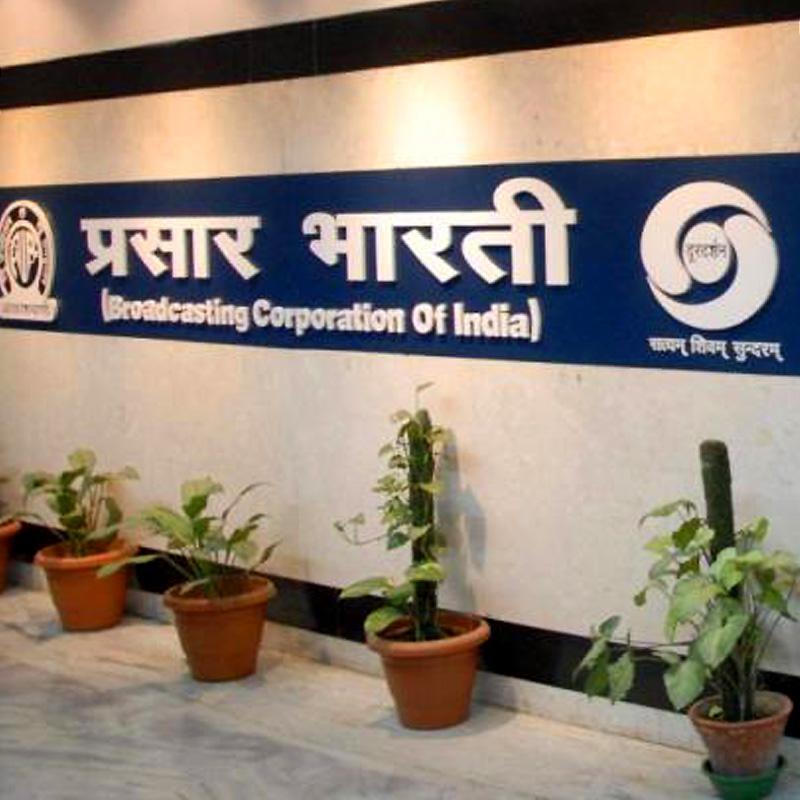
     

  • Prasar Bharati responds to TRAI consultation paper; open to sharing DTT infrastructure

    Prasar Bharati responds to TRAI consultation paper; open to sharing DTT infrastructure

    NEW DELHI: Pubcaster Prasar Bharati has sent its viewpoints  to the Telecom Regulatory Authority of India (TRAI)’s consultation paper on the involvement of the private sector in digital terrestrial broadcasting (which has been its forte, so far).

    In its response, it has stated that, even as it supports the move, it feels that the potential of available distribution options need to be critically analysed to fulfill their requirements (for example coverage, capacity, reception mode, type of service etc).

    The public broadcaster has also said that the terrestrial broadcast platform will be relevant in the long term if its usage offers veritable benefits to the broadcasters, the audiences and the society as a whole. Even in countries where cable, satellite or broadband hold a significant market share, terrestrial broadcasting is usually regarded as an essential, flexible and reliable way of delivering broadcast content to a mass audience.

    In its response to 11 questions asked by TRAI in its Consultation Paper on ‘Issues related to Digital Terrestrial Broadcasting in India,’ the pubcaster says that the terrestrial platform must be digital to remain viable in the long term.

    Prasar Bharati CEO Jawhar Sircar had told indiantelevision.com in an interview earlier that it had cleared DTT for the private sector more than a year ago.

    Given the vast landscape of the country, Prasar Bharati says DTT is absolutely vital. It is thus crucial to ensure that, in the long term, the terrestrial distribution networks should be capable of delivering the current and future, advanced linear broadcast services, and fulfilling the  ever-increasing  requirements for quality and  choice  of services, including non-linear broadcast services.

    The benefits offered by DTT according to the pubcaster are:

    •         Near-universal coverage,

    •         Ability to provide for fixed, portable and mobile reception,
                Ability to efficiently provide regional and local content

    •         It is flexibility and content format agnostic. The newer formats of TV channels such as HD TV, 3D TV, UHD TV, data and radio services etc. can thus be delivered.

    •         Technical and cost efficiency,

    •         Efficient  use  of  spectrum  as  multiple  program channels  can  be transmitted using one TV spectrum channel of 8 MHz

    •         Network has ruggedness and not prone to catastrophic failure and sabotage from enemies

    •         Terrestrial broadcasting has strategic importance along the borders

    •         A potential for further development.

    Even with the presence of huge number of DTH and cableTV channels, a strong terrestrial platform is critical to healthy competition in the TV and radio market and to the realisation of a wide range of social and cultural benefits and most essentially an all-weather reliable platforms for the distribution of radio and TV signals, says the pubcaster.

    As indicated in the consultation paper, there are 247 million households in India as per the 2011 census, and a large number of these, particularly in rural and remote areas, depend completely on the FTA (free-to-air) terrestrial broadcasting TV services provided by the public broadcaster.

    Thus, in order to meet consumer expectations and ensure optimum utilization of resources, a digital terrestrial TV service having suitable bouquet of TV channels and nationwide coverage is very essential, says the pubcaster.

    It stresses that DTT is being provided in FTA mode in most of the countries. Its capability to provide local content will facilitate in providing social benefits of promoting local talent, local culture and music, generating employment, catering to local self-governance information needs, etc.

    This powerful combination would be difficult to replicate by any single alternative technology. DTT secures greater plurality in platform ownership, ensuring that no single platform owner is so powerful that it can exert undue influence on public opinion, and hence is the need for every country.

    DTT broadcasting has emerged as one of the popular digital television platforms in countries such as the UK, the US, Japan, Germany, France and Australia as it turns out to be one of the most economical broadcast transmission systems. In the DTT broadcasting process, everybody watches the same content at the same time, and it guarantees everybody the same high level of service, since they are all bathed in the same signal, and that too free to air, whereas, in OTT, the received signal quality depends upon number of viewers watching it, simultaneously.

    By the end of 2015, DTT constituted the second highest user base worldwide among the digital TV broadcast platforms next only to that of digital cable TV services.

    The pubcaster feels that, to optimise the time and resources, DTT can be started with two multiplexes at each location, and can be enhanced to three/four in due course of time, may be after analogue switchoff (ASO). Nation-wide coverage plan may further be implemented in time-bound phased manner as has been done in the case of implementation of DAS cable system.

    Infrastructure sharing will be essential for easy and cost-effective implementation of DTT service in India. Sharing would be essential so as to minimise the cost of implementation and faster roll-out. The experience sharing during implementation of FM expansion may be considered as an input for DTT roll-out.

    Deciding a national standard for DTT service is quintessential to have a volume of scale in terms of DTT ecosystem.  Doordarshan has already adopted DVB-T2 for itsDTT service, and it would be beneficial for the nation to adopt DVB-T2 as the national standard. Besides volume of scale, it may eliminate interoperability issues. Most of the countries are following a single national standard for DTT.

    The television viewer needs variety in programming content which may be possible when private channels are allowed on terrestrial platform. This is also required to make attractive and competitive bouquet.

    Prasar Bharati, however, says that it has to be ensured that the consumers are not impacted or charged heavily for private services. Issues regarding quality of service, grievance redressal etc. are also important.

    Doordarshan also needs to see that it continues to be the public service provider while providing wholesome content. The faster roll-out of DTT would require support from every stakeholder (government/private) for creating nation-wide network.

    Prasar Bharati already has huge infrastructure such as land, building, towers, trained manpower, networks, etc, for its terrestrial transmission. It has also initiated setting up of DTT transmitters. Doordarshan has already installed 23 DVB-T2 transmitters at 19 locations and services have been started at 16 locations. Also, it is in the process of expanding this to 63 locations.

    Doordarshan has gained enough experience and has good expertise in the field of DTT implementation including coverage and frequency planning, design of DTT network, procurement, execution, measurement and testing, field  surveys  etc.  It  is , therefore, a  better-placed  entity  for setting  up Integrated DTT Broadcasting network that includes private broadcasters as well.

    In this scenario, Prasar Bharati may also become a content aggregator for sharing transmitter capacity with private service-providers to give variety of content while the platform remains with it.

    This will ensure public service broadcasting can be strengthened in the country and reach of services from public broadcaster will enhance immensely; dissemination of social, educational programmes to masses; no new regulatory framework required for implementation of DTT; existing infrastructure will be optimally utilized; and introduction of a variety of services making DTT more competitive.

    Doordarshan has already got funds from government to pioneer DTT, and it is seeking additional funds from it to complete it.  Private broadcasters may be charged a suitable fee for using this infrastructure. This has already been implemented in the DD DTH service.

    For DTT expansion plan phase 1 and 2, one option could be that Prasar Bharati  (Doordarshan) gets government funds and charges a fee from private broadcasters as in the case of the pioneer plan; or Doordarshan (Government) and private broadcaster can share the capital expenditure in a suitable sharing model. Revenue may also be shared using the same model.

    Considering the present situation in India and to optimise  time and resources, DTT can be started with two multiplexes at 63 locations and can be enhanced to three/four in due course, may be after ASO.  A suggestive model for integrated DTT broadcasting network could be:

    i)      DTT may be implemented at 630 locations almost immediately where Doordarshan (Prasar Bharati) has already started implementation of DTT and infrastructure is almost ready. Private operators may be allowed to share this infrastructure by paying a suitable fee to Doordarshan as is being done in the case of DD DTH service. [This may be called DTT Pioneer Plan]

    ii)      Of the remaining 567 locations, wherever Doordarshan has sufficient requisite infrastructure, DVB-T2 multiplexes may be established and private  broadcasters can  share  those  exactly  in  the  same  way. [This may be called DTT Expansion Plan-Phase1]

    iii)     A new CTI (common transmission) infrastructure may be established at all other places where Doordarshan infrastructure is not available. These CTIs may be established by an experienced separate entity (e.g., BECIL). However, the ownership may be with Doordarshan (or a consortium). The process for this may be started in parallel to phase-1 but may have a different target date as establishment of new CTI will take more time. [This may be called DTT Expansion Plan-Phase2]

    It will be difficult to earmark exclusive spectrum for DTT as Doordarshan is already using the UHF band-IV for analog TV service. Besides, Doordarshan is also using band-IV for DTT and has planned utilization of band-IV and band-V frequencies for already approved DVB-T2 transmitters. It has also planned a DTT transmitter network at 630 locations with 2 MUXs, in Band-IV and Band-V.

    For the simulcast period, additional spectrum is required for the parallel transmission of TV services in analogue and digital mode. The required amount of spectrum will heavily depend on the introduction strategy adopted for DTT. ITU-R studies have concluded that 224 MHz spectrum would be required in UHF band for implementation of four to five DTT Multiplex at each location. Whereas, in India, practically only 176 MHz (470-646MHz) spectrum is available in UHF band. It would be appropriate that the entire broadcasting band 470-698 MHz may be made available.

    In a statement that may help the private sector, Prasar Bharati said that countries boosted switching to digital by giving subsidy on STBs; mandatory DTT tuner in all TV receivers after a certain date; awareness campaign regarding ASO; incentives to broadcasters in terms of spectrum charges for providing simulcast, and dialogue and incentives to manufacturer/importer of DTT receiving equipment.

    India would certainly need such concerted efforts to popularize digital reception and achieve ASO. With the concerted effort, India may think of a simulcast period of at least 6-12 months before switching off analogue transmitters. As the digitization is proposed to be implemented in a phased manner, ASO will also happen in a phased manner. However, the situation will have to be reviewed before actually switching off.

    The pubcaster has suggested that provision of DVB-T2 Tuner can be made mandatory on all TVs imported/manufactured in India after 1 April 2018. Similarly, embedding of DVB-T2/T2 Lite tuner in mobile phones should also be mandated on the same date.

    Also read: http://www.indiantelevision.com/television/tv-channels/terrestrial/prasar-bharati-ceo-prasar-bharati-not-opposed-to-private-players-entry-in-dtt-160620
     

  • New addl secy, advisor in IT Ministry

    New addl secy, advisor in IT Ministry

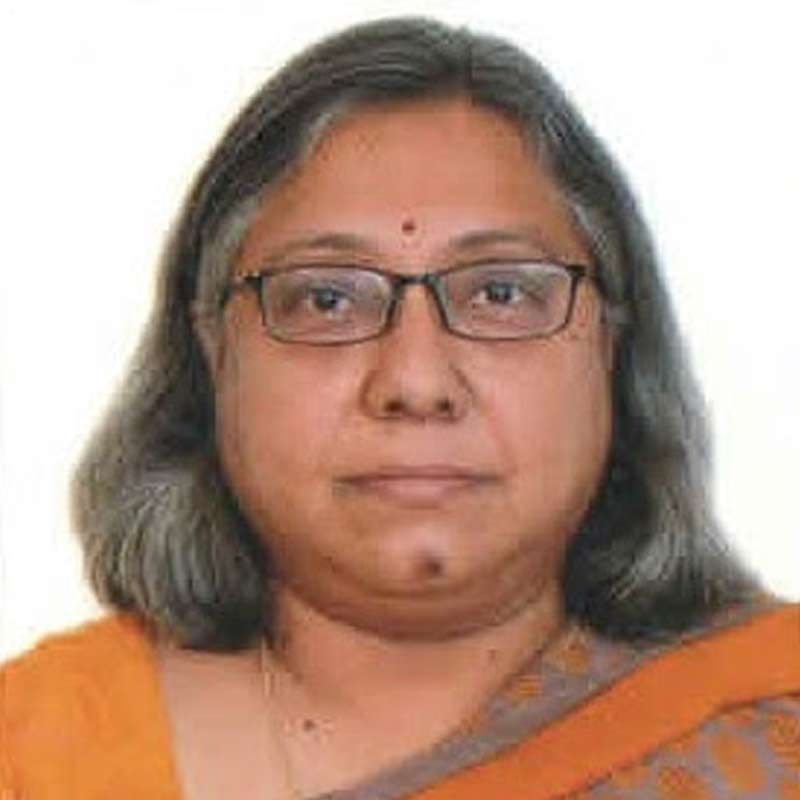
    NEW DELHI: Anuradha Mitra has been appointed as the additional secretary and financial advisor in the electronics & information technology ministry. Mitra is a 1984 batch officer of the Indian Defence Accounts Service.

    She was until now the joint secretary & financial advisor in the same ministry. She has been assigned the new role by upgrading her position for a period of two years or until further orders, whichever is earlier.

    The ministry is in charge of the development of set-top boxes for digital addressable system, and for implementing the Indian conditional access system (iCAS) which has been adopted by Doordarshan’s Freedish DTH platform.

  • New addl secy, advisor in IT Ministry

    New addl secy, advisor in IT Ministry

    NEW DELHI: Anuradha Mitra has been appointed as the additional secretary and financial advisor in the electronics & information technology ministry. Mitra is a 1984 batch officer of the Indian Defence Accounts Service.

    She was until now the joint secretary & financial advisor in the same ministry. She has been assigned the new role by upgrading her position for a period of two years or until further orders, whichever is earlier.

    The ministry is in charge of the development of set-top boxes for digital addressable system, and for implementing the Indian conditional access system (iCAS) which has been adopted by Doordarshan’s Freedish DTH platform.

  • TRAI expects stakeholders to work towards infrastructure sharing

    TRAI expects stakeholders to work towards infrastructure sharing

    NEW DELHI: India is witnessing a huge growth in the television sector and is on the threshold of complete digitization. The Telecom Regulatory Authority of India has asked stakeholders as to whether they feel the need for infrastructure sharing – irrespective of whether it is cable TV and HITS operators, DTH operators, or CAS and SMS. 

    Stakeholders have been asked to send in their comment by 21 October, 2016, with counter-comments on 4 November 2016. At the outset, TRAI says the country now has 864 private television channels apart from six private DTH players and two HITS players and a large number of MSOs and LCOs and infrastructure sharing may help the industry to grow. 

    “There appears to be a distinct possibility for sharing of distribution infrastructure among multiple DPOs for its optimal utilization. It may result in reduction in capital expenditure and operating expenditure for distributors,” says the regulator.

    Infrastructure includes satellite transponder, earth station, Head-end, Hybrid Fibre Coaxial (HFC) network, conditional access system (CAS) and subscriber management system (SMS) used for delivery of the TV broadcasting services to the subscribers.

    Each multi-channel distribution platform retransmits large number of satellite TV channels. Of these large number of satellite TV channels retransmitted by each operator, many are common across the distribution platforms in a relevant market. Therefore, retransmission of such common channels independently on each distribution platform ends up duplicating the infrastructure.

    In the light of this, TRAI has asked the stakeholders to consider certain points:

    Infrastructure sharing among Cable TV and HITS operators

    (1) Is there a need to enable infrastructure sharing among MSOs and HITS operators, or among MSOs? It is important to note that no mandate for such infrastructure sharing is being proposed.

    (2) Which model is preferred for sharing of infrastructure among MSOs and HITS operators, or among MSOs?

    Infrastructure sharing among DTH operators

    (3) Is there a need to enable infrastructure sharing among DTH operators?

    Relevant issues in sharing of infrastructure

    (4) What specific amendments are required in the cable TV Act and the Rules made there under to enable sharing of infrastructure among MSOs themselves?  

    (5) What specific amendments are required in the MSO registration conditions and HITS licensing guidelines in order to enable sharing of infrastructure among MSOs and HITS operators? 

    (6) What specific amendments are required in the guidelines for obtaining license for providing DTH broadcasting service to enable sharing of infrastructure among DTH operators? 

     (7) Do you envisage any requirement for amendment in the policy framework for satellite communication in India to enable sharing of infrastructure among MSOs and HITS operators, and among DTH operators? If yes, then what specific amendments would be required? 

    (8) Do you envisage any requirement for amendments in the NOCC guidelines and WPC license conditions relating to satellite communications to enable sharing of infrastructure among MSOs and HITS operators, and among DTH operators? If yes, then what specific amendments would be required?

    (9) Do you envisage any requirement for amendments in any other policy guidelines to enable sharing of infrastructure among MSOs and HITS operators, among MSOs, and among DTH operators?

     (10) What mechanisms could be put in place for disconnection of signals of TV channels of defaulting operator without affecting the operations of the other associated operators with that network after implementation of sharing of infrastructure among MSOs and HITS operators, among MSOs, and among DTH operators?

    (11) Is there any requirement for tripartite agreement to enable sharing of infrastructure among MSOs and HITS operators, among MSOs, and among DTH operators? Kindly elucidate with justification.

    (12) What techniques could be put in place for identification of pirates after implementation of sharing of infrastructure among MSOs and HITS operators, among MSOs, and among DTH operators?

    (13) Is there any need for further strengthening of anti-piracy measures already in place to enable sharing of infrastructure among MSOs and HITS operators, among MSOs, and among DTH operators?

    (14) Is there a requirement to ensure geographically targeted advertisements in the distribution networks? If yes, then what could be the possible methods for enabling geographically targeted advertisements in shared infrastructure set up?

    (15) Whether it is possible for the network operator to run the scrolls and logo on the specific STBs population on request of either the broadcaster or the service delivery operator after implementation of sharing of infrastructure among MSOs and HITS operators, among MSOs, and among DTH operators?

    (16) Whether implementation of infrastructure sharing affects the differentiation and personalization of the TV broadcasting services and EPG? If yes, then how those constraints can be addressed?

    (17) Whether, in your opinion, satellite capacity is a limiting factor for sharing of infrastructure? If yes, then what could be the solutions to address the issue?

    Sharing of CAS and SMS

    (18) Is there a need to permit sharing of SMS and CAS? 

     (19) If yes, then what additional measures need to taken to ensure that SMS data remain accessible to the tax assessment authorities and Authorized officers as defined in the Cable TV Act for the purpose of monitoring the compliance with relevant the Rules and the Regulations?

    (20) Whether sharing of CAS can in any way compromise the requirement of encryption as envisaged in the Cable TV Act and The rules and the regulations. 

  • TRAI expects stakeholders to work towards infrastructure sharing

    TRAI expects stakeholders to work towards infrastructure sharing

    NEW DELHI: India is witnessing a huge growth in the television sector and is on the threshold of complete digitization. The Telecom Regulatory Authority of India has asked stakeholders as to whether they feel the need for infrastructure sharing – irrespective of whether it is cable TV and HITS operators, DTH operators, or CAS and SMS. 

    Stakeholders have been asked to send in their comment by 21 October, 2016, with counter-comments on 4 November 2016. At the outset, TRAI says the country now has 864 private television channels apart from six private DTH players and two HITS players and a large number of MSOs and LCOs and infrastructure sharing may help the industry to grow. 

    “There appears to be a distinct possibility for sharing of distribution infrastructure among multiple DPOs for its optimal utilization. It may result in reduction in capital expenditure and operating expenditure for distributors,” says the regulator.

    Infrastructure includes satellite transponder, earth station, Head-end, Hybrid Fibre Coaxial (HFC) network, conditional access system (CAS) and subscriber management system (SMS) used for delivery of the TV broadcasting services to the subscribers.

    Each multi-channel distribution platform retransmits large number of satellite TV channels. Of these large number of satellite TV channels retransmitted by each operator, many are common across the distribution platforms in a relevant market. Therefore, retransmission of such common channels independently on each distribution platform ends up duplicating the infrastructure.

    In the light of this, TRAI has asked the stakeholders to consider certain points:

    Infrastructure sharing among Cable TV and HITS operators

    (1) Is there a need to enable infrastructure sharing among MSOs and HITS operators, or among MSOs? It is important to note that no mandate for such infrastructure sharing is being proposed.

    (2) Which model is preferred for sharing of infrastructure among MSOs and HITS operators, or among MSOs?

    Infrastructure sharing among DTH operators

    (3) Is there a need to enable infrastructure sharing among DTH operators?

    Relevant issues in sharing of infrastructure

    (4) What specific amendments are required in the cable TV Act and the Rules made there under to enable sharing of infrastructure among MSOs themselves?  

    (5) What specific amendments are required in the MSO registration conditions and HITS licensing guidelines in order to enable sharing of infrastructure among MSOs and HITS operators? 

    (6) What specific amendments are required in the guidelines for obtaining license for providing DTH broadcasting service to enable sharing of infrastructure among DTH operators? 

     (7) Do you envisage any requirement for amendment in the policy framework for satellite communication in India to enable sharing of infrastructure among MSOs and HITS operators, and among DTH operators? If yes, then what specific amendments would be required? 

    (8) Do you envisage any requirement for amendments in the NOCC guidelines and WPC license conditions relating to satellite communications to enable sharing of infrastructure among MSOs and HITS operators, and among DTH operators? If yes, then what specific amendments would be required?

    (9) Do you envisage any requirement for amendments in any other policy guidelines to enable sharing of infrastructure among MSOs and HITS operators, among MSOs, and among DTH operators?

     (10) What mechanisms could be put in place for disconnection of signals of TV channels of defaulting operator without affecting the operations of the other associated operators with that network after implementation of sharing of infrastructure among MSOs and HITS operators, among MSOs, and among DTH operators?

    (11) Is there any requirement for tripartite agreement to enable sharing of infrastructure among MSOs and HITS operators, among MSOs, and among DTH operators? Kindly elucidate with justification.

    (12) What techniques could be put in place for identification of pirates after implementation of sharing of infrastructure among MSOs and HITS operators, among MSOs, and among DTH operators?

    (13) Is there any need for further strengthening of anti-piracy measures already in place to enable sharing of infrastructure among MSOs and HITS operators, among MSOs, and among DTH operators?

    (14) Is there a requirement to ensure geographically targeted advertisements in the distribution networks? If yes, then what could be the possible methods for enabling geographically targeted advertisements in shared infrastructure set up?

    (15) Whether it is possible for the network operator to run the scrolls and logo on the specific STBs population on request of either the broadcaster or the service delivery operator after implementation of sharing of infrastructure among MSOs and HITS operators, among MSOs, and among DTH operators?

    (16) Whether implementation of infrastructure sharing affects the differentiation and personalization of the TV broadcasting services and EPG? If yes, then how those constraints can be addressed?

    (17) Whether, in your opinion, satellite capacity is a limiting factor for sharing of infrastructure? If yes, then what could be the solutions to address the issue?

    Sharing of CAS and SMS

    (18) Is there a need to permit sharing of SMS and CAS? 

     (19) If yes, then what additional measures need to taken to ensure that SMS data remain accessible to the tax assessment authorities and Authorized officers as defined in the Cable TV Act for the purpose of monitoring the compliance with relevant the Rules and the Regulations?

    (20) Whether sharing of CAS can in any way compromise the requirement of encryption as envisaged in the Cable TV Act and The rules and the regulations. 

  • Prasar Bharati looks at digitizing archives; to seek Rs 250 crore from govt

    Prasar Bharati looks at digitizing archives; to seek Rs 250 crore from govt

    MUMBAI: Pubcaster Prasar Bharati is taking another stab at digitizing and monetising the huge archival content catalogue that is lying in the shelves of All India Radio and Doordarshan. And it is all set to make a formal request to the ministry of broadcasting and broadcasting (MIB) for nearly Rs 250 crore to help it achieve what it intends to do. It says included in this archive are prominent speeches of national leaders, popular programmes and music.

    Prasar Bharati officials recently made a presentation to the MIB enumerating why it needs to do this. Sources say both Doordarshan and All India Radio have millions of hours of both audio and video content. In fact, All India Radio had digitized some of its content around a decade ago and even monetized some of it by selling CDs. The UK pubcaster BBC is amongst the world’s largest exporters of TV content with worldwide sales of around 400 million Euros. If Prasar Bharati manages even 10 per cent of that, it will more than recover its digitization costs.

    The problem, however, is that its archive has not been maintained in the best manner and is on beta and VHS tapes, many of which could be damaged or unrecoverable. And some of it could be have been stolen or lost.

    It is also looking at drafting a syndication policy to sell its content worldwide to other media outlets or online directly to consumers.

    Says a media observer: “Hopefully, it takes up the task seriously this time and the MIB helps it see it through to conclusion. DD is in danger of becoming a dinosaur; digitisation will allow it to bring new legs to old content which a generation has not seen. It could be put out online or on mobile for consumption apart from finding customers for its clips worldwide.”

  • Prasar Bharati looks at digitizing archives; to seek Rs 250 crore from govt

    Prasar Bharati looks at digitizing archives; to seek Rs 250 crore from govt

    MUMBAI: Pubcaster Prasar Bharati is taking another stab at digitizing and monetising the huge archival content catalogue that is lying in the shelves of All India Radio and Doordarshan. And it is all set to make a formal request to the ministry of broadcasting and broadcasting (MIB) for nearly Rs 250 crore to help it achieve what it intends to do. It says included in this archive are prominent speeches of national leaders, popular programmes and music.

    Prasar Bharati officials recently made a presentation to the MIB enumerating why it needs to do this. Sources say both Doordarshan and All India Radio have millions of hours of both audio and video content. In fact, All India Radio had digitized some of its content around a decade ago and even monetized some of it by selling CDs. The UK pubcaster BBC is amongst the world’s largest exporters of TV content with worldwide sales of around 400 million Euros. If Prasar Bharati manages even 10 per cent of that, it will more than recover its digitization costs.

    The problem, however, is that its archive has not been maintained in the best manner and is on beta and VHS tapes, many of which could be damaged or unrecoverable. And some of it could be have been stolen or lost.

    It is also looking at drafting a syndication policy to sell its content worldwide to other media outlets or online directly to consumers.

    Says a media observer: “Hopefully, it takes up the task seriously this time and the MIB helps it see it through to conclusion. DD is in danger of becoming a dinosaur; digitisation will allow it to bring new legs to old content which a generation has not seen. It could be put out online or on mobile for consumption apart from finding customers for its clips worldwide.”

  • TRAI extends dates for views on AGR issues relating to Spectrum

    TRAI extends dates for views on AGR issues relating to Spectrum

    NEW DELHI: The Telecom Regulatory Authority of India has extended the dates for getting views on minimum presumptive AGR for Spectrum and VSAT licenses.

    A release today said comments can be sent on 13 October with countercomments if any by 27 October 2016.Following a query by the Department of Telecom on25 June 2016, TRAI had asked stakeholdersif spectrum assignment on location basis/link-by-link basis on administrativebasis to ISPs, be continued in the specified bands.

    In the consultation paper issued following the DoT letter,the regulator has discussed issues relating to minimum presumptive AGR for ISPlicenses and VSAT licenses and other issues raised by DoT in its reference of25 June 2014, and 15 May 2015. The information/clarifications were furnished toDoT in the letter of 2 March 2016.

    The DoT had soughtTRAI’s recommendations in terms of clause 11(1) of TRAI Act 1997 (as amended)on:

    (A) ISP license (i) Rates for SUC; (ii) Percentage of AGR including minimum AGR; (iii) Allied issues like schedule of payment, charging ofinterest, penalty and Financial Bank Guarantee (FBG).

    (B) Commercial VSAT license (i) Floor level (minimum) AGR, based on the amount ofspectrum held by commercial VSAT operators. The Authority said in 2014 it had suo motu undertaken theexercise of review of definition of revenue base (AGR) for the reckoning oflicence fee (LF) and  spectrum usage charges (SUC).

    The Consultation Paper wasissued on 31st July 2014 and Recommendations on 6 January 2015. The Recommendationsalong with other issues also contain recommendations on minimum presumptiveAGR. In the Recommendations of 6 January 2015, the Authority hadrecommended that minimum presumptive AGR for the purpose of LF and SUC should notbe made applicable for any licenses granted by the Government for providingtelecom services.

    Paper available on trai.gov.in

    Also read

    http://www.indiantelevision.com/regulators/trai/trai-issues-consultation-paper-on-agr-issues-relating-to-spectrum-160819