Category: Regulators

  • HC stays MIB order against Care World

    HC stays MIB order against Care World

    NEW DELHI: Even as NDTV has gone to court and the MIB order against it held in abeyance, the Bombay High Court today stayed the order of the Information and Broadcasting Ministry directing a one-week ban against Care World India.

    Justice M S Karnik directed the I&B Ministry to file its reply within two weeks and listed the matter for hearing on 23 November 2016. The order would remain stayed till 24 November.

    Seven Star Satellite Pvt Ltd counsel Mayur Khandeparkar told the court that a show cause had been issued to the channel which had also been given a hearing by the Inter-Ministerial Committee, but the final order indicated that none of the argument given by the channel had been taken into consideration and “therefore it is not a reasoned order.”

    Care World had been banned since the midnight of 9 November to midnight of 16 November 2016. The order was issued under section 20(2) and 20(3) of the Cable Televisions Networks (Regulation) Act 1995 and some provisions of the Uplinking guidelines.

    Khandeparkar also said that the programme ‘Kya Karun main ab’ against which the ministerial order had come had already been taken off air and subsequent episodes would only be telecast subject to the final order of the court.

    The judge also said in his order that the channel would not be permitted to broadcast this programme till its interim order was vacated.
  • TRAI issues direction on broadband definition

    TRAI issues direction on broadband definition

    NEW DELHI: The Telecom Regulatory Authority of India has directed all telecom service providers providing broadband (wire-line or wireless) services to provide certain services in respect of all broadband tariff plans offered under Fair Usage Policy on their websites and advertisements in view of the broader definition of Broadband as directed by the Department of Telecom.

    The Department in a notification of 18 July 2013 had amended the definition of broadband, saying: “Broadband is a data connection that is able to support interactive services including Internet access and has the capability of the minimum download speed of 512 kbps to an individual subscriber from the point of presence (POP) of the service provider intending to provide Broadband service.”

    The information, which must be published in all advertisements published through any media, in respect of all broadband tariff plans offered under Fair Usage Policy will mention for Fixed broadband service:

    1. Data usage limit with specified speed;

    2. Speed of broadband connection up to specified data usage limit; and speed of broadband connection beyond data usage limit;

    For Mobile broadband service:

    1. Data usage limit with specified Primary technology (3G/4G) for providing data services;

    2. Speed offered for providing data services beyond data usage limit;

    3. provide information specified in para (a) above to both new and existing subscribers on their registered email address and through SMS on their mobile number registered with the service provider, as opted by consumer;

    4. ensure that download speed of broadband service provided to the fixed broadband subscriber is not reduced below minimum download speed for broadband as defined by the DoT from time to time in any Fair usage broadband tariff plan after expiry of assigned data quota of consumers;

    5. Provide alert to the subscriber through SMS on his registered Mobile Number or to his registered e-mail address each time when his data usage reaches fifty, ninety and hundred percent of the data usage limit under his plan. TSP should also maintain a portal/website so that user can access his usage at any point of time.

    The TRAI direction is in supersession of its earlier direction of 27 July 2012. The new direction has been issued in exercise of the powers conferred upon it under section 13, read with Section 11(1)(b). of the TRAI Act 1997 and in order to ensure transparency in delivery of internet and broadband services and to protect interests of consumers of the telecom sector and to facilitate further growth of internet and broadband services in India.

  • TRAI issues direction on broadband definition

    TRAI issues direction on broadband definition

    NEW DELHI: The Telecom Regulatory Authority of India has directed all telecom service providers providing broadband (wire-line or wireless) services to provide certain services in respect of all broadband tariff plans offered under Fair Usage Policy on their websites and advertisements in view of the broader definition of Broadband as directed by the Department of Telecom.

    The Department in a notification of 18 July 2013 had amended the definition of broadband, saying: “Broadband is a data connection that is able to support interactive services including Internet access and has the capability of the minimum download speed of 512 kbps to an individual subscriber from the point of presence (POP) of the service provider intending to provide Broadband service.”

    The information, which must be published in all advertisements published through any media, in respect of all broadband tariff plans offered under Fair Usage Policy will mention for Fixed broadband service:

    1. Data usage limit with specified speed;

    2. Speed of broadband connection up to specified data usage limit; and speed of broadband connection beyond data usage limit;

    For Mobile broadband service:

    1. Data usage limit with specified Primary technology (3G/4G) for providing data services;

    2. Speed offered for providing data services beyond data usage limit;

    3. provide information specified in para (a) above to both new and existing subscribers on their registered email address and through SMS on their mobile number registered with the service provider, as opted by consumer;

    4. ensure that download speed of broadband service provided to the fixed broadband subscriber is not reduced below minimum download speed for broadband as defined by the DoT from time to time in any Fair usage broadband tariff plan after expiry of assigned data quota of consumers;

    5. Provide alert to the subscriber through SMS on his registered Mobile Number or to his registered e-mail address each time when his data usage reaches fifty, ninety and hundred percent of the data usage limit under his plan. TSP should also maintain a portal/website so that user can access his usage at any point of time.

    The TRAI direction is in supersession of its earlier direction of 27 July 2012. The new direction has been issued in exercise of the powers conferred upon it under section 13, read with Section 11(1)(b). of the TRAI Act 1997 and in order to ensure transparency in delivery of internet and broadband services and to protect interests of consumers of the telecom sector and to facilitate further growth of internet and broadband services in India.

  • TRAI to review terms for captive VSAT licences

    TRAI to review terms for captive VSAT licences

    MUMBAI: Telecom regulatory authority TRAI has started a comprehensive review of various fee and charges related to captive VSAT (very small aperture terminal) licences, including entry fee, licence fee, bank guarantee and royalty charges.

    VSAT, a satellite communication technology, is useful for remote and inaccessible locations which lack proper terrestrial connectivity, PTI has reported.

    The consultation paper “Captive VSAT CUG (Closed User Group) policy issues” also seeks to remove the difference in licence fee for operating two hubs (earth stations that control and monitor activities of remote terminals).

    “Is there a need to review some or all of the fee or charges viz. Entry fee, licence fee, royalty charges and bank guarantee etc. For captive VSAT CUG licenses…If yes, what should be the appropriate fee or charges,” TRAI asked in the consultation paper.

    ‘Captive VSAT Licence’ refers to licence for those networks in which the equipment and facilities are owned and operated by the licensee itself for its own use under one Closed User Group (CUG). The Captive VSATs are deployed by commercial organisations like National Thermal Power Corporation, Oil and Natural Gas Corporation, as well as government bodies to cater to their own requirement and applications.

    The TRAI paper has also sought industry views on whether licence fee for a second VSAT hub, (being used independently or for redundancy purposes) should be the same as the first VSAT hub, and also the quantum of per annum fee for the second hub. The deadline for sending written comments is November 25, 2016.

    At present, the licence fee stands at Rs 10,000 per annum per VSAT earth stations installed, in case of the first hub. But in case the licensee wants to put second hub for geographical redundancy or, say, operational diversity and if that second hub station remains commissioned, a minimum license fee of Rs 16 Lakh per annum for up to 100 captive VSATs is applicable in addition to the license fee payable for the first hub.

    “…Due to such a huge difference in the license fee, a licensee is discouraged in installing a second hub…Even though their operations demand so for maintaining a hot standby,” TRAI said.

    TRAI has also asked if the captive VSAT categories should be split into Government oganisations and departments handling important missions, and commercial organisations.

    It also sought industry’s opinion on the entry fee, licence fee and royalty charges for the two categories, if separated, and whether the proposed rates for not for profit government organizations should be at a discount compared to business organisations.

  • TRAI to review terms for captive VSAT licences

    TRAI to review terms for captive VSAT licences

    MUMBAI: Telecom regulatory authority TRAI has started a comprehensive review of various fee and charges related to captive VSAT (very small aperture terminal) licences, including entry fee, licence fee, bank guarantee and royalty charges.

    VSAT, a satellite communication technology, is useful for remote and inaccessible locations which lack proper terrestrial connectivity, PTI has reported.

    The consultation paper “Captive VSAT CUG (Closed User Group) policy issues” also seeks to remove the difference in licence fee for operating two hubs (earth stations that control and monitor activities of remote terminals).

    “Is there a need to review some or all of the fee or charges viz. Entry fee, licence fee, royalty charges and bank guarantee etc. For captive VSAT CUG licenses…If yes, what should be the appropriate fee or charges,” TRAI asked in the consultation paper.

    ‘Captive VSAT Licence’ refers to licence for those networks in which the equipment and facilities are owned and operated by the licensee itself for its own use under one Closed User Group (CUG). The Captive VSATs are deployed by commercial organisations like National Thermal Power Corporation, Oil and Natural Gas Corporation, as well as government bodies to cater to their own requirement and applications.

    The TRAI paper has also sought industry views on whether licence fee for a second VSAT hub, (being used independently or for redundancy purposes) should be the same as the first VSAT hub, and also the quantum of per annum fee for the second hub. The deadline for sending written comments is November 25, 2016.

    At present, the licence fee stands at Rs 10,000 per annum per VSAT earth stations installed, in case of the first hub. But in case the licensee wants to put second hub for geographical redundancy or, say, operational diversity and if that second hub station remains commissioned, a minimum license fee of Rs 16 Lakh per annum for up to 100 captive VSATs is applicable in addition to the license fee payable for the first hub.

    “…Due to such a huge difference in the license fee, a licensee is discouraged in installing a second hub…Even though their operations demand so for maintaining a hot standby,” TRAI said.

    TRAI has also asked if the captive VSAT categories should be split into Government oganisations and departments handling important missions, and commercial organisations.

    It also sought industry’s opinion on the entry fee, licence fee and royalty charges for the two categories, if separated, and whether the proposed rates for not for profit government organizations should be at a discount compared to business organisations.

  • South Asia FM allotted Surat, Amritsar, Patna, Chandigarh and Jammu FM channels

    South Asia FM allotted Surat, Amritsar, Patna, Chandigarh and Jammu FM channels

    NEW DELHI: M/s South Asia FM Ltd has been declared as the winning bidder for five Radio FM channels, just a day after the commencement of the auction for the second batch of Phase III.

    The company will be allotted FM Channels in Surat, Amritsar, Patna, Chandigarh and Jammu.

    The details of the details of the successful bids and number of winning channelss and associated Frequency spots along with successful bid amount – Non-refundable One Time Entry Fee (NOTEF) are:

    City Frequency Spot selected (MHz) Successful Bid amount (NOTEF)

    Surat           95                                         Rs 3,60,00,000
     Amritsar     93.5                                      Rs 6,03,97,038
    Patna          93.5                                      Rs 17,89,83,876
    Chandigarh 93.5                                      Rs 19,04,72,374
     Jammu        91.9                                     Rs 1,01,07,090

    This data has been compiled on the basis of system generated “Final Round Result Report” and “Frequency Identification Report” accessible through auction administrator
    role.

    South Asia FM Limited, one of the fourteen shortlisted bidders, is a Public incorporated on 09 November 2005. It is classified as Non-govt company and is registered at Registrar of Companies, Chennai. Its authorized share capital is Rs. 6,550,000,100 and its paid up capital is Rs. 6,153,605,100.It is inolved in Motion picture, radio, television and other entertainment activities

    South Asia Fm Limited’s Annual General Meeting (AGM) was last held on 24 September 2015 and as per records from Ministry of Corporate Affairs (MCA), its balance sheet was last filed on 31 March 2015.

    Directors of South Asia FM Limited are Jagadeesan Ravindran, Kannappan Shanmugam, Arjun Rao Donakanti, .

  • South Asia FM allotted Surat, Amritsar, Patna, Chandigarh and Jammu FM channels

    South Asia FM allotted Surat, Amritsar, Patna, Chandigarh and Jammu FM channels

    NEW DELHI: M/s South Asia FM Ltd has been declared as the winning bidder for five Radio FM channels, just a day after the commencement of the auction for the second batch of Phase III.

    The company will be allotted FM Channels in Surat, Amritsar, Patna, Chandigarh and Jammu.

    The details of the details of the successful bids and number of winning channelss and associated Frequency spots along with successful bid amount – Non-refundable One Time Entry Fee (NOTEF) are:

    City Frequency Spot selected (MHz) Successful Bid amount (NOTEF)

    Surat           95                                         Rs 3,60,00,000
     Amritsar     93.5                                      Rs 6,03,97,038
    Patna          93.5                                      Rs 17,89,83,876
    Chandigarh 93.5                                      Rs 19,04,72,374
     Jammu        91.9                                     Rs 1,01,07,090

    This data has been compiled on the basis of system generated “Final Round Result Report” and “Frequency Identification Report” accessible through auction administrator
    role.

    South Asia FM Limited, one of the fourteen shortlisted bidders, is a Public incorporated on 09 November 2005. It is classified as Non-govt company and is registered at Registrar of Companies, Chennai. Its authorized share capital is Rs. 6,550,000,100 and its paid up capital is Rs. 6,153,605,100.It is inolved in Motion picture, radio, television and other entertainment activities

    South Asia Fm Limited’s Annual General Meeting (AGM) was last held on 24 September 2015 and as per records from Ministry of Corporate Affairs (MCA), its balance sheet was last filed on 31 March 2015.

    Directors of South Asia FM Limited are Jagadeesan Ravindran, Kannappan Shanmugam, Arjun Rao Donakanti, .

  • Govt seeks professional help for DD revival

    Govt seeks professional help for DD revival

    NEW DELHI: Fazed by private sector television channels’ stridency in terms of revenues and viewership in an increasingly digital India, the government is seeking outside professional help in “transformation of Doordarshan.”

    A tender has been issued by an organisation under the Ministry of Information and Broadcasting (MIB) to look for a consultant to revamp Doordarshan into a leading public broadcaster that becomes a highly successful medium of mass communication.

    Amongst the objectives listed in the tender documents by the Broadcast Engineering Consultants India Ltd. (BECIL) a stated aim is to engage a consulting firm to support Doordarshan in achieving this “transformation goal by undertaking a comprehensive view on the projects and initiatives to be executed” by the Indian pubcaster.

    Pointing out that in the last couple of decades after introduction of cable television and technological changes in a country that’s now openly flirting with digital consumption of video and audio on multiple platforms, the government admitted DD’s monopoly days are over and it is not the target media for a large swathe of Indian population. “Given the potential television has, not just commercially but also as a means for socio-economic transformation, it’s critical to revitalize Doordarshan and develop it into a powerful and commercially successful organization of mass communication,” BECIL said in a note enumerating the objectives for the project.

    The consultant would have to undertake a comprehensive view on the projects and initiatives to be executed by Doordarshan, engage all stakeholders to arrive at trouble-spots and prepare a solution map for addressing those difficulties. The government is hoping that the consultant will identify in medium term goals for “quick wins” and further help Doordarshan develop a long-term strategic roadmap.

    The interested bidders are expected to send in their queries by 2 November 2016 and get responses in a pre-bid meeting on 4 November. The technical bids will be opened on 15 November at 1530 hours. Dates for presentations by bidders and opening of financial bids will be intimated later by BECIL.

    Interestingly, Minister of State for MIB Rajyavardhan Rathore few days back had admitted at a media conference that Prasar Bharati, DD’s parent, lacked adequate programming and marketing capabilities and was open to seeking help from private players.

    Doordarshan is one of the largest broadcasting organizations in the world in terms of studios and infrastructure and claims to cover 90 per cent of the total Indian population — a claim that, however, doesn’t aptly reflect in audience measurement data. DD, which offers 23 TV channels in various Indian languages, provides television, radio, online and app-based mobile services throughout India and overseas.

    ALSO READ:

    Prasar Bharati lacks content & marketing; open to tie-ups: MIB Minister


  • Govt seeks professional help for DD revival

    Govt seeks professional help for DD revival

    NEW DELHI: Fazed by private sector television channels’ stridency in terms of revenues and viewership in an increasingly digital India, the government is seeking outside professional help in “transformation of Doordarshan.”

    A tender has been issued by an organisation under the Ministry of Information and Broadcasting (MIB) to look for a consultant to revamp Doordarshan into a leading public broadcaster that becomes a highly successful medium of mass communication.

    Amongst the objectives listed in the tender documents by the Broadcast Engineering Consultants India Ltd. (BECIL) a stated aim is to engage a consulting firm to support Doordarshan in achieving this “transformation goal by undertaking a comprehensive view on the projects and initiatives to be executed” by the Indian pubcaster.

    Pointing out that in the last couple of decades after introduction of cable television and technological changes in a country that’s now openly flirting with digital consumption of video and audio on multiple platforms, the government admitted DD’s monopoly days are over and it is not the target media for a large swathe of Indian population. “Given the potential television has, not just commercially but also as a means for socio-economic transformation, it’s critical to revitalize Doordarshan and develop it into a powerful and commercially successful organization of mass communication,” BECIL said in a note enumerating the objectives for the project.

    The consultant would have to undertake a comprehensive view on the projects and initiatives to be executed by Doordarshan, engage all stakeholders to arrive at trouble-spots and prepare a solution map for addressing those difficulties. The government is hoping that the consultant will identify in medium term goals for “quick wins” and further help Doordarshan develop a long-term strategic roadmap.

    The interested bidders are expected to send in their queries by 2 November 2016 and get responses in a pre-bid meeting on 4 November. The technical bids will be opened on 15 November at 1530 hours. Dates for presentations by bidders and opening of financial bids will be intimated later by BECIL.

    Interestingly, Minister of State for MIB Rajyavardhan Rathore few days back had admitted at a media conference that Prasar Bharati, DD’s parent, lacked adequate programming and marketing capabilities and was open to seeking help from private players.

    Doordarshan is one of the largest broadcasting organizations in the world in terms of studios and infrastructure and claims to cover 90 per cent of the total Indian population — a claim that, however, doesn’t aptly reflect in audience measurement data. DD, which offers 23 TV channels in various Indian languages, provides television, radio, online and app-based mobile services throughout India and overseas.

    ALSO READ:

    Prasar Bharati lacks content & marketing; open to tie-ups: MIB Minister


  • Prasar Bharati lacks content & marketing; open to tie-ups: MIB Minister

    Prasar Bharati lacks content & marketing; open to tie-ups: MIB Minister

    NEW DELHI: Conceding that Prasar Bharati is lagging in both content and marketing, Minister of State for Information & Broadcasting (MIB) Rajyavardhan Rathore on Wednesday said there was a need to bring in outside experts for improving these aspects.

    At the same time, not willing to throw out the baby with the bath-water, the Minister clarified that for India’s pubcaster it wasn’t an easy task as it had to telecast in 23 languages. He said that Prasar Bharati was open to partnering with other broadcasters.

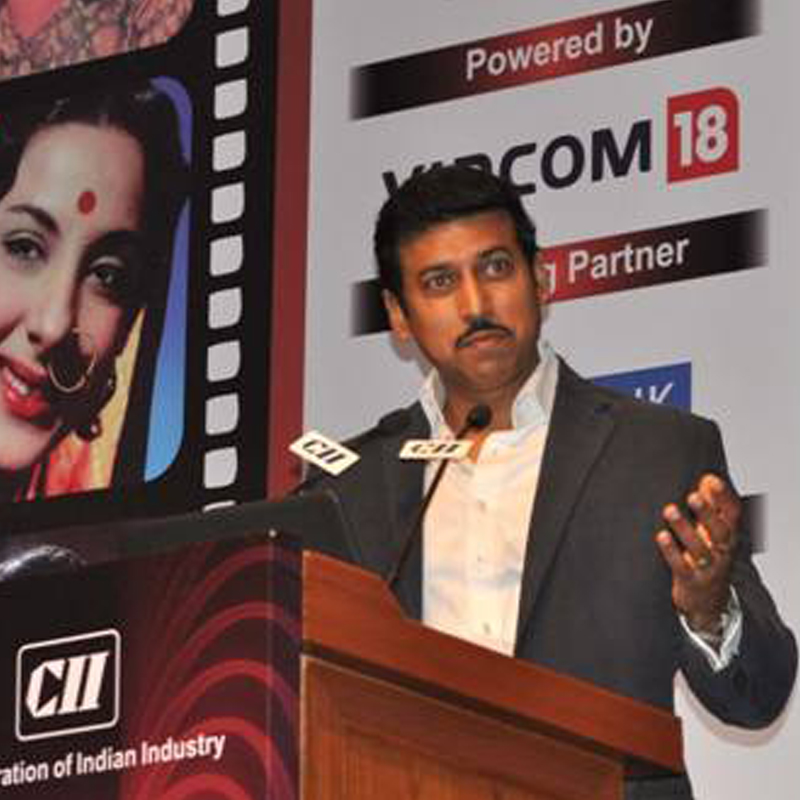
    Speaking at the CII Big Picture Summit 2016 here, Rathore admitted that with technological changes and innovations, a content platform is undergoing constant change with respect to creation, access and distribution. As a consequence, revenue and business models were being fragmented along with changes in market distribution and talent pool identification, he added.

    Pointing out that a series of measures have been undertaken to facilitate the growth and innovation within the media and entertainment (M&E) sector, the Minister said those initiatives included streamlining of processes and procedures for broadcasting sector in the context of licensing TV channels and measures to promote the branding of India’s soft power at international films festivals.

    Referring to the animation sector, the Minister said the government would be fast tracking the setting up of the National Centre for Excellence in partnership with the industry in an effort to optimise the returns in the sector.

    Later answering questions from participants, he regretted that news on online channels was going overseas unregulated and MIB would be taking up the issue with the Ministry of Information Technology. However, he said streaming of a film could not be done without a certification by the Central Board of Film Certification.

    On a question about spectrum and its scarcity, Rathore said as the whole process involved different ministries the logistics got delayed, but also pointed out that the IT Ministry had recently obtained a large chunk of spectrum from the Ministry of Defence for use in the telecoms and broadcast sectors.

    Asked about the cumbersome and time consuming process to get security clearances for television channels and multi-system operators, Rathore explained that delays were caused as several government organisations, apart from MIB, were involved in giving clearances. Still, a total of 881 TV channels had been licensed, including 349 news channels, he added, hinting that such procedural delays hadn’t slowed down the hunger for licences.