Category: Regulators

  • Dist. National Informatics Centres to be of international standards

    Dist. National Informatics Centres to be of international standards

    NEW DELHI: Electronics and Information and Technology Minister Ravi Shankar Prasad has said the National Informatics Centre is the “technological bridge of India and is best placed to lead the way for a Digital India”

    He urged the District Information Officers (DIOs) to be innovative and proactive. NIC must adopt a transformative approach to make a difference at the grassroots level. He appealed to the NIC to connect with the Common Service Centres (CSCs), who have successfully provided training on digital payment systems to over 19.6 million of rural citizens and 6,15,000 merchants.”

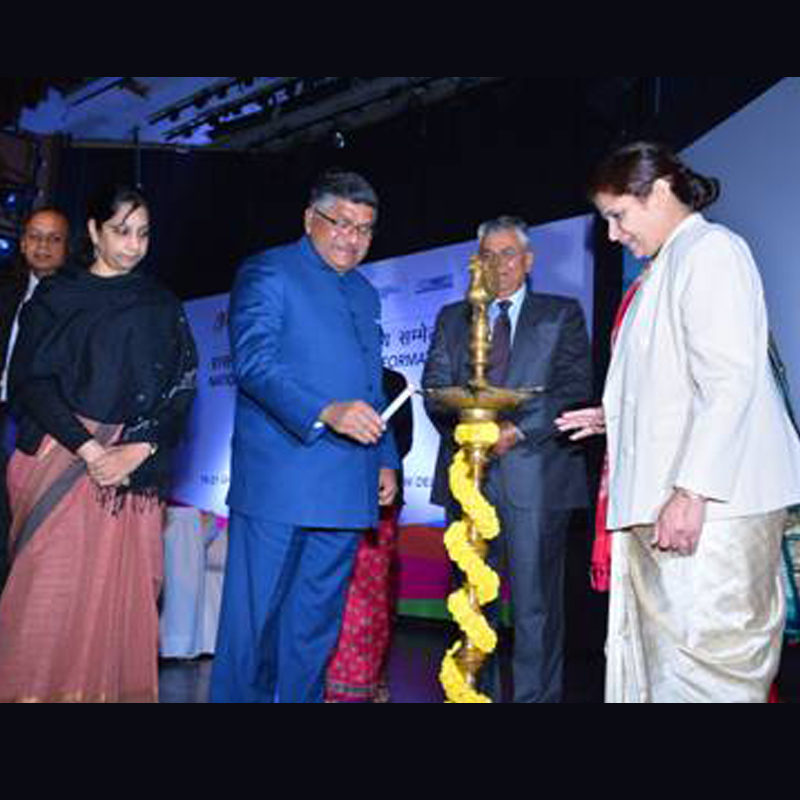
    He was speaking at an event where the NIC kicked off the National Meet on Grassroot Informatics – VIVID: Weaving a Digital India here.

    The inauguration of the three-day event was also attended Minister of State P P Chaudhary, Secretary Ms Aruna Sundararajan, Additional Secretary Ajay Kumar, NIC DG Ms Neeta Verma, and Deputy DG Ms Rama Nagpal.

    Prasad announced the Government’s plan to set up a Government Security Operation Centre and a Data Centre for Cloud in Bhopal. He also announced that the Government is going to enhance the infrastructure of district NIC offices to international standards. As a pilot project, 150 District NIC offices would be upgraded during the period 2017-18, while rest will follow soon.

    He instructed the ministry to develop a training module for the NIC officials to keep pace with the ever evolving technologies. He also announced the introduction of annual awards for the DIOs of the NIC for taking up exemplary innovative approach in their respective districts. The top three best innovators will get a reward of Rs 2,00,000, Rs 1,00,000 and Rs 50,000 respectively.

    Chaudhary said, “The threshold of the year 2017 will always be remembered for heralding in several transformative changes to benefit the economy as well to the citizens, amongst them the Digital India initiative has been the most significant one. I must congratulate NIC and DIOs for playing a pivotal role in preparing the country for a successful Digital transformation of our ecosystem.

    NIC also introduced two new portals – District Collector’s Dashboard and NIC Service Desk, which were launched by Prasad and Chaudhary respectively.

    The National Meet on Grassroots Informatics is aimed at showcasing the various initiatives of NIC in creating and enhancing the Digital Infrastructure in the country. Some of these are – setting up of ICT infrastructure, developing state of the art products to enable the government and empower the citizens, its initiatives at state and district level along the lines of Digital India initiatives along with the various awareness campaigns on Digital Payment Systems encompassing DBT, PFMS, Cashless Payment, Aadhaar etc.

    The individual sessions during these three days would throw lights on NIC’s journey so far, the best practices it follows, the Digital India programme, Digital India initiatives from NIC State Units, success stories from the districts, Financial Inclusion, its technology awareness programmes and ICT Infrastructure being provided by NIC.
  • Idea, Star Den among Rs-1200 cr FDI proposals approved; latter to switch to investing biz

    Idea, Star Den among Rs-1200 cr FDI proposals approved; latter to switch to investing biz

    NEW DELHI: Star Den Media Services and Idea Cellular are among the six proposals cleared by the government on Thursday for receiving foreign direct investment (FDI) of around Rs 1,200 crore.

    Other companies that have been cleared are — Sanofi Synthelabo India, Recipharm Participation B.V. Netherlands, Boehringer Ingelheim India Pvt. Ltd, A. Menarini India Private Limited. Six proposals have been deferred for further discussions — Gland Pharma Limited, Flag Telecom Singapore Pte Limited, Crest Premedia Solutions Pvt. Ltd, Scientific Publishing Services Pvt Ltd, You Broadband India Limited and Netmagic Solutions Pvt. Ltd.

    There were a total of 17 proposals recommended by FIPB  in its meeting held on 29 December 2016 headed by economic affairs secretary Shaktikanta Das.

    Idea Cellular Infrastructure Services Ltd’s proposal to take on record the increase of foreign investment in ICISL beyond 50 per cent and allow foreign investment in ICISL up to 67.5 per cent received approval.

    Star Den Media Services’ proposal to discontinue its existing business of providing support services to broadcasters in relation to TV channel distribution business, and thus continue to act only as investing company was also okayed.

    The Finance Ministry on the recommendation of the Foreign Investments Promotion Board has thus given permission to Den only to continue as investing company. Thus, no new foreign investment is involved.

    The committee deferred decision on a proposal by Flag Telecom Singapore Pte Limited Singapore, an indirect wholly owned subsidiary of Reliance Communications (RCOM), India seeking approval to acquire 100 per cent shares of M/s Reliance Global Cloud Xchange Limited which was incorporated in June 2016 by Indian residents.

    A proposal by M/s Crest Premedia Solutions Pvt. Ltd seeking approval for issuance of equity shares to the non-resident shareholders of M/s Springer SBM Holding Ltd., a Mauritius Company under a Scheme of Amalgamation was also deferred. SBM Holding will amalgamate into CPSPL, which is part of the Springer Group of companies.  

    M/s You Broadband India Limited had sought post facto approval for acquisition of 9,79,875 equity shares of its downstream company M/s Digital Outsourcing Private Limited (DOPL) in lieu of issue of 20,58,759 equity shares to its resident shareholders by way of swap of shares but this was deferred today.

    A proposal by Netmagic Solutions Pvt. Ltd for the increase in the shareholding of NTT Communications Corporation, Japan in the company from 81.63 per cent to 100 per cent was deferred, as was a proposal by M/s Scientific Publishing Services Pvt Ltd for issuance of equity shares to the non-resident shareholders of M/s Springer SBM Services Limited, a Mauritius Company under a Scheme of Amalgamation of SBM Services with SPSPL, pursuant to approval of the High Court.

    Also Read :

    Nod to Idea, Star Den & four may fetch Rs 1200 cr FDI; You & Crest proposals deferred

    Star Den, Flag Telecom, You & Idea FDI meet on 28 Dec


  • Idea, Star Den among Rs-1200 cr FDI proposals approved; latter to switch to investing biz

    Idea, Star Den among Rs-1200 cr FDI proposals approved; latter to switch to investing biz

    NEW DELHI: Star Den Media Services and Idea Cellular are among the six proposals cleared by the government on Thursday for receiving foreign direct investment (FDI) of around Rs 1,200 crore.

    Other companies that have been cleared are — Sanofi Synthelabo India, Recipharm Participation B.V. Netherlands, Boehringer Ingelheim India Pvt. Ltd, A. Menarini India Private Limited. Six proposals have been deferred for further discussions — Gland Pharma Limited, Flag Telecom Singapore Pte Limited, Crest Premedia Solutions Pvt. Ltd, Scientific Publishing Services Pvt Ltd, You Broadband India Limited and Netmagic Solutions Pvt. Ltd.

    There were a total of 17 proposals recommended by FIPB  in its meeting held on 29 December 2016 headed by economic affairs secretary Shaktikanta Das.

    Idea Cellular Infrastructure Services Ltd’s proposal to take on record the increase of foreign investment in ICISL beyond 50 per cent and allow foreign investment in ICISL up to 67.5 per cent received approval.

    Star Den Media Services’ proposal to discontinue its existing business of providing support services to broadcasters in relation to TV channel distribution business, and thus continue to act only as investing company was also okayed.

    The Finance Ministry on the recommendation of the Foreign Investments Promotion Board has thus given permission to Den only to continue as investing company. Thus, no new foreign investment is involved.

    The committee deferred decision on a proposal by Flag Telecom Singapore Pte Limited Singapore, an indirect wholly owned subsidiary of Reliance Communications (RCOM), India seeking approval to acquire 100 per cent shares of M/s Reliance Global Cloud Xchange Limited which was incorporated in June 2016 by Indian residents.

    A proposal by M/s Crest Premedia Solutions Pvt. Ltd seeking approval for issuance of equity shares to the non-resident shareholders of M/s Springer SBM Holding Ltd., a Mauritius Company under a Scheme of Amalgamation was also deferred. SBM Holding will amalgamate into CPSPL, which is part of the Springer Group of companies.  

    M/s You Broadband India Limited had sought post facto approval for acquisition of 9,79,875 equity shares of its downstream company M/s Digital Outsourcing Private Limited (DOPL) in lieu of issue of 20,58,759 equity shares to its resident shareholders by way of swap of shares but this was deferred today.

    A proposal by Netmagic Solutions Pvt. Ltd for the increase in the shareholding of NTT Communications Corporation, Japan in the company from 81.63 per cent to 100 per cent was deferred, as was a proposal by M/s Scientific Publishing Services Pvt Ltd for issuance of equity shares to the non-resident shareholders of M/s Springer SBM Services Limited, a Mauritius Company under a Scheme of Amalgamation of SBM Services with SPSPL, pursuant to approval of the High Court.

    Also Read :

    Nod to Idea, Star Den & four may fetch Rs 1200 cr FDI; You & Crest proposals deferred

    Star Den, Flag Telecom, You & Idea FDI meet on 28 Dec


  • TDSAT recalls attachment proceedings against MSO Sadhna Media

    TDSAT recalls attachment proceedings against MSO Sadhna Media

    NEW DELHI: The Telecom Disputes Settlement and Appellate Tribunal has recalled its order of attachment of properties of Sadhna Media Pvt Ltd after Siti Cable Network Ltd confirmed that the demand draft of Rs 26,87,793 handed over to it last month was in full and final settlement of a case pending since 2013.

    Consequently members B B Srivastava and A K Bhargava also disposed of the execution application.

    Sadhna Group is a media and broadcast business conglomerate, running multiple television channels and engaged in varied businesses of media, education, advertising, medical, mining and aviation, based in New Delhi.

    Siti Networks Limited (Siti Cable Network) is a part of the Essel Group, which is one of India’s leading business houses with a diverse portfolio. Being India’s one of the most prominent multi-system operators (MSO), Sit is reaching a billion people.

    In an order on 17 January 2017, the tribunal also directed that District Judge, Central District, Tis Hazari, Delhi, and District Judge, Gautam Budh Nagar, Noida, UP, may be informed about this order.

    The tribunal had passed the attachment order on 8 September 2016 after it was informed that despite an agreement on 22 April 2014, the MSO had failed to make any payment to Siti Cable. The details of the case can be had from the TDSAT website.

    Following this, the tribunal had asked Siti Cable on 30 April 2014 to withdraw its petition. However, Siti Cable filed a fresh application last year seeking attachment of the properties of the MSO — Sadhna Media.

    The evolution of the Sadhna Group can be traced to its beginning in 1977 as a small advertising agency. Apart from audio-visual programming and broadcasting, the group has varied business interests in the allied areas of television media – Sadhna/Sadhna News/Ishwar channels, advertising – print/outdoor, etc.

    It was in September, 2016, an execution application (E.A.) was filed by the petitioner decree holder, Siti Cable Network, for realisation of the decretal amount of Rs.18,53,650/- in terms of order of the tribunal dated 30.4.2014.

    Siti Cable Network and the respondent judgement debtor Sadhna Media Pvt. Ltd. concluded a settlement agreement before the Mediation Centre of the TDSAT on 22.4.2014. The terms of the settlement were as under: That it has been agreed by and between the parties that the respondent shall pay an amount of Rs. 18,53,650/- to the petitioner in full and final settlement of all dues. That the above amount shall be paid by the respondent in six equal monthly installments of Rs.3,08,942/- each commencing from 30 April, 2014, by way of a cheque/demand draft.

  • TDSAT recalls attachment proceedings against MSO Sadhna Media

    TDSAT recalls attachment proceedings against MSO Sadhna Media

    NEW DELHI: The Telecom Disputes Settlement and Appellate Tribunal has recalled its order of attachment of properties of Sadhna Media Pvt Ltd after Siti Cable Network Ltd confirmed that the demand draft of Rs 26,87,793 handed over to it last month was in full and final settlement of a case pending since 2013.

    Consequently members B B Srivastava and A K Bhargava also disposed of the execution application.

    Sadhna Group is a media and broadcast business conglomerate, running multiple television channels and engaged in varied businesses of media, education, advertising, medical, mining and aviation, based in New Delhi.

    Siti Networks Limited (Siti Cable Network) is a part of the Essel Group, which is one of India’s leading business houses with a diverse portfolio. Being India’s one of the most prominent multi-system operators (MSO), Sit is reaching a billion people.

    In an order on 17 January 2017, the tribunal also directed that District Judge, Central District, Tis Hazari, Delhi, and District Judge, Gautam Budh Nagar, Noida, UP, may be informed about this order.

    The tribunal had passed the attachment order on 8 September 2016 after it was informed that despite an agreement on 22 April 2014, the MSO had failed to make any payment to Siti Cable. The details of the case can be had from the TDSAT website.

    Following this, the tribunal had asked Siti Cable on 30 April 2014 to withdraw its petition. However, Siti Cable filed a fresh application last year seeking attachment of the properties of the MSO — Sadhna Media.

    The evolution of the Sadhna Group can be traced to its beginning in 1977 as a small advertising agency. Apart from audio-visual programming and broadcasting, the group has varied business interests in the allied areas of television media – Sadhna/Sadhna News/Ishwar channels, advertising – print/outdoor, etc.

    It was in September, 2016, an execution application (E.A.) was filed by the petitioner decree holder, Siti Cable Network, for realisation of the decretal amount of Rs.18,53,650/- in terms of order of the tribunal dated 30.4.2014.

    Siti Cable Network and the respondent judgement debtor Sadhna Media Pvt. Ltd. concluded a settlement agreement before the Mediation Centre of the TDSAT on 22.4.2014. The terms of the settlement were as under: That it has been agreed by and between the parties that the respondent shall pay an amount of Rs. 18,53,650/- to the petitioner in full and final settlement of all dues. That the above amount shall be paid by the respondent in six equal monthly installments of Rs.3,08,942/- each commencing from 30 April, 2014, by way of a cheque/demand draft.

  • CASBAA hails judicial review of broadcast & cable tariff

    CASBAA hails judicial review of broadcast & cable tariff

    MUMBAI: CASBAA, the association of Asia’s pay-TV industry, has applauded the judicial review now under way in India of proposed extension and tightening of India’s pay-TV rate regulations.

    The Madras High Court is reviewing the clash between the rights of copyright owners around the world and new tariff regulations proposed by the Telecom Regulatory Authority of India (TRAI). The court has ordered the TRAI not to give effect to the rules until the underlying issues are considered, with a hearing now set for 19 January.

    CASBAA CEO Christopher Slaughter observed that the new rules would be a major negative factor for the business environment in the US$ 17 billion Indian media industry. “India’s pay-TV regulations have long been among the strictest in the world”, he said. “The proposed new rules are highly intrusive and would make the environment much worse. Such a heavy-handed regulatory regime will inevitably hit foreign companies’ interest in investing in India.”

    Indian law gives copyright owners the ability to price and sell their creative works. In filing the Madras suit, the petitioner broadcasting organizations denounced the TRAI regulation as contrary to these principles as enshrined in the law, and in international treaties to which India is a signatory. (The TRAI rules would establish a controlled price regime by mandating a la carte channel supply, setting the ceiling, by specific genres, that broadcasting organizations can charge to multi-channel programme distributors, limiting discounts, prescribing carriage fees, and stipulating a compulsory distribution fee to be paid by Broadcasting Organizations to multichannel programme distributors.

    CASBAA has long expressed concern about India’s previous rate regulations, which included a cable retail price freeze imposed in 2004 “until the market became more competitive” and never revoked.

    “Today, India’s television content market is among the most competitive in the world,” said Slaughter. “Modern cable MSOs, six different DTH platforms and now online OTT television are all giving Indian consumers a wide range of viewing options.”

    CASBAA’s chief policy officer John Medeiros observed, “As convergence and greater competition sweep the TV economy, other governments around the world are eliminating rate controls, to give more scope to competition among traditional and new online providers. In the last few years, Korea and Taiwan have both undertaken to liberalize their pay-TV price controls, leaving India as the last market economy in Asia with a hyper-regulatory regime. The proposed new rules would take India in the opposite direction from the rest of the world.”

    Also Read:  Tariff order: Don’t notify without SC nod, TRAI told; Madras HC case to continue

    Also Read:  Copyright owners call for competitive pricing over TRAI regulation

  • CASBAA hails judicial review of broadcast & cable tariff

    CASBAA hails judicial review of broadcast & cable tariff

    MUMBAI: CASBAA, the association of Asia’s pay-TV industry, has applauded the judicial review now under way in India of proposed extension and tightening of India’s pay-TV rate regulations.

    The Madras High Court is reviewing the clash between the rights of copyright owners around the world and new tariff regulations proposed by the Telecom Regulatory Authority of India (TRAI). The court has ordered the TRAI not to give effect to the rules until the underlying issues are considered, with a hearing now set for 19 January.

    CASBAA CEO Christopher Slaughter observed that the new rules would be a major negative factor for the business environment in the US$ 17 billion Indian media industry. “India’s pay-TV regulations have long been among the strictest in the world”, he said. “The proposed new rules are highly intrusive and would make the environment much worse. Such a heavy-handed regulatory regime will inevitably hit foreign companies’ interest in investing in India.”

    Indian law gives copyright owners the ability to price and sell their creative works. In filing the Madras suit, the petitioner broadcasting organizations denounced the TRAI regulation as contrary to these principles as enshrined in the law, and in international treaties to which India is a signatory. (The TRAI rules would establish a controlled price regime by mandating a la carte channel supply, setting the ceiling, by specific genres, that broadcasting organizations can charge to multi-channel programme distributors, limiting discounts, prescribing carriage fees, and stipulating a compulsory distribution fee to be paid by Broadcasting Organizations to multichannel programme distributors.

    CASBAA has long expressed concern about India’s previous rate regulations, which included a cable retail price freeze imposed in 2004 “until the market became more competitive” and never revoked.

    “Today, India’s television content market is among the most competitive in the world,” said Slaughter. “Modern cable MSOs, six different DTH platforms and now online OTT television are all giving Indian consumers a wide range of viewing options.”

    CASBAA’s chief policy officer John Medeiros observed, “As convergence and greater competition sweep the TV economy, other governments around the world are eliminating rate controls, to give more scope to competition among traditional and new online providers. In the last few years, Korea and Taiwan have both undertaken to liberalize their pay-TV price controls, leaving India as the last market economy in Asia with a hyper-regulatory regime. The proposed new rules would take India in the opposite direction from the rest of the world.”

    Also Read:  Tariff order: Don’t notify without SC nod, TRAI told; Madras HC case to continue

    Also Read:  Copyright owners call for competitive pricing over TRAI regulation

  • Mass Comm courses in regional languages significant: Naidu

    Mass Comm courses in regional languages significant: Naidu

    NEW DELHI: Information and Broadcasting Minister M Venkaiah Naidu has stressed the vast need of skilled personnel in the media and entertainment sector in the country as the sector was expanding rapidly.

    The Minister referred to the prominent role being played by the Government’s Skill India Initiative for upgrading skills under multiple disciplines. He added that the vision of this Government was to bring Transformational changes in all sectors.

    Speaking about the changing paradigm in communication, the Minister said Social Media has broken the boundaries of time and space in communication. It is a pre-requisite for budding journalists to be social media savvy and to have a watchful eye about the public perception on issues of local and international importance.

    He advised students aspiring to become journalists in future to ensure that news and views are not mixed and be objective. Every budding young journalist should have an open mind to acquire maximum knowledge to present the perspective in an objective manner. He urged students to keep abreast with the latest developments, new technology and new modes of communication and should inculcate a habit of reading to remain relevant and effective.

    He also called upon the Indian Institute of Mass Communications to strive for journalism courses in all Indian languages to cater to the communication needs of the citizens all across the country.

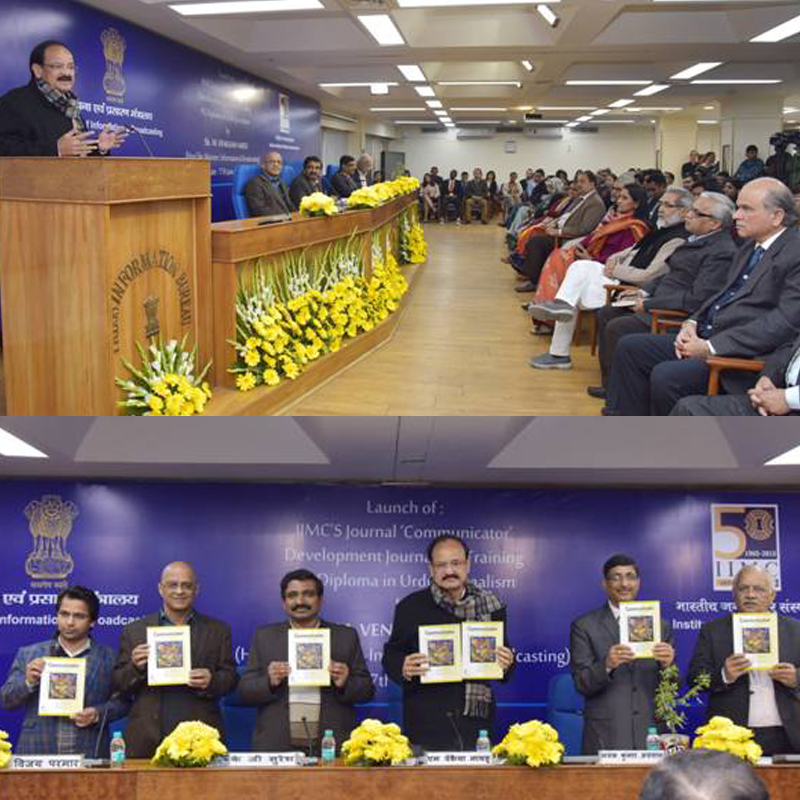
    The Minister was speaking after inaugurating the First PG Diploma course in Urdu Journalism, the 67th Diploma course in Development Journalism, and the launch of the IIMC Journal “Communicator” at Shastri Bhawan.

    Emphasizing on the training methodology, Naidu said it was important in the current scenario to include Case studies and practical exposure as a part of curriculum for learning, practising and applying new concepts. He also stressed the need for imparting an outlook that is rooted in strong ethical values among budding journalists and communicators.

    Naidu said Urdu journalism was an important and integral part of media and communication landscape of our country which had played an important role in the Freedom Struggle.

    Inaugurating the 67th Development Journalism course, the Minister said India is today regaining the lost glory of being the Knowledge hub of the world. The Development Journalism course provided a great opportunity for understanding and appreciating each other’s culture, and developing bonds of friendship.

    He added that journalist scholars from various Developing Countries were unofficial Ambassadors of India who shall provide a link of brotherhood among different cultures through their writings. The 67th batch of Development Journalism course at IIMC has 23 scholars (12 females and 11 males) from 19 different countries.

  • Mass Comm courses in regional languages significant: Naidu

    Mass Comm courses in regional languages significant: Naidu

    NEW DELHI: Information and Broadcasting Minister M Venkaiah Naidu has stressed the vast need of skilled personnel in the media and entertainment sector in the country as the sector was expanding rapidly.

    The Minister referred to the prominent role being played by the Government’s Skill India Initiative for upgrading skills under multiple disciplines. He added that the vision of this Government was to bring Transformational changes in all sectors.

    Speaking about the changing paradigm in communication, the Minister said Social Media has broken the boundaries of time and space in communication. It is a pre-requisite for budding journalists to be social media savvy and to have a watchful eye about the public perception on issues of local and international importance.

    He advised students aspiring to become journalists in future to ensure that news and views are not mixed and be objective. Every budding young journalist should have an open mind to acquire maximum knowledge to present the perspective in an objective manner. He urged students to keep abreast with the latest developments, new technology and new modes of communication and should inculcate a habit of reading to remain relevant and effective.

    He also called upon the Indian Institute of Mass Communications to strive for journalism courses in all Indian languages to cater to the communication needs of the citizens all across the country.

    The Minister was speaking after inaugurating the First PG Diploma course in Urdu Journalism, the 67th Diploma course in Development Journalism, and the launch of the IIMC Journal “Communicator” at Shastri Bhawan.

    Emphasizing on the training methodology, Naidu said it was important in the current scenario to include Case studies and practical exposure as a part of curriculum for learning, practising and applying new concepts. He also stressed the need for imparting an outlook that is rooted in strong ethical values among budding journalists and communicators.

    Naidu said Urdu journalism was an important and integral part of media and communication landscape of our country which had played an important role in the Freedom Struggle.

    Inaugurating the 67th Development Journalism course, the Minister said India is today regaining the lost glory of being the Knowledge hub of the world. The Development Journalism course provided a great opportunity for understanding and appreciating each other’s culture, and developing bonds of friendship.

    He added that journalist scholars from various Developing Countries were unofficial Ambassadors of India who shall provide a link of brotherhood among different cultures through their writings. The 67th batch of Development Journalism course at IIMC has 23 scholars (12 females and 11 males) from 19 different countries.

  • Shift to energy-efficient tech; TRAI seeks ideas by 27 Feb

    Shift to energy-efficient tech; TRAI seeks ideas by 27 Feb

    NEW DEHI: With the world coming to grips with problems of climate change and green house gas emissions, the Telecom Regulatory Authority of India is in the process of preparing a strategy to tackle the problems created by the telecom sector in this regard.

    Following a request received from the Department of Telecom, TRAI has issued the Consultation Paper on Approach towards Sustainable Telecommunications. The paper has raised 14 questions on which stakeholders have to respond by 27 February 2017.

    TRAI had issued a paper on similar issues in 2012 and the DoT had in fact given directions on that basis, but new issues have cropped up with emerging technologies.

    India has the second largest and fastest growing mobile telephone market in the world. Power and energy consumption for telecom network operations is by far the most important significant contributor of carbon emissions in the telecom industry.

    Hence, it is important for the telecom operators to shift to energy efficient technologies and alternate sources of energy. Moreover, Going Green has also become a business necessity for telecom operators with energy costs becoming as large as 25 per cent of total network operations costs. A typical communications company spends nearly one per cent of its revenues on energy which for large operators may amount to several million rupees.

    The Telecom Sector witnessed substantial growth in the number of subscribers during the year 2015-16 and up to September 2016. As of November 2016, the subscriber base was 1123.95 million, out of which 1099.51 million were wireless subscribers.

    During the year 2015-16, subscriber base recorded an increase from 969.89 million to 1033.63 while the overall teledensity increased from 79.38 to 83.36. The year also saw density from 48.37 to 51.37 while the urban teledensity increased from 148.61 to 154.01.

    The Internet subscriber base in the country as on September 2016 stood at 367.48 million as compared to 324.95 million as on September 2015. This growth also leads to greater carbon dioxide and green house gases and the DoT is working on checking this damage to the environment.

    To develop the roadmap, comprehensive program and viability gap funding for mobilizing the renewable energy technology deployment in telecom sector, DoT constituted a Renewable Energy Technology (RET) committee which submitted its report on 1 August 2014. The recommendations of RET committee were further examined by a departmental committee which has submitted its report in May 2015.

    In light of the above mentioned reports of the Committee and deliberation thereof, DoT has sought recommendations of TRAI on the methodology of measuring Carbon Emission and calibration of Directives issued by DoT in 2012 and approach for implementation (Target on the implementation of RETs).