Category: Regulators

  • News disallowed but advt terms relaxed for community radio

    News disallowed but advt terms relaxed for community radio

    NEW DELHI: While holding that the grant of permission agreement will be extended for five years at a time for community radio stations, the government has said that the application will have to be submitted in the fourth year.

    In relaxation of its Guidelines of 2006 to promote the growth in the sector, it was stated that the first extension shall be granted on the basis of an application and verification of adherence to the terms and conditions of the permission.

    For second extension beyond 10 years, the continuous operation of CRS by the permission holder for 10 years will be treated as ground for extension. CRS should submit their application for extension of permission a year before end of the permission period.

    Considering that there are less than 150 operational CRS even after more than a decade of launch of the scheme, the changes announced along with the funding scheme announced earlier this month would help the growth of this sector.

    News and current affairs and programmes of current affairs which are political in nature will not be permitted. However, CRS can broadcast news and current affairs contents sourced exclusively from All-India Radio in its original form or translated into the local language/dialect. AIR shall source its news to CRS without any charge. It will be the responsibility of the CRS permission holder to ensure that the news is not distorted or edited during translation.

    Another important relaxation is in terms of permitting additional categories that can come under non-news and current affairs broadcast.

    These are:

    (a) Information pertaining to sporting events excluding live coverage. However live commentaries of sporting events of local nature may be permissible;

    (b) Information pertaining to traffic and weather;

    (c) Information pertaining to and coverage of local cultural events, festivals;

    (d) Coverage of topics pertaining to examinations, results, admissions, career counseling;

    (e) Availability of employment opportunities;

    (f) Public announcements pertaining to civic amenities like electricity, water supply, natural calamities, health alerts etc. as provided by the local administration;

    (g) Such other categories not permitted at present that may subsequently be specifically permitted by Ministry of Information and Broadcasting from time to time.

    The additions also say that transmission of sponsored programmes shall not be permitted except programmes sponsored by Central and state governments and other organisations to broadcast public interest information.

    Limited advertising and announcements up to a maximum of seven minutes per hour relating to local events, local businesses and services and employment opportunities will be allowed.

    (In a related development, the Directorate of Advertising and Visual Publicity deleted the empanelment condition that “Community Radio Stations will undertake in writing that DAVP approved rates accepted by them are their lowest rates and exclusive to DAVP and cannot be offered to any other agency”.)

    The additions in the Guidelines further said: “In disaster situations, the District Magistrate’s permission shall be sufficient to relocate CRS. However, Ministry of Information and Broadcasting should be informed of the change of place by both the CRS and District Magistrate.

  • MIB urgently seeks pending 78 channels’ equipment details

    MIB urgently seeks pending 78 channels’ equipment details

    MUMBAI: The government of India expects all TV channels to submit technical details of their respective equipment for the purpose of monitoring. In all, 78 channels have failed to do so.

    The Ministry of Information and Broadcasting issued a Notice dated 9 December 2016 to 194 TV channels to provide a set of Professional IRD for each TV channel permitted to them which can give SD-SDI output (in case of HD channels, HD-SDI output) along with one spare IRD per bouquet, to EMMC.

    Alternatively, the pay TV broadcaster/ service  provider  should  provide  Viewing  card  (VC)  with matching  CAM  module  for interfacing with de-modulators to decrypt and demodulate the channel over IP. TV channels are also required  to  provide  the  technical  parameters  as Satellite,  Frequency,  location of teleport etc.

    Accordingly, the details/ equipment from 78 TV channels have not been received so far. The Broadcasting companies of these TV channels are required to send the details/ required equipment urgently.

    The  equipment   details may   be  sent  to  Director, Electronic Media Monitoring Centre, BECIL,  Soochna Bhawan, New Delhi.

    Also Read:  81 teleports permitted to uplink, downlink TV channels

    Also Read:  The TRAI broadcasting & cable tariff order simplified

    Also Read:  TRAI may moot MRP for bouquet TV channels; no price cap on unbundled premium products

    Also Read:  53 TV channels, six teleports’ licences up for renewal in ’17

  • MIB urgently seeks pending 78 channels’ equipment details

    MIB urgently seeks pending 78 channels’ equipment details

    MUMBAI: The government of India expects all TV channels to submit technical details of their respective equipment for the purpose of monitoring. In all, 78 channels have failed to do so.

    The Ministry of Information and Broadcasting issued a Notice dated 9 December 2016 to 194 TV channels to provide a set of Professional IRD for each TV channel permitted to them which can give SD-SDI output (in case of HD channels, HD-SDI output) along with one spare IRD per bouquet, to EMMC.

    Alternatively, the pay TV broadcaster/ service  provider  should  provide  Viewing  card  (VC)  with matching  CAM  module  for interfacing with de-modulators to decrypt and demodulate the channel over IP. TV channels are also required  to  provide  the  technical  parameters  as Satellite,  Frequency,  location of teleport etc.

    Accordingly, the details/ equipment from 78 TV channels have not been received so far. The Broadcasting companies of these TV channels are required to send the details/ required equipment urgently.

    The  equipment   details may   be  sent  to  Director, Electronic Media Monitoring Centre, BECIL,  Soochna Bhawan, New Delhi.

    Also Read:  81 teleports permitted to uplink, downlink TV channels

    Also Read:  The TRAI broadcasting & cable tariff order simplified

    Also Read:  TRAI may moot MRP for bouquet TV channels; no price cap on unbundled premium products

    Also Read:  53 TV channels, six teleports’ licences up for renewal in ’17

  • TRAI recommends e-KYC for outstation customers

    TRAI recommends e-KYC for outstation customers

    MUMBAI: The Telecom Regulatory Authority of India (TRAI) has issued its Recommendations on
    (i) “Verification of existing mobile subscribers through Aadhaar based e-KYC services”
    and
    (ii) “Permitting outstation Aadhaar card holders for e-KYC of mobile subscribers.”

    2.Aadhaar linked e-KYC service provides a robust mechanism to verify the identity of the person electronically and instantaneously from the source itself, based on the biometrics of the person. Thus, it takes care of the issues relating to fake/forged identity proof, manual entry into the system etc.

    3. In this regard, TRAI on 6th January 2016 recommended acceptance and adoption of Aadhaar based e-KYC service alongwith Aadhaar based e-Sign as a valid alternative process. Subsequently, on 16 August 2016, DoT permitted the use of Aadhaar based e-KYC service of Unique Identity Authority of India (UIDAI) for issuing mobile connections to customers. These instructions are applicable only for issue of new SIM cards but excludes the huge existing mobile subscriber base from the ambit of e-KYC. Further, use of e-KYC process was not permitted for outstation customers by DoT.

    4. The existing paper-based KYC process is not robust enough and the possibility of significant number of working SIMs, which may have been acquired on fake/forged identity, cannot be fully ruled out. The owner of such fake identity would not even be aware that SIM(s) are working in his/ her name. The Authority has received several cases from State Police (crime branch) wherein it has been found that hundreds of SIM cards have been obtained on fake documents. The existence of such SIM cards poses a real security challenge. It is essential that not only the new subscribers are enrolled through e-KYC process, but the existing subscriber base should also be verified through e-KYC process in a phased manner within a defined timeframe. Further, barring the e-KYC process for outstation customers results in artificial restriction and avoidable inconvenience.

    5. To overcome these challenges, the Authority has submitted its recommendations to DoT and the same have also been placed on TRAI’s website www.trai.gov.in. The main recommendations are:

    (a) DoT may work with the TSPs, to evolve a framework to verify the existing mobile subscribers through Aadhaar based e-KYC services in a phased manner and within a defined timeframe. However, this process should be optional to the service providers as well as mobile subscribers. The subscribers may have to be given some sops in terms of free talk-time or data to encourage them to undergo the e-KYC process.

    (b) Aadhaar based e-KYC should be permitted for outstation customers also at any place within the service area.

  • TRAI recommends e-KYC for outstation customers

    TRAI recommends e-KYC for outstation customers

    MUMBAI: The Telecom Regulatory Authority of India (TRAI) has issued its Recommendations on
    (i) “Verification of existing mobile subscribers through Aadhaar based e-KYC services”
    and
    (ii) “Permitting outstation Aadhaar card holders for e-KYC of mobile subscribers.”

    2.Aadhaar linked e-KYC service provides a robust mechanism to verify the identity of the person electronically and instantaneously from the source itself, based on the biometrics of the person. Thus, it takes care of the issues relating to fake/forged identity proof, manual entry into the system etc.

    3. In this regard, TRAI on 6th January 2016 recommended acceptance and adoption of Aadhaar based e-KYC service alongwith Aadhaar based e-Sign as a valid alternative process. Subsequently, on 16 August 2016, DoT permitted the use of Aadhaar based e-KYC service of Unique Identity Authority of India (UIDAI) for issuing mobile connections to customers. These instructions are applicable only for issue of new SIM cards but excludes the huge existing mobile subscriber base from the ambit of e-KYC. Further, use of e-KYC process was not permitted for outstation customers by DoT.

    4. The existing paper-based KYC process is not robust enough and the possibility of significant number of working SIMs, which may have been acquired on fake/forged identity, cannot be fully ruled out. The owner of such fake identity would not even be aware that SIM(s) are working in his/ her name. The Authority has received several cases from State Police (crime branch) wherein it has been found that hundreds of SIM cards have been obtained on fake documents. The existence of such SIM cards poses a real security challenge. It is essential that not only the new subscribers are enrolled through e-KYC process, but the existing subscriber base should also be verified through e-KYC process in a phased manner within a defined timeframe. Further, barring the e-KYC process for outstation customers results in artificial restriction and avoidable inconvenience.

    5. To overcome these challenges, the Authority has submitted its recommendations to DoT and the same have also been placed on TRAI’s website www.trai.gov.in. The main recommendations are:

    (a) DoT may work with the TSPs, to evolve a framework to verify the existing mobile subscribers through Aadhaar based e-KYC services in a phased manner and within a defined timeframe. However, this process should be optional to the service providers as well as mobile subscribers. The subscribers may have to be given some sops in terms of free talk-time or data to encourage them to undergo the e-KYC process.

    (b) Aadhaar based e-KYC should be permitted for outstation customers also at any place within the service area.

  • Music Broadcast plans IPO; to make buys

    Music Broadcast plans IPO; to make buys

    MUMBAI: Music Broadcast Private Limited, which operates one of the leading FM radio stations — Radio City — is planning to list. It is preparing to bring out a public offer of over Rs 500 crore comprising a fresh issue of Rs 400 crore and an offer for sale of 26.59 lakh equity shares by the promoters’ family.

    The proceeds from the issue will be utilised to retire debt of around Rs 150 crore, and the remainder to create a “war chest” for future acquisitions.

    Radio City 91.1 FM brand has been synonymous with the category since inception in 2001. Innovative programming and marketing initiatives have helped Radio City pioneer FM in India. In phase III auction, the network expanded its footprint by efficiently adding 11 new markets after carefully selecting towns with greater SEC AB population. With the addition of the new towns and addition of Radio Mantra towns, Radio City reaches to 39 most important towns of India dominating the most important advertiser markets. The first FM station will be launching internet radio streams in India with 30 stations and counting

    Music Broadcast promoter Jagran Prakashan CFO R. K. Agarwal said that they already filed the DRHP and post-regulatory approvals, and intend to hit the capital market. Most of the funds would be used to strengthen the capital structure so that a war chest was created to acquire more radio stations as and when opportunity arose, he added.

    Agrawal said it sees a lot of opportunities in radio as its business has been expanding at a CAGR of 15-16 per cent for several years, and has been operating at a margin of 33 per cent.

    Music Broadcast director Apurva Purohit said that the radio sector was the youngest in M&E but was growing fast. Radio’s share in the media and entertainment industry pie was only four per cent of the total advertisement market size due to the tardy pace of regulation, which otherwise could have been as high as 12 per cent.

  • Music Broadcast plans IPO; to make buys

    Music Broadcast plans IPO; to make buys

    MUMBAI: Music Broadcast Private Limited, which operates one of the leading FM radio stations — Radio City — is planning to list. It is preparing to bring out a public offer of over Rs 500 crore comprising a fresh issue of Rs 400 crore and an offer for sale of 26.59 lakh equity shares by the promoters’ family.

    The proceeds from the issue will be utilised to retire debt of around Rs 150 crore, and the remainder to create a “war chest” for future acquisitions.

    Radio City 91.1 FM brand has been synonymous with the category since inception in 2001. Innovative programming and marketing initiatives have helped Radio City pioneer FM in India. In phase III auction, the network expanded its footprint by efficiently adding 11 new markets after carefully selecting towns with greater SEC AB population. With the addition of the new towns and addition of Radio Mantra towns, Radio City reaches to 39 most important towns of India dominating the most important advertiser markets. The first FM station will be launching internet radio streams in India with 30 stations and counting

    Music Broadcast promoter Jagran Prakashan CFO R. K. Agarwal said that they already filed the DRHP and post-regulatory approvals, and intend to hit the capital market. Most of the funds would be used to strengthen the capital structure so that a war chest was created to acquire more radio stations as and when opportunity arose, he added.

    Agrawal said it sees a lot of opportunities in radio as its business has been expanding at a CAGR of 15-16 per cent for several years, and has been operating at a margin of 33 per cent.

    Music Broadcast director Apurva Purohit said that the radio sector was the youngest in M&E but was growing fast. Radio’s share in the media and entertainment industry pie was only four per cent of the total advertisement market size due to the tardy pace of regulation, which otherwise could have been as high as 12 per cent.

  • No exclusive pacts with telcos: TRAI to building-owners; CTI mooted

    No exclusive pacts with telcos: TRAI to building-owners; CTI mooted

    MUMBAI: The Telecom Regulatory Authority of India (TRAI) has issued its recommendations on “In-Building Access by Telecom Service Providers”.

    An effective telecommunications infrastructure is an essential component of any building for its connectivity to the outside world. Telecommunications services such as voice, data and wideband multimedia services are indispensable in the modern society. In order to improve in-building coverage and to offer quality high data rate services, installation of in-building solutions (IBS) for wireless services and laying of cables such as copper cables, optical fibre cables (OFC),LANcables etc. is required.

    To lay  cables  or  install  telecom  infrastructure   inside  the  building, Telecom Service Providers (TSP) lnfrastructure Providers (lP-I) require permission of the owner of the building. However, it is seen that generally restrictive practices are adopted by building owners while giving access to the building due to commercial. interests. In many cases, these owners enter into exclusive agreement with one of the TSPs for providing telecom services to dwellers and deny access to other TSPs, thus creating an artificial entry barrier for other TSPs. Such practices not only limit competition, it also leaves no choice to consumers except to avail services from the TSP with whom the contract is done; taking away choice and flexibility from the consumers which they would have had in terms of quality of service (QoS), tariff, redundancy etc.

    In view of the above, a need was felt for policy intervention and to evolve a framework applicable to in-building facilities to enable the telecom operators to obtain efficient access on reasonable terms and conditions. Therefore, the Authority, suo-motu, decided to initiate a consultation process on the issue. Accordingly, a Consultation Paper on “In-Building Access by Telecom Service Providers” was released on 6 June 2016 seeking the comments of the stakeholders. An Open House Discussion (OHD) on the issue was also convened on 30 September 2016 at New Delhi.

    Based on the comments received and further analysis, draft recommendations on ‘In-Building Access by Telecom Service Providers’ have been issued and the same have also been placed on TRAI’s web site. Some of the main recommendations are:

    (i)    TSPs/IP-ls be mandated to share the in-building infrastructure (IBS, OFC and other cables, ducts etc) with other TSPs, in large public places, commercial complexes and residential complexes in transparent, fair and non-discriminatory manner.

    (ii)    Indulgence   into  exclusive  contract   prohibiting   access  to  other TSPs may be treated as violation of the license agreement / registration.

    (iii)    Suitable provisions for  the creation of  Common Telecom Infrastructure (CTI) inside the building should form part of the Model Building Bye-Laws.

    (iv)    The essential requirement for telecom installations and the associated cabling should be formed part of National Building Code of India (NBC), being amended by Bureau of Indian Standards (BIS).

    (v)    Completion certificate to a building to be granted only after ensuring that the CTI as per the prescribed standards is in place.

    (vi)    Access to building including CTI facilities be available to the TSPs on a fair, transparent and non-discriminatory manner and minimum three TSPs/IP-Is should have presence in the building.

    Also Read:

    “There would be a lot on TRAI’s plate in 2017” – RS Sharma

    Wi-fi proliferation, Net Telephony discussion in January


  • No exclusive pacts with telcos: TRAI to building-owners; CTI mooted

    No exclusive pacts with telcos: TRAI to building-owners; CTI mooted

    MUMBAI: The Telecom Regulatory Authority of India (TRAI) has issued its recommendations on “In-Building Access by Telecom Service Providers”.

    An effective telecommunications infrastructure is an essential component of any building for its connectivity to the outside world. Telecommunications services such as voice, data and wideband multimedia services are indispensable in the modern society. In order to improve in-building coverage and to offer quality high data rate services, installation of in-building solutions (IBS) for wireless services and laying of cables such as copper cables, optical fibre cables (OFC),LANcables etc. is required.

    To lay  cables  or  install  telecom  infrastructure   inside  the  building, Telecom Service Providers (TSP) lnfrastructure Providers (lP-I) require permission of the owner of the building. However, it is seen that generally restrictive practices are adopted by building owners while giving access to the building due to commercial. interests. In many cases, these owners enter into exclusive agreement with one of the TSPs for providing telecom services to dwellers and deny access to other TSPs, thus creating an artificial entry barrier for other TSPs. Such practices not only limit competition, it also leaves no choice to consumers except to avail services from the TSP with whom the contract is done; taking away choice and flexibility from the consumers which they would have had in terms of quality of service (QoS), tariff, redundancy etc.

    In view of the above, a need was felt for policy intervention and to evolve a framework applicable to in-building facilities to enable the telecom operators to obtain efficient access on reasonable terms and conditions. Therefore, the Authority, suo-motu, decided to initiate a consultation process on the issue. Accordingly, a Consultation Paper on “In-Building Access by Telecom Service Providers” was released on 6 June 2016 seeking the comments of the stakeholders. An Open House Discussion (OHD) on the issue was also convened on 30 September 2016 at New Delhi.

    Based on the comments received and further analysis, draft recommendations on ‘In-Building Access by Telecom Service Providers’ have been issued and the same have also been placed on TRAI’s web site. Some of the main recommendations are:

    (i)    TSPs/IP-ls be mandated to share the in-building infrastructure (IBS, OFC and other cables, ducts etc) with other TSPs, in large public places, commercial complexes and residential complexes in transparent, fair and non-discriminatory manner.

    (ii)    Indulgence   into  exclusive  contract   prohibiting   access  to  other TSPs may be treated as violation of the license agreement / registration.

    (iii)    Suitable provisions for  the creation of  Common Telecom Infrastructure (CTI) inside the building should form part of the Model Building Bye-Laws.

    (iv)    The essential requirement for telecom installations and the associated cabling should be formed part of National Building Code of India (NBC), being amended by Bureau of Indian Standards (BIS).

    (v)    Completion certificate to a building to be granted only after ensuring that the CTI as per the prescribed standards is in place.

    (vi)    Access to building including CTI facilities be available to the TSPs on a fair, transparent and non-discriminatory manner and minimum three TSPs/IP-Is should have presence in the building.

    Also Read:

    “There would be a lot on TRAI’s plate in 2017” – RS Sharma

    Wi-fi proliferation, Net Telephony discussion in January


  • Dist. National Informatics Centres to be of international standards

    Dist. National Informatics Centres to be of international standards

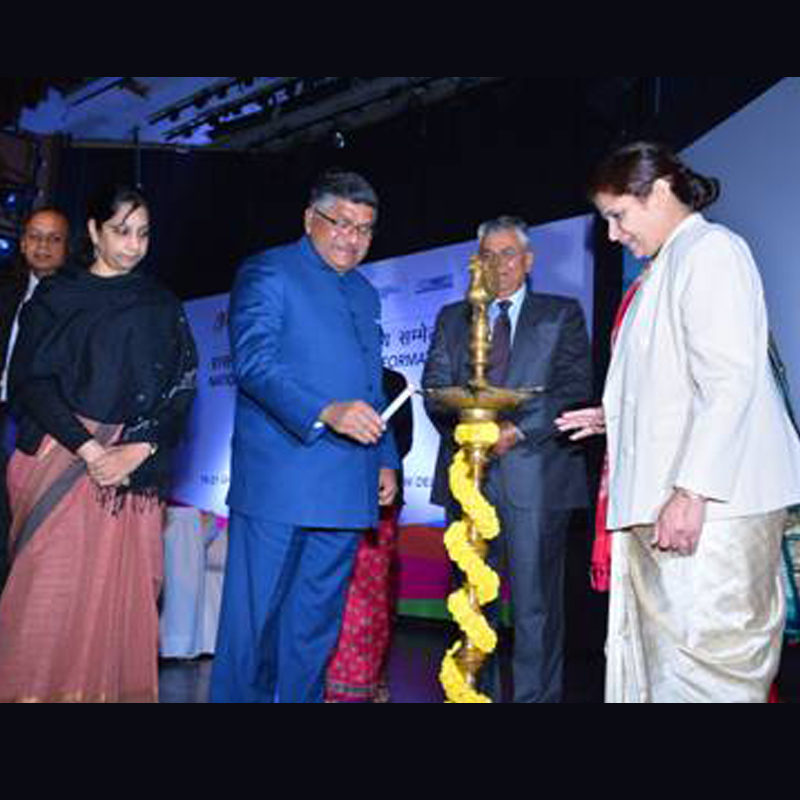
    NEW DELHI: Electronics and Information and Technology Minister Ravi Shankar Prasad has said the National Informatics Centre is the “technological bridge of India and is best placed to lead the way for a Digital India”

    He urged the District Information Officers (DIOs) to be innovative and proactive. NIC must adopt a transformative approach to make a difference at the grassroots level. He appealed to the NIC to connect with the Common Service Centres (CSCs), who have successfully provided training on digital payment systems to over 19.6 million of rural citizens and 6,15,000 merchants.”

    He was speaking at an event where the NIC kicked off the National Meet on Grassroot Informatics – VIVID: Weaving a Digital India here.

    The inauguration of the three-day event was also attended Minister of State P P Chaudhary, Secretary Ms Aruna Sundararajan, Additional Secretary Ajay Kumar, NIC DG Ms Neeta Verma, and Deputy DG Ms Rama Nagpal.

    Prasad announced the Government’s plan to set up a Government Security Operation Centre and a Data Centre for Cloud in Bhopal. He also announced that the Government is going to enhance the infrastructure of district NIC offices to international standards. As a pilot project, 150 District NIC offices would be upgraded during the period 2017-18, while rest will follow soon.

    He instructed the ministry to develop a training module for the NIC officials to keep pace with the ever evolving technologies. He also announced the introduction of annual awards for the DIOs of the NIC for taking up exemplary innovative approach in their respective districts. The top three best innovators will get a reward of Rs 2,00,000, Rs 1,00,000 and Rs 50,000 respectively.

    Chaudhary said, “The threshold of the year 2017 will always be remembered for heralding in several transformative changes to benefit the economy as well to the citizens, amongst them the Digital India initiative has been the most significant one. I must congratulate NIC and DIOs for playing a pivotal role in preparing the country for a successful Digital transformation of our ecosystem.

    NIC also introduced two new portals – District Collector’s Dashboard and NIC Service Desk, which were launched by Prasad and Chaudhary respectively.

    The National Meet on Grassroots Informatics is aimed at showcasing the various initiatives of NIC in creating and enhancing the Digital Infrastructure in the country. Some of these are – setting up of ICT infrastructure, developing state of the art products to enable the government and empower the citizens, its initiatives at state and district level along the lines of Digital India initiatives along with the various awareness campaigns on Digital Payment Systems encompassing DBT, PFMS, Cashless Payment, Aadhaar etc.

    The individual sessions during these three days would throw lights on NIC’s journey so far, the best practices it follows, the Digital India programme, Digital India initiatives from NIC State Units, success stories from the districts, Financial Inclusion, its technology awareness programmes and ICT Infrastructure being provided by NIC.