Category: I&B Ministry

  • Four new channels receive MIB permission to launch in 2015

    Four new channels receive MIB permission to launch in 2015

    NEW DELHI: While the year 2014 saw the clearance of more than 30 television channels, the first four months of 2015 have so far only seen four new channels receiving permission to launch. They are: ETV Plus, ETV Life, ETV Abhiruchi and Vedas Om TV. The largest gainer is here Eenadu Entertainment Television of Hyderabad, which owns the ETV brand of channels.


    To expedite the process, which had remained stagnant after March-end, the Ministry now holds the Open House meetings with stakeholders two time every month instead of once.


    With the four new channels being added this year, the number of permitted satellite television channels has gone up marginally to 830 by April 2015 from 826 in December-end 2014.


    The cleared channels are all general entertainment channels (GECs), which now total to 425 and all of them have been given uplinking permission.


    Statistics show that 697 channels (including 382 news channels) are permitted to uplink and downlink from within the country, and 40 (including seven news channels) are uplinked from India for beaming overseas and not in the country. There is no change in channels uplinked from overseas and downlinked into India with the number remaining static at 93 (including 16 news channels). 


    Additionally, the MIB has permitted 9X Bangla channel to assume a new name – 9X Bannao.

  • Spectrum auctions to be done in timely, fair & transparent way: Ravi Shankar Prasad

    Spectrum auctions to be done in timely, fair & transparent way: Ravi Shankar Prasad

    NEW DELHI: Communications and Information Technology Minister Ravi Shankar Prasad has assured the industry that the auction of spectrum in the future too would be conducted in a timely, fair and transparent manner.


    The hallmark will be good governance and “the road map will be fully disclosed in advance so that industry can put its act together in a planned manner,” he said.


    Inaugurating ‘Digital Bharat 2015,’ the first edition of FICCI’s platform for having transformative exchanges and deliberations, organized jointly with the Department of Telecommunications, Ministry of Communications & IT, Prasad said that the ‘Digital India’ programme was party-neutral, ideology-neutral and Centre-State-neutral. “It aims at bridging the urban-rural divide and is committed to ensure digital inclusion. I would like to see every mason and carpenter in the country using his smart phone to enhance his business and income,” he added.


    The last spectrum auction, the biggest so far, that ended in March this year fetched about Rs 1.10 lakh crore to the government. 


    The Minister also launched the FICCI-EY report titled ‘Speeding Ahead on the Telecom and Digital Economy Highway.’ 


    Telecom secretary Rakesh Garg said that the three ambitious and visionary programmes – Make in India, Digital India and Smart Cities – have opened up huge opportunities for the industry. The economy, he said, would stand to benefit immensely through higher productivity that the vast number of talented Indians will usher in. 


    He said that the government was committed to doing everything possible to make the environment conducive for industry and the consumer, the success of which will depend upon industry and government working together.


    The Indian Express whole-time director and head, new media Anant Goenka pointed out that the importance of digital technology could be gleaned from the success stories of the young multi-billionaires who have used digital platforms innovatively. “The question that remains is how ‘Digital Bharat’ is achieved in a fair and sustainable way,” he said.


    USIBC Digital Economy Industry Group chairman Joseph Alhadeff spoke of the need to achieve global standards in manufacturing and integration into the global supply chains. He also called for more enhanced cooperation amongst the stakeholders so that there was no duplication of effort. 


    FICCI president Jyotsna Suri, in her welcome address, said that it was encouraging that the Indian government is prioritizing technology as an enabler for the transformation and development of the country. “However, to reach the desired goals, it is extremely important to develop an environment, which nurtures Government-Industry dialogue and partnerships,” she emphasized and added, “We need to understand the nature of the opportunities being offered by the government programs like Digital India and Make in India and therefore FICCI has initiated the Digital Bharat series as a platform for having transformative exchanges and deliberations.”


    FICCI communications and digital economy committee chairman Virat Bhatia, who moderated the inaugural session and delivered a vote of thanks, stated, “The digital revolution now stands at the cusp of a transformation, with the government having laid out its vision of a digitally enabled India over the last one year. The success of both “Digital India” and “Make in India”, will ride on the back of strong telecom ecosystem, digital infrastructure and industry’s link in the value chain. Some important issues on policy and regulatory front will need continued attention.”


    EY global telecommunications leader Prashant Singhal presented the highlights and recommendations of the FICCI-EY report.


    The key takeaways of the report are as follows:


    ·Recommends to bring handsets under provisions of “Goods of Special Importance” under the Central Excise Tax Act, 1956; thus, capping the maximum VAT levied by states at five per cent.


    ·Endorses a ten-year tax holiday on a block of 15 years on all profits and gains for manufacturing in the mobile phone industry.


    ·Endorses to incorporate the DoT guidelines on installation of mobile tower in the statutory framework and rules in line with the 53rd Parliamentary Committee report.


    ·Recommends to have minimum interest subsidy of five per cent on all fixed capital investments for entire Electronic System Design and Manufacturing sector in the lines of benefits given under Technology Upgradation Fund Scheme.


    ·Recommends to eliminate or reduce Universal Service Obligation Fund (USOF) to one – three per cent.


    Commenting on these findings, Singhal said, “A favourable and stable regulatory environment, coupled with increased transparency, is critical for attracting investments to the sector. An empathetic perspective of challenges faced by service providers is also important for restoring its vitality. Our report highlights that the country will speed ahead on the Digital Highway only with the provision of a clear spectrum roadmap, reducing USOF levy, rationalizing taxes and providing a policy push to boost manufacturing ecosystem. The resultant benefits transcend sectors. Moreover, telecom should be considered a critical infrastructure sector and its financing needs should be addressed accordingly.”
  • Only 180 community radio stations despite financial aid by govt

    Only 180 community radio stations despite financial aid by govt

    NEW DELHI: Despite the scheme being almost a decade old and the government extending financial assistance, the total number of operational community radio stations (CRS) in the country is just 180.


    This is despite the fact that the Information and Broadcasting Ministry has issued around 410 permissions to set up community radio stations in the country. In addition to other assistance, the Government has even set up a fund for helping CRS.


    A Parliamentary Committee noted recently that 209 applications for setting up of community radio stations were pending with various Ministries. Even though the number of applications pending in the Ministries concerned has come down substantially, there are at least 50 applications that are pending, which have crossed the stipulated timeline beyond three months.


    Though the scheme was launched around a decade earlier, the outreach of the CRS was enhanced in 2006 to include non Governmental and Community based organisations with at least three years of legal existence.


    Earlier this year, Parliament was informed that only 76 letters of intent (LOI) had been issued out of the 689 applications from educational institutions, registered societies, trusts and NGOs etc received since 1 January, 2012 for setting up community radio stations.


    As many as 285 applications had been returned or rejected, while 263 had been referred back to the applicants.


    According to the list placed on the Ministry’s website as on 1 May, 2015, the largest number of community radio stations – around 90 – are being operated by private and governmental educational institutions, around 65 by non-governmental organisations, around 20 by universities including six by state agricultural universities, and six by Kendriya Vidyalya Kendras.


    Tamil Nadu has the largest number of CRS numbering around 27, followed by Uttar Pradesh with 21, Maharashtra with 17, Madhya Pradesh with 14, and Karnataka with 13. All other States and Union Territories have 10 or less CRs with Delhi having six.

  • TV Today, ENIL to challenge MIB’s decision on Oye FM sale

    TV Today, ENIL to challenge MIB’s decision on Oye FM sale

    MUMBAI: TV Today Network (TVTN) and Entertainment Network (India) Limited (ENIL) have decided to appeal against the recent decision of the Information & Broadcasting (I&B) Ministry barring TVTN to sell its radio FM business to ENIL.  


    On 8 May, 2015, the Information and Broadcasting Ministry refused to green light TVTN’s proposal of selling its radio FM business – Oye FM – to ENIL on the grounds that the proposal sale did not conform with the FM Radio Guidelines.


    In its notice to the Bombay Stock Exchange (BSE), ENIL said, “With reference to the earlier announcement dated 13 February, 2015 regarding the non-binding memorandum of understanding with TV Today Network Limited (TVTN) for the proposed purchase of seven radio stations from TVTN. The proposed purchase was subject to relevant regulatory approval(s), Entertainment Network (India) Ltd has now informed BSE that the Ministry of Information and Broadcasting (MIB), Government of India, vide their letter dated 1 May, 2015, which was received by the Company on 8 May, 2015, has declined its approval on the grounds that the proposed sale by TVTN and proposed purchase by the Company is not in conformity with the FM Radio Guidelines. However, both the Company and TVTN have decided to appeal against the MIB decision.”


    It now remains to be seen whether Oye FM, which operates in seven cities across India, continues to stay under TVTN’s umbrella or moves to ENIL.

  • MIB denies sale of TV Today’s radio biz to ENIL

    MIB denies sale of TV Today’s radio biz to ENIL

    MUMBAI: The wait for TV Today Network, which has been looking at selling its radio FM business to Entertainment Network (India) Limited (ENIL) is finally over, but not with the result that the network was expecting.


    In a recent development, the Ministry of Information and Broadcasting (MIB) has declined its approval to TV Today Network to sell its radio FM business – Oye FM – to ENIL. The approval has been denied on the grounds that the proposed sale did not conform with the FM Radio Guidelines.


    TV Today today said that the “application made to Ministry of Information and Broadcasting (MIB), Government of India seeking its approval regarding the sale of Radio FM Business [Seven Radio Stations] to Entertainment Network (India) Limited, MIB by their order dated 1 May, 2015, received on 8 May, 2015, has declined its approval on the grounds that the proposal sale is not in conformity with the FM Radio Guidelines.”


    However, the company has reserved its right to seek appropriate legal remedy, as and when required.


    Further, a committee meeting of senior officials was held on 8 May to take note of the said order. “Keeping in view the said order, the committee has considered and approved the amendment letter to the Non binding Memorandum of Understanding to be signed between the Company and Entertainment Network (India) Limited,” a statement from the company read.


    It can be recalled that earlier in April, TV Today had approached the High Court with regards to the delay in MIB’s approval to sell the company’s FM radio business to ENIL.


    The network had then said, “In relation to the proposed sale of seven radio stations to Entertainment Network (India) Limited, since time is of essence and with approval of the MIB getting delayed, hence in order to expedite the matter, an urgent writ petition in the High Court is listed for hearing, to seek necessary relief.”

  • Jaitley stresses need to integrate communication across social media platforms

    Jaitley stresses need to integrate communication across social media platforms

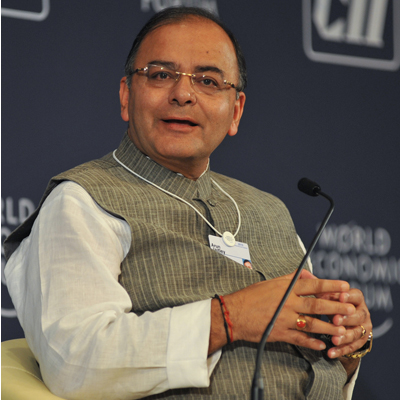
    NEW DELHI: Information and Broadcasting Minister Arun Jaitley today said the “Talkathon” serves as independent interview, which runs live on social media and taken up by all private channels as well.

     
    He added that it offered an opportunity to integrate communication across platforms as well as a direct interface with the audiences.

     
    Addressing a meeting of Consultative Committee of MPs attached to his Ministry to discuss the issue of “Harnessing role of Social Media,” he said the digital mode had become an effective medium to communicate to the wide audience while at the same time it offered opportunities to innovate.

     
    Referring to the Doordarshan (DD) app launched on 7 May, 2015, the Minister mentioned that this initiative provided an opportunity to address the needs of the audience, which followed the dissemination of information on the digital mode.

     
    Jaitley also said efforts would be made to popularize the digital mode of the 100 volumes of Mahatma Gandhi compiled by the Publications Division on the social media platforms of the Ministry. 

    At the meeting, which was also attended by Minister of State Rajyavardhan Rathore, a presentation was made by Secretary (I&B) Bimal Julka giving an overview of the steps and initiatives undertaken so far by the Ministry in harnessing the potential of the social media for disseminating the information relating to the important initiatives of the Government. 

    Members gave suggestions to enhance the reach of the Government coverage through All India Radio (AIR) and DD, especially in areas that required dissemination. It was emphasized that efforts needed to be taken to promote the reach of social media to those segments, which at times suffered due to lack of technological access. It was also suggested that measures need to be taken to facilitate information flow to the young target audience and institutions in rural areas. Members also suggested that content needed to be tailored consistently to address the information needs of the people. 

    Members who attended the meeting Dr. Jayakumar Jayavardhan, Dr. Sanjay Jaiswal, Tapas Paul, V. Sathyabama, Anil Madhav Dave, Jaya Bachchan, Dr. K. Keshava Rao, Madhusudan Mistry, Neeraj Shekhar and Vivek Gupta.

  • Inter-Ministerial Task Force studying education in media related courses

    Inter-Ministerial Task Force studying education in media related courses

    NEW DELHI: An Inter-Ministerial Task Force on Education in Media related courses has been constituted by the Human Resource Development Ministry for the studying the feasibility of a communication university.


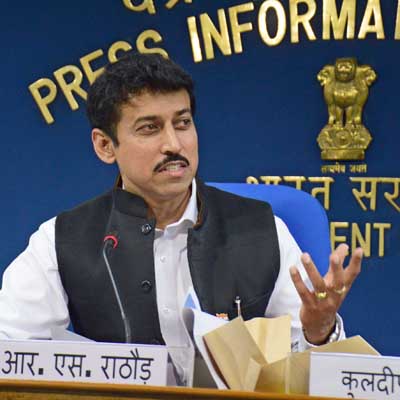
    Minister of State for Information and Broadcasting Rajyavardhan Rathore informed the Parliament that this force has representatives from the concerned Ministries and regulators as also persons of repute and eminence from the fields of cinema, TV, print media, theatre and performing arts.


    While there is no proposal at present to set up a communication university, he said that there has been a demand from certain sections of media that a communication university be set up to meet the growing demands of all types of communication systems. 


    In order to discuss the feasibility of setting up such type of institution along with its proposed structure and mechanism, the I&B Ministry has initiated the process to hold the consultations with various stakeholders.

  • MIB needs better planning to improve expenditure benchmark: Parliamentary Committee

    MIB needs better planning to improve expenditure benchmark: Parliamentary Committee

    NEW DELHI: The Ministry of Information and Broadcasting (MIB) needs to have better planning for improving the benchmark of expenditure, a Parliamentary Committee has said.


    The comments of the Parliamentary Standing Committee on Information Technology, which also examines MIB, are based on the fact that the expenditure registered a little above 50 per cent at the Budgetary Estimates stage, that is, during the first two quarters of 2014-15.


    MIB’s budgetary allocation for 2015-16 is for a total amount of Rs 3711.11 crore, which includes Rs 914.53 crore for Plan and Rs 2796.58 crore for Non-Plan.


    The Committee noted that there was an overall increase in the size of the Budget by Rs 395.11 crore for the year 2015-16 crore compared to the budgetary support for the year 2014-15 at Budgetary Estimates stage.


    A look at the financial performance of the Ministry indicates that they have been able to achieve cent per cent utilization with respect to revised estimates allocations in the year 2014-15, which the Committee described as “a healthy trend.”

  • President urges film industry to look beyond markets & nurture human values

    President urges film industry to look beyond markets & nurture human values

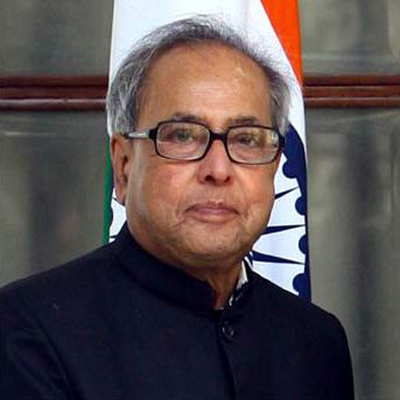
    NEW DELHI: President Pranab Mukherjee has urged the film industry to look beyond markets and work together to help “nurture universal human values, which draw on our rich civilizational heritage that celebrates diversity and nurtures inclusiveness.”


    In this context, he quoted the late filmmaker Ritwik Ghatak and said ‘Cinema is no art for me. It is only a means to the end of serving my people.’


    The President was giving away the 62nd National Film Awards for 2014 at a function at Vigyan Bhavan yesterday.


    Mukherjee said the advent of digitisation and modern technologies “do not mean that we lose touch with the grass roots. Our content has to be our strength as it is entrenched sharply in our vibrant cultural milieu. Cinema in India crosses all boundaries of region, caste, creed and religion. It reflects the immense diversity of our nation, which is home to different cultures, religions and languages. It shows the confluence of modernity as well as tradition as well as our ancient past and billion aspirations for the future.”


    Mukherjee said cinema has been an integral part of Indian culture and entertainment from the days of Dadasaheb Phalke’s Raja Harish Chandra of 1913, the first film made in India. Indian cinema transcends national boundaries and is a powerful purveyor of ideas and values that impact the consciousness of millions of people. Indian movies not only showcase the multicultural diversity of the country but are also a tribute to its linguistic richness. They are a national treasure and our country’s “soft power” in the true sense of the term, forging international ties and navigating global horizons with ease.


    The Dadasaheb Phalke award to veteran Shashi Kapoor will be presented to him in a special function in Mumbai in view of his ill-health.


    Mukherji said, “We live in a rapidly changing world to which the film industry will have to adjust and adapt. Technology has brought down the costs of production and expanded the mechanisms of dissemination. Still cameras and cell phones that record video can be now edited on a home computer and uploaded on the net. Promotion and marketing of films have now taken on a new avatar with substantial marketing happening on social media – news of a good film now spreads quicker on twitter than by word of mouth. I also understand 2014 saw the launch of four film and entertainment focused investment funds.”


    He added that India is likely to soon embrace a completely digital ecosystem, which would help us connect with even larger numbers transcending geographical and cultural barriers. The President also urged the film industry to look beyond markets and work together to help nurture universal human values that draw on India’s rich civilizational heritage that celebrates diversity and nurtures inclusiveness. He congratulated all the Awardees for their contributions in various fields of cinema.


    The President said that the Government was taking a number of steps for strengthening and promoting Indian cinema and the film industry. The Government is planning to set up a National Centre of Excellence for Animation, Gaming, and Visual Effects. A National Film Heritage Mission is to be undertaken by the National Film Archives of India for conservation/preservation, restoration and digitization of films made in the country. The Government also proposes to set up a Film Facilitation Unit, which will act as a facilitation point for filmmakers and production houses from foreign countries to enable them come to India and shoot their films in India.”


    Information and Broadcasting Minister Arun Jaitley said Indian cinema had come a long way since its birth over a century ago. It has forayed into new avenues and innovated both in form as well as content. The production of cinema in various languages and dialects has taken this art form into new areas-geographically as well as socially.


    He added that the changing social mores and aspirations also found its voice in this medium. The medium witnessed the triumph of the spirit of liberation and empowerment of women-centric themes on the Silver Screen. Social values have influenced our cinema and similarly our cinemas have had a great impact on our social values.


    The Minister said, “Cinema is also a component of India’s soft power abroad. We lead the world average in terms of number of movies produced each year. Indian movies have found increasing acceptance in the international fora. Government is committed to take all possible measures towards the overall growth of the film industry – towards its even spread across the country and not restricted to certain pockets. Keeping this approach in mind, Government is keen to set up a Film & Television Institute in the North Eastern Region for the benefit of the young creative minds from that region.”


    Jaitley said the saga of Indian cinema has been that of a spirit of entrepreneurship. Experimentation and innovation with new themes in form, content and technology have always been employed by creative movie makers of India. The times to come would witness disruption of familiar paradigm due to rapid strides in technology and its increasing presence in the space of our daily lives.


    In his welcome address, secretary Bimal Julka said the Ministry had taken several initiatives in the film sector aimed at protecting, restoring and preserving our invaluable film heritage using the best available technology. Julka also said that in addition to the innate creativity of the film professionals, the continued growth is being experienced in large measure due to increasing systematisation of production processes, wider releases across an increasing number of screens, particularly multiplexes, aggressive promotion, as well as speedy adoption of emerging digital technologies, he added.


    The highlight of the function was the live musical performance of Sukhwinder Singh and Uttara Unnikrishnan.


    A total of 45 Awards were given in the Feature film category and 21 in the non-Feature Film category. Three awards were given to Best Writing on Cinema.


    The Award for the Best Feature Film was given to Court (Marathi, Hindi, Gujarati & English) produced by Zoo Entertainment Pvt. Ltd. and directed by Chaitanya Tamhane. Asha Jaoar Majhe (Bengali) directed by Aditya Vikram Sengupta and producer: F.O.R Films Pvt. Ltd. received the Indira Gandhi Award for Best Debut Film of a Director. The Award for the Best Popular Film providing Wholesome Entertainment was given to Mary Kom (Hindi) produced by Viacom 18 Motion Pictures and directed by Omung Kumar.


    The Award for the Best Director has been conferred on Srijit Mukherji for the Film Chotushkone (Bengali). The Award for the Best Actor was conferred on Vijay for the film Nanu Avanalla Avalu (Kannada) and the Award for the Best Actress was conferred on Kangana Ranaut for the film, Queen (Hindi). The award for the Best Children’s Film was shared by Kaakkaa Muttai (Tamil) and Elizabeth Ekadashi (Marathi). Master J. Vignesh & master Ramesh shared the Award for Best Child Artist for Kaakkaa Muttai (Tamil).


    The Award for the Best Music direction (songs) was conferred on Vishal Bhardwaj for Haider (Hindi) and the award for the best music direction (Background Score) was given to Gopi Sunder for Nineteen Eighty Three (Malayalam). The award for the best lyrics was conferred on NA. Muthukumar for the song Azhagu from the film Saivam (Tamil). A special jury award has been conferred on Bhaurao Karhade for the film Khwada (Marathi). The award for the best choreography has been conferred on Sudesh Adhana for the film Haider (Hindi).

  • Govt. issues urban TV households’ list to be covered in DAS Phase III

    Govt. issues urban TV households’ list to be covered in DAS Phase III

    NEW DELHI: A total of 38,799,074 television households will be covered in 7,709 urban areas in 630 districts in 35 states and union territories in Phase III of Digital Addressable System (DAS) expected to be completed by the end of this year.


    The list is based on the Census Report of 2011 carried out for the government of India.


    The list mentions two other areas: Delhi and Chandigarh, where it says DAS was completed in Phase I.


    Tamil Nadu tops the list of urban areas with 1095, primarily because DAS was stayed in Chennai after Madras High Court orders. 


    Uttar Pradesh comes next with 906, followed by West Bengal with 858 and Maharashtra and Kerala with 524 and 520 districts respectively.


    The Ministry website gives details of each state and union territory and also lists every urban area along with TV households.