Category: I&B Ministry

  • Election Commission issues detailed media guidelines for Bihar assembly polls

    Election Commission issues detailed media guidelines for Bihar assembly polls

    NEW DELHI: Even as the Model Code has come into effect for the elections to the Bihar assembly, the Election Commission today prohibited conduct of Exit poll and dissemination of their results during the period mentioned therein, that is, from the hour fixed for commencement of polls in the first phase and half hour after the time fixed for close of poll for the last phase in all the States.


    The directive was issued under Section 126A of the Representation of Peoples Act 1951. The polls commence from 12 October and will continue till 8 November, in five phases.


    The Commission reiterated that the TV, radio channels and cable networks should ensure that the contents of the programme telecast by them during the period of 48 hours referred to in Section 126 of the Act do not contain any material, including views/appeals by panelists/participants that may be construed as promoting/prejudicing the prospect of any particular party or candidate(s) or influencing/affecting the result of the election. This among other things includes display of results of any opinion poll and of standard debates, analysis, visuals and sound-bytes.


    At the outset, the Commission said there are sometimes allegations of violation of the provisions of Section 126 by TV channels in the telecast of their panel discussions/debates and other news and current affairs programmes. The Commission said it has clarified in the past that Section 126 prohibits displaying any election matter by means of television or similar apparatus during the period of 48 hours ending with the hour fixed for conclusion of poll in a constituency.


    “Election matter” has been defined in that Section as any matter intended or calculated to influence or affect the result of an election. Violation of the aforesaid provisions of Section 126 is punishable with imprisonment up to a period of two years, or with fine or both.


    During the period not covered by Section 126 or Section 126A, concerned TV, radio, cable and FM channels are free to approach the state, district or local authorities for necessary permission for conducting any broadcast related events, which must also conform to the provisions of the model code of conduct and the programme code laid down by the Information and Broadcasting Ministry under the Cable TV Networks (Regulation) Act 1995 with regard to decency, maintenance of communal harmony, etc.


    They are also required to stay within the provisions of Commission’s guidelines dated 27 August 2012 regarding paid news and related matters. Concerned chief electoral officer or district election officer will take into account all relevant aspects including the law and order situation while extending such permission.


    Apart from issuing separate guidelines for the print media, the Commission also drew attention of the media to the guidelines issued by the Press Council of India and the News Broadcasting Standards Authority with regard to elections.
  • MIB asks FM Phase III bidders to pay full amount by 1 October

    MIB asks FM Phase III bidders to pay full amount by 1 October

    NEW DELHI: All successful bidders for the 91 FM Radio channels in 54 cities that were announced yesterday in the first stage have been asked to pay the bid deposit – 25 per cent of the bid amount – by 21 September. The balance will have to be paid by 1 October. 

    Both amounts have to be paid by demand draft in the name of the Pay and Accounts Officer, Information and Broadcasting Ministry.


    At the same time, the Ministry warned that if the bid deposit is not received by the due date, the earnest money deposit (EMD) will be forfeited, and if the balance is not received by 1 October, the bid deposit and EMD will be forfeited.


    The Ministry also made it clear that this was without prejudice to any other action that it may take against defaulters.  


    While placing the results of 91 channels in fifty-four cities on the website of the Ministry, the frequency allocated and the successful bid amount was also stated.


    The Ministry said the results do not include the results of the bids by Sun TV, South Asia FM and Kal Radio in compliance with the orders of the Madras High Court.


    It also said the Centre had decided to file a special leave to appeal in the Supreme Court against the order of 26 July of the Delhi High Court of Delhi in the petitions by Digital Radio (Mumbai) Broadcasting Ltd. & Digital Radio (Delhi) Broadcasting Ltd. respectively.


    Even as the government withheld six results because of legal cases, Entertainment Network India Ltd (ENIL) emerged the largest gainer with 17 channels in its kitty. 


    Rajasthan Patrika Pvt Ltd, Reliance Broadcast Network and DB Corp Ltd got 14 channels each. Meanwhile, Music Broadcast Pvt Ltd has got 11 channels and HT Media has 10 channels. Digital Radio (Delhi) Broadcasting Ltd and Abhijeet Realtors and Infraventures Pvt Ltd got two channels each.


    Others who have successful bid and got one channel each are Digital Radio (Mumbai) Broadcasting Pvt Ltd, Renderlive Films and Entertainment Pvt Ltd, Sarthak Films Pvt Ltd, Abir Buildcon Pvt Ltd, Mathrubhumi Printing and Publishing Co Pvt Ltd and Odisha Television Ltd.


    The auction was stopped on the 33rd day after just one round, with 97 channels in 56 cities became provisional winning channels with cumulative provisional winning price of about Rs 1156.9 crore against their aggregate reserve price of about Rs 459.8 crore.

  • Election Commission rejects demand to cancel Modi’s ‘Mann ki Baat’ before Bihar polls

    Election Commission rejects demand to cancel Modi’s ‘Mann ki Baat’ before Bihar polls

    NEW DELHI: The Election Commission has rejected a demand by the Congress and its alliance partners seeking a ban on Prime Minister Narendra Modi’s Mann Ki Baat radio broadcast on All India Radio slated for 20 September.

    The Congress said it could be used to directly influence the outcome of the Bihar Assembly elections. The Commission said it would take action if parts of the programme were found to be in violation of the model code of conduct now in place in Bihar.

    A senior official of the Commission said, “No blanket ban can be enforced on the broadcast or Cabinet meetings. But the EC can take cognisance if the Cabinet decision or the content of programme is in violation of the model code of conduct.”

    A delegation comprising leaders from the Congress, the Janata Dal (U) and the Rashtriya Janata Dal had met the chief Election Commissioner on the issue.

    An earlier complaint against the monthly broadcast during the Harayana assembly polls had been rejected after the Commission went through the recording and transcript of the episode.

    Meanwhile, Modi has urged people to record voice messages for Mann Ki Baat. 

    Earlier, people had been encouraged to send in their messages on the mygov platform. People can record their messages in either Hindi or English for Mann Ki Baat on the toll-free number 1800 3000 7800.

    “Interesting effort by @mygovindia, which enables you to join Mann Ki Baat programme. I heard some of the voice messages and they were unique. Keep the messages coming. Some will be a part of the programme this Sunday,” Modi tweeted. 

    While the broadcast is generally on the last Sunday of the month at 11 am, Modi is doing it earlier this month as he has to leave for the United Nations General Assembly session in New York.

  • ENIL wins 17 FM channels; HT Media bags Delhi for Rs 169 crore

    ENIL wins 17 FM channels; HT Media bags Delhi for Rs 169 crore

    NEW DELHI: Entertainment Network India Ltd (ENIL) appears to be the largest gainer in the first stage of the FM Radio Phase III e-auctions declared today with 17 channels in its kitty.


    HT Media was the bidder for the sole channel in Delhi, which it picked up for a whopping sum of Rs 169.16 crore. HT Media also bagged one of the two channels in Mumbai. The other went to Digital Radio (Mumbai) Broadcasting Pvt Ltd, which an affiliate of Sun TV Network.


    On the other hand, ENIL bagged the sole channel in Bengaluru along with two channels in Hyderabad, with one other channel in Hyderabad going to HT Media. ENIL also bagged the sole channel in Guwahati and one of the two in Jammu, the other going to Rajasthan Patrika.


    Rajasthan Patrika successfully bid for 14 channels, while Reliance Broadcast Network has got 14 channels and DB Corp Ltd has got 14 channels. Meanwhile, Music Broadcast Pvt Ltd has got 11 channels and HT Media has 10 channels.


    The others, who have successful bid are Digital Radio (Delhi) Broadcasting, Digital Radio (Mumbai) Broadcasting, Abhijeet Realtors and Infraventures Pvt Ltd, Renderlive Films and Entertainment Pvt Ltd, Sarthak Films Pvt Ltd, Abir Buildcon Pvt Ltd, Mathrubhumi Printing and Publishing Co Pvt Ltd and Odisha Television Ltd. 


    Bhubaneswar – the city, which got the maximum number of bids, has been bagged by Sarthak Films Pvt Ltd.


    The auction was stopped on the 33rd day after just one round, with 97 channels in 56 cities became provisional winning channels with cumulative provisional winning price of about Rs 1156.9 crore against their aggregate reserve price of about Rs 459.8 crore.


    The results of 91 channels in 54 cities were declared today (16 September) by the Information and Broadcasting Ministry. These results do not include the results of the bids by M/s Sun TV, South Asia FM and Kal Radio in compliance with the orders of the Madras High Court.


    The I&B ministry said the Centre had decided to file a special leave to appeal in the Supreme Court against the order of 26 July of the Delhi High Court in the petitions by Digital Radio (Mumbai) Broadcasting Ltd. & Digital Radio (Delhi) Broadcasting Ltd. respectively.


  • NBA apprises new I&B secretary Sunil Arora with revenue models of news b’casters

    NBA apprises new I&B secretary Sunil Arora with revenue models of news b’casters

    NEW DELHI: The newly appointed Information and Broadcasting Ministry secretary Sunil Arora was today apprised of various issues relating to news broadcasters in a wide-ranging discussion with the News Broadcasters Association (NBA). 


    NBA president Rajat Sharma told indiantelevision.com that all issues including the ad cap were discussed with Arora.


    The meeting comes soon after the adjournment of the ad cap case to 23 September by Delhi High Court.


    This is the first meeting of the new secretary who took over on 31 August, 2015.


    Issues relating to carriage with multi system operators (MSOs) and local cable operators (LCOs) and revenue models for growth of the industry were also discussed. 


    The delegation led by Sharma comprised NDTV’s Narayan Rao, Ashok Venkatramani of ABP News, Anuradha Prasad of News 24, Ashish Bagga of India Today, A P Parigi of Network 18 and NBA secretary general Annie Joseph.


    Special secretary J.S. Mathur was also present in the meeting. 


    The delegation also apprised the secretary about the initiatives taken by the broadcasting industry in the direction of self-regulation which includes working of News Broadcasters Standards Authority (NBSA), an independent authority set up by NBA and the two tier mechanism of complaints redressal relating to news channel followed by them. 

  • FM radio Phase III frequency allocation to bidders completed in three rounds

    FM radio Phase III frequency allocation to bidders completed in three rounds

    NEW DELHI: The frequency allocation of successful bidders in the FM radio Phase III was completed in three rounds of half-hour each today, following the closure of the channel allocation stage yesterday (8 September) after 125 rounds of bidding spread over 32 days.


    There was no time gap between two consecutive rounds. The e-auction commenced on 27 July and was completed today (9 September) with the frequency allocation stage.


    During the frequency allocation stage, provisional winning bidders were allowed to select FM frequency for the winning channels from the frequencies already identified in the respective city and as mentioned in the Notice Inviting Applications of 2 March read with subsequent amendments.


    Frequency selection preference was based upon the rank of the bidders – that is, Rank 1 bidder had the first preference to choose from the frequencies already identified.


    At the closure of the e-auction, 97 channels in 56 cities became provisional winning channels with cumulative provisional winning price of about Rs 1156.9 crore against their aggregate reserve price of about Rs 459.8 crore. Thus, the summation of provisional winning prices surpassed the cumulative reserve price by Rs 697.05 crore or 151.58 per cent.


    The overall cumulative provisional winning price exceeded the total reserve price of the first batch – Rs 550.18 crore – by Rs 606.72 crore or 110.27 per cent.


    The Information and Broadcasting (I&B) Ministry will announce the names of successful bidders at a later stage. According to the ministry, the current auction is indicative of the future growth of the private FM radio sector.


    This is the first time that private FM channels have been offered through Simultaneous Multiple Round Ascending (SMRA) e-auction. This auction design has enabled bidders to take informed decisions while placing bids and consider alternatives dynamically.


    Out of 15 channels in Jammu and Kashmir and the northeastern states, 12 channels got provisional winners with the city of Guwahati getting provisional winning price more than ten times its reserve price. 


    The first batch of private FM Radio Phase III channels comprised 135 channels in 69 cities that had already got FM in Phase II. However, there were no bidders for 13 cities namely Asansol, Gulbarga, Mangalore, Mysore, Puducherry, Rajahmundry, Siliguri, Tiruchy, Tirunveli, Tirupati, Tuticorin, Vijaywada and Warangal.


    The entire process of FM Phase-III roll out including the e-auctions was overseen by an Independent External Monitor in consultation with the Central Vigilance Commission.

  • FM Phase III 1st stage comes to a close with bids for 97 channels in 56 cities

    FM Phase III 1st stage comes to a close with bids for 97 channels in 56 cities

    NEW DELHI: Clocking just one round as compared to four daily rounds on the 33rd day, the first stage of the FM Phase III channel allocation stage has been closed with 97 channels in 56 cities became provisional winning channels with cumulative provisional winning price of about Rs 1156.9 crore against their aggregate reserve price of about Rs 459.8 crore.


    While there were no bids for FM channels in 13 cities, there was no activity even the smaller 31 cities that have so far got bids of Rs 1 – 9 crore.


    However, the government, which had said the e-auction would continue as long as there was even one bidder – claimed that over 71 per cent channels of the first batch were provisionally won by bidders.


    Thus, the summation of provisional winning prices surpassed the cumulative reserve price of the corresponding 97 channels by Rs 697.05 crore or 151.58 per cent.


    Overall, cumulative provisional winning price exceeded the total reserve price of the first batch – Rs 550.18 crore – by Rs 606.72 crore or 110.27 per cent. 


    At the top are three cities namely Delhi at Rs 169.16 crore for one channel, Mumbai at Rs 122.81 crore for two channels and Bengaluru at Rs 109.25 crore for one channel.


    The position is the same for other cities having got bids of more than Rs 10 crore with Chennai at Rs 53.38 crore, Ahmedabad at Rs 42.68 crore, Pune at Rs 42.03 crore, Jaipur at Rs 28.34 crore, Chandigarh at Rs 19.04 crore, Hyderabad at Rs 18 crore, Patna at Rs 17.89 crore, Varanasi at Rs 17.49 crore, Cochin at Rs 15.04 crore, Nasik at Rs 14.66 crore, Lucknow at Rs 14 crore and Jodhpur at Rs 11.44 crore. Kolhapur was not very far behind with a bid above Rs 9 crore at Rs 9.44 crore.


    Cities like Guwahati, Bhubaneshwar and Jodhpur witnessed robust bidding activity with provisionally won price being as high as 800 per cent over the reserve price for their channels. Overall, 18 cities got provisionally won bidders for their channels at prices more than double the respective reserve prices. The winning price rose by more than 100 per cent above their respective reserve prices in Ahmedabad, Amritsar, Aurangabad, Bengaluru, Jaipur, Jodhpur, Kolhapur, Nasik, Patna, Pune, Rourkela and Varanasi, all of which got provisional winning bidders at prices more than double the respective reserve prices.


    The cumulative winning price is exclusive of the migration fee, which will take the total revenue even higher, sources in the Information and Broadcasting Ministry said.


    The government said e-auction of the first batch consists of two stages – channel allocation stage, and frequency allocation stage. After the channel allocation stage, the frequency allocation stage will commence tomorrow.


    During this stage, the provisional winning bidders will be allowed to select FM frequency for the winning channel from the frequencies already identified in the respective city and as mentioned in the notice inviting applications of 2 March, 2015 read with its subsequent amendments.


    Frequency selection preference would be based upon the rank of the bidders: that is, Rank 1 bidder would have the first preference to choose from the frequencies already identified. It may be noted that all the identified frequencies were made available for selection and included in the NIA.


    After the e-Auction process is over, the government will notify the list of successful bidders.


    The Auction Activity Requirement rose to 100 per cent after the 59th round on 14 August, after being 90 per cent after the 37th round on 7 August.


    The 13 cities that eluded bidders are Asansol, Gulbarga, Mangalore, Mysore, Puducherry, Rajahmundry, Siliguri, Tiruchy, Tirunveli, Tirupati, Tuticorin, Vijaywada and Warangal.


    The demand in most cities fell by up to three per cent and by four per cent below the excess demand at the price in the 124th round in Hyderabad.

  • Complete Works of Mahatma Gandhi e-version prepared by Publications Division

    Complete Works of Mahatma Gandhi e-version prepared by Publications Division

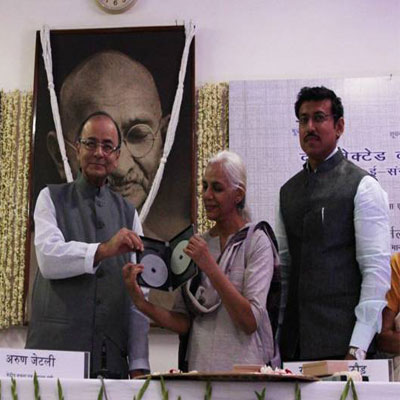
    NEW DELHI: The electronic version of the Collected Works of Mahatma Gandhi (CWMG), a monumental document of Gandhi’s words as he spoke and wrote day after day beginning from 1884 till 30 January, 1948 was released today by Information and Broadcasting Minister Arun Jaitley at Gandhi Peace Foundation.


    The e-version was also uplinked on the Gandhi Heritage Portal, a comprehensive repository of authentic Gandhiana. The portal hosts e-CWMG in a searchable PDF format to ensure easy and free accessibility of the CWMG for people across the world.


    Jaitley announced that the Hindi version of the monumental work CWMG (Sampoorna Gandhi Vangmaya) would be digitised soon. Minister of State (I&B) Rajyavardhan Rathore, Secretary (I&B) Sunil Arora and members of the Expert Committee were present on the occasion. 


    Speaking on the occasion, Jaitley said the intrinsic and heritage value of the e-CWMG Project had the collaboration and partnership of institutions that have been founded and nurtured by Gandhiji himself. Jaitley said that this digitised version of the CWMG would be instrumental in preserving the valuable national heritage and disseminating it for all humankind. 


    Arora said in order to preserve the invaluable heritage of Gandhi and make it available to future generations for all times to come, the Publications Division had taken up the task of preparing the e-version of the 100 volumes of GWMW in 2011. He added that in order to maintain the authenticity of this important work, it was decided to have a facsimile-based version in electronic form for preservation. It was also decided to make it into a searchable master copy in PDF format so that people could benefit of Gandhi’s life and thought in a simple and easy manner.


    The CWMG, published by the Publications Division, is a monumental document of Gandhi’s words, which he spoke and wrote in the period 1884 to 1948. In this series, his writings, scattered all over the world, have been collected and constructed ethically and with stringent academic discipline and loyalty.


    The CWMG took about 38 years in the making (1956-1994). They are a series of one hundred volumes, running into over 55,000 pages, intricately connected across the series, as an integrated whole. The CWMG-original-KS-edition volumes were published in the years 1956 to 1994.The Electronic Master Copy (Volumes 1 to 100) recently prepared is in the form of a searchable PDF beta version, matched with the original-KS-edition fully verified with the original source-documents. It retains the original architecture – volume structure, font structure, line structure, page structure – including its visual look – fully and loyally.


    The task of preparing the Electronic Master Copy of the CWMG-original-KS-edition has been accomplished by the Gujarat Vidyapith, Ahmedabad, India on behalf of DPD.  Execution of the task involved an intensely focused, organic, and stringently supervised effort over a period of four years.  A Committee of three experts constituted for the purpose of supervising this work had the following eminent Gandhian scholars: Gujarat Vidyapeeth former VC Prof. Sudarshan Iyengar, Sabarmati Ashram Preservation & Memorial Trust director Prof. Tridip Suhrud and renowned Gandhian Schola Dinaben Patel.

  • Day 31: All top winning cities show bids lower than clock round price in FM Phase III

    Day 31: All top winning cities show bids lower than clock round price in FM Phase III

    NEW DELHI: There was virtually no activity on the 31st day in the FM Phase III e-auctions with the cumulatve winning price at the end of the 124th round rising by just Rs 10 lakh to Rs 1156.9 crore.


    The smaller 31 cities that have so far got bids of Rs 1 – Rs 9 crore will call the shots as there appear to be no bidders for the larger cities.


    The overall cumulative provisional winning price has risen over the total reserve price of the first batch of 135 FM channels in 69 existing cities – Rs 550.18 crore – by Rs 606.72 crore or 110.27 per cent.  


    However, apart from the fact that 13 cities have not got a single bidder despite a month having passed, it is interesting that all the cities whose prices have remained static for a long period have in fact got bids lower than the clock round price (given in brackets in each case): Delhi – Rs 169.16 crore (Rs 170.86 crore) for one channel; Mumbai – Rs 122.81 crore (Rs 124.04 crore) for two channels; and Bengaluru – Rs 109.25 crore (Rs 110.34 crore). 


    The same also stands true for other cities having got bids of more than Rs 10 crore namely: Chennai at Rs 53.38 crore (Rs 53.92 crore), Ahmedabad at Rs 42.68 crore (Rs 43.11 crore), Pune at Rs 42.03 crore (Rs 42.45 crore), Jaipur at Rs 28.34 crore (Rs 28.63 crore), Chandigarh at Rs 19.04 crore (Rs 19.23 crore), Hyderabad at Rs 18 crore (Rs 18.18 crore), Patna at Rs 17.89 crore (Rs 18.07 crore), Varanasi at Rs 17.49 crore (Rs 17.66 crore), Cochin at Rs 15.04 crore (Rs 15.80 crore), Nasik at Rs 14.66 crore (Rs 14.80 crore), Lucknow at Rs 14 crore (Rs 14.14 crore) and Jodhpur at Rs 11.44 crore (Rs 11.55 crore). 


    The number of channels remained the same – 97 channels in 56 cities, and the bids showed a minor rise in the cumulative reserve price by Rs 697.05 crore or 151.58 per cent against the aggregate reserve price of about Rs 459.8 crore. The Percentage Price Increment applicable for the Next Clock Round remained nil in all cities. 


    Cities expected to enter the Rs 10 crore club in the next few days appear to be Jodhpur, Kanpur, Rajkot, Amritsar, Madurai, and Aurangabad which have all got above Rs 6 crore each.


    The 13 cities eluding bidders are Asansol, Gulbarga, Mangalore, Mysore, Puducherry, Rajahmundry, Siliguri, Tiruchy, Tirunveli, Tirupati, Tuticorin, Vijaywada and Warangal.


    The demand in most cities fell by up to three per cent and by four per cent below the excess demand at the price in the 124th round in Hyderabad.


    The winning price has risen by more than 100 per cent above their respective reserve prices in Ahmedabad, Amritsar, Aurangabad, Bengaluru, Bhubaneshwar, Chennai, Delhi, Guwahati, Jaipur, Jodhpur, Kolhapur, Mumbai, Nasik, Patna, Pune, Rourkela and Varanasi, all of which got provisional winning bidders at prices more than double the respective reserve prices.

  • Day 30: 120 bidding rounds completed in FM Phase III e-auction

    Day 30: 120 bidding rounds completed in FM Phase III e-auction

    NEW DELHI: Activity was seen in just one small city – Bareilly – and there was virtually no bidding on the 30th day in the FM Phase III e-auctions with the cumulative winning price at the end of the 120th round rising by just Rs 20 lakh to Rs 1156.8 crore.


    Clearly the bids for all the big cities appear to be over and it is now the smaller 31 cities that have so far got bids of Rs 1 – 9 crore that will call the shots.


    The number of channels remained the same as yesterday – 97 channels in 56 cities, but the bids took the cumulative reserve price up to by Rs 696.8 crore or 151.5 per cent against the aggregate reserve price of about Rs 459.8 crore. 


    The cumulative provisional winning price has thus risen over the total reserve price of the first batch of 135 FM channels in 69 existing cities – Rs 550.18 crore – by Rs 606.6 crore or 110.2 per cent.


    Cities expected to enter the Rs 10 crore club in the next few days appear to be Jodhpur, Kanpur, Rajkot, Amritsar, Madurai, and Aurangabad, which have all got above Rs 6 crore each.


    Even after 30 days of bidding, 13 cities elude bidder. The demand in most cities fell by up to three per cent and by four per cent below the excess demand at the price in the 120thround in Hyderabad.


    The Percentage Price Increment applicable for the Next Clock Round rose to five in Bareilly, which had a bid of Rs 47,23,425. It remained nil in the other cities. 


    The e-auction will now re-commence on Monday, 7 September.