Category: I&B Ministry

  • MoF assures that GST will be a game changer for M&E and subsume service tax, entertainment tax & VAT

    MoF assures that GST will be a game changer for M&E and subsume service tax, entertainment tax & VAT

    NEW DELHI: In a major relief to the media and entertainment industry, two senior officials of the Finance Ministry assured the captains of the sector that VAT, service tax and entertainment tax would be subsumed in the proposed Goods and Services Tax.


    Terming GST as a game changer, Revenue Special Secretary Rashmi Verma said the rate was being worked out but she reiterated that it would be one and uniform for the entire country.


    Member Service Tax and GST V S Krishnan added that Infosys had been given the task of creating a special portal for GST collections and the progress was good.


    He said that three processes under way were in the public domain and the stakeholders and citizens could react. As all these were drafts, changes could still be made.


    These were the rate of taxation, the law relating to GST, and the technology. The fourth relating to returns would be put in the public domain today itself. Technology  was being taken care of by Infosys.


    He added that after GST came and the government got time to review its progress, it could be improved over time.


    They were responding to remarks made by some industry leaders on the second and final day of the two-day Big Picture summit organized by the Confederation of Indian Industry.


    Sector representatives included Farokh Balsara of Ernst and Young, Film Federation of India Vice President Ravi Kottarakara, Hinduja Ventures whole time Director Ashok Mansukhani and Zee Network’s legal expert Avnindra Mohan. A P Parigi, advisor to the Chairman of Network 18 moderated the session.


    Verma added that the problem of share of centre and states would be sorted out by the Ministry and need not worry the M and E industry which will just have to pay a single tax.


    There will be slabs, but that would be restricted to just two – higher and lower, she added.


    She said bringing the Centre and 29 states on one table had been difficult but most problems had been ironed out.


    The work of the portion of the state was being worked out but the citizens need have no doubt that he will have to pay just one tax. For the citizen, the apportioning was only of academic interest.


    She said there may be some tax levied by some local bodies in some states, but this would be between half per cent to two per cent. While ways were also being found to sort out this problem, it was clear that this would only relate to the manufacturing industry.


    She also clarified that the GST would apply both to services and goods.


    The M and E industry would benefit as the multiplicity of taxation would vanish.


    The entire information will be out on a GST portal by the third week of November, she said. The transitional problems were being worked out, she added.


    Answering a point made by one of the earlier speakers who asked whether the M &  E sector was being treated at par with sinful industries, she said this was not so. The only sinful industries for the Government were cigarettes and alcohol.


    Parigi suggested creation of a separate secretariat with representatives of industry and bodies like the CII. 

  • ‘M&E industry’s $100 billion dream remains elusive with choking of investment:’ Star India COO Sanjay Gupta

    ‘M&E industry’s $100 billion dream remains elusive with choking of investment:’ Star India COO Sanjay Gupta

    MUMBAI: Despite the India Shining and Digital India waves that the country has been witnessing, the $100 billion dream has remained elusive for the Indian media and entertainment (M&E) industry.

    Speaking at a CII conclave in New Delhi today, Star India COO Sanjay Gupta lamented this fact that saying that from 0.8 per cent of GDP three years ago, the industry had resolved to grow to 1.5 per cent within a decade. However, in the past three years, media as a percentage of GDP has instead fallen by two basis points and the $100 billion dream has continued to remain distant.

    “The biggest hurdle has been the choking of investment. To meet ambitious targets, a business either needs to generate large profits internally, which are then invested back into the business or they grow on the back of external investments – national or international. But the M&E industry boasts of neither,” he said

    CII National Committee on Media and Entertainment and Group CEO, Viacom 18 Group CEO and CII National Committee on Media and Entertainment chairman Sudhanshu Vats, Prasar Bharati CEO Jawahar Sircar, Information and Broadcasting Ministry special secretary JS Mathur and Minister of State for Information and Broadcasting Rajyavardhan Singh Rathore were among those present at the summit.

    During the past 15 years, the M&E sector has barely seen any new entrants and only around $4 billion in foreign direct investment (FDI). To garner $100 billion, the industry needs to invest at least $50 billion over the next decade – something that seems farfetched, given the present circumstances. “With M&E remaining an unattractive destination for investments, investors have no interest to invest in a fragmented and unprofitable business. Despite the 12 per cent year-on-year growth touted for the industry, the sector is paradoxically riddled with a host of unprofitable verticals. For example, sports is a $2 billion industry that could easily grow to around $10 in the next five years. Be it Hockey, Football, Kabaddi or Badminton, the new sporting leagues are being lapped up by the audiences,” Gupta said.

    Yet, the M&E industry has been unable to take off on the back of these investments. “Although Star India has been investing almost Rs 200 crore every season for the past two years, dividends are not commensurate. For this to happen, one needs to scale up the volume of content. In other words, more teams, more players and more days of Kabaddi are required annually to capitalize on this opportunity,” Gupta added.

    “A bizarre challenge confronts us here, however. Although Punjab and Haryana contribute large numbers of Kabaddi players, one cannot add more teams based in either of these two states because they do not have a single indoor stadium that could host a Kabaddi match. In Mumbai, the game is hosted at the NSCI Dome, but the biggest constraint is the availability of this facility for a reasonably long period of time. One venue for a city with more than 1,000 Kabaddi clubs simply does not make sense. In this case, consumer interest and the ability to invest are no hurdles, but the fact that the sporting infrastructure required is simply non-existent. Worse, there are no plans to address this situation,” Gupta continued.

    The movie business is no different. With around 7,000 screens, India has one of the world’s lowest screen densities. Despite breakthrough movies such as Queen, PK or Bajrangi Bhaijaan, revenues are stagnant, although the cost of producing these movies has soared dramatically in the past decade. Therefore, a $2 billion industry that sets a billion hearts racing earns zero profits.

    Even news channels fare no better. Without a robust business model, news channel have no money to invest in their business. Whether English or regional, number one channel or last, none of the channels make any money because none earn any money from subscription. Globally, subscription contributes as much as 60-70 per cent of the total earnings of a news channel.

    Television distribution is roughly a third of the total value of the media industry. In the past few years, immense investments have been made in both direct to home (DTH) and the cable business. But the tragedy of this sector is that even after many years of continued investment not a single company or business makes any money. Since the sector is considered a basic need from a consumer viewpoint, the prices at which content is sold by creators to platforms is regulated – prices frozen in 2003 haven’t changed in the past 12 years. In the same 12-year period, even the price of milk has jumped from Rs 12-15 a litre to Rs 35-40 a litre. 

    “Such anomalies are making the sector bleed. But no one seems to care,” Gupta lamented. “In Delhi, for example, the new government has doubled entertainment tax. Consequently, almost 30 per cent of revenue is paid as entertainment tax. The lack of political alignment and consistency of policy in the sector makes it impossible to plan a sustainable business model.”

    In 2015, where millions across the country receive their daily dose of news from Facebook feed, radio broadcasters can only air news snippets from All India Radio (AIR). “In the US, radio has gone hyper local and people spend an hour daily listening to radio. This gives a fillip to local brands since a quick and cheap platform is available to build their business. In India, conversely, there are a limited number of radio stations and limited content that can be aired – and without any news. It is no surprise then that even in large cities where FM exists, the time spent on radio per person is five minutes. Can any industry on Earth make money in such circumstances?” he asked.

    Gupta concluded by asserting, “Unless we unblock minds, we cannot unblock capital.”

    Accordingly, there is an urgent need to make distribution profitable, position animation as the next wave of export-oriented growth, support a serious scale-up of exhibition screens and sports stadiums and allow content innovation in radio. A hugely attractive pitch for domestic and international investors is required, giving them clarity on the policy environment for the next 10 years and confidence of generating sizeable returns on the investments.

    All stakeholders, businesses, policymakers and regulators need to stop being happy with the status quo and incrementalism. In the new era backed by technology, every sector from automobiles to financial institutions and even grocery shopping have witnessed dramatic growth and serious disruptions on the back of serious flow of capital.

    “M&E too needs to see brave new entrepreneurs, disruptive ideas and unconventional business models but this will only happen if we unblock the capital,” stressed Gupta.
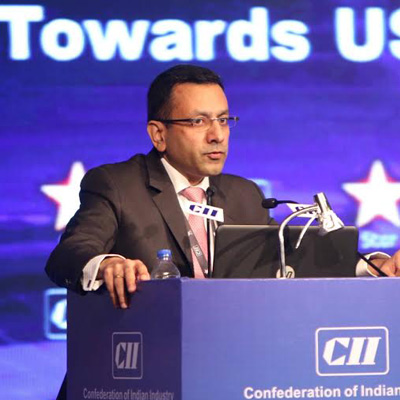
  • Government plans to increase funds for M&E industry: CII

    Government plans to increase funds for M&E industry: CII

    MUMBAI: Minister of State for Information & Broadcasting (I&B) Rajyavardhan Singh Rathore assured the media and entertainment (M&E) industry that the government policies would be supportive and calibrated to enhance the modernisation and monetisation of the sector.


    Addressing the fourth edition of the CII Big Picture Summit 2015 in New Delhi, Rathore said, “In phase II of the auction of the frequencies for the radio, there was no provision for broadcasting news. This was changed during the phase III auction, when private radio was allowed to broadcast the news of the All India Radio (AIR) for a specified time.”


    Rathore mentioned that a lot of initiatives were being taken by the government to support the M&E industry in the country, such as channelising more advertisements to the digital media like YouTube, outsourcing some of the creative works of Doordarshan and AIR to the industry. More such steps would be taken in due course.


    In this regard, plans are underway to revamp the terrestrial broadcast of DD to couple it with internet and DTH so that there would be opportunities for making local programs based on events happening in smaller towns and rural areas. This would also give a boost to creation of contents, which have local flavour and relevance. 


    Acknowledging the industry demand that the monetisation of the M&E segment had not kept pace with the requirements, Rathore disclosed that the government had proposed to set up a university to develop soft skills needed for the industry.


    This university would specialise in providing skills to students in areas like gaming, animation and other avenues of creative pursuits relevant to the industry. He wanted industry to take a lead in this endeavour and create centers of excellence, which would enable the M&E industry to reach $100 billion by 2025. He also said that industry support was imperative to improve the content and appeal of the programs and for training media professionals.


    Responding to a suggestion made by the industry to bring down high incidence of tax levied on the M&E industry, the Minister said that the Good and Services Tax (GST), which the Government wanted to enact would have subsumed various taxes incidental on the industry. He hoped that the bill would be passed soon in the interest of the nation.


    Rathore observed that the Government was keen to create a single window clearance for shooting films in India, which could enhance the monetisation and profitability of the industry. He wanted CII to come out with a plan for creating a dynamic eco system for the film industry to flourish. At the same time, he said that inadequate number of cinema halls in India as compared to countries like the US and China could be more to do with real estate prices.


    Ministry of I&B special secretary J S Mathur said, “The process of digitisation in the M&E sector was at a higher pace and would show results in the coming years. He was of the opinion that smart phones, which could carry large quantum of data including films, news bulletins etc. would redefine the digital space in India.”


    He also mentioned that the Government was in the process of finalising the draft of the Intellectual Property Rights (IPR), which would enable more and more people to invest in India in various segments like content creation, production, animation, and gaming. 


    Prasar Bharati CEO Jawhar Sircar opined that a consortium approach should be followed by the industry and the Government to promote the convergence in the M&E industry to realise its potentials. He suggested that a shared approach should be there among the players to make use of the vast infrastructure of the government through innovative schemes that would put to use smart phones as carriers of innovative contents.


    CII National Committee on Media and Entertainment and Group CEO, Viacom 18 Group CEO and CII National Committee on Media and Entertainment chairman Sudhanshu Vats pitched for easing of doing business and greater application of convergence of technology to tap the potentials of the industry. Monetisation of the industry can be enhanced through proper government support to the industry.


    Narrating the problems being faced by the M&E sector, Star India COO Sanjay Gupta said that bandwidth problems, high cost, high taxes etc were adversely affecting the growth of M&E industry. He wanted a supportive policy regime to help the industry reach $100 billion mark by 2025.

  • PM hails spectrum & FM Radio auction as proactive information to people

    PM hails spectrum & FM Radio auction as proactive information to people

    NEW DELHI: Prime Minister Narendra Modi today referred to auctions of spectrum and FM radio licenses to say that information should be given out proactively to the people.


    He described the “Right to Information” (RTI) Act as a tool through, which the common man has got not just the right to know, but also the right to question those in power. 


    In his remarks at the 10th Annual Convention of the Central Information Commission (CIC), Modi said that the Union Government’s Digital India initiative is complimentary to RTI, because putting information online brings transparency, which in turn, builds trust. 


    The Prime Minister called for an end to the silo-approach in the Government. He said administrative processes should be run based on trusting the people, rather than doubting them. 


    Modi also said that RTI has become a tool for good governance. He also described how the PRAGATI platform developed in the PMO has become a vibrant platform for monitoring progress of projects.  

  • DAS Phase III: Only 62 MSOs sent requests for agreements with b’casters even as deadline looms

    DAS Phase III: Only 62 MSOs sent requests for agreements with b’casters even as deadline looms

    NEW DELHI: Even as the deadline for completing the third phase of Digital Addressable System (DAS) appears to be hovering over, only 62 multi system operators (MSOs) have so far approached broadcasters for finalising inter connect agreements.


    The Ministry of Information and Broadcasting (MIB) today again asked all registered MSOs to immediately send their requests to broadcasters for interconnection agreements on channels in Phase lll areas.


    In case broadcasters do not respond to their requests, the MSOs have been asked to inform the Telecom Regulatory Authority of India (TRAI) immediately in this regard, with a copy to the MIB.


    It was pointed out that the Ministry had, by an email of 6 April this year, advised all MSOs to send the copies of their communication with broadcasters regarding RlOs to TRAI for intervention.


    But “it appears that some MSOs have either not approached broadcasters for channels or have not informed TRAl about their problem,” MIB said in its advisory.


    According to Chapter ll of the Interconnection (Digital Addressable Cable System) Regulations 2012 issued by TRAI, MSO are required to send a request to the broadcasters for TV channels in DAS areas and on their requests broadcasters are required to send their Reference Interconnect Offer (RlO) to them within 60 days of receipt of such requests.


    MSOs operating or planning to operate in Phase lll areas should have by now entered into interconnection agreements with the broadcasters, but the Ministry said “it is given to understand from the periodical reports submitted by the broadcasters to TRAI that only 62 MSOs have so far approached them for interconnection agreements for TV channels for phase lll areas.”

  • MIB updates areas in 16 states & UTs to be covered in DAS Phase III

    MIB updates areas in 16 states & UTs to be covered in DAS Phase III

    NEW DELHI: The Ministry of Information & Broadcasting (MIB) today updated the urban areas to be covered in 16 states during Phase III of the Digital Addressable System (DAS), which is to be completed by the end of this year.


    These states and union territories are: Arunachal Pradesh, Assam, Gujarat, Haryana, Himachal Pradesh, Jharkhand, Mizoram, Nagaland, Odisha, Rajasthan, Punjab, Tripura, Uttarakhand, Uttar Pradesh, Andaman and Nicobar, and Puducherry.


    The ministry also indicated the areas that have been deleted and those which have been added, apart from the number of television households to be covered in each case. Deletions have been made on the basis of reports of empowered officers in each state.


    This list does not contain areas covered in the first two phases.


    The list of areas to be covered in Phase III had been issued on 30 April this year.

  • MIB extends FM Radio migration fee submission date to 27 October

    MIB extends FM Radio migration fee submission date to 27 October

    NEW DELHI: The Ministry of Information and Broadcasting (MIB) has yet again extended the date of submitting the total migration fees for existing operators of Phase II FM Radio wanting to migrate to Phase III to 27 October.


    Earlier, those wanting to migrate had been told that they could pay 25 per cent of the non-refundable one-time entry fee (NOTMF) by 5 October and the balance by 15 October.


    Accepting another demand by Phase II FM operators for extension of time, the MIB once again said the option of migration only applied to Phase II operators and not Phase I operators.


    Meanwhile, the Ministry has assured the Courts that FM channels whose petitions are pending before courts would be given the chance to migrate in case they succeeded in their pleas. This includes some channels of the Sun Group of companies.


    Earlier on 29 September, it had said that the migration fee had been fixed according to the recommendations of the Telecom Regulatory Authority of India (TRAI) of 20 February this year.


    Each channel in Mumbai, which falls under the ‘A’ plus category will have to pay Rs 36.69 crore to the Ministry while each channel from category ‘D’ city- Aizawl will have to shell out Rs 0.12 crore.


    This means that from Mumbai, the Ministry will receive a total of approximately Rs 256.83 crore, considering there are seven stations – Radio City, Red FM, Fever FM, Big FM, Radio One, Radio Mirchi and Oye FM.


    The second highest pay-out will come from New Delhi, which will pay Rs 33.33 crore per channel, which means that all the stations together will contribute about Rs 266.64 crore.


  • FTII students expected to meet MIB MoS Rajyavardhan Rathore

    FTII students expected to meet MIB MoS Rajyavardhan Rathore

    NEW DELHI: A meeting of the student leaders of Film and Television Institute of India (FTII) with Minister of State for Information & Broadcasting (I&B) Rajyavardhan Rathore will be convened in the near future, according to information given to students today.


    The meeting is likely to be in Delhi, though no date has been fixed. Further discussions would depend on the outcome of this meeting, I&B sources told Indiantelevision.com.


    I&B secretary Sunil Arora, in a brief second round of discussions with the students in Mumbai took their opinion on proposals to make FTII an institution of excellence.


    The Ministry was represented by Joint Secretary (Films) Sanjay Murthy, Films Division director general Mukesh Sharma, FTII director Prashant Pathrabe and FTII eegistrar U C Bodke. The Students’ Association was represented by seven members and Aruna Raje Patil of GRAFTII.


    In the earlier round of negotiations with the FTII student leaders on 7 October, the Mukesh Sharma Committee had been set up to look into the issues of operational flexibility and procurement of equipment for FTII.  

  • AIR appoints releaseMyAd as its first virtual agency

    AIR appoints releaseMyAd as its first virtual agency

    MUMBAI: All India Radio (AIR) has joined hands with releaseMyAd as its first ever virtual advertising agency, which is authorised to accept and process radio advertisement bookings for its network of stations.


    AIR’s stations include Akashvani, Vividh Bharati, FM Rainbow and FM Gold.

    As one of the country’s foremost welfare awareness medium, AIR’s reach surpasses that of any other private FM station.


    To reinforce its presence in the virtual world, releaseMyAd.com will meet AIR’s twin objectives of optimum inventory utilisation as well as revenue augmentation.


    The facility allows advertisers to book ads online across all channels of AIR with a mouse-click. As an online media option, releaseMyAd makes mass media advertising options accessible to all by effectively matchmaking between media owners and advertisers.


    Talking about the initiative, AIR additional director general Amitabh Shukla said, “This initiative, a part of AIR’s ambitious web-enabled services for its patrons will not only assist us in adequate utilisation of last minute inventory that goes wasted if not put to use but will also fetch us valuable extra revenues.”

    “AIR is an extensive government owned network that has exclusive rights over communications by every ministry. Be it the Parliamentary talk, World Cup commentary or the Prime Minister’s monthly address, this is the only platform that gives access to these. We want to help advertisers to capitalise on AIR’s monopoly on content that is news, sports or common welfare driven. It has such wonderful properties and scope to offer. We shall now play a significant part in communicating its vision and enabling whatever opportunities it has to offer,” added releaseMyAd founder Sharad Lunia.


    AIR has complete national reach from the main urban centres to the tier 3 cities and even the most far flung rural sections of the country with its three tier broadcasting system. With its concept of local radio constituting the third tier of broadcasting, there are stations in all district headquarter towns.


    However, accessing businesses in the farthest corners who could utilise the radio for advertisements becomes very difficult for AIR. Moreover, given their location, the business owners too don’t end up reaching out to the relevant sources for the purpose.


    “Even seasoned advertisers who want to advertise on AIR are not too sure about how to reach out to them. It is not possible for Prasar Bharati to set up offices in every nook and corner of its broadcast boundaries. ReleaseMyAd will now do the needful to bridge this huge gap between businessmen and their remotely situated target groups,” Lunia added.


    At a time when the country is riding a huge startup tide that is slowly transforming the landscape, this move on the AIR’s part will help the new wave of enterprises effectively reach out to audiences in every nook and corner of India.

  • MIB to examine FTII demand for greater financial powers

    MIB to examine FTII demand for greater financial powers

    NEW DELHI: The Ministry of Information and Broadcasting (MIB) has agreed to examine a demand for an enhanced delegation of financial powers and flexibility in purchase of hardware etc to the Film and Television Institute of India (FTII) in order to enable the students to do their creative work.


    Films Division director general Mukesh Sharma has been asked to study the demand and give his report within a fortnight.


    Following the end of the strike by FTII students after an assurance of meeting the MIB officials, a meeting was held in Mumbai today between representatives of FTII Students Association and the Ministry team headed by MIB secretary Sunil Arora.


    The students, under the coordination of Aruna Raje, who represented GRAFTII – a body of alumni of the institute – will submit a blue print within a fortnight for turning FTII into an institute of national excellence at par with reputed institutions across the world.


    The Ministry has already announced its intentions in this regard, but the students were told that their views would form a major input for taking this matter forward. 


    A second round of talks will be held with the Ministry delegation on 10 October in Mumbai. A request would also be made to MIB Minister of State Rajyavardhan Rathore to meet the students in Delhi in the near future.


    Apart from the Secretary, the Ministry was represented by Joint Secretary (Films) K Sanjay Murthy; Films Division director general Mukesh Sharma; FTII director Prashant Pathrabe and FTII registrar U C Bodke.


    The FTII Students’ Association was represented by Harishankar Nachimuthu, Ajayan Adat, Vikas Urs, Reema Kaur, Malayaj Awasthi, Ranjeet Nair and Shini J K.