Category: I&B Ministry

  • Adcap case on 11 February to consider if pay channels have right to show commercials

    Adcap case on 11 February to consider if pay channels have right to show commercials

    NEW DELHI: The Delhi High Court, which is slated to hear the advertising cap (adcap) challenge case on 11 February, today agreed to consider contentions on whether pay channels should be permitted to carry commercials in view of subscription fee charged by them. 


    In a brief hearing, counsel Vivek Sarin on behalf of Home Cable Network Pvt. Ltd, which has come as an intervenor in the case, also told the Court that the petitioners had not disclosed the fact that broadcasters had given their consent to observe the 10+2 minutes ad cap rule under the Cable Television Network Regulation Rules 1994 and the Act that followed a year later and also under the Uplink and Downlink Guidelines.  


    Defending the plea that pay TV broadcasters should not be allowed to take ads as they charged subscription fee, Sarin wanted the Court to order that offending pay TV broadcasters should deposit the advertisement revenue earned during the period from 17 December, 2013 onwards in the Consumer Welfare Fund maintained by the Union Government.


    He said the Standard of Quality of Services Regulation 2012 and the subsequent amendment of December 2013 was clear that all channels had to observe the adcap.


    However, Sarin also sought to argue that since pay channels charge a subscription fee, they should not be permitted to air ads and even if they do so, then the subscription charges should be adjusted accordingly. He said that the amendment of 17 December, 2013 to the Standard of Quality of Services Regulation should be modified accordingly and the protection given by the subsequent order of 27 November last should also be modified.


    The case, filed by 9x Media, News Broadcasters Association (NBA) and others against the Telecom Regulatory Authority of India (TRAI) and the Union Government, has been adjourned from time to time on the plea that the government and the broadcasters are in talks on the issue.


    Sarin wanted issuance of directions to the TRAI to enforce the 2012 Standards of Quality of Service (Digital Addressable Cable TV Systems) Regulations as amended in 2013 and the provisions of rule 7(11) of the Cable TV Network Rules 1994 against the offending pay TV broadcasters.


    He also sought directions to TRAI and the Union Government to enforce the Clause 5.1 of the Down Linking Guidelines and the undertakings given by the Pay TV Broadcasters under Form A 1 against the pay TV broadcasters.


    In the last hearing in November 2015, the Information and Broadcasting Ministry informed the Delhi High Court that it was in talks with the NBA and other stakeholders on the issue of the advertising cap of 12 minutes per hour on television channels.


    Consequently, the Court put off hearing of the matter to 11 February, 2016 but observed that the matter had been pending for some time and therefore it will hear and conclude the case in the next hearing.


    The intervention application by multi system operator (MSO) Home Cable Network and its head Vikki Chaudhary said it wanted to intervene as it was directly affected by the outcome of the present petition and “the ordinary subscribers are unduly burdened with unjustified charges when the cost of operating the channels can be recovered from the advertisement revenue. The said cost includes notional profits also.”


    The application wanted the NBA petition to be dismissed and added, “The pay channel broadcasters are profiteering at the expense of subscribers and the DPOs. There is no justification for changing monthly subscription when commercial advertisements are inserted. The Standards of Quality of Service (Digital Addressable Cable TV Systems) Regulations 2012 (with Amendments thereafter) is justified to the extent they are applicable to pay channels. The pay channel broadcasters cannot charge the subscription fee while inserting commercials into the content or in the alternative, the subscribers have to be compensated for the revenue earned on the basis of their being subscribers of the channels.”


    In the last two hearings on 8 and 23 September, the NBA had sought the adjournment on the ground that the matter was under discussion with the Ministry to seek certain clarifications.


    It is learnt by Indiantelevision.com that this comes in the wake of a statement made by I&B Minister Arun Jaitley in January last year that there should be no ad cap in the print or electronic media, However, no instructions have been issued in this regard by Jaitley so far.


    The Court in an initial hearing of this case directed that TRAI will not take action against any channel violating the ad cap rule until the hearing of petition is over. The Court has since reiterated that this order will continue. In an earlier hearing, the Court had, at the regulator’s instance, directed that all channels keep a record of the advertisements run by them.


    The NBA had challenged the ad cap rule, contending that TRAI does not have jurisdiction to regulate commercial airtime on television channels. Apart from the NBA, petitions have been filed by Sarthak Entertainment, Pioneer Channel Factory, E24 Glamour, Sun TV Network, TV Vision, B4U Broadband, 9X Media, Kalaignar, Celebrities Management, Eenadu Television and Raj Television.
  • MIB grants 45 provisional licences to MSOs in final fortnight of 2015 to push DAS Phase III

    MIB grants 45 provisional licences to MSOs in final fortnight of 2015 to push DAS Phase III

    NEW DELHI: With the deadline for Phase III of Digital Addressable System (DAS) over, a new list issued on 2 January, 2016 showed another 45 multi system operators (MSOs) had been given provisional licences after the last list issued up to 15 December.
     
    The Information and Broadcasting Ministry website did not display the number of permanent licensees, indicating that the number remains at 230 as it has remained since 20 November.
     
    With the latest list, the number of provisional and permanent licensees has finally crossed 600 to reach 612 from 567 on 15 December, 2015.
     
    The pace appears particularly tardy considering that the Home Ministry had over six months earlier announced that it was aiming to do away with security clearances for MSOs. However, I&B Ministry sources told Indiantelevision.com that nothing had been received in writing in this regard from the Home Ministry.  
     
    The number of MSOs was 567 in mid-December, 553 by 24 November and 470 earlier in November, but this increase was merely in those who have provisional licences.
     
    The sources said many MSOs holding provisional licences had not completed certain formalities relating to shareholders and so on.
  • Shyam Benegal to head committee examining film censorship

    Shyam Benegal to head committee examining film censorship

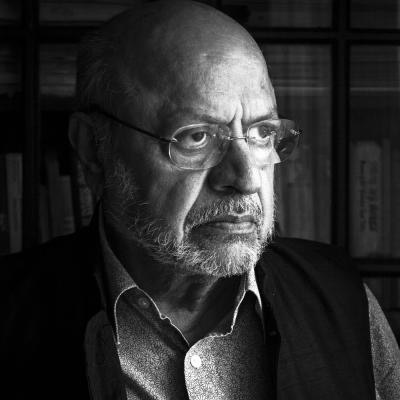
    NEW DELHI: A Committee headed by veteran filmmaker Shyam Benegal has been constituted by the Government to suggest a paradigm that ensures that artistic creativity and freedom do not get stifled or curtailed even as films are certified.
     
    Noting that “in most countries of the world there is a mechanism / process of certifying feature films and documentaries,” an official release also said that the attempt should also be that “the people tasked with the work of certification understand these nuances.”
     
    The recommendations of this Committee are expected to provide a holistic framework and enable those tasked with the work of certification of films to discharge their responsibilities keeping in view this framework. 
     
    The note said Indian films have a glorious history and a whole lot of Indian films have enriched the cultural milieu of the country besides making astonishing advances in technical aspects of film making. 
     
    During their deliberations, the Committee would be expected to take note of the best practices in various parts of the world, especially where the film industry is given sufficient and adequate space for creative and aesthetic expression. 
     
    The Committee would recommend broad guidelines / procedures under the provisions of the Cinematograph Act 1952 / Rules for the benefit of the chairperson and other members of the Screening Committee. The staffing pattern of Central Board of Film Certification would also be looked into in an effort to recommend a framework, which would provide efficient and transparent user friendly services. 
     
    The other Members of the Committee include filmmaker Rakeysh Omprakash Mehra, creative director Piyush Pandey, media veteran Bhawana Somayya, National Film Development Corporation managing director Nina Lath Gupta, and Joint Secretary (Films) Sanjay Murthy as Member Convenor. The Committee has been requested to submit its recommendations within two months.  
     

    Welcoming the appointment of the Committee, Central Board of Film Certification (CBFC) chairman Pahlaj Nihalani told Indiantelevision.com that he hoped the report will clear the air as far as certifying films was concerned.
     
    In a telephonic interview from Mumbai, Nihalani said that it was necessary to protect the freedom of speech and the right of a filmmaker, but this could not be done at the cost of permitting all kinds of language or innuendos.
     
    He, therefore, suggested that there was need for extending the certification scope by introducing two categories beyond those at present. The categories at present are Universal (U), Universal with Adult Guidance (U/A), and Adult (A). 
     
    He felt that while not permitting pornography, there should be two categories beyond the A category: A+ and A++. 
     
    Meanwhile, Benegal said in an interview to a newspaper in Mumbai that his committee does not have anything to do with Nihalani. He added that many of the guidelines need to be looked at from time to time since society was an entity where things keep changing, sensibilities change and viewers change. 
     
    This is not the first time that such a committee has been set up. After earlier attempts, the last Committee that examined similar issues was headed by Mukul Mudgal. However, no action has been taken on that report submitted in 2013.

  • Print media should adapt itself to digital technologies: Jaitley

    Print media should adapt itself to digital technologies: Jaitley

    NEW DELHI: In the rapidly growing digital era, the print media needs to accept the challenges put forth by the Digital and Information age according to Information and Broadcasting Minister Arun Jaitley.

    The internet revolution and fast changing technology presented a big challenge to the Print Media across the world to maintain its presence and sustained growth. However, India remained an exception wherein Print registered growth owing to an increasing demand and subscriber base for regional newspapers. 

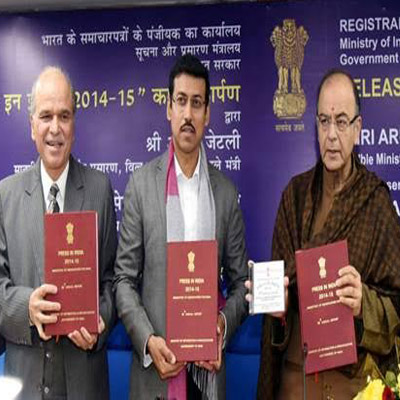
    Releasing the 59th Annual Report on Print Media – “Press in India 2014-15” – prepared and compiled by Registrar of Newspapers for India here today, Jaitley said that Print Media had to contend with the information flow disseminating from electronic media which weakened the dividing line between news and opinion. 

    The emerging viewpoint had brought certain shrillness in the debates and discussions. Print Media, thus, had a role to play in maintaining objectivity and preserving the sacred nature of news. It was important to also understand that emerging viewpoints surfaced due to the vastness of the media universe where different perspectives were put forth on a given issue.

    Minister of State for I&B Rajyavardhan Rathore was also present during the event.  

    The Minister said that it was time for magazine journalism to reinvent itself since the options for the readers were expanding due to alternatives such as digital and social media. Jaitley said the worldwide trends show that many popular magazines had shifted to the online digital edition, since it’s time for instantaneous news with fast changing world, news and technology. Hence, the shelf life for news being collated in magazines was considered outdated.

    Special Secretary J S Mathur gave an overview of the publication and highlighted the journey of Press through history. He also touched upon the changes being brought forth in the media space, especially the Print Media.

    The Annual Report “Press in India- 2014-15” was prepared on the basis of analysis of annual statements filed by the registered publications. The report provided broad analysis of the general trend of the Indian Press based on the claimed circulation.

    The print media registered a growth of 5.80 per cent over the previous year as a total of 5,817 new publications were registered during 2014-15 and 34 publications ceased their operation. Out of the total 1,05,443 publications registered as on 31 March, 2015, the largest number of newspapers and periodicals registered in any Indian language was in Hindi with a figure of 42,493 publications followed by English with 13,661 registered publications. Out of 1,05,443 registered publications, 14,984 were dailies and bi-tri weeklies and remaining 90,459 were of other periodicities. 

    State-wise analysis shows that Uttar Pradesh with 16,130 publications was at top position at the end of 2014-15. Maharashtra with 14,394 publications and Delhi with 12,177 publications were at second and third position respectively.

    The total claimed circulation of publications stood at 51,05,21,445 in 2014-15 as against 45,05,86,212 copies per publishing day in 2013-14. The number of Annual statements received in RNI for the year 2014-15 was 23,394 against 19,755 in 2013-14 registering an increase of 18.42 per cent. As per report, circulation-wise, Hindi Publications continued to lead with 25,77,61,985 copies per publishing day followed by English with 6,26,62,670 copies and Urdu with 4,12,73,949 copies per publishing day.

    The report also carried different Chapters viz. ownership of newspapers, analysis of daily newspapers, language wise study of the press and analysis of registered newspapers.

    Main highlights of the Indian Press in 2014-15 are as follows:-

  • No reduction in Govt advertising: Rathore

    No reduction in Govt advertising: Rathore

    NEW DELHI: The government has denied that there has been  any reduction in advertisements to the print or electronic media.


    Minister of State for Information and Broadcasting Rajyavardhan Rathore said in the Parliament that the quantum of advertisements is based on the requirements of the individual ministries and departments.


    He said Directorate of Advertising and Visual Publicity (DAVP) is a nodal multimedia advertising agency of the Government for advertising on behalf of various ministries and departments and organisations of the Government of India including Public Sector Undertakings and Autonomous bodies.


    The DAVP therefore publicises various policies, schemes and programmes on behalf of the client ministries and departments in accordance with their requirements, budget provisions and creatives.


    Replying to another question, he said the DAVP empanels newspapers/journals as stipulated in the Advertisement Policy of the Government with effect from 2 October, 2007.


    He said that no case of any newspaper is pending for more than six months, which fulfils all requisite norms as laid down in the Advertisement Policy.  

  • Government’s e-calendar 2016 gives link to AIR, DD News

    Government’s e-calendar 2016 gives link to AIR, DD News

    NEW DELHI: Information and Broadcasting Minister Arun Jaitley said conventional technology did not lose its importance despite the latest trends in technology.


    He was speaking after releasing the Government Calendar 2016, which he said would take forward the developmental agenda of the government highlighting one developmental theme or focus area each month. Each calendar sheet emphasised a particular goal and priority area, which concerned the people at large.


    Minister of State Rajyavardhan Rathore said that the Calendar 2016 enabled people to give feedback to the government. It also gave them access to PIB press releases, tweets and news from All India Radio and Doordarshan news. 


    The calendar is on the theme of ‘Vikas ki Nayi Udaan’. I&B secretary Sunil Arora was also present on the occasion.


    Releasing the digital version of the calendar, Rathore said it had several features to reach the target audience especially the youth and citizens who sought information on programmes and policies. He further stated that success of the schemes of the Government depended largely on the awareness levels of citizens.


    The digital version of the calendar will facilitate the information flow to the youth who were quite aware of new techniques and methods. The Minister also highlighted the initiatives being taken by DAVP to facilitate online functioning including enhancing outreach and promoting transparency. There was also an idea within DAVP to come up with advertisements targeted at specific audiences.


    The calendar has been designed and printed by the Directorate of Advertising and Visual Publicity (DAVP). It is printed in 11 languages apart from Hindi. It is distributed to all Panchayat zilla parishads, centrally aided schools; all missions abroad apart from all elected representatives Central Government Gazetted officers. 


    With the theme ‘Vikas ki Nayi Udaan’ the calendar highlights various developmental schemes launched by Government of India. It centers on Beti Bachao Beti Padhao, Mudra Yojna, smart cities, PMKYV, Jan Dhan Yojna, Digital India, Health, Power and Employment for all, farmers’ welfare and port-led development. The Calendar 2016 ends with Ashtalakshmi that lays stress on development in the North East. The Department of Posts is responsible for distribution of the Calendar across the country.

  • MIB warns broadcasters against giving FTA signals to unauthorised operators

    MIB warns broadcasters against giving FTA signals to unauthorised operators

    NEW DELHI: The Ministry of Information and Broadcasting (MIB) has warned broadcasters against giving signals of free to air (FTA) channels to unauthorised operators. 


    The government said that it should be ensured that satellite TV channels do not provide their signal reception decoders or access to their signals to any cable or multi system operators (MSO), DTH operators, IPTV service provider and headend in the sky (HITS) operator, which is not registered or permitted by the MIB.


    The Ministry said that non-adherence to the laid down stipulation is “liable for stern action from this Ministry in case corrective action by broadcasters is not taken immediately.”


    It was pointed out that there should be strict adherence to clause 5.6 of the Article 5 of Downlinking Guidelines in this regard.


    The clause stipulates that all the broadcasters “shall provide satellite TV channel signal reception decoders only to MSOs/Cable Operators registered under the Cable Television Networks (Regulation) Act 1995 or to a DTH operator registered under the DTH guidelines issued by Government of Indian or to an Internet Protocol Television (IPTV) Service Provider duly permitted under their existing Telecom License or authorised by Department of Telecommunications or to a HITS operator duly permitted under the policy guidelines for HITS operators issued by the I&B Ministry to provide such service.”


    The MIB said that it had come to its notice that certain DTH operators were beaming into India FTA channels without obtaining due license or registration authorisation in any manner from the Ministry. “These FTA TV channels, it is learnt, are permitted TV channels. However, broadcasters appear to have allowed their signals to be used by such unauthorised operators,” the Ministry said.

  • MIB to set up Film Facilitation Offices to aid foreign filmmakers in India

    MIB to set up Film Facilitation Offices to aid foreign filmmakers in India

    NEW DELHI: The Government has cleared proposals for setting up Film Facilitation Office (FFO) in Delhi, Mumbai, Chennai and Kolkata for foreign film producers in assisting them to procure requisite permissions to shoot in India.


    Minister of State for Information and Broadcasting Rajyavardhan Rathore told Parliament today that the FFO would be set up with the help of National Film Development Corporation (NFDC).


    It would also disseminate information on shooting locations and the facilities available with the Indian film industry for production and post production. 


    A total number of 33 requests from foreign filmmakers for shooting in India have been received till date during the current year, Rathore said. The requests include shooting of feature films and television shows.


    The Government has already taken several steps to promote India as a filming destination and to promote Indian film industry.


    The Ministry has also taken up with Home and External Affairs Ministries, the issues relating to easing of visa norms as well as simplification of procedures for according permission, duly taking into consideration the security concerns and other related issues.

  • Animation & Gaming Centre will be close to industry venue: Rathore

    Animation & Gaming Centre will be close to industry venue: Rathore

    NEW DELHI: While declining to give the exact venue for the proposed National Centre for Animation, Gaming and Visual Effects (NCOE), the Parliament was told today that it would be located in a place closer to the animation and gaming industry.


    Minister of State for Information and Broadcasting Rajyavardhan Rathore said in reply to a question that the Centre would be set up with participation from the industry and with the help of Media & Entertainment Skill Council (MESC).


    The objective of NCOE is to build a national centre of excellence to impart world class education at affordable fee structure in animation, gaming and visual effects.


    This would help create a world class talent pool in India to cater to the Indian and global players, the Minister said.

  • WRC meet turns down 470-698 MHz spectrum band to India for mobile communication

    WRC meet turns down 470-698 MHz spectrum band to India for mobile communication

    NEW DELHI: Following the World Radiocommunication Conference (WRC) last month in Geneva, the Information and Broadcasting Ministry has been informed that the frequency band 470-698 MHz has not been identified for International Mobile Telecommunication (IMT) for India.


    Conveying this information received from the Communications and Information Technnology Ministry, Minister of State for I&B told Parliament today that his Ministry and Prasar Bharati had earlier given their concurrence to the proposal in this regard from the Telecom Department.


    He said the I&B Ministry had laid down the condition that this was acceptable provided the present and future requirements of Doordarshan and terrestrial broadcasting will be given due priority.


    The Communications & IT Ministry after due approval and a decision by Committee of Secretaries sent a proposal for identification of the frequency band 470-698 MHz for IMT services for India under Agenda item 1.1 of WRC of the International Telecommunication Union (ITU).