Category: I&B Ministry

  • Merger of schemes under MIB lead to reduction to one-third of 11th Plan

    Merger of schemes under MIB lead to reduction to one-third of 11th Plan

    NEW DELHI: The Information and Broadcasting Ministry has brought down the number of schemes under it from 65 in the Eleventh Plan to just 21 in the 12th Plan by the year 2016-17 by merely merging together under umbrella schemes the various schemes of its different media units with similar objectives and activities.

    The Parliamentary Standing Committee for Information Technology which goes into issues relating to I and B was informed that the ministry carried out a comprehensive rationalization and restructuring of the Plan schemes to achieve the thrust areas of the 12th Five Year Plan.

    The ministry said this is expected to result in optimum and effective utilization of outlay earmarked and better monitoring of Plan Schemes at implementing stages during the year 2016-17.

    Progress in the achievement of physical and financial targets in respect of schemes is now being reviewed by the secretary in the ministry to boost utilization in the current fiscal.

    In addition, the Financial Advisor of the ministry and the concerned joint secretaries also convene meetings at their level in order to review the performance of the plan schemes. In such meetings representatives from various media units under the ministry and implementing agencies are also called for discussion, whenever required.

    The allocation of funds to various sectors during 2015-16 and 2016-17 is:
    (Rs. in crore) Sector wise Budgetary Support
    BE 2015-16
    RE 2015-16
    Expenditure as on 31.03.2016
    BE 2016-17
     
    Information
     
    70.65
     
    193.42
     
    188.20
     
    183.02
    Film
    208.55
    77.31
    69.01
    141.48
    Broadcasting
    Main Sectt.
    30.30
    25.50
    23.41
    25.50
    Prasar Bharati
    605.03
    453.77
    453.77
    450.00
    Total Broadcasting
    635.33
    479.27
    477.18
    475.50
    Total
    914.53
    750.00
    734.39
    800.00

    Thus, allocation for Broadcasting and Film Sectors has been reduced compared to last fiscal, i.e. 2015-16 but the Information Sector has got an enhanced allocation in 2016-17.

    When questioned about the reduction in other sectors and increase in the Information sector, the ministry informed the committee that the sector-wise fund allocation are based on the following rationale:

    1.    The scheme-wise expenditure trend during last four years of the 12th Five Year Plan;
    2.    Overall ceilings approved by Expenditure Finance Committee/Standing Finance Committee/Revised Cost             Estimates, for the 12th Plan (2012-17) with respect to each scheme;
    3.    Annual scheme-wise budget proposals from different wings based on their expenditure capacity;
    4.    Full provision for continuing schemes for completion of the schemes.
    5.    Overall ceiling fixed by the ministry of Finance.

    As the Revised Cost Estimates (RCE) of sub-scheme “People’s Empowerment through Development Communication (Conception and Dissemination) (Directorate of Advertising and Visual Publicity” was under consideration at the beginning of 2015-16, an amount of Rs 131 crore for this scheme was kept in the scheme “National Film Heritage Mission” of the film sector. After the RCE of this sub-scheme was approved by the Finance ministry, the allocation for this sub-scheme was enhanced to Rs 151 crore. Consequently, allocation with respect to information sector at revised estimate stage increased to Rs.193.42 crore and the allocation for the film sector decreased to Rs.77.31 crore.

    When questioned whether the present allocation of Rs.800 crore for the current fiscal is sufficient to carry out the planned activities, the ministry told the committee that given the availability of resources and the set priorities of the government, the financial allocations are made to the ministries/departments which are mostly less than what is proposed to the Finance ministry.

    The Budget Estimates allocation of Rs 800 crore for the year 2016-17 for the I and B Ministry is less than the proposed amount of Rs 1,240.69 crore.

    However subject to the resource constraint, the ministry has tried to optimize the reduced allocation of Rs 800 crore amongst the schemes of the ministry sector-wise, by allocating funds to the media units in a rational manner to overcome the difficulty of reduced allocation.

    Subject to the availability of the budget, the ministry will make all out efforts to reach out to the people of the country and fulfill their mandate of the public broadcaster, Prasar Bharati.
     

  • Merger of schemes under MIB lead to reduction to one-third of 11th Plan

    Merger of schemes under MIB lead to reduction to one-third of 11th Plan

    NEW DELHI: The Information and Broadcasting Ministry has brought down the number of schemes under it from 65 in the Eleventh Plan to just 21 in the 12th Plan by the year 2016-17 by merely merging together under umbrella schemes the various schemes of its different media units with similar objectives and activities.

    The Parliamentary Standing Committee for Information Technology which goes into issues relating to I and B was informed that the ministry carried out a comprehensive rationalization and restructuring of the Plan schemes to achieve the thrust areas of the 12th Five Year Plan.

    The ministry said this is expected to result in optimum and effective utilization of outlay earmarked and better monitoring of Plan Schemes at implementing stages during the year 2016-17.

    Progress in the achievement of physical and financial targets in respect of schemes is now being reviewed by the secretary in the ministry to boost utilization in the current fiscal.

    In addition, the Financial Advisor of the ministry and the concerned joint secretaries also convene meetings at their level in order to review the performance of the plan schemes. In such meetings representatives from various media units under the ministry and implementing agencies are also called for discussion, whenever required.

    The allocation of funds to various sectors during 2015-16 and 2016-17 is:
    (Rs. in crore) Sector wise Budgetary Support
    BE 2015-16
    RE 2015-16
    Expenditure as on 31.03.2016
    BE 2016-17
     
    Information
     
    70.65
     
    193.42
     
    188.20
     
    183.02
    Film
    208.55
    77.31
    69.01
    141.48
    Broadcasting
    Main Sectt.
    30.30
    25.50
    23.41
    25.50
    Prasar Bharati
    605.03
    453.77
    453.77
    450.00
    Total Broadcasting
    635.33
    479.27
    477.18
    475.50
    Total
    914.53
    750.00
    734.39
    800.00

    Thus, allocation for Broadcasting and Film Sectors has been reduced compared to last fiscal, i.e. 2015-16 but the Information Sector has got an enhanced allocation in 2016-17.

    When questioned about the reduction in other sectors and increase in the Information sector, the ministry informed the committee that the sector-wise fund allocation are based on the following rationale:

    1.    The scheme-wise expenditure trend during last four years of the 12th Five Year Plan;
    2.    Overall ceilings approved by Expenditure Finance Committee/Standing Finance Committee/Revised Cost             Estimates, for the 12th Plan (2012-17) with respect to each scheme;
    3.    Annual scheme-wise budget proposals from different wings based on their expenditure capacity;
    4.    Full provision for continuing schemes for completion of the schemes.
    5.    Overall ceiling fixed by the ministry of Finance.

    As the Revised Cost Estimates (RCE) of sub-scheme “People’s Empowerment through Development Communication (Conception and Dissemination) (Directorate of Advertising and Visual Publicity” was under consideration at the beginning of 2015-16, an amount of Rs 131 crore for this scheme was kept in the scheme “National Film Heritage Mission” of the film sector. After the RCE of this sub-scheme was approved by the Finance ministry, the allocation for this sub-scheme was enhanced to Rs 151 crore. Consequently, allocation with respect to information sector at revised estimate stage increased to Rs.193.42 crore and the allocation for the film sector decreased to Rs.77.31 crore.

    When questioned whether the present allocation of Rs.800 crore for the current fiscal is sufficient to carry out the planned activities, the ministry told the committee that given the availability of resources and the set priorities of the government, the financial allocations are made to the ministries/departments which are mostly less than what is proposed to the Finance ministry.

    The Budget Estimates allocation of Rs 800 crore for the year 2016-17 for the I and B Ministry is less than the proposed amount of Rs 1,240.69 crore.

    However subject to the resource constraint, the ministry has tried to optimize the reduced allocation of Rs 800 crore amongst the schemes of the ministry sector-wise, by allocating funds to the media units in a rational manner to overcome the difficulty of reduced allocation.

    Subject to the availability of the budget, the ministry will make all out efforts to reach out to the people of the country and fulfill their mandate of the public broadcaster, Prasar Bharati.
     

  • Net Neutrality: Reactions from the consumers provide deep insights

    Net Neutrality: Reactions from the consumers provide deep insights

    NEW DELHI: Issues relating to OTT and net neutrality have been in the news for almost two years now and the Telecom Regulatory Authority of India (TRAI), which had earlier issued a paper on Over-the-top (OTT) apps, came out with a paper on Net Neutrality on 30 May 2016.

    TRAI’s frequent revisiting of the Net Neutrality issue highlights the fact that the regulator is under immense pressure from various stakeholders with diverse interests. TRAI had first issued a consultation paper over 18 months back and had also passed an order — hotly contested by telecom companies— banning differential pricing floated by some telcos recently, which had sounded the death gong for Facebook’s FreeBasic in India.

    However as the TRAI website is seen generally only by those in the broadcasting or telecom sectors, a brief summary of TRAI’s pre-consultation paper has been placed on the mygov.in so that the general public can react and send in their feedbacks.

    As a result, over 73,000 posts have already come on this site from the general public who have unanimously supported net neutrality. Some have gone to the extent of asking why TRAI or the government should ask this question.

    Though indiantelevision.com firmly believes that at times the debate in India over Net Neutrality has been shrill and has clouded real and serious aspects of neutrality, there are some interesting feedbacks as well that indicate how general Indians view Net Neutrality.

    public://image 1_0.JPG

    For example, one writer says: “TRAI focus should be broadband speed minimum 50MBps Download/ 25MBps Upload. There should be no pollution, so focus on fiber/copper with speeds of up to 10GBps (ten GBps) and ensure that latency is very low, connectivity is much better (speed and latency are different).”

    The same respondent points out that companies are offering 5GB on 4Mbps for high prices up to Rs 900 and data caps should be removed or have minimum of 1TBps. He has said that lease lines should be made affordable with customer support.

    Says another respondent: “I cannot imagine an India as net partial with a discriminatory telecom structure not letting me call my kin freely, surf net with discrimination. The Governments needs to recall and emulate Dr Ambedkar’s ideas, the esteemed voice of freedom and non-discrimination of free India.”

    Yet another individual says: “In the name of neutrality. Let us not stop access of net to one billion Indians. Many pay phone/net data bills (simply by transferring data) higher than electricity bills (which is consuming energy, which is costlier to produce). Let the government ensure that data service is affordable to all.”

    Another consumer says, “We want freedom to choose and not Internet Service Provider choosing for us. There is also stress on removing corruption which can be done by removing interest on security deposit, seven days extra charge after disconnection refund, towers on house and low heights.”

    Yet another respondent commented: “Without net neutrality, internet would go into the hands of people who can pay the ISPs to give their websites for cheaper price. This will hamper start-ups and other small players who cannot afford to pay the ISPs. For a thriving economy, it is important to have competing players in market. In the absence of net neutrality, this competition will be disrupted and monopoly will be established — which is not good for the consumers.”

    public://img2.jpg

    But the responses are not confined to just plain feedbacks, and some people have also tried to support their theories and assertions.

    A respondent has attached a presentation with diagrams to say,  “Internet traffic and congestion on network problem can be sorted out by dividing the network into logistic small segments. These small logic segments can have their unique set of protocols, which when connected with the large network enable it to tackle with security and cyber issues as well as enable the large network to tackle the Internet traffic and congestion issues.

    “The logical small segments should be designed and implemented in way so that they can be extended with the increase of customers as well as data demand on that network. The core of the large network can be designed/assembled in a way that its data limitations can be extended with demand (Same technique can be apply on the logistic small networks).”

    The person, who seems to have some understanding of technology and its functioning, adds that designing/assembling and implementation of smart networking system will lead to a major step for providing a standard Internet facility to the individuals, having fixed rate data plan with standard accessibility and speed of the Internet facility. The diagrams show one of a road where the light poles have small boxes to pass the Internet signal from one to the next.

    Incidentally, the original pre-consultation paper on net neutrality issued by TRAI on 30 May 2016 is available at http://www.trai.gov.in/Content/ConDis/20775_0.aspx  on the regulator’s website does not still have any comments uploaded on the issue.  The last date for submission of comments is 21 June 2016.

  • Net Neutrality: Reactions from the consumers provide deep insights

    Net Neutrality: Reactions from the consumers provide deep insights

    NEW DELHI: Issues relating to OTT and net neutrality have been in the news for almost two years now and the Telecom Regulatory Authority of India (TRAI), which had earlier issued a paper on Over-the-top (OTT) apps, came out with a paper on Net Neutrality on 30 May 2016.

    TRAI’s frequent revisiting of the Net Neutrality issue highlights the fact that the regulator is under immense pressure from various stakeholders with diverse interests. TRAI had first issued a consultation paper over 18 months back and had also passed an order — hotly contested by telecom companies— banning differential pricing floated by some telcos recently, which had sounded the death gong for Facebook’s FreeBasic in India.

    However as the TRAI website is seen generally only by those in the broadcasting or telecom sectors, a brief summary of TRAI’s pre-consultation paper has been placed on the mygov.in so that the general public can react and send in their feedbacks.

    As a result, over 73,000 posts have already come on this site from the general public who have unanimously supported net neutrality. Some have gone to the extent of asking why TRAI or the government should ask this question.

    Though indiantelevision.com firmly believes that at times the debate in India over Net Neutrality has been shrill and has clouded real and serious aspects of neutrality, there are some interesting feedbacks as well that indicate how general Indians view Net Neutrality.

    public://image 1_0.JPG

    For example, one writer says: “TRAI focus should be broadband speed minimum 50MBps Download/ 25MBps Upload. There should be no pollution, so focus on fiber/copper with speeds of up to 10GBps (ten GBps) and ensure that latency is very low, connectivity is much better (speed and latency are different).”

    The same respondent points out that companies are offering 5GB on 4Mbps for high prices up to Rs 900 and data caps should be removed or have minimum of 1TBps. He has said that lease lines should be made affordable with customer support.

    Says another respondent: “I cannot imagine an India as net partial with a discriminatory telecom structure not letting me call my kin freely, surf net with discrimination. The Governments needs to recall and emulate Dr Ambedkar’s ideas, the esteemed voice of freedom and non-discrimination of free India.”

    Yet another individual says: “In the name of neutrality. Let us not stop access of net to one billion Indians. Many pay phone/net data bills (simply by transferring data) higher than electricity bills (which is consuming energy, which is costlier to produce). Let the government ensure that data service is affordable to all.”

    Another consumer says, “We want freedom to choose and not Internet Service Provider choosing for us. There is also stress on removing corruption which can be done by removing interest on security deposit, seven days extra charge after disconnection refund, towers on house and low heights.”

    Yet another respondent commented: “Without net neutrality, internet would go into the hands of people who can pay the ISPs to give their websites for cheaper price. This will hamper start-ups and other small players who cannot afford to pay the ISPs. For a thriving economy, it is important to have competing players in market. In the absence of net neutrality, this competition will be disrupted and monopoly will be established — which is not good for the consumers.”

    public://img2.jpg

    But the responses are not confined to just plain feedbacks, and some people have also tried to support their theories and assertions.

    A respondent has attached a presentation with diagrams to say,  “Internet traffic and congestion on network problem can be sorted out by dividing the network into logistic small segments. These small logic segments can have their unique set of protocols, which when connected with the large network enable it to tackle with security and cyber issues as well as enable the large network to tackle the Internet traffic and congestion issues.

    “The logical small segments should be designed and implemented in way so that they can be extended with the increase of customers as well as data demand on that network. The core of the large network can be designed/assembled in a way that its data limitations can be extended with demand (Same technique can be apply on the logistic small networks).”

    The person, who seems to have some understanding of technology and its functioning, adds that designing/assembling and implementation of smart networking system will lead to a major step for providing a standard Internet facility to the individuals, having fixed rate data plan with standard accessibility and speed of the Internet facility. The diagrams show one of a road where the light poles have small boxes to pass the Internet signal from one to the next.

    Incidentally, the original pre-consultation paper on net neutrality issued by TRAI on 30 May 2016 is available at http://www.trai.gov.in/Content/ConDis/20775_0.aspx  on the regulator’s website does not still have any comments uploaded on the issue.  The last date for submission of comments is 21 June 2016.

  • MIB to TV: Use same language captions & audio descriptions for differently-abled

    MIB to TV: Use same language captions & audio descriptions for differently-abled

    NEW DELHI: All news and other television channels have been requested to carry the same language captions and audio descriptions along with the programmes and news reports for persons with disabilities.

    In a notice out on its website yesterday, the Information and Broadcasting Ministry said this was in compliance with concerns raised by the Department of Empowerment of Persons with Disabilities (DoEPwD) regarding formulation of Accessible India Campaign (Sugamya Bharat Abhiyan) for achieving universal accessibility for persons with disabilities (PwDs).

    The note was addressed to all channels and also to the News Broadcasters Association (NBA), the Indian Broadcasting Foundation (lBF), and the Association of Regional Television Broadcasters.

    The DoEPwD had stressed that access to TV programmes for many persons with disabilities is denied due to lack of assistive technology. During discussion with various NGOs, a need was felt to prepare guidelines that include that broadcasting partners should develop and telecast a certain percentage of programmes with audio description and captioning as an experiment to the benefit of the target persons with disabilities.

    The note said the media has always been in the forefront of taking up important issues and causes including those for the welfare of the disadvantaged sections of society. In the recent past, Republic Day Parade commentary and Independence Day ceremony was carried with sign language interpretation for the benefit of differently abled people.

  • MIB to TV: Use same language captions & audio descriptions for differently-abled

    MIB to TV: Use same language captions & audio descriptions for differently-abled

    NEW DELHI: All news and other television channels have been requested to carry the same language captions and audio descriptions along with the programmes and news reports for persons with disabilities.

    In a notice out on its website yesterday, the Information and Broadcasting Ministry said this was in compliance with concerns raised by the Department of Empowerment of Persons with Disabilities (DoEPwD) regarding formulation of Accessible India Campaign (Sugamya Bharat Abhiyan) for achieving universal accessibility for persons with disabilities (PwDs).

    The note was addressed to all channels and also to the News Broadcasters Association (NBA), the Indian Broadcasting Foundation (lBF), and the Association of Regional Television Broadcasters.

    The DoEPwD had stressed that access to TV programmes for many persons with disabilities is denied due to lack of assistive technology. During discussion with various NGOs, a need was felt to prepare guidelines that include that broadcasting partners should develop and telecast a certain percentage of programmes with audio description and captioning as an experiment to the benefit of the target persons with disabilities.

    The note said the media has always been in the forefront of taking up important issues and causes including those for the welfare of the disadvantaged sections of society. In the recent past, Republic Day Parade commentary and Independence Day ceremony was carried with sign language interpretation for the benefit of differently abled people.

  • India has 890 TV channels against 12th Plan target of 1500

    India has 890 TV channels against 12th Plan target of 1500

    NEW DELHI: With the government having cleared a total of 890 television channels including 401 news channels, it appears highly unlikely that the country will achieve the target of 1500 channels by March next year.

    The Parliamentary Standing Committee for Information Technology which goes into issues relating to Information and Broadcasting noted that the State Finance Commission, while drafting its proposals for the 12th Plan (2012-17), had assumed that the number of permitted TV channels would rise to 1500.

    However, a recent I and B ministry report said that a total of 890 TV channels had got permission to start their operation as on 31 May. Out of these, twenty channels including seven news channels have been permitted to uplink from India but not downlink within the country, and 96 including 81 general entertainment channels are uplinked from overseas but allowed to downlink into TV homes in the country.

    Meanwhile, the committee was told that the present set up of Electronic Media Monitoring Centre (EMMC) has developed logging and recording facility for 900 TV channels and is thus fully equipped to start monitoring of all permitted channels available on public domain.

    The Broadcast Engineering Consultants India Ltd. (BECIL) is configuring all available free to air channels in the content monitoring system of the EMMC.

    However, configuration of pay channels will require broadcasters to provide necessary equipment for downloading and decryption of the content/signal and this is expected to be completed within 4 months’ time.

    The Parliamentary Standing Committee for Information Technology which goes into issues relating to Information and Broadcasting observed that the monitoring capacity of EMMC is being augmented in a phased manner to achieve the objective of developing content acquisition facility for 1500 channels by the end of the 12th Plan.

    By the end of Fiscal Year 2014-15, EMMC successfully achieved the Plan target of content acquisition facility of 600 TV channels. Under the 12th Plan, Rs.56.37 crore had been utilized as of 31 March 2016 out of the total outlay of Rs.90 crore.

    The committee was told that the budget estimate for 2016-17 had been reduced to Rs 12 crore as compared to Rs 21 crore in 2015-16, out of which Rs 19.76 had been spent by 3 March 2016.

    During the year 2015-16, EMMC has procured content acquisition hardware for setting up monitoring facility for 300 additional TV channels and installed at the new set up on the eleventh floor of Soochna Bhawan in New Delhi. The channels are being configured.

    The ministry also informed the committee that issues pertaining to monitoring of 600 channels, hardware for which was acquired in FY 2014-15 had been resolved. Hence, EMMC was able to stabilize and regularly monitor 600 TV channels.

    The ministry said its target under the Machinery and Equipment head was to develop content acquisition facility for additional 300 TV channels by the end of FY 2016-17.

    The committee was informed that during the year 2015-16, 11 cases were found where TV channels were in violation of content guidelines (Programme Code and Advertisement Code).

    While there is no provision of pre-censorship of the content telecast on private TV channels, all programmes/ advertisements telecast on such TV channels are required to adhere to the Programme and Advertising Codes prescribed under the Cable Television Networks (Regulation) Act, 1995 and the rules framed thereunder. Action is taken whenever any violation of the Codes is noticed or brought to the notice of the ministry.

  • India has 890 TV channels against 12th Plan target of 1500

    India has 890 TV channels against 12th Plan target of 1500

    NEW DELHI: With the government having cleared a total of 890 television channels including 401 news channels, it appears highly unlikely that the country will achieve the target of 1500 channels by March next year.

    The Parliamentary Standing Committee for Information Technology which goes into issues relating to Information and Broadcasting noted that the State Finance Commission, while drafting its proposals for the 12th Plan (2012-17), had assumed that the number of permitted TV channels would rise to 1500.

    However, a recent I and B ministry report said that a total of 890 TV channels had got permission to start their operation as on 31 May. Out of these, twenty channels including seven news channels have been permitted to uplink from India but not downlink within the country, and 96 including 81 general entertainment channels are uplinked from overseas but allowed to downlink into TV homes in the country.

    Meanwhile, the committee was told that the present set up of Electronic Media Monitoring Centre (EMMC) has developed logging and recording facility for 900 TV channels and is thus fully equipped to start monitoring of all permitted channels available on public domain.

    The Broadcast Engineering Consultants India Ltd. (BECIL) is configuring all available free to air channels in the content monitoring system of the EMMC.

    However, configuration of pay channels will require broadcasters to provide necessary equipment for downloading and decryption of the content/signal and this is expected to be completed within 4 months’ time.

    The Parliamentary Standing Committee for Information Technology which goes into issues relating to Information and Broadcasting observed that the monitoring capacity of EMMC is being augmented in a phased manner to achieve the objective of developing content acquisition facility for 1500 channels by the end of the 12th Plan.

    By the end of Fiscal Year 2014-15, EMMC successfully achieved the Plan target of content acquisition facility of 600 TV channels. Under the 12th Plan, Rs.56.37 crore had been utilized as of 31 March 2016 out of the total outlay of Rs.90 crore.

    The committee was told that the budget estimate for 2016-17 had been reduced to Rs 12 crore as compared to Rs 21 crore in 2015-16, out of which Rs 19.76 had been spent by 3 March 2016.

    During the year 2015-16, EMMC has procured content acquisition hardware for setting up monitoring facility for 300 additional TV channels and installed at the new set up on the eleventh floor of Soochna Bhawan in New Delhi. The channels are being configured.

    The ministry also informed the committee that issues pertaining to monitoring of 600 channels, hardware for which was acquired in FY 2014-15 had been resolved. Hence, EMMC was able to stabilize and regularly monitor 600 TV channels.

    The ministry said its target under the Machinery and Equipment head was to develop content acquisition facility for additional 300 TV channels by the end of FY 2016-17.

    The committee was informed that during the year 2015-16, 11 cases were found where TV channels were in violation of content guidelines (Programme Code and Advertisement Code).

    While there is no provision of pre-censorship of the content telecast on private TV channels, all programmes/ advertisements telecast on such TV channels are required to adhere to the Programme and Advertising Codes prescribed under the Cable Television Networks (Regulation) Act, 1995 and the rules framed thereunder. Action is taken whenever any violation of the Codes is noticed or brought to the notice of the ministry.

  • TV, Radio urged to mark International Yoga day in befitting manner

    TV, Radio urged to mark International Yoga day in befitting manner

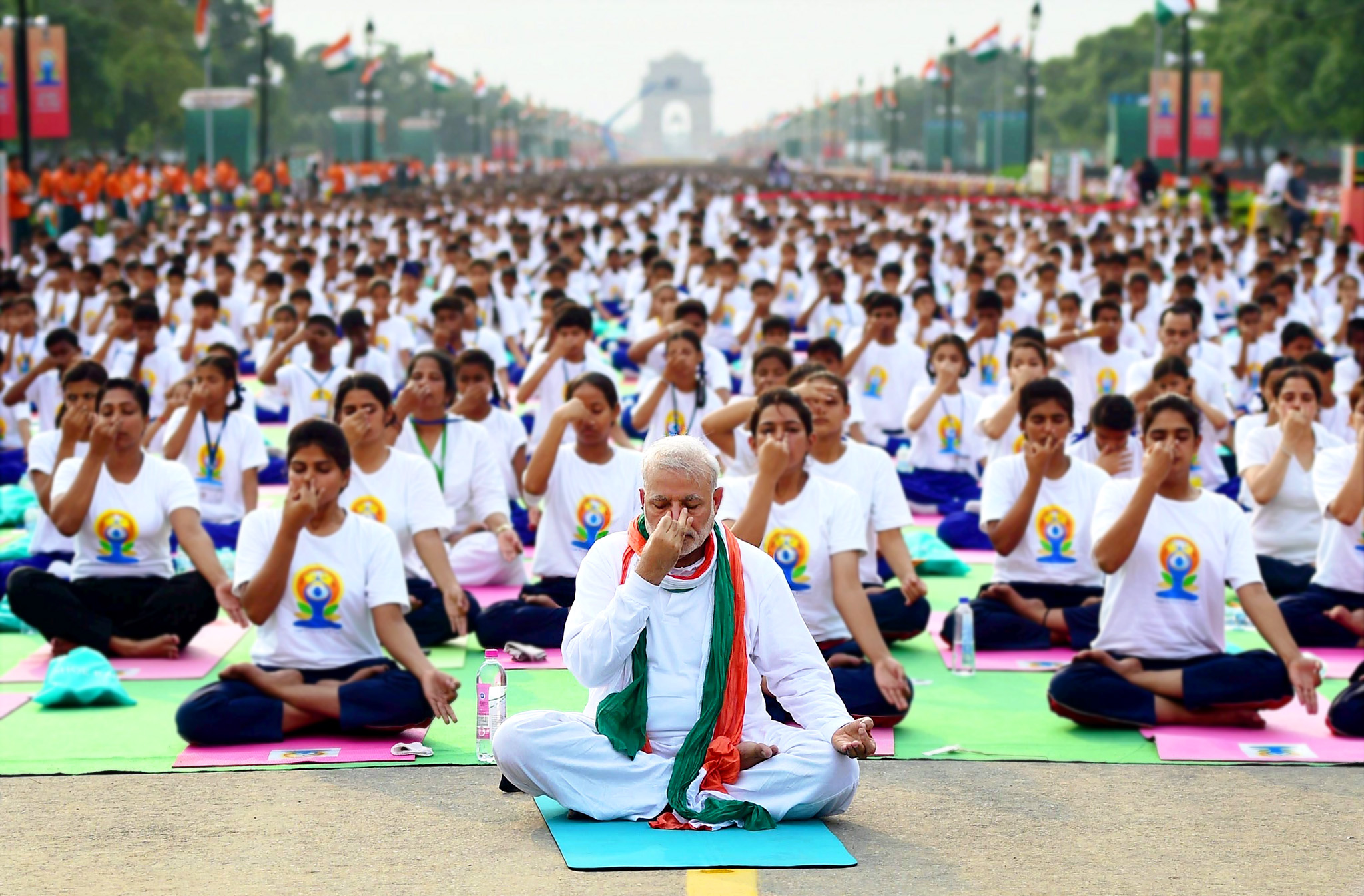
    NEW DELHI: All television channels, FM Radio, and Community Radio stations are expected to take ‘all possible steps this year also to promote the International Yoga Day (lYD) on 21 June by carryrng special features or in any other befitting manner during the period leading to the occasion’.

    In a note on the Information and Broadcasting Ministry website, it has been pointed out that all TV channels, FM channels and community radio stations have contributed immensely to the cause of promotion of Yoga and International Day of Yoga in the past.

    The message from the ministry says that it has special significance for India to mark the day in a befitting manner since the genesis of Yoga is associated with this country.

    Meanwhile Ayush Minister Shripad Naik said while the Government was prepared to consider the demand for declaring the day as a holiday, no such demand had come so far as Yoga gets over before 8 am in the morning and so there is no need for a holiday

    As part of the Internatinal Yoga Day, video clips of 20 celebrity endorsements including Amitabh Bachchan, Shilpa Shetty, Virat Kohli, etc. will be telecast on multiple channels.

    Video spots of thirty secnds each on important Yog Asnanas will be telecast on Doordarshan as Asana of the Day. 

    There will be articles in the print media and social media is expected to carry blogs, on mobile apps, Twitter, Facebook etc.

    A new dynamic and interactive IDY Web Portal has been launched on 25 May and carries interesting online quizzes and contests. 

    The I and B note says that the United Nations General Assembly had on 11 December 2014 declared 21 June to be celebrated as the International Yoga Day (lYD) each year, after the call in this regard by Prime Minister Narendra Modi during his address to the UN General Assembly on 27 September 2O14. Modi had stated that “Yoga is an invaluable gift of India’s ancient tradition which embodies unity of mind and body that provides a holistic approach to health and well-being.”

    The note said several initiatives have been taken by institutions, both public and private, to promote the cause.

  • TV, Radio urged to mark International Yoga day in befitting manner

    TV, Radio urged to mark International Yoga day in befitting manner

    NEW DELHI: All television channels, FM Radio, and Community Radio stations are expected to take ‘all possible steps this year also to promote the International Yoga Day (lYD) on 21 June by carryrng special features or in any other befitting manner during the period leading to the occasion’.

    In a note on the Information and Broadcasting Ministry website, it has been pointed out that all TV channels, FM channels and community radio stations have contributed immensely to the cause of promotion of Yoga and International Day of Yoga in the past.

    The message from the ministry says that it has special significance for India to mark the day in a befitting manner since the genesis of Yoga is associated with this country.

    Meanwhile Ayush Minister Shripad Naik said while the Government was prepared to consider the demand for declaring the day as a holiday, no such demand had come so far as Yoga gets over before 8 am in the morning and so there is no need for a holiday

    As part of the Internatinal Yoga Day, video clips of 20 celebrity endorsements including Amitabh Bachchan, Shilpa Shetty, Virat Kohli, etc. will be telecast on multiple channels.

    Video spots of thirty secnds each on important Yog Asnanas will be telecast on Doordarshan as Asana of the Day. 

    There will be articles in the print media and social media is expected to carry blogs, on mobile apps, Twitter, Facebook etc.

    A new dynamic and interactive IDY Web Portal has been launched on 25 May and carries interesting online quizzes and contests. 

    The I and B note says that the United Nations General Assembly had on 11 December 2014 declared 21 June to be celebrated as the International Yoga Day (lYD) each year, after the call in this regard by Prime Minister Narendra Modi during his address to the UN General Assembly on 27 September 2O14. Modi had stated that “Yoga is an invaluable gift of India’s ancient tradition which embodies unity of mind and body that provides a holistic approach to health and well-being.”

    The note said several initiatives have been taken by institutions, both public and private, to promote the cause.