Category: I&B Ministry

  • FM Radio revenues witness seasonal slump in Q4-16, Q1-17

    FM Radio revenues witness seasonal slump in Q4-16, Q1-17

    BENGALURU: Generally the Indian private FM industry witnesses a quarter-over-quarter (q-o-q) advertisement (ad) revenue slump in the first quarter of every year (Q1, quarter ended 30 June), which may sometimes carry over to the second quarter (Q2, quarter ended 30 September) of the fiscal. Since fiscal 2014, the industry has also seen fourth quarter (Q4, quarter ended 31 March) revenue slumps. Continuing the trend, private FM in India has seen a drop in revenue for quarters ended 31 March 2016 (Q4-16) and 30 June 2016 (Q1-17). As mentioned above trend was noticed Q4-14 and Q1-15 onwards, when the country held general elections and political parties used this so very local medium to garner votes.

    As per data released by the Telecom Regulatory Authority of India (TRAI), for Q1-17, 244 radio stations had consolidated ad revenues of Rs 468.08 crore, down 9.81 percent q-o-q as compared to the Rs 514.75 crore reported by 242 stations in Q4-16. The last quarter of the previous fiscal also saw ad revenue decline of 4.35 percent from Rs 533.70 crore reported for its immediate quarter that ended on 31 December 2015 (Q3-15).

    Please refer to Figure A below for FM Radio Ad Revenue over a five year plus period spanning a 21 quarter period starting with the quarter ended 30 June 2011 (Q1-12) until the quarter ended 30 September 2016 (Q1-17) as per TRAI data. The amounts are in Rs crore and rounded off to the nearest decimal place.

    public://f1.jpg

    As is obvious from the red dots on the chartabove, Q1-12, Q1-13, Q1-14, Q1-15, Q1-16 and Q1-17 have all seen q-o-q revenue drops, as have Q4-14, Q4-15 and as mentioned above- Q4-16.

    Figure B below shows the q-o-q and year-over-year FM Radio Ad revenue trends. Generally y-o-y, revenues have been higher across all quarters in the period under consideration in this report, except for Q3-12 that saw a y-o-y ad revenue decline. For Q3-11, TRAI Indicator Reports mentioned ad revenue of Rs 284.88 crore from 227 radio stations or an average revenue of Rs 1.25 crore per station, as compared to ad revenue per station of Rs 1.20 crore for Q3-12.

    public://f2.jpg

    Conclusion

    Overall, despite the year-end andnew fiscal drops, ad revenues as well as ad revenues per station show a linear increasing trend as more and more advertisers have begun to understand the value proposition this very local medium with a pan-India footprint can offer. Further, the third quarter of the fiscal (Q3, quarter ended 31 December) is also the festival quarter of the year in India – a sweet quarter as far as the radio industry is concerned. The industry should see revenues rising in Q3-17.

     A few of the companies such as JagranPrakashan that has large networks like Radio City and Entertainment Network India Limited (ENIL) which has the Radio Mirchi network in the country have already started operations of the new stations that they obtained in the FM Phase 3 auctions. The revenue of the new stations acquired in phase 3 auctions by other players such as Reliance Broadcast Network Limited (RBNL, Big FM) and HT Media Limited (Hindustan Times fame, Fever FM) if/once they start operations this fiscal, the radio industry should report substantial revenue increases. Profitability may take a hit initially, but over time that too is bound to change for the better.

    Results for the quarter ended 30 September 2016 of companies whose financials are within the public domain can at the most be termed a mixed bag. While ENIL has reported a growth in revenue, its profit after tax – both on a y-o-y and a q-o-q basis have been hit with a70.3 percent y-o-y decline and a51.7 percent q-o-q decline.

    ENIL won 17 stations in Phase 3 auctions and has launched 4 new stations in Q2-17 – at Chandigarh, Ahmedabad, Surat and Jaipur. Earlier the company had launched Bengaluru, Guwahati, Hyderabad and Kochi stations. Bengaluru wasRadio Mirchi’s first launch in the second frequencies network.

    However, ENIL managing director and CEO Prashant Panday is upbeat. In ENIL’s Q2-17 results press release he said, “We have stepped up marketing spends and early research indicates that we have made a strong start and in fact have become leaders in key markets. I am confident this will translate into a stronger business in the years ahead!”

    Note:The unit of currency in this report is the Indian rupee – Rs (also conventionally represented by INR).The Indian numbering system or the Vedic numbering system has been used to denote money values. The basic conversion to the international norm would be:

    (a) 100,00,000 = 100 lakh = 10,000,000 = 10 million = 1 crore.

    (b) 10,000 lakh = 100 crore = 1 arab = 1 billion.
     

  • FM Radio revenues witness seasonal slump in Q4-16, Q1-17

    FM Radio revenues witness seasonal slump in Q4-16, Q1-17

    BENGALURU: Generally the Indian private FM industry witnesses a quarter-over-quarter (q-o-q) advertisement (ad) revenue slump in the first quarter of every year (Q1, quarter ended 30 June), which may sometimes carry over to the second quarter (Q2, quarter ended 30 September) of the fiscal. Since fiscal 2014, the industry has also seen fourth quarter (Q4, quarter ended 31 March) revenue slumps. Continuing the trend, private FM in India has seen a drop in revenue for quarters ended 31 March 2016 (Q4-16) and 30 June 2016 (Q1-17). As mentioned above trend was noticed Q4-14 and Q1-15 onwards, when the country held general elections and political parties used this so very local medium to garner votes.

    As per data released by the Telecom Regulatory Authority of India (TRAI), for Q1-17, 244 radio stations had consolidated ad revenues of Rs 468.08 crore, down 9.81 percent q-o-q as compared to the Rs 514.75 crore reported by 242 stations in Q4-16. The last quarter of the previous fiscal also saw ad revenue decline of 4.35 percent from Rs 533.70 crore reported for its immediate quarter that ended on 31 December 2015 (Q3-15).

    Please refer to Figure A below for FM Radio Ad Revenue over a five year plus period spanning a 21 quarter period starting with the quarter ended 30 June 2011 (Q1-12) until the quarter ended 30 September 2016 (Q1-17) as per TRAI data. The amounts are in Rs crore and rounded off to the nearest decimal place.

    public://f1.jpg

    As is obvious from the red dots on the chartabove, Q1-12, Q1-13, Q1-14, Q1-15, Q1-16 and Q1-17 have all seen q-o-q revenue drops, as have Q4-14, Q4-15 and as mentioned above- Q4-16.

    Figure B below shows the q-o-q and year-over-year FM Radio Ad revenue trends. Generally y-o-y, revenues have been higher across all quarters in the period under consideration in this report, except for Q3-12 that saw a y-o-y ad revenue decline. For Q3-11, TRAI Indicator Reports mentioned ad revenue of Rs 284.88 crore from 227 radio stations or an average revenue of Rs 1.25 crore per station, as compared to ad revenue per station of Rs 1.20 crore for Q3-12.

    public://f2.jpg

    Conclusion

    Overall, despite the year-end andnew fiscal drops, ad revenues as well as ad revenues per station show a linear increasing trend as more and more advertisers have begun to understand the value proposition this very local medium with a pan-India footprint can offer. Further, the third quarter of the fiscal (Q3, quarter ended 31 December) is also the festival quarter of the year in India – a sweet quarter as far as the radio industry is concerned. The industry should see revenues rising in Q3-17.

     A few of the companies such as JagranPrakashan that has large networks like Radio City and Entertainment Network India Limited (ENIL) which has the Radio Mirchi network in the country have already started operations of the new stations that they obtained in the FM Phase 3 auctions. The revenue of the new stations acquired in phase 3 auctions by other players such as Reliance Broadcast Network Limited (RBNL, Big FM) and HT Media Limited (Hindustan Times fame, Fever FM) if/once they start operations this fiscal, the radio industry should report substantial revenue increases. Profitability may take a hit initially, but over time that too is bound to change for the better.

    Results for the quarter ended 30 September 2016 of companies whose financials are within the public domain can at the most be termed a mixed bag. While ENIL has reported a growth in revenue, its profit after tax – both on a y-o-y and a q-o-q basis have been hit with a70.3 percent y-o-y decline and a51.7 percent q-o-q decline.

    ENIL won 17 stations in Phase 3 auctions and has launched 4 new stations in Q2-17 – at Chandigarh, Ahmedabad, Surat and Jaipur. Earlier the company had launched Bengaluru, Guwahati, Hyderabad and Kochi stations. Bengaluru wasRadio Mirchi’s first launch in the second frequencies network.

    However, ENIL managing director and CEO Prashant Panday is upbeat. In ENIL’s Q2-17 results press release he said, “We have stepped up marketing spends and early research indicates that we have made a strong start and in fact have become leaders in key markets. I am confident this will translate into a stronger business in the years ahead!”

    Note:The unit of currency in this report is the Indian rupee – Rs (also conventionally represented by INR).The Indian numbering system or the Vedic numbering system has been used to denote money values. The basic conversion to the international norm would be:

    (a) 100,00,000 = 100 lakh = 10,000,000 = 10 million = 1 crore.

    (b) 10,000 lakh = 100 crore = 1 arab = 1 billion.
     

  • NDTV ban: SC to hear appeal today

    NDTV ban: SC to hear appeal today

    MUMBAI: The Supreme Court in New Delhi is on Monday scheduled to hear the appeal filed by NDTV against the ban imposed on its NDTV India channel for telecasting security-related information linked to the terrorist attack on the Pathankot air force base earlier this year.

    India’s highest court had, on November 6, deferred the hearing in the case to 5 December, citing reason of no urgency for its hearing. Information and broadcasting ministry had asked NDTV India to go off-air on 9 November after the government accused it of airing sensitive information related to the terror attack on Pathankot base in January.

    NDTV had, however, refuted the allegations stating that other channels had also reported the same. Information and broadcasting minister M. Venkaiah Naidu however supported the ban, stating that it was in the interest of India’s security.

    Major media organisations and journalists condemned the ban and protested against it, comparing it with the emergency when the right of the freedom of press was violated.

    Naidu had earlier said that there have been only two cases in the past two years and the current year where the government put on hold its orders asking TV channels to prohibit transmission for limited time.

    These relate to channel DY 365 for a news broadcast on 12 June 2014 and the NDTV India for a report on 4 January 2016, Naidu told the Parliament. In both cases, he said, the channels had made representations to the ministry which were under consideration.

    In a separate case, Prannoy Roy and family-controlled NDTV heaved a sigh of relief. The channel had got a notice from SEBI in June 2016 for alleged violation of takeover norms with respect to timely disclosure of share transactions of its promoters. With regards to their petition to the Delhi High Court, the date of the hearing, which was 29 November. was adjourned to 17 January 2017.

    Also read

    http://www.indiantelevision.com/regulators/ib-ministry/telecast-ban-withheld-in-two-of-31-cases-no-imc-recast-plan-161203

    http://www.indiantelevision.com/television/tv-channels/news-broadcasting/limited-punitive-action-taken-against-31-tv-channels-in-11-years-161126

    http://www.indiantelevision.com/television/tv-channels/news-broadcasting/ndtv-india-ban-sc-to-hear-appeal-on-5-dec-govt-may-restructure-review-panel-161109

  • NDTV ban: SC to hear appeal today

    NDTV ban: SC to hear appeal today

    MUMBAI: The Supreme Court in New Delhi is on Monday scheduled to hear the appeal filed by NDTV against the ban imposed on its NDTV India channel for telecasting security-related information linked to the terrorist attack on the Pathankot air force base earlier this year.

    India’s highest court had, on November 6, deferred the hearing in the case to 5 December, citing reason of no urgency for its hearing. Information and broadcasting ministry had asked NDTV India to go off-air on 9 November after the government accused it of airing sensitive information related to the terror attack on Pathankot base in January.

    NDTV had, however, refuted the allegations stating that other channels had also reported the same. Information and broadcasting minister M. Venkaiah Naidu however supported the ban, stating that it was in the interest of India’s security.

    Major media organisations and journalists condemned the ban and protested against it, comparing it with the emergency when the right of the freedom of press was violated.

    Naidu had earlier said that there have been only two cases in the past two years and the current year where the government put on hold its orders asking TV channels to prohibit transmission for limited time.

    These relate to channel DY 365 for a news broadcast on 12 June 2014 and the NDTV India for a report on 4 January 2016, Naidu told the Parliament. In both cases, he said, the channels had made representations to the ministry which were under consideration.

    In a separate case, Prannoy Roy and family-controlled NDTV heaved a sigh of relief. The channel had got a notice from SEBI in June 2016 for alleged violation of takeover norms with respect to timely disclosure of share transactions of its promoters. With regards to their petition to the Delhi High Court, the date of the hearing, which was 29 November. was adjourned to 17 January 2017.

    Also read

    http://www.indiantelevision.com/regulators/ib-ministry/telecast-ban-withheld-in-two-of-31-cases-no-imc-recast-plan-161203

    http://www.indiantelevision.com/television/tv-channels/news-broadcasting/limited-punitive-action-taken-against-31-tv-channels-in-11-years-161126

    http://www.indiantelevision.com/television/tv-channels/news-broadcasting/ndtv-india-ban-sc-to-hear-appeal-on-5-dec-govt-may-restructure-review-panel-161109

  • Reliance Jio may be fined for using PM’s pic in ad sans permission

    Reliance Jio may be fined for using PM’s pic in ad sans permission

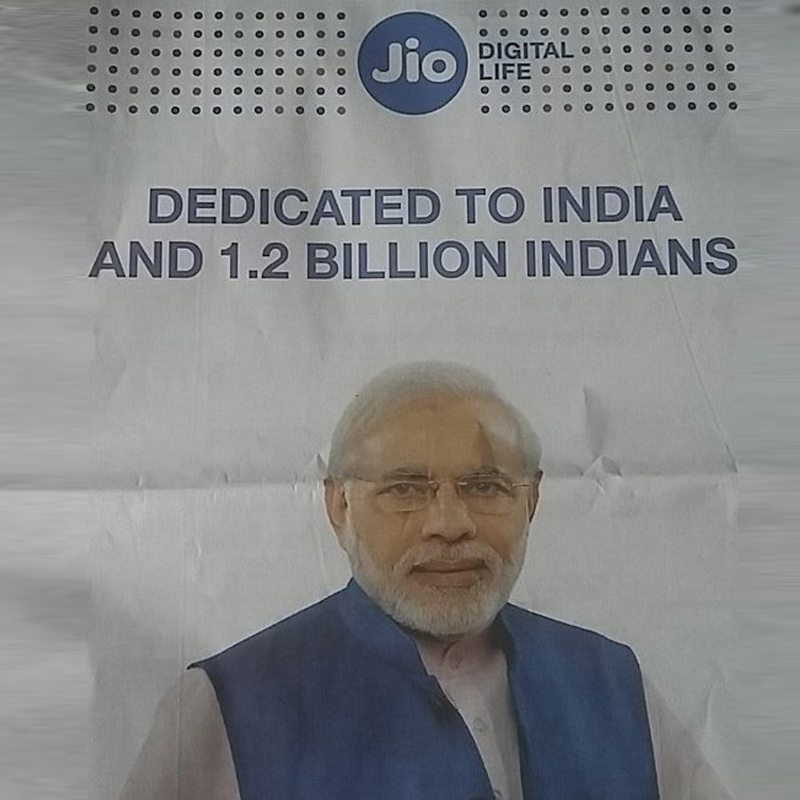
    NEW DELHI: The Government has denied that it gave permission for publication of a full-page photograph of the prime minister Narendra Modi in advertisements in newspapers about Reliance Jio.

    Minister of state for information and broadcasting Rajyavardhan Rathore said: “No permission was granted by the Prime Minister’s Office.”

    Rathore told the Parliament that the Act, ‘The Emblems and Names (Prevention of Improper Use) Act, 1950’ is administered by the Consumer Affairs, Food & Public Distribution Ministry.

    He also said that the directorate of advertising and visual publicity (DAVP) of his ministry releases Government advertisements only and does not release advertisements of any private body.

    Reliance Jio may have to pay only Rs 500 as fine for using Modi’s picture in advertisement, without permission from the government. Newspapers reported that the minor penalty could be charged from Jio.

    Rathore, in a written reply, admitted that it was aware that Reliance Jio used the PM’s photographs in the advertisement. About the actions that can be taken against Jio, he replied that the (DAVP) unit was responsible for it is the Emblems and Names (prevention of improper use) Act 1950.

    Section-3 of the Act states that no person shall use any “specified” name or emblem for the purpose of any trade, business or any such activities without the “previous permission of the central government” or officers authorised by the government. The list of names and emblems that cannot be used without prior permission from the government includes the president of India, the PM, governor of a state, the government of India or any state, Mahatma Gandhi, Indira Gandhi, Jawaharlal Nehru, United Nations Organisation, Ashok Chakra or Dharma Chakra.

  • Reliance Jio may be fined for using PM’s pic in ad sans permission

    Reliance Jio may be fined for using PM’s pic in ad sans permission

    NEW DELHI: The Government has denied that it gave permission for publication of a full-page photograph of the prime minister Narendra Modi in advertisements in newspapers about Reliance Jio.

    Minister of state for information and broadcasting Rajyavardhan Rathore said: “No permission was granted by the Prime Minister’s Office.”

    Rathore told the Parliament that the Act, ‘The Emblems and Names (Prevention of Improper Use) Act, 1950’ is administered by the Consumer Affairs, Food & Public Distribution Ministry.

    He also said that the directorate of advertising and visual publicity (DAVP) of his ministry releases Government advertisements only and does not release advertisements of any private body.

    Reliance Jio may have to pay only Rs 500 as fine for using Modi’s picture in advertisement, without permission from the government. Newspapers reported that the minor penalty could be charged from Jio.

    Rathore, in a written reply, admitted that it was aware that Reliance Jio used the PM’s photographs in the advertisement. About the actions that can be taken against Jio, he replied that the (DAVP) unit was responsible for it is the Emblems and Names (prevention of improper use) Act 1950.

    Section-3 of the Act states that no person shall use any “specified” name or emblem for the purpose of any trade, business or any such activities without the “previous permission of the central government” or officers authorised by the government. The list of names and emblems that cannot be used without prior permission from the government includes the president of India, the PM, governor of a state, the government of India or any state, Mahatma Gandhi, Indira Gandhi, Jawaharlal Nehru, United Nations Organisation, Ashok Chakra or Dharma Chakra.

  • Telecast ban withheld in two of 31 cases; no IMC recast plan

    Telecast ban withheld in two of 31 cases; no IMC recast plan

    NEW DELHI: Information and broadcasting minister M Venkaiah Naidu has said that there have been only two cases in the past two years and the current year where the government has put on hold its orders asking TV channels to prohibit transmission for limited time.

    These relate to channel DY 365 for a news broadcast on 12 June 2014 and the NDTV India for a report on 4 January 2016, Naidu told the Parliament. In both cases, he said, the channels had made representations to the ministry which were under consideration.

    The minister of state for information and broadcasting Rajyavardhan Rathore, answering a supplementary, said that there was no proposal to re-constitute the Inter-Ministerial Committee (IMC) which already includes representatives from the industry.

    DY 365 TV channel telecast news bulletin revealing identity of rape victims in two separate news reports. The matter was placed before the IMC on 13 January 2015 in which a representative of the channel was also afforded an opportunity of personal hearing. IMC recommended that the channel may be taken off air for a day due to multiple violations. With the approval of competent authority, an order dated 26 March 2015 was issued to DY 365. Subsequently, the channel submitted a representation on 27 March.

    NDTV India TV channel telecast a report on Pathankot terrorist attack disclosing sensitive information well beyond the briefing given by the designated officer while the anti-terrorist operations were still under way. The content was found in violation of Rule 6(1)(p) of the Programme Code. The matter was placed before the IMC on 25 July, 2016, in which representative of the channel was also afforded an opportunity of a personal hearing. It was recommended that the channel may be taken off air for at least one day keeping in view the gravity of the violation and an order issued on 2 November 2016. Subsequently, the channel submitted a representation dated 7 November 2016 which is pending.

    (Meanwhile, the Bombay High Court has admitted for hearing a petition by Care World India challenging a week-long telecast prohibition order.)

    In reply to another question, Rathore said as many as 31 TV channels had been ordered to stop transmission for periods ranging from one to 60 days since 2005. These include Care World India and AXN two times each, News Time Assam for three news items.

    The authority for exercising powers under Cable Act by Central Government or concerned Government/ authorised officers are provided under various sections of the Cable Act and mainly under Section 19 & 20.

  • Telecast ban withheld in two of 31 cases; no IMC recast plan

    Telecast ban withheld in two of 31 cases; no IMC recast plan

    NEW DELHI: Information and broadcasting minister M Venkaiah Naidu has said that there have been only two cases in the past two years and the current year where the government has put on hold its orders asking TV channels to prohibit transmission for limited time.

    These relate to channel DY 365 for a news broadcast on 12 June 2014 and the NDTV India for a report on 4 January 2016, Naidu told the Parliament. In both cases, he said, the channels had made representations to the ministry which were under consideration.

    The minister of state for information and broadcasting Rajyavardhan Rathore, answering a supplementary, said that there was no proposal to re-constitute the Inter-Ministerial Committee (IMC) which already includes representatives from the industry.

    DY 365 TV channel telecast news bulletin revealing identity of rape victims in two separate news reports. The matter was placed before the IMC on 13 January 2015 in which a representative of the channel was also afforded an opportunity of personal hearing. IMC recommended that the channel may be taken off air for a day due to multiple violations. With the approval of competent authority, an order dated 26 March 2015 was issued to DY 365. Subsequently, the channel submitted a representation on 27 March.

    NDTV India TV channel telecast a report on Pathankot terrorist attack disclosing sensitive information well beyond the briefing given by the designated officer while the anti-terrorist operations were still under way. The content was found in violation of Rule 6(1)(p) of the Programme Code. The matter was placed before the IMC on 25 July, 2016, in which representative of the channel was also afforded an opportunity of a personal hearing. It was recommended that the channel may be taken off air for at least one day keeping in view the gravity of the violation and an order issued on 2 November 2016. Subsequently, the channel submitted a representation dated 7 November 2016 which is pending.

    (Meanwhile, the Bombay High Court has admitted for hearing a petition by Care World India challenging a week-long telecast prohibition order.)

    In reply to another question, Rathore said as many as 31 TV channels had been ordered to stop transmission for periods ranging from one to 60 days since 2005. These include Care World India and AXN two times each, News Time Assam for three news items.

    The authority for exercising powers under Cable Act by Central Government or concerned Government/ authorised officers are provided under various sections of the Cable Act and mainly under Section 19 & 20.

  • India to digitise all services, says I&B MoS Rathore

    India to digitise all services, says I&B MoS Rathore

    NEW DELHI: Minister of State for Information & Broadcasting Rajyavardhan Rathore has said that the government is making all efforts to digitalise the whole spectrum of services available to the citizens. He said that convergence of array of services to empower citizens through mobile technology was already happening.

    Speaking after giving away the awards at the conclusion of the 47th International Film Festival of India in Panaji in Goa yesterday evening, Rathore said the Film Facilitation Office (FFO) set up by the government was a step towards facilitating single window clearance for filmmakers, promote India as a filming destination and provide the platform for film tourism in the country.

    He said films were not only a means for entertainment but a powerful art form which heralded social change. He added that it was a testament to the power of fluency and persuasion that cinema was the only art form that is deemed fit to be regulated by an Act of Parliament.

    The role of Cinema to bridge cultures was experienced in IFFI with the partnership between India and the focus country for the year 2016 – South Korea — through films which acted as gateway for further cultural exchanges.

    Rathore said multiplexes had revolutionised the film-viewing experience with the top films grossing box office returns due to the multiplex boom. A paradigm shift in technology also enabled the mobile viewing boom in the country. This enabled individuals to shoot films based on one’s taste and perception of the given environment. This acted as a big fillip to young filmmakers and it was evident from the record number of entries at the Swachh Bharat Film Festival organised by the ministry.

    (Speaking at another event earlier in the day, Rathore said IFFI provided a unique platform for experts from across the globe to share their behind the screen experiences and stories. The effort was to provide a rich experience for all the delegates and film fraternity.

    Rathore said Films were an effective tool as a medium of communication and appreciated the efforts of NFAI in depicting the struggle of freedom fighters through this exhibition on cinema. Linking the issue of films with the demonetisation scheme of the Government, Rathore said this initiative of the Government would bring transparency in the film industry and would curb the use of black money.)

    Iranian film “Daughter” bagged the Golden Peacock for best feature film at the Festival with a certificate and a cash prize amount of Rs Four million, shared between the Director and the Producer equally. Iranian actor Farhad Aslani won the ‘Best Actor’ award for his portrayal of the strict father in the same film, picking up the Silver Peacock and Rs 1 million in cash prize. The film had also won the best film award in the Moscow International Film Festival earlier this year.

    The awards were given away by Rathore in the presence of the Goa governor Mridula Sinha, the chief minister Laxmikant Parsekar and the chief guest S S Rajamouli.

    The ‘Best Director’ award was given to Baris Kaya for the film “Rauf”, who bagged the Silver Peacock Trophy and cash prize of Rs 1.5 million. Elina Vaska won the Best Actress Award for the film “Fellow Mud”, getting the Silver Peacock Trophy and cash Prize of Rs One million. The Special Jury award was given to Lee Joon-ik for the Direction of the movie “The Throne” with the Silver Peacock Award and a cash prize of Rs 1.5 million.

    The ICFT –UNESCO Gandhi Medal was awarded to Turkish film maker Mustafa Kara’s ‘Cold of Kalandar’. This award, instituted by the International Council for Film & Television, Paris, and UNESCO is given to a film that portrays the Gandhian values of peace and harmony. ‘Cold of Kalandar’, set in a mountain village in the Black Sea region is also Turkey’s official entry for ‘Best Foreign Language Film’ category of Oscar Awards.

    The Canadian multi-lingual entry ‘The Apology’ by Toronto based Tiffany Hsiung won the Special Mention under the ICFT-UNESCO Gandhi Medal competition. In all seven films, including an Indian film ‘Allama’ by T S Nagabharana, were in the fray for this award.

    Earlier, Parsekar said that collaboration between the central and state governments and the film industry made this edition of IFFI a great success which not only promoted Indian Film Industry but also promoted Goa as a creative hub.

    Rajamouli said the biggest beneficiaries of such film festivals are young filmmakers who gets a platform to see the best of films across the globe and learn from the vision of reputed film makers around the World.

    I and B additional secretary Jayashree Mukherjee said IFFI besides showcasing films also provided a large number of avenues for learning in form of workshops and master classes.

    The closing ceremony witnessed glitz and glamour through the scintillating musical performances representing a rich musical culture of India composed by Sachin Jigar.

  • India to digitise all services, says I&B MoS Rathore

    India to digitise all services, says I&B MoS Rathore

    NEW DELHI: Minister of State for Information & Broadcasting Rajyavardhan Rathore has said that the government is making all efforts to digitalise the whole spectrum of services available to the citizens. He said that convergence of array of services to empower citizens through mobile technology was already happening.

    Speaking after giving away the awards at the conclusion of the 47th International Film Festival of India in Panaji in Goa yesterday evening, Rathore said the Film Facilitation Office (FFO) set up by the government was a step towards facilitating single window clearance for filmmakers, promote India as a filming destination and provide the platform for film tourism in the country.

    He said films were not only a means for entertainment but a powerful art form which heralded social change. He added that it was a testament to the power of fluency and persuasion that cinema was the only art form that is deemed fit to be regulated by an Act of Parliament.

    The role of Cinema to bridge cultures was experienced in IFFI with the partnership between India and the focus country for the year 2016 – South Korea — through films which acted as gateway for further cultural exchanges.

    Rathore said multiplexes had revolutionised the film-viewing experience with the top films grossing box office returns due to the multiplex boom. A paradigm shift in technology also enabled the mobile viewing boom in the country. This enabled individuals to shoot films based on one’s taste and perception of the given environment. This acted as a big fillip to young filmmakers and it was evident from the record number of entries at the Swachh Bharat Film Festival organised by the ministry.

    (Speaking at another event earlier in the day, Rathore said IFFI provided a unique platform for experts from across the globe to share their behind the screen experiences and stories. The effort was to provide a rich experience for all the delegates and film fraternity.

    Rathore said Films were an effective tool as a medium of communication and appreciated the efforts of NFAI in depicting the struggle of freedom fighters through this exhibition on cinema. Linking the issue of films with the demonetisation scheme of the Government, Rathore said this initiative of the Government would bring transparency in the film industry and would curb the use of black money.)

    Iranian film “Daughter” bagged the Golden Peacock for best feature film at the Festival with a certificate and a cash prize amount of Rs Four million, shared between the Director and the Producer equally. Iranian actor Farhad Aslani won the ‘Best Actor’ award for his portrayal of the strict father in the same film, picking up the Silver Peacock and Rs 1 million in cash prize. The film had also won the best film award in the Moscow International Film Festival earlier this year.

    The awards were given away by Rathore in the presence of the Goa governor Mridula Sinha, the chief minister Laxmikant Parsekar and the chief guest S S Rajamouli.

    The ‘Best Director’ award was given to Baris Kaya for the film “Rauf”, who bagged the Silver Peacock Trophy and cash prize of Rs 1.5 million. Elina Vaska won the Best Actress Award for the film “Fellow Mud”, getting the Silver Peacock Trophy and cash Prize of Rs One million. The Special Jury award was given to Lee Joon-ik for the Direction of the movie “The Throne” with the Silver Peacock Award and a cash prize of Rs 1.5 million.

    The ICFT –UNESCO Gandhi Medal was awarded to Turkish film maker Mustafa Kara’s ‘Cold of Kalandar’. This award, instituted by the International Council for Film & Television, Paris, and UNESCO is given to a film that portrays the Gandhian values of peace and harmony. ‘Cold of Kalandar’, set in a mountain village in the Black Sea region is also Turkey’s official entry for ‘Best Foreign Language Film’ category of Oscar Awards.

    The Canadian multi-lingual entry ‘The Apology’ by Toronto based Tiffany Hsiung won the Special Mention under the ICFT-UNESCO Gandhi Medal competition. In all seven films, including an Indian film ‘Allama’ by T S Nagabharana, were in the fray for this award.

    Earlier, Parsekar said that collaboration between the central and state governments and the film industry made this edition of IFFI a great success which not only promoted Indian Film Industry but also promoted Goa as a creative hub.

    Rajamouli said the biggest beneficiaries of such film festivals are young filmmakers who gets a platform to see the best of films across the globe and learn from the vision of reputed film makers around the World.

    I and B additional secretary Jayashree Mukherjee said IFFI besides showcasing films also provided a large number of avenues for learning in form of workshops and master classes.

    The closing ceremony witnessed glitz and glamour through the scintillating musical performances representing a rich musical culture of India composed by Sachin Jigar.