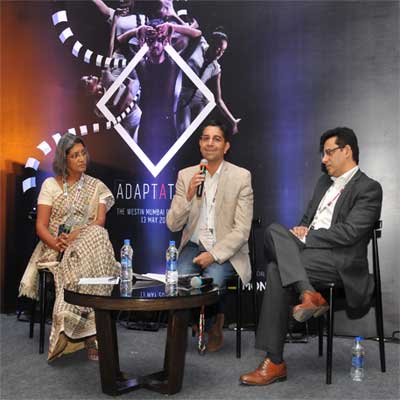
MUMBAI: The last session of PromaxBDA witnessed a candid and fun conversation between broadcast executives and agencies, who acknowledged the elephant in the room – pitching. For many agencies and their clients, pitching is a hot and sensitive topic.
The session with Namit Sharma, Abhijit Avasthi, Maxus South Asia’s Kartik Sharma and Reliance Broadcast Network’s Paritosh Painter was moderated by Reliance Broad Network CEO Tarun Katial.
Panelists had a unanimous answer to the three key points that one must prepare before engaging in a pitch. They are as follows: 1) Knowing what the client wants, 2) A unique idea and 3) Conviction to pitch the idea before presenting it to the client.
Sharma was of the opinion that one should share ideas in the time given. He said, “You have five minutes to convince the client. If he is not convinced in that time then you should move on to plan B,” he said.
Avasthi added, “You need to be ruthless to yourself while evaluating the idea so that you can get the best out of it.”
Maxus’ Sharma further added, “You need to work for the client, so that he can benefit and that should also be a point that one should keep in mind.”
Replying to Katial’s question as to whether ideas should be original or inspired, Painter said, “Ideas are generally original, but the client might not understand it at the first instance. At that point, one needs to give them referral points so that they understand it better. Hence they are original and inspired.”
On questioning about the tangibility of the idea, Sharma said, “It can be a combination of both. But pitching needs execution.”
An agency wins or loses a pitch on the basis of the execution. Maxus’ Sharma said, “A brilliant idea can help us win a pitch.” Stating an example, he said that there have been times when his team has gone unprepared for a pitch, but the client has liked the idea and they have won pitches. Indeed, he is of the opinion that winning or losing a pitch doesn’t depend on the tangibility of the idea.
When asked as to what happens when a tangible idea is not strong, Avasthi said, “Personally, since I come from the advertising background, I feel one needs to evaluate the idea and then pitch it. I have seen instances when my team has come up to me and we have brainstormed the idea because I am quite aware that they will not be able to polish it. So I try to pull out something breakthrough from their idea.”
Painter asserted that one should sell the idea in 30 seconds. He said, “I am generally convinced about my idea so that I can sell it. When I evaluate pitches, I first try to understand the intention of the pitch. Is it business or passion that is driving the person? If it is business then the person sitting in front of me has to do a lot of hard work to convince me, but if it is passion, 70 per cent of the convincing job is done. You just have to push the person the extra 30 per cent for you to say yes. And that person will do it, because a lot of passion drives him to do that.”
The discussion then took the curve of whether an experienced person’s pitch value is more than that of a youth. Sharma opines that the idea must be focused on and not the experience of the person. On the other hand, Avasthi and Maxus’ Sharma opined that it depends on the client. If the client is new then youngsters do present pitches, while if it is an old and important client then an experienced person should give the pitch.
Concluding the discussion with tips on what one should do after the pitch, Avasthi said, “The person should take ownership of the pitch and it is important that the other person is concurrent with that.”
Painter asserted, “One must do a thorough research on the idea and on the client.”
Concluding, Maxus’ Sharma said, “Ask a lot of questions and you will get rich insights. During the pitch have a feedback and close the pitch with a dialogue.”