Category: News Headline

  • Gitika Sharan takes charge of marketing at Wadhwani AI Global

    Gitika Sharan takes charge of marketing at Wadhwani AI Global

    MUMBAI: Gitika Sharan has been appointed head of marketing and communications at Wadhwani AI Global, the artificial intelligence non-profit applying technology to solve challenges in the Global South.

    Sharan joins from Welspun World, where she was general manager martech. Before that, she spent over four years at Indira IVF group, heading internal and external communications, CSR and ESG initiatives, and franchisee operations. Her earlier stints included senior communications roles at Platinum Guild International, MSL Group, Ogilvy PR and Burson.

    In her new role, Sharan will shape Wadhwani AI Global’s brand voice and outreach as it works on AI-led interventions in agriculture, public health and other development priorities. 

    “We are applying AI to address some of the most pressing challenges in the Global South… the focus is on ensuring technology truly serves communities and creates sustainable impact,” she said.


  • Formula 1 races into record books with blockbuster first half of 2025

    Formula 1 races into record books with blockbuster first half of 2025

    MUMBAI: Full throttle, no pit stops! Formula 1’s 2025 season hasn’t just been about roaring engines and tight overtakes, it’s been a spectacle both on and off the track. From Brad Pitt’s F1: The Movie smashing box office records to sold-out Grands Prix pulling in millions of fans, the sport has hit top gear in its 75th anniversary year.

    The season opened with F1 75 Live at London’s O2, where 16,000 fans watched all ten teams unveil their new cars alongside live music from global stars like MGK, Tems and Take That. The livestream drew 7.5 million viewers worldwide, setting Youtube records and proving that F1 knows how to put on a show as much as a race.

    Hollywood soon joined the grid. Pitt’s racing blockbuster has already grossed more than 600 million dollars, making it the highest-earning sports film ever and his biggest box-office hit. Premieres in New York and London drew A-listers from Tom Cruise and Naomi Campbell to Lewis Hamilton and Charles Leclerc, not to mention Formula 1’s biggest names behind the wheel.

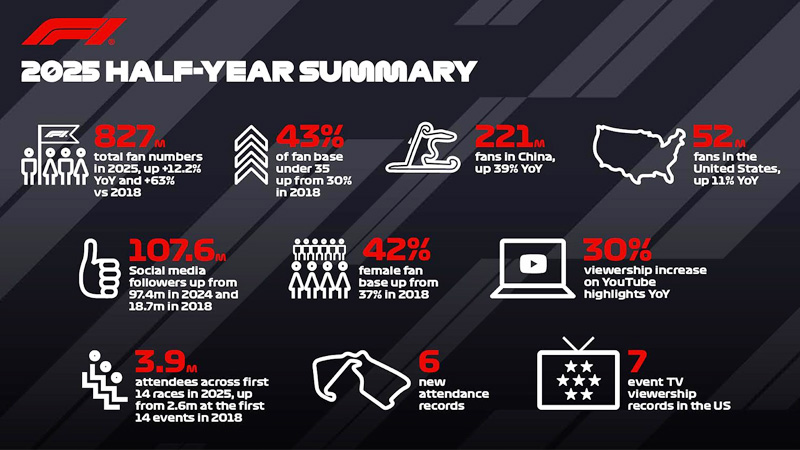
    On track, the numbers are just as electrifying. More than 3.9 million fans attended the first 14 races, which is the highest ever mid-season tally, with Australia and Britain each topping 400,000. 11 of the 14 events sold out, while record-breaking crowds turned up in Spain, Canada and Belgium.

    Digital reach is also flying. Formula 1’s social media following has surged past 107 million, up 21 percent year-on-year, with Tiktok and YouTube highlights pulling in record views. Younger fans are driving the growth too: 43 percent of F1’s global fanbase is now under 35, and nearly half are women.

    Commercially, the grid is just as busy as the paddock. Partnerships with Disney, Pepsico, LEGO, Barilla and luxury powerhouse LVMH have broadened F1’s global appeal, while quirky activations such as LEGO driver parades and gourmet pasta pop-ups, have kept fans talking.

    And the best part? There’s still half a season left. With Zandvoort kicking things off this weekend, F1’s second act promises more drama, more speed and, if the first half is anything to go by, more records smashed.
     

  • Campus laces up with Kriti Sanon to kickstart women’s sneaker revolution

    Campus laces up with Kriti Sanon to kickstart women’s sneaker revolution

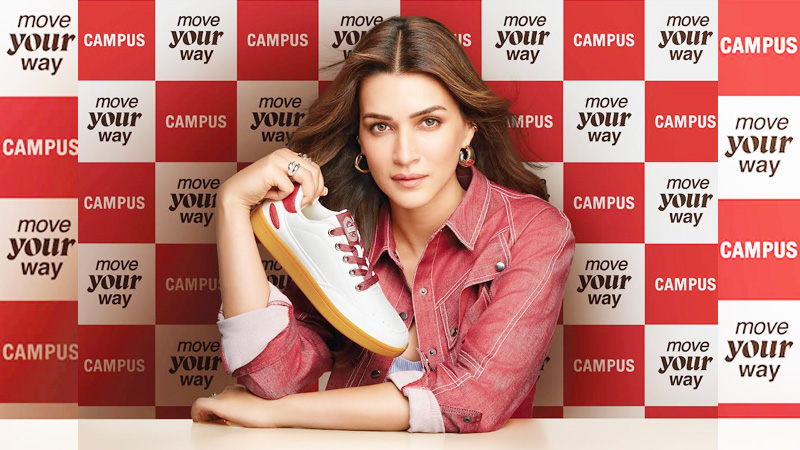
    MUMBAI: Sneakerheads, meet your new style captain Kriti Sanon. Campus Activewear, one of India’s biggest sports and athleisure footwear brands, has signed on the National Award-winning actress as the face of its women’s category, a move that cements the brand’s ambitions to step up its game in the fast-growing segment.

    For Campus, women’s sports and athleisure is no sidekick, it’s become one of the biggest growth drivers over the past year, fuelling the brand’s rise in India’s sneaker story. Now, with Kriti Sanon, an engineering graduate turned Bollywood star and entrepreneur fronting the campaign, the brand is tying its laces for the next lap: making sneakers bolder, trend-forward, and uncompromisingly comfortable for women who juggle multiple roles.

    Nikhil Aggarwal, CEO and Whole Time Director of Campus Activewear, called the women’s portfolio “one of the most significant growth engines,” noting that Kriti’s ambition and versatility make her the perfect match. Kriti, meanwhile, says she’s drawn to Campus’ belief that style should reflect who you are “designing footwear as versatile as the roles women play.”

    With athleisure booming and Campus eyeing bigger strides, Kriti’s arrival signals more than just another celebrity face on a billboard. It’s a sneaker statement: India’s women are not just walking in style, they’re sprinting ahead.

  • Bengaluru’s hoardings go missing in action with wives at the centre

    Bengaluru’s hoardings go missing in action with wives at the centre

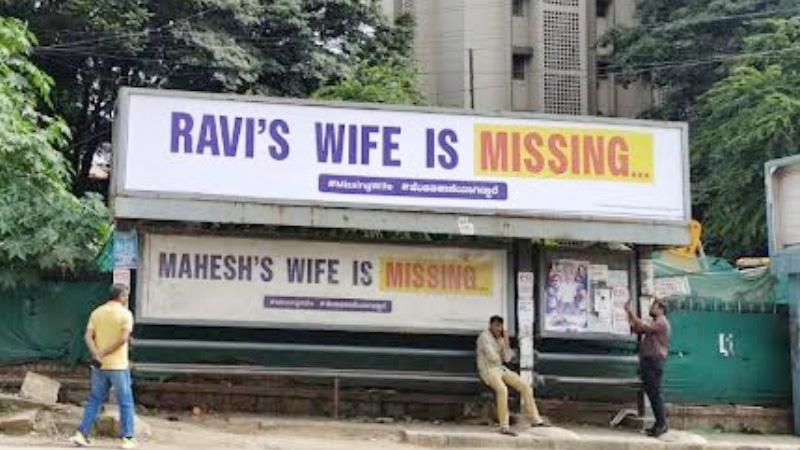
    MUMBAI: Bengaluru is having a missing persons crisis on hoardings, not in homes. Over the past few days, the city has been plastered with giant posters screaming, “Atul’s wife is missing”, “Senthil’s wife is missing”, “Ravi’s wife is missing” and the list keeps growing. The stark black-and-white designs, with no logos, hashtags or explanations, have thrown the city into a frenzy. Commuters stuck at signals, social media scrollers, and even seasoned ad-watchers are scratching their heads. What started as a handful of sightings has snowballed into a full-blown urban mystery, with new “missing wives” appearing every passing day.

    Famed photographer Atul Kasbekar joined the fun on Instagram, posting the hoarding with a tongue-in-cheek plea for help and a “suitable reward.” Influencers including Eshwar Go, Haripriaa Kulkarni, and Sariflog have also jumped into the conversation, their posts amplifying the intrigue to thousands of followers.

    From Koramangala to MG Road, speculation is rife: is this a cheeky ad campaign, a guerrilla social message, or a true-blue whodunnit? While Instagram threads and WhatsApp forwards are brimming with theories, nobody has cracked the code just yet.

    For now, Bengaluru’s skyline is dominated by the mysterious “missing wives” and the only thing multiplying faster than the hoardings is the curiosity. One thing’s for sure: until the reveal, the city won’t be missing this story.
     

  • Reliance joins hands with Google Cloud to put India’s AI future on steroids

    Reliance joins hands with Google Cloud to put India’s AI future on steroids

    MUMBAI: Reliance Industries has never done things by halves. On 29 August, India’s largest private company unfurled its latest grand project: a sweeping expansion of its alliance with Google Cloud, centred on a new, dedicated AI-first cloud region in Jamnagar, Gujarat. The ambition is as audacious as it is familiar. Having once upended India’s telecoms industry with Reliance Jio and cheap data, Mukesh Ambani is now training his firepower on artificial intelligence, promising to democratise access to computing muscle for the world’s most populous country.

    The project is being pitched as India’s “AI leapfrog moment.” Reliance will design, build, and power state-of-the-art cloud facilities, all running on renewable energy and plugged into Jio’s sprawling fibre and digital network. Google will provide the brains: its AI hyper computer, a secure and integrated generative AI stack, and the know-how to run workloads of breath taking intensity. The facility, Reliance says, will meet global service-level standards and support the most demanding AI use cases—from training large models to building next-generation applications for consumers and enterprises.

    Why Jamnagar? The coastal city is already the beating heart of Reliance’s refining and petrochemicals empire. It is also becoming a symbol of the company’s reinvention: its green energy giga factory is rising there, and now the AI cloud campus will sit alongside it. Running on renewable power, the project ticks boxes for sustainability even as it scales to hyper speed. Jio, meanwhile, will string high-capacity fibre links connecting Jamnagar to metros like Mumbai and Delhi, effectively wiring India’s AI ambitions to its business and political capitals.

    Mukesh Ambani cast the partnership in almost civilisational terms: “Just as Jio and Google came together to democratise the internet for every Indian, we will now democratise intelligence for every Indian,” he declared. The subtext was clear: Reliance does not want to merely be a customer of AI; it wants to be the platform on which India builds its AI future.

    For Google, the tie-up is equally strategic. The American giant has long struggled to monetise India at scale, despite Android’s dominance. Its alliance with Reliance, first forged through a $4.5bn investment in Jio Platforms in 2020, has been its best bet. Sundar Pichai, Google’s boss, was almost wistful: “Our work together over the last decade has helped bring affordable internet access to millions. And now, we are building on this to help shape the next leap with AI. This is only the beginning.”

    The beginning it may be, but the context is fiercer. Microsoft has partnered with the Adani group to push Azure into Indian enterprises. Amazon Web Services (AWS) has invested heavily in local data centres. By anchoring Google Cloud in Reliance’s infrastructure, Ambani is offering it the biggest distribution muscle in the country—from India’s biggest retailer to its mightiest mobile operator.

    Reliance has always built moats around scale and integration. Hydrocarbons fed petrochemicals; petrochemicals funded telecoms; telecoms birthed digital platforms; retail wrapped around them. Now AI is being woven into every strand. Reliance’s retail arm, one of the world’s fastest-growing, will be powered by predictive analytics and AI-first services. Its digital platforms can churn out generative-AI-powered customer tools. Even its energy and refining business can tap AI for predictive maintenance, efficiency, and emissions management.

    The bet is as much about geopolitics as economics. AI compute has become a strategic resource, akin to oil in the 20th century. By hosting a dedicated, hyperscale AI cloud region in India, Reliance and Google are hedging against global bottlenecks in semiconductors and compute availability. They are also offering Indian enterprises and the government a “sovereign-flavoured” cloud alternative to relying wholly on Western or Chinese platforms.

    The entire project will be underpinned by Reliance’s push into renewable power. The AI data centres, notorious for their energy hunger, will be fed through Reliance’s green energy parks and hydrogen initiatives. Jio’s high-capacity fibre, spanning metros and regions, adds the digital sinew to match the green muscle. The combination allows Reliance to brand the initiative not merely as profitable, but as sustainable—a key card to play with regulators, policymakers, and global investors.

    For India, the stakes are towering. Domestic enterprises, startups, and public sector organisations often face prohibitive costs in accessing cutting-edge AI compute. By pooling Reliance’s infrastructure with Google’s stack, the hope is to lower barriers and accelerate adoption. Small businesses may soon have access to AI tools that were once the preserve of Silicon Valley. Universities and research institutes could run high-performance AI models without prohibitive cost. And the government could scale citizen-facing AI services in health, education, and agriculture.

    But challenges remain. Building AI facilities is one thing; ensuring India has the talent, regulation, and guardrails to use them responsibly is another. AI also raises thorny issues of bias, surveillance, and security. Reliance’s ambition to become India’s AI backbone will inevitably attract scrutiny—whether from privacy hawks, antitrust watchdogs, or foreign competitors.

    Yet, if history is a guide, Reliance has a knack for bending markets to its will. When Jio entered telecoms in 2016, it offered free calls and dirt-cheap data, triggering a brutal price war that wiped out rivals and left India with the world’s cheapest mobile internet. Now, Ambani appears ready to repeat the trick with AI: offer access at scale, bundle services across Reliance’s ecosystem, and set the floor so low that competitors struggle to keep up.

    The Jamnagar AI cloud, then, is not just about servers and software. It is about a new architecture of power: technological, economic, and political. If it works, Reliance and Google may indeed make India a global leader in artificial intelligence. If it fails, it could end up as another white elephant in the deserts of Jamnagar.
    For now, though, one thing is certain. India’s AI race has just been given a jolt of steroids—and Mukesh Ambani is holding the syringe.

    (The picture featured above is representational of two businessmen joining hands and there is no intention to insinuate that it  resembles either Mukesh Ambani or Sunder Pichai. It is an AI generated image)

  • Motorola turns up the volume with Bose-tuned Loop and bass-heavy buds

    Motorola turns up the volume with Bose-tuned Loop and bass-heavy buds

    MUMBAI: When it comes to sound, Motorola just dropped the bass, literally. The smartphone giant, now calling itself India’s leading AI phone brand, has launched two true wireless earbuds designed to take on every mood, beat and playlist: the moto buds Loop powered by Bose Audio, and the moto buds Bass with segment-best 50db active noise cancellation.

    Priced at Rs 7,999 (with a bank offer cutting Lop to Rs 6,999) and Rs 1,999 for Bass, the earbuds go on sale 1st September and 8 September respectively, across Flipkart, Motorola.in, and retail stores. Both arrive armed with features aimed squarely at India’s growing tribe of music junkies, gamers, and on-the-go professionals.

    The moto buds Loop stand out with an open-ear design tuned by Bose, 12mm ironless drivers, and spatial sound for 3D-like immersion. They deliver 8 hours on a single charge and 39 hours with the case, plus a quick 10-minute top-up for 3 hours of playback. Add IP54 water resistance, a memory alloy frame, and trekking green finish, and Loop is more style statement than accessory.

    For bass-heads, the moto buds Bass promise Super Bass tuning, Hi-Res LDAC audio, and 12.4mm composite dynamic drivers. With 50db ANC across a 4kHz range, users can toggle between Adaptive, Transparency, or Noise Cancelling modes at will. Battery life stretches to 7 hours (ANC off) plus 41 hours with the case, totalling a marathon 48 hours. Quick cadds 2 hours of playback in 10 minutes. At just 51g, with triple-mics on each bud and finishes like dark shadow, blue jewel, and posy green, these are built for marathon listening sessions without compromise.

    Connectivity gets a boost too both models feature Bluetooth 5.3, Google fast Pair, and Crystaltalk AI to cut through background chaos on calls. With smart connect and moto ai integration, users can switch devices or trigger commands (“Catch me up”) hands-free, making them lifestyle companions as much as audio gear.

    Motorola India MD T.M. Narasimhan summed it up: “With Loop and Bass, we’re blending technology, design and usability to create audio experiences that resonate with evolving lifestyles.” Translation? Whether you crave Bose-tuned clarity or chest-thumping bass, Motorola now has a bud for every beat.

  • Smart Bazaar and McCann reframe retail with ‘living well’ campaign

    Smart Bazaar and McCann reframe retail with ‘living well’ campaign

    MUMBAI: Smart Bazaar has teamed up with McCann Worldgroup India to roll out a fresh brand campaign that captures a cultural shift sweeping through Indian homes, the move from ‘making do’ to ‘living well’.

    The films spotlight how everyday spaces such as kitchens, bathrooms, living rooms, are being reimagined with more intention, reflecting dignity, pride and a desire for quality. At the centre of this change are women, the everyday architects of aspiration, turning homes into reflections of both dreams and needs.

    “This is not just about retail, it’s about enabling aspiration,” said Reliance Retail, CMO, Surabhi Sen. “Consumers today want both savings and quality, and Smart Bazaar bridges that gap, turning everyday upgrades into everyday reality.”

    McCann Worldgroup’s CEO and CCO Prasoon Joshi added, “India is at a cultural inflection point. Living well is no longer a luxury, it’s dignity and joy. With Smart Bazaar, we tapped into a truth quietly redefining daily life.”

    The campaign, featuring films like Masterchef, Twinning, Twins and Shepreneur, positions Smart Bazaar not merely as a store but as a cultural enabler, making quality living accessible to all.

  • Polycab plugs into Ganesh Utsav with comfort zones and safety towers

    Polycab plugs into Ganesh Utsav with comfort zones and safety towers

    MUMBAI: Powering devotion with a human touch, Polycab is lighting up Mumbai’s ganesh utsav with installations that go well beyond wires and cables.

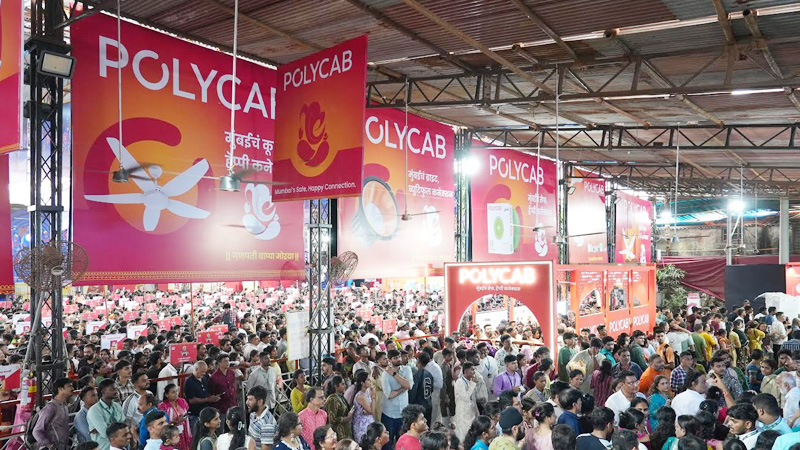
    This year, the brand has shifted gears from product promotions to people-first gestures, creating comfort zones, safety watch towers and breezy walkways at two of the city’s biggest festive hotspots, Lalbaugcha Raja and Juhu Beach.

    At Lalbaugcha Raja, where queues stretch for hours, Polycab has turned a regular bus stop into a “comfort zone” with mobile charging points and sheltered spaces offering respite from the city’s muggy weather. Devotees also find an experiential walkway with Polycab fans for a refreshing darshan route, and even a dedicated rest zone for Mumbai police personnel keeping the crowds in order.

    Polycab

    Meanwhile at Juhu Beach, a prime immersion site, Polycab’s branded safety watchtowers are helping authorities monitor the massive gatherings, adding an extra layer of security to the celebrations.

    Polycab

    “Ganesh Chaturthi is about unity and devotion. With these installations, we want to offer comfort and care to communities, going beyond products to build meaningful connections,” said Polycab India Ltd, senior vice president, brand & marcom, Shwetal Basu.

    The initiative doesn’t stop in Mumbai. Pune is set to see branded gates and banners at major pandals, while Hyderabad’s Khairatabad ganesh pandal will feature a Polycab-branded police booth with water and charging facilities, along with a striking LED arch for devotees.

    From Puri’s rath yatra to ganesh utsav in Mumbai, Polycab has been steadily building a reputation for festive connections powered by care, not cables.


  • JSW MG, Cheil X shift gears with witty ‘EV Sahi Hai’ films

    JSW MG, Cheil X shift gears with witty ‘EV Sahi Hai’ films

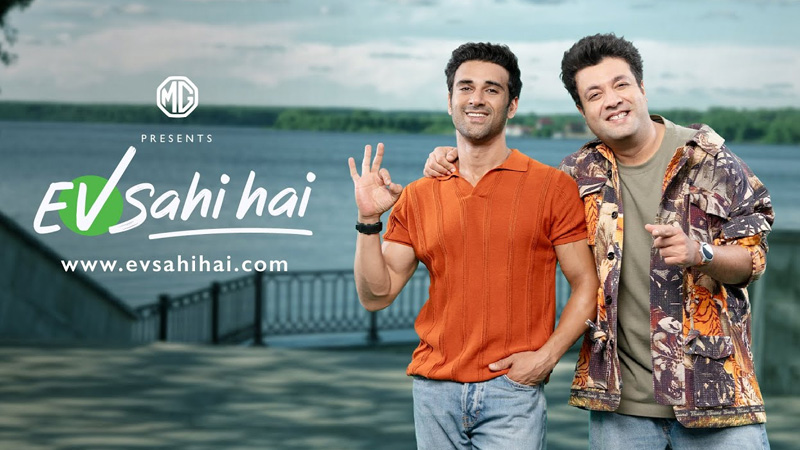
    MUMBAI: JSW MG and Cheil X are back with a laughter-fuelled second phase of their ‘EV sahi hai’ campaign, this time plugging into the star power of Varun Sharma and Pulkit Samrat of Fukrey fame.

    Shot against the scenic backdrops of Dehradun and Rishikesh, the new films tackle two of India’s biggest EV myths: the lack of charging stations and dreaded range anxiety, all with the duo’s signature banter and tongue-in-cheek charm.

    The first film plays out like a cheeky guessing game about India’s quirky town names, cleverly tying them back to the country’s 29,000 plus charging stations. The message? No matter how offbeat the location, you’re never too far from a plug point.

    The second film flips the focus to road trips, with Pulkit confidently cruising in his EV while Varun plays the sceptic, questioning whether it can survive the long haul to Goa. By the end, humour disarms doubt, leaving viewers with one simple conclusion: EV Sahi Hai.

    “Humour is at the heart of this phase, because what better way to bust myths than with a laugh?” said JSW MG Motor India, head of marketing, Udit Malhotra adding that celebrity voices would help the campaign reach “people from all walks of life.”

    Cheil X, national creative director, Amit Nandwani called it a conscious attempt to move beyond “just presenting facts” and instead “debunk myths in a fun and engaging manner”.

    Meanwhile, Cheil X Delhi, vice president and head of operations, Kanika, said the duo’s infectious energy makes them the “perfect pair to keep the message light yet impactful.”

  • Thums Up serves a toofani twist as SRK and Jagapathi dig into biryani

    Thums Up serves a toofani twist as SRK and Jagapathi dig into biryani

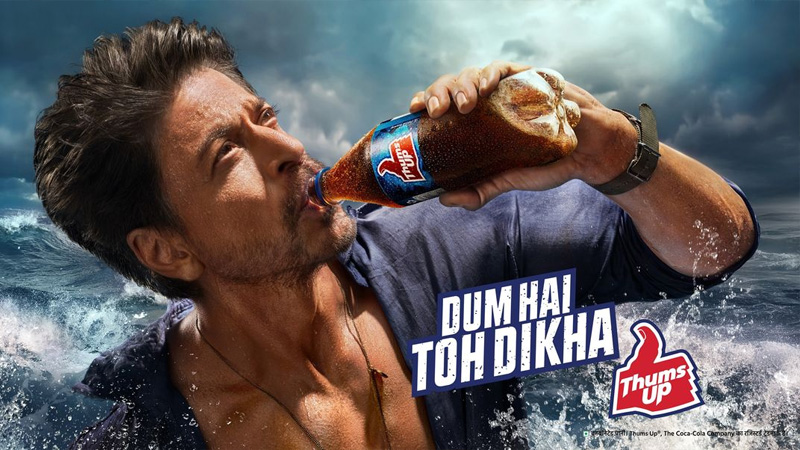
    MUMBAI: When Shah Rukh Khan and Jagapathi Babu lock horns, you expect fireworks this time, the spark came from a plate of biryani and a bottle of Thums Up. Thums Up, Coca-cola India’s billion-dollar blockbuster, has dropped its latest campaign, “Biryani Ek Nahi, Do Haath Se Khaate Hai”, directed by Karthik Subbaraj and fronted by Bollywood royalty SRK alongside Telugu powerhouse Jagapathi Babu. The TVC starts with a tense face-off that quickly dissolves into a toofani moment once biryani and the fizzy cola arrive, elevating the meal into a cultural ritual.

    Over the last three years, Thums Up has steadily claimed biryani as its gastronomic soulmate turning what was once an instinctive pairing into what the brand calls a “social currency.” From the Toofani Biryani Hunt in 2023 to today’s cinematic campaign, the message has stayed consistent: biryani isn’t meant to be rushed. Keep aside the spoon, silence the phone, and savour every grain with one hand on the biryani and the other wrapped around a chilled Thums Up.

    With SRK quipping about the endless Hyderabadi vs Lucknowi vs Kolkata biryani debates (“but what’s undisputed is the way we enjoy it”), and Jagapathi Babu emphasising biryani as a tradition best enjoyed slow, the campaign doubles down on indulgence over interruption. Backed by Coca-cola India’s integrated roll-out across TV, digital, social and on-ground activations, the campaign will also hand fans exclusive biryani vouchers, extending the ritual from screen to plate.

    As Coca-Cola category head India and Southwest Asia for sparkling flavours Sumeli Chatterjee puts it, Thums Up isn’t just adding fizz to biryani; it’s turning the meal into a “moment people want to share, repeat and make their own.” And with star power, spice, and a thunderous taste, the toofani pairing looks set to remain India’s most flavourful ritual.