Category: Hindi

  • Cannes delegates apprised of opportunities in Indian film industry

    NEW DELHI: India has invited some masters of world cinema to conduct master classes and workshops in Film Bazaar at the International Film Festival of India in Goa in November and visit different locations in India.

    Addressing foreign and Indian delegates to the India Pavilion at Cannes, Information and Broadcasting Ministry Joint Secretary (Films) Ashok Parmar said this was “in sync with our Film in India initiative under the aegis of the Film Facilitation Office. We also had the opportunity to speak about international collaboration between talent and co-creation of content since we have signed co-production treaties with several countries.”

    He said the meeting with the various delegates enabled the Ministry to introduce internationally celebrated filmmakers to IFFI, which is in its 48th year and thus showcases the latest critically acclaimed films. “We would be delighted to have these eminent personalities”, he added

    He went on to inform the filmmakers that setting up of the National Centre of Excellence in Animation, Gaming and Visual Effects in Mumbai and a new Film and Television Institute in the North Eastern State of Arunachal Pradesh will enhance the skill of the film sector.

    The delegates were informed of the Ministry’s ambitious National Film Heritage Mission through the National Film Archives based in Pune and the National Museum of Indian Cinema in Mumbai under the aegis of Film Division, as an endeavour on the part of the Government’s effort to preserve the century old cinematic heritage of the country.

    The meeting also discussed how the Directorate of Film Festival could promote Indian cinema across various cities in the UK and Poland and at the same time give their films a footprint in India.

    The National Film Development Corporation which conducts the Film Bazaar tied up with Marco Muller – Artistic Director, Pingyao International Film Festival, to introduce various initiatives to acclaimed international filmmakers and representatives of various National Bodies from Countries that have an international co-production with India.

    Indian Ambassador to France Mohan Kumar said, “We had very useful discussions centered around two fundamental objectives: how to achieve greater visibility for Indian Cinema worldwide and how to promote India as a destination for foreign movies. Discussions with Directors, Producers and Policy-makers from UK, Italy, Poland Germany and China proved fruitful and a possible road map to increase the global footprint did emerge”.

    The delegates in attendance included Fatih Akin (Director/Producer – Germany);
    Nurhan Sekerci (Producer – Germany); Bady Minck (Director/Producer – Austria/Luxembourg); Simone Gattoni (Director/Producer – Italy); Heather Stewart (Creative Director – British Film Institute; Izabela Kiszka-Hoflik (Head of Film production and Project Development – Polish Film Institute; and Michel Pradier and Marielle Poupelin – Telefilm Canada

    The India Pavilion is organized by the NFDC on behalf of the Ministry and is a fully equipped and functional business centre during this period and provides Indian delegates with an opportunity to meet and conduct business with leading members of the international film fraternity.

    The Pavilion will host knowledge sessions with various filmmakers and also facilitates the publicity of films produced by Indian filmmakers. The Corporation has published an India Guide with details of Indian professionals registered with the Cannes Film Festival & Market.

  • Hindi Medium….Fun in parts

    MUMBAI: Hindi Medium is meant to be a satire on the education system as it has evolved in India lately. Just about every institution likes to add the word ‘International’ to its name and claim to be affiliated to a system of education somewhere in the West. 

    It is a take on the money versus schooling and the snob value added to education.

    Publications have taken to ranking educational institutions and many swear by these rankings. And, just about every family on the top of the social ladder in Delhi, where the story is based, wants its ward to get into the number one in ranking; the rest would be a compromise and a blot on their status during society parties.

    Saba Qamar is one such mother who wants her daughter to go to Delhi Grammar School, ranked number one.

    The characters of Irrfan Khan and Saba are an old Delhi, Chandni Chowk, couple, married after a phase of teenage courting.  The couple have a daughter. Irrfan, a ladies tailor’s son, has grown up to be a millionaire now owning a huge women’s high-end dress showroom. 

    Along with that, he also possesses the gift of gab. His customers, mostly women and into buying wedding trousseaus, usually go away having bought more than they planned to.

    While, Irrfan, a dropout and has no English, Saba, a graduate, is fluent. Irrfan and Saba’s love is intact but Saba has just one ambition which is to get her daughter into Delhi’s number one school.

    To this end, the process starts when Saba convinces Irrfan to shift to a posh Delhi locality, Vasant Vihar, because Chandni Chowk is downmarket and schools number one to five would not admit a child from this area. Some schools also have rules about admitting new students only if they are wards of ex-students or those belonging to vicinity.

    Having moved, Saba now tries to fit in to the new neighbourhood. She pretends to be in with the rich neighbours but Irrfan’s way of life is a pure giveaway of his old Delhi ways. They are soon told that being rich is not the only criteria, being suave and savvy is also important. The neighbour’s kids would not play with Saba’s daughter because she speaks Hindi, not English!

    Saba tries a number of ways but when everything fails, Irrfan is informed of the 25% RTE (Right To Education) quota meant for the poor as per the law set by the authorities. On Saba’s insistence, Irrfan applies. What ensues thereafter is another story altogether.

    To prove that theirs is a poor family, Irrfan and Saba shift to a typical Delhi jhuggi jhopdi basti. That is because the school authorities plan to visit and verify the poor applicants. Here, in poor basti, the film takes a detour, going into the equation between selfish rich and the sacrificing poor. Irrfan’s neighbour, Deepak Dobrail, has also applied for his son’s admission under RTE and what ensues is pure 1960s drama of pure heart versus evil heart.

    So far riding on subtle humour and human bondage, the film unfortunately decides to conclude on preaching. This costs about 20 extra minutes to finish. Its 133 minute duration starts feeling like 180. The climax is way too predictable. Which means, once again, that the editors have little say nowadays. Music plays to no effect. Dialogue is simple and witty. Saba’s takiya kalaam about her daughter ending up as a drug addict is fun.

    This is an Irrfan vehicle but the one who excels is Deepak Dobriyal in an author-backed role. Saba, as an obsessed wife and mother, follows next. Irrfan remains his usual competent self.

    Hindi Medium has had a weak opening. The film has been exempted from paying entertainment tax in Gujarat and Maharashtra and some more states may follow suit. With a good word of mouth, the film should pick over the weekend.

    Producers: Bhushan Kumar, Krishan Kumar, Dinesh Vijan.

    Director: Saket Chaudhary.

    Cast: Irrfan Khan, Saba Qamar, Deepak Dobriyal.

    Half Girlfriend……Half Hearted!

    We have had titles such as JhuthaSach, ThodisiBewafaii which raised some pre-release debates. But, in the absence of such widespread and active media we have now, not as much as Half Girlfriend did. Normally too, people are in a habit of defining friendship with unnecessary adjectives like True friend, loyal friend etc. A friend is a friend and, similarly, one has a man/boyfriend or a girlfriend. 

    The title Half Girlfriend may have sounded good enough for the novel ChetanBhagat wrote since it would help raise curiosity and sell copies. In the film, it sounds funny despite explanations. Does a girl qualify to be called girlfriend after she has slept with the boy? That is how it comes across in this film. Since Shraddha Kapoor has no such immediate plans, she suggests Arjun Kapoor consider her as his half girlfriend! 

    This, then, is an indication of things to come. 

    Arjun Kapoor, a native of a small town in Bihar, applies at Delhi’s prestigious college, St Stephens, on sports quota being an ace basketball player. He is being interviewed by a panel but is unable to answer since he knows no English. He suggests he be interviewed in Hindi rather than ‘the language of a country thousands of miles away’! The panel looks extremely ashamed of their insistence on English no matter all the education meted out by the faculty is in English. 

    He calls up his mom, Seema Biswas, who runs a school in his hometown and expresses a desire to return because of language problem. She gives him a new mantra about never to give up or something to that effect! While he is talking to Seema, he spots Shraddha practicing basketball. More than the mother’s mantra it isShraddha magic that makeshim ‘Mantramugdha’ and he decides to stay. Shraddha, who arrives in college in a limousine, is the daughter of a millionaire Delhi businessman.

    The list of students accepted by the college is put up and Arjun has qualified. This looks a bit strange since the college seems to be functioning in its full glory with students teeming all over the campus!

    Forget English, Arjun now concentrates all his attention on Shraddha. He manages to draw her attention when she is not having a good time with her scoring on the basketball court by suggesting how to go about it. It works for her. But, there is nothing thereafter. She seems to have forgotten he existed while all of Arjun’s time around the college is spent stalking her. To guide him are three of his fellow Bihari friends in the hostel who may never have talked to a girl but know what Arjun should do next!

    Friends advise Arjun ask Shraddha out on a movie date and only then will they believe she is not leading him on! That done, Arjun is told that the only way Bihar knows to make sure if a girl really loves a boy is to invite her over to have sex! 

    Angry, Shraddha, walks out and decides it is better to sleep with a suitor her parents have chosen for her by marrying him than to sleep with the man she loves! 

    There is no way to salvage the film hereafter.

    Half Girlfriend has two major faults: casting and scripting. As for casting, the chemistry does not work between Arjun and Shraddha, Arjun and Seema or Arjun and his friends. As of the script, if there are 80 scenes in the film, they all seem to have their origins in some or other old film. It is a totally contrived script. The situations created of a pining lover Arjun fail to create empathy.  Direction is below par. Music has no takeaway value. Editing is lacking. 

    There is not much to talk about performances. Arjun Kapoor lacks range and carries limited expressions. Shraddha Kapoor is okay. Seema Biswas’ is an ill-defined role. Same goes for Vikrant Massey. Rhea Chakraborty is good in a brief role.

    Half Girlfriend has at some centres and average at others and not expected to sustain for long.

    Producers: Ekta Kapoor, Shobha Kapoor, MohitSuri, ChetanBhagat. 

    Director: MohitSuri.

    Cast: Arjun Kapoor, Shradha Kapoor, Seema Biswas, Vikrant Massey, Rhea Chakraborty.


  • Vkaao & Shemaroo to re-release cult classic ‘Namak Halaal’ in theatres

    MUMBAI: Vkaao, India’s first ever ‘theatre-on-demand’ service associates with Shemaroo ShowTime – a sub-brand of Shemaroo Entertainment Ltd that deals in screening of iconic block buster films on big screens.

    The duo is re-releasing the cult classic film ‘Namak Halaal’ to mark the completion of ‘35 years’ of its release. The movie is restored by Shemaroo Entertainment Ltd to offer the audience enhanced watching experience. Viewers across the country can book a private screening of the movie through Vkaao , at a theatre of their choice and convenient time. Alternatively, one can also book a ticket at the ticket counter of the theatre and be part of special screening of the movie on 21 May.

    PVR Pictures CEO Kamal Gianchandani said, “For our latest addition to Vkaao’s movie library, we decided to revive the much-loved classic Namak Halaal.The concept of screening iconic films in theatres is highly popular in the west and we hope to popularize the same in India through Vkaao.”

    Namak Halaal was the perfect start to this endeavour as its witty dialogue, rib-tickling humour and stellar performances are timeless and hold a strong appeal even today. We want to give young audiences a chance to enjoy classic Indian movies such as this one. In addition, we want to offer older audiences the opportunity to watch the movies they have come to love and help them re-create their movie-going memories from yesteryears.”

    Shemaroo Entertainment director Hiren Gada shares his thoughts on the occasion, “We are overwhelmed and excited to re-release the film Namak Halaal on the big screen under our sub brand – Shemaroo ShowTime. It has been conceived to re-release / screen iconic movies from our vast library, thereby emoting nostalgic feeling in the audience. He also added, “In our experience, we have found that the younger audience too would love to have an opportunity to watch classic landmark movies like Namak Halaal. They have shown us positive response on social media and during theatrical screenings of such movies along with other platforms. In fact, with the growing popularity of retro content, we hope that, we soon will have to expand the number of platforms of our retro offerings.”

    Directed by Prakash Mehra, Namak Halaal stars Amitabh Bachchan, Shashi Kapoor, Smita Patil, Parveen Babi & Waheeda Rehman. Undoubtedly one of the most entertaining movies ever made in Bollywood, it showcased Amitabh Bachchan’s comic side to the hilt.

    The film traces the journey of a country bumpkin, Amitabh Bachchan, who finds a job in a hotel only to realise that he must thwart a murder plot against the owner Shashi Kapoor. With the addition of Namak Halaal to its movie library, Vkaao aims to continue to bring classics from India as well as abroad and acquaint younger audiences with them along with offering older viewers a chance to revisit their favourite films.

  • NY Indian Filmfest: ‘Mukti Bhawan’ is best feature, short on Kejriwal is best docu

    NEW DELHI: The Hindi film ‘Mukti Bhawan’ (Hotel Salvation) by Shubhashish Bhutiani on treatment of senior citizens has won the best film award at the 17th annual New York Indian Film Festival.

    The actress Konkona Sen Sharma, who hails from a film family, won two awards: one as director for ‘A death in the Gunj’ and the second as actress for ‘Lipstick under my burkha’.

    The week-long festival premiered 85 shorts, documentaries and feature films from the Indian subcontinent in Hindi and English, and in seven regional languages (Tamil, Malayalam, Kannada, Punjabi, Marathi, Gujarati and Bengali).

    The best actor award went to K Kaladharan for ‘The Narrow Path’. The best screenplay award went to P Balachandran for ‘Kammattipadam’. The best short was ‘Aaba’ by Amar Kaushik and the best documentary award went to ‘An insignificant man’ by Khushboo Ranka and Vinay Shukla about the meteoric rise of Arvind Kejriwal on the Indian political scene which has already won acclaim overseas.

    ‘Aaba’ has also been selected for the Berlin International Film Festival.

    ‘Mukti Bhawan’ had also received the special mention in the National Awards for producer Red Carper Moving Pictures and director Shubhashish Bhutiani and actor Adil Hussain and had its world premiere at the Venice International Film Festival on 2 September last year.

    public://IAAC2.jpg

    In addition to film premieres, the festival featured sidebar programming such as Sibling Filmmakers (Deepa & Dilip Mehta), Priyanka Produces (VENTILATOR & SARVANN), Tribute to Om Puri, Mobile Bollywood, “Shoot a Short Film” workshop, industry panels (CAA’s Short Film Initiative), nightly networking events, red carpets and a gala.

    More than 40 filmmakers attended the festival and participated in Q&A sessions after their films.

    The annual festival was organized by the Indo-American Arts Council (IAAC): Founded in 1998, the IAAC is a secular, not-for-profit, service and resource arts organization charged with the mission of promoting and building the awareness, creation, production, exhibition, publication and performance of Indian, sub-continental and cross-cultural art forms in North America.

    It also works with artists and arts organizations in North America as well as to facilitate artists and arts organizations from India as well as other countries from the rest of the Indian sub-continent to exhibit, perform and produce their work here. The IAAC works passionately to become an integral part of the amazing cultural diversity of New York City and the United States. The IAAC supports all artistic disciplines int he classical, fusion, folk and innovative forms influenced by the arts of the Indian subcontinent.

  • Sarkar 3…Flogging a dead horse

    The trend of making sequels seems to be more pronounced of late owing to the bankruptcy of ideas and imagination. Sarkar 3 carries the taking-the-audience-for-granted culture to a ridiculous level. Sarkar, the first installation was sort of a cross between The Godfather and the life and persona of Shiv Sena supremo, Bal Thackerey.

    Sarkar released in 2005 and boasted of some known names in its cast like Katrina Kaif, Kay Kay Menon and Anupam Kher, along with Abhishek Bachchan and Amitabh Bachchan. Sarkar Raj, the sequel, followed in 2008, with Manoj Bajpayee and Jackie Shroff added to the cast along with Aishwarya Rai Bachchan but, while the first one promised some novelty and managed to pass muster, the sequel did not find favour with the audience.

    Well, if Sarkar Raj was rejected, why then make Sarkar 3, that too with a star cast that can hardly stand up to the protagonist, Sarkar — Amitabh Bachchan?  Amith Sadh is dropped into the proceedings at the onset as Bachchan’s grandson from his son, Abhishek Bachchan. Abhishek was killed in an earlier instalment and only his life-sized portrait adorns this film.

    The character of Amitabh Bachchan is still the Sarkar, the man with the remote control, who runs the local government while the CM and all others in office are his puppets. The CM, in this case, is also Bachchan’s spy and informant; he keeps Bachchan posted on the activities of his enemies. Bachchan also has two loyal men at his back and call, played by Ronit Roy, and another one who can’t speak. Bachchan is not a don, he is a messiah. Millions in the city of Mumbai love and respect him. But, Mumbai is a goldmine for realtors. As there is little left of this aspect to be exploited, the Dubai-based don, played by Jackie Shroff, eyes the biggest opportunity available, the acres of land over which Dharavi is spread.

    Jackie may operate from Dubai but he pulls strings of many of his puppets based in Mumbai. One of them is a big builder who is asked to meet Bachchan for his help to vacate the settlement with force without resettlement or compensation for the occupants. Jackie’s pawn, supposed to be a big-time builder, comes across as a pygmy in front of Bachchan and his two aides but when he approaches Bachchan with a line—‘we can do it without your help too as we have the system in our pocket’—You know this is a lost plot.

    The film is riddled with problems as it goes on introducing multiple side-tracks without relevance to the plot. Looks like the only way to making money and survive in Mumbai for the villains is to eliminate Bachchan!  Manoj Bajpayee’s character wants to be the next CM, but the character of Yami Gautam has a grouse against him too, and some Shetty guy as well as a nondescript small timer also plans to kill him.

    As the film comes to the end of its first half, you realise that nothing has happened yet. And, it has been about 75 minutes. In the second half, it goes haywire. Just about everybody is betraying the other. Everybody wants to be the Sarkar in place of Sarkar! There are shootouts, people killed, one is blamed but the other has done it but the viewer does not know that, only those involved do!

    The film ends like an old time murder thriller where the protagonist decides to explain the whole muddle you were subjected to for over two hours!

    Talking of a muddle, that is what the script is. It has no substance, a routine one-liner as a story which it expands at convenience by adding unnecessary characters and Jackie’s PJs with his girlfriend (surprisingly, for a big shot Don in Dubai, he has only one with DUH written all over her). As for direction, it is all about ‘technology’ Ram Gopal Varma style, to no avail. Thankfully, the film has no songs though the background score is out of sync and loud as if to distract you from the glitches on screen. Dialogue lacks punch. Editing is poor.

    As for performances, Amitabh Bachchan does his usual best this being the third instalment of playing Sarkar. Manoj Bajpayee is becoming a caricature of himself. Ronit Roy is impressive but you don’t want to see him shed tears! Amit Sadh is okay, trying to play the Bachchan of the Deewaar era. Yami Gautam has nothing to do in this film. Jackie Shroff seems to be on a holiday throughout.

    Producers: Rahul Mittra, Anand Pandit, Gopal Shivram Dalvi, Krishan Choudhary.

    Director: Ram Gopal Varma.

    Cast: Amitabh Bachchan, Jackie Shroff, Manoj Bajpayee, Yami Gautam, Amit Sadh, Ronit Roy, Rohini Hattangadi, Bharat Dabholkar.

    Meri Pyaari Bindu: An unromantic love tale

    There was a trend a few years ago to name films after a popular old hit number. Meri Pyari Bindu takes it from the hit song from Mahmood’s comedy film, Padosan. If that gives anybody an idea that this one is going to be another romantic comedy, nothing like that is going to happen.

    Meri Pyaari Bindu is a love story. The character of Ayushmann Khurana falls in love with his new neighbour, played by Parineeti Chopra (Bindu), as a child, in the city of Kolkata. They study together and complete their education sharing the same set of friends.

    Ayushmaan has now become a writer of cheap fiction thrillers. Staying away from Kolkata, Ayushmann has been called back home to Kolkata by his parents on a false pretext of their divorce. Initially, he is angry about this prank but coming back to his childhood home reminds him of Parineeti and his love for her. He has always been pining for her.

    The film then resorts to number of flashbacks going between Ayushmann’s past memories and present. This scenes spring up suddenly and you need to follow the timeline printed at the bottom. This makes for trying watch.

    Parineeti on the other hand is all about herself. She is never sure about herself. For her, Ayushmann is just a friend. And, what links them together is their interest in old songs. Parineeti’s ambition is to become a singer and cut her own album and Ayushmann helps her all the way.

    An attempt has been created to effect anxiety when Parineeti decides to migrate to Australia when her mother is killed in an accident due to her drunkard father’s rash driving. Eventually to return.

    The script creates confusion as it traverses back in time and present. Where it fails totally is that there is no romance since the love is one sided throughout the film so no scope to create a chemistry. Direction is average at the best. Editing is slack. Visually, too, there is not much to please the eyes. The medley of old songs provides some relief.

    Ayushmann does not quite make the romantic hero cut. Parineeti’s characterisation provides her no scope. In brief roles, Rajatava Dutta and Aparajita Adhya are good.

    Meri Pyaari Bindu has opened to poor response and shows little prospects of catching up.

    Producer: Adityya Chopra.
    Director: Akshay Roy.
    Cast: Ayushman Khurana, Parineeti Chopra, Rajatava Dutta, Aparajita Adhya.

  • Non-Khan Bahubali2 shows the power of three — Rs 300 cr

    It is happy hours for the exhibitors, especially the multiplex properties. After starving for footfalls, Bahubali 2: The Conclusion has come as a saviour. Never look a gift horse in the mouth so no matter it is not a Hindi super star film, just a dubbed film from South. The film carried a solid brand equity created by its predecessor, Bahubali: The Beginning.

    The multiplexes tried all possible avenues to feed their auditoriums in absence of films. Earlier, they tried to programme IPL matches and other such events to no avail. Who would want to watch an exciting match of cricket in a dark hall under a disciplined guidelines when you can watch it at home or a restaurant or a club with drinks and full control over the proceedings with a remote in your hand?

    So, building multi-screen halls was not a wise decision which proves a liability when you don’t have a Salman Khan or Aamir Khan film. They give you a fortnight audience while others manage a weekend’s feed.

    Saying, ‘where the next meal is is coming from’ won’t be an exaggeration in case of these multiplexes.

    Bahubali: The Beginning came out of the blue and left promising a lot. Hence, Bahubali 2: The Conclusion, became the most awaited film by both, the audience as well as the exhibition trade. To every stakeholder’s relief, the film has more than lived up to all the expectations the earlier film promised.

    Because, except Bahubali 2 there is nothing the multiplexes as well as the single screens have to screen. They have been facing the ‘No audience, No show’ routine for a long time.

    *Bahubali 2: The Conclusion (Dubbed from Telugu) has been collecting figures all through its first week which most Hindi superstar films do on their day one or two if they manage to find a holiday release. In fact, the film has exceeded best Hindi film collections by miles.

    *Since the entire exhibition trade is surviving on just one film for the last few days, here is how and why: The film has continued to maintain collections in high crore range all through its first weekend by collecting Rs 40 crore on Friday and Saturday and peaking at Rs 46 crore on Sunday to end its opening weekend with over Rs 146 crore.

    The victorious run continued as the film kept on the same scale on Monday with part of India having a holiday. The collections dropped by 25% on Tuesday but that was not alarming since the film picked up again. Finally, the film ended its first week sweep of the box office with a total take of Rs 245.6 crore.

    The film has been enjoyed a fitting second weekend which is reported to have added another Rs 80.2 crore for its second weekend thus taking its 10 day total to Rs 325.8 crore.

    The other films released in recent weeks, Noor, Maatr, Begum Jaan, Naam Shabana, Phillauri have all ended with disastrous outcome.

    *Last week’s release, Mantostaan, despite a very limited release, has failed to draw the audience.

  • Mantostaan….For a select few

    If you go by the title, it is not really designed to draw the audience to the cinema halls. Also, not many in today’s movie-going audience would know about Sadat Hasan Manto. Talking of Staan, Manto had none. He was not quite happy in India before Partition nor when he migrated to the newly formed country, Pakistan. The Staan in the title refers to Manto’s own space he created for himself.

    Mantostaan takes four of Manto’s short stories for this film. The four stories, all set around the Partition are: Khol Do, Aakhri Salute, Thanda Ghosht and Assignment.

    These omnibus short story stuff has been tried earlier in films, the last one in memory being Vinay Shukla’s Mirch, which told four stories written by the Italian writer, Giovanni Boccaccio, who in turn had copied his collection of short stories from the Indian legends of The Panchtantra, among others.
    That said about films with multiple stories, Mantostaan’s four stories run simultaneously with each other. And, that, at times affects the narration. One feels that telling these four short stories independent of each other may have been more effective.

    The stories depict violence that took place during the Partition.

    In Khol Do, a man trying to go to Pakistan along with his wife and daughter survives but remembers his wife being killed. When he comes to a refugee camp, he searches for his daughter. Then, he is promised by some young men who risk going back to Amritsar and bring women and children back, that they will search for his daughter.

    Another story, Assignment, is about a retired Muslim judge stuck in his house in Amritsar with his daughter and son as most other Muslims have moved to safer locations. It is Eid day and a Sikh who owed the judge a favour pays a visit even as a mob waits down the street to finish their task.

    Aaakhri Salute is about a banter between an Indian soldier and a Pakistani, both serving at the border.

    The fourth story is about a man trying to hide a macabre truth about himself, something he did during the riots, from his woman.

    Manto, for those initiated, makes for taut reading, but here, in the film, it does not really grip you. Direction shows lack of experience.

    Performances are mediocre, save for Raghuvir Yadav.

    Producers: Rahat Kazmi, Tariq Khan, Aditya Pratap Singh.

    Director: Rahat Kazmi.

    Cast: Raghuvir Yadav, Sonal Sehgal, Veerendra Saxena and Rahat Kazmi.

  • Reflect on constructive and meaningful engagement through cinema: Naidu

    NEW DELHI: President Pranab Mukherjee has said that the creation of the Film Promotion Fund would help promote and motivate talented independent filmmakers to promote their work across the globe in various International Film Festivals.

    Mukherjee described the film industry as a microcosm of India which celebrated the diversity of languages, customs, religions and culture.

    Indian Cinema and its diversity convey underlying spirit of brotherhood, tolerance, acceptance and co-existence, he said, adding that the inherent strength of the unity in spite of diversity was the cultural heritage inherited through the ages.

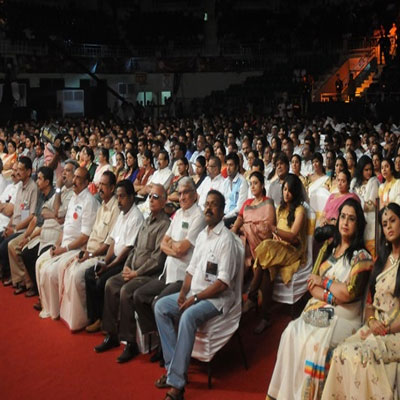
    The President was speaking after giving away the 64th National Film Awards for 2016. Information & Broadcasting Minister M Venkaiah Naidu and MoS Rajyavardhan Rathore were also present on the occasion.

    The National Film Awards were presented on 3 May as it is the day on which the first-ever indigenous feature ‘Raja Harishchandra’ by D G Phalke was released in 1913.

    The President also conferred this year’s Dada Saheb Phalke award to K Viswanath, renowned film director and actor, for his outstanding contribution to the growth and development of Indian cinema. A presenter of classical and traditional art, music and dance, K Viswanath has been a guiding force in the Indian film industry.

    Naidu said care and caution should be taken while depicting stories of tragedy and all stakeholders should reflect on the creative, constructive and meaningful engagement through the medium of cinema.

    Indian cinema had remarkably showcased the vast richness of the country’s cultural diversity, beautiful landscapes and languages and had been a great unifying force in promoting national integration, he said.

    While complementing the film industry, he said filmmakers had set their mind on delivering excellence and promoting societal values. The film industry should join hands to facilitate mission the making of developed India as it had strong influence on society and its values.

    He said movies that had won awards focus on a variety of issues and themes ranging from discrimination, love, historical relationships and relevant social challenges. He added that the National Film Awards showcase the capacity to set standards and to recognize the efforts of Indian filmmakers and artists who achieve heights.

    Speaking about the Films as a medium of communication, Naidu said it was the most beautiful form of expression that encompassed a multitude of visual arts such as music, dance and drama. It was also a medium through which contemporary socio- economic, political and cultural issues of individuals and society are showcased. The language of cinema is a universal one. It has been a powerful tool to reach out to people transcending the boundaries in society.

    The Feature Film Central panel was headed by eminent filmmaker Priyadarshan, popularly known for his Malayalam movie Kanchivaram among others. The Chairperson for the Non–Feature Film Jury was Raju Mishra while the Chairperson for Writing on Cinema Jury was Ms. Bhawana Somaaya. The Most Film Friendly State award jury was chaired by Telugu director Radha Krishna Jagarlamudi.

    In feature films, the highest number of awards went to Hindi (11) followed by Marathi (9); Malayalam (7); Tamil (5); Telugu, Bengali and Kannada (4 each); Assamese (3), and one each to Gujarati, Konkani and Manipuri. One award each also went to two languages not in Schedule VIII of the Constitution: Moran and Tulu.

    While the Marathi film ‘Kasaav’ by Sumitra Bhave & Sunil Sukthankar got the best feature film award, and actor Akshay Kumar for ‘the Hindi film ‘Rustom’ and Surabhi C M for the Malayalam film ‘Minnaminungu–the Firefly’ won the top awards for acting.

    Rajesh Mapuskar for the Marathi film ‘Ventilator’ has been named best director in the Awards for 2016. The state of Uttar Pradesh has been named as the Most Film Friendly state and Jharkhand gets a special mention in this category which was announced for the first time last year.

    ‘Fireflies in the Abyss’ by Chandrashekhar Roy got the best non-feature film award, while G. Dhananjayan was named best film critic and ‘Lata: Sur Gatha’ by Yatindra Mishra was given best book on cinema award.

    The full list of awards can be seen at http://www.dff.nic.in/writereaddata/NFA64PressNote2016.pdf

  • Dubbed film Baahubali 2 survives IPL fever

    Finally the film the moviegoer as well as the exhibition trade have been waiting for: Baahubali 2: The Conclusion, hits the screens. There will be debates about its merits. Its comparison with the first part, Baahubali: The Beginning, is inevitable. However, one subject, on which there will be no debates, is the film’s box office prospects.

    Baahubali: The Beginning created a solid ground work for this film, created a brand equity and made the audience wait for the Conclusion. Those involved made the most of it as they planned an open week release for the film at over 4,000 screens, a rare phenomenon for a dubbed South origin film.

    What Baahubali2 is expected to do at the box office is beyond what any Hindi film has done so far and may, hopefully, inspire Hindi filmmakers. Salman Khan and Aamir Khan have been the best draws so far when it comes to Hindi films. But, even their hit films fall short by a length of what this South dubbed film is expected to achieve. The film also stands to gain on its first Monday, it being a holiday in Maharashtra and some other states.

    The 45-day long Indian Premier League (IPL) T20 tournament, during which release of major films is avoided, seems to have had no effect on the collections of this film.

    The film opened to full or near full houses and maintained figures of over Rs 40 crore on all days of its opening weekend to come up with collections figure of Rs 128 crore for three days.

    *Noor, a film based on the Pakistani author/journalist SabaImtiaz’s book ‘Karachi You Are Killing Me!’ proves a damp squib. Totally out of sync with audience taste, the film fails badly. It manages to collect Rs 6.6 crore in its opening week.

    *Maatr, RavinaTandon’s film about gang rape and revenge finds few takers. The film just about crosses one crore mark to collect Rs 1.1 crore in its first week.

    *Begum Jaan collects Rs 2.75 crore in its second week to take its two week tally to Rs 17.85 crore.

  • Baahubali 2: The Conclusion — Spectacular!

    Baahubali 2: The Conclusion is a sort of prequel as well as the sequel to the earlier film, Baahubali: The Beginning, the epic fiction fantasy. In that, this film lets the viewer into some of the unrevealed parts of the earlier saga including the general curiosity about, why did Katappa kill Baahubali!

    The film begins with the character of Ramya Krishnan, playing the guardian of the kingdom till the character of Prabhas, the Baahubali, grows up to inherit the crown of his kingdom. Prabhas is now an accomplished heir to the crown as he is trained in all aspects of protecting his kingdom as well its people. His strength and endurance are of superhuman levels.

    Ramya announces the date of Prabhas’s coronation but asks him to go around his kingdom so as to check on his people and their wellbeing. Prabhas is accompanied by his trusted aide, Katappa played by Sathyaraj. While on his recce of his kingdom, Prabhas comes across, Anushka Shetty, who plays the princess of another smaller kingdom. A group of bandits are attacking her and she single-handedly fights them, excelling in art of combat.

    For Prabhas, it is love at first sight. He and Sathyaraj decide to tag along with Anushka, seeking a job for Prabhas and also asking her help to train him in warfare. She is told that Prabhas is a dimwit and some training may make him worthy for an employment at her palace. Prabhas tries his best to hide his virtues from Anushka.

    It is not long before Anushka realises that Prabhas is not a twit he is pretending to be. On the contrary, he is an accomplished warrior. Prabhas’s love is not one-sided anymore. Anushka too has grown to love him. Prabhas thinks it is time to fulfil Ramya’s desire to get for her a daughter in law matching her expectations though Ramya is not aware of the choice made by Prabhas yet.

    The family politics now sets in. The character of Rana Daggubati, who has always been bypassed in getting Ramya’s attention despite he being her son, and who has also been bypassed as the choice to inherit the crown, sees a chance to upset Prabhas. He has learned through his spies that Prabhas has fallen for this princess and devices a plan to make Ramya commit to him that she will fix his match with Anushka.

    The film, which was all about romance now goes head-on into family politics, the palace intrigues as father and son, Rana and Nassar, plot ways to displace Prabhas. They manage to turn Ramya, who loved Prabhas more than her own son, against Prabhas. His ascendency to the throne is withdrawn and Rana made the king instead.

    Prabhas turns a commoner from being the king in waiting. He joins the common people in their settlements and help their better their lives. This makes Rana and Nassar uncomfortable for they can see that for people, Prabhas was still their king. They feel that only if Prabhas is eliminated can they have a full control over the kingdom.

    The film drops pace as it moves from romance and verbal duels between Prabhas and Rana on one side and Anushka and Ramya on the other, to treachery and manipulations and, finally, to backdoor plotting. The action and romance are replaced by some gore; claptrap dialogue goes missing. The parts about Rana and Nassar’s ploys are not interesting enough. The finale, the fights in the climax are stretched.

    Excelling in direction, SS Rajamouli, has also mastered the use of special effects with which he makes parts of the film into fantasy which has been a part of every growing child. Cinematography is top-rated. As for the songs, they are not to the taste of the Hindi audience, the background score goes with the need of the narration.

    The performances are generally good. However, Prabhas, Anushka, Ramya and Sathyaraj excel on their author backed roles. Rana and Nassar are apt.

    Baahubali2: The Conclusion has the advantage of the ground created by its predecessor, Baahubali: The Beginning, a trailblazer for a regional film dubbed in Hindi. While the predecessor had the advantage of being a surprise packet for the audience, Baahubali2 has the burden of high expectations. This has afforded the film an outlandish opening response on its extensive release (reportedly 4000 screens). It come as a great relief to the cinema halls starving of a film with staying power, at least for next couple of weeks.

    Producers: Shobu Yarlagadda, Prasad Devineni.

    Direction: SS Rajamouli.

    Cast: Prabhas, Rana Daggubati, Anushka Shetty, Ramya Krishnan, Tamannah, Sathyaraj, Nassar.