Category: People

  • McCann Worldgroup India elevates Jitender Dabas as chief strategy officer

    McCann Worldgroup India elevates Jitender Dabas as chief strategy officer

    MUMBAI: McCann Worldgroup India has made several key appointments starting with Jitender Dabas, who has been elevated as chief strategy officer.

    Additionally, Suraja Kishore will now take on the new role of national planning head – Truth Central. 

    Punit Kapoor, who joined MRM McCann in May 2006 and was heading its Delhi operations has been elevated as vice president and general manager for all India operations of MRM McCann.

    Commenting on the promotions, McCann Asia Pacific and McCann Worldgroup India CEO and McCann Asia Pacific chairman Prasoon Joshi said, “I am happy to announce these promotions. Over these year, Jitender brings forth an intricate understanding of brands coupled with leadership in building a stellar strategic planning team. I am confident he will bring tremendous value to the organisation at McCann Worldgroup level. Suraja who has been instrumental at great brand work will now also head the ‘Truth Central,’ which is McCann Worldgroup’s Global Thought leadership unit engaged in creating original research, unearthing unique truths to help shape and grow clients’ businesses. Punit, who has helped grow MRM’s Delhi business year on year beyond industry average is ready to take on the challenge for MRM at national level.”

  • ‘Advertising is only a sliver of marketing:’ Pratap Bose

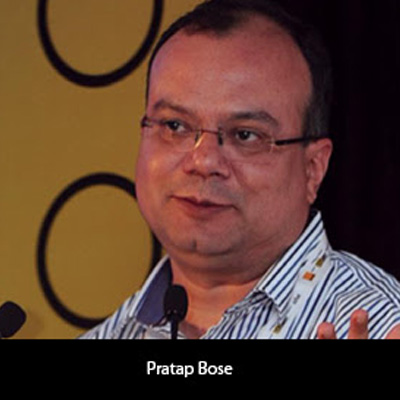
    ‘Advertising is only a sliver of marketing:’ Pratap Bose

    Seven months back ad man and former Ad Club president Pratap Bose embarked on his entrepreneurial journey with The Social Street, a digitally driven agency that looks at advertising as part of the many marketing solutions that an advertiser seeks. Joining him in the initiative were partners Mandeep Malhotra, Arjun Reddy and Pradeep Uppalapati — all pioneers in different fields.

    After his exit from DDB Mudra as the chief operating officer, it was natural that The Social Street’s launch would make headlines with all industry’s eyes trained on its proceedings. Now, seven months later, with the buzz receding, we find the workings of this new fledgling agency becoming more and more shrouded in mystery. “It is a conscious decision to not reveal our account wins, as we don’t want to be in that game,” Bose simply answers when queried about the same. 

    Currently operating through 10 satellite offices with 160 employees who handle over 50 clients to boot, The Social Street credits its quick growth to its unique positioning in the market. In a candid chat with Indiantelevision.com’s Papri Das, Bose speaks on the advertising philosophy the start-up agency holds, their game plan for 2016, his thoughts on retail and shopper marketing and why their focus is not advertising.

    Excerpts:

    How has life been as an entrepreneur? What are the biggest changes that you have observed from your past role?

    Not much honestly. I am not someone who has worked in 10 agencies in the last 25 years of my career. In terms of work hours, the pressure and handling people, it comes very naturally to me. The only thing that has changed is that it’s my business and I am not answerable to any chain of superiors or hierarchy. I am the one accountable. There is no reporting to New York or Hong Kong, for example. It certainly brings a fresh perspective now that I am on the other side. Now I can see things far more realistically from a client’s point of view.

    When you work for a large agency, I think fundamentally you are chasing revenue rather than cultivating good strategic work. I am not saying that has always been so but in the last five years or so, the pressure on margins and revenues from an agency’s point of view is getting more acute than ever before. And performance, no matter what the industry says, is evaluated on a quarter by quarter basis on revenue target achievements. 

    How does The Social Street differ from that mindset? What is its advertising philosophy? 

    In any business numbers are very important, especially so for start-ups, though I prefer not to call us one. Because if you are not profitable as an agency, whether you operate with 20 people or 200 people, there is always going to be a strain on the business. But you are not accountable to every person in the organisation who wants to know what the numbers are. If your fundamentals in the strategy is bang on then we believe the numbers will happen in any which way. We have an offering and range of services that really sets us apart from most agencies. I am not competing with any creative agency as the market I want to penetrate, is world apart. 

    If I have to round up, we have seven buckets of businesses, which includes out of home, traditional media like television, print and radio, experiential, branded content, shopper and retail, rural, youth and sports marketing and cause marketing. Then there are specialisations that come with each.

    How was year 2015 for The Social Street? Did you set any benchmarks when it comes to the work and mandates? How was it in terms of new business?

    It takes time to build an organisation. Nothing happens in six months’ time. Having said that, have we done well? I think so, yes. The fact that we have opened 10 satellite offices and three main offices, hired around 160 people, and managed to get over 50 clients onboard is great progress, I feel. It was a conscious decision to not publicise about the account wins. We prefer to put all the investments upfront so in that regard I feel we have broken traditions in the business as well. And the experiment has paid off for us. Clients are happy with us. For seven months, I feel that is a pretty large amount of progress.

    Your expertise is legendary in the industry and now you have Deepak Singh onboard. Tell us how this appointment helps the agency reach its advertising philosophy? 

    The creative process and approach we take to a client is one of our differentiating aspects. So therefore, the kind of people we are looking for are new age thinkers who are willing to look beyond TV commercials and newspaper ads. 

    Today the market needs creatives to think like clients who are seeking accountability. So I am looking for creatives who are not afraid to talk about how we are delivering incremental sales through the most creative process, of course. So Deepak fit the bill perfectly and hence he is onboard with us. He shares the same advertising philosophy as we do. 

    The Social Street was recently making headlines for its partnership with Rediffusion. Please tell us the thought behind this partnership and how it will play out?

    The Social Street and Rediffusion have worked together twice in the past during our initial days. It worked well for both the companies and the vibes were just right. The clients were happy too. That led to the idea of taking our partnership on a bigger scale. We decided to offer the entire gamut of our services to the entire group. We are having a separate unit of about 35 – 40 people, for that who will closely work with Rediffusion on all their clients. We will cater to their Out of Home needs, experiential, digital and other requirements, rather than core media. We won’t be making TV commercials for them, Rediffusion will cater to their creative needs instead.

    Being a fairly new company, was it difficult to penetrate the market?

    Though we deal in core media, I am not really focusing in the advertising part of it. I am not looking forward to making TVCs and newspaper ads. There will be some as they are bread and butter and I need to pay the bills as well. But at the end of the day my focus is to deliver business solutions in a way that delivers ROI for the client. Therefore I don’t see creative agencies as competition. For us, it’s more about solving business problems or finding innovation business solutions with data consulting and analytics. We have a unique positioning in the market thanks to the various and distinct services we can offer, all under the same umbrella. Clients see value in going to one agency and getting all their requirements fulfilled than knocking at 10 different doors.

    Though several forecasts predict that digital ad spends are growing by leaps and bounds, television still remains the most preferred medium for advertisers to invest in. What do you have to say to that?

    I am not looking into advertising budgets of brands, I am looking into marketing budgets. The advertising spends are a fraction of what brands and clients have put together for their marketing. For example’s sake, if there is a large retailer owning 500 stores in india, those 500 stores are the most important part of his business. He puts in way more effort and money into those stores, which could be easily ten times of what he spends on advertising them. If I have the ability to measure every customer who is walking in his store and profiling and understanding them, to help him create a marketing strategy for them in a creative way, they will see far more value in it. It is very important to understand the distinction between marketing and advertising. Advertising is only a sliver of marketing.

    What are your thoughts on the current landscape of marketing?

    I feel that shopper marketing, which is one of the most important tools in the western world, should be paid more heed to. If a shampoo brand spends Rs 50 crore in advertising but doesn’t get picked up by the shopper in the mall, what use is that? So at the moment of truth, whether you go to the roadside kirana store or a mall, you go from being a consumer to a shopper. That science, research and understanding is massive and we need young professionals to understand that.

    What is interesting is that the same shopper market is now turning to digital marketing as well, as more and more consumers choose to shop online, which calls for completely different game plans. There are studies done in western markets on ways to influence customers even in their online shopping experience.

    Where do you see most of your business coming in from? 

    From clients who are seeking solutions in anything that is process and tech driven, because that’s where there is a huge amount of incremental value to the clients. That is where the growth will happen for us.

    If I were to break it down, I see the entire experiential marketing space coming back in the business. Obviously digital will grow, there’s no doubt about it. I also see some clients looking for content based solutions, which may even be viral videos etc. I also see a huge scope in the rural marketing category as there are hardly any players in the business who have a strategy in place, but that’s where brands are spending. And last but not the least, retail and shopper marketing, as I said, holds a lot of promise for us.

  • ‘Advertising is only a sliver of marketing:’ Pratap Bose

    ‘Advertising is only a sliver of marketing:’ Pratap Bose

    Seven months back ad man and former Ad Club president Pratap Bose embarked on his entrepreneurial journey with The Social Street, a digitally driven agency that looks at advertising as part of the many marketing solutions that an advertiser seeks. Joining him in the initiative were partners Mandeep Malhotra, Arjun Reddy and Pradeep Uppalapati — all pioneers in different fields.

    After his exit from DDB Mudra as the chief operating officer, it was natural that The Social Street’s launch would make headlines with all industry’s eyes trained on its proceedings. Now, seven months later, with the buzz receding, we find the workings of this new fledgling agency becoming more and more shrouded in mystery. “It is a conscious decision to not reveal our account wins, as we don’t want to be in that game,” Bose simply answers when queried about the same. 

    Currently operating through 10 satellite offices with 160 employees who handle over 50 clients to boot, The Social Street credits its quick growth to its unique positioning in the market. In a candid chat with Indiantelevision.com’s Papri Das, Bose speaks on the advertising philosophy the start-up agency holds, their game plan for 2016, his thoughts on retail and shopper marketing and why their focus is not advertising.

    Excerpts:

    How has life been as an entrepreneur? What are the biggest changes that you have observed from your past role?

    Not much honestly. I am not someone who has worked in 10 agencies in the last 25 years of my career. In terms of work hours, the pressure and handling people, it comes very naturally to me. The only thing that has changed is that it’s my business and I am not answerable to any chain of superiors or hierarchy. I am the one accountable. There is no reporting to New York or Hong Kong, for example. It certainly brings a fresh perspective now that I am on the other side. Now I can see things far more realistically from a client’s point of view.

    When you work for a large agency, I think fundamentally you are chasing revenue rather than cultivating good strategic work. I am not saying that has always been so but in the last five years or so, the pressure on margins and revenues from an agency’s point of view is getting more acute than ever before. And performance, no matter what the industry says, is evaluated on a quarter by quarter basis on revenue target achievements. 

    How does The Social Street differ from that mindset? What is its advertising philosophy? 

    In any business numbers are very important, especially so for start-ups, though I prefer not to call us one. Because if you are not profitable as an agency, whether you operate with 20 people or 200 people, there is always going to be a strain on the business. But you are not accountable to every person in the organisation who wants to know what the numbers are. If your fundamentals in the strategy is bang on then we believe the numbers will happen in any which way. We have an offering and range of services that really sets us apart from most agencies. I am not competing with any creative agency as the market I want to penetrate, is world apart. 

    If I have to round up, we have seven buckets of businesses, which includes out of home, traditional media like television, print and radio, experiential, branded content, shopper and retail, rural, youth and sports marketing and cause marketing. Then there are specialisations that come with each.

    How was year 2015 for The Social Street? Did you set any benchmarks when it comes to the work and mandates? How was it in terms of new business?

    It takes time to build an organisation. Nothing happens in six months’ time. Having said that, have we done well? I think so, yes. The fact that we have opened 10 satellite offices and three main offices, hired around 160 people, and managed to get over 50 clients onboard is great progress, I feel. It was a conscious decision to not publicise about the account wins. We prefer to put all the investments upfront so in that regard I feel we have broken traditions in the business as well. And the experiment has paid off for us. Clients are happy with us. For seven months, I feel that is a pretty large amount of progress.

    Your expertise is legendary in the industry and now you have Deepak Singh onboard. Tell us how this appointment helps the agency reach its advertising philosophy? 

    The creative process and approach we take to a client is one of our differentiating aspects. So therefore, the kind of people we are looking for are new age thinkers who are willing to look beyond TV commercials and newspaper ads. 

    Today the market needs creatives to think like clients who are seeking accountability. So I am looking for creatives who are not afraid to talk about how we are delivering incremental sales through the most creative process, of course. So Deepak fit the bill perfectly and hence he is onboard with us. He shares the same advertising philosophy as we do. 

    The Social Street was recently making headlines for its partnership with Rediffusion. Please tell us the thought behind this partnership and how it will play out?

    The Social Street and Rediffusion have worked together twice in the past during our initial days. It worked well for both the companies and the vibes were just right. The clients were happy too. That led to the idea of taking our partnership on a bigger scale. We decided to offer the entire gamut of our services to the entire group. We are having a separate unit of about 35 – 40 people, for that who will closely work with Rediffusion on all their clients. We will cater to their Out of Home needs, experiential, digital and other requirements, rather than core media. We won’t be making TV commercials for them, Rediffusion will cater to their creative needs instead.

    Being a fairly new company, was it difficult to penetrate the market?

    Though we deal in core media, I am not really focusing in the advertising part of it. I am not looking forward to making TVCs and newspaper ads. There will be some as they are bread and butter and I need to pay the bills as well. But at the end of the day my focus is to deliver business solutions in a way that delivers ROI for the client. Therefore I don’t see creative agencies as competition. For us, it’s more about solving business problems or finding innovation business solutions with data consulting and analytics. We have a unique positioning in the market thanks to the various and distinct services we can offer, all under the same umbrella. Clients see value in going to one agency and getting all their requirements fulfilled than knocking at 10 different doors.

    Though several forecasts predict that digital ad spends are growing by leaps and bounds, television still remains the most preferred medium for advertisers to invest in. What do you have to say to that?

    I am not looking into advertising budgets of brands, I am looking into marketing budgets. The advertising spends are a fraction of what brands and clients have put together for their marketing. For example’s sake, if there is a large retailer owning 500 stores in india, those 500 stores are the most important part of his business. He puts in way more effort and money into those stores, which could be easily ten times of what he spends on advertising them. If I have the ability to measure every customer who is walking in his store and profiling and understanding them, to help him create a marketing strategy for them in a creative way, they will see far more value in it. It is very important to understand the distinction between marketing and advertising. Advertising is only a sliver of marketing.

    What are your thoughts on the current landscape of marketing?

    I feel that shopper marketing, which is one of the most important tools in the western world, should be paid more heed to. If a shampoo brand spends Rs 50 crore in advertising but doesn’t get picked up by the shopper in the mall, what use is that? So at the moment of truth, whether you go to the roadside kirana store or a mall, you go from being a consumer to a shopper. That science, research and understanding is massive and we need young professionals to understand that.

    What is interesting is that the same shopper market is now turning to digital marketing as well, as more and more consumers choose to shop online, which calls for completely different game plans. There are studies done in western markets on ways to influence customers even in their online shopping experience.

    Where do you see most of your business coming in from? 

    From clients who are seeking solutions in anything that is process and tech driven, because that’s where there is a huge amount of incremental value to the clients. That is where the growth will happen for us.

    If I were to break it down, I see the entire experiential marketing space coming back in the business. Obviously digital will grow, there’s no doubt about it. I also see some clients looking for content based solutions, which may even be viral videos etc. I also see a huge scope in the rural marketing category as there are hardly any players in the business who have a strategy in place, but that’s where brands are spending. And last but not the least, retail and shopper marketing, as I said, holds a lot of promise for us.

  • Red Fuse Communications ups Shubha George as Asia MD

    Red Fuse Communications ups Shubha George as Asia MD

    MUMBAI: WPP’s Red Fuse Communications has promoted Shubha George as managing director of Asia and CEO of India with immediate effect.

    In her new role, George will lead the development of integrated marketing communications for Colgate-Palmolive across Asia. 

    She will continue to be based out of Mumbai and will continue to report in to Red Fuse Communications global CEO Stephen Forcione.

    George’s new remit will be in addition to her current role of CEO India of Red Fuse Communications; a role she assumed in 2013.

    Prior to joining Red Fuse, she was the CEO at MEC India, where she started working on the Colgate-Palmolive business. George also led the development of digital, sports marketing and content partnerships for the agency.

    Speaking on her new role, George said, “Working with Colgate-Palmolive and the Red Fuse teams at both Mumbai and Hong Kong has been a truly rewarding experience; and with my new responsibilities, I look forward excitedly to contribute to Colgate-Palmolive’s success in the region by efficiently and creatively cross –pollinating ideas and processes across and between, people and offices.”

    Previously, she has also worked in agencies like Ogilvy, JWT and Mindshare.

  • Red Fuse Communications ups Shubha George as Asia MD

    Red Fuse Communications ups Shubha George as Asia MD

    MUMBAI: WPP’s Red Fuse Communications has promoted Shubha George as managing director of Asia and CEO of India with immediate effect.

    In her new role, George will lead the development of integrated marketing communications for Colgate-Palmolive across Asia. 

    She will continue to be based out of Mumbai and will continue to report in to Red Fuse Communications global CEO Stephen Forcione.

    George’s new remit will be in addition to her current role of CEO India of Red Fuse Communications; a role she assumed in 2013.

    Prior to joining Red Fuse, she was the CEO at MEC India, where she started working on the Colgate-Palmolive business. George also led the development of digital, sports marketing and content partnerships for the agency.

    Speaking on her new role, George said, “Working with Colgate-Palmolive and the Red Fuse teams at both Mumbai and Hong Kong has been a truly rewarding experience; and with my new responsibilities, I look forward excitedly to contribute to Colgate-Palmolive’s success in the region by efficiently and creatively cross –pollinating ideas and processes across and between, people and offices.”

    Previously, she has also worked in agencies like Ogilvy, JWT and Mindshare.

  • Milagrow ropes in Debashis Das as CEO

    Milagrow ropes in Debashis Das as CEO

    MUMBAI: Consumer robotics brand in India Milagrow has appointed Debashis Das as CEO.

    Milagrow founder and CEO Rajeev  Karwal said, “Debashis has, over his career, carved a niche for himself by redefining the very meaning of brand value and consumer connect. Bringing him on board as Milagrow’s CEO will aid the growth of our company by leveraging his invaluable experience in sales and marketing to further our brand proposition. With his success in establishing new brands as industry leaders and re-launching established brands with to new innovative strategies, Debashis is the perfect candidate to spearhead Milagrow on to the next phase of its growth.”

    Das added, “Having seen the impact technology can have on everyday life, it is very clear that robots are the next level of innovation. This explains my move to Milagrow, which has established itself as India’s no.1 consumer robotics company. I am eagerly looking forward to all that this association will entail, and am confident of using my industry knowledge to drive the company’s continued growth.”

    Das has previously worked with companies like Gillette, Perfetti, Dabur, Henkel, Mother Dairy and SC Johnson.

    A graduate from IMT, Ghaziabad, Das is credited for having created the liquid dish wash segment in the Indian market with Pril Utensil Cleaner and has several awards and recognitions for his work.

  • Milagrow ropes in Debashis Das as CEO

    Milagrow ropes in Debashis Das as CEO

    MUMBAI: Consumer robotics brand in India Milagrow has appointed Debashis Das as CEO.

    Milagrow founder and CEO Rajeev  Karwal said, “Debashis has, over his career, carved a niche for himself by redefining the very meaning of brand value and consumer connect. Bringing him on board as Milagrow’s CEO will aid the growth of our company by leveraging his invaluable experience in sales and marketing to further our brand proposition. With his success in establishing new brands as industry leaders and re-launching established brands with to new innovative strategies, Debashis is the perfect candidate to spearhead Milagrow on to the next phase of its growth.”

    Das added, “Having seen the impact technology can have on everyday life, it is very clear that robots are the next level of innovation. This explains my move to Milagrow, which has established itself as India’s no.1 consumer robotics company. I am eagerly looking forward to all that this association will entail, and am confident of using my industry knowledge to drive the company’s continued growth.”

    Das has previously worked with companies like Gillette, Perfetti, Dabur, Henkel, Mother Dairy and SC Johnson.

    A graduate from IMT, Ghaziabad, Das is credited for having created the liquid dish wash segment in the Indian market with Pril Utensil Cleaner and has several awards and recognitions for his work.

  • Maxus Digital South names Suraj Nambiar as general manager

    Maxus Digital South names Suraj Nambiar as general manager

    MUMBAI: Maxus has strengthened its top management by appointing Suraj Nambiar as general manager of Maxus Digital South.

    Nambiar will play the dual role of leading the digital business for south and improving the product for all our non-paid digital media services.

    He will report in to Maxus digital national director Vishal Jacob. With Nambiar coming on board, Maxus has consolidated the senior management strength in the South.

    Commenting on the new appointment,  Jacob said, “We have been looking to strengthen our digital presence in the south market and we seem to have found the right person to do so. Suraj moreover, has an impressive track record of working on some of India’s most loved brands. We are very excited to have Suraj join us and take our digital services to the next level”

    Elaborating on his new role Maxus, Nambiar said, “I am very excited by the role given to me at Maxus. The agency is well known for being integrated, nimble and fearless! Looking forward to some great times ahead.”

    Nambiar has worked with brands across industries like Toyota, Amazon, Puma, Tanishq, 3M, Titan Industries, Mercedes Benz, DHL, Colgate, Nivea, Accenture, Kingfisher, MCI, Samsung, Make My Trip, Yahoo, Sony and Canon.

  • Maxus Digital South names Suraj Nambiar as general manager

    Maxus Digital South names Suraj Nambiar as general manager

    MUMBAI: Maxus has strengthened its top management by appointing Suraj Nambiar as general manager of Maxus Digital South.

    Nambiar will play the dual role of leading the digital business for south and improving the product for all our non-paid digital media services.

    He will report in to Maxus digital national director Vishal Jacob. With Nambiar coming on board, Maxus has consolidated the senior management strength in the South.

    Commenting on the new appointment,  Jacob said, “We have been looking to strengthen our digital presence in the south market and we seem to have found the right person to do so. Suraj moreover, has an impressive track record of working on some of India’s most loved brands. We are very excited to have Suraj join us and take our digital services to the next level”

    Elaborating on his new role Maxus, Nambiar said, “I am very excited by the role given to me at Maxus. The agency is well known for being integrated, nimble and fearless! Looking forward to some great times ahead.”

    Nambiar has worked with brands across industries like Toyota, Amazon, Puma, Tanishq, 3M, Titan Industries, Mercedes Benz, DHL, Colgate, Nivea, Accenture, Kingfisher, MCI, Samsung, Make My Trip, Yahoo, Sony and Canon.

  • Indian advertising stalwart AG Krishnamurthy passes away

    Indian advertising stalwart AG Krishnamurthy passes away

    MUMBAI: An entrepreneur to the core… a creative disrupter who did not care about the establishment and the way it functioned in the late seventies and eighties. This perhaps best describes Atchyutani Gopala Krishnamurthy, fondly known as AGK, who passed away at the age of 73 in Hyderabad following a brief hospitalisation on 5 February.

    The founder, chairman and managing director of Mudra Communications, AGK was regarded by many in the industry as a legend — an adman, a creative genius, a pioneer in business and marketing, and an author — all rolled into one. His sudden demise after a brief illness came as a shock to many. Incidentally, 5 February, 2016 also marked the silver jubilee of MICA – the advertising institute, which Krishnamurthy established.

    Krishnamurthy had been an inspiration for many generations of advertising enthusiasts and veteran creatives in the country, and his ‘rags to riches’ story of setting up Mudra Communications from a Rs 35,000 and one client company to an empire worth millions, is one of the biggest success stories of our times.

    Born on 28 April, 1942 in Vinukonda, in the southern state of Andhra Pradesh, Krishnamurthy didn’t start off his career in advertising but chance and impromptu necessity led him in. In 1968 he joined the Calico Mills, a big textile name in the 60s and 70s, to assist Giraben Sarabhai. Later, he was commissioned by Reliance Dhirubhai Ambani to come up with “the best possible advertising in textiles” for Reliance’s in-house fabric brand, Vimal. And from him came the brand’s tagline – ‘Only Vimal.’ He was also the man behind the simple yet evergreen tagline – ‘I love you Rasna.’

    By 1980, AGK had christened ‘Mudra’ as an independent advertising agency while scouting for like minded business partners. With his insights and leadership, it didn’t take long for Mudra to become a full-service national-level advertising house.

    He later penned a biographical book titled Dhirubhaism on Dhirubhai Ambani’s business philosophy and the anecdotes that he shared with Krishnamurthy when they worked together, which is still referred to by many management and business students.

    Although his creative works are revered and celebrated even today, his biggest contribution to the advertising fraternity is no doubt, setting up of MICA or Mudra Institute of Communications, Ahmedabad as it was earlier called. It was the first of its kinds in all of Asia when it was established in 1991.

    AGK’s talent for starting new businesses and establishing its success in the market didn’t end there. After retiring from Mudra in 2003, he founded AGK Brand Consulting as ran it as chairman.

    A few ad men took to social media to express their grief.

    Cartwheel Creative founder Ramakrishna Desiraju, popularly known as Ramki tweeted, “Flooded by memories of AGK. What a remarkably atypical adman he was. MICA, perhaps more than Mudra, will be his lasting legacy. RIP. Much too late, I regret not staying in touch with AGK. His strange accent, his warm smile, and his earthy wisdom will always stay with me.”

    R K Swamy Hansa Group chairman SK Swamy tweeted, “Hardly 74 years Founder of Mudra Communications AG Krishnamurthy is no more. He changed the rules when he ruled….”

    Krishnamurthy is survived by his wife, three daughters and son. We at Indiantelevision.com express our heartfelt condolences to the family. May his soul rest in peace.