Category: Media and Advertising

  • Digi Osmosis’s 3 tier digital marketing campaign for Rocky Handsome

    Digi Osmosis’s 3 tier digital marketing campaign for Rocky Handsome

    MUMBAI: Digi Osmosis, the newly incepted mar-tech agency in partnership with John Abraham and Azure Entertainment, expect to take Rocky Handsome to new heights with a unique digital campaign.  The campaign unfolded in three steps —

    Campaign Phase 1:
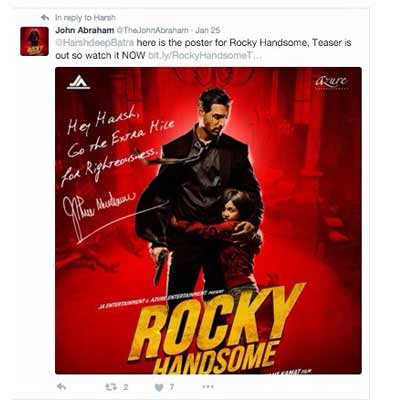
    Earlier this year, Digi Osmosis had carried out an event with Twitter and Rocky Handsome. Every person who tweeted with a certain hashtag received a personalised Rocky Handsome poster and with a small message that went with it. A teaser link was also attached to that, which became instrumental in driving impressions to nearly 1.1 million.

    Campaign Phase 2:
    For the launch of the trailer, the concept was simple. All one had to do was log into their Facebook account, go to the Rocky Handsome page, click on the link and subscribe! The subscriber then became one of the few to watch the Rocky Handsome trailer before the world saw it. It became an exclusive preview for the die-hard fans, and turned into one of the most anticipated blockbusters this year.

    Campaign Phase 3:
    Another activity in which Digi Osmosis played a role was a Facebook Live with John Abraham. The star held a Q&A session with his fans on his Facebook page on the 8 March and garnered nearly 3 lakh views. It was an open event and everyone was invited to chat with the star.

    Commenting on the campaign Digi Osmosis founder Manish Kumar said “We are proud to be a part of Rocky Handsome. The team has placed immense trust in us as their digital partner and we are personally invested in driving innovative, quirky and fun digital content that is shareable and make Rocky Handsome the biggest blockbuster of the year.”

    Commenting on the association, producer Sunir Kheterpal added “A unique movie like this requires a special touch and that is why we turned to the team at Digi Osmosis. For Rocky Handsome, the biggest target audience is the youth. The youth are the lifeblood of social media and so, who better than Digi Osmosis to take the lead on the digital front.”

  • Kesh King ropes in Imtiaz Ali and Huma Qureshi for TVC

    Kesh King ropes in Imtiaz Ali and Huma Qureshi for TVC

    MUMBAI: Ayurvedic hair care brand Kesh King is set to release its new ad film for which it has roped in actors Imtiaz Ali and Huma Qureshi. The ad film will go on air around mid-March 2016.

    Emami Limited director Priti A Sureka said, “Till now the brand Kesh King used to run mass communication messages focusing only on the functional benefits of the product. Post-acquisition of the brand, we have conducted extensive consumer research which threw up myriad moments of truth in the life of an Indian woman for her falling, damaged, dull and lifeless hair due to daily stress, improper diet, pollution, weather and many other reasons. We have found out that many women tend to suffer from low confidence, low self-esteem and even depression due to problems like excessive hair fall, premature graying and unhealthy hair quality. Basis this insight, we thought of weaving in these consumer findings in our ad story and establish Kesh King as the one stop solution for all these hair woes of women and give them back healthy lustrous hair along with their lost confidence and happiness. We believe that this new film focusing more on the consumer needs will strike a chord with our TG.”

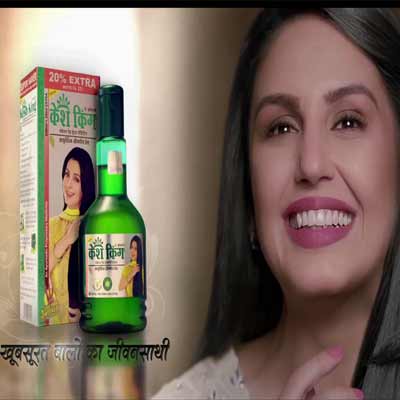
    The storyline of the ad film has actor Huma as a hassled housewife complaining to her husband about her falling, lifeless and dull hair and her distress at people including her husband being indifferent to her agony of having bad hair.  As the husband introduces her to Kesh King and its benefits and helps her to manage her tousled tresses, Kesh King tries to establish itself as a brand that not only takes care of hair woes but also mends relations.

  • Kesh King ropes in Imtiaz Ali and Huma Qureshi for TVC

    Kesh King ropes in Imtiaz Ali and Huma Qureshi for TVC

    MUMBAI: Ayurvedic hair care brand Kesh King is set to release its new ad film for which it has roped in actors Imtiaz Ali and Huma Qureshi. The ad film will go on air around mid-March 2016.

    Emami Limited director Priti A Sureka said, “Till now the brand Kesh King used to run mass communication messages focusing only on the functional benefits of the product. Post-acquisition of the brand, we have conducted extensive consumer research which threw up myriad moments of truth in the life of an Indian woman for her falling, damaged, dull and lifeless hair due to daily stress, improper diet, pollution, weather and many other reasons. We have found out that many women tend to suffer from low confidence, low self-esteem and even depression due to problems like excessive hair fall, premature graying and unhealthy hair quality. Basis this insight, we thought of weaving in these consumer findings in our ad story and establish Kesh King as the one stop solution for all these hair woes of women and give them back healthy lustrous hair along with their lost confidence and happiness. We believe that this new film focusing more on the consumer needs will strike a chord with our TG.”

    The storyline of the ad film has actor Huma as a hassled housewife complaining to her husband about her falling, lifeless and dull hair and her distress at people including her husband being indifferent to her agony of having bad hair.  As the husband introduces her to Kesh King and its benefits and helps her to manage her tousled tresses, Kesh King tries to establish itself as a brand that not only takes care of hair woes but also mends relations.

  • Revital H replaces Salman Khan with MS Dhoni as brand ambassador

    Revital H replaces Salman Khan with MS Dhoni as brand ambassador

    MUMBAI: Revital H has unveiled a new campaign featuring youth heartthrob and captain of the Indian cricket team Mahendra Singh Dhoni. MS Dhoni replaces the Kick hitmaker Salman Khan.

    The integrated campaign, created by Lowe Lintas Delhi rests on the powerful and intrinsically Indian insight that often success is attributed to luck, thereby diluting all the effort that goes behind the achievement. The campaign vividly attempts to correct this misconception and pave a way for the brand as a partner of success while embodying hard work and mental alertness. With that intention, the most successful Indian cricket captain, MS Dhoni was roped in as Revital H’s brand ambassador.

    Commenting on the new campaign, Lowe Lintas Delhi  president Naveen Gaur said, “The challenge for the agency was to take a really popular leader brand like Revital H to the next level of growth by creating a highly persuasive campaign. In its attempt to become a fast-evolving, achiever society there is a huge stress that’s laid on professional and personal success among individuals. The campaign attempts to position Revital H as a partner of success.”

    Sharing his thoughts on the campaign approach, Lowe Lintas  CCO  Arun Iyer said, “The campaign stems from the interesting insight that many times the success achieved by others is ascribed to their luck and all the effort that goes behind gets diluted. We took a leap on this insight and created communication that most Indians would resonate with.”

    Adding his insight on the new campaign, Sun Pharma consumer health care VP and head Subodh Marwah  said, “The goal now is to expand our reach and induce higher trials and we plan to do it in a way that will be well received by the consumers. In Mahendra Singh Dhoni, we have found a perfect ambassador who is not only a physically fit athlete, but also boasts of extreme mental agility – attributes that define Revital H at its core.”

  • Revital H replaces Salman Khan with MS Dhoni as brand ambassador

    Revital H replaces Salman Khan with MS Dhoni as brand ambassador

    MUMBAI: Revital H has unveiled a new campaign featuring youth heartthrob and captain of the Indian cricket team Mahendra Singh Dhoni. MS Dhoni replaces the Kick hitmaker Salman Khan.

    The integrated campaign, created by Lowe Lintas Delhi rests on the powerful and intrinsically Indian insight that often success is attributed to luck, thereby diluting all the effort that goes behind the achievement. The campaign vividly attempts to correct this misconception and pave a way for the brand as a partner of success while embodying hard work and mental alertness. With that intention, the most successful Indian cricket captain, MS Dhoni was roped in as Revital H’s brand ambassador.

    Commenting on the new campaign, Lowe Lintas Delhi  president Naveen Gaur said, “The challenge for the agency was to take a really popular leader brand like Revital H to the next level of growth by creating a highly persuasive campaign. In its attempt to become a fast-evolving, achiever society there is a huge stress that’s laid on professional and personal success among individuals. The campaign attempts to position Revital H as a partner of success.”

    Sharing his thoughts on the campaign approach, Lowe Lintas  CCO  Arun Iyer said, “The campaign stems from the interesting insight that many times the success achieved by others is ascribed to their luck and all the effort that goes behind gets diluted. We took a leap on this insight and created communication that most Indians would resonate with.”

    Adding his insight on the new campaign, Sun Pharma consumer health care VP and head Subodh Marwah  said, “The goal now is to expand our reach and induce higher trials and we plan to do it in a way that will be well received by the consumers. In Mahendra Singh Dhoni, we have found a perfect ambassador who is not only a physically fit athlete, but also boasts of extreme mental agility – attributes that define Revital H at its core.”

  • Virtual Reality: What’s in it for marketers?

    Virtual Reality: What’s in it for marketers?

    MUMBAI: In the marketing industry, digital era is not something being anticipated but a reality that has arrived and the way one interact with digital content is also changing rapidly especially through the advent of virtual reality (VR) and augmented reality(AR). 

    The terms are often thrown in the air by marketers when citing examples of latest technology in marketing, but what few realize the ground zero report on the actual work and its effectiveness done using VR and Augmented reality as a marketing tool.

    And who better to vouch for it than Ashish Limaye the chief operating officer of Happy Finish, a creative post production studio media agency that dabbles heavily in VR, CG and AR.

    With a global presence of over 12 years, Happy Finish headquartered in the United Kingdom has managed to bag substantially big name clients since it entered the Indian market five years ago. The studio works closely with other creative agencies and caters to specific skillsets that a campaign requires while also having several clients of their own to boot.

    “We work with almost all the leading brands including brands like Unilever, Nestle and Marico to Coke and Pepsi in the beverage section,” points out Limaye, adding, “In the automobile section we work with Maruti Suzuki, Tata Motors, Toyota, and Renault.”

    Adapt or perish

    The single largest shift in the paradigm that Limaye has noticed in the last one year is the completely insulated channels that brands have established with consumers irrespective of any external stakeholders. “When I say stakeholders, I mean magazine, television, billboards etc. And this insulated channel is possible through smartphones that have penetrated the Indian market,” points out Limaye. “The shift which is happening is from all the above-the-line conventional paid media to a ‘owned by the brand’ media, which also generates organic reach through social media without spending a penny.” Coupled with the data points that smartphones facilitate, brands can now directly target their consumers and know them like never before -.not as part of some mass, but by name age and behaviour and preference. As smartphones and other smart devices can easily be used to access VR environment, its use in marketing will grow manifold in the coming years.

    Scope for VR in marketing

    When asked about the scope for VR and augmented reality he sees in marketing in India, Limaye points out the major challenges that today’s marketers are facing with conventional mediums of communication.  “There are two constants in this day and age: one if that media is getting fragmented, and second, consumer attention is getting more fragmented. Today, the consumer is bombarded with so many different media and it has become extremely tough establishing a dialogue with them. And that is where VR becomes extremely advantageous to marketers as it allows you to engage the consumer on a one-on-one basis.”

    To sum it up he adds, “Firstly, VR helps brands with a significant amount of credibility through immersive experience, which otherwise is not possible as effectively. Secondly it also allows to communicate the entire value chain with the customer, through multiple channels — be it retail, or post sale etc; from the factory to the showroom and then road.”

    Limaye explains with an example. “Suppose a telecom is launching their 4G services. With the past record of 3G services not being so favourable with people complaining of call drop, there is a lot of doubt in the market on how well the 4G will do. To counter that a marketer can create an immersive experience of a user in the 4G service and share it with prospective consumers to add credibility to 4G services.”

    VR Vs AR: 

    While VR has been cited several times for its use in experiential marketing, it is easy to confuse it with augmented reality. Limaye defines the two in a simple sentence: “Augmented reality is when I import an external element into my world, while virtual reality allows me to travel to that world.” 

    The biggest differentiating factor is that augmented reality can be consumed by more than one person at a time. “You can project a car on a table while sitting in coffee shop and show to a client or a buyer the inside of the car, its interiors, how it functions and drives. That’s augmented reality.”

    Another good example of clever use of augmented reality in a marketing campaign is what can be done for the online furniture brands like Pepperfry. “It allowed consumers to scan their living room and feed the information to their app, and then place furniture items wherever you like with the use of augmented reality to see what looks like where.”

    Adoption amongst brands:

    In India, the adoption of the technology is picking up fast. Limaye says he gets at least two to three requests daily from several big and small brands when it comes to VR, although he does acknowledge the presence of a learning curve that the industry is going through for this fairly new technology. “While there are brands interested in trying these out, when you ask them what exactly they want to do with it. They have no answer.”

    The area in which the marketers are falling behind is the lack of creative approach when working with VR and augmented reality. “You can’t be using VR for the sake of it just to sound cool or be counted amongst those who are progressive in the industry. There has to a communicative objective that the use of VR must fulfill,” Limaye said.

    The brands which have come forward in using VR and AR come from FMCG sector, beverages like Pepsi and Coke, tourism and travel, and of course automobiles. Currently 30 per cent of Happy Finish’s client base for VR is from the automobile sector.

    Accessibility and cost:

    While VR and AR paves way for endless possibility in use of the technology for marketing purpose, one can’t help but question if India is ready for it in terms of the accessibility of the experience. Can brands only target niche consumers or go brand to brand with it?  

    Knowing that similar questions have been bothering the industry for quite sometime, Limaye says: “It is a myth that you need a high-end headgear to access Virtual reality. You can access it in many ways. Firstly you have Google Cardboard, which is priced as low as Rs 100. Secondly you can access it using YouTube and Facebook that have started their 360 degree videos. Your mobile or your smart device – be it laptop or iPad – then becomes your window to the virtual reality. All one needs to do is shoot 360 media and put it up. Thirdly, if one has a budget to spare, one can go for head gears for a more complete experience. I can see big spending brands keep a gear at their showroom for showcases etc, or for B2B communication. So the distribution challenge is being dealt with in every level.”

    The ROI Factor: 

    So how much should a marketer going for VR budget for their new campaign? Typically, the feeling is that use of a new technology is more expensive as one has to set in place the infrastructure for it. But Limaye disagrees.

    Though the average budget is subjective to the brands need but for a decent campaign which includes an app development and a live action shoot, a budget of Rs 1 to s 1.5 crore is good enough for a good immersive experience using VR. That also reflects in the ROI.

    “I have metrics in place for how many people have downloaded an app, what feature they are interested in and I can even have a call to action post their immersive experience and directly lead the campaign to sales. The call to action is also well monitored and measure. When it comes to ROI, the investment too is very less when you compare it to mediums like television. To reach the Hindi Speaking Market with TVC, a marketer needs to have at least Rs 2 to 3 crore budget to reach a decent TRP number. But this is not needed when I am talking about a VR campaign while still reaching out to the relevant audience.” 

    “The quality of engagement is much higher as compared to other mediums, and the cost of acquisition of the customer’s attention is much lower, and the absolute spend is also lower. In all these metrics, the ROI is much higher,” Limaye adds in parting.
  • Virtual Reality: What’s in it for marketers?

    Virtual Reality: What’s in it for marketers?

    MUMBAI: In the marketing industry, digital era is not something being anticipated but a reality that has arrived and the way one interact with digital content is also changing rapidly especially through the advent of virtual reality (VR) and augmented reality(AR). 

    The terms are often thrown in the air by marketers when citing examples of latest technology in marketing, but what few realize the ground zero report on the actual work and its effectiveness done using VR and Augmented reality as a marketing tool.

    And who better to vouch for it than Ashish Limaye the chief operating officer of Happy Finish, a creative post production studio media agency that dabbles heavily in VR, CG and AR.

    With a global presence of over 12 years, Happy Finish headquartered in the United Kingdom has managed to bag substantially big name clients since it entered the Indian market five years ago. The studio works closely with other creative agencies and caters to specific skillsets that a campaign requires while also having several clients of their own to boot.

    “We work with almost all the leading brands including brands like Unilever, Nestle and Marico to Coke and Pepsi in the beverage section,” points out Limaye, adding, “In the automobile section we work with Maruti Suzuki, Tata Motors, Toyota, and Renault.”

    Adapt or perish

    The single largest shift in the paradigm that Limaye has noticed in the last one year is the completely insulated channels that brands have established with consumers irrespective of any external stakeholders. “When I say stakeholders, I mean magazine, television, billboards etc. And this insulated channel is possible through smartphones that have penetrated the Indian market,” points out Limaye. “The shift which is happening is from all the above-the-line conventional paid media to a ‘owned by the brand’ media, which also generates organic reach through social media without spending a penny.” Coupled with the data points that smartphones facilitate, brands can now directly target their consumers and know them like never before -.not as part of some mass, but by name age and behaviour and preference. As smartphones and other smart devices can easily be used to access VR environment, its use in marketing will grow manifold in the coming years.

    Scope for VR in marketing

    When asked about the scope for VR and augmented reality he sees in marketing in India, Limaye points out the major challenges that today’s marketers are facing with conventional mediums of communication.  “There are two constants in this day and age: one if that media is getting fragmented, and second, consumer attention is getting more fragmented. Today, the consumer is bombarded with so many different media and it has become extremely tough establishing a dialogue with them. And that is where VR becomes extremely advantageous to marketers as it allows you to engage the consumer on a one-on-one basis.”

    To sum it up he adds, “Firstly, VR helps brands with a significant amount of credibility through immersive experience, which otherwise is not possible as effectively. Secondly it also allows to communicate the entire value chain with the customer, through multiple channels — be it retail, or post sale etc; from the factory to the showroom and then road.”

    Limaye explains with an example. “Suppose a telecom is launching their 4G services. With the past record of 3G services not being so favourable with people complaining of call drop, there is a lot of doubt in the market on how well the 4G will do. To counter that a marketer can create an immersive experience of a user in the 4G service and share it with prospective consumers to add credibility to 4G services.”

    VR Vs AR: 

    While VR has been cited several times for its use in experiential marketing, it is easy to confuse it with augmented reality. Limaye defines the two in a simple sentence: “Augmented reality is when I import an external element into my world, while virtual reality allows me to travel to that world.” 

    The biggest differentiating factor is that augmented reality can be consumed by more than one person at a time. “You can project a car on a table while sitting in coffee shop and show to a client or a buyer the inside of the car, its interiors, how it functions and drives. That’s augmented reality.”

    Another good example of clever use of augmented reality in a marketing campaign is what can be done for the online furniture brands like Pepperfry. “It allowed consumers to scan their living room and feed the information to their app, and then place furniture items wherever you like with the use of augmented reality to see what looks like where.”

    Adoption amongst brands:

    In India, the adoption of the technology is picking up fast. Limaye says he gets at least two to three requests daily from several big and small brands when it comes to VR, although he does acknowledge the presence of a learning curve that the industry is going through for this fairly new technology. “While there are brands interested in trying these out, when you ask them what exactly they want to do with it. They have no answer.”

    The area in which the marketers are falling behind is the lack of creative approach when working with VR and augmented reality. “You can’t be using VR for the sake of it just to sound cool or be counted amongst those who are progressive in the industry. There has to a communicative objective that the use of VR must fulfill,” Limaye said.

    The brands which have come forward in using VR and AR come from FMCG sector, beverages like Pepsi and Coke, tourism and travel, and of course automobiles. Currently 30 per cent of Happy Finish’s client base for VR is from the automobile sector.

    Accessibility and cost:

    While VR and AR paves way for endless possibility in use of the technology for marketing purpose, one can’t help but question if India is ready for it in terms of the accessibility of the experience. Can brands only target niche consumers or go brand to brand with it?  

    Knowing that similar questions have been bothering the industry for quite sometime, Limaye says: “It is a myth that you need a high-end headgear to access Virtual reality. You can access it in many ways. Firstly you have Google Cardboard, which is priced as low as Rs 100. Secondly you can access it using YouTube and Facebook that have started their 360 degree videos. Your mobile or your smart device – be it laptop or iPad – then becomes your window to the virtual reality. All one needs to do is shoot 360 media and put it up. Thirdly, if one has a budget to spare, one can go for head gears for a more complete experience. I can see big spending brands keep a gear at their showroom for showcases etc, or for B2B communication. So the distribution challenge is being dealt with in every level.”

    The ROI Factor: 

    So how much should a marketer going for VR budget for their new campaign? Typically, the feeling is that use of a new technology is more expensive as one has to set in place the infrastructure for it. But Limaye disagrees.

    Though the average budget is subjective to the brands need but for a decent campaign which includes an app development and a live action shoot, a budget of Rs 1 to s 1.5 crore is good enough for a good immersive experience using VR. That also reflects in the ROI.

    “I have metrics in place for how many people have downloaded an app, what feature they are interested in and I can even have a call to action post their immersive experience and directly lead the campaign to sales. The call to action is also well monitored and measure. When it comes to ROI, the investment too is very less when you compare it to mediums like television. To reach the Hindi Speaking Market with TVC, a marketer needs to have at least Rs 2 to 3 crore budget to reach a decent TRP number. But this is not needed when I am talking about a VR campaign while still reaching out to the relevant audience.” 

    “The quality of engagement is much higher as compared to other mediums, and the cost of acquisition of the customer’s attention is much lower, and the absolute spend is also lower. In all these metrics, the ROI is much higher,” Limaye adds in parting.
  • Honda Motorcycle and Scooter India unveils new OOH campaign for CB Hornet 160R

    Honda Motorcycle and Scooter India unveils new OOH campaign for CB Hornet 160R

    MUMBAI: Posterscope India will execute on pan-India basis the new OOH campaign for CB Hornet 160R launched by Honda Motorcycle and Scooter India.

    The CB Hornet 160R is a high-performance machine that has struck the chord with India’s youth. It heralds a new era of Street Naked Sports Biking and is priced at Rs 79,900 (ex-showroom Delhi) in India.

    The concept has been made to focus on product features like backlit hoarding to highlight the signature X-shaped tail light. The optimized campaign plan includes billboards, mall facades, bus shelters, metro branding, kiosks, institutional media and corporate parks.

    Honda Motorcycle and Scooter India Senior Vice President of Sales and Marketing Yadvinder Singh Guleria said, “Ever since its launch in December, the CB Hornet 160R has stood out for its Raw, Real & Ripped appeal. Designed to set the pulse racing with its looks, aggressive styling and cutting edge performance, the CB Hornet 160R has caught the fancy of the youth. With the vehicle now available across Honda’s main network, this campaign is set to enhance the awareness among the target audience. We look forward to the OOH expertise that Posterscope India will bring to the table and help us build on this early success.”

    Commenting on the win, Posterscope Group India MD and Asia Pacific Regional Director Haresh Nayak said, “We are extremely happy to be associated with brand Honda. CB Hornet 160R with its macho looks and durable performance has already won hearts. We will further, ensure that the Street Naked Sports Biking momentum is continued throughout. This is an important win for us. We would like to extend our heartfelt thanks to have showed trust on us.”