Category: Media and Advertising

  • Draftfcb+Ulka creates a TVC for Wipro’s Santoor PureGlo

    Draftfcb+Ulka creates a TVC for Wipro’s Santoor PureGlo

    MUMBAI: Wipro has re-launched Santoor Glycerine bathing bar as Santoor PureGlo, with a new TVC created by Draftfcb+Ulka.

    The key issues kept in mind while executing the TVC was that it had to drive the message that skin gets dry during winters and makes you look dull. As a research revealed that women generally experience skin dryness and dullness during winters and glycerine is seen as a moisturising agent that helps keep skin soft and supple. Hence, the new Santoor PureGlo (a special soap for winters) helps you keep your skin moisturized and gives a youthful glow even in winters.

    Dwelling upon the thought process behind the creative, Draftfcb+Ulka creative director Dharmesh Shah said, “The creative idea is one of surprise. How an admirer is surprised by Santoor woman’s glowing skin even in winter, as winter tends to leave one’s skin dry and dull. Along with this the challenge was to embed it in the core of Santoor, which is the secret of younger looking skin”. 

  • Contract gets a new head of art – India in Vineet Mahajan

    Contract gets a new head of art – India in Vineet Mahajan

    MUMBAI: Contract Advertising has brought on board Vineet Mahajan as head of art – India. Prior to this, Mahajan was heading McCann Erickson’s Delhi office as head of art. It would be his second stint at Contract after a gap of five years.


    Mahajan said, “Contract holds a special place for me and the new role will be far more challenging with lots of new opportunities. New city, new role, new place should be exciting.”

    Contract Advertising COO Rana Barua said, “Contract prides itself in offering the best talent available in the country to its clients. Vineet’s coming on board is yet another step in that direction as his impeccable credentials and skill sets will bring in a huge value add to our clients. Contract is well poised to take bigger strides in the industry as we get into the New Year with a lot of hope and zeal to partner our clients in their journey to success.”


    In the past, Mahajan along with Contract Advertising NCD Ashish Chakravarty was also instrumental in putting Contract Delhi on the International awards map after a gap of 10 years. “Well, frankly Vineet Mahajan needs no introduction, so let me just say that I am absolutely thrilled to have him on board. He will be based out of Mumbai, but will work closely with me on all key brands across all offices. There is much value he brings to the table in terms of art and aesthetics, and I feel all our clients should benefit from this. Plus he has such a colorful presence, it should certainly liven things up at Contract”, said Chakravarty.


    With over 15 years of experience, he has spent between O&M, McCann Erickson and Contract where he has worked on various award-winning campaigns.


  • Global ad spend goes upward in the first half of 2013

    Global ad spend goes upward in the first half of 2013

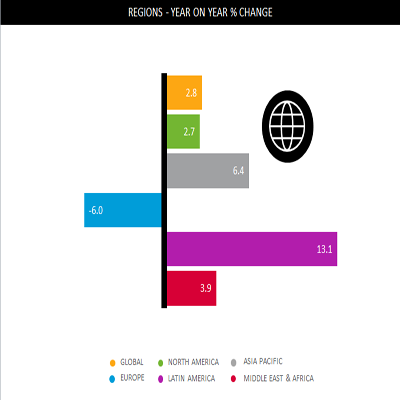
    NEW DELHI: Ad spends grew by a substantial 6.4 per cent in the first half of 2013, making it the largest growth among different regions of the world.

    Marketers continue to gradually increase their global ad spending, as expenditures grew 3.5 per cent in the second quarter of 2013 and 2.8 percent on a year-over-year basis for the January-June periods of 2013 and 2012, according to Nielsen’s quarterly Global AdView Pulse report.

    Although many marketers remain conservative with advertising budgets, those in Latin America continue to buck the norm, increasing their expenditures by 13.1 percent (to $13.5 billion) for the January-June period.

    All regions contributed to global growth for the first half of the year except Europe, where marketers remain modest with their ad budgets amid the regions’ continued fiscal crisis, resulting in a six percent decline for the period. Ad spend continued to recover after slumping during the economic downturn, with growth of 3.9 percent in the Middle East and Africa, and 2.7 percent in North America.

    Argentina contributed significantly to growth for the Latin America region with nearly 30 per cent growth. Indonesia, China and the Philippines all contributed to double-digit ad growth in Asia-Pacific for the first half of 2013, with expenditures reaching $51 billion. In Europe, ad spend increased in Norway, Switzerland, and Greece (2.5 per cent, 0.6 per cent, and 7.4 per cent respectively), while expenditures declined in all other countries in the region.


    Nielsen Global AdView Pulse measures ad spending for TV, newspapers, magazines, radio, outdoor, cinema and Internet display advertising. Ad spend is based mainly on published rate-cards. Some markets may exclude select media due to data availability.

    The external data sources for the other countries included in the report are:

    Argentina: IBOPE
    Brazil: IBOPE
    Croatia: Nielsen in association with Ipsos
    Egypt: PARC (Pan Arab Research Centre)
    France: Yacast
    Greece: Media Services
    Hong Kong: admanGo
    Japan: Nihon Daily Tsushinsha
    Kuwait: PARC (Pan Arab Research Centre)
    Lebanon: PARC (Pan Arab Research Centre)
    Mexico: IBOPE
    Pan-Arab Media: PARC (Pan Arab Research Centre)
    Portugal: Mediamonitor
    Saudi Arabia: PARC (Pan Arab Research Centre)
    Spain: Arce Media
    Switzerland: Nielsen in association with Media Focus
    UAE: PARC (Pan Arab Research Centre)

  • Himalaya launches campaign for its lip care product

    Himalaya launches campaign for its lip care product

    MUMBAI: Winters are here and cosmetic companies are leaving no stone unturned to make the most of the weather.

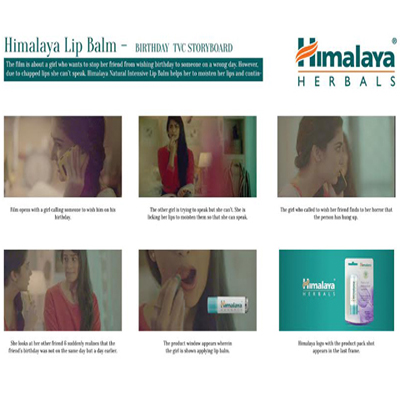
    Himalaya has launched a series of three television commercials for the natural intensive lip balm. With humour as a backdrop, the advertisement campaign highlights the brand message – ‘Healthy lips make great conversations.’

    The campaign is conceptualised by KarishmaLintas and directed by Rahul Sengupta. Team KarishmaLintas said, “Humour has been our primary ingredient in this advertisement to connect with the youth and share the message that soft and beautiful lips lead to healthy conversations. The idea came by asking “what do people do with healthy lips?” Is it just a healthy smile or a whole lot of talking! With this idea in mind we came with the message “use a Himalaya lip balm taaki baatein sookh na jaye (don’t let your conversations run dry).”

    In all the three commercials, the TVC takes a humorous angle where it shows two friends, one who tends to get into trouble a lot and the other who cannot stop her due to her dry lips. It conveys the product benefit in a witty manner.

    On the campaign, Himalaya consumer products division business head Rajesh Krishnamurthy said, “The new lip care TVC uses a humorous situation to bring out the functional benefit of using a lip balm regularly. Dry lips are a common problem and we all have faced it sometime or the other. We wanted to build on the fact that healthy conversions are the key to healthy relationships. The message our TVC conveys is ‘don’t let your conversations run dry because of chapped lips.”

  • GroupM delves into Digital World 2013

    GroupM delves into Digital World 2013

    MUMBAI: “Internet is just a world passing around notes in the classroom,” said American television host and stand-up comedian Jon Stewart about the whole world wide web.

    Considering that the classroom has increased manifolds in the past couple of years with each and everyone using the internet ever second, every day of their life, Indiantelevision.com takes a look atGroupM’s recently released report, “This Year Next Year Interaction 2014” which highlights the impact of technology and tech companies on consumers and advertiser behaviour.

    The preview report mostly talks about the social media and video platforms and how the platforms have been utilised by various brands. The penetration and growth of smartphones in the world is stating the obvious and hence, it elaborates on how a few of the next billion online users will use a PC-like object as the principal method of access. Tablets and smartphones rule the roost, these days.

    The report goes on to state that by one mean or other, one-third of the world population is online. With television and print taking a backseat, advertisers have made PCs and now mobile devices a priority to reach out to the attentive audiences.   

    “However, with magnification of fragmentation, multi-tasking, active screen time and increasing adoption of over-the-top (OTT) and often ad-free media, the challenges among advertisers is increasing. Advertisers have to deliver effectively in more places and on more platforms with little additional resources,” highlights the report.

    The report goes on to say that 25 years after the web’s conception, what it delivers to consumers and to the business could not have been imagined by its creator. “Google is the 800-pound gorilla that has seamlessly combined its core revenue engine, search with a strong position in online video and successfully evolved both into mobile.”

    The report adds, “More significantly, Youtube has become the uber-network of video networks and is the wireframe on which more and more of the world’s video content hangs. With 25 per cent of all views on mobile devices and by Google’s definition that excludes tablets, Youtube sits alongside Facebook, twitter and Goggle search as one of the dominant applications of mobile consumption.”

    Global Youtube revenue is estimated, as per the report, at $5 billion and the top 10 brands which have been the platform’s biggest content creators include: Blackberry, DCShoecoUSA, Google, Coca Cola, Old Spice, GoPro, Samsung, Nike, Volkswagen and RedBull.

    Furthermore, the report goes on to say that if 2013 was the year of mobile advertising then Facebook and Twitter made it so. “Of its 700 million daily users, 500 million use the platform of Facebook via a mobile device. And if advertisers create more high-frequency engagement, they will in turn increase the algorithmics distribution of messages to a greater percentage of their fans and beyond, reducing the need to pay for that reach,” says the report.

    Also in 2013 Facebook positioned itself to participate in two new areas – search, long dominated by Google and ‘moments’ news, TV and otherwise on which Twitter has begun to build its revenue base. However, the report also states that twitter will never achieve the level of penetration of Facebook. “The platforms are so often referenced in the same sentence yet they have little in common other than as examples of the network effect as a catalyst of growth.”

    The top brands on the social networking site, as mentioned  in the report, are: Coca Cola, MTV, Disney, Red Bull, Converse, Starbucks, etc.

    Having said that, the report adds how many media companies have embraced Twitter as a tool  to extend the reach of their programming and deepen their advertiser relationship by re-distributing content on it. Top brands on Twitter are: Samsung, Starbucks, Whole Foods, Blackberry, Disney, Zappos, Chanel, says GroupM.

    The agency’s report has highlighted the benefits that professional networking site Linkedin provides to HR managers globaly, even, surprisingly in China. One third of the world’s profesionals, 95 per cent of Americans and 40 per cent Europeans use Linkedin, it says. With a quarter of a billion individual profiles, as well as 300,000 corporate profiles, it states and  goes on to explain how corporations, through their own profiles, sponsored updates and influencer content postings are investing significantly in building their brands and cohorts of followers.  The most-followed companies on the professional networking site are Google, IBM, HP, Microsoft, Apple etc.

    The report also looks at the online presence of  Apple, and its online music service iTunes and iTunesRadio. With almost 700 million iOS users globally, and 200 million iTunes accounts in the US it is a tour de force able to offer varying advertising options to advertisers. The report then goes on to examine how Yahoo, Microsoft (it acquired Nokia’s handset business this year), AOL, Amazon (almost 35 per cent of all digital customer journeys in the US end up at this online retailer, GroupM research states) and Electronic Arts have been dealing with the rapid evolution online and in digital and what kind of advertiser offerings they are drawing up, and how much success they are achieving.

    If one has to wrap up the year and see what’s next? “For advertisers the world will get more complex. The promise of the cloud and of big data implies an information adjacency and the ability to deliver content to the customer that promises super-precision in segmentation and targeting and by inference a value in an increasingly granular, dynamic and data-informed media environment,” as per the report.

    The report aims to give readers a real understanding of what’s happening in the world of online, and how they as marketers can get prepared to efficiently use the evolving ecosystem.


  • It’s ‘Agility’ for festival of Media Asia Pacific

    It’s ‘Agility’ for festival of Media Asia Pacific

    MUMBAI: The Festival of Media Asia Pacific (FOMAP), the largest gathering of media leaders in Asia Pacific, is back for its third year.

    “The theme of this year’s event is ‘Agility’, and will see influential speakers sharing unique regional perspectives on how businesses can be more ‘agile’ in adapting to the ever-changing media landscape,” said, Founder of Festival of Media and Chairman of C Squared Charlie Crowe. “Attendees will have the opportunity to learn about some of the most topical issues affecting the industry today, whilst getting the chance to network with a broad range of media companies from across Asia.”

    Topics being discussed at the 2014 event include the future of Native Advertising in Asia, virtual media trading, social media in the newly-opened up Myanmar, unlocking the potential of Indian consumers and understanding Bitcoin, among others.
    The Festival will attract over 700 delegates from across 22 countries in Asia, who will be coming together to hear from some of the media industry’s most agile and forward-thinking leaders.

    Charlie Crowe added, “A stellar line-up of exciting industry speakers, excellent awards programs, and thought-provoking content, all within the larger Asian media context, means that FOMAP 2014 is set to be the most exciting yet.”

    Some of the speakers for the event include:

        Linda Yueh, Chief Business Correspondent, BBC World News
        Rita Nguyen, Co-Founder and CEO, SQUAR
        Vipul Chawla, VP and CMO, Yum! Asia
        Mark Laudi, Former CNBC presenter
        Daryl Lee, Global CEO, UM
        Leo Liang, Senior Director of National Business Development, Youku Tudou
        Steve Mosko, President, Sony Pictures Television
        Scott Lamb, VP of International, Buzzfeed
        Lakshmi Pratury, Host and Curator, The INK Conference
        Rose Tsou, Senior Vice President, APAC, Yahoo!
        Peter Vessenes, Founder and CEO, CoinLab, Chairman Bitcoin Foundation
        Manmeet Vohra, Marketing Director, Tata Starbucks
        Jerry Wind, Professor, Wharton Future of Advertising Program

     The festival will take place from 16-18 March at the Capella Singapore.

  • Canon India targets digitising Rs 3000 crore photo print market with DreamLabo 5000

    Canon India targets digitising Rs 3000 crore photo print market with DreamLabo 5000

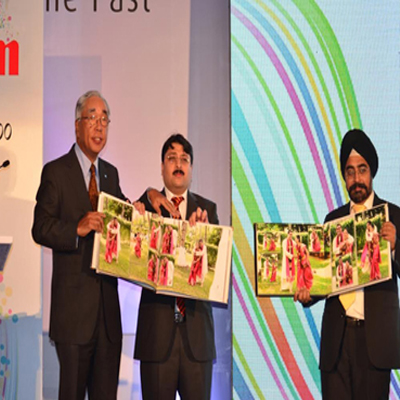
    BENGALURU: Canon India (Canon) announced its entry into the Rs 3000 crore photo printing market in India, and more specifically the Rs 300 crore digital printing market with the introduction of the USD 500,000 (About Rs 3.2 crores) priced DreamLabo 5000 commercial inkjet printer equipment, with the intent of targeting the retail photo and album printing industry. This launch makes India the first country in South Asia where the DreamLabo 5000 machine is being installed says the company.

    Canon India President and CEO Kazutada Kobayashi, said, “Canon has always been at the forefront of bringing innovative products to customers. With this latest business entry, we are hoping to strengthen our ability to meet the printing needs of professional and wedding photographers. With the DreamLabo 5000, we clearly want to establish innovation leadership in India. For us at Canon India, this is not just a new machine, but the technology that can revitalise the entire industry and open up substantial new business opportunities. Canon is setting a new benchmark for the production printing of high quality photos with this launch.”

    Globally, DreamLabo merchandise has been positioned as premium item. The company is following a systematic approach with DreamLabo 5000. It started with a leading photolab in each region and then expanded the presence in that country or region. Its first customer for the DreamLabo 5000 in India is Bangalore-based 100 year old, 22 photo lab store chain G K Vale. G K Vale clocks revenues of about Rs 50 crore annually.

    GK Vale Managing director Anand Sukumar said to  www.indiantelevision.com, “DreamLabo 5000 will help our bottom line, and will not make a very major impact to our bottom line. We have received a good response and may even buy a second machine.”

    A campaign is being planned by both Canon India and G K Vale to attract commercial clients. Some of the ideas being mulled at Canon are including a small flyer or a booklet with each of the 20,000 digital SLRs’ that it sells monthly, in-store promotions at Canon Image Squares, among others. Industry sources reveal that Canon India is likely to spend around Rs 0.75 crore to Rs1 crore during the next calendar year towards above the line (ATL) and below the line (BTL) activities for promotion of its partners such as G K Vale. Canon India spends around Rs100 crore towards brand building, marketing, ATL and BTL activities. Dentsu handles the creative duties for Canon India.

    GK Vale spends about Rs 1 crore annually, but with the installation of the DreamLabo 5000, it will double its advertising spends on social media, print and outdoor and local radio.

    Commercial printing business contributes just about Rs 95 crores or 5 per cent to Canon India’s top line, revealed Canon India executive vice president Alok Bhardawaj. Canon expects revenue of just Rs15 crore during the next calendar year and is targeting revenue of Rs100 crore from this stream over a five year period.

  • Aegis Media India launches Carat Fresh Rural

    Aegis Media India launches Carat Fresh Rural

    MUMBAI: Aegis Media India has launched Carat Fresh Rural, a professionally run, international rural communications agency. Carat Fresh Rural, the rural division of Carat Fresh Integrated, will provide comprehensive rural marketing and communication solutions to clients, which include rural planning, implementing outreach campaigns in rural areas, route planning, monitoring, van operations, haat and mandi contact programs, wall paintings, melas and any other marketing communication activities that may be required in small towns and villages.

    Interestingly, it has already bagged assignments from clients like Mahindra & Mahindra, Godrej Consumer Products, Escorts, Godrej, GPI, SONY MAX, Pidilite, Force Motors, Bayer Crop Science, and others. Carat Fresh Rural will be starting with a team of 30 rural marketers and a network of 1500 operators, across seven offices and 20 operation bases, led by the famous rural expert, Keshav Chandorkar, who will report to Carat Fresh Integrated head, Ravi Shankar.

    Before launching, they have already carried out activities in over 18000 villages across 21 states.

    “Rural Marketing Communications is the holy grail that no agency has successfully cracked in India, thus far. I believe that there is a universe at least equal to the size of the entire advertising industry available to agencies to explore in the rural marketing communications field. Carat Fresh Rural will, in many ways, pioneer that.  We are developing, for the first time in India, state-of-the-art rural management tools.  The Carat Fresh suite of Rural Tools will have the country’s only real time Rural Planning Tool, enabled by 3G connectivity and linked to a host of data sources including the rich census data, media data and 16 other sources of data. Since implementation in rural is key, every one of the Carat Fresh Rural operators will have an App on their GPS enabled trackers that will automatically monitor and relay data without human intervention. Several Tools and Apps are being developed to revolutionize rural communications in India” said, chairman India & CEO South East Asia Ashish Bhasin.

    Carat Fresh Rural aims to have a network of 10,000 people and 100 rural experts, across  26 states, by mid-2015. By 2015 Carat Fresh Rural expects to have covered over 100,000 villages throughout India.  In the second phase of expansion, which will span from 2016 t0 2018, it is anticipated that the network will grow to 20000 people, employees to 200+ and over 200,000 villages would have been covered.

  • ZenithOptimedia predicts global ad spend to grow by 5.3 per cent in 2014

    ZenithOptimedia predicts global ad spend to grow by 5.3 per cent in 2014

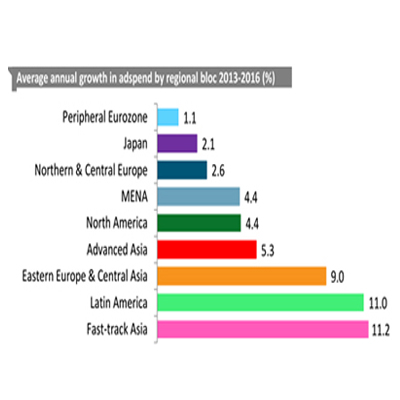
    MUMBAI: Global advertising expenditure is expected to grow by 5.3 per cent to $ 532bn, according to a report from media agency ZenithOptimedia.

    The agency has increased its forecast for 2014 by 0.2 percentage points since September, after recent signs of stronger growth from markets like the US, the UK, Germany, Hungary, Poland, Australia and Mexico, together with evidence that Spain’s steep downturn is finally bottoming out.

    Interestingly, this is the second time that the agency upgraded its expectations for 2014 this year, the first was in June (from 5.0 per cent to 5.1 per cent). In fact, for the year 2015, it expects the global ad market to accelerate to 5.8 per cent, followed by another year of 5.8 per cent growth in 2016.

    As part of its global analysis, the agency has also included Ireland in the so-called Peripheral Eurozone category. It assumes that the growth for these countries will be somewhat more muted.

    The agency says that in Europe, it has separated the ‘PIIGS’ markets (Portugal, Ireland, Italy, Greece and Spain), which have faced the full brunt of the Eurozone crisis, into the Peripheral Eurozone. “Their ad  markets have fallen even more sharply than their economies, as local advertisers cut back to reduce losses and preserve cash, and multinationals withdraw budgets to redeploy in more economically healthy regions. We estimate that ad expenditure in Peripheral Eurozone fell by 11.1% in 2013. 2014 looks a lot better, with ad expenditure forecast to shrink by just 0.9%, followed by a slow recovery of 1.8% growth in 2015 and 2.5% growth in 2016. This assumes that the Eurozone avoids disaster over our forecast period, and in particular assumes that no country crashes out of the euro, or falls into disorderly default on its debts,” says the report.

    The report also reveals that the rest of Western Europe, as well as Central European countries like the Czech Republic, Hungary and Poland, which are currently performing more like countries such as France, Germany or the UK than the much-faster growing markets of Eastern Europe, such as Russia and Ukraine. “This is partly because many of these Central European markets are in the Eurozone, and because they have strong trading links with Zenith Optimedia Group Limited,” it says.

    As far as the Asian market is concerned, the agency has divided it in to four parts – Japan, Eastern Europe and Central Asia, Advanced Asia and Fast-track Asia.

    The report says that the Eastern European advertising markets, such as Russia and Ukraine, recovered quickly after the 2009 downturn and have since continued their healthy pace of growth, largely (though not entirely) unaffected by the problems in the Eurozone. “Their near neighbours in Central Asia, such as Azerbaijan and Kazakhstan, have behaved very similarly, so we have gathered them together under the Eastern Europe & Central Asia bloc. We expect this bloc to have grown 11.7% by the end of 2013, followed by 8%-10% growth for the rest of our forecast period,” it says.

    The agency has kept Japan separate as the market behaves differently from the other markets in Asia. Even after the recent economic stimulus, Japan remains stuck in its rut of persistent low growth and grew 2.1 per cent in 2013. The agency estimates the growth rate of the country to remain at 2 per cent per year through to 2016.

    Apart from Japan, there are five countries in Asia with developed economies and advanced ad markets and thus they are categorised as “Advanced Asia”. It includes Australia, New Zealand, Hong Kong, Singapore and South Korea. The report reveals that growth here has been a disappointing 1.3 per cent in 2013, after a period of heightened tension between North Korea and its neighbours caused advertisers in South Korea to cancel or postpone several campaigns. “We forecast a much healthier 4.5 per cent growth in 2014, followed by 6.6 per cent growth in 2015 and 4.8 per cent growth in 2016,” says the agency in the report.

    Fast-track Asia includes countries like China, India, Indonesia, Malaysia, Pakistan, Philippines, Taiwan, Thailand and Vietnam as these economies are growing extremely rapidly as they adopt Western technology and practices. This group barely noticed the 2009 downturn (ad expenditure grew by 7.2 per cent that year) and since then has grown comfortably at double-digit rates. We estimate that ad expenditure in Fast-track Asia has grown 10.7 per cent in 2013, followed by 10 per cent to 12 per cent annual growth in 2014 to 2016.

  • RAPP India appoints Kapil Bhatia as associate VP

    RAPP India appoints Kapil Bhatia as associate VP

    MUMBAI:  RAPP India has roped in Kapil Bhatia as AVP for the agency’s growing clientele in Mumbai.

    Kapil joins RAPP India from Squad Digital, Nairobi, where he was general manager overseeing the operations of the agency across digital strategy, creative solutions, media planning, social media marketing and mobile marketing.

    Before moving to Nairobi, Kapil worked with the DDB Mudra Group for four years and was primarily in-charge of client servicing for one of the agency’s largest clients, LIC.

    On joining RAPP India, Bhati said, “This is going to be an exciting opportunity to tap into my through the line communication understanding. I look forward to help RAPP with the building its multi-channel capabilities.”

    RAPP India and Tribal Worldwide India president Venkat Mallik said, “We are going through an interesting phase of transformation and growth at RAPP in India. Kapil joins RAPP at just the right time as we look to remodel the agency and introduce a set of new initiatives to strengthen  the multi-channel RAPP offering across Mass Media, E Commerce, Social Media, Email marketing & CRM. RAPP is one of the few agencies with the ability to offer genuinely integrated communication thinking and Kapil’s skills and experience complement this really well.”

    Commenting on this, Vice President, RAPP India vice president Bijoe George said, “As we go about building RAPP INDIA as a media agnostic, data-led agency we needed leaders who can champion this cause amongst clients. Kapil comes with the requisite experience and fits the bill perfectly”.