Category: Media and Advertising

  • Dentsu expands India executive council post Ohri’s relocation

    Dentsu expands India executive council post Ohri’s relocation

    MUMBAI: With an aim to drive the group’s business in India, Dentsu Aegis Network has expanded its executive council in the country. The move comes post the recent relocation of Rohit Ohri to Singapore.


    The council consists of leaders of all the Network companies and heads of key functions. This will give the network in India an opportunity to offer specialist services to their clients under one umbrella.


    Chaired by Dentsu Aegis Network chairman and CEO South Asia Ashish Bhasin, the executive council includes Anand Bhadkamkar (Group Finance), Dimple Maheshwary (HR), Divya Karani (Dentsu Media), Simi Sabhaney (Dentsu Communications), Makato Nakao (Japanese International Clients), Kartik Iyer (Carat), Haresh Nayak (Posterscope), Sidharth Rao (Dentsu Webchutney), Narayan Devanathan (Dentsu Creative Impact), Shamsuddin Jasani (Isobar), Vivek Bhargava (iProspect), Nabendu Bhattacharyya (Milestone Brandcom), Rajiv Dingra (WAT Consult), Umesh Shrikhande (Taproot Dentsu), S. Yesudas (Vizeum) and R. Ravishankar (psLIVE). C.P Arora will be a special invitee.


    “I am proud to say that we are the only media and advertising group in India to provide world-class specialist services with such depth under one umbrella,” said Bhasin. 


    “We want to offer our clients all the benefits of specialization without the hassles of silos and our unique One P&L structure enables us to do so. Consequently, the Executive Council has the important role of capitalizing on this advantage. Since we have been the fastest growing agency group for two years in a row, we are now amongst the top 3 groups in India. By Dec 2017 we aim to be the top 2, which will be a mandate for this Council,” he added.


    The members of the executive council will be encouraged to think beyond their immediate roles for the efficiency of the group’s 1700 personnel across seven cities and 15 companies. 


    With specialist companies like Posterscope and Milestone (OOH), Taproot Dentsu (creative), Carat (media) and with nearly 700 personnel across the digital space in SEO, SEM, and social media, the expanded Executive Council will now aim to build on this momentum.

  • Dentsu Aegis Network acquires majority share in Flexmedia

    Dentsu Aegis Network acquires majority share in Flexmedia

    MUMBAI: Dentsu Aegis Network has acquired Thailand based digital advertising agency Flexmedia.


    Joining one of Dentsu Aegis’ eight global network brands – global performance marketing agency iProspect – the agency will be known as Flexmedia iProspect. The acquisition will significantly scale iProspect’s digital credentials to become the largest performance marketing agency in Thailand and strengthen the already significant Dentsu Aegis Network business locally.


    Founded in 2005, the digital agency led by Nathamon Kongthananon as CEO, Komjak Kamthornpasinee as chief marketing officer and Pichit Chearjaraswongs as chief technology officer, has grown to a team of 33 marketing professionals currently servicing international and local brands such as Sumsung, Sansiri, and Siam Commercial Bank.


    Nathamon will continue as CEO of Flexmedia iProspect, reporting to Dentsu Aegis Network Thailand CEO Amornsak Sakpuaram.


    Dentsu Aegis Network Southeast Asia CEO Dick van Motman said, “Over the last five years, admittedly starting from a very low base, the estimated number of Internet users in Thailand has increased sixfold. The country continues to rank among the top 30 economies worldwide and second among emerging economies of East Asia on the ease of doing business. The combination of iProspect and Flexmedia in Thailand will allow us to bring best-in-class performance marketing, data and analytics to our clients, thus adding to a strong, dynamic network in a robust market like Thailand.”


    iProspect Asia Pacific CEO Ruth Stubbs added, “With the improved scale and diversity of product and skillset, a combined Flexmedia/iProspect offering will allow iProspect to not only better manage global and local clients, but also to provide true leadership in performance marketing.Flexmedia offers us a seasoned team that can represent the iProspect brand to create relevance in the emerging Thai digital landscape.”


    “We are thrilled to join the iProspect and Dentsu Aegis Network family. This new partnership will strengthen and grow the company and I look forward to harnessing the global skills and resources to deliver great work for our clients,” said Kongthananon.

  • Publicis Groupe acquires Match Media in Australia

    Publicis Groupe acquires Match Media in Australia

    MUMBAI: Publicis Groupe has acquired Australia’s independent media agency Match Media.


    Match Media will be part of ZenithOptimedia Group’s newly launched global media network, Blue 449. As part of the Blue 449 network, Match Media will benefit from the extensive range of “open source” services offered within Publicis Groupe in order to better equip its clients with the latest technologies, accompanying them through their fast-paced business transformation fuelled by digital, technology, innovation, and consumer empowerment today.


    Match Media was founded in 2003 by John Preston. The agency, headquartered in Sydney, has more than 75 employees and specialises in media strategy and buying, digital planning and buying, search, social and analytics. Over the last twelve years, Match Media has focused on helping clients grow by creating work that works.


    Match Media will retain its management team under the leadership of John Preston as CEO and James Simmons as COO. They will in turn report directly to ZenithOptimedia Asia Pacific global managing partner and APAC chairman Gerry Boyle. Match Media in Australia will be the vanguard to expansion of the Blue 449 network across Asia-Pacific.


    The network launched in February with the rebranding of Walker Media in London to Blue 449. There are now four Blue 449 hubs – Australia, France, Italy and UK – and a further 13 are planned for launch by the end of the year.


    Boyle said, “Blue 449 is a new global network comprised of like-minded entrepreneurs who are embracing technology and data as a means to delivering growth for clients. As a progressive digitally focused agency, Match Media is the perfect fit and we are pleased to announce their addition to the Blue 449 network.”


    Preston added, “Match has enjoyed a wonderful run in its twelve year history as an independent. Now, the rapidly changing world of data and technology has motivated us to explore potential partners that will allow us to provide our clients access to the latest technology and a suite of world class platforms and tools. The challenge was finding a partner who could supercharge our existing offering but also had a kindred spirit. Publicis Groupe and its network ZenithOptimedia really impressed us with their digitally progressive vision and their focus on harnessing the independent entrepreneurial spirit that is in our DNA. I am really looking forward to the next evolution of Match as part of the Blue 449 network.”


    Simmons said, “This is the natural next big step in the story of Match. We have been on a continual journey of improvement and have built what we believe to be an excellent foundation. The time is right to leverage the assets that Blue 449 can bring to our clients, people and business to grow and create another chapter of pushing the boundaries in the media agency landscape.”

  • Dentsu to acquire Polish performance marketing agency

    Dentsu to acquire Polish performance marketing agency

    MUMBAI: Dentsu Aegis Network has reached an agreement to acquire the Polish performance marketing agency Marketing Wizards.


    In Poland, Dentsu provides its clients with services in the digital performance domain through iProspect. Post-acquisition, Marketing Wizards will be integrated with iProspect, further strengthening its capabilities in the digital performance domain and providing even more innovative solutions through collaboration with other Group companies.


    Founded in 2010, Marketing Wizards is a full-service digital agency that provides marketing services such as strategic planning, SEM, SEO, digital advertising in the social domain, e-mail marketing & CRM, and creative production in the digital arena.


    The agency’s strengths in the digital performance domain include measurement of the causal relationship between digital advertising and consumer purchasing behavior that is linked to actual purchases, and its clients include many e-commerce companies who are focused on their businesses’ return on investment (ROI).


    In its March 2015 worldwide advertising expenditure forecasts, the Group’s media communications agency Carat announced that digital advertising expenditures, which are second in scale only to television advertising expenditures in Poland, rose 7.5 per cent in 2014 (2.1 per cent increase in the advertising market overall), and are expected to rise further to nine per cent in 2015 and 11 per cent in 2016.


    Marketing Wizards, which is headed by Marcin Pogroszewski as managing director, has 60 employees and its revenue for the year ended December 2014 stood at approximately $2.3 million (PLN 8,750,000). 

  • Television dominates consumption even as other mediums emerge

    Television dominates consumption even as other mediums emerge

    MUMBAI: Despite the growth explosion in the digital and mobile universe, the age-old medium of television continues to lead the popularity chart when it comes to consumption, according to ZenithOptimedia’s Media Consumption Forecasts report.


    Attracting 183.9 minutes of consumption a day in 2014, television, despite its recent relatively minor decline, by far remains the most popular of all media globally.


    On the other hand, Internet consumption came a distant second at 109.5 minutes a day. Television accounted for 42.4 per cent of global media consumption in 2010, and 37.9 per cent in 2014 as per the report, generated after surveying the changing patterns of media consumption in 65 countries across the world. The report also predicts that television will still account for more than a third (34.7 per cent) by 2017.


    Internet disrupting traditional media with its robust growth

    While the internet has propelled growth in overall media consumption, it has also eroded the consumption of traditional media. The consumption of every traditional medium except outdoor (i.e. newspapers, magazines, television, radio and cinema) fell between 2010 and 2014, directly because of competition from the internet, the report predicts their decline to continue to 2017.


    Newspapers have suffered the most from competition from the internet, followed by magazines. Between 2010 and 2014, the average time spent reading newspapers fell by 25.6 per cent, while time spent reading magazines fell 19 per cent. Television consumption fell by just six per cent. Between 2014 and 2017, newspaper consumption is expected to shrink by an average of 4.7 per cent a year, while magazines and TV will shrink at average rates of 4.4 per cent and 1.6 per cent respectively.


    Internet consumption to grow at 10 % p.a, expanding overall consumption

    Global media consumption increased from an average of 461.8 minutes a day in 2010 to 485.3 minutes a day in 2014, an increase of 5.1 per cent, or an average of 1.2 per cent a year. Over these years, the amount of time people spent using the internet nearly doubled from an average of 59.6 to 109.5 minutes a day, while time allocated to more traditional media shrank from 402.2 to 375.8 minutes. Mobile technology in particular has created new opportunities to consume media, by allowing people to access the internet while out and about – shopping, commuting to work, waiting to meet friends, and so on.


    The report forecasts that, between 2014 and 2017, the amount of time spent consuming media around the world will increase by an average 1.4 per cent a year, reaching 506.0 minutes in 2017. Meanwhile, internet consumption will grow by 9.8 per cent a year to reach 144.8 minutes a day. The internet’s share of overall media consumption will rise from 12.9 per cent in 2010 and 22.6 per cent in 2014 to 28.6 per cent in 2017.


    Exposure to outdoor advertising is rising

    The amount of time people are exposed to outdoor advertising increased by 1.2 per cent between 2010 and 2014, from 106.0 to 107.2 minutes a day. This is the result of several factors more displays being built in public spaces, migration to cities in emerging markets, and consumers’ greater willingness to spend their leisure time out of the home as their disposable income recovered after the financial crisis. Between 2014 and 2017, exposure to outdoor advertising is expected to increase by 0.2 per cent a year.


    Latin Americans spend the most time with media; Asia Pacific the least

    Media consumption is highest in Latin America, where people spent an average of 744 minutes consuming media in 2014, and lowest in Asia Pacific, where consumption averaged just 301 minutes that year. Time spent consuming media in Asia Pacific is growing well ahead of the global average, however, as economic development gives people access to more media, and more leisure time in which to consume them: media consumption expanded by 6.7 per cent in 2014. The report forecasts average annual growth of 2.9 per cent to 2017.


    “The average person already spends half their waking life consuming media. But people around the world are clearly hungry for even more opportunities to discover information, enjoy entertainment and communicate with each other, and new technology is supplying these opportunities. Technology also enables brands to communicate with and learn from consumers in new ways. We expect media consumption to continue to grow for the foreseeable future, multiplying the opportunities for brands to develop relationships with consumers,” said ZenithOptimedia head of forecasting Jonathan Barnard.

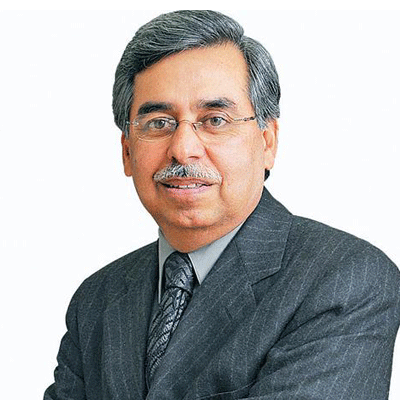
  • Hero MotoCorp names Pawan Munjal as chairman

    Hero MotoCorp names Pawan Munjal as chairman

    MUMBAI: Hero MotoCorp has named Pawan Munjal as chairman as his father Dr. Brijmohan Lall, who has been the company’s chairman since its inception in 1984, expressed his desire to relinquish his post.


    The company’s board unanimously approved Munjal’s appointment as the chairman, managing director and CEO.


    Accepting Dr. Lall’s offer to relinquish his duties as the executive chairman of the company, the board requested him to continue to mentor the company in the form of chairman emeritus, which he accepted.


    Under the leadership of Munjal, Hero has remained the world’s largest two-wheeler manufacturer in terms of unit volumes sold in a calendar year by a single company since 2001 – the year he took over as the MD and CEO. Munjal has consistently demonstrated his visionary leadership to emerge as one of India’s highly respected business leaders.


    Hero MotoCorp continues to command well over 50 per cent share in the domestic motorcycle market in India. The company sold record 6.63 million units two-wheelers in the financial year 2015 – its highest-ever annual sales.

  • WPP’s Brand Union promotes Toby Southgate to worldwide CEO

    WPP’s Brand Union promotes Toby Southgate to worldwide CEO

    MUMBAI: WPP’s global brand strategy and design agency Brand Union has promoted Toby Southgate to worldwide CEO, effective 1 July.


    Southgate will manage the growth of the global network while to continuing his responsibilities in the Americas. He will remain based in New York and will report to Brand Union and FITCH group CEO Simon Bolton.


    “Toby is a true professional in our industry and a trusted adviser to senior clients all around our network. He has a unique thought process and leadership style that enables him to have compelling conversations with clients, prospects and talent alike. I have no doubt Toby has what it takes to step into this role on a worldwide stage and take Brand Union to the next level,” said Bolton.


    In this new role, Southgate will be responsible for leading the growth of Brand Union across each of its 24 markets. He will manage all of Brand Union’s international teams and lead collaboration with other WPP agencies, delivering on the group’s ‘horizontality’ strategy.


    “I love this business and I’m proud to be leading Brand Union beyond the traditional definition of branding. I’m delighted Simon has given me the chance to lead the network. Brand Union is all about creating brilliantly designed and beautifully connected experiences for our clients and their brands. There is much more to come,” said Southgate.


    Southgate brings extensive Brand Union experience to this role, having joined the agency in 2008. He has held a number of roles including Brand Union Middle East managing director, Brand Union UK CEO and most recently, CEO Americas. In his latest role, he helped grow the agency’s footprint leading the acquisition of Epigram, a Brazilian brand and communications agency, in 2014.


    He has been a key player in the agency’s business development over the last seven years, bringing in major clients like The Coca-Cola Company, Vodafone, Shazam, GlaxoSmithKline and CBRE.


    CBRE global chief marketing officer Paul Suchman said, “Toby’s partnership and dedication to our business has been nothing short of outstanding. Under his leadership, Brand Union has helped us find a powerful global voice and significantly strengthen our brand equity in every market we serve.”

  • Dentsu Asia Pacific appoints Rohit Ohri as CEO

    Dentsu Asia Pacific appoints Rohit Ohri as CEO

    MUMBAI: In a strategic move, Dentsu Aegis Network has appointed Rohit Ohri as CEO of Dentsu Asia Pacific, where he will be covering all markets in the region except for Japan.


    Ohri, who previously helmed Dentsu in India and Asia Pacific (South), will relocate from Delhi to Singapore as part of his new role.


    With Ohri moving to Singapore, all agencies under the Dentsu umbrella in India namely Taproot Dentsu, Dentsu Webchutney, Dentsu Marcom, Dentsu Communication, Dentsu Media, Vizeum, iPorspect and Isobar will now come under and report to Dentsu Aegis Network chairman and CEO South Asia Ashish Bhasin.


    On the other hand, Ohri will have a more regional role and will handle Dentsu’s Branded Agencies.


    Dentsu Aegis Network Asia Pacific CEO Nick Waters said, “Rohit has done a fabulous job transforming Dentsu in India. Across Asia, Dentsu has an extraordinary track record of innovation and as the largest agency in the region has an unmatched depth and breadth of capabilities. Sano-san and myself are really looking forward to working more closely with Rohit to unleash the full potential of the business.”


    Dentsu Branded Agencies CEO and Dentsu Inc executive officer Hiroaki Charlie Sano added, “Dentsu is an agency network with a long standing history and a strong footprint in Asia Pacific. Rohit shares our creative ambition and strong vision for Dentsu and the way we work with our clients. I’m delighted he will be taking on a more central position within the network to help guide the business outside of Japan.”

  • Ad monotony takes the zing out of IPL

    Ad monotony takes the zing out of IPL

    MUMBAI: From mid-February to the end of May, India saw cricket action aplenty this year. Between the ICC Cricket World Cup and the recently concluded Indian Premier League (IPL), a total of 109 matches were played, which gave brands ample ground to target maximum consumers in a cricket crazy nation. While many brands seized the opportunity to grab maximum eyeballs by taking up premium inventory, what lacked to an extent was creativity and uniqueness in the story telling.

    While some brands ensured that they had an elaborate storyboard so that viewers had something new to watch every time, some others took monotony to another level by hammering the same ad throughout the tourney.

    Leo Burnett chief creative officer Rajdeepak Das tells Indiantelevision.com about how Amazon.in went about advertising through the IPL. “In the case of Amazon.in, we wanted to tell people one message and that was ‘Aur Dikhao’, about the range that we had. Vodafone for example, had a lot of things to talk about, be it its speed, 3G or other services and hence communicated multiple messages. While Amazon.in was very clear that it wanted the nation to speak one message and that is ‘Aur Dikhao’.”

    Das adds, “Sometimes repetition helps remember things, like how we used to mug up things to remember them during childhood. Similarly, for a consumer to remember Amazon.in as a brand, the repetition was a must. In a seven series film, Amazon.in communicated its message so that they do not reach consumer fatigue level. You have to see what the nation speaks and that’s what Amazon.in really wanted to do.”

    On the other hand, direct to home (DTH) operator Tata Sky with its disruptive daily recharge offer of Rs 8 set out with a storyboard of 13 episodes, which revolved around a love story set in a small Kashmir town. The story unveiled how the product worked and cleverly amplified the benefits of a daily recharge, through its lead protagonists. Building on the curiosity to know ‘what happens next?,’ each TVC smoothly highlighted how the daily recharge enabled convenience and value for money.

    Vodafone India, which has been showcasing different themes and offerings every IPL, seems to have hit the nail on the head. From coming up with as many as 27 new television commercials (TVCs) featuring the inimitable Zoo Zoos, this telecom brand has more often than not upped its creative ante.

    Speaking to this website about the brand campaign, Vodafone India SVP brand communications and insights Ronita Mitra says, “IPL is the biggest sporting platform in the country designed to appeal to a wide audience with high clutter and frequency during a very compact period. It allows multiplicity of communications and offers an opportunity to reach out to a wider target audience and strengthen Vodafone’s brand connect.”

    “The first IPL season with the Zoo Zoos saw us launching a series of 27 television spots talking about Vodafone’s VAS services. This approach continues in the eighth edition of IPL. Our ‘Speed is Good’ campaign is a series of short but charming and memorable stories where Vodafone customers use their fast 3G network to bring a smile to someone’s face. With our focus on digital, this year we partnered with Being Indian, a channel on YouTube, to produce engaging video in lines with our campaign objectives. The video has been well received on YouTube with close to 40,000 hits in three days,” she asserts.

    From its learnings over the last seven years, Vodafone believes that if truly innovative and cutting edge things are done during the IPL, then the impact multiplier effect and bang for the buck is unmatchable.

    Sharing insights about how the online wallet – PayTM – has been working on getting their share of pie through advertising via an event like IPL and the ICC World Cup, PayTM SVP Shankar Nath says, “Repetition is valuable for ad effectiveness. More exposure gives more visibility and increases liking and preference for that experience. It also ensures that that there is more recall for the ad. An ad that you do not recall cannot be effective and the more you recall it; the more you have processed its message. At the same time, one has to be careful that there is no excessive repetition, leading to viewer fatigue.”

    Sharing his views on whether brands should look at a new approach, Nath says that ideally a brand crafts the right experience to engage with its audiences and evoke the desired emotional and behavioural response. “The approach towards the content must show a higher level of audience understanding to earn their engagement, which will, in turn, deliver deeper value as the brand experience is integrated into their lives,” he informs.

    Nath is also of the opinion that after a level of consumer fatigue, consumers need to see fresh content, which will not only benefit the brand but also help them build a strong communication connect.

    In today’s digital milieu, brands also have at their disposal multiple platforms like YouTube et al where they can hammer in varied messaging. When queried about whether brands were looking at more platforms for better consumer engagement with different ads, Nath says, “The market is evolving. New channels are coming up. There is fragmentation. Digital has become a very important medium, as certain audiences are spending more time on mobile and web. We see a lot of brands that are creating communication specifically for digital. Certain brands release their video campaign first on digital and subsequently move in with shorter edits on television.”

    However Nath derides the fact that a brand, which does not launch multiple TVCs to offer creative variation, does so in order to cut costs. “Cost is not something that really bothers the brand. There is a possibility that the brand never thought of communicating that way,” he states as a matter of fact.

    On the other hand, RK Swamy BBDO India creative director Rudra Sen says, “Honestly, I think the IPL is a very well integrated brand communication platform at various levels. With a supple dose of cricket spiced with Bollywood, it combines two very powerful genres.”

    “The IPL provides brands with multiple communication platforms to engage, involve and reward viewers, fans and field spectators alike… be it on TV, digital, ambient, in-stadia, in-studio, on-ground contests, promos or activation like the Vodafone Fans Club or the Pepsi Viewing Gallery. The TVCs that stood out for me were that of Vodafone. Then comes Amazon but I think it’s more to do with the ‘Aur Dhikhao’ jingle, which hit the sweet spot. Magic Bricks too used an interesting storyline narrative that was engaging. The rest interrupted the action.”

    Ogilvy & Mather executive creative director Sumanto Chattopadhyay says, “Most brands eventually end up having one communication strategy for a period and an event like the IPL because of various reasons like huge production cost and cost of airing the spots. So I think for most brands it becomes a matter of getting the time, effort and money into one communication and they tend to bombard it. For an avid viewer, who is watching all the matches, it is repetitive and also irritating to an extent.”

    “A big brand like Vodafone, which has a large ad budget focuses on the IPL and prepares campaigns for an event like this. However, not every brand has these kinds of resources to do multiple ads. So too much repetition of anything is annoying, not only ads,” he adds.

    According to Chattopadhyay, brands have certain limitations like budget constraints or even the time to make multiple creatives. “They can bring in some amount of variation within the same communication just to sustain the interest of the viewers,” he says.

    While brands like Tata Sky, Amazon.in and Vodafone have managed to make different storyboards to engage the audiences and leverage the IPL platform, other brands, which bombarded viewers with the same storyboard, were at the risk of causing viewer fatigue.

    For brands that do not come up with a storyboard, cost could be a concern. However, for pre-planned big ticket events like the IPL, creative agencies as well as brands need to churn out innovative ads that tickle the imagination and curiosity of the viewer and also keeps them engaged throughout the season.


  • Cheil India appoints Ogilvy Singapore’s Sonal Narain as chief strategy officer

    Cheil India appoints Ogilvy Singapore’s Sonal Narain as chief strategy officer

    MUMBAI: Integrated marketing solutions agency Cheil India has appointed Sonal Narain as its chief strategy officer.


    Narain comes to Cheil from Ogilvy Singapore, where she was head of planning. Additionally, she is also head of Ogilvy Change (the firm’s Behavioural Sciences practice).


    She will be based in Cheil’s Gurgaon office, which is the regional headquarters for South-West Asia.


    At Ogilvy, she has been driving an organisation-wide agenda for effectiveness that has resulted in over 20 wins at all major awards at local, regional and international shows. She was also awarded Planner of the Year 2014 in Singapore.


    Cheil South-West Asia group president Shiv Sethuraman said, “Sonal understands the intersection between media, technology and popular culture and has done impressive work in areas far beyond the limits of conventional advertising. That is what makes her the perfect choice to lead Cheil India’s planning and strategy function. We’re aiming to transition into an agency that is ahead of the curve and Sonal will be a big part of that. She understands technology but at the core, it’s her understanding of human behaviour and her focus on effectiveness that set her apart.”


    Narain added, “The opportunity to marry human insight with technology and create fundamental change only comes along once in a while and few agencies are as well placed to take advantage of this as Cheil India is. As a dynamic and young organisation that’s shown steady growth in both size and reputation, Cheil seeks to up the ante and I’m hugely excited to be part of that.”