Category: Media Agencies

  • Madison PR adds 20 clients to its kitty in January

    Madison PR adds 20 clients to its kitty in January

    MUMBAI: It seems to be a great year for Madison already. Madison Public Relations has won 20 new clients in the month of January, itself.


    Commenting on the new wins, Madison Public Relations CEO Paresh Chaudhary said, “It’s a great start for the last quarter of the year and lays a strong foundation for the next year, with over 50 per cent of our big wins as retainer clients. A focused strategic communication partnership approach, coupled with intense capability building mechanisms, are converting PR managers to brand managers, thus enhancing the brand building process.”


    Madison PR has further strengthened its dominance in the youth, entertainment, luxury and lifestyle segments. The agency signed up brands across diverse sectors, including The Lodha Group, Zee Media Corp, Indian Merchant Chambers, Enamor, Celio, VVF, Radio Mirchi, and Max Fashions, among others.


    As the agency’s client roster extends, it is also investing in quality talent with relevant strategic communication experience. The agency claims to have also recorded less than 5 per cent attrition rate as opposed to the industry standard of 20-25 per cent. A new strategy brand planning team has been created to provide a cutting edge to every campaign right from conceptualisation.


    Madison World chairman Sam Balsara said, “I am delighted at Madison PR’s consistent high growth over two years. I am glad that more and more advertisers are waking up to the power of brand PR. PR, when used intelligently and strategically, can greatly enhance the power of advertising.”


    Meanwhile, the Madison Public Relations Partners Meet has been introduced as an annual property, the first one held in December 2013. The interaction with external partners is aimed at tappingon their strengths on a regular basis. It has helped Madison PR to understand markets, issues and challenges better, whilst gaining insight that guides the team better in planning city-specific activations. This deeper engagement between external partners and Madison PR has proved mutually beneficial in harnessing further business because of the high level of effectiveness of plans.


    The agency recorded a growth of 32 per cent in 2012-13 and is expected to end 2013-14 with close to 30 per cent growth.


    Going forward, Madison PR aims to strengthen its practices in the areas of entertainment, luxury, tourism, IT and FMCG.

  • Aegis Media and Dentsu Network join hands to create Dentsu Aegis Network

    Aegis Media and Dentsu Network join hands to create Dentsu Aegis Network

    MUMBAIFrom 1 January 2014 Aegis Media and Dentsu Network combined to form the Dentsu Aegis Network. Together they form the first truly global communications network for the digital age, in 110 countries worldwide with over 22,000 dedicated specialists.


    Nick Waters will lead Dentsu Aegis Network in Asia Pacific and will be responsible for the management of the business and the development of network, specialist and local brands across the region.


    With over 5,500 employees in China including associates, full integration in China will begin in 2015. Until then, Aegis Media and Dentsu Network will continue to work in parallel, managed by Phil Teeman CEO Aegis Media China and Motohiro Yamagishi CEO Dentsu Network China.  KF Lee will take the role of Chairwoman Dentsu Aegis Network China working across the two businesses.  Motohiro Yamagishi will additionally lead the Dentsu agency brand across North Asia.  Rohit Ohri will lead the Dentsu agency brand across the rest of the region – Asia Pacific South.


    Luke Littlefield will lead Dentsu Aegis Network Australia and New Zealand as CEO and Rob Hughes, Dentsu Aegis Network North Asia. Ashish Bhasin is appointed CEO Dentsu Aegis Network South Asia and Dick van Motman takes leadership as CEO for the group in Southeast Asia. 


    Brand leaders:

    Motohiro Yamagishi                                 CEO Dentsu China & North Asia

    Rohit Ohri                                                 Chairman Dentsu India & CEO Dentsu Asia Pacific South

    Sean O’Brien                                              CEO Carat Asia Pacific

    Jean Lin                                                     CEO Isobar Asia Pacific & Global Chief Strategy Officer

    Ruth Stubbs                                              CEO iProspect Asia Pacific

    Kristian Barnes                                          CEO Vizeum Asia Pacific


    Nick Waters, CEO of Dentsu Aegis Network Asia Pacific said: “With our brand and leadership structures confirmed we have the opportunity to develop the Dentsu Aegis Network, and our client base, by delivering a wider range of distinctive products and services across the region. The new Dentsu Aegis Network has a unique position in the market, and with this brings the opportunity to grow our clients’ businesses with our own.”


    The Dentsu Aegis Network will be headquartered in London. Carat, the Dentsu agency brand, iProspect, Isobar, Posterscope and Vizeum will work together for the first time under the operating model of one P&L per country alongside growing multi-market specialist and local brands.


  • Havas Media is awarded global media buying role for Iglo Group

    Havas Media is awarded global media buying role for Iglo Group

    MUMBAI: Iglo Group has hired Havas Media as its global media buying agency. This follows the appointment of Havas Worldwide as the Group’s global brand positioning and advertising agency in Q4 of 2013.

    Havas Media was selected after a competitive pitch process which included Iglo Group’s incumbent agencies. Havas Media presented a compelling proposal that best met the Group’s selection criteria.

    Commenting on the appointment, Iglo Group’s CEO, Elio Leoni Sceti said:

    “After a highly competitive pitch process I am delighted to announce the appointment of Havas Media as our global media buying agency. The appointment will give us the ability to have a fully joined-up approach to our creative and media communication. This new approach to our marketing and the Iglo brand is central to our new growth strategy that aims to double the size of the business by 2020.”

    Marc Schader Global Chief Commercial Officer, Havas Media Group added: “We are honoured to become Iglo Group’s partner across Europe and look forward to helping them achieve their exciting and ambitious targets.

    Having another trusted partner join the Havas Media network is a testament to its strength and the success of our new integrated, digital & data at the core structure and philosophy. With their strong ethos for sustainable growth, Iglo Group needed a partner to offer agility, strength and scale and we are delighted that the team saw how well this can be delivered within our network”.


  • What now for TV ratings and TAM

    What now for TV ratings and TAM

    MUMBAI: When the cabinet committee on economic affairs announced that it had approved the Telecom Regulatory of India (TRAI) recommendations on TV ratings guidelines in the first week of  2014 the first question that struck everyone was – what will TAM do now?


    The fracas between angry broadcasters and TAM has been brewing for  several years and finally came to its boiling point last year when seven TV networks announced that they were clicking on the TAM TV rating unsubscribe button. This put a big question mark over TAM’s very existence but it managed to get out of the corner it was in by hammering out a solution which was acceptable to most subscribers. 


    As far as the current threat to TAM’s continuance is concerned, the Cabinet’s go ahead to the proposed regulatory framework has now to be notified. When that will happen no one knows, though speculation is that it could be sooner than later. However, what is sure is that TAM will have 30 days from notification date to comply with its guidelines and then seek a licence from the Ministry of Information and Broadcasting (MIB).  From all angles it looks like a pressure cooker-like situation that the TV ratings provider has landed itself in. 


    Broadcasters seem to be the happiest of the lot. NDTV group CEO Vikram Chandra – whose company sued TAM in a New York court two years ago – is cock-a-hoop with delight that the government has affirmed what industry has been voicing since nearly six to seven years: that TAM and the ratings process in India needs to be spruced up.


    “The introduction of firm guidelines is a positive step as everything is clear now. It shows that we should never be hesitant to change something that isn’t right,” says Chandra.


    Whether TAM will manage to find the capital to ramp up its peoplemeter sample to 20,000 within a month or two is something that is concerning industry. What is also a big question mark is how the MIB will view the WPP group’s 50 per cent equity in TAM (through Kantar Media Research 20 per cent, and Cavendish Square Holdings 30 per cent), as mentioned in the NDTV suit with the supreme court in New York.


    “Kantar and Cavendish will have to exit since their parent is WPP. TAM has been worrisome and everyone has realised it. So now it has just two options, either shape up or ship out,” says a senior news broadcaster from the News Broadcasters Association (NBA).


    However, a source from the IBF presents another option. “We are a democratic country so the government cannot force things on anybody. TAM has the freedom to go to the court and appeal against the guidelines,” says the source.


     If TAM decides to oppose the guidelines and go to court and gets a stay order, then we might see some delays in the roll out of the guidelines. This will allow it to continue to operate until a final decision is given by the court, thus buying it some time. Additionally, the industry-backed Broadcast Audience Research Council (BARC) will also get some time to get its act together with the minimum 20,000 meters.


    Media agencies and advertisers aren’t too happy with the way the cabinet has thrust the deadline on TAM.


    Says a senior media professional:  “In the beginning of cable and satellite TV in India in the nineties, we had TAM and INTAM. The latter could not sustain itself and TAM continued. Then we had TAM and aMap in the mid of the previous decade. aMap too found the going tough without full industry support and folded up. The fact is TAM has started from scratch and survived so many upheavals. It is a sad situation to be destroying something that has been existing and running for so long. ”


    However, she is clutching on to a thin sliver of hope that TAM and BARC could co-exist for a while until things smooth out on the ratings front. 


    “The time given to follow and make all the changes as per the guidelines is impractical,” says Madison World chairman & MD Sam Balsara. “It is obvious that TAM will not be able to handle it all at such a short notice.”


    The Indian Society of Advertisers (ISA) chairman Hemant Bakshi says that he is discussing the consequences of the cabinet’s clearance to the new ratings guidelines with major advertisers and other players to gauge the possible impact on their businesses.


    One scenario that everyone is dreading is that TAM fails to comply with all the requirements within the time period it is given, and the courts dismiss its appeal, if it makes one. Will it then be forced to cease operations immediately and lead to a ratings-less period for the Indian television business? This is extremely alarming for all concerned.


    IPG Mediabrands CEO Shashi Sinha who is also in the technical committee of BARC feels that the management of the new proposed ratings system needs to pull their socks up, and accelerate the rollout of people meters. But even then he says that “we are hoping to be on our feet and start functioning only by September/October.”


    That seems a long, long time away, going by how things are moving. Madison’s Balsara is quite clear on the way forward. Says he: “As an industry we need ratings, all the time! Therefore, till BARC comes up, we need an alternate. As an industry we should appeal to the ministry to relax the deadline for the implementation.”


    Hence, it is imperative for all concerned – whether it is the MIB led by Manish Tewari, the government, TAM, the ISA, advertising agencies, broadcasters and BARC – to choose their next steps wisely.


     

  • DDB Mudra Group names Anurag Bansal as CFO

    DDB Mudra Group names Anurag Bansal as CFO

    MUMBAI: DDB Mudra Group has announced Anurag Bansal as chief financial officer (CFO) of the group, effective 1 January.


    Bansal takes over from Dilipkumar Upadhyaya who has stepped down after 26 years with the group. Upadhyaya will however continue to be a consultant with the group.


    In his new role, Bansal will oversee the finance, legal & commercial and information technology functions of all entities under the group, in addition to heading the financial integration of the DDB Mudra Group with Omnicom Group.

    With over 16 years of experience Bansal said, “I am very excited to step in to the role of the group CFO. The CFO of today is very different from the CFO of even a decade ago. The CFO’s role today goes beyond the mere accuracy of numbers. Apart from implementing a robust process for financial information, compliance and corporate governance, together with a high level of risk assessment, he is required to have a more sophisticated understanding of all areas of the business and its operations. The journey for me has just begun and I look forward to some challenging yet exciting times ahead!”


    He is also a trustee of the Mudra Foundation for Communications Research and Education.


    On the appointment, DDB Mudra Group CEO and MD Madhukar Kamath said, “Anurag, in the short span of six years with us, has grown tremendously within the DDB Mudra Group. Apart from his professional capability and competence, I truly admire his energy, enthusiasm and leadership qualities. I am glad to have him partner me in our next phase of growth.”

  • Maxus wins Kotak Mahindra’s media AoR

    Maxus wins Kotak Mahindra’s media AoR

    MUMBAI: The year has been a good one for Maxus and it ended it by bagging the media duties for Kotak Mahindra following a multi-agency pitch.

    Prior to the development, Starcom MediaVest handled the business of the financial services conglomerate.

    On the win, Maxus south Asia MD Kartik Sharma who will take over the responsibilities of Maxus south Asia from Ajit Verghese effective January 2014, said in a statement, “We are excited about working with one of India’s most established brands, with a legacy of over 20 years. 2013 has been a great year for Maxus and we are excited with yet another client in our roster.”

    The agency acquired several new businesses including Ruchi Soya, Tata Tea, Redbus and Musafir.com while retaining the L’Oreal business.

  • It’s ‘Agility’ for festival of Media Asia Pacific

    It’s ‘Agility’ for festival of Media Asia Pacific

    MUMBAI: The Festival of Media Asia Pacific (FOMAP), the largest gathering of media leaders in Asia Pacific, is back for its third year.

    “The theme of this year’s event is ‘Agility’, and will see influential speakers sharing unique regional perspectives on how businesses can be more ‘agile’ in adapting to the ever-changing media landscape,” said, Founder of Festival of Media and Chairman of C Squared Charlie Crowe. “Attendees will have the opportunity to learn about some of the most topical issues affecting the industry today, whilst getting the chance to network with a broad range of media companies from across Asia.”

    Topics being discussed at the 2014 event include the future of Native Advertising in Asia, virtual media trading, social media in the newly-opened up Myanmar, unlocking the potential of Indian consumers and understanding Bitcoin, among others.
    The Festival will attract over 700 delegates from across 22 countries in Asia, who will be coming together to hear from some of the media industry’s most agile and forward-thinking leaders.

    Charlie Crowe added, “A stellar line-up of exciting industry speakers, excellent awards programs, and thought-provoking content, all within the larger Asian media context, means that FOMAP 2014 is set to be the most exciting yet.”

    Some of the speakers for the event include:

        Linda Yueh, Chief Business Correspondent, BBC World News
        Rita Nguyen, Co-Founder and CEO, SQUAR
        Vipul Chawla, VP and CMO, Yum! Asia
        Mark Laudi, Former CNBC presenter
        Daryl Lee, Global CEO, UM
        Leo Liang, Senior Director of National Business Development, Youku Tudou
        Steve Mosko, President, Sony Pictures Television
        Scott Lamb, VP of International, Buzzfeed
        Lakshmi Pratury, Host and Curator, The INK Conference
        Rose Tsou, Senior Vice President, APAC, Yahoo!
        Peter Vessenes, Founder and CEO, CoinLab, Chairman Bitcoin Foundation
        Manmeet Vohra, Marketing Director, Tata Starbucks
        Jerry Wind, Professor, Wharton Future of Advertising Program

     The festival will take place from 16-18 March at the Capella Singapore.

  • Canon India targets digitising Rs 3000 crore photo print market with DreamLabo 5000

    Canon India targets digitising Rs 3000 crore photo print market with DreamLabo 5000

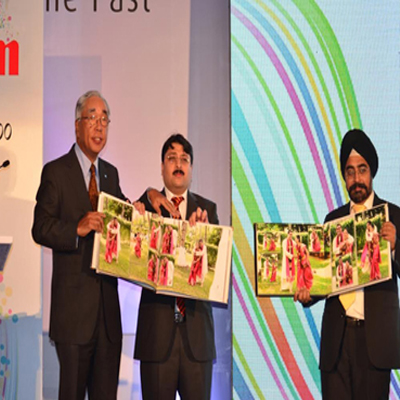
    BENGALURU: Canon India (Canon) announced its entry into the Rs 3000 crore photo printing market in India, and more specifically the Rs 300 crore digital printing market with the introduction of the USD 500,000 (About Rs 3.2 crores) priced DreamLabo 5000 commercial inkjet printer equipment, with the intent of targeting the retail photo and album printing industry. This launch makes India the first country in South Asia where the DreamLabo 5000 machine is being installed says the company.

    Canon India President and CEO Kazutada Kobayashi, said, “Canon has always been at the forefront of bringing innovative products to customers. With this latest business entry, we are hoping to strengthen our ability to meet the printing needs of professional and wedding photographers. With the DreamLabo 5000, we clearly want to establish innovation leadership in India. For us at Canon India, this is not just a new machine, but the technology that can revitalise the entire industry and open up substantial new business opportunities. Canon is setting a new benchmark for the production printing of high quality photos with this launch.”

    Globally, DreamLabo merchandise has been positioned as premium item. The company is following a systematic approach with DreamLabo 5000. It started with a leading photolab in each region and then expanded the presence in that country or region. Its first customer for the DreamLabo 5000 in India is Bangalore-based 100 year old, 22 photo lab store chain G K Vale. G K Vale clocks revenues of about Rs 50 crore annually.

    GK Vale Managing director Anand Sukumar said to  www.indiantelevision.com, “DreamLabo 5000 will help our bottom line, and will not make a very major impact to our bottom line. We have received a good response and may even buy a second machine.”

    A campaign is being planned by both Canon India and G K Vale to attract commercial clients. Some of the ideas being mulled at Canon are including a small flyer or a booklet with each of the 20,000 digital SLRs’ that it sells monthly, in-store promotions at Canon Image Squares, among others. Industry sources reveal that Canon India is likely to spend around Rs 0.75 crore to Rs1 crore during the next calendar year towards above the line (ATL) and below the line (BTL) activities for promotion of its partners such as G K Vale. Canon India spends around Rs100 crore towards brand building, marketing, ATL and BTL activities. Dentsu handles the creative duties for Canon India.

    GK Vale spends about Rs 1 crore annually, but with the installation of the DreamLabo 5000, it will double its advertising spends on social media, print and outdoor and local radio.

    Commercial printing business contributes just about Rs 95 crores or 5 per cent to Canon India’s top line, revealed Canon India executive vice president Alok Bhardawaj. Canon expects revenue of just Rs15 crore during the next calendar year and is targeting revenue of Rs100 crore from this stream over a five year period.

  • Aegis Media India launches Carat Fresh Rural

    Aegis Media India launches Carat Fresh Rural

    MUMBAI: Aegis Media India has launched Carat Fresh Rural, a professionally run, international rural communications agency. Carat Fresh Rural, the rural division of Carat Fresh Integrated, will provide comprehensive rural marketing and communication solutions to clients, which include rural planning, implementing outreach campaigns in rural areas, route planning, monitoring, van operations, haat and mandi contact programs, wall paintings, melas and any other marketing communication activities that may be required in small towns and villages.

    Interestingly, it has already bagged assignments from clients like Mahindra & Mahindra, Godrej Consumer Products, Escorts, Godrej, GPI, SONY MAX, Pidilite, Force Motors, Bayer Crop Science, and others. Carat Fresh Rural will be starting with a team of 30 rural marketers and a network of 1500 operators, across seven offices and 20 operation bases, led by the famous rural expert, Keshav Chandorkar, who will report to Carat Fresh Integrated head, Ravi Shankar.

    Before launching, they have already carried out activities in over 18000 villages across 21 states.

    “Rural Marketing Communications is the holy grail that no agency has successfully cracked in India, thus far. I believe that there is a universe at least equal to the size of the entire advertising industry available to agencies to explore in the rural marketing communications field. Carat Fresh Rural will, in many ways, pioneer that.  We are developing, for the first time in India, state-of-the-art rural management tools.  The Carat Fresh suite of Rural Tools will have the country’s only real time Rural Planning Tool, enabled by 3G connectivity and linked to a host of data sources including the rich census data, media data and 16 other sources of data. Since implementation in rural is key, every one of the Carat Fresh Rural operators will have an App on their GPS enabled trackers that will automatically monitor and relay data without human intervention. Several Tools and Apps are being developed to revolutionize rural communications in India” said, chairman India & CEO South East Asia Ashish Bhasin.

    Carat Fresh Rural aims to have a network of 10,000 people and 100 rural experts, across  26 states, by mid-2015. By 2015 Carat Fresh Rural expects to have covered over 100,000 villages throughout India.  In the second phase of expansion, which will span from 2016 t0 2018, it is anticipated that the network will grow to 20000 people, employees to 200+ and over 200,000 villages would have been covered.

  • ZenithOptimedia predicts global ad spend to grow by 5.3 per cent in 2014

    ZenithOptimedia predicts global ad spend to grow by 5.3 per cent in 2014

    MUMBAI: Global advertising expenditure is expected to grow by 5.3 per cent to $ 532bn, according to a report from media agency ZenithOptimedia.

    The agency has increased its forecast for 2014 by 0.2 percentage points since September, after recent signs of stronger growth from markets like the US, the UK, Germany, Hungary, Poland, Australia and Mexico, together with evidence that Spain’s steep downturn is finally bottoming out.

    Interestingly, this is the second time that the agency upgraded its expectations for 2014 this year, the first was in June (from 5.0 per cent to 5.1 per cent). In fact, for the year 2015, it expects the global ad market to accelerate to 5.8 per cent, followed by another year of 5.8 per cent growth in 2016.

    As part of its global analysis, the agency has also included Ireland in the so-called Peripheral Eurozone category. It assumes that the growth for these countries will be somewhat more muted.

    The agency says that in Europe, it has separated the ‘PIIGS’ markets (Portugal, Ireland, Italy, Greece and Spain), which have faced the full brunt of the Eurozone crisis, into the Peripheral Eurozone. “Their ad  markets have fallen even more sharply than their economies, as local advertisers cut back to reduce losses and preserve cash, and multinationals withdraw budgets to redeploy in more economically healthy regions. We estimate that ad expenditure in Peripheral Eurozone fell by 11.1% in 2013. 2014 looks a lot better, with ad expenditure forecast to shrink by just 0.9%, followed by a slow recovery of 1.8% growth in 2015 and 2.5% growth in 2016. This assumes that the Eurozone avoids disaster over our forecast period, and in particular assumes that no country crashes out of the euro, or falls into disorderly default on its debts,” says the report.

    The report also reveals that the rest of Western Europe, as well as Central European countries like the Czech Republic, Hungary and Poland, which are currently performing more like countries such as France, Germany or the UK than the much-faster growing markets of Eastern Europe, such as Russia and Ukraine. “This is partly because many of these Central European markets are in the Eurozone, and because they have strong trading links with Zenith Optimedia Group Limited,” it says.

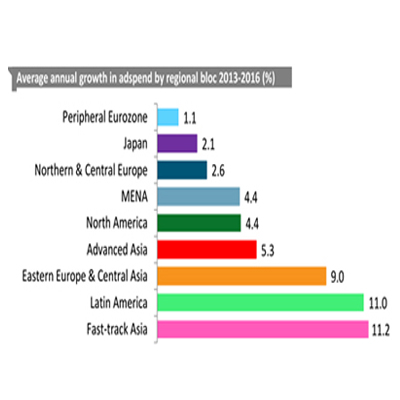
    As far as the Asian market is concerned, the agency has divided it in to four parts – Japan, Eastern Europe and Central Asia, Advanced Asia and Fast-track Asia.

    The report says that the Eastern European advertising markets, such as Russia and Ukraine, recovered quickly after the 2009 downturn and have since continued their healthy pace of growth, largely (though not entirely) unaffected by the problems in the Eurozone. “Their near neighbours in Central Asia, such as Azerbaijan and Kazakhstan, have behaved very similarly, so we have gathered them together under the Eastern Europe & Central Asia bloc. We expect this bloc to have grown 11.7% by the end of 2013, followed by 8%-10% growth for the rest of our forecast period,” it says.

    The agency has kept Japan separate as the market behaves differently from the other markets in Asia. Even after the recent economic stimulus, Japan remains stuck in its rut of persistent low growth and grew 2.1 per cent in 2013. The agency estimates the growth rate of the country to remain at 2 per cent per year through to 2016.

    Apart from Japan, there are five countries in Asia with developed economies and advanced ad markets and thus they are categorised as “Advanced Asia”. It includes Australia, New Zealand, Hong Kong, Singapore and South Korea. The report reveals that growth here has been a disappointing 1.3 per cent in 2013, after a period of heightened tension between North Korea and its neighbours caused advertisers in South Korea to cancel or postpone several campaigns. “We forecast a much healthier 4.5 per cent growth in 2014, followed by 6.6 per cent growth in 2015 and 4.8 per cent growth in 2016,” says the agency in the report.

    Fast-track Asia includes countries like China, India, Indonesia, Malaysia, Pakistan, Philippines, Taiwan, Thailand and Vietnam as these economies are growing extremely rapidly as they adopt Western technology and practices. This group barely noticed the 2009 downturn (ad expenditure grew by 7.2 per cent that year) and since then has grown comfortably at double-digit rates. We estimate that ad expenditure in Fast-track Asia has grown 10.7 per cent in 2013, followed by 10 per cent to 12 per cent annual growth in 2014 to 2016.