Category: Media Agencies

  • Digi Osmosis’s 3 tier digital marketing campaign for Rocky Handsome

    Digi Osmosis’s 3 tier digital marketing campaign for Rocky Handsome

    MUMBAI: Digi Osmosis, the newly incepted mar-tech agency in partnership with John Abraham and Azure Entertainment, expect to take Rocky Handsome to new heights with a unique digital campaign.  The campaign unfolded in three steps —

    Campaign Phase 1:
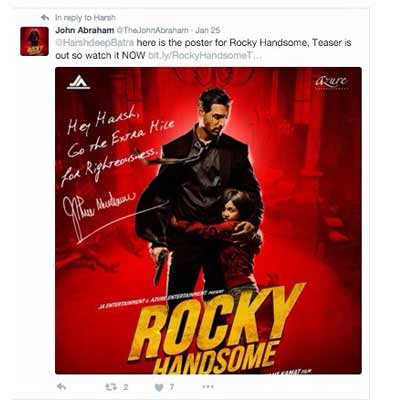
    Earlier this year, Digi Osmosis had carried out an event with Twitter and Rocky Handsome. Every person who tweeted with a certain hashtag received a personalised Rocky Handsome poster and with a small message that went with it. A teaser link was also attached to that, which became instrumental in driving impressions to nearly 1.1 million.

    Campaign Phase 2:
    For the launch of the trailer, the concept was simple. All one had to do was log into their Facebook account, go to the Rocky Handsome page, click on the link and subscribe! The subscriber then became one of the few to watch the Rocky Handsome trailer before the world saw it. It became an exclusive preview for the die-hard fans, and turned into one of the most anticipated blockbusters this year.

    Campaign Phase 3:
    Another activity in which Digi Osmosis played a role was a Facebook Live with John Abraham. The star held a Q&A session with his fans on his Facebook page on the 8 March and garnered nearly 3 lakh views. It was an open event and everyone was invited to chat with the star.

    Commenting on the campaign Digi Osmosis founder Manish Kumar said “We are proud to be a part of Rocky Handsome. The team has placed immense trust in us as their digital partner and we are personally invested in driving innovative, quirky and fun digital content that is shareable and make Rocky Handsome the biggest blockbuster of the year.”

    Commenting on the association, producer Sunir Kheterpal added “A unique movie like this requires a special touch and that is why we turned to the team at Digi Osmosis. For Rocky Handsome, the biggest target audience is the youth. The youth are the lifeblood of social media and so, who better than Digi Osmosis to take the lead on the digital front.”

  • Digi Osmosis’s 3 tier digital marketing campaign for Rocky Handsome

    Digi Osmosis’s 3 tier digital marketing campaign for Rocky Handsome

    MUMBAI: Digi Osmosis, the newly incepted mar-tech agency in partnership with John Abraham and Azure Entertainment, expect to take Rocky Handsome to new heights with a unique digital campaign.  The campaign unfolded in three steps —

    Campaign Phase 1:
    Earlier this year, Digi Osmosis had carried out an event with Twitter and Rocky Handsome. Every person who tweeted with a certain hashtag received a personalised Rocky Handsome poster and with a small message that went with it. A teaser link was also attached to that, which became instrumental in driving impressions to nearly 1.1 million.

    Campaign Phase 2:
    For the launch of the trailer, the concept was simple. All one had to do was log into their Facebook account, go to the Rocky Handsome page, click on the link and subscribe! The subscriber then became one of the few to watch the Rocky Handsome trailer before the world saw it. It became an exclusive preview for the die-hard fans, and turned into one of the most anticipated blockbusters this year.

    Campaign Phase 3:
    Another activity in which Digi Osmosis played a role was a Facebook Live with John Abraham. The star held a Q&A session with his fans on his Facebook page on the 8 March and garnered nearly 3 lakh views. It was an open event and everyone was invited to chat with the star.

    Commenting on the campaign Digi Osmosis founder Manish Kumar said “We are proud to be a part of Rocky Handsome. The team has placed immense trust in us as their digital partner and we are personally invested in driving innovative, quirky and fun digital content that is shareable and make Rocky Handsome the biggest blockbuster of the year.”

    Commenting on the association, producer Sunir Kheterpal added “A unique movie like this requires a special touch and that is why we turned to the team at Digi Osmosis. For Rocky Handsome, the biggest target audience is the youth. The youth are the lifeblood of social media and so, who better than Digi Osmosis to take the lead on the digital front.”

  • Virtual Reality: What’s in it for marketers?

    Virtual Reality: What’s in it for marketers?

    MUMBAI: In the marketing industry, digital era is not something being anticipated but a reality that has arrived and the way one interact with digital content is also changing rapidly especially through the advent of virtual reality (VR) and augmented reality(AR). 

    The terms are often thrown in the air by marketers when citing examples of latest technology in marketing, but what few realize the ground zero report on the actual work and its effectiveness done using VR and Augmented reality as a marketing tool.

    And who better to vouch for it than Ashish Limaye the chief operating officer of Happy Finish, a creative post production studio media agency that dabbles heavily in VR, CG and AR.

    With a global presence of over 12 years, Happy Finish headquartered in the United Kingdom has managed to bag substantially big name clients since it entered the Indian market five years ago. The studio works closely with other creative agencies and caters to specific skillsets that a campaign requires while also having several clients of their own to boot.

    “We work with almost all the leading brands including brands like Unilever, Nestle and Marico to Coke and Pepsi in the beverage section,” points out Limaye, adding, “In the automobile section we work with Maruti Suzuki, Tata Motors, Toyota, and Renault.”

    Adapt or perish

    The single largest shift in the paradigm that Limaye has noticed in the last one year is the completely insulated channels that brands have established with consumers irrespective of any external stakeholders. “When I say stakeholders, I mean magazine, television, billboards etc. And this insulated channel is possible through smartphones that have penetrated the Indian market,” points out Limaye. “The shift which is happening is from all the above-the-line conventional paid media to a ‘owned by the brand’ media, which also generates organic reach through social media without spending a penny.” Coupled with the data points that smartphones facilitate, brands can now directly target their consumers and know them like never before -.not as part of some mass, but by name age and behaviour and preference. As smartphones and other smart devices can easily be used to access VR environment, its use in marketing will grow manifold in the coming years.

    Scope for VR in marketing

    When asked about the scope for VR and augmented reality he sees in marketing in India, Limaye points out the major challenges that today’s marketers are facing with conventional mediums of communication.  “There are two constants in this day and age: one if that media is getting fragmented, and second, consumer attention is getting more fragmented. Today, the consumer is bombarded with so many different media and it has become extremely tough establishing a dialogue with them. And that is where VR becomes extremely advantageous to marketers as it allows you to engage the consumer on a one-on-one basis.”

    To sum it up he adds, “Firstly, VR helps brands with a significant amount of credibility through immersive experience, which otherwise is not possible as effectively. Secondly it also allows to communicate the entire value chain with the customer, through multiple channels — be it retail, or post sale etc; from the factory to the showroom and then road.”

    Limaye explains with an example. “Suppose a telecom is launching their 4G services. With the past record of 3G services not being so favourable with people complaining of call drop, there is a lot of doubt in the market on how well the 4G will do. To counter that a marketer can create an immersive experience of a user in the 4G service and share it with prospective consumers to add credibility to 4G services.”

    VR Vs AR: 

    While VR has been cited several times for its use in experiential marketing, it is easy to confuse it with augmented reality. Limaye defines the two in a simple sentence: “Augmented reality is when I import an external element into my world, while virtual reality allows me to travel to that world.” 

    The biggest differentiating factor is that augmented reality can be consumed by more than one person at a time. “You can project a car on a table while sitting in coffee shop and show to a client or a buyer the inside of the car, its interiors, how it functions and drives. That’s augmented reality.”

    Another good example of clever use of augmented reality in a marketing campaign is what can be done for the online furniture brands like Pepperfry. “It allowed consumers to scan their living room and feed the information to their app, and then place furniture items wherever you like with the use of augmented reality to see what looks like where.”

    Adoption amongst brands:

    In India, the adoption of the technology is picking up fast. Limaye says he gets at least two to three requests daily from several big and small brands when it comes to VR, although he does acknowledge the presence of a learning curve that the industry is going through for this fairly new technology. “While there are brands interested in trying these out, when you ask them what exactly they want to do with it. They have no answer.”

    The area in which the marketers are falling behind is the lack of creative approach when working with VR and augmented reality. “You can’t be using VR for the sake of it just to sound cool or be counted amongst those who are progressive in the industry. There has to a communicative objective that the use of VR must fulfill,” Limaye said.

    The brands which have come forward in using VR and AR come from FMCG sector, beverages like Pepsi and Coke, tourism and travel, and of course automobiles. Currently 30 per cent of Happy Finish’s client base for VR is from the automobile sector.

    Accessibility and cost:

    While VR and AR paves way for endless possibility in use of the technology for marketing purpose, one can’t help but question if India is ready for it in terms of the accessibility of the experience. Can brands only target niche consumers or go brand to brand with it?  

    Knowing that similar questions have been bothering the industry for quite sometime, Limaye says: “It is a myth that you need a high-end headgear to access Virtual reality. You can access it in many ways. Firstly you have Google Cardboard, which is priced as low as Rs 100. Secondly you can access it using YouTube and Facebook that have started their 360 degree videos. Your mobile or your smart device – be it laptop or iPad – then becomes your window to the virtual reality. All one needs to do is shoot 360 media and put it up. Thirdly, if one has a budget to spare, one can go for head gears for a more complete experience. I can see big spending brands keep a gear at their showroom for showcases etc, or for B2B communication. So the distribution challenge is being dealt with in every level.”

    The ROI Factor: 

    So how much should a marketer going for VR budget for their new campaign? Typically, the feeling is that use of a new technology is more expensive as one has to set in place the infrastructure for it. But Limaye disagrees.

    Though the average budget is subjective to the brands need but for a decent campaign which includes an app development and a live action shoot, a budget of Rs 1 to s 1.5 crore is good enough for a good immersive experience using VR. That also reflects in the ROI.

    “I have metrics in place for how many people have downloaded an app, what feature they are interested in and I can even have a call to action post their immersive experience and directly lead the campaign to sales. The call to action is also well monitored and measure. When it comes to ROI, the investment too is very less when you compare it to mediums like television. To reach the Hindi Speaking Market with TVC, a marketer needs to have at least Rs 2 to 3 crore budget to reach a decent TRP number. But this is not needed when I am talking about a VR campaign while still reaching out to the relevant audience.” 

    “The quality of engagement is much higher as compared to other mediums, and the cost of acquisition of the customer’s attention is much lower, and the absolute spend is also lower. In all these metrics, the ROI is much higher,” Limaye adds in parting.
  • Virtual Reality: What’s in it for marketers?

    Virtual Reality: What’s in it for marketers?

    MUMBAI: In the marketing industry, digital era is not something being anticipated but a reality that has arrived and the way one interact with digital content is also changing rapidly especially through the advent of virtual reality (VR) and augmented reality(AR). 

    The terms are often thrown in the air by marketers when citing examples of latest technology in marketing, but what few realize the ground zero report on the actual work and its effectiveness done using VR and Augmented reality as a marketing tool.

    And who better to vouch for it than Ashish Limaye the chief operating officer of Happy Finish, a creative post production studio media agency that dabbles heavily in VR, CG and AR.

    With a global presence of over 12 years, Happy Finish headquartered in the United Kingdom has managed to bag substantially big name clients since it entered the Indian market five years ago. The studio works closely with other creative agencies and caters to specific skillsets that a campaign requires while also having several clients of their own to boot.

    “We work with almost all the leading brands including brands like Unilever, Nestle and Marico to Coke and Pepsi in the beverage section,” points out Limaye, adding, “In the automobile section we work with Maruti Suzuki, Tata Motors, Toyota, and Renault.”

    Adapt or perish

    The single largest shift in the paradigm that Limaye has noticed in the last one year is the completely insulated channels that brands have established with consumers irrespective of any external stakeholders. “When I say stakeholders, I mean magazine, television, billboards etc. And this insulated channel is possible through smartphones that have penetrated the Indian market,” points out Limaye. “The shift which is happening is from all the above-the-line conventional paid media to a ‘owned by the brand’ media, which also generates organic reach through social media without spending a penny.” Coupled with the data points that smartphones facilitate, brands can now directly target their consumers and know them like never before -.not as part of some mass, but by name age and behaviour and preference. As smartphones and other smart devices can easily be used to access VR environment, its use in marketing will grow manifold in the coming years.

    Scope for VR in marketing

    When asked about the scope for VR and augmented reality he sees in marketing in India, Limaye points out the major challenges that today’s marketers are facing with conventional mediums of communication.  “There are two constants in this day and age: one if that media is getting fragmented, and second, consumer attention is getting more fragmented. Today, the consumer is bombarded with so many different media and it has become extremely tough establishing a dialogue with them. And that is where VR becomes extremely advantageous to marketers as it allows you to engage the consumer on a one-on-one basis.”

    To sum it up he adds, “Firstly, VR helps brands with a significant amount of credibility through immersive experience, which otherwise is not possible as effectively. Secondly it also allows to communicate the entire value chain with the customer, through multiple channels — be it retail, or post sale etc; from the factory to the showroom and then road.”

    Limaye explains with an example. “Suppose a telecom is launching their 4G services. With the past record of 3G services not being so favourable with people complaining of call drop, there is a lot of doubt in the market on how well the 4G will do. To counter that a marketer can create an immersive experience of a user in the 4G service and share it with prospective consumers to add credibility to 4G services.”

    VR Vs AR: 

    While VR has been cited several times for its use in experiential marketing, it is easy to confuse it with augmented reality. Limaye defines the two in a simple sentence: “Augmented reality is when I import an external element into my world, while virtual reality allows me to travel to that world.” 

    The biggest differentiating factor is that augmented reality can be consumed by more than one person at a time. “You can project a car on a table while sitting in coffee shop and show to a client or a buyer the inside of the car, its interiors, how it functions and drives. That’s augmented reality.”

    Another good example of clever use of augmented reality in a marketing campaign is what can be done for the online furniture brands like Pepperfry. “It allowed consumers to scan their living room and feed the information to their app, and then place furniture items wherever you like with the use of augmented reality to see what looks like where.”

    Adoption amongst brands:

    In India, the adoption of the technology is picking up fast. Limaye says he gets at least two to three requests daily from several big and small brands when it comes to VR, although he does acknowledge the presence of a learning curve that the industry is going through for this fairly new technology. “While there are brands interested in trying these out, when you ask them what exactly they want to do with it. They have no answer.”

    The area in which the marketers are falling behind is the lack of creative approach when working with VR and augmented reality. “You can’t be using VR for the sake of it just to sound cool or be counted amongst those who are progressive in the industry. There has to a communicative objective that the use of VR must fulfill,” Limaye said.

    The brands which have come forward in using VR and AR come from FMCG sector, beverages like Pepsi and Coke, tourism and travel, and of course automobiles. Currently 30 per cent of Happy Finish’s client base for VR is from the automobile sector.

    Accessibility and cost:

    While VR and AR paves way for endless possibility in use of the technology for marketing purpose, one can’t help but question if India is ready for it in terms of the accessibility of the experience. Can brands only target niche consumers or go brand to brand with it?  

    Knowing that similar questions have been bothering the industry for quite sometime, Limaye says: “It is a myth that you need a high-end headgear to access Virtual reality. You can access it in many ways. Firstly you have Google Cardboard, which is priced as low as Rs 100. Secondly you can access it using YouTube and Facebook that have started their 360 degree videos. Your mobile or your smart device – be it laptop or iPad – then becomes your window to the virtual reality. All one needs to do is shoot 360 media and put it up. Thirdly, if one has a budget to spare, one can go for head gears for a more complete experience. I can see big spending brands keep a gear at their showroom for showcases etc, or for B2B communication. So the distribution challenge is being dealt with in every level.”

    The ROI Factor: 

    So how much should a marketer going for VR budget for their new campaign? Typically, the feeling is that use of a new technology is more expensive as one has to set in place the infrastructure for it. But Limaye disagrees.

    Though the average budget is subjective to the brands need but for a decent campaign which includes an app development and a live action shoot, a budget of Rs 1 to s 1.5 crore is good enough for a good immersive experience using VR. That also reflects in the ROI.

    “I have metrics in place for how many people have downloaded an app, what feature they are interested in and I can even have a call to action post their immersive experience and directly lead the campaign to sales. The call to action is also well monitored and measure. When it comes to ROI, the investment too is very less when you compare it to mediums like television. To reach the Hindi Speaking Market with TVC, a marketer needs to have at least Rs 2 to 3 crore budget to reach a decent TRP number. But this is not needed when I am talking about a VR campaign while still reaching out to the relevant audience.” 

    “The quality of engagement is much higher as compared to other mediums, and the cost of acquisition of the customer’s attention is much lower, and the absolute spend is also lower. In all these metrics, the ROI is much higher,” Limaye adds in parting.

  • Dentsu Webchutney bags a Gold and a Silver at the Olive Crown Awards

    Dentsu Webchutney bags a Gold and a Silver at the Olive Crown Awards

    MUMBAI: Dentsu Aegis Network’s digital agency Dentsu Webchutney was honoured with two awards at the sixth edition of the Olive Crown Awards that was held on 9 March.

    It won a Gold in the Press – Consumer Products category while Akshay Anand brought home a Silver in the “Young Green writer of the Year” category. Dentsu Webchutney won both the awards for its Help us green – Sow, Don’t Throw campaign.

    About the campaign:
    In India, most of the puja samagri (religious material) makers use images of gods on their products to boost sales. Once the product gets consumed, the devotees face the dilemma of disposing of such packets.

    While some leave these packets under trees, others immerse them in rivers. No matter what the mode of disposing is, the packets end up affecting the nature or the religious sentiments.

    Help us green had similar concerns over the launch of their new incense. And therefore, they wanted a packaging solution that could give the devotees a green way to dispose of their packets. In order to meet this objective, Dentsu Webchutney joined hands with Help us green to come up with the idea of plan table packaging for puja materials.

    The packet is made from seed paper that is infused with Tulsi (Basil) seeds and uses ink made from vegetable dyes. Once the product gets consumed, the devotees can plant the package in a pot and be greeted by a Tulsi plant in a few days.

    Commenting on the win, Dentsu Webchutney chief creative technologist Gurbaksh Singh said, “We are absolutely pleased to have won these awards. What makes it even more special is the fact that it comes for a work that’s different from what we have been doing.”

  • Dentsu Webchutney bags a Gold and a Silver at the Olive Crown Awards

    Dentsu Webchutney bags a Gold and a Silver at the Olive Crown Awards

    MUMBAI: Dentsu Aegis Network’s digital agency Dentsu Webchutney was honoured with two awards at the sixth edition of the Olive Crown Awards that was held on 9 March.

    It won a Gold in the Press – Consumer Products category while Akshay Anand brought home a Silver in the “Young Green writer of the Year” category. Dentsu Webchutney won both the awards for its Help us green – Sow, Don’t Throw campaign.

    About the campaign:
    In India, most of the puja samagri (religious material) makers use images of gods on their products to boost sales. Once the product gets consumed, the devotees face the dilemma of disposing of such packets.

    While some leave these packets under trees, others immerse them in rivers. No matter what the mode of disposing is, the packets end up affecting the nature or the religious sentiments.

    Help us green had similar concerns over the launch of their new incense. And therefore, they wanted a packaging solution that could give the devotees a green way to dispose of their packets. In order to meet this objective, Dentsu Webchutney joined hands with Help us green to come up with the idea of plan table packaging for puja materials.

    The packet is made from seed paper that is infused with Tulsi (Basil) seeds and uses ink made from vegetable dyes. Once the product gets consumed, the devotees can plant the package in a pot and be greeted by a Tulsi plant in a few days.

    Commenting on the win, Dentsu Webchutney chief creative technologist Gurbaksh Singh said, “We are absolutely pleased to have won these awards. What makes it even more special is the fact that it comes for a work that’s different from what we have been doing.”

  • Publicis Media restructures organisation

    Publicis Media restructures organisation

    MUMBAI   Publicis Media CEO Steve King has unveiled structure and leadership appointments for the organization. “We are driven to get to the future first,” said King. “Publicis Media is a fresh opportunity to simplify our organisation, invent more modern approaches to gain efficiency, introduce structures for greater collaboration and effectiveness, and drive new levels of scale and client value.”

    “The new Publicis Media imagined by Steve King is fully equipped to fit the future and best serve our clients,” Publicis Groupe chairman and CEO Maurice Lévy endorsed, “A leaner and simpler structure will bring more value to our clients and will further accelerate our growth.”

    Publicis Media’s structure will cover Top 20 markets, organised by three regions and led by Regional CEO for the Americas Tim Jones, Regional CEO for EMEA Iain Jacob, and Regional CEO for APAC, Gerry Boyle.

    At a global management level, Adrian Sayliss will become CFO for Publicis Media, Séverine Charbon will become the Chief Talent Officer for Publicis Media, and John Sheehy will oversee Global Clients for Publicis Media.

    Publicis Media will consolidate its six global agency brands: Starcom, Mediavest, Spark, Zenith, Optimedia and Blue 449 into four global agency brands namely Starcom, Zenith, Mediavest | Spark and Optimedia | Blue 449. Starcom and Zenith will each continue to operate as global agency brands while Mediavest | Spark will be a third large global agency brand and Optimedia | Blue 449 will be brought together to form a powerful global challenger brand.

    Each agency will be led by a Global Brand President with Lisa Donohue as Global Brand President for Starcom, Vittorio Bonori as Global Brand President for Zenith, Brian Terkelsen as Global Brand President for Mediavest | Spark, and Andras Vigh as Global Brand President for Optimedia | Blue 449. These

    Global Brand Presidents will be responsible for leading clients, driving growth and enabling best work.

    Additionally, there will be four US CEOs with Chris Boothe becoming CEO of Mediavest | Spark,

    Dave Ehlers of Optimedia | Blue 449, Lou Rossi continuing at Zenith and Lisa Donohue continuing as US CEO for Starcom until a successor is named. All US brand leadership will report into Tim Jones, CEO of Americas.

    Dave Penski will become Chief Investment Officer for Publicis Media in the U.S. overseeing all media investment and media vendor partnerships. He reports to Jones. Publicis Media’s U.S. consolidated investment power, estimated at $39 Billion and 33% market share, makes Publicis Media the largest media buying entity in the U.S., according to RECMA’s most recent Overall Activity Ranking Report.

    Powering Publicis Media will  be seven centralised ‘Global Practices’ that standardise approaches, scale quickly and deliver connectivity, consistency, that span geography, agency brands and clients.

    These Global Practices will be:

    •     Data, Technology & Innovation led by Stephan Beringer

    •     Content led by Belinda Rowe

    •     Trading & Buying led by Simon Pardon

    •     Performance led by Michael Kahn

    •     Business Development & Communications led by Lauren Hanrahan

    •     Business Transformation led by Richard Hartell

    •     Analytics, Research & Insight led by Steve Simpson

    In this new model, the agency network names of Starcom Mediavest Group and ZenithOptimedia Group are retired to better enable a flatter organisational structure. Publicis Media will deliver client value through combined scale and capabilities of our media agency brands.

    VivaKi capabilities will be fully integrated into Publicis Media’s Global Practice model. Performics will remain Publicis Media’s global performance marketing brand and scale across all agency brands.

    The reorganisation of Publicis Groupe’s media capabilities into a Publicis Media hub is part of Publicis Groupe’s transformation efforts previously announced. Publicis Groupe is organised into four Solutions hubs—Publicis Communications led by Arthur Sadoun, Publicis Media led by Steve King, Publicis.Sapient led by Alan Herrick and Publicis Health led by Nick Colucci—which are connected through a Chief Revenue Officer organization, led by Laura Desmond, which will deliver client satisfaction across Publicis Groupe’s entire range of services.

  • Publicis Media restructures organisation

    Publicis Media restructures organisation

    MUMBAI   Publicis Media CEO Steve King has unveiled structure and leadership appointments for the organization. “We are driven to get to the future first,” said King. “Publicis Media is a fresh opportunity to simplify our organisation, invent more modern approaches to gain efficiency, introduce structures for greater collaboration and effectiveness, and drive new levels of scale and client value.”

    “The new Publicis Media imagined by Steve King is fully equipped to fit the future and best serve our clients,” Publicis Groupe chairman and CEO Maurice Lévy endorsed, “A leaner and simpler structure will bring more value to our clients and will further accelerate our growth.”

    Publicis Media’s structure will cover Top 20 markets, organised by three regions and led by Regional CEO for the Americas Tim Jones, Regional CEO for EMEA Iain Jacob, and Regional CEO for APAC, Gerry Boyle.

    At a global management level, Adrian Sayliss will become CFO for Publicis Media, Séverine Charbon will become the Chief Talent Officer for Publicis Media, and John Sheehy will oversee Global Clients for Publicis Media.

    Publicis Media will consolidate its six global agency brands: Starcom, Mediavest, Spark, Zenith, Optimedia and Blue 449 into four global agency brands namely Starcom, Zenith, Mediavest | Spark and Optimedia | Blue 449. Starcom and Zenith will each continue to operate as global agency brands while Mediavest | Spark will be a third large global agency brand and Optimedia | Blue 449 will be brought together to form a powerful global challenger brand.

    Each agency will be led by a Global Brand President with Lisa Donohue as Global Brand President for Starcom, Vittorio Bonori as Global Brand President for Zenith, Brian Terkelsen as Global Brand President for Mediavest | Spark, and Andras Vigh as Global Brand President for Optimedia | Blue 449. These

    Global Brand Presidents will be responsible for leading clients, driving growth and enabling best work.

    Additionally, there will be four US CEOs with Chris Boothe becoming CEO of Mediavest | Spark,

    Dave Ehlers of Optimedia | Blue 449, Lou Rossi continuing at Zenith and Lisa Donohue continuing as US CEO for Starcom until a successor is named. All US brand leadership will report into Tim Jones, CEO of Americas.

    Dave Penski will become Chief Investment Officer for Publicis Media in the U.S. overseeing all media investment and media vendor partnerships. He reports to Jones. Publicis Media’s U.S. consolidated investment power, estimated at $39 Billion and 33% market share, makes Publicis Media the largest media buying entity in the U.S., according to RECMA’s most recent Overall Activity Ranking Report.

    Powering Publicis Media will  be seven centralised ‘Global Practices’ that standardise approaches, scale quickly and deliver connectivity, consistency, that span geography, agency brands and clients.

    These Global Practices will be:

    •     Data, Technology & Innovation led by Stephan Beringer

    •     Content led by Belinda Rowe

    •     Trading & Buying led by Simon Pardon

    •     Performance led by Michael Kahn

    •     Business Development & Communications led by Lauren Hanrahan

    •     Business Transformation led by Richard Hartell

    •     Analytics, Research & Insight led by Steve Simpson

    In this new model, the agency network names of Starcom Mediavest Group and ZenithOptimedia Group are retired to better enable a flatter organisational structure. Publicis Media will deliver client value through combined scale and capabilities of our media agency brands.

    VivaKi capabilities will be fully integrated into Publicis Media’s Global Practice model. Performics will remain Publicis Media’s global performance marketing brand and scale across all agency brands.

    The reorganisation of Publicis Groupe’s media capabilities into a Publicis Media hub is part of Publicis Groupe’s transformation efforts previously announced. Publicis Groupe is organised into four Solutions hubs—Publicis Communications led by Arthur Sadoun, Publicis Media led by Steve King, Publicis.Sapient led by Alan Herrick and Publicis Health led by Nick Colucci—which are connected through a Chief Revenue Officer organization, led by Laura Desmond, which will deliver client satisfaction across Publicis Groupe’s entire range of services.

  • Prime Focus reloads advertising services

    Prime Focus reloads advertising services

    MUMBAI: Independent media services provider Prime Focus Limited has reloaded its advertising services offering in India with a series of hires across its creative team and a new offline editing facility. The newly revamped division offers advertising clients world-class post production technology and access to some of the nation’s leading creative talent.

    Bhaarath Sundar has rejoined the Prime Focus advertising team as chief business development officer for Advertising & Animation after a period of two years as group CEO and managing partner of Teamwork Studios. Sundar is leading the reloaded advertising offering, which operates across three integrated sites in Khar, Mumbai, offering online editing and grading, a dedicated CG / VFX and animation team and a brand new dedicated offline editing studio.

    Commenting on the re-launch, Sundar said, “Indian agencies and brands are producing truly world-class advertising, and we have reloaded thePrime Focus Advertising division to give our clients access to the best facilities and talent in India. Following our recent hires, we estimate we have almost 90 per cent of the high-end advertising services creative talent available in India, working under one banner and with all the latest technology at their finger-tips. The way ads are finished and delivered is constantly changing, and we’re here not only to help realize our clients’ ideas as beautifully as possible, but also to take away the headaches of the technical aspects of delivery.”

    Joining Prime Focus co-founders and creative heads Huzefa Lokhandwala and Prakash Kurup on the creative team is an exciting list of some of the advertising services industry’s top talent in India.

    “We have been a market-leader in the Advertising post production space for many years, but standing still is not in our DNA,” said Prime FocusLimited global CEO executive chairman founder and founder  Namit Malhotra.

    “This investment in talent and technology shows our commitment to the advertising community and the incredible work that they are producing. Our full-service post production offering, working alongside our Camera and Equipment Rental division, ensures that our advertising clients have access to the very latest kit and the best artistic talent from shoot all the way through post-production to multi-platform delivery.”

    The Prime Focus Advertising team has recently delivered a number of high-profile commercials, including Advertising Age India’s ‘Top Ads of the Week’: IndiaMART ‘#IndiaKiKhoj’ (Show&Tell Productions / Bang In The Middle); Maggi ‘Hostel’ (Breathless Films / McCann Erickson); and Cadbury Dairy Milk Silk ‘Puppets’ (Breathless Films / Ogilvy & Mather).

    Click here for the full list of the team

  • Prime Focus reloads advertising services

    Prime Focus reloads advertising services

    MUMBAI: Independent media services provider Prime Focus Limited has reloaded its advertising services offering in India with a series of hires across its creative team and a new offline editing facility. The newly revamped division offers advertising clients world-class post production technology and access to some of the nation’s leading creative talent.

    Bhaarath Sundar has rejoined the Prime Focus advertising team as chief business development officer for Advertising & Animation after a period of two years as group CEO and managing partner of Teamwork Studios. Sundar is leading the reloaded advertising offering, which operates across three integrated sites in Khar, Mumbai, offering online editing and grading, a dedicated CG / VFX and animation team and a brand new dedicated offline editing studio.

    Commenting on the re-launch, Sundar said, “Indian agencies and brands are producing truly world-class advertising, and we have reloaded thePrime Focus Advertising division to give our clients access to the best facilities and talent in India. Following our recent hires, we estimate we have almost 90 per cent of the high-end advertising services creative talent available in India, working under one banner and with all the latest technology at their finger-tips. The way ads are finished and delivered is constantly changing, and we’re here not only to help realize our clients’ ideas as beautifully as possible, but also to take away the headaches of the technical aspects of delivery.”

    Joining Prime Focus co-founders and creative heads Huzefa Lokhandwala and Prakash Kurup on the creative team is an exciting list of some of the advertising services industry’s top talent in India.

    “We have been a market-leader in the Advertising post production space for many years, but standing still is not in our DNA,” said Prime FocusLimited global CEO executive chairman founder and founder  Namit Malhotra.

    “This investment in talent and technology shows our commitment to the advertising community and the incredible work that they are producing. Our full-service post production offering, working alongside our Camera and Equipment Rental division, ensures that our advertising clients have access to the very latest kit and the best artistic talent from shoot all the way through post-production to multi-platform delivery.”

    The Prime Focus Advertising team has recently delivered a number of high-profile commercials, including Advertising Age India’s ‘Top Ads of the Week’: IndiaMART ‘#IndiaKiKhoj’ (Show&Tell Productions / Bang In The Middle); Maggi ‘Hostel’ (Breathless Films / McCann Erickson); and Cadbury Dairy Milk Silk ‘Puppets’ (Breathless Films / Ogilvy & Mather).

    Click here for the full list of the team