Category: Digital Agencies

  • WWO executes a Digital campaign for a Bollywood movie

    WWO executes a Digital campaign for a Bollywood movie

    MUMBAI: In a first of its kind movie promotion in India, an exclusive digital campaign was conceptualized and designed by World Wide Open (WWO) for TE3N’ starring Amitabh Bachchan, Vidya Balan and Nawazuddin Siddiqui and directed by Ribhu Das Gupta. The movie marks World Wide Open’s foray into the world of movie promotion.

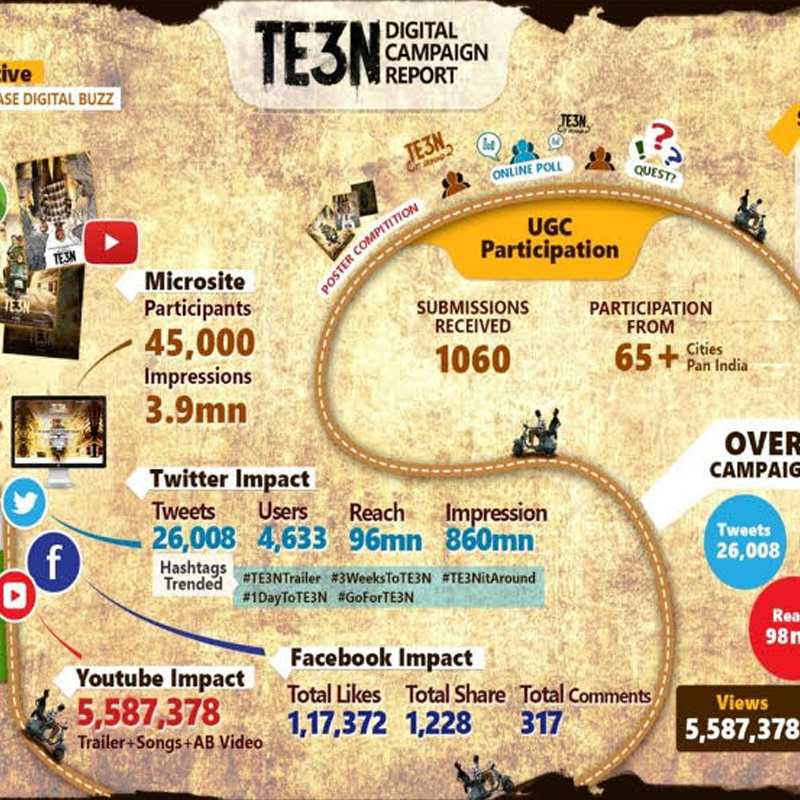
    To create buzz for this movie, an interactive digital campaign, ‘TE3NItAround’ was launched across digital platforms. A microsite was created for public at large to participate in the movie promotions through a number of activities. WWO also collaborated with Talent House and Reliance Gamesto promote the movie on Crowd-sourcing and Gaming platform respectively.

    The campaign commenced by asking individuals to create their own version of the movie poster from assets that were provided. This campaign garnered participation from more than 65 countries such as Egypt, Malaysia, Saudi Arabia, Algeria and others. Contest winners got the rare opportunity to meet Amitabh Bachchan at an event and received autographed and enlarged copies of the film’s poster that they had created. Winning posters were also recreated into hoardings and placed across India.

    The campaign also involved a public voting to select a game for the movie and posters created through UGC contest. The most voted ‘TE3N’ game was unveiled by Mr. Amit Khanduja, the CEO of Reliance Games at the mega event that happened in Mumbai.

    The overall campaign received tremendous response with over 864+ mn impressions and 50,000 participants worldwide.

    TE3N released on 10th June and so far has grossed over 12cr.

    On the successful execution of the TE3N it around campaign, the CEO of WWO, Mr. Arun Mehra said,” WWO announces its foray by setting up a new division for Movie Marketing which is headed by Saahil Krishnani with the TE3N it Around campaign. We have executed one of most innovative campaigns for the movie TE3N and the response we have received is amazing. It was one of a kind campaign executed for a movie by us and we are looking forward to many such interesting campaigns. “

  • WWO executes a Digital campaign for a Bollywood movie

    WWO executes a Digital campaign for a Bollywood movie

    MUMBAI: In a first of its kind movie promotion in India, an exclusive digital campaign was conceptualized and designed by World Wide Open (WWO) for TE3N’ starring Amitabh Bachchan, Vidya Balan and Nawazuddin Siddiqui and directed by Ribhu Das Gupta. The movie marks World Wide Open’s foray into the world of movie promotion.

    To create buzz for this movie, an interactive digital campaign, ‘TE3NItAround’ was launched across digital platforms. A microsite was created for public at large to participate in the movie promotions through a number of activities. WWO also collaborated with Talent House and Reliance Gamesto promote the movie on Crowd-sourcing and Gaming platform respectively.

    The campaign commenced by asking individuals to create their own version of the movie poster from assets that were provided. This campaign garnered participation from more than 65 countries such as Egypt, Malaysia, Saudi Arabia, Algeria and others. Contest winners got the rare opportunity to meet Amitabh Bachchan at an event and received autographed and enlarged copies of the film’s poster that they had created. Winning posters were also recreated into hoardings and placed across India.

    The campaign also involved a public voting to select a game for the movie and posters created through UGC contest. The most voted ‘TE3N’ game was unveiled by Mr. Amit Khanduja, the CEO of Reliance Games at the mega event that happened in Mumbai.

    The overall campaign received tremendous response with over 864+ mn impressions and 50,000 participants worldwide.

    TE3N released on 10th June and so far has grossed over 12cr.

    On the successful execution of the TE3N it around campaign, the CEO of WWO, Mr. Arun Mehra said,” WWO announces its foray by setting up a new division for Movie Marketing which is headed by Saahil Krishnani with the TE3N it Around campaign. We have executed one of most innovative campaigns for the movie TE3N and the response we have received is amazing. It was one of a kind campaign executed for a movie by us and we are looking forward to many such interesting campaigns. “

  • Brands roll out digital campaigns on Father’s Day

    Brands roll out digital campaigns on Father’s Day

    MUMBAI: Sunday celebrated fatherhood in India, and so did brands. With the heart warming and viral advertisements revolving around holy month of Ramadan, this Sunday has given other occasion to interact with audiences. Brands have released various digital campaigns on the occasions.

    One of the most popular advertisement for Father’s day is BankBazaar.com first digital campaign viedo #ThankyouDad. The brand claims to pay an ode to fathers as the first port of call in a person’s financial decision making.

    A father is the first person who taught the first lessons on financial planning and everyone turns to their father for all kinds of financial advice. The campaign is based on this insight. From the very first time we thought about saving to the first time we filed our taxes, fathers have been there to lead us through the complex financial maze. The brand, with this campaign, intends to strike a chord with the online generation in the age group of 25-40.

    The new digital advertising campaign went live on June 15, 2016 and targeted various digital mediums. BankBazaar.com’s new digital advertisement campaign has been conceived and conceptualized by ad veteran Manoj Shetty, ex-Ogilvy Group Creative Head.

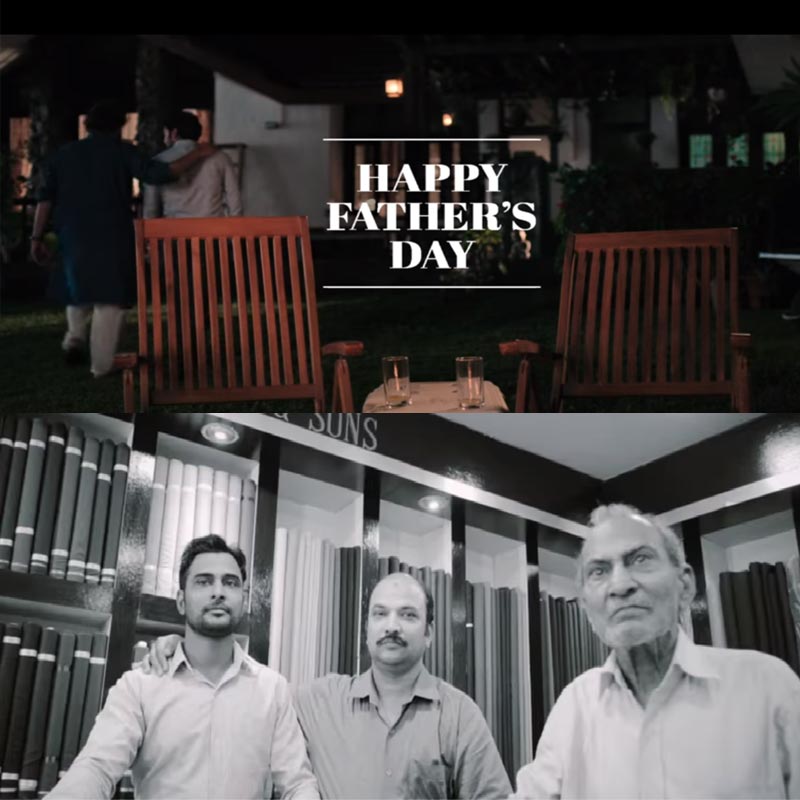
    IndiaMART announced an exclusive digital campaign #CarryTheLegacy, celebrating the occasion. The campaign is a reflection of successive generation carrying on their father’s legacy and inheriting the responsibilities of their business from the head of the family.

    Treading that line of thought, the company has collaborated with Bang in the Middle to launch the campaign via a one minute short film that is intended to celebrate and acknowledge every father who works hard to ensure a better future for his children.

    The short film thoughtfully captures the sincerity and commitment of fathers across India, who built successful businesses on their own terms and proudly hand over the reins of their enterprises to the next generation. The scenes profoundly establish a father’s affection towards his children through those popular ‘Hari, Mehta, or Aziz & sons/daughters’ signboards. Showcasing the father-child bond, the video depicts how these duos work together to build a greater enterprise which carries their family name. Shot across various brick and mortar marketplaces, the campaign hopes to strike a chord with the audience and make them realize the importance of their father in their lives.

    BITM executive creative director Anirban Sen said, “Whatever a father acquires in his life, it is always for his children. The same goes for whatever he builds and creates. Be it a home or business, the vision is always passing these down to his kids. Since we generally see signboards relaying names such as Mehta and Sons, Aggarwal and Sons, Singh and Sons everywhere, it gave us an idea to create a campaign that would make a nice, moving testimony of a father’s hard work and dedication being passed down through generations.”

    Brands have also counted on twitter trending with their hash tag campaigns. These campaigns are interactive, and bind on people’s interactions and connections with their fathers.

    Foodpanda has innovated #MyDadCEO (Chief Eating Officer) campaign where the brand introduced the campaign on their official twitter account and gave a timeline of different themes. People were asked to respond according to themes, as per their father’s. The first theme that rolled out with a graphic was ‘#MyDadCEO T1: Rajma Rice + Sugar? Share the weirdest food mismatch combos your Dad has ever made to win vouchers!’  Followers responded with their dad’s strange food combinations. The second theme was the dad’s favourite chakna, followed by third theme Favourite music while partying. Theme 4 asked for most ordered food. The best answers won food vouchers from Foodpanda.

    public://dadceo_0.png

    Oxigen wallet started #ExcuseMeDad content on its twitter handle where it asked users to give unique excuses to ask money from dad. The best answer is offering a #winBig price from the wallet. The brand also promoted to like and share the campaign. It has received innovative responses.

    public://excusemedad_0.png

    Nutralite has rolled out #DaddyReceipe campaign, where it asked followers to send their dad’s hack tricks from kitchen to garage. Tweet the trick with hash tag and and a picture with father. The campaign has received quiet a lot of hacks from dad.

    public://nutri_0.png

  • Brands roll out digital campaigns on Father’s Day

    Brands roll out digital campaigns on Father’s Day

    MUMBAI: Sunday celebrated fatherhood in India, and so did brands. With the heart warming and viral advertisements revolving around holy month of Ramadan, this Sunday has given other occasion to interact with audiences. Brands have released various digital campaigns on the occasions.

    One of the most popular advertisement for Father’s day is BankBazaar.com first digital campaign viedo #ThankyouDad. The brand claims to pay an ode to fathers as the first port of call in a person’s financial decision making.

    A father is the first person who taught the first lessons on financial planning and everyone turns to their father for all kinds of financial advice. The campaign is based on this insight. From the very first time we thought about saving to the first time we filed our taxes, fathers have been there to lead us through the complex financial maze. The brand, with this campaign, intends to strike a chord with the online generation in the age group of 25-40.

    The new digital advertising campaign went live on June 15, 2016 and targeted various digital mediums. BankBazaar.com’s new digital advertisement campaign has been conceived and conceptualized by ad veteran Manoj Shetty, ex-Ogilvy Group Creative Head.

    IndiaMART announced an exclusive digital campaign #CarryTheLegacy, celebrating the occasion. The campaign is a reflection of successive generation carrying on their father’s legacy and inheriting the responsibilities of their business from the head of the family.

    Treading that line of thought, the company has collaborated with Bang in the Middle to launch the campaign via a one minute short film that is intended to celebrate and acknowledge every father who works hard to ensure a better future for his children.

    The short film thoughtfully captures the sincerity and commitment of fathers across India, who built successful businesses on their own terms and proudly hand over the reins of their enterprises to the next generation. The scenes profoundly establish a father’s affection towards his children through those popular ‘Hari, Mehta, or Aziz & sons/daughters’ signboards. Showcasing the father-child bond, the video depicts how these duos work together to build a greater enterprise which carries their family name. Shot across various brick and mortar marketplaces, the campaign hopes to strike a chord with the audience and make them realize the importance of their father in their lives.

    BITM executive creative director Anirban Sen said, “Whatever a father acquires in his life, it is always for his children. The same goes for whatever he builds and creates. Be it a home or business, the vision is always passing these down to his kids. Since we generally see signboards relaying names such as Mehta and Sons, Aggarwal and Sons, Singh and Sons everywhere, it gave us an idea to create a campaign that would make a nice, moving testimony of a father’s hard work and dedication being passed down through generations.”

    Brands have also counted on twitter trending with their hash tag campaigns. These campaigns are interactive, and bind on people’s interactions and connections with their fathers.

    Foodpanda has innovated #MyDadCEO (Chief Eating Officer) campaign where the brand introduced the campaign on their official twitter account and gave a timeline of different themes. People were asked to respond according to themes, as per their father’s. The first theme that rolled out with a graphic was ‘#MyDadCEO T1: Rajma Rice + Sugar? Share the weirdest food mismatch combos your Dad has ever made to win vouchers!’  Followers responded with their dad’s strange food combinations. The second theme was the dad’s favourite chakna, followed by third theme Favourite music while partying. Theme 4 asked for most ordered food. The best answers won food vouchers from Foodpanda.

    public://dadceo_0.png

    Oxigen wallet started #ExcuseMeDad content on its twitter handle where it asked users to give unique excuses to ask money from dad. The best answer is offering a #winBig price from the wallet. The brand also promoted to like and share the campaign. It has received innovative responses.

    public://excusemedad_0.png

    Nutralite has rolled out #DaddyReceipe campaign, where it asked followers to send their dad’s hack tricks from kitchen to garage. Tweet the trick with hash tag and and a picture with father. The campaign has received quiet a lot of hacks from dad.

    public://nutri_0.png

  • Digital transformation of OOH in India

    Digital transformation of OOH in India

    MUMBAI: Digital billboards, synchronized messaging across hoardings, real time trading, interactive digital displays, mobile convergence, geo-tagged tracking of impressions and measurement — digital is rapidly evolving how out-of-home advertising is perceived.

    A good look around and you will be amazed to see to what extent we are surrounded by advertisements–  on moving buses, at  public places like railways, bus stops, airports, malls and theatres and of course the billboards and hoardings beside every major building and driveway. Out of Home or ‘OOH’ is a ‘traditional’ as well as one of the oldest formats of advertising.

    Though the medium has only ever evolved gradually with time in the last few decades, currently it is at the cusp of a major overhaul that is riding the digital wave.

    http://www.indiantelevision.com/sites/drupal7.indiantelevision.co.in/files/styles/large/public/ooh%20%282%29.jpg?itok=yX7kDlRF

    OOH: The late entrant to digital

    Unlike other advertising mediums, OOH was the latest to feel the impact of the digital disruption here, be it in terms of innovation or revenue loss in ad spends. Where serious concerns were being raised on how digital’s advent will split the ad revenue pie of the market, and cannibalize other media, OOH to the most part was oblivious.

    Sharing his perspective on this transition, Kinetic India CEO South Asia and Middle East Suresh Balakrishnan informs indiantelevision, “The advent of digital in our country in all its form, whether it’s digital, or display or social, mobile has eaten away the budgets of most media.  Having said that, it has happened to India at a good time, for as a market India is growing. We are probably one of the only few markets that are growing at an average of 15 to 18 per cent. Therefore we have made space for digital.”

    “As far as OOH is concerned there has been some revenue loss to digital, but I don’t think it has been significant. I don’t remember a time when OOH was growing at 20 to 30 per cent year on year. It has always lingered around 10 to 13 percent year on year, which again is moderately good growth for OOH,” he adds.

    But that doesn’t mean that ‘change’ isn’t chasing OOH.  

    “OOH can’t sit on its haunches and think that digital will not affect it. Unless, OOH marries digital and adapts what digital has to offer to enhance its services and experience for the consumer, we won’t be able to fight the battle in the long run,” Balakrishnan explains.  

    And that battle is more than about mere survival. It is the way forward for the medium to be more relevant to the consumers, more useful to the clients and more creatively enriching for the agencies.

    Digital, the perfect partner

    To say that digital will aid OOH is an understatement.

    Digital innovation in OOH has enabled the medium to achieve what it was earlier unable to attempt.

    While the idea of a dynamic digital billboard in itself is attractive and engaging for consumers, agencies are now able to explore technology that helps target and track consumers in a better manner and even give a push to point of sale campaigns in malls and other retail outlets.

    http://www.indiantelevision.com/sites/drupal7.indiantelevision.co.in/files/styles/large/public/ooh%20%284%29.jpg?itok=ExgOdzkb

    “There are a lot of innovations that are happening in this area. For example, now digital technology allows users and consumers to scan bar codes from hoardings which directly lead to any product website through their devices,” points out Havas Media Group, India and South Asia CEO Anita Nayyar.

    “Whether it is in the way of ‘blipping’ the product from the hoardings, or digitally connecting an LED screen with some data source, there are various innovations that go hand in hand with billboards that are digitally enabled,” she adds.

    Balakrishnan on the other hand takes delight from the classier messaging that is made possible with digital. He cites an example of a campaign that Kinetic had earlier done for Mondelez’s popular chocolate brand Cadbury Bubbly.

    The crowd at Palladium Mumbai witnessed the experiential and innovative activation where in a digital screen was placed at all these places with a new motion sensor technology that transformed the normal Cadbury Silk chocolate into Cadbury Silk Bubbly with each and every movement around the screen. At metro stations in Mumbai, the screen was placed in such a way that the chocolate bubbled up with the movement of the train.

    http://www.indiantelevision.com/sites/drupal7.indiantelevision.co.in/files/styles/large/public/ooh.JPG?itok=jpwP5Ri8

    The number game: Measurability

    OOH as a medium had long struggled to measure the reach of campaigns. Therefore, very less accountability was placed on the medium and most of the money spent on the medium goes into brand building.

    “With the lack of a streamlined synchronised measurement system, there has been constant pressure from client to prove the effectiveness of the campaign,” Balakrishnan reveals.  But, to many creatives in OOH, digital is a great way to achieve that sense of measurability.

    Nayyar, having seen the Indian advertising scenario evolve, admits that while one medium (digital) is accountable, the other is almost immeasurable.

    “Apart from a couple of researches done, it is very hard to measure this medium. Thus, by clubbing the two medium, outdoor as a medium can gain huge credibility and measurability from digital,” asserts Nayyar.

    http://www.indiantelevision.com/sites/drupal7.indiantelevision.co.in/files/styles/large/public/ooh%20%283%29.jpg?itok=yH00fYXz

    Kinetic has, in fact, launched a tool called SAS or Social Amplification Score worldwide that can add some numbers to even an OOH campaign. The tool has so far been released globally by the Kinetic team and is expected to hit India in the next three months.  

    “The moment an OOH campaign is released, the tool tracks the buzz it creates by using 37 or more keywords like OOH, malls, bus shelter, etc. Basically wherever it is seen and spoken about, to tool automatically puts a score to that. It gathers the information by using geo-tagging technology that most social media platforms have enabled. With this tool therefore, we can put certain reachable numbers to an OOH campaign,” Balakrishnan informs about the effectiveness of the tool.

    Milestone Brandcom founder MD and a pioneer in the OOH business Nabendu Bhattacharyya however sheds a different light on the matter.

    “It is true that all mediums have their own struggle with measurements. Amongst all of them, OOH is the least measurable and most unorganised, Bhattacharyya opines.

    Pointing out that individual agencies have their own measurement systems that help provide clients with numbers, the veteran OOH man says, “If digital billboards become more mainstream, it will help us approach clients on a better ground as digital can incorporate those numbers.”

    Digital OOH: International VS Local

    In spite of some very obvious perks of the digital transformation, India has a lot of catching up to do when it comes to innovating OOH using technology.  Travel to any western country and one can easily spot the vast gap in the digital revolution of OOH.

    http://www.indiantelevision.com/sites/drupal7.indiantelevision.co.in/files/styles/large/public/ooh%20%281%29.jpg?itok=hxnGGHXB

    “If you look at the western markets, OOH is far more advanced and digitised than in our country. It’s also a question of infrastructure as installing these billboards needs a certain aesthetic upgradation as well. Broadband and connectivity also become an issue and do not allow the proposition to be completely seamless and workable,” Nayyar explains.

    Balakrishnan concurs with Nayyar and says, “The more mature markets have gone and beautifully adapted digital with OOH. In fact, I would say the west has shown us that one of the mediums that integrate with digital is OOH.”

    However, Bhattacharyya feels that aesthetically India isn’t far behind western markets in exploiting digital options.

    “In the last few years we have seen some major infrastructural changes in India like the airports have been modernised, fantastic looking metro rails have come up in different places, the malls that are coming up are engineered to look aesthetically good. Therefore these places have immense potential to support a digitally charged OOH campaign. Within the controlled environment, the look and feel of the architectures and the interior designs are at par with what we see internationally,” Bhattacharyya says.

    Challenges: what’s holding OOH back?

    Though each industry player has its own take where Indian OOH stands from a global perspective, most agree that the primary reason that holds them back to optimise the medium’s digital potential is the slow bureaucracy of the country.

    According to the industry, less than 10 per cent of the overall OOH inventory is digital. The reason for that is two-fold: firstly agencies have a hard time securing permissions to go digital in full throttle.

    “The government is slow and the municipal authorities take time to give us those permissions and update themselves,” Balakrishnan explains while highlighting the bureaucratic hurdles.

    The initial cost of setting up digital installations for a campaign is pretty high, and hence media owners who invest in it, think ten times before putting up money.  

    “The setup costs are high when it comes to digital, so naturally the clients also look to quickly amortise it within a year or two. That pushes up the cost of the entire campaign and sometimes clients back out in the end. Balakrishnan puts it bluntly, adding high immeasurability also puts a question mark on big budgets being sanctioned.

    Bhattacharrya goes a step further explaining that ‘real problems’ start beyond the controlled environment spaces.

    “As per government laws, for the most part, digital displays are not allowed in this country. Except for one or two places like Bangalore and Kolkata, it is hard to find legitimate space for putting up an LED display. But those too are in a slideshow format and not really as big as you see in other countries,” Bhattacharrya adds.

    Industry experts point out that if Mumbai and Delhi are taken as example, one has more than ten authorities to deal with before one can even think of a draft design of a campaign. “MMRDA, Mumbai Municipal Corporation, the railway authorities, PWDs –the complications are endless, and way more compared to other countries,” Bhattacharya complains.

    Even if permissions to innovate in the controlled environment space become more lenient budget becomes a hindering factor.

    http://www.indiantelevision.com/sites/drupal7.indiantelevision.co.in/files/styles/large/public/ooh8.jpg?itok=DpHb99t5

    “Out of overall spends in the industry, the budget allotted for controlled environment advertising is close to 20 percent only while the bulk of the budget goes to the uncontrolled environment.  And that 20 percent is further split into the different mediums with digital being one. It’s a small percentage that goes into digital,” Balakrishnan shares.

    International advertisers have another advantage over their Indian counterparts, though.

    Elaborating on what Balakrishnan opined, Bhattacharya says, “In other countries the tenders are done for a 10 to 15 year contract, whereas in India it is two to three years at the maximum. From a business perspective, this dissuades media owners from actively investing in the business, as it lacks the guarantee of a prolonged period. Add to that the fact that the initial investment to digitise the OOH infrastructure is high. Thus a short term contract is disadvantageous for a media owner.”

    Nayyar, however, feels if the technology works and gets the clients the desired results, advertisers are willing to pay and go that extra mile for  really effective storytelling.

    Indian OOH’s digital ‘jugaad’

    (Jugaad (alternatively Juggaar) is a colloquial Hindi-Urdu word that can mean an innovative fix or a simple work-around, used for solutions that bend rules, or a resource that can be used as such, or a person who can solve a complicated issue).

    Creatives here are trying to work around their limitations and adopt digital tools and services in their own way.

    From putting up digital billboards for a short period of three days to digitally enable a normal billboard, the ‘jugaads’ are many.

    Balakrishnan highlights the Indian mindset.

    “For example, creatives can use a CEE app that can be embedded into anything and works on an image recognition technology. If embedded in a brand’s app, every single static piece of communication would become interactive sans the use of barcodes, QR code. Just let your phone that has the CEE enabled app of a particular brand register its visual or logo, and it will take you to a large billboard or a small screen for that matter.”

    http://www.indiantelevision.com/sites/drupal7.indiantelevision.co.in/files/styles/large/public/ooh%209.jpg?itok=5l456I4p

    As always, when presented with adversity, the Indian ‘jugaad’ mindset easily kicks in and it seems to be working wonders for the industry so far.

    But that may not sustain it for too long if the country wants to compete and be at par with other mature markets and make the most of the double digit ad spend growth it’s currently experiencing with dollops of digital help from the government, of course.
  • Digital transformation of OOH in India

    Digital transformation of OOH in India

    MUMBAI: Digital billboards, synchronized messaging across hoardings, real time trading, interactive digital displays, mobile convergence, geo-tagged tracking of impressions and measurement — digital is rapidly evolving how out-of-home advertising is perceived.

    A good look around and you will be amazed to see to what extent we are surrounded by advertisements–  on moving buses, at  public places like railways, bus stops, airports, malls and theatres and of course the billboards and hoardings beside every major building and driveway. Out of Home or ‘OOH’ is a ‘traditional’ as well as one of the oldest formats of advertising.

    Though the medium has only ever evolved gradually with time in the last few decades, currently it is at the cusp of a major overhaul that is riding the digital wave.

    http://www.indiantelevision.com/sites/drupal7.indiantelevision.co.in/files/styles/large/public/ooh%20%282%29.jpg?itok=yX7kDlRF

    OOH: The late entrant to digital

    Unlike other advertising mediums, OOH was the latest to feel the impact of the digital disruption here, be it in terms of innovation or revenue loss in ad spends. Where serious concerns were being raised on how digital’s advent will split the ad revenue pie of the market, and cannibalize other media, OOH to the most part was oblivious.

    Sharing his perspective on this transition, Kinetic India CEO South Asia and Middle East Suresh Balakrishnan informs indiantelevision, “The advent of digital in our country in all its form, whether it’s digital, or display or social, mobile has eaten away the budgets of most media.  Having said that, it has happened to India at a good time, for as a market India is growing. We are probably one of the only few markets that are growing at an average of 15 to 18 per cent. Therefore we have made space for digital.”

    “As far as OOH is concerned there has been some revenue loss to digital, but I don’t think it has been significant. I don’t remember a time when OOH was growing at 20 to 30 per cent year on year. It has always lingered around 10 to 13 percent year on year, which again is moderately good growth for OOH,” he adds.

    But that doesn’t mean that ‘change’ isn’t chasing OOH.  

    “OOH can’t sit on its haunches and think that digital will not affect it. Unless, OOH marries digital and adapts what digital has to offer to enhance its services and experience for the consumer, we won’t be able to fight the battle in the long run,” Balakrishnan explains.  

    And that battle is more than about mere survival. It is the way forward for the medium to be more relevant to the consumers, more useful to the clients and more creatively enriching for the agencies.

    Digital, the perfect partner

    To say that digital will aid OOH is an understatement.

    Digital innovation in OOH has enabled the medium to achieve what it was earlier unable to attempt.

    While the idea of a dynamic digital billboard in itself is attractive and engaging for consumers, agencies are now able to explore technology that helps target and track consumers in a better manner and even give a push to point of sale campaigns in malls and other retail outlets.

    http://www.indiantelevision.com/sites/drupal7.indiantelevision.co.in/files/styles/large/public/ooh%20%284%29.jpg?itok=ExgOdzkb

    “There are a lot of innovations that are happening in this area. For example, now digital technology allows users and consumers to scan bar codes from hoardings which directly lead to any product website through their devices,” points out Havas Media Group, India and South Asia CEO Anita Nayyar.

    “Whether it is in the way of ‘blipping’ the product from the hoardings, or digitally connecting an LED screen with some data source, there are various innovations that go hand in hand with billboards that are digitally enabled,” she adds.

    Balakrishnan on the other hand takes delight from the classier messaging that is made possible with digital. He cites an example of a campaign that Kinetic had earlier done for Mondelez’s popular chocolate brand Cadbury Bubbly.

    The crowd at Palladium Mumbai witnessed the experiential and innovative activation where in a digital screen was placed at all these places with a new motion sensor technology that transformed the normal Cadbury Silk chocolate into Cadbury Silk Bubbly with each and every movement around the screen. At metro stations in Mumbai, the screen was placed in such a way that the chocolate bubbled up with the movement of the train.

    http://www.indiantelevision.com/sites/drupal7.indiantelevision.co.in/files/styles/large/public/ooh.JPG?itok=jpwP5Ri8

    The number game: Measurability

    OOH as a medium had long struggled to measure the reach of campaigns. Therefore, very less accountability was placed on the medium and most of the money spent on the medium goes into brand building.

    “With the lack of a streamlined synchronised measurement system, there has been constant pressure from client to prove the effectiveness of the campaign,” Balakrishnan reveals.  But, to many creatives in OOH, digital is a great way to achieve that sense of measurability.

    Nayyar, having seen the Indian advertising scenario evolve, admits that while one medium (digital) is accountable, the other is almost immeasurable.

    “Apart from a couple of researches done, it is very hard to measure this medium. Thus, by clubbing the two medium, outdoor as a medium can gain huge credibility and measurability from digital,” asserts Nayyar.

    http://www.indiantelevision.com/sites/drupal7.indiantelevision.co.in/files/styles/large/public/ooh%20%283%29.jpg?itok=yH00fYXz

    Kinetic has, in fact, launched a tool called SAS or Social Amplification Score worldwide that can add some numbers to even an OOH campaign. The tool has so far been released globally by the Kinetic team and is expected to hit India in the next three months.  

    “The moment an OOH campaign is released, the tool tracks the buzz it creates by using 37 or more keywords like OOH, malls, bus shelter, etc. Basically wherever it is seen and spoken about, to tool automatically puts a score to that. It gathers the information by using geo-tagging technology that most social media platforms have enabled. With this tool therefore, we can put certain reachable numbers to an OOH campaign,” Balakrishnan informs about the effectiveness of the tool.

    Milestone Brandcom founder MD and a pioneer in the OOH business Nabendu Bhattacharyya however sheds a different light on the matter.

    “It is true that all mediums have their own struggle with measurements. Amongst all of them, OOH is the least measurable and most unorganised, Bhattacharyya opines.

    Pointing out that individual agencies have their own measurement systems that help provide clients with numbers, the veteran OOH man says, “If digital billboards become more mainstream, it will help us approach clients on a better ground as digital can incorporate those numbers.”

    Digital OOH: International VS Local

    In spite of some very obvious perks of the digital transformation, India has a lot of catching up to do when it comes to innovating OOH using technology.  Travel to any western country and one can easily spot the vast gap in the digital revolution of OOH.

    http://www.indiantelevision.com/sites/drupal7.indiantelevision.co.in/files/styles/large/public/ooh%20%281%29.jpg?itok=hxnGGHXB

    “If you look at the western markets, OOH is far more advanced and digitised than in our country. It’s also a question of infrastructure as installing these billboards needs a certain aesthetic upgradation as well. Broadband and connectivity also become an issue and do not allow the proposition to be completely seamless and workable,” Nayyar explains.

    Balakrishnan concurs with Nayyar and says, “The more mature markets have gone and beautifully adapted digital with OOH. In fact, I would say the west has shown us that one of the mediums that integrate with digital is OOH.”

    However, Bhattacharyya feels that aesthetically India isn’t far behind western markets in exploiting digital options.

    “In the last few years we have seen some major infrastructural changes in India like the airports have been modernised, fantastic looking metro rails have come up in different places, the malls that are coming up are engineered to look aesthetically good. Therefore these places have immense potential to support a digitally charged OOH campaign. Within the controlled environment, the look and feel of the architectures and the interior designs are at par with what we see internationally,” Bhattacharyya says.

    Challenges: what’s holding OOH back?

    Though each industry player has its own take where Indian OOH stands from a global perspective, most agree that the primary reason that holds them back to optimise the medium’s digital potential is the slow bureaucracy of the country.

    According to the industry, less than 10 per cent of the overall OOH inventory is digital. The reason for that is two-fold: firstly agencies have a hard time securing permissions to go digital in full throttle.

    “The government is slow and the municipal authorities take time to give us those permissions and update themselves,” Balakrishnan explains while highlighting the bureaucratic hurdles.

    The initial cost of setting up digital installations for a campaign is pretty high, and hence media owners who invest in it, think ten times before putting up money.  

    “The setup costs are high when it comes to digital, so naturally the clients also look to quickly amortise it within a year or two. That pushes up the cost of the entire campaign and sometimes clients back out in the end. Balakrishnan puts it bluntly, adding high immeasurability also puts a question mark on big budgets being sanctioned.

    Bhattacharrya goes a step further explaining that ‘real problems’ start beyond the controlled environment spaces.

    “As per government laws, for the most part, digital displays are not allowed in this country. Except for one or two places like Bangalore and Kolkata, it is hard to find legitimate space for putting up an LED display. But those too are in a slideshow format and not really as big as you see in other countries,” Bhattacharrya adds.

    Industry experts point out that if Mumbai and Delhi are taken as example, one has more than ten authorities to deal with before one can even think of a draft design of a campaign. “MMRDA, Mumbai Municipal Corporation, the railway authorities, PWDs –the complications are endless, and way more compared to other countries,” Bhattacharya complains.

    Even if permissions to innovate in the controlled environment space become more lenient budget becomes a hindering factor.

    http://www.indiantelevision.com/sites/drupal7.indiantelevision.co.in/files/styles/large/public/ooh8.jpg?itok=DpHb99t5

    “Out of overall spends in the industry, the budget allotted for controlled environment advertising is close to 20 percent only while the bulk of the budget goes to the uncontrolled environment.  And that 20 percent is further split into the different mediums with digital being one. It’s a small percentage that goes into digital,” Balakrishnan shares.

    International advertisers have another advantage over their Indian counterparts, though.

    Elaborating on what Balakrishnan opined, Bhattacharya says, “In other countries the tenders are done for a 10 to 15 year contract, whereas in India it is two to three years at the maximum. From a business perspective, this dissuades media owners from actively investing in the business, as it lacks the guarantee of a prolonged period. Add to that the fact that the initial investment to digitise the OOH infrastructure is high. Thus a short term contract is disadvantageous for a media owner.”

    Nayyar, however, feels if the technology works and gets the clients the desired results, advertisers are willing to pay and go that extra mile for  really effective storytelling.

    Indian OOH’s digital ‘jugaad’

    (Jugaad (alternatively Juggaar) is a colloquial Hindi-Urdu word that can mean an innovative fix or a simple work-around, used for solutions that bend rules, or a resource that can be used as such, or a person who can solve a complicated issue).

    Creatives here are trying to work around their limitations and adopt digital tools and services in their own way.

    From putting up digital billboards for a short period of three days to digitally enable a normal billboard, the ‘jugaads’ are many.

    Balakrishnan highlights the Indian mindset.

    “For example, creatives can use a CEE app that can be embedded into anything and works on an image recognition technology. If embedded in a brand’s app, every single static piece of communication would become interactive sans the use of barcodes, QR code. Just let your phone that has the CEE enabled app of a particular brand register its visual or logo, and it will take you to a large billboard or a small screen for that matter.”

    http://www.indiantelevision.com/sites/drupal7.indiantelevision.co.in/files/styles/large/public/ooh%209.jpg?itok=5l456I4p

    As always, when presented with adversity, the Indian ‘jugaad’ mindset easily kicks in and it seems to be working wonders for the industry so far.

    But that may not sustain it for too long if the country wants to compete and be at par with other mature markets and make the most of the double digit ad spend growth it’s currently experiencing with dollops of digital help from the government, of course.

  • LinTeractive launches Deep Digitisation

    LinTeractive launches Deep Digitisation

    MUMBAI: LinTeractive, the digital arm of MullenLowe Lintas Group, unveiled a proprietary framework named Deep Digitisation at a major regional industry event today, in Singapore.

    Digital Transformation is a subject gaining currency, both as an opportunity and a cause-of-concern, across the industry over the past year. LinTeractive’s framework, Deep Digitisation, looks at re-imagining organizations for a digitized environment, leading to transformation as the outcome.

    Eight months ago, the agency set up a task-force of technologists, designers, analysts and strategists, to develop approaches that could help large organisations evolve for a digitised environment. The team, led by LinTeractive EVP Sumanta Ganguly came up with several hypotheses and some prototypes that eventually led to the Deep Digitisation framework. The agency claims to have tested alpha versions of it with some of its existing clients to establish applicability and robustness.

    MullenLowe Lintas Group — marketing services Group CMO and President Vikas Mehta said, “We’ve been in several conversations with clients about Digital Transformation over the past months. A pattern seems to be emerging, where a discussion with CMOs quickly evolves to include the CTOs and the CEOs as crucial players who need to come together to drive digitisation. While there are several offerings in the market that promise digital transformation, they come from either consulting or technology firms. Each has its own strengths, but almost all of them fall short of building an ecosystem around every company’s most important asset, its customers. This observation led us to start working on a model that could put users (including consumers), at the heart of an organisation’s digital ecosystem.”

    Speaking of the launch, Ganguly said, “Most of today’s successful companies were born in an era of competition. They are organised around competencies and structured to create competitive advantage. Their digital pursuits are reflective of this reality where every department is driving multiple digital efforts simultaneously. But when you add them all up, it ends up with common gaps, as well as duplicated efforts. In an era of collaboration, the whole company needs to come together as one, and create a seamless experience for every user group. We’ve attempted to achieve that through Deep Digitisation. The framework helps companies reorganize around their existing structures and yet, have a unified approach to digital transformation.”

    As per the Deep Digitisation framework – digital transformation is the outcome of an ecosystem of platform play that sets the stage for consistent innovation.

    Applied to organisations, the approach is semi-structured and leads to a customised solution in each instance. As Ganguly puts it, “What we’ve seen with most use-cases so far, it’s about two-thirds constant where the modules are plug-and-play, and one-third bespoke. The customization varies depending on the scale, complexity and ambition of the company.”

  • LinTeractive launches Deep Digitisation

    LinTeractive launches Deep Digitisation

    MUMBAI: LinTeractive, the digital arm of MullenLowe Lintas Group, unveiled a proprietary framework named Deep Digitisation at a major regional industry event today, in Singapore.

    Digital Transformation is a subject gaining currency, both as an opportunity and a cause-of-concern, across the industry over the past year. LinTeractive’s framework, Deep Digitisation, looks at re-imagining organizations for a digitized environment, leading to transformation as the outcome.

    Eight months ago, the agency set up a task-force of technologists, designers, analysts and strategists, to develop approaches that could help large organisations evolve for a digitised environment. The team, led by LinTeractive EVP Sumanta Ganguly came up with several hypotheses and some prototypes that eventually led to the Deep Digitisation framework. The agency claims to have tested alpha versions of it with some of its existing clients to establish applicability and robustness.

    MullenLowe Lintas Group — marketing services Group CMO and President Vikas Mehta said, “We’ve been in several conversations with clients about Digital Transformation over the past months. A pattern seems to be emerging, where a discussion with CMOs quickly evolves to include the CTOs and the CEOs as crucial players who need to come together to drive digitisation. While there are several offerings in the market that promise digital transformation, they come from either consulting or technology firms. Each has its own strengths, but almost all of them fall short of building an ecosystem around every company’s most important asset, its customers. This observation led us to start working on a model that could put users (including consumers), at the heart of an organisation’s digital ecosystem.”

    Speaking of the launch, Ganguly said, “Most of today’s successful companies were born in an era of competition. They are organised around competencies and structured to create competitive advantage. Their digital pursuits are reflective of this reality where every department is driving multiple digital efforts simultaneously. But when you add them all up, it ends up with common gaps, as well as duplicated efforts. In an era of collaboration, the whole company needs to come together as one, and create a seamless experience for every user group. We’ve attempted to achieve that through Deep Digitisation. The framework helps companies reorganize around their existing structures and yet, have a unified approach to digital transformation.”

    As per the Deep Digitisation framework – digital transformation is the outcome of an ecosystem of platform play that sets the stage for consistent innovation.

    Applied to organisations, the approach is semi-structured and leads to a customised solution in each instance. As Ganguly puts it, “What we’ve seen with most use-cases so far, it’s about two-thirds constant where the modules are plug-and-play, and one-third bespoke. The customization varies depending on the scale, complexity and ambition of the company.”

  • Two months since Canvas Ads launch on Facebook

    Two months since Canvas Ads launch on Facebook

    MUMBAI: Digital marketers and new age advertisers were quite in frenzy when Facebook introduced its new product called Canvas at Cannes last year and subsequently launched it globally in February 25 2016. And why not? Canvas allowed advertisers to combine video, photographs and copy in an ad promising an immersive experience for the consumers. It was based off the very root of all digital marketers’ worry — intrusive ads that are point blank disliked by consumers.

    It’s not a secret that YouTube’s ‘Skip Ad’ button is probably the most clicked button ever, not to mention the high bounce rates at sites with too many full page ads, be it desktop or mobile; perhaps more so on mobile advertising due to the limited space on screen.

    The challenge was simple — how to create engaging experiences through ads so that people, instead of being put off by them, willingly spend more time on the platform.

    “We’re committed to building great mobile experiences for people and doing so also opens up new creative possibilities for advertisers. We’ve invested in engaging experiences like video and the carousel format to empower advertisers with more creative space to share their brand and products on mobile,” Facebook had shared then. The project was brought to life after a collaboration of the advertising community, Facebook Engineers, Designers, and Creative Shop– all working together in a constant feedback loop.

    “This space was designed and invented and inspired by our relationship with the creative community,” Facebook, CCO Mark D’Arcy was earlier heard stating.

    It’s been a little over two months and within these two months, 186 countries have experienced Canvas with US, Brazil, Mexico, Italy, UK, France, Thailand, Germany, Turkey, India being the top 10 countries.

    Facebook has already achieved a significant amount of what it aimed at, as per the data the social media giant shared with Indiantelevision.com. In the past three months, people have spent more than 100 years of time in Canvases and people spend an average of 31 seconds in Canvas.

    The other USP feature of Canvas is its ease of use to create a dynamic ad for mobile, just what the SMEs needed.

    “Teams simplified the creation experience to six core elements that we heard were the building blocks that people cared about and provided enough creative freedom to build compelling experiences such as — headers, photos, videos, text, buttons, and carousels,” Facebook explained in an official statement, and as per its freshly gathered data 50 per cent of the Facebook ads created on canvas are done in 10 minutes or less time.

    Facebook’s internal user engagement behaviour data was a huge help in guiding the developers address some of the major issues consumers faced on Facebook while interacting with engaging advertisements on mobile.

    “One of the major feedbacks on mobile ads was that ‘Videos took too long to load.’ For this the team made a huge shift to re-architect all of our client renderings to enable content to load faster and progressively fetch elements in a Canvas as they were needed (rather than downloading the whole thing.) We made video compression much more efficient,” shared a Facebook Canvas representative, acknowledging the importance of videos in today’s two way communication on mobile. Interestingly canvasses also allowed advertisers to intervene in real time and improve their canvas ads based on feedback and data responses.

  • Two months since Canvas Ads launch on Facebook

    Two months since Canvas Ads launch on Facebook

    MUMBAI: Digital marketers and new age advertisers were quite in frenzy when Facebook introduced its new product called Canvas at Cannes last year and subsequently launched it globally in February 25 2016. And why not? Canvas allowed advertisers to combine video, photographs and copy in an ad promising an immersive experience for the consumers. It was based off the very root of all digital marketers’ worry — intrusive ads that are point blank disliked by consumers.

    It’s not a secret that YouTube’s ‘Skip Ad’ button is probably the most clicked button ever, not to mention the high bounce rates at sites with too many full page ads, be it desktop or mobile; perhaps more so on mobile advertising due to the limited space on screen.

    The challenge was simple — how to create engaging experiences through ads so that people, instead of being put off by them, willingly spend more time on the platform.

    “We’re committed to building great mobile experiences for people and doing so also opens up new creative possibilities for advertisers. We’ve invested in engaging experiences like video and the carousel format to empower advertisers with more creative space to share their brand and products on mobile,” Facebook had shared then. The project was brought to life after a collaboration of the advertising community, Facebook Engineers, Designers, and Creative Shop– all working together in a constant feedback loop.

    “This space was designed and invented and inspired by our relationship with the creative community,” Facebook, CCO Mark D’Arcy was earlier heard stating.

    It’s been a little over two months and within these two months, 186 countries have experienced Canvas with US, Brazil, Mexico, Italy, UK, France, Thailand, Germany, Turkey, India being the top 10 countries.

    Facebook has already achieved a significant amount of what it aimed at, as per the data the social media giant shared with Indiantelevision.com. In the past three months, people have spent more than 100 years of time in Canvases and people spend an average of 31 seconds in Canvas.

    The other USP feature of Canvas is its ease of use to create a dynamic ad for mobile, just what the SMEs needed.

    “Teams simplified the creation experience to six core elements that we heard were the building blocks that people cared about and provided enough creative freedom to build compelling experiences such as — headers, photos, videos, text, buttons, and carousels,” Facebook explained in an official statement, and as per its freshly gathered data 50 per cent of the Facebook ads created on canvas are done in 10 minutes or less time.

    Facebook’s internal user engagement behaviour data was a huge help in guiding the developers address some of the major issues consumers faced on Facebook while interacting with engaging advertisements on mobile.

    “One of the major feedbacks on mobile ads was that ‘Videos took too long to load.’ For this the team made a huge shift to re-architect all of our client renderings to enable content to load faster and progressively fetch elements in a Canvas as they were needed (rather than downloading the whole thing.) We made video compression much more efficient,” shared a Facebook Canvas representative, acknowledging the importance of videos in today’s two way communication on mobile. Interestingly canvasses also allowed advertisers to intervene in real time and improve their canvas ads based on feedback and data responses.