Category: Digital Agencies

  • Affle to acquire strategic stake in Bobble AI

    Affle to acquire strategic stake in Bobble AI

    NEW DELHI: Affle (India) Ltd today announced the signing of definitive agreements to acquire eight per cent ownership in Talent Unlimited Online Services Private Ltd (Bobble AI), India. The company also has an option to acquire incremental ownership on attainment of certain key performance targets within the next three years. Affle has secured exclusive global ad monetisation rights of tech products of Bobble AI for five years. Bobble AI is the conversation media platform offering indigenous social keyboard with 10+ patents filed and significant investments from Xiaomi and SAIF Partners.

    Bobble AI’s flagship offering – “Bobble Indic Keyboard” includes speech-to-text capabilities and is accessible in approximately 100 international languages including 23 Indian languages. It lets users personalise their communication while offering AI-based contextual recommendations and expressive endorsements with branded stickers and emojis. Bobble AI has partnered with Xiaomi to pre-embed its custom made “Mint Keyboard” as a default keyboard across multiple Xiaomi devices in India. Bobble AI has leveraged its strengths in both Indian and International languages and is partnering with multiple Original Equipment Manufacturers (OEMs), Mobile Network Operators (MNOs) and financial services companies as distribution partners adding significantly to their customer engagement. 

    Affle chairman, MD and CEO Anuj Khanna Sohum said, “We are excited to announce our strategic investment in Bobble AI. A keyboard is the core of a user’s smart device experience and is one of the most used apps daily. We believe Bobble AI complements our vernacular strategy and significantly strengthens our partnership with OEMs where this keyboard is a default/pre-installed app. We remain committed to Affle2.0 growth strategy leveraging upon strategic consolidation opportunities to augment our market leadership position globally. We also continue to be a strong enabling platform for the indigenous apps ecosystem in India.”

    Bobble AI founder and CEO Ankit Prasad commented, “We are elated to have found partners in Affle as we enter into the next phase of growth and monetization. Affle’s investment reinforces our vision to build world’s largest Conversation Media Platform. Affle’s strong market position, differentiated business model and our deep AI-driven tech is setting us together on a long-term growth trajectory. As a founding team, me and Rahul would like to thank our team, users and partners for their continued support, and looking forward to exciting days ahead.”

    Existing investor of Bobble AI, SAIF Partners noted, “Bobble AI has grown rapidly in the past couple of years driven by Ankit and Rahul's leadership and focus on execution. We welcome Affle's strategic investment into the company, which will further strengthen Bobble's market position and create a leading and unique engagement model for both users and partners. We look forward to a strong growth path for Bobble AI.”
  • Badshah’s fake views controversy highlights influencer marketing inadequacies

    Badshah’s fake views controversy highlights influencer marketing inadequacies

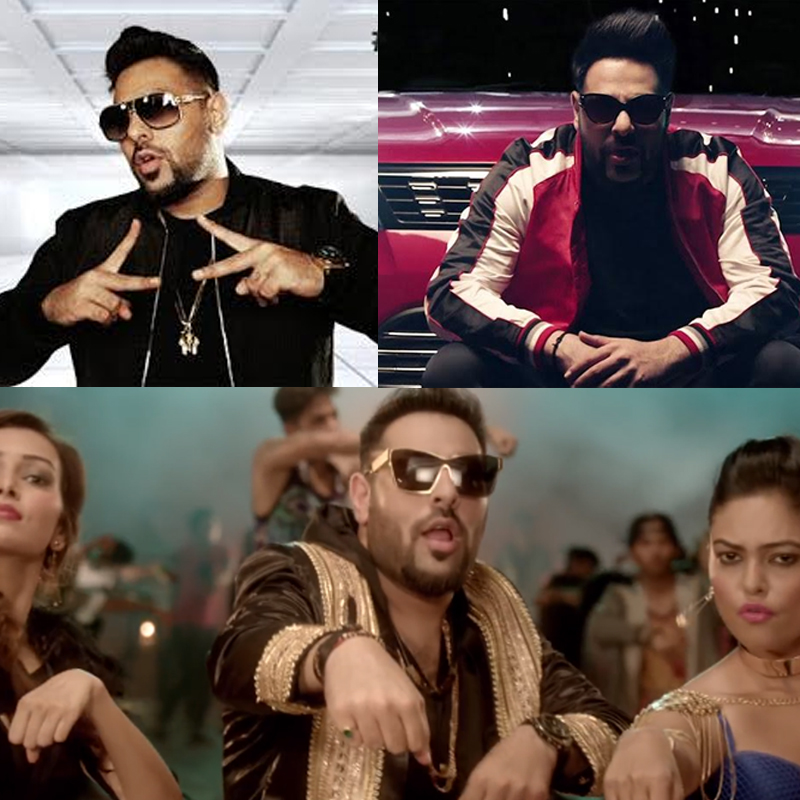
    NEW DELHI: Bollywood rapper Badshah has come under scrutiny for allegedly buying fake views for one of his music videos. This has, once again, opened up the debate on the ‘fake followers’ strategy prevalent in the social media landscape and how celebrities and influencers are highly involved in this practice.

    According to media reports, Badshah confessed that he had purchased around 7.2 crore views for Rs 72 lakh to set a world record for the most-viewed YouTube video in the first 24 hours. He had claimed that the music video for 'Pagal Hai' was watched 75 million times on the first day of its release, beating previous records set by Taylor Swift and the Korean boy band BTS. However, the claim was rejected by Google.

    Monk Media Network assistant vice president Pranav Nair explains, “In this scenario, he's paid to get more numbers on his content and not a brand's. So, from a brand management perspective, one can accept the fact that he's investing money to grow his metrics on social media.”

    The issue has come at a time when digital consumption spiked in the lockdown period and advertisers are spending a hefty amount on influencer marketing. As per reports, influencer marketing is seen as one of the fastest-growing categories in the Rs 21,000 crore digital advertising space.

    Buying fake followers is the unpalatable side of the digital marketing industry and the way brands invest in followers for reach, reflects how deep the problem is. Brands that take decisions based on one post or just the number of followers will see reality when the ROI hits them.

    Lets Influence founder Bhawna Sethi opines, “The major issue faced by brand managers is that it's not possible to dissect every single profile they are planning to collaborate with. Hence, big brands prefer hiring influencer marketing agencies as they have expertise in a specific service, industry, audience, channel, etc., and can help them avoid collaborating with such fake profiles.”

    Nair advises that brands should not collaborate with such an influencer as it cuts the organic reach of the brand, which is one of the reasons why brands collaborate with influencers.

    In recent times, many in-house tools have been launched to help identify fake followers, their percentage share and the impact of engagement. However, the rampant problem of vanity metrics, bots and others in the digital domain still lingers. A lot of celebrities have also been a part of it and measures are needed to control the growing menace.

    Sethi says, “While working with celebrities, we realised that more than being a part of it, celebrities are victims of this. There are many instances when they engage with agencies for paid promotions and aren't even aware that the followers joining them are not real people. It won't be right to say that they bought fake followers with full awareness.”

    Badshah has also been associated with brands like Pepsi, Yamaha, Hitachi, Mahindra and OPPO. This incident is likely to have an impact on his associations. It has also led to many people unfollowing his social media accounts.

    MAD Influence founder and CEO Gautam Madhavan says, “It's very disheartening for the viewers to know first that their favourite celeb has bought fake followers and on the other hand, agencies like us won't also promote such celebs in suggesting to various brand campaigns. Thus, they lose the brand credibility and the money too.”

  • 74% of respondents will continue to make purchases via contactless mode: MasterCard report

    74% of respondents will continue to make purchases via contactless mode: MasterCard report

    NEW DELHI: As communities begin to slowly reopen, business owners and the consumers they serve are entering unknown territory, navigating the new normal, living with precautions. During these times, contactless and other forms of digital payments have emerged as the healthiest way of making payments as they are more secure and require minimum physical contact between the merchant and customer.

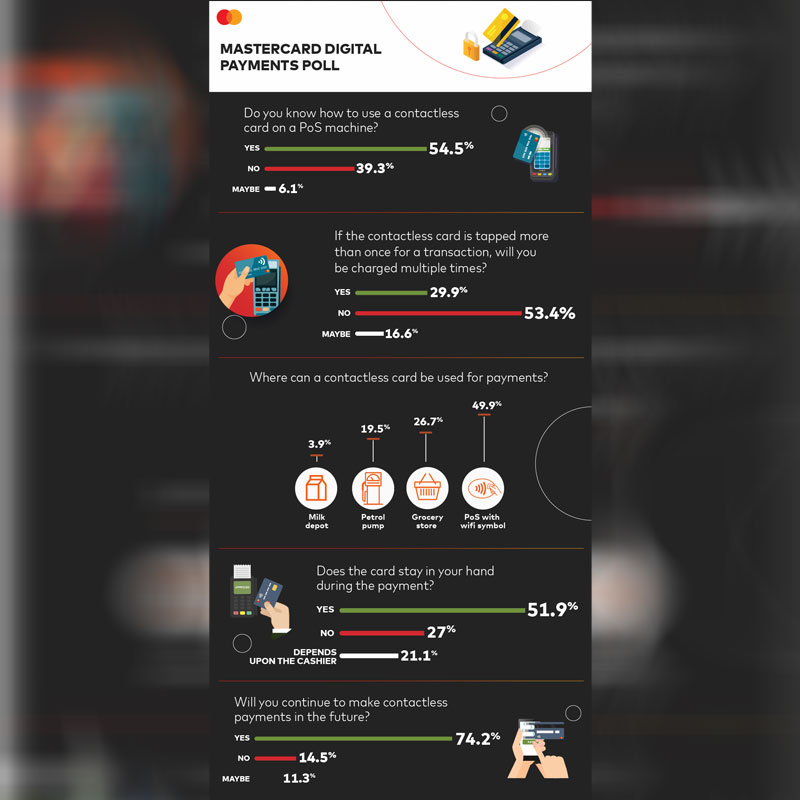
    To garner more insights on Indian consumer sentiment towards contactless payments Mastercard in India recently conducted a digital payments poll. Indian consumers show an increased awareness and positive shift in preferences towards contactless payments:

    Over 54 per cent of the respondents know how to use a contactless card on a PoS machine
    53  per cent of the respondents know that consumers don’t get charged multiple times if the contactless card is tapped more than once. However, 30  per cent   did not know this highlighting the need for more awareness of the safety of contactless payments
    74 per cent of the respondents, a high number, said that they will continue to make purchases digitally or via contactless mode in the coming times
    51  per cent   of the respondents know that contactless card remains in the hand of the customer while making a transaction
    49  per cent   of the voters know that a POS machine with a WIFI symbol will allow them to use a contactless card to make a payment

    Increase in awareness and usage of digital payments

    In the current environment, there has been significant growth in adoption of contactless payments both globally and in India. Consumers are aware that contactless technology and digital payments can ease some of the tension by reducing a measure of daily risk when we pay. This technology also empowers some of the most financially vulnerable with a safe and secure way to make and receive payments.

    According to recent Mastercard data, there is a 19 per cent increase in the actual contactless cards issued in Q1 2020 over Q4 2019. Currently, the top 5 cities in contactless transactions are Bengaluru at 16 per cent, Delhi and NCR at 12 per cent, Chennai at seven per cent and Mumbai at six per cent. The South region dominates the contactless ecosystem with maximum number of contactless transactions seen there. Bangalore has by far the highest number of contactless transactions, more than twice the next city which is Hyderabad.

    Interestingly penetration of contactless transactions is the highest in the lowest ticket size. Below $ 10 seems to be the sweet spot for contactless transactions in India and this trend bodes well for mass adoption. India is making rapid strides in bridging the digital payments divide. Penetration of contactless transactions is being driven by the top four categories that includes food stores, restaurants, fuel and drug stores dominating the contactless ecosystem. Food stores, restaurants and bars and gas stations are the only category with one million + transactions in each month of Q1 2020.

    The poll was conducted with approximately 39288 individuals between 15-19 June 2020 through Twitter. 

  • Brands join moment marketing with Janmashtami creatives

    Brands join moment marketing with Janmashtami creatives

    NEW DELHI: Festivals hold an importance for all. Last week, brands portrayed campaigns on the theme of Raksha Bandhan and this week they are celebrating lord Krishna’s birthday aka Janmashtami.

    Dahi Handi events are held with much cheer, especially in Mumbai. However, due to the Covid2019 pandemic, all celebration activities are cancelled and people are enjoying the festival at home. But despite the real celebrations being lower, social media has helped keep up the spirit. This time brands have not launched specific campaigns due to subdued budgets but have invested on digital media.

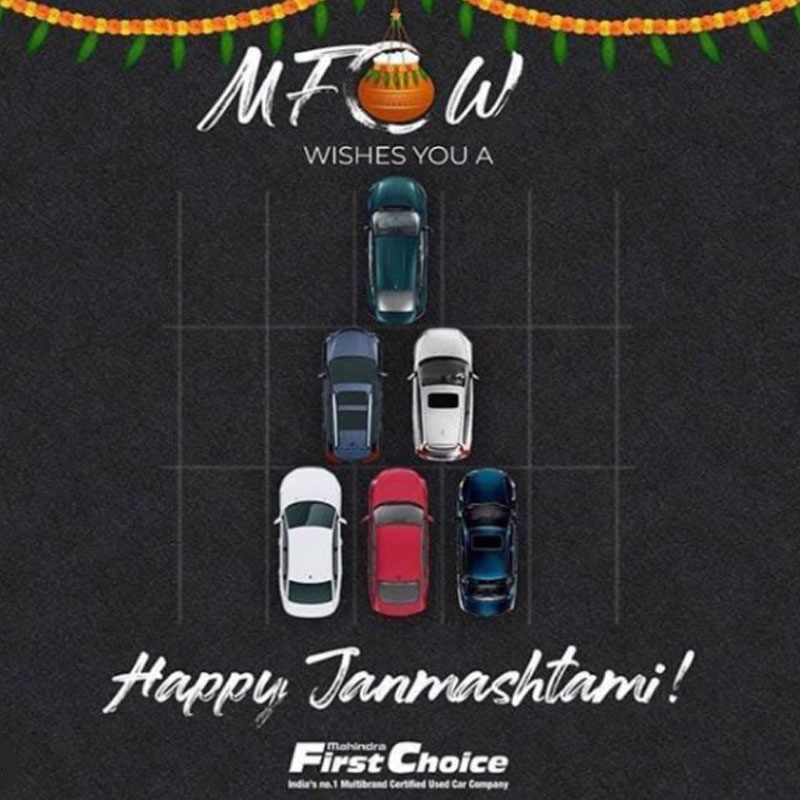
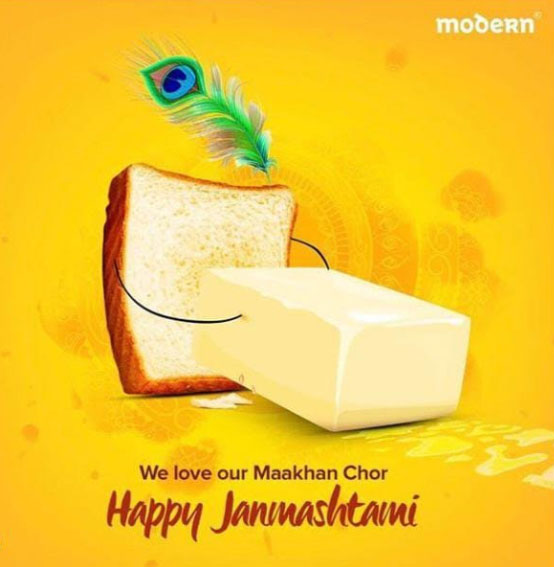
    Zomato, Modern Foods, Madhusudan, Maruti Suzuki's First Choice and others have launched interesting creatives on social media platforms.

    Brands and their digital agencies hop on these opportunities to engagingly connect with the audience and generate an emotional bonding.

    Here’s a look at some of the best creatives from brands on the birth of lord Krishna:

  • Brands doing moment marketing the Binod way

    Brands doing moment marketing the Binod way

    NEW DELHI: Internet is a weird place; from woke discussions on politics, society, and economy to reviews of movies, shows, and books, to national and international news, to good and bad memes, anything can be found on the web. The place has often provided brands great moment marketing ideas , like the costly bananas that Rahul Bose once ate and the recent Netflix release, Indian Matchmaking . 

    While most of these moment marketing themes had a context or content to spur the reactions and brand participation, the most recent bait to catch brands’ attention — Binod — left many scratching their heads. The faceless man is viral with no great feat achieved.

    The trend originated from a YouTube parody video covering weird comments that the creators, Abhyudaya and Gautami were getting on their channel Slayy Point and one fine gentleman named Binod Tharu had innocently commented, well, his own first name. After several days of the video going online, some bright minds of the web noticed the comment and started a hilarious meme fest over the weekend, which was soon joined by some of the brands.

    One of the first few to join the league was Paytm, which upon getting prompted by its followers, changed its name on Twitter to Binod.

    Here are some more brands that joined the moment marketing fest that Binod sparked.

    Amazon Prime India

    Call 112 Uttar Pradesh

    Disney + Hotstar

    Mumbai Police

    State Bank of India

    Surat City Traffic Police

    Tinder India

  • Omnicom Media Group named SAP Global Media AOR

    Omnicom Media Group named SAP Global Media AOR

    NEW DELHI:  Omnicom Media Group (OMG), the media services division of Omnicom Group Inc, has been named media agency network-of-record for global software corporation SAP SE to support SAP Marketing’s global paid media planning and buying activities. The decision follows an extensive review in which OMG presented North Star, a customised media unit that draws talent, tools and technology from the entire Omnicom Media Group network   as a solution to continue the acceleration of SAP’s unified customer and brand experience. Supported by the Omni operating system, North Star enables innovative and meaningful end-to-end consumer experiences that drive better business outcomes.   

    SAP’s media business has been with OMG’s PHD Worldwide since 2015.

    Initiated by SAP Global Chief Marketing Officer, Alicia Tillman, this new relationship with Omnicom serves as another critical element to furthering SAP’s progress in becoming one of the 10 most valuable brands in the world. “We are confident that Omnicom Media Group’s strategic capabilities, best-in-class tools and diverse, data-led approach will help SAP continue to grow our brand value, modernize our marketing capabilities to deliver innovative experiences most meaningful to our customers and the broader markets we serve,” said Tillman. “Since 2016, we have grown our brand value over $18B and this new agency partnership will support our vision of executing in a more innovative, agile, flexible and efficient way for the continued benefit of our customers, stakeholders and for SAP’s global ecosystem.”

    “This is a transformative moment for SAP, requiring a transformative approach,” says OMD Worldwide CEO Florian Adamski, who led the cross-network pitch team.  “With North Star we’re expanding the foundation built  by PHD over the past five years to create a re-envisioned solution: a   totally connected, cross-agency  operational network that enables a global vision for media while maintaining local specificity and execution; delivers a seamless experience across media and creative; and assures data  flexibility and transparency –  all of which are integral to a SAP’s growth strategy and long-term vision.” 

    The current PHD team will continue to support SAP through the transition period, which should be complete by end of year 2020. 

  • Zenith: global ad spend to dive 9.1% in 2020

    Zenith: global ad spend to dive 9.1% in 2020

    MUMBAI: There appears to be doom and gloom for the media sector, considering the sharp downturn in consumer sentiment and in advertising courtesy Covid2019.  Global agency Zenith concurs with this view and has revised its numbers for 2020.

    In its latest Advertising Expenditure Forecasts report, it says that the decline in global ad spend will be 9.1 per cent in 2020, much lower than the 9.5 per cent drop experienced during the recession of 2009. And it is also optimistic about 2021 when it says ad dollars will rise by 5.8 per cent buoyed by the Olympics in Tokyo and the UEFA Cup in Europe.

    It explains that advertisers pulled the plug when the scale of the pandemic started becoming clear and the worst period was between March and May 2020, with the timing varying by country, the agency said. But with the unlocking happening in many territories ad spends will start climbing back again.  

    Zenith pointed out that various regions are expected to decline with differing intensities. US adex is expected to dip just seven per cent, benefiting from political spending around the presidential elections in November. Asia Pacific is forecast to shrink by eight per cent, thanks to the success of some markets in keeping the virus under control. Advertisers in western Europe cut spend aggressively in Q2 and there the shrinkage will be a sharper 15 per cent. Central and eastern Europe will decline eight per cent, Latam 13 per cent and MENA by 20 per cent.

    Legacy media such as print, television and radio are all expected to be impacted, though the latter two will have it easier. TV and radio are expected to be hit by 11 per cent and 12 per cent drops, while newspaper and magazine advertising are expected to get 21 per cent and 20 per cent shaves in what advertisers spend on them. Zenith says that the crisis has only exacerbated the long term decline that print advertising has been witnessing for some time now. Out-of-home and cinema have suffered the most from government restrictions on movement, and consumers’ avoidance of public places. Out-of-home advertising is forecast to shrink by 25 per cent in 2020 and cinema by 51 per cent.

    Digital advertising will end 2020 with just a thin slice of two per cent cut out of its growth. Consumption of digital media, along with television, spiked in the early weeks of lockdown. Although both are now trending down again, they are not expected to retreat to pre-crisis levels any time soon. Together with the rise of e-commerce and data, this has driven a rapid shift in media budgets from traditional to digital media, accelerating the trend that was already taking place. Zenith now forecasts that digital advertising will account for 51 per cent of global ad spend this year, up from the 49.5 per cent it forecast in December.

    Digital ad budgets were cut quickly in the crisis’ first phase, says Zenith, given that it is generally easier to cut without penalty. But as time progressed, brands allocated more budget into digital channels to take advantage of their flexibility and ability to optimise performance, particularly important qualities in an uncertain time. Zenith does not expect any of digital’s share to return to traditional media as the crisis eases – its market share is forecast to reach 54.6 per cent in 2022.

    The agency disclosed that the pandemic has imposed some behavioural changes in consumers, they are relying increasingly on e-shopping and e-commerce. It cited global research by Criteo which said that in recent months 53 per cent of consumers have discovered at least one form of online shopping that they plan to continue. Retail footfall will be subdued for months, if not years, to come, says Zenith. This has forced brands to accelerate digital transformation efforts and made it critical to have a robust commerce strategy in place, either D2C or through retail partners.

    The crisis also raised the value of first-party data for brands. First-party data gives brands powerful insights into their customers’ behaviour and provides a real competitive edge. It will allow brands to navigate changes to consumers’ behaviours and attitudes as the crisis develops, and identify when it’s time to start investing for the upturn.

    Zenith is not optimistic about the prospects for advertising in newspapers and magazines in 2021, both will continue to slide. As compared to this TV and radio will grow two per cent and one per cent respectively. While OOH and cinema will spurt 16 per cent and 65 per cent respectively in 2021, they will not revert to the 2019 peak even by 2022.

    “The Covid2019 forced brands to embrace digital advertising even faster than expected and made digital transformation of businesses more urgent than ever,” said Zenith’s head of forecasting Jonathan Barnard. “This year will be the first in which digital advertising will attract more than half of total global ad spend, a milestone we previously expected in 2021.”

  • Fork Media Group  launches ContextAds across India, GCC and SEA regions

    Fork Media Group launches ContextAds across India, GCC and SEA regions

    NEW DELHI:  Media tech entity – Fork Media Group announced the launch of ContextAds – a programmatic platform to enable marketers adopt a holistic approach towards digital advertising. Having delivered over 1000+ brand campaigns through the managed service route, the programmatic platform of ContextAds is an advancement to the digital advertising offering of Fork Media Group.  ContextAds enables brands to take a well-informed ad decision through its AI/ML backed platforms while helping marketers establish a stronger brand connect. Through this platform, brands get granular details like sentiments, entities, content categories, user intent and hence they don’t have to rely on just a bunch of keywords and categories to make ad decisions. 

    ContextAds is an SSP with a data management platform backed by one of its kind combinations of context and audience data married with crucial factors like content quality, brand safety, and viewability. The platform gives marketeers access to over 100+ publications across India, GCC & SEA regions. Through ContextAds, marketeers can process the image. article text, headline categorization to not only deliver context but also deliver other extremely relevant parameters such as brand safety including dynamically striking off nudity, violence, negative social trend through entity extraction. This enables brands to target audience / context or both for a particular category that marries itself seamless to their product's attributes.

    In addition to helping marketeers, Fork Media Group is also helping publishers to improve the yield optimisation of advertising space inventory on websites to minimise wasted space and maximise views. Talking about the new launch, Fork Media Group founder and group CEO-Sammar Verma says,” The platform was built with a view to solve the problem of declining yield on display for publishers. We have always viewed the conventional display formats to be broken and hence, we identified context as a key missing link in the whole chain. Through this platform, we aim to bring back the incremental value on inventory through context. Historically, context has existed in the market primarily through key-word targeting and, in our view, that approach is highly inaccurate so technologically we have taken this light years ahead with AI & ML. We have now added layers of audience to our context data and programmatic capabilities to further enhance context delivery and monetization respectively.”

    Adding his thoughts on the relevance building aspect offered by the platform, Fork Media CTO Nikhil Sheth says, “Our proprietary ContextAds technology scans content and images across millions of pages, helping you to target contextually relevant pages. Our page screening technology also ensures that your brand is never advertised on pages with any inappropriate content. Along with this, our audience targeting helps you to target right audience based on their interest and behaviour. By combining power of page context, content safety and right audience, we make sure that your reach right audience all the time.”

    Talking about leveraging a tech-forward approach, Context Ads Product Head-Santosh Khandekar says, “With ContextAds, we are aiming to revolutionize the ad-decision model while delivering a controlled and scalable media buying experience through the Private Marketplace (PMP). Our proprietary technology managed to combine the Audience with Context to get a conclusive understanding of the user's past activities and present content consumption, helping brands deliver personalized brand awareness through innovative ads.”

    Follow Tellychakkar for the consumer facing news & entertainment

  • Isobar India launches experience-led transformation consulting practice ‘Isobar Consulting’

    Isobar India launches experience-led transformation consulting practice ‘Isobar Consulting’

    NEW DELHI: Isobar, the digital agency from the house of Dentsu Aegis Network (DAN), has announced the launch of Isobar Consulting in India. A global transformation consultancy, Isobar Consulting will help brands define their digital transformation strategies. It will also help brands construct roadmaps to unlock their exponential business growth within the country while reinforcing Isobar's strategic capabilities to deliver experience-led transformation and ensuring excellence in the delivery of end-to-end solutions to clients.

    The offering has been developed to respond to the demand for customer-centric solutions to drive growth. It has been built on the strong plinth of Isobar India Group's existing consulting capabilities – powered by Fractal Ink and Isobar India. For the record, Fractal Ink and Isobar India have strong experience in delivering experience-led transformation projects in markets such as India, Switzerland, Mauritius, Indonesia, Kenya, Egypt, and parts of the Middle East.

    In its initial phase, Isobar Consulting will help companies build their digital culture. It will create digital transformation roadmaps by identifying internal operational efficiencies and opportunities to ace the X-factor for end consumers, partners, and employees, and, thus, foster the industry’s 4.0 capabilities.

    Isobar Consulting will be led by Priyanka Agrawal, co-founder, COO and chief strategy officer, Fractal Ink, as country head. Additionally, the agency has also appointed Rahul Vengalil as chief business officer, Isobar Consulting. Both Agrawal and Vengalil will report into Shamsuddin Jasani, Group MD, Isobar South Asia.

    Shamsuddin said, “We have been readying ourselves to launch this world-class experience-led transformation business for almost six months now. However, we wanted to fine tune it before launch and now, on the back of two big wins, we are launching Isobar Consulting. I feel that by drawing capabilities from two of the finest agencies within the Isobar India group – Fractal Ink and Isobar India, we can deliver a roadmap for a lot of businesses that seek this transformation. experience-led transformation is our key offering, and we genuinely believe that we have a substantial competitive advantage in this space. With the addition of this service, the Isobar India Group can deliver end-to-end solutions to clients – right from consulting to delivery.”

    Agrawal added, "The digital world is changing at a break-neck speed. We realised we need a new formula for the new era that a traditional consulting or design agency alone cannot deliver – an experience-led innovation consulting. We merged the design strategy, creative, and digital capabilities of Fractal Ink and the broad reach, mar-tech experience, and deep business and brand strategy of Isobar India to create something that brings immense value to our clients and catapults their growth. With depth, commitment, and impact in our DNA, we strive to orchestrate the capabilities to truly change the game and deliver insights at speed and solutions at scale. We are looking forward to be a part and reason for the digital transformation success stories of companies.”

    Speaking on the appointment and launch, Vengalil commented, "Digital platforms and technologies have become an integral part of consumer journeys today. It is not an advertising platform for them. They are transacting, communicating, researching, building relationships, banking, etc. It is a different life for consumers on digital. Forward-looking businesses need to understand consumer needs and solve their problems using digital solutions. For this, we need to change the existing advertising codes and reorient the entire organization to keep consumer needs and problems at the centre.”

    Isobar Consulting will drive this experience-led Transformation practice across all Dentsu Aegis Network offices in India.

  • WATConsult finds 70% of internet users to access in local languages by Dec 2020

    WATConsult finds 70% of internet users to access in local languages by Dec 2020

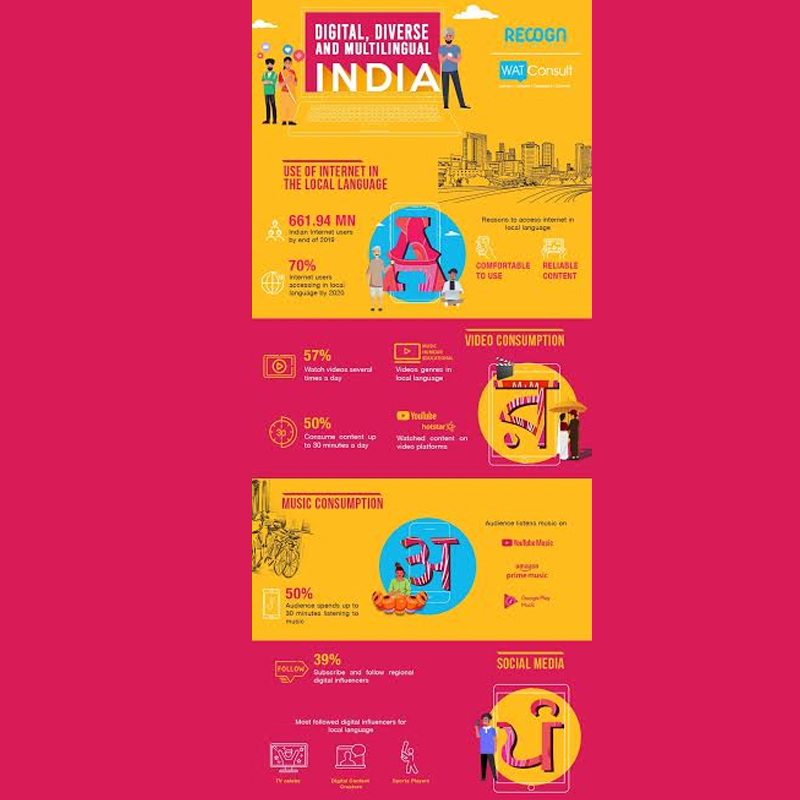
    MUMBAI: WATConsult, the globally awarded hybrid digital agency from the house of Dentsu Aegis Network (DAN) India, under its market research division –Recogn, has unveiled its latest report on ‘Digital, Diverse & Multilingual India’. The report maps digital content consumption patterns of Indian users across local and regional languages. It also shares an in-depth analysis of the users’ preferences inside the Indian demography.

    Over the past few years, internet usage behaviour has changed tremendously with more users accessing the internet in their respective languages. Also, whilst most Indians are well-versed in at least two languages, it is observed that they are more comfortable accessing information in their local dialects. Consequently, a variety of digital solutions along with mobile and internet applications have recently been introduced in several local languages to cater to such consumer demands.

    This report, therefore, brings afore the digital content consumption patterns of these users across categories such as music, video streaming, and short-and-long-format content, amongst others. For a deeper understanding of the audience, the report has further segmented them into categories like functional users, casual users, students, etc.

    Below are the key findings of the report: 

        By December 2020, WATConsult estimates that close to 70% of all internet users will access the internet in their local languages.

        A majority of Indians prefer watching content around food, entertainment and education in their local language.

        Video content on technology, gadgets, fashion, and sports are preferred to be consumed in English.

        57% of the audiences watch online videos several times a day. YouTube is the most used application to watch and consume online video content, followed by Hotstar     and JioTV.

        There has been a great transition in the music streaming market with the advent of global players like Spotify, YouTube Music, and others. The audiences prefer     listening to music in their local or regional languages because it builds an emotional connect.

        While browsing on social media platforms, more than one-fourth of the users like to consume content related to memes, videos, images, etc. in their local language.
        More than one-fourth of the users feel that the search results in their local language is inaccurate.

        43% of the housewives feel that there are limited options to choose the language on online shopping websites. Lack of this local language feature does not result in a suitable experience that the customer is looking for.

    Speaking on the report WATConsult CEO Heeru Dingra said, “The report brings across a plethora of interesting data that can be further useful for stalwarts across industries. Since India is a diverse country with multiple languages and dialects, we believe that it is extremely important to approach consumers in the languages they prefer. While it is a mammoth challenge to process and train all the data for so many different languages, the insights presented in the report would benefit marketers significantly in chalking their way ahead.”

    The report can be viewed on: (https://www.watconsult.com/watinsights/local-language/)and is available for download at Rs. 999.

    Follow Tellychakkar for the consumer facing news & entertainment