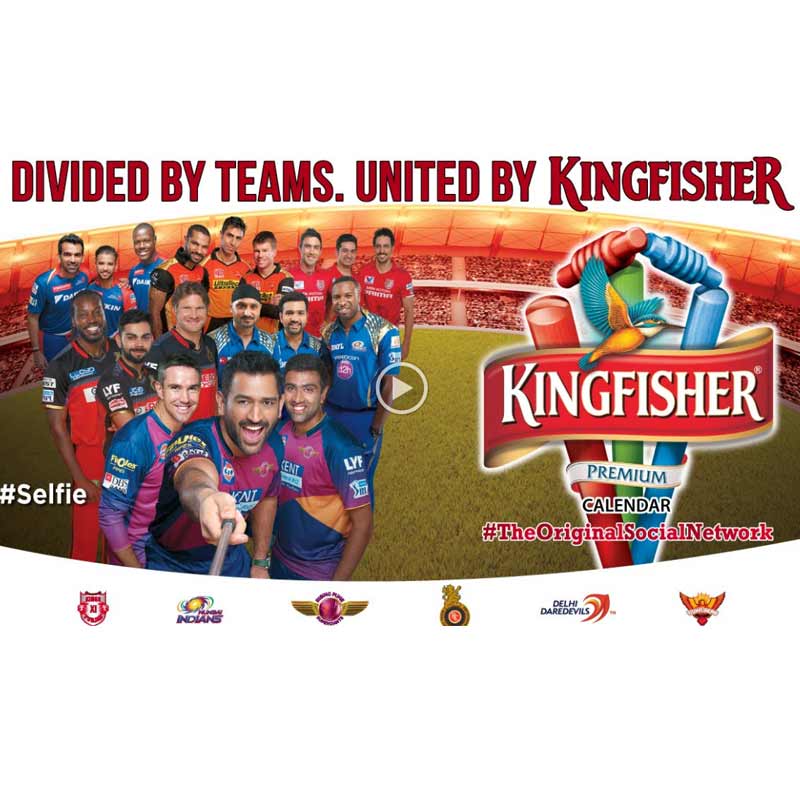
New Delhi: The ‘Singing cricketers’ dancing to the Kingfisher jingle O la la Leo O has become the first ever television commercial shot entirely by the cricketers themselves/
The TVC is aimed at cricketers celebrating on the streets in their respective cities and interacting with their fans.
This is claimed to be the first ever campaign shot entirely in a selfie mode – using hand held phones, cameras, selfie sticks and drones
The TV campaign took 24 international cricketers and close to a thousand fans to create this magnum opus.
In the current season of T20 Indian Premier League, Kingfisher is associated with six of the eight teams – Royal Challengers Bangalore, Rising Pune Supergiants, Mumbai Indians, Sunrisers Hyderabad, Delhi Daredevils and Kings XI Punjab.
UBL Senior Vice President Marketing Samar Singh Sheikhawat said “True to the tagline ‘Divided by teams, United by Kingfisher’, the newly launched television commercial for this season’s T20 extravaganza captures the spirit of camaraderie and sportsmanship that binds the teams together. Our latest campaign highlights the game of cricket as more than a sport; it is a medium that brings together diverse people in celebration and revelry. This is in perfect sync with Kingfisher’s positioning as the Original Social Network – some of the best memories are made while watching a game of cricket and sipping on some cold Kingfisher brew!”
In March, Kingfisher introduced the first of its kind Special Edition Cricket Pack, which combined the love for the game and the power of the innovation, to bring this experience in to every consumer’s hand.
This was followed up by a new TV commercial themed around its campaign ‘The Original Social Network’. Building up the crescendo, the iconic ‘Oo la la le lo’ advertisement hit the screens, featuring cricketers singing and celebrating on the streets of their respective home cities.
New Delhi: The ‘Singing cricketers’ dancing to the Kingfisher jingle O la la Leo O has become the first ever television commercial shot entirely by the cricketers themselves/
The TVC is aimed at cricketers celebrating on the streets in their respective cities and interacting with their fans.
This is claimed to be the first ever campaign shot entirely in a selfie mode – using hand held phones, cameras, selfie sticks and drones
The TV campaign took 24 international cricketers and close to a thousand fans to create this magnum opus.
In the current season of T20 Indian Premier League, Kingfisher is associated with six of the eight teams – Royal Challengers Bangalore, Rising Pune Supergiants, Mumbai Indians, Sunrisers Hyderabad, Delhi Daredevils and Kings XI Punjab.
UBL Senior Vice President Marketing Samar Singh Sheikhawat said “True to the tagline ‘Divided by teams, United by Kingfisher’, the newly launched television commercial for this season’s T20 extravaganza captures the spirit of camaraderie and sportsmanship that binds the teams together. Our latest campaign highlights the game of cricket as more than a sport; it is a medium that brings together diverse people in celebration and revelry. This is in perfect sync with Kingfisher’s positioning as the Original Social Network – some of the best memories are made while watching a game of cricket and sipping on some cold Kingfisher brew!”
In March, Kingfisher introduced the first of its kind Special Edition Cricket Pack, which combined the love for the game and the power of the innovation, to bring this experience in to every consumer’s hand.
This was followed up by a new TV commercial themed around its campaign ‘The Original Social Network’. Building up the crescendo, the iconic ‘Oo la la le lo’ advertisement hit the screens, featuring cricketers singing and celebrating on the streets of their respective home cities.
NEW DELHI: ‘Be your own hero’, an advertising campaign by Wrogn with Virat Kohli as the chief brand evangelist, is a bold and irreverent take on the symbolism of idol worship.
Virat Kohli is seen breaking statutes and tearing posters of his own ‘imagery’ with a message to move ahead and not get caught up trying to be someone else. This new campaign is being rolled out nationally across outdoor, print and digital mediums in Tier-1 cities.
Wrogn’s brand philosophy incorporates questioning the conventions, accepted norms and expected fads by shunning symmetry and conformity. The new ‘Be your own hero’ advertising campaign extends this brand philosophy with a new narrative that captures the essence of the youth of today.
Universal Sportsbiz CEO Anjana Reddy said: “WROGN is one of the fastest growing brands in the youth fashion segment. With Virat Kohli as the Chief Brand Evangelist, it has helped us form a deep connect with youth across the country and our new ‘Be your own hero’ campaign will endear him further to the target groups. With our new Wrogn Exclusive Brand Outlet (EBO) strategy and the new campaign, Wrogn will consolidate its position as the number #1 choice in the youth fashion segment for casual wear.”
Fisheye Creative Solutions Pvt Ltd CEO & Strategy Head Dave Banerjee said, “Perhaps no other country hero worships movie stars, cricketers or even politicians like we Indians do. That probably comes from an innate inferiority complex, a sense of subservience. As a breakaway youth fashion brand, we thought Wrogn is in a good position to address this issue. Virat, who’s easily the most influential youth icon, is in a very unique position to speak openly about it and try to make the Indian youth start looking up to themselves rather than some other ‘hero’.”
Wrogn co-founder Virat Kohli said, “I am extremely excited with the new ‘Be your own hero’ campaign for Wrogn. The world has changed and the new campaign reflects the change. Social media is an indicator that every individual is now his or her own ‘hero’ in a way and the campaign captures this cultural change with dramatic effect. I’m keen to know the feedback of the youth and will be waiting for comments on my social media channels. Wrogn as a brand is growing very fast and I’m extremely enthused with the response from fans and customers across India”.
NEW DELHI: ‘Be your own hero’, an advertising campaign by Wrogn with Virat Kohli as the chief brand evangelist, is a bold and irreverent take on the symbolism of idol worship.
Virat Kohli is seen breaking statutes and tearing posters of his own ‘imagery’ with a message to move ahead and not get caught up trying to be someone else. This new campaign is being rolled out nationally across outdoor, print and digital mediums in Tier-1 cities.
Wrogn’s brand philosophy incorporates questioning the conventions, accepted norms and expected fads by shunning symmetry and conformity. The new ‘Be your own hero’ advertising campaign extends this brand philosophy with a new narrative that captures the essence of the youth of today.
Universal Sportsbiz CEO Anjana Reddy said: “WROGN is one of the fastest growing brands in the youth fashion segment. With Virat Kohli as the Chief Brand Evangelist, it has helped us form a deep connect with youth across the country and our new ‘Be your own hero’ campaign will endear him further to the target groups. With our new Wrogn Exclusive Brand Outlet (EBO) strategy and the new campaign, Wrogn will consolidate its position as the number #1 choice in the youth fashion segment for casual wear.”
Fisheye Creative Solutions Pvt Ltd CEO & Strategy Head Dave Banerjee said, “Perhaps no other country hero worships movie stars, cricketers or even politicians like we Indians do. That probably comes from an innate inferiority complex, a sense of subservience. As a breakaway youth fashion brand, we thought Wrogn is in a good position to address this issue. Virat, who’s easily the most influential youth icon, is in a very unique position to speak openly about it and try to make the Indian youth start looking up to themselves rather than some other ‘hero’.”
Wrogn co-founder Virat Kohli said, “I am extremely excited with the new ‘Be your own hero’ campaign for Wrogn. The world has changed and the new campaign reflects the change. Social media is an indicator that every individual is now his or her own ‘hero’ in a way and the campaign captures this cultural change with dramatic effect. I’m keen to know the feedback of the youth and will be waiting for comments on my social media channels. Wrogn as a brand is growing very fast and I’m extremely enthused with the response from fans and customers across India”.
MUMBAI: There is no dearth of ‘shocking’ videos that circulate the internet and take netizens by a storm for a brief period of time, but rarely does one leave a lasting impact like PETA’s Behind That Exotic-Skin Handbag.
As the name reflects, the video aims to bring to light the controversial and yet generally known issue of animal cruelty in the luxury leatherwear industry.
In partnership with advertising mammoth Ogilvy and Mather, PETA manages to capture the macabre behind the leather fashion industry by bringing it to the glossier front of the showroom.
For years PETA has fought against the cruel abuse of animals in the leather industry with a major challenge being to convince the fashionistas who, though sympathise with the cause, but completely dissociate from it when admiring that fine leather clutch in the showroom.
Therefore Ogilvy and Mather were up for a challenge to execute a campaign that not only effectively spreads the message but lets people experience the cruelty first hand.
“It is a challenge how to communicate the same message that has been done in various forms effectively with impact. So, we came up with this campaign that not only delivers the message but to let the target audiences experience the cruelty in their hands,” Ogilvy & Mather Thailand, Vice Chairman and Chief Creative Officer Nopadol Srikieatikajohn.
The mandate from PETA was simple, “no animals should be killed and used in the process of campaign production,” and that’s exactly what Ogilvy did, much to the surprise of those who have seen the video.
They created a pop up store ‘Leatherworks’ in the heart of Thailand’s largest shopping centres, promising urban shoppers and fashionistas leather goods, more real than they perhaps ever wanted.
The objective was clear: to convince fashion lovers to give up on real leather merchandise and go for faux leather or synthetic leather, and they did so amazingly by shocking potential buyers ‘beating hearts’, ‘bloody skins,’ and ‘gory sinews’. Ironically, the bloody ‘insides’ showcased in the video really are made up of various types of plastic and synthetic material, as per PETA Asia Pacific. To give it that realistic appeal was the most challenging part of executing this campaign, pointed out Srikieatikajohn..
“The organ mock ups and mechanics was one of the most challenging parts. It doesn’t only need to look real but the mechanic behind also has to be programmed perfectly with the sensor detection to make the organs move when they were exposed to the light (when the bags opened.) This experiment process took up to 12 weeks before we get the perfect fully functioned mock ups running,” he explained.
“It wasn’t an easy job to set up a show that looked real enough to come shop either. To make it most effective, it had to be at the centre of a tourist shopping district. With budget constraints and a very provoking campaign idea, it was really hard to find the right venue that could support us and agree with the small budget. After 3 to 4 location surveys and contacts, we finally found the one that worked.”
“It took two months– from showroom design to the full set up. Before we were allowed to rent the store, campaign details and store design were submitted to the landlord for approval,” the creative explained.
When asked about the people shown in the published video, Srikieatikajohn said, “With the legal issues, some of the footage of real shoppers cannot be used. The people in the Video are a mix of real shoppers and people that we invited to the shop; however they were all unaware of what they would see in the shop while we were filming and we captured their real shocking reactions.”
The issue with a shocking brand communication is that sometimes people might be overwhelmed by the shock and forget the underlying message. PETA and O&M knew this well, and were patient with how people responded to the campaign and the following video.
“We did not expect them to understand the message right away so we had a staff approached them right after they found out what’s inside, handed out the brochure and explained the true message behind the campaign,” Srikieatikajohn said.
“Every year, hundreds of thousands of reptiles are crudely bludgeoned and skinned alive, all for the sake of so-called ‘luxury’ shoes, belts and bags”, says PETA India Chief Executive Officer Poorva Joshipura. “PETA Asia’s gruesome pop-up shop reminds shoppers that the only way to keep blood and guts out of our closets is to choose vegan clothing, shoes and accessories,” she added in parting.
MUMBAI: There is no dearth of ‘shocking’ videos that circulate the internet and take netizens by a storm for a brief period of time, but rarely does one leave a lasting impact like PETA’s Behind That Exotic-Skin Handbag.
As the name reflects, the video aims to bring to light the controversial and yet generally known issue of animal cruelty in the luxury leatherwear industry.
In partnership with advertising mammoth Ogilvy and Mather, PETA manages to capture the macabre behind the leather fashion industry by bringing it to the glossier front of the showroom.
For years PETA has fought against the cruel abuse of animals in the leather industry with a major challenge being to convince the fashionistas who, though sympathise with the cause, but completely dissociate from it when admiring that fine leather clutch in the showroom.
Therefore Ogilvy and Mather were up for a challenge to execute a campaign that not only effectively spreads the message but lets people experience the cruelty first hand.
“It is a challenge how to communicate the same message that has been done in various forms effectively with impact. So, we came up with this campaign that not only delivers the message but to let the target audiences experience the cruelty in their hands,” Ogilvy & Mather Thailand, Vice Chairman and Chief Creative Officer Nopadol Srikieatikajohn.
The mandate from PETA was simple, “no animals should be killed and used in the process of campaign production,” and that’s exactly what Ogilvy did, much to the surprise of those who have seen the video.
They created a pop up store ‘Leatherworks’ in the heart of Thailand’s largest shopping centres, promising urban shoppers and fashionistas leather goods, more real than they perhaps ever wanted.
The objective was clear: to convince fashion lovers to give up on real leather merchandise and go for faux leather or synthetic leather, and they did so amazingly by shocking potential buyers ‘beating hearts’, ‘bloody skins,’ and ‘gory sinews’. Ironically, the bloody ‘insides’ showcased in the video really are made up of various types of plastic and synthetic material, as per PETA Asia Pacific. To give it that realistic appeal was the most challenging part of executing this campaign, pointed out Srikieatikajohn..
“The organ mock ups and mechanics was one of the most challenging parts. It doesn’t only need to look real but the mechanic behind also has to be programmed perfectly with the sensor detection to make the organs move when they were exposed to the light (when the bags opened.) This experiment process took up to 12 weeks before we get the perfect fully functioned mock ups running,” he explained.
“It wasn’t an easy job to set up a show that looked real enough to come shop either. To make it most effective, it had to be at the centre of a tourist shopping district. With budget constraints and a very provoking campaign idea, it was really hard to find the right venue that could support us and agree with the small budget. After 3 to 4 location surveys and contacts, we finally found the one that worked.”
“It took two months– from showroom design to the full set up. Before we were allowed to rent the store, campaign details and store design were submitted to the landlord for approval,” the creative explained.
When asked about the people shown in the published video, Srikieatikajohn said, “With the legal issues, some of the footage of real shoppers cannot be used. The people in the Video are a mix of real shoppers and people that we invited to the shop; however they were all unaware of what they would see in the shop while we were filming and we captured their real shocking reactions.”
The issue with a shocking brand communication is that sometimes people might be overwhelmed by the shock and forget the underlying message. PETA and O&M knew this well, and were patient with how people responded to the campaign and the following video.
“We did not expect them to understand the message right away so we had a staff approached them right after they found out what’s inside, handed out the brochure and explained the true message behind the campaign,” Srikieatikajohn said.
“Every year, hundreds of thousands of reptiles are crudely bludgeoned and skinned alive, all for the sake of so-called ‘luxury’ shoes, belts and bags”, says PETA India Chief Executive Officer Poorva Joshipura. “PETA Asia’s gruesome pop-up shop reminds shoppers that the only way to keep blood and guts out of our closets is to choose vegan clothing, shoes and accessories,” she added in parting.
MUMBAI: Going by the almost half page print ads on major dailies issued by The Tobacco Institute of India claiming to enlighten readers on ‘the facts behind about pictorial warnings on cigarette packs’, one must know that one is witnessing a war in progress. Yes, a war whose trumpet was blown when the Health Ministry of India issued a strict mandate asking all tobacco manufacturers to cover 85 percent of a cigarette pack’s surface with health warning from April 1 2016.
This left the major cigarette manufacturers in the country smouldering, and they soon met the government’s fire with a threat to shut down the manufacturing units on grounds of ‘ambiguity’ of the mandate. When the government did not entertain the letter written to the Ministry of Health & Family Welfare on 15 March, 2016, asking clarity on the mandate, the industry lobby group, Tobacco Institute Of India followed up their threat with action.
By April 1, ITC, which is India’s largest cigarette manufacturer and major stakeholder in TII, had shut down its factories, followed by Godfrey Phillips, which is a partner of Philip Morris of the US, and VST Industries, according to the Tobacco Institute of India. Albeit, the move was worded differently by The Tobacco Institute of India –‘Fearing, potential violation of rules by continuing production, TII members have decided to shut their factories,’ was TII’s official stance on the matter read.
To add to this boycott of sorts, The Tobacco Institute of India has launched an intense campaign to challenge the reason behind implementing the 85 per cent pictorial warnings by the government. And they are doing so on two grounds — firstly, TII claims the pictorial warnings are excessive and non-factual and secondly, they are futile in checking consumers from buying foreign brands that are smuggled into the country.
‘Gruesome and oversized pictorial warning will give boost to illegal cigarettes and adversely impact the livelihood of 4.6 crore Indians,’ one such ad by TII on Times City‘s Mumbai edition read.
In fact, the lobby estimated that this rage quit of the major players (shutdown of manufacturing units) had cost the industry Rs 350 crore per day in production turnover. Backed with facts and figures, the tobacco lobby left no stone unturned to make for itself a strong case against the government’s mandate, questioning the usefulness of the increased pictorial warnings.
It may be recalled that India witnessed a similar tussle between a big corporation and government in recent time, where the government emerged victorious with flying colours. Mark Zuckerberg’s Facebook had launched a high decibel campaign to influence public opinion against the government ruling that hindered operation of Free Basics in India. In a similar strategy, Facebook had tried to appeal to the people of India about the prospect of bringing development and job creation, but the campaign was met with serious criticism as its motive was ‘oh so’ transparent to the public’s eye. The campaign failed to establish Facebook as a benevolent company that meant well for the people of India without any ulterior motive.
Several in the advertising industry believe that the tobacco lobby’s campaign is headed the same way, with the communication in the advertisement clearly giving away their motive, i.e., the withdrawal of the mandate, and undermines their ‘concern’ for the livelihood of the people involved in the tobacco Industry.
Some also feel that it is foolhardy on TII’s part to call the pictorial warnings unsuccessful or inefficient in regulating cigarette consumption in India and at the same time refusing to comply with it.
Few expect the government to answer back in a more strategic way, and instead of a counter campaign on print, get social influencers to publish articles on the harms of smoking cigarette.
This battle between regulatory authorities and the powerful Tobacco lobby isn’t restricted to India. The US saw a similar showdown between the large Tobacco Corporations. In the 1990s, the tobacco lobby engaged in a comprehensive and aggressive effort advancing its pro-tobacco agenda through campaigns to neutralise clean indoor air legislation.
The ‘Unswitchables’ campaign — featuring a black eyed smoker claiming to rather fight than quit smoking created quite a stir, the government cracked down on the tobacco manufacturers with stricter legislature, ending their days of glory in the country. (Source: The Advertising Age Encyclopaedia of Advertising By John McDonough and, Karen Egolf)
Will we see a similar story panning out in India, or does the future holds something different for the Tobacco lobby in India, given the socio-economic differences in the country? With the major Tobacco corporations spending big on advertising dollars in campaigning against the government, one can’t help but wonder if the government will also fight back with a counter campaign of its own, or will sit back let the TII fume and smoke, until its fire fizzles out?
MUMBAI: Going by the almost half page print ads on major dailies issued by The Tobacco Institute of India claiming to enlighten readers on ‘the facts behind about pictorial warnings on cigarette packs’, one must know that one is witnessing a war in progress. Yes, a war whose trumpet was blown when the Health Ministry of India issued a strict mandate asking all tobacco manufacturers to cover 85 percent of a cigarette pack’s surface with health warning from April 1 2016.
This left the major cigarette manufacturers in the country smouldering, and they soon met the government’s fire with a threat to shut down the manufacturing units on grounds of ‘ambiguity’ of the mandate. When the government did not entertain the letter written to the Ministry of Health & Family Welfare on 15 March, 2016, asking clarity on the mandate, the industry lobby group, Tobacco Institute Of India followed up their threat with action.
By April 1, ITC, which is India’s largest cigarette manufacturer and major stakeholder in TII, had shut down its factories, followed by Godfrey Phillips, which is a partner of Philip Morris of the US, and VST Industries, according to the Tobacco Institute of India. Albeit, the move was worded differently by The Tobacco Institute of India –‘Fearing, potential violation of rules by continuing production, TII members have decided to shut their factories,’ was TII’s official stance on the matter read.
To add to this boycott of sorts, The Tobacco Institute of India has launched an intense campaign to challenge the reason behind implementing the 85 per cent pictorial warnings by the government. And they are doing so on two grounds — firstly, TII claims the pictorial warnings are excessive and non-factual and secondly, they are futile in checking consumers from buying foreign brands that are smuggled into the country.
‘Gruesome and oversized pictorial warning will give boost to illegal cigarettes and adversely impact the livelihood of 4.6 crore Indians,’ one such ad by TII on Times City‘s Mumbai edition read.
In fact, the lobby estimated that this rage quit of the major players (shutdown of manufacturing units) had cost the industry Rs 350 crore per day in production turnover. Backed with facts and figures, the tobacco lobby left no stone unturned to make for itself a strong case against the government’s mandate, questioning the usefulness of the increased pictorial warnings.
It may be recalled that India witnessed a similar tussle between a big corporation and government in recent time, where the government emerged victorious with flying colours. Mark Zuckerberg’s Facebook had launched a high decibel campaign to influence public opinion against the government ruling that hindered operation of Free Basics in India. In a similar strategy, Facebook had tried to appeal to the people of India about the prospect of bringing development and job creation, but the campaign was met with serious criticism as its motive was ‘oh so’ transparent to the public’s eye. The campaign failed to establish Facebook as a benevolent company that meant well for the people of India without any ulterior motive.
Several in the advertising industry believe that the tobacco lobby’s campaign is headed the same way, with the communication in the advertisement clearly giving away their motive, i.e., the withdrawal of the mandate, and undermines their ‘concern’ for the livelihood of the people involved in the tobacco Industry.
Some also feel that it is foolhardy on TII’s part to call the pictorial warnings unsuccessful or inefficient in regulating cigarette consumption in India and at the same time refusing to comply with it.
Few expect the government to answer back in a more strategic way, and instead of a counter campaign on print, get social influencers to publish articles on the harms of smoking cigarette.
This battle between regulatory authorities and the powerful Tobacco lobby isn’t restricted to India. The US saw a similar showdown between the large Tobacco Corporations. In the 1990s, the tobacco lobby engaged in a comprehensive and aggressive effort advancing its pro-tobacco agenda through campaigns to neutralise clean indoor air legislation.
The ‘Unswitchables’ campaign — featuring a black eyed smoker claiming to rather fight than quit smoking created quite a stir, the government cracked down on the tobacco manufacturers with stricter legislature, ending their days of glory in the country. (Source: The Advertising Age Encyclopaedia of Advertising By John McDonough and, Karen Egolf)
Will we see a similar story panning out in India, or does the future holds something different for the Tobacco lobby in India, given the socio-economic differences in the country? With the major Tobacco corporations spending big on advertising dollars in campaigning against the government, one can’t help but wonder if the government will also fight back with a counter campaign of its own, or will sit back let the TII fume and smoke, until its fire fizzles out?
MUMBAI: Lodha Group has revealed an ad campaign with Deepika Padukone as the brand ambassador for its premium weekend home development, Lodha Belmondo. The campaign presents Deepika at her best and captured in various moods, enjoying her weekend on this plush property around a riverside Greg Norman golf course.
“Experienced #TheReserve at #Lodha Belmondo away from the hustle & bustle of Mumbai. My perfect #WeekendGetaway. One visit to Lodha Belmondo, and I was thoroughly impressed. It fits my active lifestyle perfectly – be it sports or leisure,” said Deepika Padukone.
This campaign depicts the luxury living experience bringing together the finest privileges of life. Speaking about her own experience shooting at Lodha Belmondo, Deepika said, “Although it was a hectic 2 days, I enjoyed it so much because it didn’t feel like I was working. It was more like enjoying 2 days of my weekend, experiencing this exclusive enclave… playing golf, relaxing at the spa, sitting by the river and watching a movie.” Deepika believes in working really hard but she also believes in giving herself time to unwind.
Located on the Mumbai-Pune expressway, this exclusive enclave is a short pleasure drive from both Mumbai and Pune, ensuring an enjoyable stay every weekend. Lodha Belmondo will be a home where residents can go relax, play a game of golf, spend some quality family time by the riverside promenade, entertain friends and family over the weekends and indulge in outdoor sports; recharging and rejuvenating for the coming week.
MUMBAI: Lodha Group has revealed an ad campaign with Deepika Padukone as the brand ambassador for its premium weekend home development, Lodha Belmondo. The campaign presents Deepika at her best and captured in various moods, enjoying her weekend on this plush property around a riverside Greg Norman golf course.
“Experienced #TheReserve at #Lodha Belmondo away from the hustle & bustle of Mumbai. My perfect #WeekendGetaway. One visit to Lodha Belmondo, and I was thoroughly impressed. It fits my active lifestyle perfectly – be it sports or leisure,” said Deepika Padukone.
This campaign depicts the luxury living experience bringing together the finest privileges of life. Speaking about her own experience shooting at Lodha Belmondo, Deepika said, “Although it was a hectic 2 days, I enjoyed it so much because it didn’t feel like I was working. It was more like enjoying 2 days of my weekend, experiencing this exclusive enclave… playing golf, relaxing at the spa, sitting by the river and watching a movie.” Deepika believes in working really hard but she also believes in giving herself time to unwind.
Located on the Mumbai-Pune expressway, this exclusive enclave is a short pleasure drive from both Mumbai and Pune, ensuring an enjoyable stay every weekend. Lodha Belmondo will be a home where residents can go relax, play a game of golf, spend some quality family time by the riverside promenade, entertain friends and family over the weekends and indulge in outdoor sports; recharging and rejuvenating for the coming week.