Category: Ad Campaigns

  • Digital media budgets, e-commerce selling surge in 2020: MMA report

    Digital media budgets, e-commerce selling surge in 2020: MMA report

    MUMBAI: The Covid2019 pandemic has triggered a definite shift in the consumer and business landscape. The advertising and marketing industry has had to quickly adapt to the new normal, realigning monies and deploying new tools and tactics to connect with audiences; in this regard, digital ecosystem has been the biggest gainer. In fact, digital media budgets have registered a 34 per cent increase over the past several months, states the Modern Marketer Reckoner report released by GroupM and MMA India.

    The report, which takes a deep dive into the business and media ecosystem of the country, underlines that 23 per cent of business respondents have focused on ecommerce selling this year.

    It further states that 54 percent of businesses in India have been impacted by the pandemic, of which retail, travel and tourism have been hit the hardest. It highlights that almost 90 per cent of people are more careful about how they spend their money in the new normal. 50 per cent of people have delayed big purchases and almost 38 per cent have cut down on day-to-day expenses.

    Most affected by consumers' tightened purse-strings are the discretionary categories – 77 per cent have reduced eating at restaurants, while 55 per cent have cut down on purchasing clothes and fashion accessories. Further, 48 per cent respondents have reduced spending on consumer electronics.

    What has seen a positive impact are the areas related to health and hygiene – 29 per cent are exercising more at home, 24 per cent are consuming more vitamins and supplements, and 23 per cent are spending more on groceries.

    With the onset of the pandemic, people stepped out of their comfort zones, tried something new, picked up diverse skillsets. Among the digital-first timers – 45 per cent streamed movies, 33 per cent used an e-learning app, 28 per cent purchased grocery online, and 22 per cent consulted a doctor online. As work from home became the norm, 43 per cent respondents utilised software to smoothen the workflow.

    This year’s Modern Marketer Reckoner report focuses on two major perspectives – the consumer lens and the marketer lens. The consumer lens focuses on the theme “Nothing Is Certain” and it captures the uncertainty and the changes which happened in 2020 at various levels from a consumer’s point of view. The first half of the report talks from a consumer sentiment perspective and the impact it has had at a socio-cultural level. It also highlights the media consumption perspective, with a special focus on digital and mobile app ecosystem. This looks at the growth in the mobile and digital ecosystem in the last few months and how it has leapfrogged. And lastly, it highlights the shopping perspective, focusing on how the shopping basket has changed for consumers, the shift towards essentials and the huge increase in ecommerce as a mode of shopping.

    The second half of the report – ‘Everything is Possible’ – focuses on providing a modern marketing reckoner to marketers on the key strategic tentpoles they should look at, so as to navigate the ambiguity and the uncertain business and economic landscape. It highlights the strategic pillars of modern marketing which marketers should deploy to not only deal with the current uncertainty but is a reckoner, even beyond. This part focuses on how the way consumer content has been changing and therefore how the content ecosystem is seeing the emergence of new formats and trends. Thus, it showcases and discusses how brand communication has moved from creativity to proliferation and thereby what should brands do to retool their strategies. It also highlights the growing importance of accountability in marketing and why it is more critical at times like this.

    GroupM south Asia CEO Prasanth Kumar said, “The advertising and marketing industry has been encountering some fast changes in the past few years with the advancement in innovation and technology. In this current wave of uncertainty and ambiguity, it becomes even more critical for marketers to measure ROI and therefore, invest in data and technology to do the same. This year with the report we wanted to decipher the changing face of content and influencers, new communication formats and channels, and the ways to build powerful brands.”

    “The reckoner underlines the marketing industry’s certainty when it comes to the rapidly expanding mobile channel,” said MMA MD APAC Rohit Dadwal. “The industry, on the whole, recognises that the modern era of the market is upon us and we need to embrace it. This new age of marketing is going to be built on tools and technology that this report helps to outline along with great examples through the lens of various industry leaders who are the torch bears of this change… helping shape the future for marketers and agencies in India and abroad.”

    GroupM south Asia president Tushar Vyas said, “One of the biggest areas of impact that has emerged is the digital ecosystem. It plays a huge part in the way the business landscape of today has unfolded. We believe that modern marketers will have an advantage if they can apply deep insights to understand the changing landscape. In this period of uncertainty, we need to be more outcome-driven and mobile aligned to usher hope and dynamism into the life of the consumer again. With this report, we wanted to address the huge changes in the industry and talk about the new ways to embed data into every part of the business and decode them to get powerful insights which in turn can help brands communicate better.” 
  • Sleepwell wishes customers ‘a healthy 2021’

    Sleepwell wishes customers ‘a healthy 2021’

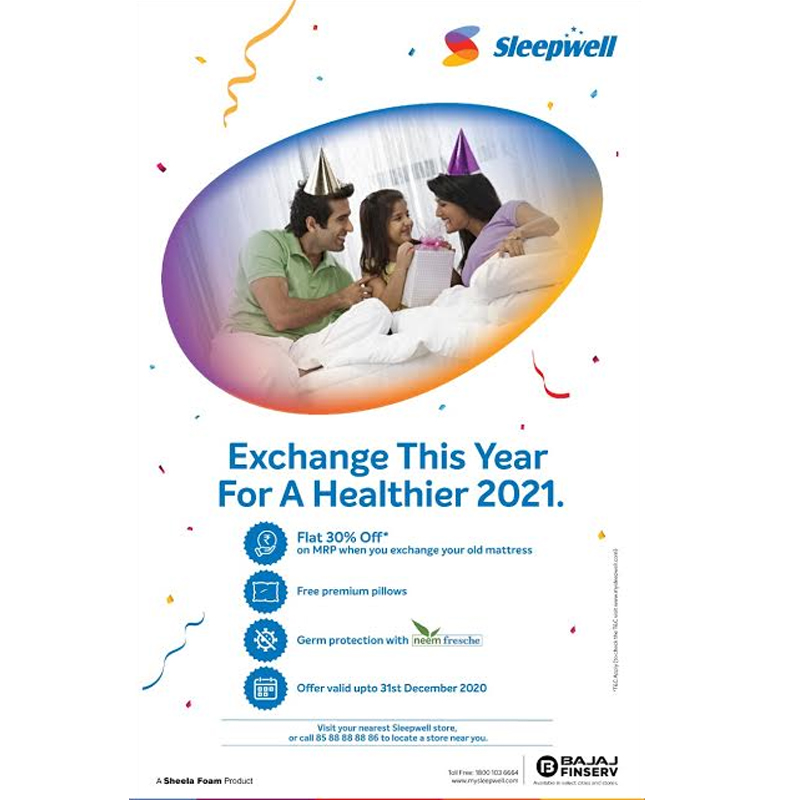
    NEW DELHI: Sleepwell is ending 2020 on a positive note with its new campaign. It is spreading the message of welcoming 2021 by encouraging customers to give up their old mattresses and bring home a brand new mattress for a healthy start. 

    Sleepwell is also offering a flat 30 per cent off on the MRP with the exchange of any old mattress. Consumers also get free premium pillows with this special offer.

    Sheela Foam Ltd CMO Sumit Sehgal said, “A priority for all consumers this year has been to make their homes safe. As we leave 2020 behind, it is important to also focus on sleeping better and the best way to do that is by upgrading your mattress to one that offers the best of both worlds- comfort and germ-free protection. Our wide range of mattresses come equipped with the special Neem Fresche technology, which is a win-win for everyone. We are confident that our year-end exchange offer will be well-received by our customers, helping them enjoy both a happy as well as a healthy New Year in 2021.”

    The offer can be availed at any Sleepwell store up to 31 December 2020.

  • #Throwback2020: The year’s most controversial ads

    #Throwback2020: The year’s most controversial ads

    NEW DELHI: Advertising informs. It generates awareness, entertains; less often than not – if one goes by harsh cynics – leads to a buy decision, and with even lesser frequency flies into controversy. Sometimes the storm that follows proves beneficial for the brand, especially if it is a cult product. At other times, it proves highly detrimental. 2020 was no different. The year had its fair share of brands and labels which got into the crosshairs of some activist group or other, inviting consumers' ire and even unmentionable expletives. Even though what they communicated was well-meaning, and should be considered by most to be within the norms of decency. Most of these ads will end up finding a mention in marketing case history books, detailing what transpired.

    Here's our collection of some of the brands, TVCs and ads that ran into controversy.

    1.  Tanishq – Baby Shower

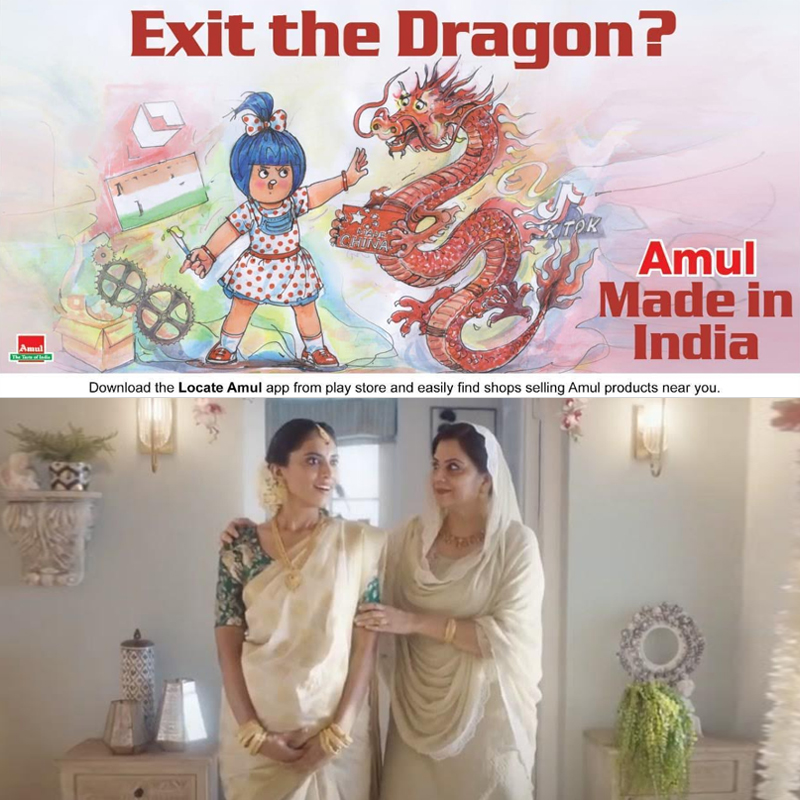
    The jewellery brand from Titan released a TVC on the theme of Ekatvam (Oneness) featuring a Hindu girl married in a Muslim family which is celebrating her baby shower. This ritual is customarily not a part of the Muslim culture but the ad film showcased a liberal family that was more concerned about their daughter-in-law’s happiness. The film ran into a major wrangle, as a lot OF people opposed the premise and claimed that their cultural sentiments had been hurt. They asked why advertising industry always goes for these tropes and why a Muslim girl was not featured in a Hindu environment. Allegations of promoting ‘love jihad’ were also thrown around. The backlash pushed the brand on the backfoot and it pulled the plug on the ad. However, the move was not acceptable to certain sections, who criticised Tanishq for not taking a stand. For the record, the film got a clean chit from every industry body and reviewers.

    2.      Tanishq – Ekatvam

    Not happy with getting a social media caning from certain pressure groups, Tanishq’s marketing mavens decided to take a shot at being liberal in its outlook and released a TVC promoting its Ekatvam range. The film featured four artistes – Neena Gupta, Nimrat Kaur, Sayani Gupta and Alaya F – talking about the festivities. During the film, one of the actors’ spoke about not bursting firecrackers and celebrating a peaceful Diwali. While the idea was to prevent  pollution, several people took it in a different light and rebuked the brand to not tell others how to celebrate the festival of lights. The brand was stalked by trolls for the second time in a month. Again, Tanishq was forced to withdraw the ad.

    On both occasions, trollers pointed that the ad had hurt Hindu sentiments.

    3.      Kent RO

    This year, several brands tried to cash In on  the pandemic by communicating how they could help in the fight against pathogens, especially the Coronavirus. While some brands came out with effective ads, some made exaggerated claims even as others tried to be extra cautious in their communication.  One such company which took such a tack was the maker of water purification system Kent RO. In an advertisement, Kent cautioned against letting the househelp knead flour in case “her hands might be infected,” which served as the plug for the company’s product. Featuring Hema Malini and her daughter Esha Deol as celebrity endorsers, the TVC got thrashed black and blue on social media. Some even complained to the Advertising Standards Council of India (ASCI). Their reasoning: the TVC was  insensitive towards the domestic helps who were already facing discrimination from housing societies across the country. The film was pulled off Kent’s social media handles and the brand issued an apology and promised to investigate its advertising procedures and deploy corrective measures.

    4.      Amul – Exit the Dragon

    During June this year, tensions between India and China were at its peak. Starting with the tiff in Galwan valley, where PLA soldiers were pushed back while trying to enter Indian territory, to boycotting Chinese brands and products with a call for Atmanirbhar Bharat, the dairy brand Amul, famed for its on point topicals, came up with a creative titled ‘Exit the Dragon’. The creative showcased the iconic Amul Girl telling the dragon to exit – an oblique reference to Chinese products. The powerful creative clearly communicated the message in regards to boycott of goods manufactured in China. Shortly after the cartoon was posted, the Twitter account of Gujarat Milk Marketing Federation (which owns Amul) was blocked. Twitterati accused the social networking platform of having a bias against India and #Amul became a top trend. The account was restored soon after.

    5.      WhiteHat Jr

    The ed-tech brand certainly caught the pulse of the nation when it was acquired by Byju’s for a staggering $300 million. Post that, the brand went on a new audience acquisition spree on the back of a huge marketing campaign. However, as many as seven WhiteHat Jr ads fielded complaints for being misleading. Out of these, complaints regarding five ads were upheld by ASCI, which directed them to be pulled down. It used messages such as “TedX Speaker at the age of seven,” among other inflated, unverified claims.

    The brand also used the images of global leaders such as Elon Musk, Sundar Pichai, Steve Jobs and others to convey a message that joining WhiteHatJr will turn kids into tech geniuses like them.  

    6.      ISL Mohun Bagan

    The ad, meant to create hype for the ISL 2020-21 season among Bengali football enthusiasts, wreaked havoc instead. Mohun Bagan loyalists objected to a scene where a team jersey is dipped into a washing machine along with an ATK jersey. The narration of the ad also mentioned a "six-year-old emotion" that fans found offensive, since Mohun Bagan, which debuted in ISL this season with the brand name ATK Mohun Bagan FC, has a long and glorious history of 131 years.

    They were also perturbed with the idea of the team wearing three stars on the left sleeve of their jersey under the ISL logo, with the words 'Champions 2019-20' written under them. The Mohun Bagan fanbase perceived the mishandling of the branding and advertising of their team as an attempt to undermine their club's legacy and heritage. They expressed their disagreement with these branding efforts online. Soon enough, team management stepped in and took measures to cool down the situation.

    7.      Indore Law School ad

    A print advert by the Indore Institute of Law drew a comparison between two fictional characters – Harvey Specter from American TV series Suits, and Akshay Kumar from Jolly LLB 2. It bore the caption that an aspiring lawyer could be either – “Choice is yours.”

    The picture started doing the rounds on social media platforms and netizens were quick to slam the college’s perceived elitist stance behind the ad. Others accused the institute of denigrating the “dignity of Indian lawyers.” Several people questioned whether the college had obtained permission from the original creators before running the campaign. A fair few wondered why the institute chose fictional characters instead of its own alumni or famous practitioners of law in the real world.

    The ad-makers were brutally trolled for their creative sense and the ad was roundly panned as problematic and in poor taste.

    Facing flak, the law college later issued an apology saying, “We assure everyone that it was absolutely not our intention to offend anyone or defame any section of the legal profession.” 

    Please find our clarification regarding our advertisement published on 15/10/2020. We would like to make clear the…

    Posted by Indore Institute of Law on Thursday, 15 October 2020

    8.      MobiKwik takes a dig at Paytm

    The fintech firm took a dig at arch rival Paytm by calling it “Chinese.” It further said that while 220 Chinese apps have been banned, many consumers are still using them on the downlow. MobiKwik urged users to go Indian and questioned them if they were still using Paytm, a Chinese app, for paying their bills.

    Describing itself as a ‘truly Indian Payments’ app, the ad called on users to use Mobikwik for all their payment needs.

    9.      Honey War

    After the Centre for Science and Environment  (CSE) sparked a controversy in the FMCG space by reporting that several leading honey brands had not been able to clear purity tests, a brand war started. The ones that passed the litmus are now talking about their purity, while those that flunked are questioning the report. Post honeygate, several brands released ads sharing their perspective on the situation. The ad war was obvious as no brand would want to let its market share degrade based on one report. Industry experts believe that a massive PR and advertising war will be waged in this category as brands would go to any extent to retain their customers.

  • In a first, Rexona books umpires’ armpits for advertising

    In a first, Rexona books umpires’ armpits for advertising

    NEW DELHI: One may have heard of underarm bowling in cricket, but underarm advertising has to be a first. In the latest, Rexona has partnered with Cricket Australia and Big Bash League (BBL 2020) in a unique sponsorship deal that does not include players, but focuses on umpires instead.

    The deodorant and antiperspirant brand will be advertising on the underarms of the umpires. The use of armpits for product placement is believed to be a first in the world of sports.

    The deal requires umpires in the BBL 2020 to sport the product’s branding under their arms, which will be fully revealed to the watching world upon the signalling of a six (both arms raised, two logos revealed) or a bye (just one).

    Along with the six, Rexona brand will also be sighted when an umpire raises his finger to give a batsman out. Other than this the brand will feature on cardboard cut-outs of umpires in supermarkets and retail outlets, according to reports in Australian media.

    The deal is the latest in a string of commercial partnerships either renewed or acquired by Cricket Australia this year. The organisation will generate a record $70 million in sponsorship this summer, despite the financial difficulties presented by the Covid2019 pandemic.

    Rexona is the 22nd sponsor to join cricket’s stable of commercial partners as part of its strategy to “own the underarm space” during summer for Cricket Australia.

    This season beside Rexona, Australian board has clinched landmark sponsorship deals with Dettol as T20 and ODI series sponsor, Vodafone as Test Match series sponsor. Besides this KFC has been renewed as title sponsor of the BBL 2020, with Cricket Australia rejecting $10 million a year offer by rival fast food giant McDonald's in favour of the fried chicken brand.

  • Ghadi wears a mask to say prevention is better than cure

    Ghadi wears a mask to say prevention is better than cure

    NEW DELHI: What is the simplest thing anyone can do to protect themselves and their loved ones from the pandemic that is raging across the country and the world? The answer lies in remembering to wear a mask every time we step out. Yet, this simple message has either not reached everybody or is simply being ignored or forgotten.

    Ghadi detergent has decided not just to reach out and remind millions but walk the talk themselves.

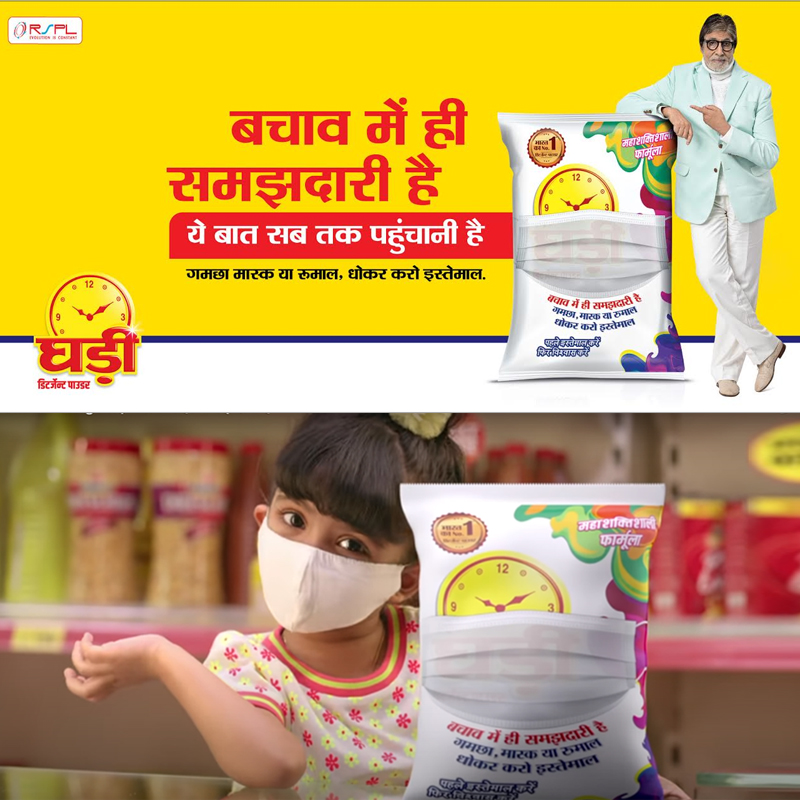
    In an initiative conceptualised and executed by ADK Fortune Communications, a WPP company and part of Wunderman Thompson South Asia Group, the most powerful and effective medium was used to drive this message home – the Ghadi detergent pack. The pack reaches millions of Indian households, even in areas where the reach of TV and other mass media is extremely limited. So, to spread awareness and reach the maximum number of households, the Ghadi pack was utilised.

    Ghadi covered its logo (the very face of the brand) across its entire range of detergents, with a printed mask to remind and inspire people to wear a mask. And emblazoned on every pack is the message: Bachaav Mein Hi Samajhdaari Hain (It makes sense to save yourself), to underline the importance of putting on masks to check the spread of the Coronavirus.

    To further scale up this message, Ghadi supported this initiative with a digital film directed by Pradeep Sarkar. It shows a young girl in a shop who makes her father realise that the best way to show you care is by wearing a mask – just like the pack itself. Produced by Apocalypso Filmworks Pvt Ltd, the film will be released across India in five regional languages with a full-blown PR and social media campaign.

    RSPL joint MD Rahul Gyanchandani said, “As a category leader, Ghadi has always believed in making a positive impact. In these troubled times, using our pack and then extending the campaign to other mediums seemed like the best way to bring about a change in behaviour and further build upon our connection with our massive consumer base.”

    ADK Fortune Communications VP & ECD Nakul Sharma commented, “It started as a small idea; a unique way of connecting with the consumer. But with the client backing it fully, this initiative by Ghadi is now actually impacting people and their thinking. For Ghadi, this is just the beginning. We truly want our mask-wearing initiative to become the starting point of a mass movement.”

    In the coming days, Ghadi plans to distribute 10 lakh masks across India for free. 

  • #McGrillisBack: Iconic burger returns after online petition

    #McGrillisBack: Iconic burger returns after online petition

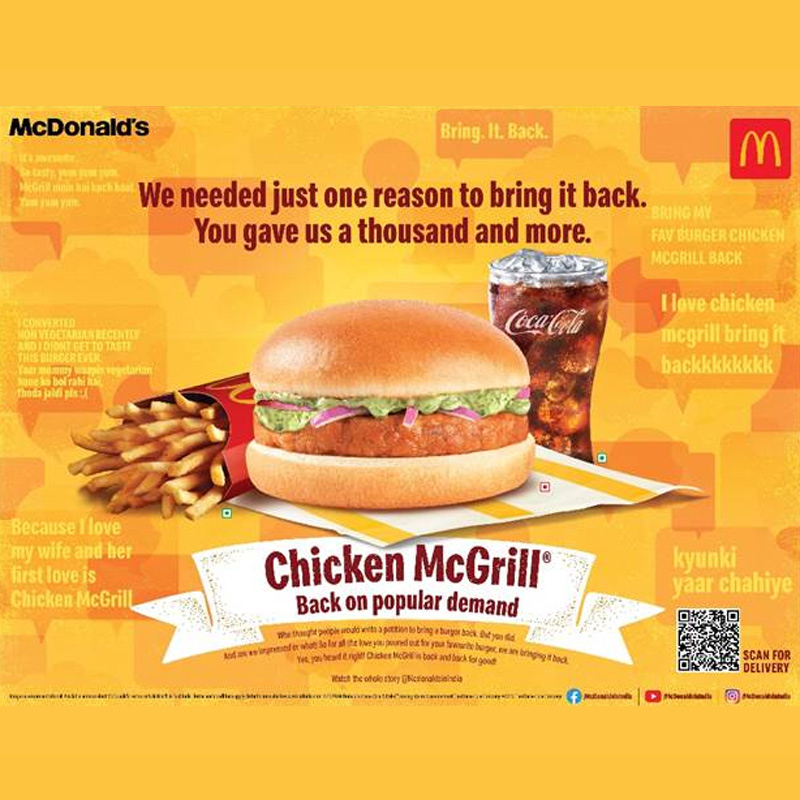
    NEW DELHI: Days after giving in to popular demand of bringing back the much-loved Chicken McGrill burger, McDonald’s India north & east has launched the #McGrillisBack campaign for the most talked about burger in town.

    Fans of the iconic Chicken McGrill had started a petition and took to social media to begin a movement asking McDonald’s to #BringMcGrillBack. The rally found support from comic Abhishek Upmanyu and actor Neha Dhupia, who also signed the petition and spoke about their love for the burger. After a large number of requests started pouring in, the fast food giant decided to reintroduce the burger.

    "You guys did it. Chicken #McgrillisBack on popular demand in stores near you. You read it right, YOU WIN," wrote the official handle for McDonald's India on Instagram. It had been taken off menus in 2019 when outlets had reopened in Delhi. 

    The ‘#McGrillisBack’ campaign, featuring actress Shreya Chaudhary, puts a funny spin on some of the popular reactions by netizens on their love for Chicken McGrill and their celebrations when the burger was put back on the menu. Conceptualised by DDB Mudra, the campaign with the help of digital films uses situational humour to highlight people’s craze for the burger.

    Robert Hunghanfoo, head, CPRL (Connaught Plaza Restaurants operates McDonald’s restaurants in north and east India) said, "Chicken McGrill has been one of the most loved menu offerings at McDonald’s. The reaction and desire we witnessed on social media is a true testament to people’s love for it. With this campaign, we are offering our customers another chance to relive their favourite memories by offering them a menu item that they have been asking us for."

    “Chicken McGrill is an icon. And the icons are timeless. Its teeming fans had been campaigning for its comeback. Therefore, it was only natural for us to make this unbound love for the Chicken McGrill, the fuel for its comeback. The campaign celebrates this very love for the burger in a heartfelt, McDonald’s way so that the fans never have to stop lovin’ it!” said Ashutosh Sawhney, managing partner – DDB Mudra Group, north.

    Chicken McGrill is now a part of the all-day menu across all McDonald’s restaurants in north and east India, including McDelivery and takeaway orders.

  • REFRESHING OUR ‘CHAIWALLA AT THE TRAIN STATION’ MEMORY, SOCIETY TEA BREWS IN A DELIGHTFUL CAMPAIGN WITH ITS INSTANT ONE MINUTE TEA

    REFRESHING OUR ‘CHAIWALLA AT THE TRAIN STATION’ MEMORY, SOCIETY TEA BREWS IN A DELIGHTFUL CAMPAIGN WITH ITS INSTANT ONE MINUTE TEA

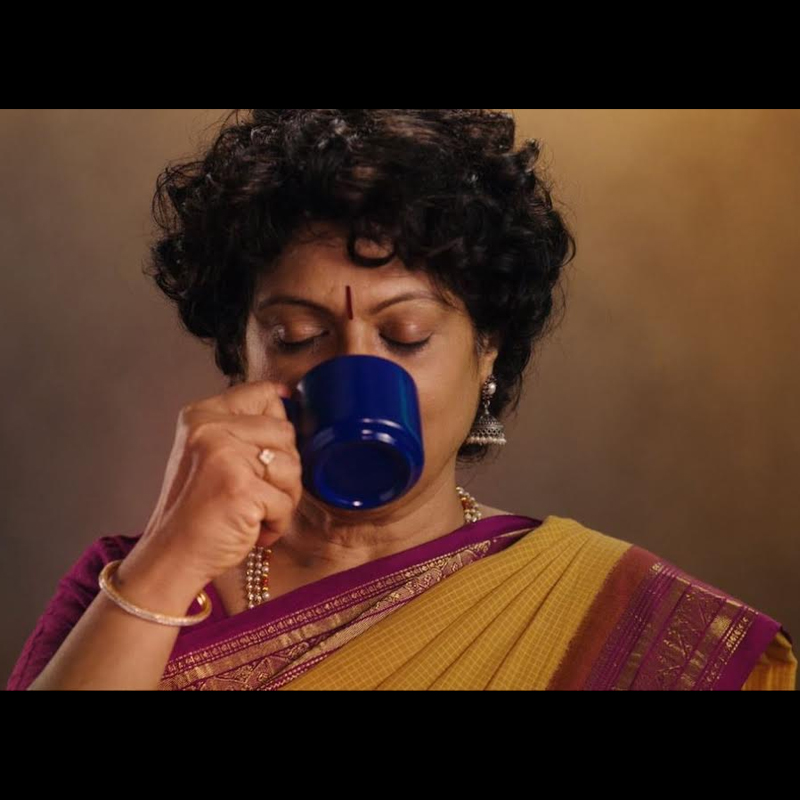
    Mumbai: One of the country’s premium tea brands and a celebrated household name, Society Tea brews in a delightful film celebrating the iconic ‘Chai Chai’ phraseology employed by the ubiquitous chaiwallas at the station. The film conveys the message of relishing a piping hot cup of refreshing special chai instantly with its aromatic One Minute Tea range.

    Tea is so weaved into the fabric of our everyday life that sometimes all it takes is a little nudge to rekindle some of the associations with tea. One such memorable association is the Chaiwalla at the train station. Every station that the train used to stop wasn’t just a break from the journey, it was also a much anticipated tea break one would look forward to. As soon as the train halted at the station, one couldn’t miss the nasal twang laden, strangely rhapsodic, sing-song sales pitch of the chaiwalla for his refreshing cup of the special chai…his annoyingly rhythmic tone invitingly piercing the air. And in this short interlude of the journey, just about anyone was able to enjoy his special chai.

    Inspired by that little hiatus, the film beautifully conveys a message that now anyone can enjoy a special cup of flavoured tea – a mix of aromatic Indian spices – be it the quintessential ‘Masala’, the ‘Desi Elaichi’, the 'Adrakwali Chai' or the refreshing ‘Lemongrass tea’, anywhere, anytime in just under a minute with Society Tea’s One Minute Instant Tea!

    Karan Shah, Director, Society Tea said, “Tea to Indians is not just a beverage, it is a habit embedded into life. Most of us want to have our special chai in a moment’s notice but usually that’s not possible. One Minute Tea is an outcome of this need for a special cup of chai that anyone can make. And what better way to convey this than juxtapose the very memorable call for chai at train and bus stations against people of all ages.”

    Society Tea’s One Minute Instant Tea is available in a variety of aromatic range, comprising of four variants, Lemongrass Tea, Ginger Lemongrass Tea, Masala Tea, and Elaichi Tea. https://shop.societytea.com/collections/one-minute-instant-tea .

    In order to manufacture high quality Tea and Dairy products, Society Tea has set up a plant in Vadodara (Gujarat). It is one of India’s most advanced and completely automated milk and soluble tea processing units which manufactures products under strict hygienic standards, to meet the high levels of quality and excellence. 

  • Urban Company humanises face masks with #WearASmile campaign

    Urban Company humanises face masks with #WearASmile campaign

    NEW DELHI: As we all don masks to lead our daily lives in the new normal, in some ways we've all attained a degree of uniform anonymity. With most of our faces covered up, it's as though our true selves – who we are as a human – are also hidden. In light of this, Urban Company’s has unveiled the #WearASmile campaign, which aims to allay the diminished human element between consumers and professionals, by adding a smile to the face mask.

    Under this initiative, all service professionals will be issued face masks with a smile on it. The company believes that while masks keep consumers and service professionals safe, they make people (service professionals) invisible by hiding their faces and humanity. To this effect, all professionals on the platform will be issued face masks with smiles on them – as a small reminder of the human behind the mask, and a way to humanise the mask itself.

    Urban company director – marketing Tarun Menon said, “For our service professionals, masks hide their faces, making them unrecognisable; hiding the individuals behind the masks. Through the pandemic, we’ve heard stories from around the world that have reaffirmed our faith in the indomitable human spirit. Our intent with this small change to the masks our service professionals wear is to make the face mask in itself a little more human, with the smallest of reminders of that unbeatable human spirit – a smile.”

    Brands such as Uber, OYO, Big Basket, Ola Money and Pharmeasy have extended their support to this initiative – some will change their social media display pictures across platforms to their logos with smiling face masks on them in support.

    In addition, Urban Company’s app icon will also change to reflect the new smiling mask being issued to service professionals. At the outset of the pandemic, Urban Company was one of the first brands to add a face mask to their app icon, underscoring its commitment to offering safe services.

    So, be it on the mask or underneath it, smile. After all, a smile is a curve that sets everything straight.

  • ‘What is love’: OkCupid may have the answer for Indian millennials

    ‘What is love’: OkCupid may have the answer for Indian millennials

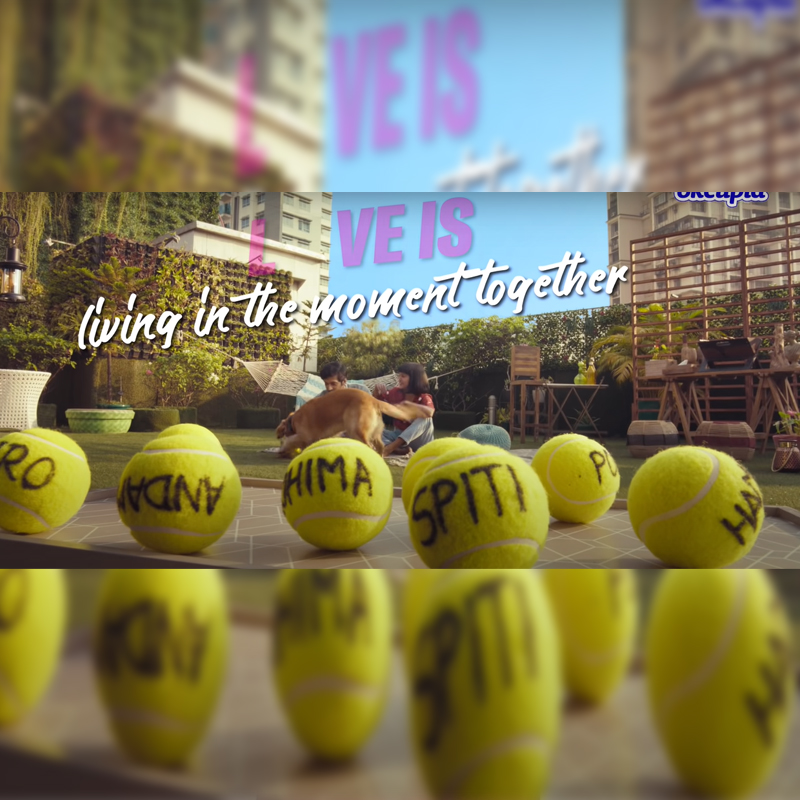
    New Delhi: ‘What is love?’ Haddaway had plaintively demanded years ago, and it's a question that still rankles in peoples' minds. With a hope to solve this conundrum to a great extent, international dating app OkCupid has launched its latest digital campaign titled ‘Love is…’ that reclaims love for Indian millennials. The campaign is a conceptual take on love that is unique to your individual personality, values and aspirations. It recognises and celebrates that every person is seeking a different kind of love – from romantic dates to sharing memes, and that uniqueness is valid, accepted and deserves to be celebrated. 

    The campaign draws insight from user responses to over 3,000 questions on the app, breaking stereotypes about what relationships mean for dating Indian millennials. A large majority are in fact hopeful romantics with 88 per cent men and 87 per cent women wanting to find love, or have love find them. They are open to finding serendipity of love on a dating app like OkCupid with 61 per cent men and 57 per cent women saying yes to falling in love with someone they meet online. Surprisingly, 68 per cent don’t even believe marriage is mandatory for people in love. When it comes to the kind of relationship they want, 72 per cent believe traditional gender roles, such as men being default heads and not househusbands, or women taking care of chores and children or changing names, have no place in their lives. While, they might believe in love and its serendipity, the kind of love each Indian millennial wants is completely unique. OkCupid’s ‘Love Is…’ takes these insights and brings them to life to showcase how every person is seeking a different kind of love, one that they deserve to have. 

    Developed by Taproot Dentsu-Mumbai, the ‘Love is…’ campaign includes four short films as well as a VoxPop. The VoxPop is a fun dipstick video of single Indian millennials as they express their honest views of what love means to each of them. In true millennial style, the answers vary from drawing similarities to food, farts and fairytales. This experiment is an attempt to reflect the diversity of love and what it means for different people spotlighting what essentially makes love and relationships so special and bespoke. The four campaign films also use these insights along with user responses to questions on the app to articulate what love is to different people. 

    The first film “Love Is… Working Overtime Together” tells the story of a couple who are career driven but won’t make a compromise on love. It draws from the insight that 88 per cent millennials are looking forward to both love and professional growth, refusing the long held notion that you can only have one. 

    “Love Is… all About The Little Things” is inspired by the 87 per cent users on OkCupid who have expressed the importance of everyday romance in their lives. It reminds those looking for a relationship built on the little expressions of love that will find what they’re looking for even if everybody else is telling them otherwise. 

    “Love Is… Living In The Moment Together” was born from well-meaning but untrue advice that giving up spontaneity is the road to adulthood and thus a meaningful relationship. This film encourages you to be unapologetically you and find a partner who loves that about you. 

    The final film “Love Is… A Partnership” was born from the shifting gender roles in Indian relationships where men and women both play equal roles as homemakers and breadwinners, building a relationship of equality and partnership. This will go live by later today. 

    OkCupid India marketing director Anukool Kumar says, “Love is not one size fits all and that’s exactly what OkCupid India’s campaign ‘Love is…’ celebrates. The very fact that most singles are being told that they have to choose between a career and love or romance and practicality is archaic to us at OkCupid! This campaign celebrates love in the way that an Indian millennial craves it, breaking away from the cringey unattainable version that has been fed to us for generations.” 

    Taproot Dentsu Mumbai ECD Pallavi Chakravarti says, “What is love? Now if we knew the right answer to that one, we’d be Gods not mortals. So together with team OkCupid, we agreed to do the next best thing for our new campaign – acknowledge that there is no one right answer. But no matter how one defines love, chances are they’ll find what they’re looking for on this app.”

    The campaign was featured on OkCupid’s YouTube, Instagram and Facebook pages. The first film went live on 27 November 2020 and has received an overwhelmingly positive response, with over five million views in just a week.

  • Finding the right fit ‘Feels So Fine’, says Wacoal in new ad

    Finding the right fit ‘Feels So Fine’, says Wacoal in new ad

    NEW DELHI: Japanese lingerie brand Wacoal has launched its first digital and television advertisement campaign in India. The ‘Feels So Fine’ catchphrase of the new ad campaign emphasises on the incredible feeling of fulfilment brought by a pair of perfectly fitted lingerie, making a woman feel beautiful and confident from within. With India being a priority market, through this initiative the brand aims to strengthen its connect with the Indian audience and penetrate deeper in the country.

    Appealing to modern women by demonstrating Wacoal’s commitment to providing innerwear that caters to their requirements, the ‘Feels So Fine’ campaign manifests the incredibly sensorial experience of finding the right fit. 

    The TV ad has been released in a 20-second format and the digital version as a 60-second film. The campaign will be guided by an intensive cross-platform marketing strategy to engage with the consumers including an aggressive digital approach to reach out to a larger audience followed by some key on-ground activities such as the ‘Can Your Best Bra Feel So Fine’ challenge. The initiative will encourage women to bring forward their best bra and we are confident about finding an offering from Wacoal that feels better.

    Pooja Merani, business head, Wacoal India business head Pooja Merani said, “We have had an exciting journey so far and are thrilled to be moving forward in a new direction with the launch of Wacoal’s first advertisement campaign ‘Feels So Fine’ in India. We have launched this campaign across digital and television platforms with the aim of representing our long-standing pledge and philosophy to create lingerie that makes women feel their best and unique selves, always. The new campaign echoes this sentiment and is rooted in the sensorial experience of finding the right fit and how it can make a woman feel beautiful and extraordinary, just the way they are. We are constantly working towards innovating our products with the objective of providing superior quality fits and contemporary designs for the modern woman of today and we are confident the campaign will be instrumental in establishing stronger ties with our target consumer base.”

    McCann WorldGroup India VP Suchismita Ganguli said, “We have always had our ears to the ground and echoed the sentiments of the evolving woman consumer. When it comes to lingerie, consumers today are quite demanding. They are looking for the perfect fit, comfort, right support, contemporary designs and varied silhouettes – they want it all. But finding the right bra is more than all of this. It is about how a woman feels when she slips into that piece of lingerie. This is exactly what Wacoal offers – through this brand campaign, we are interacting with women who constantly seek finer experiences in life.”

    Wacoal’s network in India is currently located across 22 exclusive brand stores and 28 outlets present in large-format stores, across key markets such as Mumbai, Delhi NCR, Kolkata, Chennai, Bangalore, Hyderabad, Ahmedabad, Lucknow etc. Headquartered in Mumbai. Wacoal entered the Indian market in 2015 through a joint venture with Periwinkle Fashions Pvt Ltd, the flagship company of the Tainwala Group.