Category: MAM

  • GUEST COLUMN: How a cookie-less environment will affect the digital space

    GUEST COLUMN: How a cookie-less environment will affect the digital space

    Mumbai: For the past decade, marketers have been experimenting in the digital environment to enhance brand-customer interactions. In the B2C and B2B spaces, the growth of social platforms has changed how marketers communicate with their clients. In addition, advances in big data and artificial intelligence have enabled marketers to better target and communicate with customers and analyse the impact of their efforts. Third-party cookies are crucial for such advancements.

    The advertising/marketing game now stands on the verge of groundbreaking change. Google plans to stop supporting third-party cookies on its Chrome browser by the end of 2023, ultimately ending two decades of media and data-driven performance-focused marketing. As a result, marketing executives and their teams must prepare for a world without cookies by focusing on consent-based advertising and adopting digital transformation strategies for a world without cookies.

    We have boiled down the entire marketing plan fitting for a cookie-less world into five steps.

    Shift to the first-party data strategy

    The websites visitors visit place first-party cookies on their browsers, which the website owner owns. They assist in collecting vital analytical data, language preferences, and the overall delivery of a positive user experience. Companies must make changes in their digital transformation strategy and start investing in developing the ability to acquire first-party data precisely. Businesses must be early adopters and ensure that their first-party cookies are mature enough to gather critical data elements. 

    According to a Deloitte survey, 61 per cent of high-growth enterprises are shifting to a first-party data strategy.

    Start developing second-party relationships

    Sharing second-party data is standard among organisations in related domains, and it may be highly advantageous to all parties involved. The company’s first-party data is shared under a contractual arrangement as second-party data to another company. Such mutualistic ties may become increasingly significant for enterprises with a considerable audience overlap in the near future.

    This change will only come to fruition once the marketers are willing to rethink their digital transformation strategy for enterprises.

    Focus on building rapport with tech giants

    Marketers may need to explore outside their boundaries to expand their first-party data. For example, marketers should establish connections with tech giants like Google and Facebook and other media publishers to acquire access to their ‘walled gardens’ of corresponding insights and data to ensure internal data creation.

    This step will require exceptional digital transformation services at your business’ disposal.

    Reinvent your media spend strategy

    Cookie obsolescence would aggravate existing digital ad measurement difficulties, such as transparency and integration standards and attribution accuracy. Instead, reinvent measurement baselines, engage in market research, and lock in essential resources to prepare for an era of advertising experimentation.

    Revamping your brand marketing is not a piece of cake. You will require a robust and streamlined process for your digital transformation strategy. Many digital marketing agencies in India offer remarkable digital transformation services for B2B and B2C firms. 

    Practice contextual targeting

    Behavioral targeting tries to collect data on a visitor’s behavior to ensure that the ad is relevant to them while ignoring the context of the ad. Marketers must evolve this strategy and shift to contextual targeting practice, which targets visitors based on the page’s content where the ad appears. As the number of options for giving individualised advertising to audiences decreases, marketers must return to the basics and concentrate on contextual targeting to get their messages to the right audience.

    Adapting, surviving, and thriving in a cookie-less world is possible with specific finetuning measures in your digital transformation strategy.

    (About Author: Ambika Sharma is the Pulp Strategy founder and managing director)

  • WPP launches global engineering centre in Chennai

    WPP launches global engineering centre in Chennai

    Mumbai: Creative agency WPP has announced the launch of a new global engineering centre (GEC) in Chennai.  

    According to the statement, the GEC will play a pivotal role in further strengthening WPP’s global service offering, by partnering resilient, industry-leading technology and skills with creative brilliance. “Chennai was chosen as a strategic location with its vast candidate pool and strong IT capabilities,” it added.

    Over the next eight months, WPP will assemble a team of over 200 IT professionals who will support several areas including platform services, cloud and network infrastructure, engineering and operations across core products, and cyber security.

    “The pandemic has caused a fundamental shift in the way most businesses operate,” said WPP CEO Mark Read. “Technology, now more than ever, is the primary driver of growth, and will be critical to help us build back not just better – but best. WPP is genuinely invested in growing our presence in India and increasing our focus on recruiting highly skilled talent at a local level – not only in our creative industries but also in the technology industry. Our new WPP colleagues in Chennai will play a pivotal role in further developing our technology offering – and will have the unique opportunity to work together with colleagues in an industry that has the power to create positive change at scale. Something I’m very excited about.”

    “India is already playing a major role in WPP’s transformation with over 4000 people working across several global Technology COEs,” said WPP country manager India CVL Srinivas. “The GEC will add to this talent pool and help us scale technology across our global company.”

    “I’m extremely excited about the launch of our new GEC in Chennai and the potential we have to further accelerate our position as leaders not only in the creative transformation industries, but also the IT industry,” said WPP chief information officer Rachel Higham. “In support of our purpose to build better futures for our people, we are committed to investing in their personal and professional advancement, placing them in the best position to grow their careers with us in the way that they want to. By joining us, they will be part of a team that develops, supports, and delivers cutting-edge technology – providing them with a unique opportunity to be pioneers in their field.”

  • Post-Covid outlook for India’s creative economy

    Post-Covid outlook for India’s creative economy

    Mumbai: The pandemic has shaken the spine of economies across the world, and the Indian economy was no different. The impact is well analysed and measured by several studies, but ‘Taking the Temperature’ research is a first-of-its-kind, landmark longitudinal report on the impact of the Covid-19 pandemic on India’s creative economy.

    The British Council, FICCI, and Art X Company have jointly launched the third edition of the report at the Jaipur Literature Festival (JLF).

    Released against the backdrop of Asia’s largest literature festival, JLF, the report transcends the literature sector, and for the first time, offers a quantitative mapping of India’s creative economy and culture sector – in the organised and unorganised sectors – across literature, crafts, festivals, performing arts and other art forms. The final edition is a series of three reports, and a culmination of 18 months of mapping the sector.

    The research tracks the longitudinal impact of the pandemic on India’s creative and culture industry and identifies a way ahead in a systematic and sustainable roadmap for recovery. The pioneering research is a first-of-its-kind, the extensive report outlines the monetary size and scale of the creative economy and contribution of the culture industries to the national GDP and wealth creation in India.

    On this, FICCI creative and cultural industries co-chair Sanjoy Roy said, “The TTT report on the creative sector underlies the vital nature and impact of this sector and its potential in creating jobs, contributing to local economies and creating a platform to realise one’s full potential.”

    The British Council works with the Indian stakeholders to strengthen India’s creative economy and create sustained livelihoods for Indian creative professionals. The report, in collaboration with FICCI and The Art X Company, underlines the British Council’s aim to gather credible information and insights that can enable businesses and governments to make effective and well-informed decisions about public and private investment in the creative sector.

     Key findings of the report:

        India’s creative economy reduced to Rs 30,440 crore GDP in 2021 from Rs 50,000 crore GDP in 2020, pre-Covid.

        There was a 39 per cent recession in creative industries to Rs 30,440 crore in 2021.

        50 per cent of creative sectors reported 51 per cent or more loss in annual revenue in the financial year 2020-2021.

        89 per cent of creative sectors in TTT2 and 82 per cent in TTT 3 have confirmed the pandemic impacted their income.

        49 per cent of creative sectors have not been able to keep creative businesses and artistic programmes running in the financial year 2020-2021.

        94 per cent of arts sectors are now operating in ‘digital only’ or ‘hybrid’ models.

        27 per cent of the sector is generating income through digital platforms with only eight per cent running physical programmes.

    In view of the findings and the feedback from the creative industry workforce and stakeholders, the report makes the following recommendations:

        Establish a cross-government creative economy Task Force from the 14 ministries that have a mandate for arts and culture in India.

        Government emergency grant-in-aid for MSMEs.

        A comprehensive national skills campaign across urban and rural geographies for creative MSMEs in digital and technological skills, business development, marketing, and communication capacity.

        Establish sector-specific management, self-help groups and management organisations, and city-wide enterprise zones and clusters.

        Establish arms-length bodies (ALBs) to strengthen and invest in arts and culture through a partnership of public and private investors.

        Embed tax coding of the creative industries in the formal economy through the Goods and Services Tax (GST) council.

    British Council India director – arts Jonathan Kennedy said, “Since the onset of Covid-19, we’ve dedicated our research to understanding the impact of the pandemic on India’s creative and culture economy with FICCI, Art X Company, and Smart Cube.”

    The final report makes practical recommendations for the short and long-term recovery of creative sectors and livelihoods. While our first two reports measured the impact of the pandemic on the incomes of the professionals and culture organisations, the third edition offers a definitive mapping of the scale and significance of the creative economy in India, added Kennedy.

    “There could not have been a better platform than the Jaipur Literature Festival to announce the report and we hope the insights from the report trigger much-needed conversations amongst stakeholders. We hope recommendations for recovery of the creative economy will be implemented through governance, infrastructure development and India’s enduring self-reliance,” he said.

    The Art X Company founder-director Rashmi Dhanwani said, “This final leg of the Taking the Temperature survey underscores the hard journey that the cultural sector in India has been on. Not only has the sector lost more than 50 per cent of its income, its performance has also affected India’s GDP growth. Besides the economic impact, the loss of lives and livelihoods that the pandemic has caused begs an urgent intervention – India’s culture sector needs a voice and demands urgent regulatory frameworks to safeguard this vital part of India’s identity.”

  • Cleartrip makes slew of executive appointments amid 2022 growth plans

    Cleartrip makes slew of executive appointments amid 2022 growth plans

    Mumbai: Online travel company Cleartrip on Monday announced a series of senior appointments to spearhead the company’s aggressive growth plans and focus on the execution of strategic priorities for 2022. The appointments include the heads of strategy, hotels & accommodation, flights, corporate communications, and B2B.

    The hiring encompasses redefining the organisational culture and strengthening values in line with the growth plans, the travel company said in a statement. “With these appointments, the company is gearing us for its next phase of growth across its business verticals and further plans to ramp up its employee strength by 60 per cent by the end of the year,” it added.

    Gaurav Patwari has been named VP – air category. He will use his 16 years of rich experience in the travel and aviation industry to help further build Cleartrip’s air travel vertical. He will be responsible for meeting the air business’s P&L targets while also developing a multi-year strategy for the company’s evolution and expansion. Patwari was most recently associated with GoFirst.

    Karthick Prabhu D, the newly appointed Cleartrip head of strategy, has been a part of the travel tech industry for over 17 years with various travel brands such as Treebo hotels, Sabre, IDS Next, to name a few. As a product management leader, he has helped launch products that solve customer pain points, boost revenue, introduced an industry-first product as a tablet-based property management system, and got one of the apps featured in the ‘Best In India’ category in the Apple Appstore and Google Play Store.

    Flipkart veteran Manu Sasidharan who has taken over as senior director – hotels and accommodation was the business head of Myntra’s men’s fashion segment prior to joining Cleartrip. He has worked with companies such as General Motors India and Bajaj Auto. He intends to use his diverse expertise to structurally rebuild and relaunch the hotels and accommodation category, with a strong emphasis on greater customer experience.

    Divya Kumar has been appointed as director of public relations. In her new role, she will focus on building and spearheading the development, advancement and execution of the company’s corporate communications strategy. She was previously leading the public relations and sustainability mandate at AirAsia India. Before joining the field of corporate communications, Kumar started her career at NDTV Hindu, in the news & events department. Throughout her career spanning over 11 years, she has worked closely with the senior leadership team as a strategic advisor providing in-depth expertise in change management, crisis response, maneuvering corporate and consumer crises.

    A Cleartrip veteran with over 21 years of experience, Sukesh Shetty has been roped in to head the B2B and API business, with a focus to bring automation and growth in the online B2B travel experiences. In his previous stint, Shetty was the co-founder of Tripsforbusiness, a B2B focused travel tech platform involved in building a content-rich, metasearch and book travel product for B2B customers. His journey resumes with the purpose of contributing to the success of the B2B business at Cleartrip.

    “Cleartrip is at a pivotal point in its growth trajectory, and we seek to excel in every area we operate in,” commented Cleartrip CEO Ayyappan Rajagopal. “Building the right leadership team across verticals is crucial as senior leaders serve as catalysts in exponentially accelerating our overall growth. The new leadership team and I have a clear vision to take the Cleartrip brand forward.”

  • GUEST COLUMN: AI-powered influencer marketing redefining the landscape in 2022

    GUEST COLUMN: AI-powered influencer marketing redefining the landscape in 2022

    Mumbai: From Facebook recasting itself into a metaverse to marketers executing new lines of thought for sailing through yet another year amidst the pandemic, 2021 was indeed a roller coaster year for the digital marketing industry. However, one phenomenon which flourished all through was influencer marketing.

    The thriving influencer marketing arena in India is expected to grow at a compound annual growth rate (CAGR) of 25 per cent till 2025 to reach a size of Rs 2,200 crore (Source: GroupM INCA’s India Influencer Marketing Report). Globally, the industry is set to increase by approximately $13.8 billion by 2022 end (Source: 2021 State of Influencer Marketing Benchmark Report). What’s more, the induction of AI into influencer marketing is going to completely change the dynamics of decisions & ROI from it.

    With a plethora of types of influencer relationships and ongoing campaigns, supervising it the right way will be pertinent to a brand’s success.

    Data and analytics are now at the centerstage with marketers focusing on when and where to run campaigns, what kind of influencers, and how many influencers to engage with. By measuring the impact and performance of influencer campaigns, Data-driven influencer marketing is not only helping marketers calculate the ROI, further optimise the campaigns but is also helping them identify new opportunities and shortlist key influencers for future collaborations- while keeping a close eye on consumer preferences.

    As tools, artificial intelligence (AI), machine learning (ML), and natural language processing (NLP) are redefining the way brands conceptualise and execute influencer marketing by integrating quantitative and qualitative metrics in a relevant way. Such AI-driven influencer marketing campaigns will improve quality audience check and success measurements. Let’s deep dive into this…

    The right Influencer: In the recent influencer campaign meetings ‘The right influencer’ term is being used by brands on a continuous basis and they need a more detailed understanding of the selection. This process is going to be governed by AI technology by the end of this year since it’s all based on the data & if we are able to process those calculations in microseconds instead of minutes then this hunt will certainly get more interesting.

    With a few common filters we can easily narrow down the list but if we actually want to go in-depth for any decent-sized campaign, it consumes a lot of time and effort which can be easily tackled with AI-based tools. AI-based influencer marketing systems are steadily being leveraged to analyze the minutest of data from an influencer’s social media profile including every content piece posted by them.

    Marketers are looking to partner with those influencers whose online persona and style resonates with their brand’s image- to ensure that those influencers’ audiences are more likely to engage with their brand. AI-powered influencer marketing is helping brands analyse the performance of multiple influencers across various social media platforms irrespective of the language being used. Such scalability will further expand this year as marketers analyse diverse metrics including the reach and engagement metrics of individual posts.

    The Game of Fake Audience: While it can become really tricky to analyse the authenticity of the audience manually, AI is changing this game altogether. With the right algorithmic factors and by considering the step-by-step evolution of ML in this process, brands and agencies can make the right decision without too much time allocation.

    Reporting: ML & AI can assist marketers by generating very insightful analysis. The industry stakeholders are seeking to understand the reach and impact of influencer campaigns on multiple levels, even when the campaign is not huge in scale. AI will definitely help in exploring the influencer marketing insights on a level that the market hasn’t explored before and hence add many layers to what brands and agencies are doing so far.

    2022 will be a game-changing year when it comes to AI’s influence in the world of influencer marketing. It will play a crucial role in tracking sentiment to shortlisting influencers of all sizes and influencing brands in the way they define their goals and prioritise authenticity. The growing market of D2C brands in India is steadily increasing their budgets and now also want to control their data and creator relationships with the help of AI tools. 2022 will further raise the excitement with new influencer marketing trends unfolding for D2C brands, e-commerce companies, digital marketing, and advertising agencies.

    This year will see an escalation of influencer marketing growth as digital marketers will combine innovative strategies with data-driven marketing. 

    (About the Authors: Shreyansh Bhandari is the Lyxel&Flamingo co-founder and COO; Veda Bashishtha is the LYRKL co-founder and CEO)

  • ZFunds bolsters its leadership with two new appointments

    ZFunds bolsters its leadership with two new appointments

    Mumbai: Mutual fund distribution platform ZFunds on Monday announced two new leadership appointments as the company expands its footprints. While Yogesh Yadav joins as the chief technology officer (CTO), Tanvi Jadhav is the new head of products. 

    The appointments strategically enable the platform in the distribution of financial products in tier-2, 3 and 4 cities and rural India through its experts, ZFunds said in a statement.

    “We are pleased to welcome Yogesh and Tanvi on board. Their belief in new-age start-ups like ours despite their backgrounds with long-standing organisations is heartening,” commented ZFunds co-founder and CEO Manish Kothari. “At ZFunds, we are proud of our culture of meritocracy, customer-centricity, growth, and diversity. These attributes serve us right in our mission of making purchases of financial products and decision making Sahi (Right) and Asaan (Easy) in the 500 bottom-most districts of India.”

    Yadav has extensive experience in software engineering and joins ZFunds from ByPrice-Mexico where he worked as a CTO. Before ByPrice, he worked with the leading e-comm player in Latin America;  Linio. Beyond work, he utilises his experience in blockchain for an in-depth study of trends in cryptocurrency. He holds a B-tech from Delhi College of Engineering. “At ZFunds we have built tech products simple and easy. It allows people from lower-economic-rung to invest in Gold and Mutual Funds and thus help the Indian economy grow. I have had an offer from a global giant too but I chose to refute it,” said Yogesh Yadav, on joining ZFunds.

    Jadhav comes from a rich experience in the fintech industry, with past stints at InCred Financial Services, Paisabazaar, HealthKart and Kotak Mahindra Bank, where she played a crucial role in building digital products. She is a graduate of IIT Guwahati with a bachelor’s degree in mathematics and computing. “For me, the option of heading the products at ZFunds was more than merely a professional pursuit. Instead, I took it as an opportunity to participate in a financial reform of sorts for our society. I am looking forward to being part of the vibrant team and driving digital-first innovations,” stated Tanvi Jadhav.

    ​​​​​​

  • An Indian general election is the largest TG one is ever going to deal with: Jayshree Sundar

    An Indian general election is the largest TG one is ever going to deal with: Jayshree Sundar

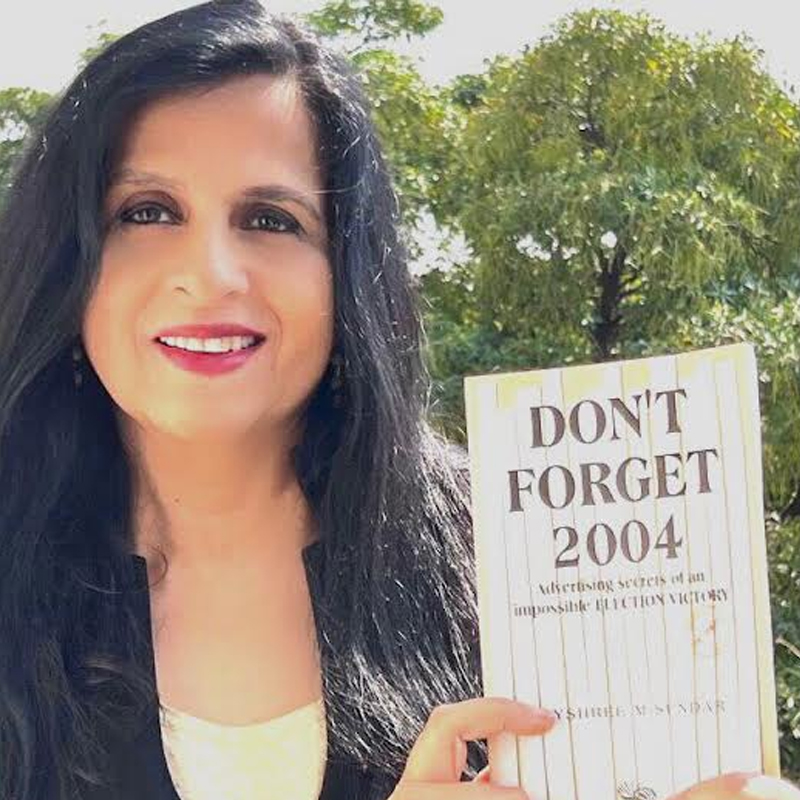
    Mumbai : How does one craft a winning marketing strategy when your brand’s target group (TG) is basically every 18+ out there, and when the entire country of over a billion is potentially your consumer base? Former Leo Burnett president-North and the author of “Don’t Forget 2004: Advertising Secrets of an Impossible Election Victory” Jayshree Sundar gives us the lowdown, in an exclusive in-depth conversation with IndianTelevision.com.

    Having worked extensively across all sectors including auto, FMCG, durables, and government in her advertising career of over two decades, Sundar got a shot at working on a political campaign in late 2003. And not just any, but for the grand old party of Indian politics – the Congress party.

    Circa December 2003:  The Congress party had taken a drubbing in three state elections, and the AB Vajpayee-led BJP government was on a roll with its ‘India Shining’ campaign. And to make matters worse for the party, who had been out of power for nine years, the 2004 Lok Sabha elections loomed large in less than five months’ time.

    Yes, the scenario is not much different from today when the national party has faced a rout in pretty much every one of the five states during the recently concluded assembly elections.

    Nobody expected the national party to even matter in the final reckoning, much less pull off a resounding, surprise victory in May 2004. It’s the quintessential story of an underdog ‘brand’ taking on and winning against a mighty opponent in a segment it has been completely written off, to make election and marketing history.

    Sundar reveals the core differences when it comes to political advertising versus regular brand advertising, while also giving us an insight into what she would do differently if she were to redo the campaign today.

    Edited Excerpts:

    On the core difference between political advertising and regular brand advertising

    At the very basic level, both are the same. Because, you have to find the right set of consumers, you have to target a specific set of consumers and you have to get your brand messaging correct. But there are many differences.

    Firstly, a general election comes once in five years. And what you are really looking for is the consumer or the voter who will go out on the voting day and cast their vote. Here, there is one vote for one person and there is no difference between rich-poor, man-woman, rural-urban, old-young. Every vote is the same, unlike in your normal brands where you have your heavy users, medium users, light users, and non-users. But here every voter is equal.

    Secondly, in political advertising, there is no repeat purchase. So if you miss your voter on the D-day, because they haven’t been motivated enough to go out to vote- it’s over and out. Your campaign, your messaging, your persuasion, the relevance of your messaging have to be so sharp and so good that on the voting day the person is motivated enough to go out and cast their ballot.

    Also, on-ground activations and the scale of execution in a political campaign are huge. It has to go down to the last village – from stickers to posters, to wall paintings et al. So, if you’re executing a creative campaign, it’s a lot of work right down the line, because your consumer could be sitting in a tiny village somewhere. And, we know that more of rural India goes to vote than urban India. So you cannot say, I’ll only focus on metros and mini-metros. You have no such choice in political campaigns.

    Another thing is, like how brands have a brand ambassador, in a political campaign having a brand ambassador- and by that I mean the leadership face- is very important. Without a leadership face, the voter is left confused- ‘Who am I voting for?’ So, it’s crucial to announce that name.

    Likewise, the slogan is critical. Getting a good slogan with good currency with the public, which becomes a part of the popular lingo, like ‘Yes, We Can,’ ‘Let’s Make America Great Again’ etc is key. And it’s complex, because every state is different, and has different issues at stake. So, yes, those are some of the core differences between a regular and a political campaign.

    On how they went about reaching out to the entire country as target group

    This was, without doubt, the largest target audience one is ever going to deal with and the largest target audience in the world: An Indian general election. If you have to reach out to everybody 18 plus and hope that they will vote for you, that goes to over a billion people in India. And obviously, you cannot reach a billion people because then, in media terms, you will need endless money. We had to get going, with a very limited budget. So obviously we knew upfront that we are not going to be able to do that. So then out of that, who do you carve out as your ‘primary target group’ and what you want to message them becomes critical.

    From the research, we found out that in semi-urban and rural areas there were clusters of consumers who were completely untouched by the NDA’s ‘India Shining’ campaign. And these were four clusters. These clusters were the unemployed youth waiting for jobs, women which were 48.5 per cent of the population then, but felt very unaddressed. Then there were the farmers who were struggling with high loan rates etc, and then there was the middle-class. So, this was the group of people we carved out. This was the unserved, unaddressed market, which, therefore, we needed to get in and address. That’s how the core strategy was formed.

    On what was the most daunting part of the campaign and the job at hand

    The whole job in its entirety, I would say. The first daunting part of the job was to crack a winning strategy that would make it past the competitive field of eight agencies who were pitching.

    And, the second one was the huge scale of execution. And also the fact that everything had to be kept top secret- that was the one mandate from their side that nothing should leak out. So, we had to put in a lot of checks and balances to make sure of that. All this was unlike any other regular brand campaign.

    On comparing the media strategy for a political campaign then & now – Would there be any change in the media mix today?

    Yes, there will definitely be a change. The big differentiator today in the media plan would, of course, be social media and mobile. Today there are over a billion mobile screens in India, so we can roughly make an estimate that almost every voter has a mobile. And post-pandemic, the screen time of Indians has gone up drastically. It is now one potent device on which everything happens- work, entertainment, shopping, and social media. And the numbers are mind-boggling. Facebook, for example, in India has over close to 500 million subscribers, quickly followed by YouTube, which is another 300-400 million, and then WhatsApp. Instagram is also catching up. With all of this put together, the main difference social media has brought in is: it’s a two-way communication medium.

    In the case of mass media, you put it on TV or print, but it’s one way- a brand talking to its consumer base. With social media, if I’m a brand or a political party and I’m targeting you, I send you something you can reply to me- there is a connection you can have. You can even do live streaming. And, now with digital coming in, it’s a whole different ball game. If you have the right data you will not have analysis paralysis if you are mining your data properly. As they say, data is the new oil, and if you mine the data properly you can penetrate deep down to the last polling booth. And you can actually have two-way communication and, you know, get to your voter directly.

    Having said that, I must add that the mobile split or the internet split between rural and urban India is still skewed towards urban. Though rural is getting there gradually, it’s 30 per cent connected as of now. So just going the social media/digital way would be a bit off the mark. For instance, for a farmer who’s in a field in a village all day, or the woman who’s cooking in a little hut somewhere – they actually listen to the radio. So you would need to use the radio and go on TV, while print being expensive as a medium one would have to use prudently. However, you cannot ignore mass media or do away with them completely.

    But yes, today one would have to put quite a big chunk of money on digital and social media.

    On what has changed today, as far as ‘audience appeal’ is concerned

    Today’s consumer is very invested in politics. As I say, politics is the new entertainment. While we always heard India has two religions, which is Bollywood and cricket, I think now there’s a third, which is politics. The kind of interest there is, whether it’s programming on TV, or YouTube, or social media, like foot soldiers who are making messages, there’s so much investment and so much noise and buzz. Like when the country was going through the five assembly elections recently, all of India was glued to the results on counting day. It’s got all the elements for excitement- there’s protagonist, there’s antagonist, there’s incumbency, non-incumbency, there are brand ambassadors, there’s a mystery in the run-up to the result day.

    And to answer your questions specifically, you would find some of the issues are the same-  rising prices, unemployment, women’s issues, education, poverty -these are some of the issues that get taken out, year on year. And in some way, you’ll find that they are big issues even today.

    On what she would do differently if she had to redo the campaign in today’s times

    I wouldn’t do too much differently, but definitely, I would have a big piece on social media and then have had fun in creativity with our slogan ‘Aam Aadmi Ko Kya Mila’ on social media. If you’re doing an anti-incumbency campaign, you need to raise the right questions. I can imagine the kind of buzz it would have created today. It was a non-negative and honest campaign. Also, in political campaigning, you can’t just keep saying the other party is bad. The whole picture has to be complete, so you need to give the other side of it- like, what will you do if you come to power.  

    And for digital, we would need to go to influencers because they have a really large following. So I would pick and choose the influencers who would dovetail with our idea, and enlist their services as well.

    On the objective behind penning it all down now – more than 15 years later

    Firstly, although it’s 15 years, there’ve been only three general elections in between. Having said that, yes, it’s a long time since 2004. But I thought I will do such a disservice to my industry, to my profession, to the world of advertising, marketing, branding, politics, and even to the history of India if we just kept this totally among myself and my team. Such a big case study happened and, if nobody knew it wouldn’t be right. Because this, in many ways, was the advent of political branding and advertising in India. 2004 had two amazing campaigns pitted against each other- ‘India Shining’ and ‘Aam Aadmi Ko Kya Mila.’

    It was something that was so integrated. I teach the subject of integrated marketing communications, which is the 360-degree approach to when advertising moved beyond just television, print, radio, and other things like internet, gaming, activation, and on-ground events. And this was a typical first INC campaign of India. So I thought it was important to tell the story about this milestone. And when the pandemic happened it all just came together.

    Of course, I didn’t write it like a boring case study, a textbook with bar charts and pie charts. I wanted to write it like a fast-paced thriller because I wanted to engage a lot more people than just the B-schools and students- basically, everybody who likes a good story.

    On the lessons learnt from the campaign as an advertiser

    As an advertiser, the lesson learned is to get your consumer right. Because if you don’t tug at the heartstrings of the consumer, if the campaign has no relevance to him or her, they’re not going to listen to you or go out to vote on that day.

    Our biggest contribution was the background research and strategy built-up on the basis of solid consumer insights, which went into coining the winning slogan ‘Aam Aadmi Ko Kya Mila,’ and set the tone for the rest of the campaign. Hence, have a strong strategy in place and just stick to your plan and go ahead.

    So definitely in advertising, one has to, first of all, find out who’s the consumer that one wants to target and have to get the messaging right. And that has not changed and will never change.
  • GUEST COLUMN: Digital innovation in the advertising industry

    GUEST COLUMN: Digital innovation in the advertising industry

    Mumbai: While the age-old basic tenets of advertising (4Ps) remain the same, digital innovations have opened more channels than ever before. Back in the day digital innovations ran speedily and dynamically changed how marketeers approached these basic tenets. But, today there are no drastic innovations, only steady transformation. New technologies have now become an integral part of marketing strategies and their ecosystems. 

    Having said that, are we future-proofing our marketing strategies? No, but there are a few innovations that will grow on us and become fundamental to how we are going to develop marketing concepts.

    Amalgamation:

    Gone are the days of linear model. Today, technological innovation and consumer behavior have created a complex reality. The key to combat this challenge is to amalgamate creativity with data to maximise consumer experience. While storytelling will remain fundamental to the process but data will give the marketing strategies an impactful edge. Art and science have always sat on different silos in the traditional method but in the new world they will converge and we will have to think holistically.

    Decentralisation:

    Many agencies have a centralised marketing structure, but nearly half of them plan to decentralise their operations in the near future. As data hacking becomes more common, demand for decentralisation will rise, and decentralisation is a solution since it places a greater emphasis on privacy and security. 

    Here are a few more advantages of decentralisation:

    1. It has a higher level of customisation for brand-specific campaigns.
    2. Content is distributed much more quickly.
    3. It will enable agencies to be more innovative and work more quickly for their clients.
    4. It will assist you in making quicker decisions.

    AI, ML, IoT, and NFT:

    When we talk about the future of going digital, we’re talking about AI, machine learning, and the Internet of Things (IoT). The new world would not exist without it, because these technologies provide us with the dynamism of what our future can be and how we can shape it. Personalisation at scale requires AI, which collects enough consumer data to see trends and offer more relevant communications to their target audience. It can learn new information as it comes in using machine learning, and then make modifications to increase performance without having to be programmed to do so. IoT improves performance across the board, from content to interactive advertising. In the year 2021, the globe will also witness a recent innovation known as NFT. A digital asset, such as a patent, can now be owned by anybody.

    CTV advertising:

    TV advertising will work harder as a result of smart TV and the entire web and connected devices ecosystem. People are already replacing their televisions with Smart TVs, which is causing a significant increase in the Indian market share for TVs. It will play a major role in the commercial experience as the traditional linear TV format loses its relevance. Connected to the internet platforms it is paving the way for selective, targeted, and flexible advertising formats. The CTV evolution has already entered India and has made significant inroads (growing in double digits month on month), as the web ecosystem is enabling connectivity through smart TVs, dongles, gaming consoles, etc.

    Just when we thought that we have mastered Facebook, metaverse caused unimaginable disruption. The treadmill of innovation doesn’t show any sign of slowing down in the near future. In such a scenario how creativity will pan across devices, experiences and platforms, how you will tell your story effectively through voice-enabled, geo-tagging, and wearable chatbots will now become crucial to us dream merchants. We will have to adapt fast and adapt with humility as we break down silos and embrace the new world order.

    (About Author: Arun Fernandes is the Hotstuff Medialabs founder and CEO)