Category: MAM

  • 12th IAA Olive Crown Awards: Kirloskar bags ‘Green Campaign of the Year’ award

    12th IAA Olive Crown Awards: Kirloskar bags ‘Green Campaign of the Year’ award

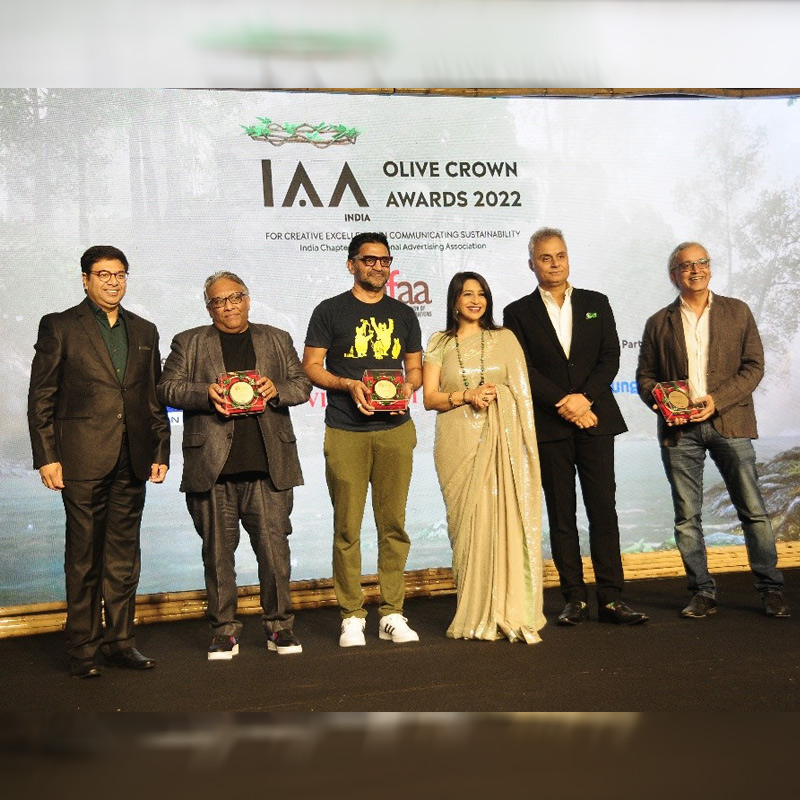
    Mumbai: Adland rolled out the green carpet at the 12th edition of the Olive Crown awards hosted by the India Chapter of the International Advertising Association (IAA) on 28 April in Mumbai. The awards acknowledged the remarkable work of those individuals and corporates who drove the message of sustainability or ‘green advertising.’

    The awards were presented across 16 different categories, including the coveted title ‘Green Crusader of the Year’ award, which was presented to Sadhguru for his efforts to ‘Save Soil’ and his new endeavour of a 100-day long motorcycle journey to spread awareness about soil degradation.

    ‘Green Campaign of the Year’- gold was bagged by Kirloskar – Limitless for its ‘Mother Nature Says Hello’ campaign, while Reliance Industries won the ‘Green Brand of the Year’- gold for its ‘Stories of Sustainability.’

    Chirag Rural Development Foundation & People for Animals Wildlife Rescue and Conservation Centre both bagged the gold in the category ‘Green NGO of the Year.’

    Shreerang Charitable Trust took home a haul of six awards, followed by Centrick Marketing Solutions LLP who picked up three Olive Crowns.

    ‘Young Green Crusader of the Year’ was awarded to Harshvardhan Joshi, an Indian mountaineer who reached the summit of Mount Everest in May 2021 in the most sustainable way possible keeping his carbon footprint to a minimum.

    The event was attended by senior marketing, media, and advertising professionals from across the country. Blue Star Ltd was the cooling partner; Vijayavani and Warner Bros Discovery were the associate partners, and Hungama Digital Media was the ‘green partner’ for the event.

    An eminent jury comprising renowned professionals such as Havas Group chairman and chief creative officer Bobby Pawar, Wunderman Thompson regional creative director- South Asia Tista Sen, House of Awe co-founder Carlton D’silva, and Madison BMB CEO and chief creative officer Raj Nair shortlisted the winners through a rigorous process.

    “The IAA Olive Crown Awards are more than just awards, they are a manifestation of all our thoughts with regards to Brand Earth,” said IAA – India Chapter president and Warner Bros Discovery – South Asia managing director Megha Tata. “They are a collected expression of what the marketing and communication industry can do so well. They are a way of showing the world that communication can be and is a true force for good and that is why we decided to support ‘Save Soil’. I really hope that the IAA India Chapter continues to take on one good cause every year and use the magic of the Marcom industry to amplify that cause.”

    Addressing the gathering, the minister for environment and tourism of Maharashtra Aaditya Thackeray spoke about the government’s new efforts of adding 24 new conservation reserves in Maharashtra and 15000 hectares of wetland for protection. “In these times of climate emergencies, it’s no longer about the future generation, this is about us, this is about being selfish because each of us can make this a better planet, to have clean air, clean water and a world which is freer and safe without hazards,” he added.

    As an Olive Crown Initiative, IAA along with AAFA is supporting the global ‘Save Soil’ movement launched by Sadhguru to address the relatively unknown but critically important issue of soil degradation. 

    Entries were invited for creative campaigns/ideas to spread awareness about this global problem. An eminent jury comprising, McCann Worldgroup India & Chairman McCann Asia Pacific CEO & CCO Prasoon Joshi; Mullenlowe Lintas group CCO and chairman Amer Jaleel, and Wunderman Thompson South Asia chief creative officer Senthil Kumar judged the entries received for the ‘Save Soil’ campaign.

    The joint winners were: Rohan Joseph, Vallabh Yeolkar, and Raj Nair from Madison BMB and Masumi Shrimankar from Fulcro. A film based on the winning campaign created by Rohan Joseph, Vallabh Yeolkar and Raj Nair from Madison BMB has been produced by Zirca Digital Solutions and Pixel Party.

    “The Olive Crown Awards have been an event, an honour, a recognition for over a decade with a lot of love to celebrate media, communications, marketing, and advertising to work towards sustainability,” said IAA Olive Crown Awards chairperson Pradeep Dwivedi. “It is rightly said that we have not received this planet from our ancestors, but we have merely borrowed it from the coming generation. It is a massive responsibility that we as an industry continue putting efforts towards sustainability.”

    Check out the complete list of winners here.(EMBED: Winner doc)

  • The HUL journey: A growth story powered by purpose, says CEO & MD Sanjiv Mehta

    The HUL journey: A growth story powered by purpose, says CEO & MD Sanjiv Mehta

    Mumbai: FMCG major Hindustan Unilever Ltd (HUL) has become a Rs 50,000 crore turnover company, the first pure FMCG firm to achieve this milestone. The company’s revenues for the full year increased 11.3 percent to Rs 51,193 crore, as compared to its revenues of Rs 45,996 crore for FY21, a flat volume growth due to unprecedented inflation notwithstanding.

    Sharing the news on LinkedIn, HUL CEO and managing director Sanjiv Mehta wrote: “The Hindustan Unilever journey has been a growth story powered by our purpose ‘To Make Sustainable Living Commonplace’.”

    Calling the HUL of today “a perfect example of #ProfitsThroughPurpose,” Mehta stated that the results demonstrate how their “values & purpose-led, the future-fit business model delivers superior financial performance.”

    “We have created a water potential of over 1.9 trillion litres by working in thousands of villages in India. Our carbon emissions from manufacturing have reduced by 94 per cent against the 2008 baseline,” detailed Mehta.

    “We achieved plastic neutrality, empowered 1.6 lakh rural women micro-entrepreneurs through Project Shakti and have helped thousands of people living in the slums of Mumbai get a better life through Suvidha, our scalable community hygiene & sanitation centres. And during these last nine years, we have doubled our turnover, tripled our EBITDA, and quadrupled our market cap to over Rs five lakh crores or $70 billion,” he further shared.

    The HUL executive additionally went on to thank all their consumers, stakeholders and employees for ‘believing in and unequivocally supporting’ the company along the way.

    The company released its financial performance for the quarter and year ending 31 March on Wednesday.

    “In challenging circumstances, we have grown competitively and protected our business model by maintaining margins in a healthy range,” Sanjiv Mehta commented, adding, “I am also pleased that we have become a Rs 50,000 crore turnover company in this fiscal. Our consistent performance is reflective of our strategic clarity, strength of our brands, operational excellence, and dynamic financial management of our business. While there are near-term concerns around significant inflation and slowing market growth, we are confident of the medium to long term prospects of the Indian FMCG sector and remain focused on delivering a consistent, competitive, profitable and responsible growth.”

    The FMCG behemoth’s revenue from sales of products during the fourth quarter stood at Rs 13,468 crore, up 11 per cent, as compared to the corresponding period a year ago, HUL said in its regulatory filing.  

    The company now has 16 brands with a turnover of Rs 1,000 crore each and reported a 5.34 per cent increase in its consolidated net profit to Rs 2,307 crore for the fourth quarter ended in March 2022, a flat volume growth due to unprecedented inflation notwithstanding. The profit and revenues reported by the company were higher than analyst estimates.

    [[{“fid”:”1073049″,”view_mode”:”default”,”fields”:{“format”:”default”,”alignment”:””,”field_file_image_alt_text[und][0][value]”:false,”field_file_image_title_text[und][0][value]”:false},”type”:”media”,”field_deltas”:{“1”:{“format”:”default”,”alignment”:””,”field_file_image_alt_text[und][0][value]”:false,”field_file_image_title_text[und][0][value]”:false}},”attributes”:{“class”:”media-element file-default”,”data-delta”:”1″}}]]

    Home Care growth at 24 per cent was broad-based with a strong performance in fabric wash and household care category. Both categories grew in strong double-digits with all parts of the portfolio performing well. Liquids and fabric sensations continued to outperform driven by effective market development actions, the company stated.

    Beauty and personal Care grew competitively at four per cent, while foods and refreshments grew five per cent on a very high prior-year comparator, driven by solid performance in beverages, foods, and ice-cream.

    Skin Cleansing category delivered double-digit growth driven by pricing and led by strong performance in ‘Lux,’ ‘Dove,’ and ‘Pears.’ A calibrated approach towards price increase in skin cleansing and hair care has helped protect the FMCG’s business model even as vegetable oils continue to inflate at record levels. Skin care and colour cosmetics had a muted quarter with Covid-19 third wave and high inflation impacting discretionary consumption.

    Meanwhile, HUL has consistently remained among the top-ten advertisers on television, according to Broadcast Audience Research Council (Barc) India’s report on advertising trends for week 16 (16 to 22 April). The FMCG giant had an advertising volume of over 4,775 seconds on the medium, which’s nearly equivalent to the sum of the next top four advertisers’ ad volumes.

  • DCMN expands insights capabilities in India; onboards Akshay Kapur

    DCMN expands insights capabilities in India; onboards Akshay Kapur

    Mumbai: The growth marketing partner for digital brands DCMN has announced the expansion of its insights capabilities in India. To help oversee the new expansion, DCMN has brought Akshay Kapur on board.

    Based out of Gurgaon, Kapur joins DCMN from audience insights and analytics leader Nielsen, where he spent close to four years working with clients including Pernod Ricard India, DSM, Dabur, Reckitt Benckiser, and GSK.

    With ad spend set to cross the Rs one lakh crore mark this year in India alone, brands have never been more aware of the need to invest their budgets in the right audiences and campaigns that will help them drive real growth.

    DCMN’s insights solutions are built to eliminate guess-work from a campaign, with capabilities including:

    Target group analysis: Helping brands gain a true understanding of their audiences’ socio-demographics, needs, interests, media behavior and drivers for using a specific product or service. From there, marketing teams can better adapt their messaging and campaigns to appeal to these particular demographics.

    Ad concept testing: Allowing brands to see which out of a selection of creative ad concepts is the most impactful and will resonate the most with consumers. This ensures businesses are getting the most bang for their buck before launching into the costly production process.

    Brand tracking: Measuring metrics such as brand awareness, consideration, usage and loyalty, among others. This is especially helpful to measure before and after a specific campaign, allowing businesses to measure upswing in key branding metrics and understand how successful a campaign really is.

    “Performance metrics can only give you so much insight into how well an advertising campaign has performed,” said DCMN country head India Bindu Balakrishnan. “Our clients are increasingly focused on building brand salience and want to know what impact a campaign has had on more nuanced awareness metrics like likeability and brand recognition. These are the questions our Insights product is designed to help answer.”

    “Having this overview of both sides of the coin – i.e. both the performance and broader awareness metrics – gives a fuller picture of a marketing campaign’s impact and is invaluable for charting a brand’s growth,” he further added.

    To date, DCMN has worked with hundreds of businesses to help them make better strategic decisions with data-based insights, including for unicorn eSports and mobile gaming platform Mobile Premier League, and leading global caller ID app Truecaller.

  • TV advertising embraces digital in Kantar’s Creative Effectiveness Awards 2022

    TV advertising embraces digital in Kantar’s Creative Effectiveness Awards 2022

    Mumbai: Advertisers increased their advertising and media investments in 2021, as lockdown restrictions in many markets started to ease, with further investment in digital platforms. Digital ad spend saw a growth of 30.5 per cent, compared with 19.2 per cent overall, and more media channels became digitalised, according to data-driven insights and consulting company Kantar. The company revealed the results of its Creative Effectiveness Awards, recognising the most impactful ads of last year, as judged by consumers.

    Throughout 2021, Kantar’s Link creative testing platform was used to evaluate more than 13,000 TV, digital, print and outdoor ads in 75 markets. The awards celebrate those which were most impactful in building brands, driving sales and increasing long-term equity. As well as recognising the best creative work of the year, the awards showcase the ‘creative sparks’ – the common themes which set apart the most effective ads, and underline some of the key market trends influencing advertising in 2021.

    An accelerated shift to digital

    “These dynamic trends create significant opportunities for new types of creative expression in advertising, both online and offline. Channel fragmentation means a greater need to understand ad effectiveness than ever. The integration of Behavioural Science techniques, better automation, and faster, more granular insights mean creative testing should be part of every team’s development cycle,” commented Kantar EVP creative and media solutions Jane Ostler. “And of course, the universal principles still hold true; when you combine clear marketing objectives with brilliantly executed creative, we see effectiveness in action.”

    Winning ads reveal the ‘creative sparks’ to ignite effectiveness

    Across the 13,000+ adverts analysed using link, Kantar’s validated ad testing solution, Kantar identified five ‘creative sparks’ that set the most effective executions apart:

    Ad breaks go social:

    The winning TV ads in this year’s awards demonstrate a clear move towards infusing direct references to digital environments and themes. This could be a deliberate attempt to acknowledge the existence of online platforms, which many of us are immersed in for hours each day. Including visual cues from the digital world undoubtedly makes TV ads more compelling and more absorbing to watch.

    In eighth place in the top 10 TV ads of the year, Chupa Chups XXL Flavour Playlist TV spot is one example of this trend in action. “We are delighted to have our work recognised by Kantar. Our goal was to use the launch of our new product as an opportunity to extend the brand’s reach and relevance among young adults,” Perfetti Van Melle senior brand manager Jordi Rosell said. “One of the key things we wanted to capture was the independence, assertiveness, and rebellious spirit of young people. The creative approach was designed to break with tradition, using references to TikTok, gaming and other cultural touchpoints in a way that reflects their lives, while giving prominence to the unique features of the product.”

    Every second counts:

    With winning ads ranging from six to 136 seconds long, the awards show you can effectively tell a story at any ad length. While digital ads are often short to reflect our online attention span, one of the winners in the digital category is a two minutes and 15 seconds long ad for Colombian beer brand BBC, which uses an unusual and distinct graphic style soundtracked by a jazz track that draws viewers in.

    Global campaigns, local heroes:

    Many brands want to build a consistent perception amongst viewers globally, but local understanding is key to creative choices that are effective and support the global brand vision. Diageo brand Johnnie Walker scooped awards for ads in the UK, Mexico and Thailand with effective local executions which contribute to a consistent global strategy.

    Show, don’t tell:

    Even with the myriad of new developments and sophisticated ways to stretch creative boundaries with advancements in visual and audio techniques, our winning ads show that the product demo is still as effective as ever.

    In first place in the TV category, Mitre 10’s “With you all the way” spot is a stand-out example of a product demo that is natural and maintains the flow of the ad. “‘With you all the way’ is a promise of partnership. We’re there to help our customers build confidence in their ability to get the job done right,” Mitre 10 chief marketing officer Jules Lloyd-Jones commented. “With a touch of humour thrown in, the ad creative reflects that promise and centres on our greatest asset – our people. Leaning into that differentiator, the aim was to take us from retailer to trusted project partner for our customers, really inspiring them to love where they live, work and play. We’re so pleased the ad has landed so well with Kiwi customers and we’re honoured to see the campaign recognised internationally in the Creative Effectiveness Awards.”

    Make them smile:

    Laughter has long been a staple in advertising. But the last twenty years have seen a steady decline in the use of humour as a result of the purpose-based marketing boom, and as brands looked to communicate sensitively during the pandemic. Recent analysis from Kantar shows that humour is a powerful tool in creating ads which are expressive, involving and distinct. Award winners from Rappi, Zespri, Amazon and Chromebook show that bringing humour back into advertising pays off.
    On Wed, Apr 27, 2022 at 7:37 PM Anupama Sajeet <anupamas@indiantelevision.co.in> wrote:

  • Ad spends are likely to get impacted if consumption reduces: Carat India CEO Anita Kotwani

    Ad spends are likely to get impacted if consumption reduces: Carat India CEO Anita Kotwani

    Mumbai: In March this year, India completed a year of double-digit wholesale price inflation (WPI inflation). This is the sixth occasion when inflation has remained over 10 per cent for a year or longer, and it came more than a quarter of a century after the last such episode — between March 1994 and May 1995.

    In an exclusive interaction with IndianTelevision.com, Carat India CEO Anita Kotwani noted that inflation is already impacting FMCG which is the broadcast industry’s highest ad spender. She offers her take on the impact of inflation noting that right now ad spend patterns are unlikely to be impacted and the market is recovering from Covid-19. But she warns that if the price of commodities significantly goes up, then that could impact consumption negatively. And ad spends are the easiest to cut back on when commodity prices rise. She offers the example of domestic aviation cutting back on TV ad spends in a significant manner so far this year. On a more positive note, she sheds light on the resilience of TV as an ad medium.

    Edited excerpts:

    There is talk about high inflation. How is this impacting companies especially FMCG?

    High inflation is likely to bite into the FMCG sector’s volume growth in 2022. Retail inflation in India rose to a seven-month high from 6.01 per cent in January, breaching the upper tolerance level. The rise was mainly on account of high food inflation, which jumped to a 14-month high of 5.43 per cent, along with a high base.

    A majority of FMCG companies have already reported a decline in volume growth in the third quarter of FY22. At this juncture, FMCG firms face the dilemma of choosing between margins and volumes. However, the analysts believe that protecting the margins will further impact volumes as consumers will hold back consumption.

    A recent Nielson IQ report suggests that demand in the rural segment has taken a hit, with volume growth declining by 2.9 per cent. Inflation in the price of fertiliser and diesel has impacted the disposable income of the farmers, thus, impacting the consumption in the rural regions.

    Some of the recent reports also suggest that consumers may have to pay more for their daily essential items. Since the FMCG companies are mulling over another round of price hikes, to offset the impact of an unprecedented level of inflation in commodity prices such as wheat, palm oil and packaging materials. A 10-15 per cent hike is expected across industries. The market is volatile as of now, therefore, brands will consider multiple factors before finalising the incremental in the price for their product.

    Do you see clients’ ad spending getting impacted in the coming quarters as consumer sentiment turns negative and spending slows down?

    Currently, the negative sentiments are not very strong and things are still volatile. Ad spends are likely to get impacted if consumption reduces. However, the impact on consumption will be determined by the increase in the cost of the product. Yes, the essentials are getting a bit expensive but that is largely due to the increased fuel cost led by the Russia-Ukraine conflict. Apart from that, the market has been steadily recovering from Covid and the advertiser spend patterns are unlikely to see any impact. Only if the price of commodities significantly goes up, then that could impact consumption negatively.

    Which are the sectors that you see coming under stress due to inflation?

    As per the Consumer Price Index (CPI) of March 2022, India stood at an inflation rate of 6.95 per cent.

    Amidst the hardening of fuel prices, India’s wholesale price-based inflation quickened to 14.55 percent in March from 13.11 percent in February. Retail inflation for March has also climbed to 6.95 per cent, a 17-month high. According to the country’s CPI-based inflation report, the spike in prices was led by food items.

    A continuous rise in fuel prices since March 22 has not been completely captured in the latest data, suggesting that inflation may remain elevated in the coming months. A surge in crude oil prices to a 14-year high has resulted in broad price pressures on Indian households.

    Among food items, the index for oil and fats recorded the largest sequential price hike, by 5.3 per cent in March. This may raise pressure on the government to make edible oils cheaper.

    The worst affected sectors include food (+1.4 percent over February), clothing and footwear (+0.9 percent over February), and fuel and light (+0.9 percent over February).

    Do you see urban and rural India both being equally affected?

    Since the beginning of 2021, inflation has started to see a gap between urban and rural geographies. For rural consumers, their basket has a higher weightage on food and essentials. Whereas, for urban consumers, the non-food items dominate their shopping baskets as well. Recreation (malls/cinemas) also impact urban consumers more than rural.

    While the inflation gap between urban and rural audiences is always going to remain, rural is also likely to see an impact in consumption due to increased prices of fertilisers and diesel. This impacts the disposable income of people in the rural region.

    The people who are most affected by rising inflation are the final consumers of goods. The prices of goods and services are constantly rising. However, the salaries and income of consumers do not rise proportionately. Hence, there is a lag leading to goods and services becoming less affordable to the final consumers. The CPI inflation witnessed significant and sustained moderation during 2012-13 to 2018-19, before rising thereafter.

    Rural and urban inflation exhibited a similar trend; the only difference witnessed was that urban inflation started rising from 2018 to 2019.

    Moreover, the annual average urban inflation which was ruling below rural inflation till 2017-18, moved above it during 2018-19 and 2019-20 (Chart 1a). Food and non-food inflation contributed to the divergence between urban and rural inflation (Chart 1b).

    The consumer food price inflation for rural areas was 3.94 per cent in March 2021. It went up to 8.04 per cent in March 2022. Similarly, the CPI for rural India has also gone up to 7.66 per cent in 2022, from 4.61 per cent in March 2021.

    The rural food inflation in March has also registered a steep hike in comparison to February 2022. It has gone up to 8.04 per cent in March, from 5.81 per cent in February.

    The Consumer food price inflation for India as a whole, including rural and urban, has gone up to 7.68 per cent in March 2022, from 4.87 per cent in March 2021. Given this understanding, yes, inflation will impact rural and urban consumers equally.

    What does the media industry need to do to prepare for growth potentially not being as smooth?

    Ad spends are the first and the easiest way to cut costs during times of high commodity prices. It is already evident. Hit by high aviation fuel prices, domestic airlines in the country have cut television advertising by as much as 27 per cent , during the first five months of the year.

    When companies try to reduce the ‘extra’ spending, the packages provided by marketers for consolidated marketing become way more lucrative for the brands concerned.
    It is imperative for brands to understand that the focus of cost-cutting should be on reducing wastages and not reducing activity that can generate future sales or build a brand.

    When a brand is in its growth phase, a reduction in ad spends is unadvisable, even during times of inflation. If a brand is sensitive to media ad spends, which consequently drives movement in business impact, then they too should not cut ad costs. This education to brands by media agencies and partners is imperative.

    360-degree media campaigns are the most lucrative campaigns. They combine the most effective and efficient mediums that drive business impact for the brand and further boost media outcomes to the best possible, depending on the category.

    Exploring newer advertising options like addressable TV, geo-fencing on digital, digital OOH and interactive print is not only more efficient but far much more sharp-targeted to the audience, avoiding spillage and minimizing costs.

    Is there a likelihood of revising the projected ad spend growth of  Rs 82,500 crore?

    As an industry we are keeping a close watch on how the media spends are progressing, advertisers and agencies have come to terms that things need to normalise despite rising in covid cases, we will have to co-exist with the virus and continue business as usual. We are hopeful that the situation will not deteriorate, and growth projections if needed will be upward only.

    It is a bit unclear right now if the projection for the ad spends will get changed. There has to be a situation as major as the 2020 Covid crisis for the ad spend projections to change significantly.

    Will print be the first medium to suffer if clients cut back on spends? What is your take?

    In a world wherein all media inputs are determined by ROI, print is the low-hanging fruit. It always witnesses cuts whenever there are budget cuts. A lot of marketing mix modeling (MMM studies) show that for a lot of FMCG brands, print has the lowest ROI, and hence print is always under the scanner.

    Dentsu’s ad forecast report mentioned TV being the most resilient. What is the reason for this?

    Linear television remains to be the most popular and resilient media in India with a 40 per cent share of spend. Linear television ad volumes continued to post a healthy growth starting H2 2021, as marketers leveraged the reach and power of TV to raise the profile of their brands.

    We have seen this in the past as well. In 2021, the TV spends were fully recovered and since TV is still the highest reach building media, brands must leverage TV for building equity and for the movement in top-funnel metrics. While there has been a shift in content viewing with some audiences moving from TV to OTTs and demand for OTT advertising is rising, the impact on TV spends is minimal.

    On TV which are the top five properties for an advertiser?

    The properties are bucketed under different genres and are listed below:

    ⦁ Cricket – IPL & CWC
    ⦁ Dance Reality Shows (“Dance India Dance,” “Dance+”)
    ⦁ Singing Reality Shows (“Indian Idol,” “SaReGaMaPa”)
    ⦁ Unscripted Shows (“Bigg Boss,” “Fear Factor”)
    ⦁ Fictions/Scripted Shows (“Anupama,” “Imli,” “KumKum Bhagya”)

    Will smaller genres like music continue to find the going difficult?

    Over the last couple of years, there has been a drop in the viewership of the music genre. A major reason is the movement of audiences from music to news and film genres, especially post Covid. Additionally, music listeners who also like to watch music videos have moved to YouTube to watch the videos of their choice. While the viewership for smaller genres will continue to remain low, relevant brands can still look at these genres for the right targeting. Brands targeting youth and females can look at this genre to build frequency.
  • Chivas announces Hrithik Roshan as its brand ambassador and launches its new campaign

    Chivas announces Hrithik Roshan as its brand ambassador and launches its new campaign

    Chivas has appointed Hrithik Roshan as its new brand ambassador with a captivating campaign, ‘Made of Great Character’.

    Chivas showcased a refreshing brand image through the new campaign narrative, which highlights a ‘rich blend of success, generosity & brotherhood’, while retaining the brand ethos. The 360-degree integrated campaign will be widely seen on social media platforms, popular newspapers, OOH & during IPL on Hotstar.

    Conceptualized by creative agency Ogilvy, the ad film has been shot by the famous French filmmaker and visual artist Jean Claude Thibaut.

    The campaign celebrates the spirit of an individual’s positive character that makes them stand out as beacons of grace and gratitude, hope and high ideals. “We see various facets of great character through different lenses that highlight the attributes of self-made individuals who prioritize knowledge and progressive values above materialistic pleasures. The core ideology of character being a true measure of a successful individual with a positive spirit that is cultivated over years & refined over time, is reflected through the campaign,” the company said in a statement.

    “The ad film showcases Hrithik as a successful entrepreneur who is pure class, reflective of his positive character. A seasoned actor who has only gained respect for his charisma and bold persona, Hrithik is a class apart both in real and reel life. He embodies modern values and a progressive mindset and is aware of his goals and desires,” it said.

    The multi-talented actor, with his sheer simplicity, integrity, kind-heartedness and love for his audience, truly represents the brand’s philosophy, which is also reflected in the campaign film. The film also features actor Mouni Roy.

    Commenting on the announcement, Pernod Ricard India chief marketing officer Kartik Mohindra said, “Chivas is an iconic brand for the successful individuals who embody progressive values & appreciate luxury.”

    “The brand has always inspired others while celebrating the stories of those who have led the new paths of success. With Hrithik Roshan being one of the most successful and celebrated actors, his inspiring story of upholding great values while riding on the path to success makes him unarguably the best choice as our new brand ambassador. The coming together of Hrithik and Chivas’s outstanding character in the campaign ‘Made of Great Character’, will help forge a new direction for the brand,” he added.

    On his partnership with the brand actor Hrithik Roshan, said, “I am thrilled to be the face of Chivas and take pride in being the voice of their latest campaign ‘Made of Great Character’. I truly believe that great values embody great character, which ultimately forges the path to success. I love the core theme of the campaign that encourages people to lead a life that they value and to develop their character. It also connects with so many different aspects of my life.”

    “Character defines destiny” – simple, yet powerful words underline the fact that destiny is not a predetermined outside force. Rather, an individual’s future is determined by his inner character. The crux and the core of Chivas exemplifies this. Character is at the heart of Chivas’ spirit. The Chivas campaign revolves around our protagonist, who not just mirrors these values, but elevates character by capturing its many nuances,” said Ogilvy, North, executive creative director and head of design Nitin Srivastava.

  • One-word description of Abby’s this year would be ‘game-changer’: The Ad Club’s Partha Sinha & Rana Barua

    One-word description of Abby’s this year would be ‘game-changer’: The Ad Club’s Partha Sinha & Rana Barua

    Mumbai: The stage is finally set for the annual awards hosted by The Advertising Club (TAC) to be held from 5 to 7 May at the GoaFest this year. The thirteenth edition of the Abby awards is back on ground after taking an enforced breather of two years, thanks to the pandemic. IndianTelevision.com caught up with The Ad Club president Partha Sinha and Abby Awards Governing Council 2022 chairman and The Ad Club VP Rana Barua to find out what has changed at the Abbys and on the participation from agencies and industry at large at this year’s awards.

    The award ceremony that celebrates the cream of the country’s advertising works and the advertising industry at large is in its thirteenth year at the GoaFest. Earlier this year, The Ad Club announced its partnership with the prestigious The One Show for Abby’s 2022, and thereafter the appointment of three International jury chairs to judge the works.

    What’s different this time

    “One of the key things that we wanted to do was to take Abby’s to global standards and we have done precisely that. We have tied up with the world’s most credible and sought-after award program, The One Show,” says Partha Sinha, diving right into what’s different this year about the awards.

    This was unimaginable, says Sinha, reminiscing about the initial days of the awards. “Abby’s used to be a cottage industry- from there we have moved it to The One Show – that’s like the biggest global standard there is.” So, thanks to that a few things will be very different this year, he continues. “That is the standard of judging, the quality of jury we are getting due to the intervention of The One Show, and we also expect this to serve as a shortlist for global awards. Because here the remit maybe South Asia but the standard is global.”

    “So South Asia entries will be judged in global light and my guess is that some of the works which will win here will go on to win on global platforms,” Sinha adds.

    The work that is being judged is from the last three years, Barua reminds while talking about the awards’ association. “It’s truly now a part of an international circuit via this collaboration. So also, the quality of work is not going to be basic. I think that’s one of the biggest changes that is going to start- maybe some of it this year too but you will see it in the subsequent years- the work quality will automatically start improving.”

    The quality of jury chairs that has come in because of The One Show, it’s going to become an introspective pressure on all of them because you have to raise the benchmark of work that’s coming out now, continues Barua. “That’s the exciting bit for us.”

    Kind of work being received

    What is the kind of work being received in the wake of the pandemic, considering that the pandemic has served as a disruptor for most industries- advertising and marketing included? To that Barua says, “We need to remember that it is three years of work that we are judging this time. So there might be a pre-pandemic, pandemic, and also post-pandemic work from last year- which is when we came out of the pandemic and more or less life was returning to normalcy.”

    “Also, because of the strictness of the process, neither Rana nor me- nor anybody in the committee, for that matter, has seen the work. The work is seen and evaluated only by the jury,” he emphasises, adding that, “We will get to see the work and the award only when it wins an award, and when the Abby is made. There’s a sanctity to the whole process and that is the beauty of The One Show. I’m loving it.”

    Having said that, Sinha perceives that a key part of the works this time could be humane in nature “because one thing everybody has realised- whether its communication or business or anything- is that you need to have a lot of sympathy, a lot of empathy towards your audience.” Calling the pandemic the biggest teacher, he says, “The pandemic taught us that maybe ‘empathy’ is a bigger power than even ‘persuasion’ so we will get to see some reflection on that, rather than pure persuasion and selling.”

    Participation from agencies

    Abby’s partnership with The One Show will add credibility and raise levels of transparency to the entire selection process for the awards, which had come in for a fair share of criticism from agencies in the past over transparency in the awarding process. It also saw a few big names in agencies dropping out of the process.

    On the participation from agencies this time around after a gap of two years, Barua says, “I can just tell you the participation numbers this year have beaten both 2018 and 2019’s numbers. Both on Creative and on Media we have had some outstanding contributions from all the agencies- independent as well as network agencies.” It’s probably a record-breaking year, he adds, and so next year is going to get tougher for us as the stakes are going to be higher.

    Barua acknowledges that because of the timing and uncertainty due to the Omicron wave, few network agencies could not manage to participate within time. “But they have all shown equal participation because of The One Show and from next year we are going to see a maximum number of these agencies coming back.”

    Sinha draws attention to another event recently held by TAC- the EMVIES, which was likely the advertising industry’s first large-scale event post the pandemic. “We saw the energy, the number of entries, the quality of entries. And I am not expecting anything lesser- this will be as big, as exciting. The number of entries has surpassed all kinds of records so we think the participation is very strong. My guess is that even the quality of work would be great, as also seen during EMVIES. And I’m expecting the quality to only go upwards from here,” he says.

    “And I’m also expecting that because of this global standard jury process, some of the work which wins here will also go on to win on some global platforms,” he further adds.

    Earlier this year, post its partnership announcement with the prestigious The One Show for Abby’s 2022, the Ad Club announced the appointment of three International Jury Chairs for judging Abbys this year, namely – Menno Kluin, Aricio Fortes and Myra Nussbaum, who are each stalwarts in the global advertising industry and also some of the world’s most awarded.

    Additionally, the Abbys Governing Council announced the names of six advertising professionals, who will be judging Abbys 2022 along with the international judges as jury chairs.

    Reaction from jury members

    On the excitement from jury members, Barua says, “They were very excited to know about this entire association. For most of the global persons who have come onto the jury, India is a country that they would have loved to become a part of and play a role in this. And they are playing it either directly or indirectly through the network from some of the best agencies.”

    If the time had permitted they would have got a wider range of people, says Barua. “Some of these names are absolutely the biggest in the industry. And there’s high excitement, they would love to know what’s happening in the country. Some of the best juries have managed to come onboard. We gave them the right categories to manage so that it’s easy for them to understand the entire thing.”

    To give an insight into the kind of responses they were getting from the jury chairs, Sinha read out a text from a jury chairman (whose name is not disclosed for now). “TOS judging interface is a game-changer, it made the whole process on-the-go,” he reads out. “I found the composition of the jury very refreshing and I must appreciate the TAC for being so thorough even though it’s the first year of their collaboration.”

    Setting a benchmark

    He further went on to say, “If there’s a one-word description of Abby’s this year, it would be ‘game-changer’. Everybody thinks it’s a game-changer. Everybody who judged thinks so too. We know it’s a game-changer. We want to make sure it is.”

    Calling it a big change that the industry will always remember, Sinha says, “We spent serious money and effort doing this collaboration. And we did all of that with just one thought in mind,” He continues, “Because I think we owe it to our fellow communication people in the industry, that we do something which’s of a standard. And Abby is going to be of a standard which is going to be recognised by anybody across the globe.”

    The TAC duo shared that the international collaboration has generated a lot of interest in the event amongst the global community, which was a little insulated before this. And that includes the kind of speakers the adfest is attracting. “We are getting Dan Wieden – that’s the man behind Nike’s famous ‘Just Do It’ slogan in 1988. Then there’s Menno Kluin – he’s the rockstar in the global creative world today. So suddenly the whole story is changing in a manner where people are now seeing us as a part of a circuit.”

    They further add, “We have to get it to the level of those Monaco circuits, Singapore circuits. To be a part of that circuit it has to have that quality, status and stature. And that is precisely what we are doing. So our job as the ad club office bearers would be to make sure we take a very strong step towards preparing our entire circuit in such a way that it is world-class.”

    “We have had enough bumps, hurdles, potholes so it’s time for us to even out the entire road and raise the game,” The Ad Club duo signs off.

  • GroupM merges Essence and Mediacom, integrates Mindshare with Neo

    GroupM merges Essence and Mediacom, integrates Mindshare with Neo

    Mumbai: WPP’s media investment group GroupM announced on Wednesday its plans to merge Essence with MediaCom and Mindshare with Neo in its latest steps to transform and further simplify its operations. The moves, which build on the April 2021 launch of Choreograph, WPP’s global data and technology company, will create a new 9,000-strong cross-channel performance platform built on AI technology, it said.

    Additionally, Finecast, Xaxis, and GroupM Services – GroupM’s global community of activation experts – will be brought together to form media performance organisation, GroupM Nexus. Xaxis Global CEO Nicolas Bidon will oversee GroupM Nexus as Global CEO.

    Essence and MediaCom will merge to form EssenceMediacom, a new agency offering fusing the digital and data-driven DNA of Essence with MediaCom’s scaled multichannel audience planning and strategic media expertise.

    MediaCom Global CEO Nick Lawson will lead newly formed EssenceMediacom as Global CEO. Kyoko Matsushita, after eight years at Essence, is promoted to a new role as WPP’s CEO in Japan as the company continues to invest in expanding, high-growth markets.

    Mindshare will complete the integration with global performance agency Neo, wherein both will operate under the Mindshare brand but will retain and scale Neo’s operating model, focused on pureplay performance solutions at its heart, integrating this into Mindshare’s full-funnel offering.

    Neo’s 1,200 digital-first, performance experts and consultants will be integrated with Mindshare’s 10,000 media specialists and Neo’s digital-first services will be fully embedded into Mindshare and GroupM’s offering, stated the agency.

    With this reorganisation, GroupM’s five agency brands will be streamlined into Mindshare, Wavemaker, EssenceMediacom, GroupM Nexus and Choreograph.

    “The future of marketing is outcomes-driven, supported by audience-first planning and continually improving, AI-enabled performance standards,” stated GroupM Global CEO Christian Juhl. “Through GroupM Nexus and our agency powerhouses Mindshare, Wavemaker, and EssenceMediacom we are building a tech-enabled future, side-by-side with our clients, that is accountable to advertisers’ growth goals and to our vision for an advertising ecosystem that works for everyone. I also want to congratulate Kyoko, who has grown and strengthened Essence in her time as Global CEO, on her exciting new role as WPP’s CEO in Japan. We will continue to work closely together to strengthen the position of our agencies across APAC.”

    The merger of Essence and MediaCom builds on a record of strong business growth for both agencies, according to the agency. Comvergence ranked MediaCom first in the industry for new business wins in 2021 with $2.87 billion in new billings attributed to wins, while Essence has continued to grow and expand its remit with Google and other key clients.

    “The formation of EssenceMediacom builds on the strong and proven relationship between the agencies to create the agency model our clients want for the future — one founded on brilliant strategy and brand-building capabilities, with pioneering digital expertise running throughout,” said EssenceMediacom CEO Nick Lawson. “EssenceMediacom will not only help our clients see the bigger picture and reimagine what’s possible; it will also provide opportunities for our people to upskill and train in new areas, further enriching and enhancing their careers.”

    “Today’s global marketers need both agility and scale from their agency partners to properly support their businesses across international markets. Bringing together Essence and MediaCom – each with their own celebrated histories of excellence – will create a truly unique combination of agile innovation and global scale in a single agency,” added Kyoko Matsushita.

    GroupM Nexus will comprise 9,000 practitioners around the world, collectively responsible for the activation of more than two million campaigns managed by GroupM each year. This global community represents the industry’s leading team of experts in digital channels and platforms, search, social, programmatic, AI, cross-channel optimization, and data-driven technologies and software.

    GroupM Nexus unites GroupM’s addressable content and TV, AI technology (Copilot), and omnichannel solutions from Finecast, Xaxis, and GroupM Services into a single unit. The global organisation will be underpinned by a new cross-channel performance platform and international delivery hubs to set new benchmarks for performance innovation and efficiency for GroupM’s agencies and clients.

    “GroupM Nexus unites leading media talent, digital services excellence, cutting-edge AI technology and unique scaled partnerships into a new cross-channel performance organisation with one purpose: power growth for our people, our agencies and the amazing brands they represent. We cannot wait to innovate together and unlock new opportunities for everyone,” said GroupM Nexus CEO Nicolas Bidon.

    “This is a journey we’ve been on for the past year with many clients who have been demanding more diverse media services to drive their growth,” commented Mindshare Global CEO Adam Gerhart. “The merger delivers seamless access to Neo’s digital-first capabilities and a relentless focus on performance models to accelerate Good Growth. For our teams it means more opportunity and the ability to create greater impact across the world. I’m delighted to partner with Neo CEO Nasreen Madhany as we complete the integration of the two businesses and move into a new future together.”

  • GUEST COLUMN: Streamlining performance marketing via automation is must in post-pandemic era

    GUEST COLUMN: Streamlining performance marketing via automation is must in post-pandemic era

    Mumbai: The Covid-19 pandemic altered how we live and work in ways that will redefine our behavior even after its effects subside. As of today, businesses are still continuing to rapidly deploy digital and automation technologies which in turn are putting trends (previously progressing at a slower pace) on a fast-track mode. The marketing automation software market poised to grow at 8.55 per cent is slated to unlock a market capitalisation of $6.4 billion by 2024 (Source- Marketing Automation Market by Component-Software, Services). While over 51 per cent of businesses are already using marketing automation, over 58 per cent of companies have plans of adopting it (Source- Emailmonday).

    Across advanced economies, the dynamics of these changes, whether in business models, operations or consumer behavior will continue this year but not with the same intensity as witnessed in 2020 or 2021. Against such a scenario, a lot of businesses are stretched for margins. Therefore, the best utilisation of resources for them is to focus on growing their businesses by having their employees focus on tasks that are oriented towards value-creation. Using automation to replace all the man-hours put into repetitive manual processes will be their arsenal!

    This year marketers in India are channeling their energies towards generating distinct, value-added user experiences and making user engagement even more connected for consumers who are always online. Digital marketers in India should look to leverage automation in five important ways to make their performance marketing strategies more efficient and scalable.

    Offer testing

    Nobody wants to send traffic to an inactive offer or to spend money on users that are not going to yield any return. Offer testing can save both time and cost for advertisers and publishers. By identifying broken links, corrective measures can be taken in a timely manner to make the most of the efforts. This saves hours and hours of advertising operations along with manual back and forth communication to solve an issue, which can be identified by an automated tool within seconds. Some of the leading performance marketing management platforms offer testing as an inbuilt part, where all the actions from creating a new offer to promoting them to your partners can be validated by the system upon the user’s choice.

    Data-driven campaign optimisation

    The next key lever typically in the hands of marketers to pull when it comes to optimizing their digital marketing campaigns is audience targeting. They should focus on effectively targeting their audience based on geolocation, device, traffic type, carriers, interests, and other custom data. Performance marketing solutions with automated audience targeting can reduce the amount of manual work and cost based on rules set by the marketers. Additionally, they can set rules that determine which ads are distributed to the publisher partners to best match the audiences targeted using advanced machine learning algorithms. This means that companies can use granular targeting options manually and also use a platform’s recommendation tool, powered by machine learning, to suggest the right advert for the right user, thereby increasing the ROI for the advertiser and profitability for businesses.

    Automated insights

    While the first-generation campaign management tools only provide limited data insights and still require substantial manual work processes, the next-generation solutions are integrating more sophisticated data science tools. Digital marketers can partner with performance marketing management platforms which can lend them greater accessibility to performance metrics. This in turn will allow marketers and partners to see tracking and revenue numbers in real-time. Further, today’s data science tools can automatically discover patterns, trends, and business opportunities in the given data sets, so that marketers can further optimize their performance marketing efforts. Business users can query billions of real-time events in seconds with just drag and drop actions and marketers can identify patterns in traffic across a business with just a few clicks. Many global martech platforms are offering these directly with zero setup and no third-party fees and integration pains.

    Automatic offer approval

    Affiliate or partner marketing is unique from other digital advertising channels (like search or social media) in the way that the marketer must distribute and accept offers with the partner for referring potential customers. It’s a process that is until today manual and archaic in the digital marketing age. Fortunately, automation now enables importing, creating, and accepting offers from a vast number of integrated partners based on predefined rules, thereby saving tons of time and resources. When it comes to taking any action with automation, marketers should look at partnering with those martech platforms which allow them to configure the rule to their needs. Flexibility is a key ingredient for automation to succeed and their martech platforms should empower them to set up their processes with dos and don’ts and let the platform handle the rest while they can focus on other value-adding tasks.

    Automated client notifications

    Another big part of the partner marketing domain is keeping all partners informed of all the changes that might be happening on an offer. Communicating this information to the partner in real-time can be a bit of a challenge. With automation, all of this can be handled with a click of a button. An industry-wide innovation like ‘Smart Triggers’ helps identify your partners and the contacts, write an appropriate text for the update, and all marketers need to do is schedule it.

    Performance marketing is made even more effective by automation. To really hit business goals, it’s important to build campaigns strategically—choose the right platforms, advertising formats, and optimisation goals, focus on the right audience, and, of course, create campaigns that will resonate with the target audience. Automation is the key to scaling and achieving these goals.

    (About Author: Yogeeta Chainani co-founded Swaarm, in September 2020. As the CEO of Swaarm, Yogeeta drives product innovation and human resources along with spearheading business development in India and other global geographies for her company.)

  • Menstrual equity and gender inequality are inextricably linked: Shally Mukherjee

    Menstrual equity and gender inequality are inextricably linked: Shally Mukherjee

    Mumbai: There are 500 million women worldwide who are experiencing ‘period poverty’ i.e., lack of access to menstrual products, education, hygiene facilities, waste management, or a combination of these. Recently, Miss Universe Organisation, social entrepreneur Arunachalam Muruganantham, social impact agency DDB For Good, and humanitarian organisation Plan India formed a social impact alliance to address the issue of menstrual equity.

    The initiative, which will be piloted in India, will lead efforts to raise awareness, education, policy and access to sustainable resources and products for menstrual equity. In India, 62 per cent of young women and girls do not have access to safe menstrual care, according to a study. The campaign will go global in the coming years.

    The coalition’s goal is to achieve menstrual equity for five million women and girls by 2025 in India. Plan India will act as the on-ground NGO partner to drive the mission while DDB For Good in partnership with philanthropic consulting firm Change Our World will mobilise the public using creative storytelling to raise funds for the platform. Both DDB For Good and Changing Our World are a part of the Omnicom Group. Muruganantham aka ‘Padman’ will help the coalition set up affordable manufacturing units in geographies and communities most affected by period poverty that will be run by the women and girls themselves.

    In the past, DDB For Good has worked with Udhyam, a non-government organisation that works in the space of building entrepreneurial mindsets. They were the communications partner for Unicef on the Yuwaah initiative during Covid. The agency created and led the ‘Team For Humanity’ platform to raise funds for families who lost their breadwinners in the second wave of Covid.

    DDB For Good founder and head Shally Mukherjee has over a decade of experience understanding issues around menstrual equity through her work on some of the leading brands (P&G) in the category, not just in India but globally. In conversation with IndianTelevision.com, she speaks about the role of menstrual equity in addressing the larger problem of gender inequality and more.

    Edited Excerpts:

    On the link between menstrual equity and gender inequality

    Menstrual equity in its entirety can be defined as the ability of every woman to manage her menstruation experience with dignity, safety and confidence. More specifically, it entails menstrual awareness for her and the society in general, access to hygienic menstrual products, safe disposal spaces and elimination of taboos.

    Menstrual equity and gender inequality are inextricably linked. In my opinion, it’s the root cause. Gender inequality intensifies when a girl gets her first period, with taboos and a list of do’s and don’ts. These are impressionable years for a girl and she gets shaped by what she is told and what she experiences. Menstrual poverty leads to not just a physically traumatic menstrual experience for her but mental and social as well, during her growth years. And thus the inequality in her own mind and those of others around her begins. The more measurable and tangible effects are girls dropping out of school, leading to a loss in education and hence lesser participation in the workforce as they grow up. Leading further to the vicious cycle of intensification of gender inequality and everything that lack of education means.

    On the coalition solving the issue on menstrual poverty

    The Global Coalition for menstrual Equity is a global call to end menstrual poverty. It’s a platform created to invite partners who can help scale up the effort in the space because the issue is huge and widespread.

    Each founding member brings a unique ability to scale up the effort in this space. Ms Universe 2021 Harnaaz Kaur Sandhu is a huge influencer and can leverage her reach and popularity to create change. Miss Universe Organisation has a reach of 90+ countries through a network of influencers. Plan India is a nationally registered NGO that will be the on-ground implementation partner, with not just reach across the country but also expertise in the space of menstrual equity. Plan India is a member of the Plan International Federation, and the coalition will leverage their reach in 70+ countries to scale this globally. Padamshree Mr. Arunachalam Muruganantham, aka Padman, is a social entrepreneur, who has done pioneering work in the space of period poverty alleviation and the coalition will leverage his expertise and affordable pad production machines to create access for menstrual products. DDB for Good brings in subject matter expertise, with almost a decade of work in this space. In addition, DDB For Good and Changing Our World have the expertise to create collaborative platforms, such as this, to create a pool of resources, expertise and influence for at-scale impact.

    On the blueprint of the initiative
    Creating regular access to safe, hygienic and affordable sanitary products is at the centre of our program as we kick this off. However, we will also be addressing the two other key pillars of awareness and taboos.

    Other than addressing the awareness, taboos, disposal and access issue, it is extremely important to bring boys and men into the conversation.

    On the communication strategy

    The coalition has just kicked off. We are working through the mass communications strategy. There are several pillars that need to be addressed. For now, the organic PR and the social media attention that the coalition is getting is proving to be adequate to spread awareness about the platform. The coalition announcement has garnered a huge response from several organisations and entities to participate and support. We are currently in conversation with potential partners.

    On the progress of the initiative

    We have an ambition of creating menstrual equity for five million girls and young women in India by 2025. We will also be launching the program in some other markets across the globe this year.