Category: MAM

  • Filter Coffee Co. wins the digital media mandate for Vanity Wagon

    Filter Coffee Co. wins the digital media mandate for Vanity Wagon

    Mumbai: Digital agency Filter Coffee Co. has bagged the digital media mandate for homegrown beauty marketplace, Vanity Wagon.

    The agency will be in charge of designing and managing Vanity Wagon’s digital and social media communications while curating custom-tailored strategies that are ‘on-brand’ and ‘on-trend’.

    “The agency’s strategy to achieve desired objectives is by creating great thumb-stopping content that makes this association one of its kind. We look forward to effective campaigns for our brand to achieve the desired output that makes a difference,” said Vanity Wagon co-founder and CEO Prateek Ruhail.

    Filter Coffee Co. founder Anuja Deora added, “We are thrilled to be entering into a partnership with Vanity Wagon, which operates across multiple verticals to pave the way for relevant, compelling, and customized concepts to connect with its target audience. To elevate our association, we’ll use a tailored and upbeat content marketing approach backed with our robust production capabilities to ensure the brand is on top of the latest digital trends.”

    Vanity Wagon is a platform that aims to introduce people to the safe, effective, genuine, and non-toxic beauty and personal care products. The brand’s vision is to replace regular off-the-shelf products with natural and organic alternatives that are safe for one’s skin and the environment.

    Filter Coffee announced the addition of the beauty marketplace to its growing portfolio of notable brands across categories that include Olay, L’Oreal, Nykaa, Starbucks, Herbal Essences, Japanese beauty brand Bioré, Nature’s Basket, Forest Essentials, Caudalie, Kelloggs, Yakult and Protinex (Danone International), Benefit Cosmetics, Biolage, Kiehl’s India, AptaGrow, to name a few.

  • Gozoop Group wins digital media mandate for Tourism NZ’s online community in India

    Gozoop Group wins digital media mandate for Tourism NZ’s online community in India

    Mumbai: Independent marketing agency, Gozoop Group has won the digital media and community management mandate for Tourism New Zealand’s travel trade marketing activities.

    As part of the mandate, the agency will deliver best-in-class campaign implementation including content development and online community management for the travel trade.

    Tourism New Zealand is the organisation responsible for marketing New Zealand to the world as a premier tourist destination. The travel trade is recognised as a key partner in supporting the recovery of New Zealand holiday travel from India and a key channel to maximise holiday bookings and establish New Zealand as an ultimate tourist destination.

    Commenting on the partnership, Tourism New Zealand regional consumer marketing manager, Asia, Venessa Chen said, “We are excited to partner with Gozoop. Their digital and social media expertise will help Tourism New Zealand stay connected with our travel partners during this period of travel disruption, and importantly, reach out and tell our story in a way that keeps Indian travellers inspired to visit New Zealand when that’s possible.”

    Gozoop Group CEO (India) Samrat Bedi added, “Gozoop understands the importance of communities and the impact they have on brands. Coupled with our strength of creative communication, we are keen to work wonders within the Indian travel trade for Tourism New Zealand.”

  • Twitter to address Elon Musk’s demands by providing crucial tweet data

    Twitter to address Elon Musk’s demands by providing crucial tweet data

    MUMBAI: In a bid to end the standoff between the company and Elon Musk, Twitter will grant Tesla’s CEO unprecedented access to its “firehose” of public tweet data, The Washington Post reported. With this, the tech giant seeks to assuage Musk’s concerns over fake or automated accounts by yielding access to the firehose API, which contains ‘every tweet as it is posted.’

    Twitter’s firehose API, in its entirety, shows what a user would see if they followed every account on Twitter — although the sheer volume of data is impossible to obtain or analyse without automation. Due to its value for ad-targeting and platform surveillance, it is also one of the company’s most closely held resources.

    Firehose data could be immensely valuable as raw material for a study on automated activity. However, conducting a full study of automated activity would require significant time and resources, given the sheer scale of the data.

    Providing valuable data could help Twitter score political points over Musk, as the micro networking platform seeks to fend off Musk’s qualms over the number of bots or automated accounts on the platform, and ensure that he honours his part of the buyout deal.

    The news comes just days after the maverick billionaire once again threatened to back out of his deal to purchase Twitter, accusing it of failing to provide data on fake accounts.

    In his filing with the US Securities Exchange on Monday, Musk accused Twitter of breaching its April agreement by not providing him sufficient data on automated accounts, rejecting the company’s offer to provide more detail on its internal studies of the issue.

    Musk legally committed to purchasing Twitter in April this year, but since then has been increasingly vocal about growing bot activity on the platform, in what is seen by many as an attempt to renegotiate the deal on more favourable terms or cancel it altogether.

    ALSO READ |The Twitter-Elon Musk tussle: To be ‘bot’ or not to be

    “Twitter’s latest offer to simply provide additional details regarding the company’s testing methodologies is tantamount to refusing Musk’s data requests,” Musk’s representatives said in the filing. “At this point, Musk believes Twitter is transparently refusing to comply with its obligations under the merger agreement.”

    Despite all this, Twitter Inc. remains confident the deal will proceed as planned. In an internal meeting, a senior company executive assured employees that the deal was proceeding normally and set for a shareholder vote in late July or early August.

    Meanwhile, the networking giant’s stock continues to trade well below the $54.20 price set by Musk, reflecting market skepticism that the deal will go through as agreed.

    In response to Musk’s SEC filing, Twitter issued a statement earlier this week. “Twitter has and will continue to cooperatively share information with Musk to consummate the transaction by the terms of the merger agreement,” the statement reads. “We intend to close the transaction and enforce the merger agreement at the agreed price and terms.”

  • Sakshar Media wins PR mandate for Trycon Technologies

    Sakshar Media wins PR mandate for Trycon Technologies

    Mumbai: Delhi based public relations and social media agency, Sakshar Media has won the PR mandate for Trycon Technologies, a leading provider of QR Code solutions across the globe.

    The agency bagged the account in a multi-agency pitch. As a part of this association, the agency will be responsible for increasing the brand awareness and media visibility for Trycon Technologies.

    Trycon builds a suite of products based on QR Code technology. Businesses use these QR Code-based services to ramp up their campaign engagement rates and make their operations better. Content-coded QR Codes powered by Trycon help bridge the gap between offline and online media with a single scan through a smartphone. Till today, the company has served more than 200,000 businesses from over 195 countries that have created over 500,000 QR Codes.

    Headquartered in Delhi with principal offices pan India, Sakshar Media handles an impressive portfolio of brands across industries such as health, education, hospitality, and more. On the back of its contributions to the Indian PR fraternity, the company has won several awards and accolades including those from PR 40 under 40 Awards, IBR Award, etc. The agency has also established a strong foothold in the Indian market with key brand mandates such as Alniche Lifesciences, The Biryani House, India Book of Records among others.

    Commenting on the association Trycon Technologies co-founder and CEO Gautam Garg said, “While Trycon is a leading provider of QR Code solutions across the globe, our aim is to further establish the Trycon brand in India. We believe Sakshar Media’s diverse experience in PR and deep understanding of the tech industry makes them a perfect partner to drive our communications with. We’re excited to onboard them as a core partner and work closely with them to build the Trycon brand.”

    Sakshar Media founder-director Puneet Kumar Kanojia said, “We are incredibly excited for the opportunity to collaboratively work with a credible, trusted and leading tech organization in the nation. We aim to execute creative, impactful, disruptive and seamlessly driven PR campaigns that would bring maximum ROI for the brand in India. We hope to redefine the landscape for the brand with our initiatives and help Trycon Technologies accomplish their desired outputs.”

  • TAM Sports IPL 15 report: ad volumes up 11% compared to IPL 14

    TAM Sports IPL 15 report: ad volumes up 11% compared to IPL 14

    Mumbai: According to a TAM Sports report, ad volume in season 15 of the Indian Premier League (IPL15) increased by 11 per cent per channel compared to the previous season. While ad volume increased, viewership dropped 20-25 per cent this season compared to IPL 14.

    According to the research, the indexed ad volume growth in IPL 15’s eliminator was 17 per cent higher than in IPL 14’s, and the indexed growth based on average ad volume in IPL 15’s first and second play-offs was 11 per cent and 8 per cent higher than in IPL 14.

    Meanwhile, ad volumes per channel grew by 9 per cent in the IPL 15 finals compared to the IPL 14 finals. Additionally, this year’s IPL included 74 live matches, compared to only 60 in IPL 14.

    The report also stated that the number of categories, advertisers, and brands in IPL 15 dropped by 21 per cent, 13 per cent and 21 per cent respectively, as compared to IPL 14. IPL 15 included over 70 categories, 110 advertisers and 180 brands.

    Although four of the top five categories were the same in both IPL 15 and IPL 14, four categories were common in both IPL 15 and IPL 14. In IPL 15, Ecom-Gaming came out on top, while in IPL 14, it came in second. In contrast, Ecom-Education, which was first in IPL 14, fell to fourth in IPL 15. The top five categories accounted for 39 per cent of total ad volume during IPL 15, compared to 36 per cent in IPL 14.

    During IPL 15, the top five sponsors contributed 24 percent of ad volume, compared to 20 per cent in IPL 14. Between IPL 15 and IPL 14, Sporta Technologies, Think & Learn, and FX Mart were among the top five advertisers.

    Dream11.com was the top advertised brand during both IPL 15 and IPL 14. In IPL 15, the top five brands accounted for 21 per cent of ad volume, while the top five brands in IPL 14 accounted for 18 per cent. The top five brands were Tata Neu App, Kamla Pasand Silver Coated Elaichi, Cred, and Meesho App

    In comparison to IPL 14, this year’s match featured over 20 new categories, and 40 categories did not appear in IPL 15 compared to IPL 14. Ecom-Auto Rental Services was the most popular of the new categories, followed by Shaving System/Razor.

    The report also mentioned that 10 to 20-sec ads, followed by 21 to 40-sec ads, were preferred the most during commercial breaks.

  • Smriti Irani releases ASCI’s guidelines on harmful gender stereotypes

    Smriti Irani releases ASCI’s guidelines on harmful gender stereotypes

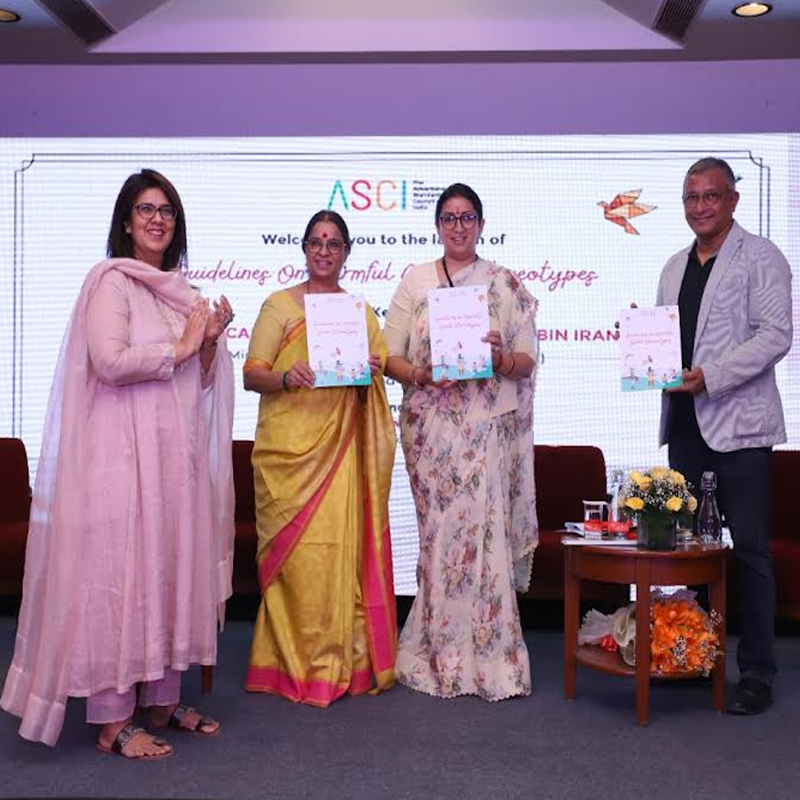
    Mumbai: Seeing gender stereotypes in advertising has become so common that now people take harmful gender differences as social norms. Unfortunately! The gender stereotypes are so deep-rooted in our minds that we hardly stop and think, why should an ideal family in any ad have an older boy and a younger girl, why not a family with two girls? Why should a typical Indian brand’s ad start with a man reading a newspaper and the woman making him a cup of tea? Why do terms like “men will be men” strike our minds?

    Taking into consideration the deep-seated gender stereotypes in our minds, the Advertising Standards Council of India (ASCI) has launched a set of eight guidelines on harmful gender stereotypes. The new guidelines aim to focus not just on the bigger violations but on the ones that the audience might not even register, at once.

    The guidelines come as a follow up for its GenderNext report released by ASCI and Futurebrands in October 2021. It was released by the minister for women and child development Smriti Irani at an event held in Delhi.

    Just a few days after the Layer’r shot advertisements were taken down, the guidelines seem like a timely intervention from ASCI. The advertisements from the perfume brand didn’t go well with the audience and were accused of promoting rape culture in the country.

    Sharing his thoughts on ASCI chairman Subhash Kamath added, “Advertising has the power to influence mindsets and decision making and bring about behavioural changes. Hence, we need to help shape the narrative. The recent controversy implies that there is a need for sensitisation, in terms of how we portray genders in advertising.”

    Gender portrayal is a complex and nuanced issue and the guidelines provide an interpretation of ASCI’s Chapter III (related to harmful situations), which deals with ads that can cause harm to individuals or society. Gender stereotypes are harmful because they lock individuals in certain roles and perpetuate certain dynamics that are harmful to society. Advertising, through subtle and implicit depictions, reinforces certain harmful stereotypes and overlooks the aspirations of individuals and groups. A recent study by Kantar shows that 64 per cent of consumers believe that advertising reinforces rather than helps eradicate harmful gender stereotypes.

    While the guidelines focus on women, they also provide guardrails for the depiction of other genders.

    The guidelines, encourage advertisers and creators to deploy the SEA (Self-esteemed – Empowered – Allied) framework that guides stakeholders in imagining as well as evaluating portrayals of gender in their advertising by building empathy and aiding evaluation, as well as the 3S framework, which provides a checklist to guard against tropes and implicit stereotypes that creep into advertising.

    These frameworks can prove to be extremely useful for marketing and advertising professionals to improve their advertising ROIs.

    Speaking at the launch of the guidelines on harmful gender stereotypes, the minister for women and child development, Smriti Zubin Irani said, “While there are women who are happy with the incremental change that has been made in the advertising industry, women of my generation are a bit more impatient. It is time not only for the men but also for the women in the advertising industry to step up. This is a very important move, and I believe that there is a long journey to be undertaken to turn the thinking but it’s required now. Work in this area must move with more and more speed and organisations like ASCI should lead this, the action beginning with its member base”

    She also pointed out how we just end up blaming and boycotting actors who are playing the sexiest roles instead of lashing out at each stakeholder included in the production of a particular advertisement. Irani feels that the real change will only come when each stakeholder will take the responsibility to bridge the gender gap.

    ASCI chairman Subhash Kamath added, “The new guidelines were created after extensive consultation with many partners- both from industry, as well as civil society organisations, including the Unstereotype Alliance and UNICEF. These guidelines are a big step forward in strengthening ASCI’s agenda to shape a more responsible and progressive narrative. We are grateful to the government and Shrimati Smriti Irani for supporting these guidelines, and to the many partners who have been with us on this journey.”

    Social activist and writer Ranjana Kumari reiterated that such guidelines are an attempt to start a discussion and debate around subtle messaging that may go unnoticed. “It is also important to push for laws that will appropriately penalise offenders,” she added.

    ASCI’s Guidelines on harmful gender stereotypes in advertising are as follows:

        1. ASCI will consider an ad’s likely impact when taken as a whole and in context.
        2. ASCI will consider stereotypes from the perspective of the group of individuals being stereotyped.
        3. The use of humour or banter is not likely to overcome the underlying issue of such harmful stereotypes.
        4. The guidelines do not intend to prevent ads from featuring:
            a. glamorous, attractive, successful, aspirational or healthy people or lifestyles;
            b. one gender only, including in advertisements for products developed for and aimed at a particular gender;
            c. gender stereotypes as a means to challenge their harmful effects.

    Advertisements must not include gender stereotypes that are likely to cause harm or widespread offence.

       1.  While advertisements may feature people undertaking gender-stereotypical roles e.g., a woman cleaning the house or a man going to an office, or displaying gender-stereotypical characteristics, or for, e.g., a man being assertive or a woman being sensitive to others’ needs, they must not suggest that stereotypical roles or characteristics are:

    •  always uniquely associated with a particular gender;
    •  the only options available to a particular gender; or
    •  never carried out or displayed by another gender(s).

    1.1 Advertisements that are aimed at / depict children may target and feature a specific gender but should not convey that a particular children’s product, pursuit, behaviour, or activity, including choice of play or career, is inappropriate for one or another gender(s). For example, ads suggesting that a boy’s stereotypical personality should be “daring” or that a girl’s stereotypical personality should be “caring”, or someone chiding a boy playing with dolls or girls from jumping around because it is not the typical activity associated with the gender, are likely to be problematic.

    2. While advertisements may feature glamorous and attractive people, they must not suggest that an individual’s happiness or emotional wellbeing depends on conforming to these idealised gender-stereotypical body shapes or physical features.   

    3. Advertisements should not mock people for not conforming to gender stereotypes, their sexual orientation or gender identity, including in a context that is intended to be humorous, hyperbolic or exaggerated. For example, an ad may not belittle a man for carrying out stereotypically female roles or tasks or make fun of a same-sex relationship.

    4. Advertisements should not reinforce unrealistic and undesirable gender ideals or expectations. For example, an advertisement must not depict a man with his feet up and family members creating a mess around a home, while a woman is solely responsible for cleaning up the mess, or a woman overly grateful for the man helping her in everyday chores. Similarly, a woman returning from work may not be shown as solely responsible for doing household duties while others around her are at leisure.

    5. An advertisement may not suggest that a person fails to achieve a task specifically because of their gender e.g., a man’s inability to change nappies; or a woman’s inability to park a car. In categories that usually target a particular gender, care must be taken to not depict condescension towards any other gender or show them as incapable of understanding the product or unable to make decisions. This does not prevent the advertisement from showing these stereotypes as a means to challenge them.

    6. Where an advertisement features a person with a physique or physical characteristics that do not match an ideal stereotype associated with their gender, the advertisement should not imply that their physique or physical characteristics are a significant reason for them not being successful, for example in their romantic, social or professional lives. For example, an ad may not suggest that a man who is short, a woman who is dark, or any individual who is overweight has difficulty finding a job or a partner due to this aspect of their physique.

    7. Advertisements should not indulge in the sexual objectification of characters of any gender or depict people in a sexualised and objectified way for titillating viewers. This would include the use of language or visual treatments in contexts wholly irrelevant to the product. For example, an online takeaway service featuring an image of a woman wearing lingerie lying back in a provocative pose behind various fast-food items would be considered problematic. Even though the image may not be sexually explicit, by using a suggestive image of a woman that bears no relevance to the advertised product, the ad would be considered objectifying women by presenting them as sexual objects, and therefore is a gender stereotype that is likely to cause harm.

    8. No gender should be encouraged to exert domination or authority over the other(s) by means of overt or implied threats, actual force or through the use of demeaning language or tone. Advertisements cannot provoke or trivialise violence (physical or emotional), unlawful or anti-social behaviour based on gender. Additionally, advertisements should not encourage or normalise voyeurism, eve-teasing, stalking, emotional or physical harassment or any similar offences. This does not prevent the advertisement from showing these depictions as a means to challenge them.

  • Zomato-Blinkit deal: all one needs to know

    Zomato-Blinkit deal: all one needs to know

    Mumbai: Restaurant aggregator and food delivery company Zomato’s proposal to acquire quick commerce player Blinkit (formerly Grofers) will come up for board approval on 17 June 2022, when the company’s board meets to sign-off on the acquisition.

    The deal estimated at $700 million has likely dropped in valuation, stripping the online grocery firm of its prized unicorn status earned last year.

    The development emerged two months after reports on the merger deal via share-swap appeared. While the outlines of the deal are still being worked out, Zomato will acquire the shares of the quick commerce startup in an all-stock deal. As per the proposal, Blinkit investors will gain proportionate shares in the listed entity that amounts to a little less than 10 per cent stake in Zomato.  

    Softbank Vision Fund, the largest investor in Blinkit, is expected to come away with nearly four per cent stake in the food-tech company if the deal is closed.

    Once the board gives its approval, Zomato may not need the Competition Commission of India’s (CCI) nod to acquire the Softbank-backed startup, as it plans to make use of an exemption called ‘de-minimis’, which applies to companies of a certain size.

    In August 2021, Zomato received CCI’s go ahead for a $100 million investment in Blinkit for little over nine per cent stake.

    In its third quarter earnings call earlier in February, Zomato management said that it is aggressively growing in the quick commerce segment and will invest $400 million over the next two years in the category.

    Later in March, Blinkit signed a merger agreement with the food aggregator company. Speculations of the deal were doing the rounds in the news since Zomato first invested in the startup. The latest developments coincide with reports of Blinkit laying off staff and delaying vendor payments due to a cash crunch.

    The 10-minute grocery delivery market is expected to grow 15 times to reach $5.5 billion by 2025, as per consultancy firm RedSeer. Zomato has attempted to enter this space twice, dropping its plans due to the uncertainty caused by the pandemic. This latest move helps it gain ground over its arch-rival Swiggy.

    Both food aggregators – Zomato and Swiggy – had diversified into grocery delivery as a natural extension of food delivery, by launching the service on their existing apps. While Swiggy continues to offer its Instamart service, Zomato withdrew from grocery deliveries in September 2021 after burning cash to the tune of several millions. Its investment in Blinkit helps it reach scale in the quick commerce sector.

    There is no shortage of startups trying to be associated with the promise of quick delivery with players like Dunzo and Zepto in the mix. However, it was Blinkit (Grofers) that pioneered the 10-minute grocery delivery model.

  • GUEST COLUMN: Why Software as a Service puts video service providers in control

    GUEST COLUMN: Why Software as a Service puts video service providers in control

    How can we increase market share? Can we meet the demands of consumers who want to watch high-quality video on any screen, anywhere, anytime? What should we do to protect our content, and build new revenue streams?

    These are some of the critical questions video service providers are continually asking themselves and us. And the Software as a Service (SaaS) model is proving it has what it takes to address these burning issues by allowing providers to quickly launch, scale and update streaming services and keep focusing on the right questions to stay competitive.

    Scaling ambition

    SaaS puts customers firmly in the driving seat. Flexible, affordable, and scalable – with the onus on the software provider to host and maintain the service – it means providers can start small and pay as their ambitions scale, whilst reaping the benefits of new product enhancements, features and functionality added as frequently as multiple times a day.

    Some early adopters are already turning their backs on inflexible, bespoke technology deployments and instead embracing SaaS solutions. Interestingly, we are finding these are not just those born-in-the cloud streaming services that might first spring to mind but also more traditional pay-TV providers and telcos.

    One particular factor driving SaaS demand is the increased appetite for TV advertising. Where once the focus was on subscriber acquisition and market share, broadcasters and other service providers are now demanding the flexibility to create new Avod and Fast services that help counter the cost of content. For example, a leading provider in southeast asia is deploying Synamedia Iris, our SaaS addressable advertising solution, to manage, deliver and measure advertising consistently across its entire subscriber base including set-top boxes with one-way connectivity. Synamedia Iris is a key area of focus at our R&D centre in Bengaluru along with the development of our other SaaS solutions, including Synamedia Go.

    Increasing modularity

    Until now, service providers have had little alternative to customised, complex deployments involving heavy Software Design Kits and pre-defined, sequential phases of testing with no overlap between phases. It sometimes takes many months for acceptance testing to support the launch of a single feature or a new device. In today’s rapidly evolving business and technology environment, that’s simply unsustainable.

    By contrast, the SaaS model offers flexibility, agility and Opex models that come with public cloud, service-based delivery and DevOps. With a modular suite of solutions, providers can start small, only paying for what they need, then easily add more packs or services as their needs evolve.

    And SaaS isn’t just for the big players. Its effects are disruptive because the entry barrier to these new levels of experimentation and creativity has been lowered and its modular nature opens up opportunities for smaller and non-conventional businesses.

    Our SaaS transformation

    At Synamedia, we are living and breathing multi-tenant SaaS internally and witnessing its power first-hand. As one example, in just the first six weeks of 2022 we made 130 discreet feature drops into production in our Synamedia Iris addressable advertising solution. In the previous generation software-based solution, we had releases every six months and our customers typically added two or three months of testing on top of that.

    In a rapidly changing world, this velocity and agility is game changing for us and more importantly for our customers. It has impacted every department in our company including the way we sell, support, and contract with customers. Where once our platform deployments were bespoke for each customer, with the SaaS model any customisation now only needs to happen at the edges.

    The result is our pace of change of product delivery has increased an order of magnitude over the last year. Importantly, we have also evolved our development approach to one that considers the complete customer experience. We are now more focused and efficient when releasing new features and everything is delivered with built-in market validation.

    Keeping pace with change

    Our industry is a late adopter of SaaS and one of the main reasons is that it requires changes not just within the vendor community but also within the user community. Put simply, users cannot realize the benefits of SaaS without changing their operating model to accommodate a high velocity and multi-tenanted approach, most notably acceptance testing.

    Those that don’t change will be outmanoeuvred by more agile competitors, maybe not in the short run, but inevitably over time. Those that adopt SaaS will give their subscribers a better service and will benefit from a much lower cost of ownership.

    Importantly, the product won’t just be better from a user experience and feature functionality perspective: releasing software in small batches that can be easily verified and backed out as necessary dramatically increases quality as well.

    And, finally, well-designed cloud-based APIs support a new level of openness that gives users the option of integrating point solutions or procuring suites of solutions from their preferred software suppliers. This openness is something that Synamedia has embraced strongly for its own solutions.

    Delivery the SaaS way has shifted Synamedia’s cultural mindset, and our internal teams have had to reorganise to support different priorities and responsibilities. In this golden age of content, where consumers want to change what and how they watch in the blink of an eye, it’s time for video service providers to buckle-up, rev-up the SaaS engine and make sure they’re not lagging behind.

    The author is Paul Segre, CEO, Synamedia

  • Crompton Greaves appoints Preetika Mehta as head of digital marketing

    Crompton Greaves appoints Preetika Mehta as head of digital marketing

    Mumbai: Crompton Greaves Consumer Electricals has appointed Preetika Mehta as head of digital marketing, according to her recent LinkedIn update. 

    In her new role, she will lead digital and e-commerce marketing initiatives across business segments. Mehta is a digital marketing professional with over 13 years of experience across media sectors including digital, print, radio and industries such as BFSI.

    She was previously associated with Godrej Consumer Products for five years where she led the digital marketing for its brands across categories like personal care, home care, detergent and key organisation level initiatives. 

    Earlier, she had stints at Yahoo, Network18 Media and Investments (Forbes India), Radio Mirchi and American Express.

  • Ants Digital bags Vega’s digital, brand and performance marketing mandate

    Ants Digital bags Vega’s digital, brand and performance marketing mandate

    Mumbai: Vega has appointed Ants Digital as its digital, brand and performance marketing partner, the company said in a statement.

    The agency will be responsible to launch the upcoming vertical across digital and social platforms & create innovative campaigns for the B2B market.  

    Vega plans to offer a comprehensive range of services and solutions curated by the leading grooming professionals for styling experts. By leveraging this launch the brand aims to redefine the future of styling and grooming for ‘creators’.  

    Vega chief marketing officer Eiti Singhal said, “As part of our expansion plan for this financial year we are looking to broaden our horizon into the B2B space. We will be embracing the strong fundamentals and market understanding from the core business yet creating a new niche by delivering quality, precision, and the widest assortment of professional tools to this creator community. We wanted to partner with an agency that understood how to link a powerful creative idea and create a meaningful proposition out of that. Thrilled to have Ants join us on this journey.”  

    Speaking on the appointment, Ants Digital chief executive officer Sanjay Arora said, “Vega as a strong legacy brand is an asset to our portfolio. We are super excited to put some revolutionary ideas into action for their new vertical. By developing new age, innovative strategies by constantly studying and recognizing industry bottlenecks, we are exponentially growing the B2B push for many brands. With the launch of this new premium vertical, we have the opportunity here to scale Vega’s product offerings and consumer acumen by building a robust community of creators & a strong digital and retail presence”.