Category: MAM

  • IdeateLabs ropes in Dr. Bhaskar Das as new chairperson

    IdeateLabs ropes in Dr. Bhaskar Das as new chairperson

    Mumbai: Digital-first marketing solutions provider IdeateLabs has announced that Dr. Bhaskar Das has joined the company as chairman. He will be mentoring the senior leadership team in augmenting the company’s offerings across data, content, and community solutions.

    IdeateLabs works across a body of clients, offering turnkey digital transformation solutions that enable brands to embrace the ever-evolving business environment. The company said that it operates as a preferred partner for brands, taking up the responsibility of impacting business outcomes using web 3.0 technologies and direct-to-consumer conversations for the brands.

    IdeateLabs MD Amit Tripathi said, “IdeateLabs is enhancing capabilities across functions to build the most comprehensive solutions stack for the brands we work with. In order to navigate the challenges that such growth brings, it was imperative to bring an experienced eye to guide the company’s journey toward becoming a true marketing partner. Having known Dr. Das for more than a decade, we are absolutely delighted at his acceptance of working with the company to build the company’s vision as we diversify solutions with a customer first digital transformation strategy.”

    Das added, “I am glad to have joined hands with this rapidly growing organisation. The company is committed to bringing innovative solutions for building brand conversations and is at par with the current market trends, especially in the world of metaverse and web 3.0 trends. I look forward to working cohesively with the senior management to sketch growth strategies for the group’s expansion in the Indian and international markets.”

    Das is a well-known professional in the marketing and advertising industry. He has been associated with The Times of India (BCCL) as president and board member for over three decades; Zee Media as the group CEO; and Republic TV as the group president. Prior to joining IdeateLabs, Das was associated with Unica Token as director of content creation.

  • Watconsult wins ORM & social listening mandate for Olx Autos

    Watconsult wins ORM & social listening mandate for Olx Autos

    Mumbai: WATConsult, a hybrid digital agency owned by Dentsu Creative India, has won the online reputation management and social listening mandate for OLX Autos.

    Following a multi-agency pitch, the account was won and will be managed by the agency’s Mumbai office.

    According to the mandate, WATConsult will be in charge of the brand’s response management, which includes monitoring, listening, responding to queries, and reporting to users online.

    OLX Autos’ marketing country head Siddharth Agrawal said, “We are excited to have WATConsult on board as our partner for ORM and digital listening mandate. It is a very important element in further accelerating our brand journey & reputation. We look forward to elevating our customer service and the overall platform experience through this engagement.”

    Isobar India group CEO Heeru Dingra, said, “We are delighted to have OLX Autos on board. The brand has fared remarkably well in recent quarters, and social listening will be critical to its future success. Our team is well-equipped to provide the necessary skills, and we are very much looking forward to assisting them on this journey.”

    WATConsult Managing Partner Sahil Shah said, “This addition solidifies our already strong offering on auto clients. OLX Autos being a new-age digital-first brand, just resonates very well with our go-to-market at many levels. I welcome OLX Autos to our esteemed list of clients and look forward to a great partnership with them.”

  • Brands are allocating nearly 25-30% of their budgets to influencer marketing: GroupM’s Ashwin Padmanabhan

    Brands are allocating nearly 25-30% of their budgets to influencer marketing: GroupM’s Ashwin Padmanabhan

    The advertising & media landscape in the country is evolving every day, especially with the exponential growth of all things digital during the pandemic. According to market research firm Statista, the influencer marketing industry in India- a relatively new-age advertising segment- has grown robustly and is worth Rs 9 billion, as of 2021. It is projected to grow at a compound annual growth rate (CAGR) of 25 per cent over the next five years to reach Rs 22 billion by 2025. There has also been a perceptible paradigm shift from banking on celebrity endorsers to engaging influencers for product placements in recent years.

    On the sidelines of its flagship content summit Brew, IndianTelevision.com had an in-depth conversation with GroupM’s president of partnerships and trading Ashwin Padmanabhan, to find out whether influencer marketing has finally come of age in India.

    Padmanabhan also weighs in on the importance of responsible advertising, while sharing insights on the marketing & advertising strategies brands and OTT platforms are adopting to improve the bottom lines in today’s uncertain inflationary times, with consumers tightening their purses.

    Edited Excerpts:

    On has influencer marketing reached a stage in India where brands are now keeping aside a substantial part of its annual adspend towards it

    Absolutely. If we look at our clients in the GroupM universe, currently, close to 150 odd brands actively use influencer marketing as a strategy to reach their consumers. Importantly, they are using it in more than one area. One is to drive consideration because the nature of influencer marketing is such that influencers create content which their followers are highly engaged with. That’s one of the reasons that influencers are becoming very relevant in a brand’s marketing mix: to drive engagement.

    We are also seeing some brands now moving from driving consideration to engagement to actual action, as the tech infrastructure becomes increasingly better, to enable a call-to-action where the consumer can directly click on a link to buy a service or product. So we are seeing that shift too with brands in a mid-to-lower funnel.

    In fact, during the lockdown, nobody could go out & shoot content or create TVCs, etc. That’s when we started working with a lot of brands as an alternative to traditional television commercials or traditional web commercials, and influencers became very relevant in that environment. But as brands started working with them, they realised that they can start working with influencers on a standalone basis- as an integral part of their marketing strategy, and not just because they can’t do something else. And that’s the shift that has happened in the last two years.

    On how much percentage of a brand’s annual marketing/ ad spends is allocated today to influencer marketing

    The way we look at brands right now we see three buckets of clients: There are brands which have become native to influencer marketing who allocate close to 25-30 per cent of their budgets to influencer marketing. It’s a very integral part of their marketing strategy. D2C brands make up a large mix within this, but we are seeing even FMCG and especially, personal care brands allocating more than 15-20 percent of their budgets on influencer marketing. They may not be in the top four or five, but they are surely in the mid to lower funnel range. These brands have realised that it’s a great way to create ‘Share of Voice’ (SOV). They can’t fight the ‘big boys’ in the media space, especially in the CPG (consumer packaged goods) category, SOV is very critical. And influencer marketing becomes a great tool to drive SOV. And hence these brands are over-indexed in influencer marketing than their peers, which are the larger organisations.

    Loreal- one of our clients- although a big name, in specific categories like personal care and especially in cosmetics range like Maybelline, they are highly over-indexed in influencer marketing. They had an ‘always-on’ influencer marketing strategy throughout the year. And that’s the other shift we are seeing from stand-alone campaigns. It also allows you to have a threshold level of visibility, engagement, and driving action from the consumer through the year- that’s the beauty of influencer marketing.

    Also, there’s the middle bucket of the brands which have become mature, that would have anywhere from 10 to 25 per cent of its ad spend allocation. These are brands which have tried using influencer marketing and continue using it but it’s not part of their ‘always on’ strategy for them. They look at it very tactically, a lot of their influencer marketing is around events that they do. And then the set of influencers they work with amplifies the work they do. So, they use it differently as a strategic mix. But even here we see anywhere from five to ten per cent spending allocation.

    And then there’s still a very large bucket of clients who are curious and they are wondering how to work with influencer marketing. They are trying to gauge and test the waters & see what’s in it for them, and what kind of metrics they can work with. So they have a lot of questions in their mind on how they quantify their investment, how they define ROI in this case, is there some kind of measurement that’s credible. And that is where we come in with INCA. With the tech that we have built, today we can analyse anywhere close to 45,000 influencers in India & have a very detailed understanding of not only what space they create content in. We also have a detailed understanding of their audiences, their demographic, and what part of geography they come from. Stuff like this has not been organised in many years as it’s an evolving space,  which is also why we took out the INCA influencer marketing report- the first edition of which came out last year.

    Our estimate about the industry last year was close to Rs 900 crore, and this is not the money being spent on media or the money being spent on boosting the content being created. This is money being spent specifically and directly on influencers, which is a significant number. And it’s only growing 25-30 per cent YoY.

    And not just data, but also a lot of qualitative research as well that’s going into it, to quantify the ROI or shift that’s happening when we work with an influencer or celebrity influencers. And the more we do it, the more we see brands getting warmed up to it. It’s suddenly moving out of a space they didn’t understand to a space they can make sense of their investment.

    On ASCI stricture of ‘paid sponsorship’ tag affecting the influencer marketing revenue

    Not really because the way we advise our clients to work with influences is not to force the influencer to post your content. The idea is to create content that’s organic to the influencer and has a brand message embedded. As long as brands do that, there’s content for their followers to consume that’s in line with their expectations. The moment you stray from that and you start using the influencer purely as a reach medium then I think we are moving away from the basic principles of influencer marketing. So it’s not really about the guidelines, which are only making it clear that whatever content you are consuming is sponsored by someone. It’s a disclaimer or statement we are making upfront so it’s transparent. That’s a good thing, and as long as the content remains true to what the influencer makes regularly there’s no difference. On the other hand, even without that paid content tag if you stray away from this principle you’ll not get the required reach.

    On how GroupM ensures it stays in the realm of “responsible advertising”

    Creativity doesn’t mean a licence to abuse or licence to harm someone. Creativity is about connecting with people in ways that surprise them positively, not negatively. And for us “responsible investment” is a very huge part of what we do at GroupM. We have something called the Responsible Investment (RI) framework that we started applying to the content that we produce.

    One is the content that we produce with influencers around INCA. Then there is the long-form content we produce in the motion content group, such as web series, films as well as TV shows where we are bringing RI.

    From this perspective we have defined four goals or areas for us: The first is around sustainability, second is DEI (Diversity, equity and inclusion) with a magnifying glass into gender equality. The third is around primary education, because in India about 40 percent of kids drop out of school after fifth grade, and there are a lot of companies which are trying to do something to change this. The fourth is around financial inclusion. So these are the four pillars that we have defined.

    So the question we are asking is how can we bring any of these themes into the shows we are doing. And we believe that if we need to truly make a difference in the world then habits have to change. And I think “content” is the most powerful way to do that. Content creates cultures, passion and habits, even the way we behave with each other. And one of the routes to driving RI is how we create this content. We believe as an organisation we have to be the catalyst for the world to come around these four principles. 

    Creators and platforms are forever chasing a formula that they think works. Today, there’s a conflict in the creative space when it comes to content. Where at one level we are probably becoming more regressive because we have seen that certain regressive content has worked, and everybody wants to do the same kind of thing. On the other side, we see a lot of independent creators who want to create content which makes a positive difference. That’s why we are committed to them and putting our money behind them. These productions are investments done by GroupM, as we believe as such an important player in the media space in India if we don’t do it then we can’t expect others to do it.

    On how Netflix introducing ad-supported plans impacts OTT viewership

    The fact is that there’s some great content being produced today, but the access to that content is limited today because of the sheer investment a subscriber/ audience has to make to watch that content.

    On OTTs, unlike on TV, if somebody wants to watch content across different platforms and different languages, then they need to be in the top one per cent in the country, otherwise, nobody can afford it. So clearly, from an economic perspective while it does make sense for the channels as they will be able to get more viewership. But from the audience’s perspective, it makes the content more democratic. So I think it’s great if more platforms open up to that and understand that.

    On getting brands to achieve cost efficient & strategic ad spends during these times of rising inflation, and the impact on AdEx

    We don’t anticipate it to impact AdEx as much, it’s more about how those spends can stretch longer or do more for me. What it is potentially doing is, forcing organisations to go back to the question of efficiency. So, you start moving towards value communication at such times. But the value in the equation is being driven by questions such as how can we make it reach more people, are there different ways to reach them, and can I engage with them more and drive more actions?

    One big trend I’m seeing is that it’s forcing organisations to look inwards. And ask what are those systems and processes that they can build more efficiency to save cost, so as to reduce impact on the consumer. Be it in the way they are packaging their products, or the way they are distributing them physically. So, they are trying to build more efficiencies into their own processes to be able to cut costs, so they don’t need to pass on the burden of inflationary pressure they are facing onto the consumers.

    The other question is, how do they help the consumer get to their product in different ways which are not necessarily the way in which they have been used to buying the product. So new distribution channels, whether its D2C or e-marketplaces or whether its small kiosks or QSRs that have been set up to create a physical space as well. So there’s a lot of innovation happening at the ‘point of sale’ and how the consumer accesses the product.

    Yes, there is some part of the pressure which gets passed onto the consumer but that’s being done in different ways. Like, probably reducing the size of the product while keeping the price same as before, so it won’t pinch your monthly budget as much. The reality is that outside of the one per cent of the country’s population, these pressures that we are going through mean a lot to everybody else. If you are not sensitive to what consumers are going through, it’s not good business as well. And honestly, we are seeing this sensitivity very clearly across our clients. These are some of the biggest CPGs (consumer packaged goods) that we manage. And CPG is where one feels the pinch the most because these are staple, everyday items which you need to run your home. These organisations are being extremely realistic about the fact that they need to start at home before they start putting pressure on the consumer.
  • GUEST COLUMN: Five ways digital attribution can improve CTV & OTT advertising return on ad-spend

    GUEST COLUMN: Five ways digital attribution can improve CTV & OTT advertising return on ad-spend

    Mumbai: CTV/OTT viewership has exploded in India since the start of the pandemic, opening a new market of opportunities for advertisers. Combining the best of digital and traditional linear TV advertising, CTV/OTT advertising has become marketers’ favourites because of its ability to reach the right audience at the right time. These platforms provide advertisers with easy access to a vast pool of active buyers with high purchasing power.

    It is estimated that more than 500 million Indians are already consuming OTT content. The number of CTV (connected TV) users is expected to reach 80 million households or nearly 320 million users by 2025. As linear TVs continue to lose viewers’ attention, advertisers are scrambling to make the most of the rising CTV/OTT viewership. This has also led to an increase in the amount of money spent on advertising on CTV/OTT, especially by B2B marketers.

    In the OTT and CTV spaces, marketers have the advantage of clear targets, ideal buyer profiles, and clear-cut targeting strategies. While some other factors may affect the overall impact of CTV and OTT campaigns, these platforms also help in improving the return on ad spend (ROAS) through the right digital attribution.

    Here are five ways in which digital attribution can help improve the ROAS:

    Identifies customer touchpoints better

    Marketers have to engage with customers at multiple touchpoints for successful conversions. In video campaigns, it is not easy to identify the exact touchpoint at which the viewer decides to convert.

    Advertisers must have a comprehensive understanding of the customers’ journey for better ROAS. This issue can be mitigated by adopting multi-touch digital attribution for CTV/OTT, as it will enable the advertiser to locate the touchpoint that triggered the conversion. Such knowledge will empower them to reduce ad spend wastage.

    Filters out non-performing tactics

    Through conventional attribution, specific campaigns walk away with sales and conversion credit without giving an insight into what parameters actually worked. This technique fails to take into account that some of the sales may be due to repeat customers or old customers who may have restarted their services. For CTV/OTT, conventional attribution will fail to give the real picture as advertisers use multiple tactics to drive conversions. Digital attribution can help identify the exact ways that resulted in sales on CTV/OTT. It will enable advertisers to focus more on winning tactics and avoid unnecessary ad spending on non-performing strategies.

    Real-time optimisation

    CTV/OTT metrics provide real-time data on customer responses to ad campaigns, allowing marketers to make in-the-moment adjustments. If something is not working, advertisers can withdraw the campaign and launch its alternative or improved version in real time. Digital attribution plays an important role here by enabling advertisers to identify the highest-performing tactics and make adjustments in real time. For example, during live streaming of a new movie on CTV/OTT, if a 30-second video ad is outperforming a 60-second creative, the advertiser can use this data to allocate more budget towards the better-performing 30-second campaign rather than giving in to the length of a video campaign.

    Targets the right audience

    The CTV and OTT streaming markets have exploded since the pandemic. As a large part of the population was confined indoors due to lockdowns, the demand for new entertainment platforms and content also increased. The availability of cheaper data across the country further amplified viewership on OTT and CTV. The surge in OTT/CTV content demand gave advertisers access to a massive new audience.

    However, it has also become important to segment audience attributes for better targeting. With the right attribution, advertisers can easily segment customer databases to identify at which stage of the purchase the customer is actually converted.

    Identifies “buy signals” more accurately

    One of the most common differentiators between a successful and unsuccessful marketer is their ability to identify the “buy signal” from a prospective customer. The “buy signal” on CTV/OTT is an action or behaviour indicating a viewer is ready to become a customer. The actual sale often takes place much after the campaign is over. The right attribution can help in identifying the buy signal correctly. It will further enable marketers to match their strategy with sales insights to optimise the campaign for better results.

    To sum up

    Converting sales from a digital campaign requires slick digital attribution. This beats conventional ad-based tracking. It not only provides precise data points where the customer is most likely to convert, but it also provides insights into consumer purchasing behaviours. A modern world needs more contemporary digital attribution techniques, and we are already ready with one.

    The author is VDO.AI founder and CEO Amitt Sharma.

  • IAA to host summit on ‘Gender Sensitisation In Media: Voice Of Change’

    IAA to host summit on ‘Gender Sensitisation In Media: Voice Of Change’

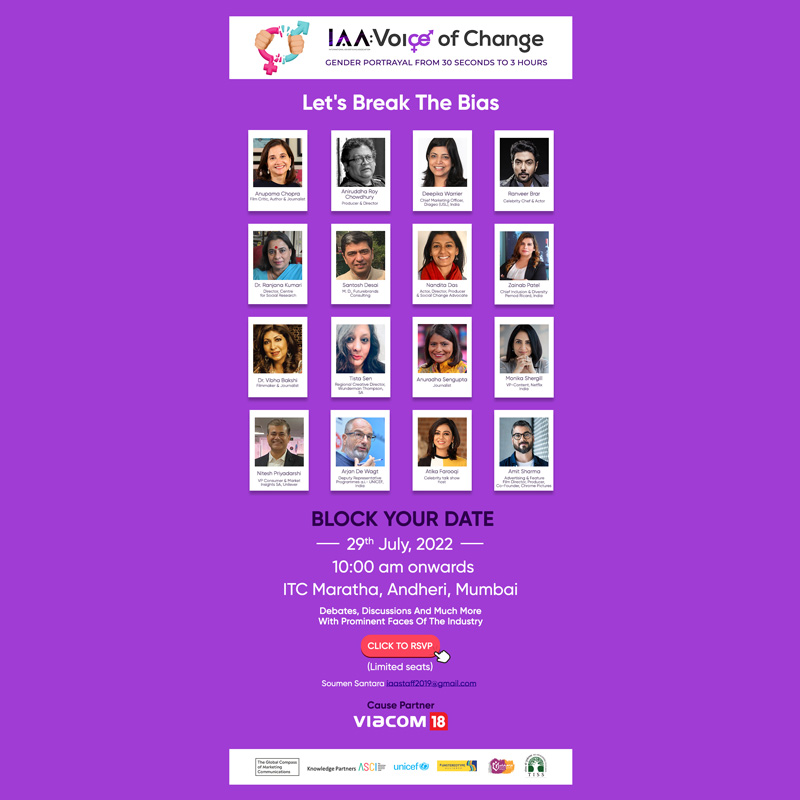
    Mumbai: International Advertising Association (IAA), India chapter is hosting a summit on Gender Sensitisation In Media on the 29 July at ITC Maratha, Andheri, Mumbai.

    The theme is Gender Portrayal across the creative spectrum from a 30 seconds TVC to a three Hour film. Prominent voices of the industry will be speaking on why it is of paramount importance to ‘break the bias’ that surrounds the industry when it comes to gender depiction.

    The summit shall witness prominent industry bodies and partners such as like ASCI, UNICEF, Tata Institute Of Social Sciences, Unstereotype Alliance and Akshara Centre along with Chief Guest Poonam Mahajan and prominent voices like Vidya Balan, Deepika Warrier, Monika Shergill, Anupama Chopra, Santosh Desai, Nandita Das, Ranveer Brar, Tista Sen, Anuradha Sengupta and many more.  

    The Voice Of Change was started as a behaviour change communication initiative which was aimed at addressing the skewed portrayal of gender in the field of advertising and communication with the launch of the ‘Geena Davis’ study with Unicef, in September 2021, the IAA – India took the first step towards effective change. The facts presented in the study, based on the evaluation of more than thousand plus ads, showed a disturbing trend of widespread gender stereotyping and prejudice. Sore truths were discovered about how women and other genders are seen, their abject objectification and pigeon holing.

    On the backdrop of such ground-breaking research being done, the IAA has stepped up to bring all this knowledge and more out in the public eye under an umbrella banner through this summit. The aim is to ensure that the discourse reaches the right people and sensitises all creative minds and industry forces to drive palpable change.

    IAA aims to sanction change through influential and evocative dialogue to enable effective change.

    Speaking about the summit, IAA India president Megha Tata said, “IAA has always brought forward initiatives that are meaningful and gender sensitive, on and off screen and has also been the one who has always taken the lead on this issue in the industry. We felt that it is time for all of us to come together and be the voice of change. We want to address the dialogue of gender discrimination across the media spectrum and hope we will collectively bring much needed change in the system.”

    “Over the last decade, women have broken stereotypes in this industry both behind the scenes and on the screen. It’s time we tell more of those stories and break biases. Through this change summit, the IAA brings prominent industry voices to communicate, converge and be the Voices Of Change that we need to empower the narrative,” said IAA Women Empowerment Committee chairperson and Viacom 18 Hindi and Kids TV Network head Nina Elavia Jaipuria.

  • dentsu X India bags integrated media mandate for Tata 1mg

    dentsu X India bags integrated media mandate for Tata 1mg

    Mumbai: Media agency Dentsu X India, on Wednesday, won the media mandate for Tata 1mg – India’s largest digital healthcare platform.

    Dentsu X will oversee the brand’s planning and buying duties for traditional as well as digital media. The account will be serviced from the agency’s Gurugram office.

    Speaking on the partnership, Dentsu X India chief executive officer Roopam Garg said, “We are delighted to get the opportunity to work with a future focussed and trusted brand like Tata 1mg. At dentsu X, we answer ‘Why beyond What’, led by our people, data and tech. We look forward to helping the brand with solutions based on the same.”

    Tata 1mg co-founder Gaurav Agarwal commented, “We are excited to work with Dentsu X. Through their data-driven methodology, they have already established themselves as an integrated media firm and among the best in their industry. We look forward to collaborating with them on cutting-edge media innovations and opportunities.”

  • HiveMinds onboards Aayush Arora as vice president

    HiveMinds onboards Aayush Arora as vice president

    MUMBAI: Hiveminds Innovative Market Solutions, a unit of Madison World, has hired Aayush Arora as vice president of client success at Gurgaon.

    Arora is a digital marketing professional with over 10 years of experience across India & Canada. He has worked across agencies, Merkle Sokrati, Ad Global 360 and had also run his digital agency in the past. His latest stint before HiveMinds was with an Ed-tech major, Textbook.

    HiveMinds founder & CEO Jyothirmayee JT commented, “We’ve been fortunate to add many large clients from Delhi/NCR in our portfolio in the last one year. Aayush’s deep digital understanding along with his experience in managing clients over the years will help us in delighting our clients with innovation and account success.”

    Madison World chairman and managing director Sam Balsara said, “Delhi remains a key focus region for us. We’re reinstating our commitment to our clients by adding senior talent to drive digital growth and strategy. Following the recent return of Shobhit Gaur to Madison Digital in Delhi NCR, we are now adding Aayush to Hiveminds Delhi NCR to further strengthen our team capabilities in the region to exceed the demanding expectations of our growing client list.”

    The digital marketing company is headquartered in Bangalore with a team of 270 people spread across Bangalore, Mumbai and NCR.

    Commenting on his appointment Aayush Arora said, “I am thrilled to be joining HiveMinds. Jyothi’s passion for the business and industry is infectious and her ambitions got me excited. I look forward to learning further and building on my decade-long experience in the agency business.”

    He added, “I believe that my work on the brand side in the Ed-tech industry has given me the right perspective to now lead client success in NCR.”

    The Bengaluru-based full-service digital marketing company and consultancy manage digital mandates for Dominos, MaxLife Insurance, BigBasket, CoinSwitch Kuber, and eCommerce mandates of brands like Crompton, P&G, Nivea, Saffola Honey, Sugar Cosmetics, ITC Dermafique, Titan Sonata Watches among others.

  • Volvo & Mindshare launch ‘Volvoverse’ campaign to provide 3D experience to customers

    Volvo & Mindshare launch ‘Volvoverse’ campaign to provide 3D experience to customers

    Mumbai: Volvo Car India has announced the launch of its first-ever electric vehicle in the Metaverse called ‘Volvoverse.’ The campaign launch is conceptualised by Mindshare India. This is the first-of-its-kind collaboration on Metaverse across WPP India agencies.

    The Volvo XC40 Recharge is being launched in a virtual world by Volvo Car India managing director Jyoti Malhotra, while ushering in a new era of digital platforms for Volvo customers with accessible 3D experiences.

    Mindshare collaborated with other WPP agencies including Hogarth, Yonder, Grey, and Genesis BCW to deliver ‘Volvoverse’, realising the group’s ambition for customers to efficiently access specialist companies in the group to achieve their objectives with a single point of contact.

    Mindshare South Asia CEO Amin Lakhani said, “We at Mindshare strive to provide our clients with tech-enabled, creative branding solutions. The concept behind launching the XC40 Recharge in the metaverse was to launch the EV in a sustainable ecosystem, following the vision of Volvo. The metaverse is evolving the internet by bringing people closer. Using virtual worlds, we are looking to reach out to the maximum audience. We are excited to do the first-ever EV launch in the metaverse with a campaign that appeals to our audience in an exciting new environment, which is the first of its kind.”

    Speaking about this unique experience, Malhotra said, “Volvo has always been at the forefront of innovation and technology, and we, as a company, are also globally known for our commitment to sustainability. The launch of the XC40 Recharge on the metaverse platform is a pioneering moment leveraging digital technology in the marketing sphere. The metaverse launch also contributes to our sustainability mission as it leaves a negligible carbon footprint as compared to conventional launches.”

    Hogarth India CEL Gopikaa Davar added, “Hogarth is committed to reaching net zero by 2030, and we are excited to partner with Mindshare and Volvo on a project which brings together both our focus areas of sustainable production and the metaverse. Launching an electric vehicle in the virtual world is only befitting as a conscious alternative to a physical event where an average conference attendee would have produced around 170 kg of CO2 emissions in a one-day event. This is a great example of how we are all reducing and mitigating the environmental impact by using virtual studios and green screen shoots as a driving force, removing the need for location shoots and events (reduces carbon footprint) and maximising the utilisation of the content we capture.”

  • Nikon India appoints magnon eg+ to handle its creative and digital duties

    Nikon India appoints magnon eg+ to handle its creative and digital duties

    Mumbai: Nikon India on Tuesday announced that it has on-boarded magnon eg+ as its creative and digital partner. The account was won after a multi-agency pitch and will be managed by the agency’s Delhi NCR office.

    As part of the partnership, magnon eg+ will be responsible for the creative strategy and execution across online and offline platforms, including digital campaign planning, social media management, media planning and buying, online reputation management, and content strategy and creation, along with strategizing and executing influencer and creator-led content. The agency’s focus will be to partner closely with the team at Nikon to further build and strengthen equity for the brand and manage the entire portfolio of their imaging products.

    Speaking about this collaboration, Nikon India managing director Sajjan Kumar said, “Nikon’s presence in the imaging market has been exceptional and we wanted an innovative digital strategy to take it further. I am pleased that this partnership with magnon will bring a fresh perspective to the brand proposition.”

    Adding to it, magnon group founder and CEO Vineet Bajpai said, “We are delighted to win the creative & digital mandate for a renowned brand like Nikon, a world leader in the imaging products industry. Our team at magnon eg+ comes with marketing communications experience of over 20 years and is confident about delivering effective solutions and strategies to enhance the top-of-the-mind recall of the brand.”

    Further, magnon eg+ managing director Vivek Merani added, “We are glad that Nikon India appreciated our creative concepts and awarded this mandate to us. We look forward to supporting the brand in a long-term partnership to further increase the desirability of its product portfolio and help convert customers to brand loyalists. This association is bound to click and we are all geared up to take it to the next level.”