Category: Brands

  • ‘Winning in India’, co-authored by Samarjit Singh and Amit Burman unveiled

    ‘Winning in India’, co-authored by Samarjit Singh and Amit Burman unveiled

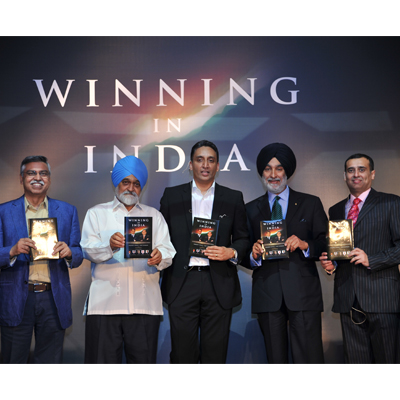
    MUMBAI: The book ‘Winning in India’- Secrets of the World’s Most Complex Market, was launched at the Oberoi, New Delhi by Montek Singh Ahluwalia in the presence of Analjit Singh and Sunil Munjal. Over 350 high profile guests representing the most successful entrepreneurs and who’s who of the Delhi circle attended the event.


    The book written by Samarjit Singh and Amit Burman with Pooja S Mehta explores secrets for running a successful business enterprise in India. Montek Singh Ahluwalia in his launch speech called it “an affectionate account of India.” R C Bhargava, Chairman, Maruti Suzuki Ltd, said that the book is “A fascinating and deeply insightful understanding of what makes India “Different.” The authors have compiled a must read for anyone doing business in India, especially foreign investors.


    In ‘Winning in India’, the authors, who themselves run very large companies, India Homes and Dabur Foods Ltd, have distilled the business learning of five business titans- Analjit Singh, Sunil Mittal, K P Singh, Sunil Munjal and Hari S Bhartia.


    An essence of many intense discussions with these business leaders, ‘Winning in India’ explores how Indian frugality makes admiration of flamboyance a spectator sport and therefore what it means for a business in India. It unravels how deep spirituality ensures that while we are teetering on the brink of chaos, we are never falling.  It provides insights for working with emotionally sensitive Indians who find solace in community.  From Jugaad mindset to value perception to a unique Indian way, the book takes you through a series of experiences that help envisage a strategy for winning in India.


    In a nation that was always known to be obsessed with cricket and Hindi cinema, the unbridled pursuit of success and winning is becoming a new national sport. Millions of starry-eyed graduates leave schools and colleges armed with over-reaching ambition as their primary emotion. On the other hand the international businesses have viewed the rising spending power and the promise of volumes in India with a longing eye. Yet, India has remained elusive and business in India a daunting challenge.


    However, in this conundrum of action, there is an axiom of insight. The book unravels the secrets of the world’s most complex market in a simple actionable format that allows for racy reading, thought provoking reflection and determined action.


    The authors call it a project that is not intended to be a conclusive thesis. It is a thought and a conversation starter. It is an invitation for the readers to join them on their quest to understand the enigmas called corporate India and the Indian consumer and therefore they invite the readers to join the debate at www.WinningInIndia.com and share their personal experiences at #WinningInIndia.

  • Unilever expands Sustainable Living plan

    Unilever expands Sustainable Living plan

    MUMBAI: In its third year, Unilever’s Sustainable Living Plan has made good progress, and with an intention to expand it further to bring about broader change on a global scale, the company plans to undertake more projects.


    Unilever CEO Paul Polman said, “In the three years since we launched the Unilever Sustainable Living Plan we have learned that sustainability drives business growth and a much deeper connection with our employees and consumers. In 2013, we’ve seen good progress, particularly on targets within our direct control. Our Plan is helping us to save money, reduce risk and drive innovation, and brands that have done the most to embrace sustainable living, like Dove, Lifebuoy, Pureit and Domestos, are enjoying some of our fastest growth.”


    Highlighting the progress made in India, Hindustan Unilever (HUL) MD & CEO Sanjay Mehta said, “Our Sustainable Living Plan is what makes our business model different from others because sustainability is integral to how we do business and how we build growth. The success of brands like Lifebuoy clearly demonstrates that there is no contradiction between sustainability and profitable growth. We are happy with the progress we have made on our Plan in India in 2013. We have further built on our plan with the launch of ‘Prabhat’, which is a part of our long term effort to engage with and contribute to the development of local communities around our manufacturing sites. Prabhat focuses on health and hygiene, livelihoods and water conservation initiatives which are fully aligned to the Unilever Sustainable Living Plan priorities.”


    The company will continue to focus its scale, influence, expertise, and resources on making a fundamental change to entire systems, not just incremental improvements. This will involve stepping up plans to tackle several major global sustainability challenges, including:


    · helping to combat climate change by working to eliminate deforestation, which accounts for up to 15% of global greenhouse gas emissions

    · improving food security by championing sustainable agriculture, and improving the livelihoods of smallholder farmers who produce 80% of the food in Asia and Sub Saharan Africa

    · improving health and well-being by helping more than a billion people gain access to safe drinking water, proper sanitation and good hygiene habits

    In the area of social compliance, Unilever also confirmed that the Sustainable Living Plan has been expanded with a more substantive Enhancing Livelihoods programme focusing on:

    · fairness in the workplace

    · opportunities for women

    · developing inclusive business


    These three areas of focus are fundamental to the way Unilever aspires to do business and will help support its continued growth.


    Announcing the expanded plan, Polman, said, “We’re making good progress in reshaping our business for sustainable, equitable growth. But we need to do more. We have always recognised the bigger role that businesses need to play, and now is the moment for Unilever to step up and expand efforts in key areas, driving transformational change where we know we can make the biggest impact. In this way we will leverage our scale and work collaboratively in partnership with others to reach a tipping point in areas that will make a significant difference.”

  • Brands piggyback the selfie

    Brands piggyback the selfie

    MUMBAI: When Oscars 2014 host Ellen DeGeneres posted a selfie co-starring some of Hollywood’s finest stars, it went on to crash the record hitherto held by President Barrack Obama. At the end of the awards’ ceremony, DeGeneres’ “Best photo ever” stood at 2,070,132 retweets and counting; a milestone in social media history. More importantly, the fact that Degeneres had clicked the iconic selfie using a Samsung Galaxy Note 3 (given to her by the brand itself) wasn’t lost on the teeming tweeple. In fact, various international reports stated that 37 million people worldwide tuned in to the broadcast to view DeGeneres’ tweet while 43 million tuned in just to view the Samsung snap.

    Taking a cue from Samsung and other such international brands, home-grown brands too are increasingly tapping into the marketing potential of the selfie, allegations of narcissism notwithstanding. For instance, Dove and Ponds from the house of HUL are running a large-scale social media contest incorporating the selfie element even as we speak. When contacted, company officials refrained from sharing any details. However, it is learnt that along with cross promotions, these products are creating a lot of noise across social media platforms.

    Click here to watch the video

    At least a dozen Indian brands are putting the selfie to good use. ”Selfies are the latest fad and something that would instantly connect with our customers. From celebrities to teenagers to even middle-aged people, everyone today is suddenly using their phone cameras to not only click their surroundings but themselves,” said Lenskart CEO & founder, Peyush Bansal. Recently, Lenskart rolled out a social media campaign, asking for selfies from its fan base. “The idea was to see how involved our customers are in our products. We wanted to engage the online customers in a fun Lenskart selfie contest by asking them to take a selfie, share it on our and their social media pages by linking and tagging Lenskart through all platforms and using the hashtag – #mylenskartselfie. They had to ask all their friends to ‘like’, ‘favourite’ their selfies and the ones with the maximum number of likes won the contest,” said Bansal.

    Force-fitting selfie-ness

    Using selfies to market products is fine but the general perception is that all brands, from beauty to surrogate, are looking to engage social media by calling for selfies. We spoke to a few social media experts for their views.

    “Not every brand can pull off a selfie stunt and hope to make it an instant social media hit. It needs to connect with the audiences; it should come across as something natural or on the spur of the moment and not staged. Unless one makes no bones about it but does it in style,” said Grey Digital executive creative director Navin Kansal.

    On the other hand, Digital Quotient COO Vinish Kathuria, expressed the view that curated content really works for brands these days. “It is interesting to see that various brands are thinking in terms of crowd sourcing techniques while rolling out contests on social media,” he said.  

    Whether the continued use of selfies will work for brands or it will reach a point of saturation, only time will tell.

  • Symphony selling & distribution expenses in Q4-2014 flat, could see upsurge in Q1-2015

    Symphony selling & distribution expenses in Q4-2014 flat, could see upsurge in Q1-2015

    BENGALURU: Evaporative air cooler manufacturer, Symphony, spent Rs 19.09 crore (16.42 per cent of Income from Operations or Inc from Ops) towards selling and distribution expenses (Sel & Dist Exp) in Q4-2014, almost the same as the Rs 19.14 crore (16.05 per cent of Inc from Ops) in Q3-2014. Y-o-y, Symphony’s Sel & Dist Exp in Q4-2014 increased 25.59 per cent from Rs.15.2 crores (17.31 per cent of Inc from Ops) in Q4-2013.

    Please note that (1) The company’s accounting year ends on 30 June every year, but in keeping with the convention in India, quarter ended 30 June has been referred to as Q1, quarter ended 30 September as Q2, quarter ended 31 December as Q3 and quarter ended 31 March as Q4 of each respective year in this report.

    (2) 100,00,000=100 Lakh = 1 crore

    (3) All trends mentioned in this report are linear trends based on data across nine quarters starting Q4-2012 and ending Q4-2014 and across FY-2011 to FY-2013.

    In its  corporate presentation, Symphony says that it incurs the highest ad spends in the air cooler category in India and that it has been advertising through television, radio, print, BTL since 1990 and on the internet since 2010. Fig 1 below indicates that the company’s Sel & Dist Exp shows a downward trend as percentage of Inc from Ops across nine quarters starting Q4-2012 and ending Q4-2014.

    However, in terms of absolute value, with the increase in Inc from Ops across their nine quarters, the trend towards higher spends in absolute value is upwards.

    Across three financial years starting FY-2011 to FY-2013, Sel & Dist Exp for Symphony show as upward trend both in absolute rupees as well as Sel & Dist Exp as percentage of Inc from Ops, as is evident from Fig 1A below. Across the nine quarters under consideration, Symphony’s average Sel & Dist Exp is 18 per cent of Inc from Ops, so Q3-2014 and Q4-2014 spends are definitely  below par. However, the company says that its business is seasonal and maybe based on the numbers reported for Q1 -2014 and Q4-2014, a splurge in Sel & Dist Exp could happen in Q1-2015.

    Symphony’s Inc from Ops as well as PAT show as upward trend across the 9 quarters in question as is evident from Fig 2 below.


  • Everybody loves the Amul girl!

    Everybody loves the Amul girl!

    MUMBAI: April was an eventful month or so for Amul, the iconic brand marketed by Gujarat Cooperative Milk Marketing Federation (GCMMF).

    On the one hand, GCMMF crossed Rs 18,000 crore in 2013-14; a jump of 32 per cent from the previous year, apart from posting the fastest growth ever for a four decade-old dairy cooperative. On the other hand however, Amul has been served legal notice by the Sahara Group for its hoarding ‘Besahara Parivar’ where Sahara employees are shown begging to collect Rs 5,000 crore for group chief Subrata Roy’s bail.

    Indeed, Amul has built a reputation for its witty but unflinching stance on a wide range of issues of national importance. At the same time, it has also come under fire for force-fitting itself. Indiantelevision spoke to some industry experts for their views on the Amul brand of marketing.

    “Amul advertising is today iconic in its genre. A powerful set of topical creatives gives this brand high scale visibility across a relatively small set of hoardings and selective print vehicles across the country. It can be noted that sometimes, due to the pressure of wanting new creatives, the brand has been force-fitting itself. I do believe it needs to set a standard that it will not fall below,” said Harish Bijoor Consults CEO and brand expert Harish Bijoor. According to him, the creative around the Sahara Group is a terrific one, as usual. “The brand is used to receiving legal notices I am sure. This is all part of the game”, he said.


    Tata Housing head of marketing services Rajeeb Dash, pointed out that Amul has always rolled out ads that are a break-through of sorts. “Sometimes, taking a strong stance helps brands create break-through via communication strategies. Amul seems to have taken that route since a while.”

    Curry-Nation founder Priti Nair, expressed the view, “Amul usually puns on something and connects it to the butter. Sometimes good, sometimes not so good. I don’t think this deserves a legal notice.” For Nair, the hoardings are iconic. “Amul as a brand has used a spin on current happenings as its communication strategy. Be it other brands or cricket or politics or Bollywood. Whatever is in the news and has eyeballs, Amul always does a spin on that and nobody minds cause it is always in good spirit.”

    One thing that came across was that the fraternity loves the li’l Amul girl and everything about her. No matter the challenges, she looks set to win hearts…

  • Honda Cars India registers 30% growth in April 2014

    Honda Cars India registers 30% growth in April 2014

    MUMBAI: Honda Cars India (HCIL) recorded a monthly domestic sale of 11,040 units in April 2014 registering a growth of 30 per cent owing to the success of the all new Honda City and strong sales momentum for Honda Amaze. The company sold 8,488 units in the corresponding month, last year.


    Expressing delight on the company’s performance, Honda Cars India sr vice president marketing & sales Jnaneswar Sen, said, “We have started the financial year 2014 – 15 on a positive note and would like thank our customers for the fantastic response to the all new Honda City. We also celebrated the 1st anniversary of Honda Amaze by introducing the anniversary edition and we are confident of its good sales in this fiscal as well.”


    HCIL also exported a total volume of 402 units during April 2014. 

    The company’s product range includes Honda Brio, Honda Amaze, Honda City and Honda CR-V. Honda’s models are strongly associated with advanced design and technology, apart from its established qualities of durability, reliability and fuel-efficiency. The company has a strong sales and distribution network with 170 facilities in 107 cities spread across the country.

  • Marico Q4-2014 Ad spends down 9 per cent; 6 per cent down in FY-2014

    Marico Q4-2014 Ad spends down 9 per cent; 6 per cent down in FY-2014

    BENGALURU:  Indian consumer products in beauty and wellness space company Marico spent (-9.08) per cent less at Rs 121.91 crore (11.38 per cent of Operating Income or Op Inc) in Q4-2014 towards advertisement and sales promotion (Ad & SP Exp) as compared to the Rs 134.08 crore (11.17 per cent of Op Inc)  in Q3-2014. Further, Marico’s Ad & SP Exp in Q4-2014 was also lower by (-3.0) per cent as compared to the Rs 125.68 crore (12.59 per cent of Op Inc) in the year ago quarter Q4-2013.

    During FY-2014, the company’s Ad & SP Exp was down (-6.15) per cent at Rs 561.17 crore (11.97 per cent of Op Inc) as compared to the Rs 597.94 crore (13.01 per cent of Op Inc) in FY-2013. The company’s average Ad & Sp Exp as percentage of Op Inc over nine quarters starting Q4-2012 until Q4-2014 is 12.48 per cent, and the current year’s Ad & SP Exp throughout the year as well in Q4-2014 are lower than that average.

    Notes: 100,00,000=100 Lakhs = 1 crore

    Marico’s Op Inc for Q4-2014 was (-10.71) per cent lower at Rs 1072.06 crore as compared to the Rs 1200.69 crore in Q3-2014. Y-o-y, Op Inc for Q4-2014 was 7.36 per cent more than the Rs 998.59 crore in Q4-2014.

    Please refer to Fig 1 and Fig 1A below:

    In line with the consumer goods industry trends, the company’s PAT in Q4-2014 has dropped by (-34.42) per cent to Rs 88.77 crore from Rs 135.37 crore in Q3-2014. However, y-o-y, Marico’s PAT in Q4-2014 was 5.85 per cent more than the Rs 83.86 crore in Q4-2013.

    Across the nine quarters in question, PAT trend is upwards, both in terms of absolute rupee value and as percentage of Op Inc.  PAT as per cent of Op Rev also trends upwards between three financial years staring FY-2012 to FY-2014. Please refer to Fig 2 and Fig 2A below.

    Marico says that its business has shown steady recovery in volume growths with sustained improvements in market shares. In India, due to the weak demand environment, the growth rates of various segments have come down. This has impacted the company’s growth rates as well.

    The company entered the Hair Colour category by introducing Livon Conditioning Cream Colour. The initial retailer and consumer feedback across the board has been positive.

    To commemorate 25 years since incorporation, the company has declared a one-time Silver Jubilee Third Interim Dividend of 175 per cent (Rs 1.75 per share) on the equity share capital of Rs 64.48 crore at the meeting of its Board of Directors held in March 2014.

    Marico Managing Director & CEO Saugata Gupta said, “Despite the challenges in the environment during FY1-2014, it has been a satisfying year with Marico’s brands gaining shares across most of the portfolio. In Q4 we have been able to get back to healthy levels of growth in key categories and expect to see a gradual increase in momentum in the coming quarters.

    Here is what the company has to say about its various products and brands:

    Parachute coconut oil in rigid packs (the focus part of the Parachute portfolio) recorded a volume growth of about 10 per cent during the quarter. Q4FY14 has shown a recovery in volume growth from an abnormally low growth in Q3FY14. During the 12 month period ended March 2014, Parachute along with Nihar maintained its market share at 56 per cent.

    The Saffola refined edible oils franchise grew by about 11 per cent in volume terms during Q4FY14 as compared to Q4FY13, reporting a continuous improvement in performance. The brand has been able to reverse a softer performance in 2012-13 and accelerate in the second half of the year based on its effective equity building communication. The brand maintained its leadership position in the super premium refined edible oils segment with a market share of about 55 per cent during the 12 months ended March 2014.

    In the breakfast cereals, Saffola Oats has increased its market share by 24 bps to 14 per cent and has retained its no two position. Saffola Oats crossed Rs 50 crore ($ 8 million) landmark in top line during the year under review. The company expects to continue the robust growth in Oats.

    Marico’s hair oil brands (Parachute Advansed, Nihar Naturals and Hair & Care) grew by 5 per cent in volume terms during Q4FY14 over Q4-2013. Nihar Shanti Amla continues to gain market share and achieved a volume market share of about 30 per cent for the 12 months ended March 2014 in the Amla hair oils category (MAT FY13: 25 per cent). Niha Shanti Amla is now a Rs 250 crore ($ 40 million) brand.

    Due to the challenging environment, the body lotion category growth rate has fallen to single digit. Parachure Advansed Body Lotion has maintained its no three position with a market share of six per cent. The company expects the brand to be back on track next year.

    The Company says that it launched India’s first unique multi-dimensional ‘spray-on’ body lotion during the quarter. The variant has been launched in a 100ml SKU with an introductory price ofRs. 99.

    The acquired portfolio of youth brands grew by 16 per cent during the year over FY13. Due to inflationary trend and restricted spends on discretionary products, the category growth rates of Post Wash Serums, Hair Gels/Creams and Deodorants have come off considerably. This coupled with a high base in Q4FY13 (due to re-launch of Zatak) has led to a flat performance of the portfolio in Q4-2014.

    Set Wet and Zatak increased its market share marginally in the deodorants segment to five per cent for the 12 months ended March 2014, in this crowded category. In February, Set Wet launched a new variant Set Wet Infinity, a non-aerosol perfume spray with ‘no-gas’ formulation. The launch will be supported by an extensive media campaign during IPL7. Set Wet (Deodorants and Gels) is now a Rs 100 crore ($ 17 million) brand with a strong equity and growing consumer franchise.

    This youth portfolio will also witness a much higher interaction with overseas portfolio thereby leveraging scale and innovation synergies.

    Sales in Modern Trade (nine per cent of the domestic turnover) continued its good run and grew by 16 per cent in

    Q4-2014 led by Saffola and coconut oil.

    Marico’s rural sales continue to clock a faster pace of growth than its urban sales. The continued focus on distribution expansion in rural markets has pushed FY-2014 rural sales to more than 30 per cent of total Indian FMCG sales.

  • Wham! Mobiles announces Chris Gayle as brand Ambassador

    Wham! Mobiles announces Chris Gayle as brand Ambassador

    BENGALURU:  Indian handset manufacturer, Wham! Mobiles, has announced West Indian and IPL Royal Challengers Bangalore (RCB) cricketer Chris Gayle as its brand ambassador.


    The association at present will be for a year, but Wham Infocom (Wham) managing director Subhash Chandra L says that it would probably be extended for further periods. Chris Gayle will be endorsing the entire range of smart phones, feature phones and tabs for Wham! in India.


    Wham! was launched by Sangeetha Mobiles which has been in the mobile retail business for the past 18 years. The company says that with this move, Wham! makes its pitch at the national level – offering cutting edge mobiles at affordable prices with a big star to endorse it for greater impact.  For the young generation, who demands a handset packed with many features that’s also easy on the pocket, they can easily relate to Chris Gayle with his power performance on the field just as Wham!


    Chandra says, ““We are thrilled to unleash the famous ‘Gayle Storm’ on our customers. We couldn’t find a better connect to our brand than Chris. Wham! is an all-rounder just like our brand ambassador Chris Gayle, providing the ever evolving Indian customers with the latest innovation, the finest features and the most stylish products at an affordable price. Chris Gayle is the perfect embodiment of what Wham! is all about. We are proud to be associated with the all-rounder.”


     “We are working on a media plan on how to use Gayle effectively. Quite obviously, television, print and outdoor as well as social media and youtube, digital media would all be a part of those plans. We have no option but to burn money on branding to make our presence felt and to grow our revenues from Rs 60 crore in the last fiscal to about Rs.250-300 crore in this one,” reveals Chandra.


     “We are on the verge of finalising the creative agency, and would probably announce this in a couple of days’ time. The main contenders are Beehive Communications and Bengaluru based People along with a couple of other agencies. Beehive has worked with us for our parent company Sangeetha Mobiles in the past. We have been buying media through different agencies, as well as directly. We have a different agency for television, another one for outdoor and another one for print for Sangeetha Mobiles,” adds Chandra.


    Wham! has launched 32 models in the market at an attractive price range of Rs 999 to Rs 14,999, within one year. “Our products have been received very well by our Indian customers in 11 states. We aim to expand our presence nationally. With this partnership, we look forward to bringing both the all-rounders – Wham! and Chris Gayle – on the national platform for better delivery and a power-packed performance,” concludes Chandra.

  • Dabur ad spends in FY-2014 up 19.4 per cent, PAT up 19.7 per cent

    Dabur ad spends in FY-2014 up 19.4 per cent, PAT up 19.7 per cent

    BENGALURU:  Dabur India Limited (Dabur) spent 19.44 per cent more towards Advertisement and Publicity (Ad & Pub) in FY-2014 at Rs 999.67 crore (14.09 per cent of Income from Operations or Inc from Ops) as compared to the Rs 836.98 crore (13.55 per cent of Inc from Ops) in FY-2013. The company’s PAT at Rs 913.92 crore in FY-2014 was 12.88 per cent more than the Rs 763.42 crore in FY-2013.

    Notes: 100,00,000=100 lakhs = 1 crore

    Dabur Ad & Pub spend was Rs 228.38 crore (12.87 per cent of Inc from Ops) in Q4-2014 which was (-21-14) per cent lower than the Rs 289.62 crore (15.87 per cent of Inc from ops) in Q3-2014, but 19 per cent more y-o-y as compared to the Rs 191.92 crore (12.43 per cent of Income from Ops) in Q4-2013.

    Though the company’s Inc from Ops in Q4-2014 at Rs 1774.41 crore was (-7.06) per cent lower than the Rs 1909.29 crore during the immediate trailing quarter, y-o-y, Op inc was 14.95 per cent more than the Rs 1543.65 crore in Q4-2013. Dabur’s Inc from Ops for FY-2014 at Rs 7049.43 crore was 14.87 per cent more than the Rs 6176.12 crore in FY-2013. Please refer to Fig 1 & 1A below. Across 9 quarters starting Q4-2012 to Q4-2014, the company’s Ad & Pub Exp shows an upward trend, both in terms of absolute value as a well as percentage of Op Inc.

    Q-o-q, Dabur’s PAT in Q4-2014 at Rs 235.29 crore was (-3.13) per cent lower than the Rs 242.88 crore in the immediate trailing quarter, but was 17.32 per cent more than the year ago PAT of Rs 200.55 crore in Q4-2013. Please refer to Fig 2

    Category Growths

    The company says that the digestives category posted a 23.3 per cent growth during the fourth quarter of 2013-14, while the foods business riding on strong demand for its packaged juices ended the period with a 20.6 per cent growth. The toothpaste business for Dabur led by Dabur Red Paste reported a 20.7 per cent growth, while the shampoo business grew by 19 per cent. The health supplements business saw a 17.6 per cent growth during the quarter, while the home care category grew by 13 per cent.

    “The business has performed well on all operating parameters. Our strong performance reflects the robustness of our business model and our ability to efficiently manage the emerging challenges. Dabur has been reporting strong and consistent performance despite intensifying competitive pressures and the challenging market environment being witnessed for some quarters now. Going forward too, our focus will be on pursuing an aggressive and profitable growth strategy,” Dabur chief executive officer Sunil Duggal said.

  • HUL ad spends down 10 per cent in Q4-2014, up 12 per cent in FY-2014

    HUL ad spends down 10 per cent in Q4-2014, up 12 per cent in FY-2014

    BENGALURU: Indian FMCG giant Hindustan Unilever Limited (HUL) Advertisement and Promotions spends (Ad & Promo spends) was down 9.59 per cent in Q4-2014 at Rs 840.34 crore as compared to the Rs 929.46 crore in the immediate trailing quarter (Q3-2014), but was 2.34 per cent more than the Rs 821.13 crore in the year ago quarter (Q4-2013). The company spent the lowest amount towards Ad & Promo in Q4-2014 during FY-2014.

    Note : All figures are standalone.

    Overall, across eight quarters starting with Q1-2013 until Q4-2014, HUL’s Ad & Promo spend shows an upward trend, both in rupee value as well as percentage of Operating Income (Op Inc) terms. Please refer to Fig 1 below.

    Also,  the company’s Ad & Promo spends is trending upwards, both in absolute value and as percentage of Op Inc terms between FY-2012 to FY-2014 as is evident from Fig 1A below:

    Across the eight quarters under consideration, HUL’s Op Inc shows an upward trend, though Op Inc in Q4-2014 was (-1.79) per cent lower at Rs 7094.1 crore  as compared to the Rs 7223.35 crore in Q3-2013, though y-o-y Op Inc was higher by 9.72 per cent than the Rs 6465.81 crore in Q4-2013.

    The company’s PAT has shown a declining trend, both in absolute as well as percentage of Op Inc terms during the eight quarters under consideration. PAT for Q4-2014 was (-17.90) per cent lower at Rs 872.13 crore as compared to the Rs 1062.31 crore in Q3-2014 and was 10.79 per cent more than the Rs 787.20 crore in the year ago quarter Q4-2013.

    However, on annualised basis, across three financial years from FY-2012 to FY-2014, PAT has increased and is showing an upward trend, albeit slower in FY-2014, during which it grew by 1.87 per cent to Rs 3867.49 crore from Rs 3796.67crore in FY-2013. Correspondingly, PAT grew in FY-2013 more rapidly at 41.07 per cent from Rs 2691.40 crore in FY-2012. Please refer to Fig 2 and Fig 2A below.

    HUL says that the slowdown in the market in growth (volume and value) across categories continues, and though input costs have been firm, there has been a sharp rise in cost of PFAD, while at the same time competitive intensity has remained high. The company says that its Q4-2014 domestic business has increased by 9 per cent with a 4 per cent underlying volume growth that is far ahead of the market. It says that its soaps and detergents business grew by 9 per cent, personal products and beverages grew by 8 per cent each and packaged foods by 13 per cent during the quarter.

    Here is what the company has to say about various categories.

    Soaps and Detergents: Healthy performance

    Skin Cleansing delivered double digit growth, aided by a step up in price growth as judicious pricing actions were taken to manage input cost inflation. Growth was broad based across brands with the liquids portfolio seeing accelerated growth.

    In laundry, growth was led by the premium segment with Surf maintaining its double digit growth momentum and Rin delivering good growth on the bars portfolio. Wheel growth stepped up on the back of its re-launch in the last quarter. Comfort Fabric Conditioners continue to lead market development with sustained high growth. Vim led the performance in Household Care.

    Personal Products: Growth in a challenging environment

    Skin Care grew well in a soft market. The re-launch of Fair & Lovely, with the new ‘Best Ever Formula’ and supported by a focused activation plan, is yielding positive results. Ponds had a good quarter at the premium end while Lakme and Dove sustained their robust performance. The Facial Cleansing portfolio registered broad based growth driven by innovations launched in previous quarters.

    Hair Care sustained volume led double digit growth with Dove delivering another strong performance and Clinic Plus doing well. TRESemmé, which saw the addition of a new Split Remedy variant, continued to make very good progress.

    In Oral Care, significant investments were made to sustain our competitiveness in the category. While Close Up grew in the quarter, Pepsodent was impacted by the high promotional intensity in the market. Actions are underway to step up performance.

    Colour Cosmetics maintained its strong innovation led growth momentum across both Lakme and Elle 18. Lakme continues to strengthen its position in premium make up driven by a range of exciting and contemporary offerings.

    Beverages: Growth led by Tea

    Tea sustained double digit growth on the back of stepped up volumes. Taj Mahal, Red Label and 3 Roses grew in double digits, driven by a strengthened mix and focused in-market activities. The thrust on leading market development for tea bags saw flavoured and green tea bags more than double sales in the quarter. In Coffee, Bru Gold continued to perform well.

    Packaged Foods: Strong performance by Kissan, Kwality Walls and Magnum

    Kissan registered another robust quarter with growth accelerating on both Ketchups and Jams, driven by impactful activation while Knorr growth continued to be led by Instant Soups which more than doubled volumes. Ice creams saw strong growth arising from the selling in of Magnum which was extended to four other cities, and sharper in-market execution on Kwality Walls, ahead of the season.