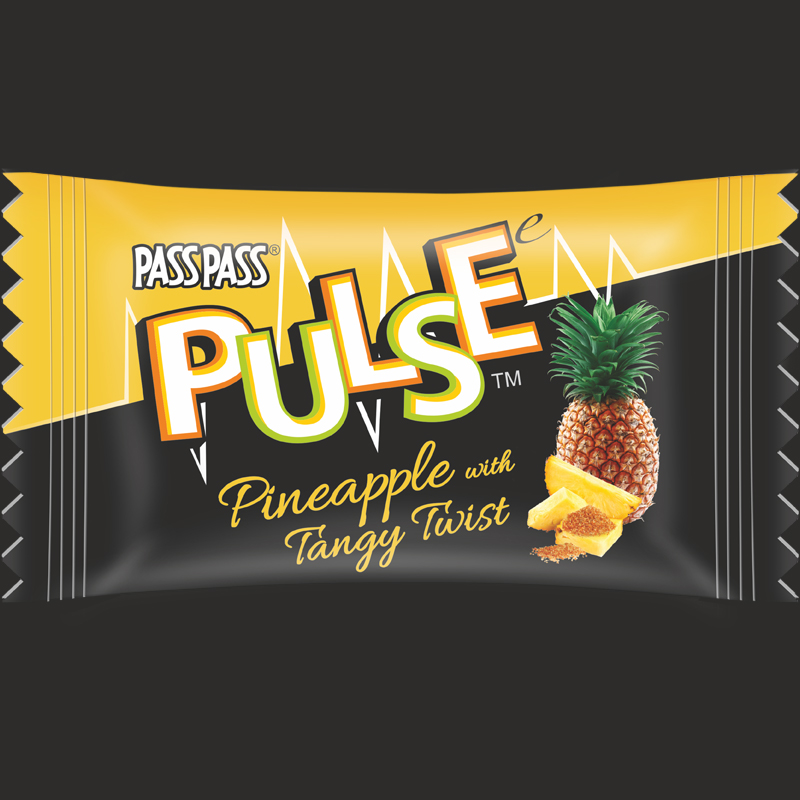
MUMBAI: The famous tangy, sweet Pulse candy is back in news, but this time for another flavour! DS Group has launched a new flavour ‘Pulse Pineapple’, further expanding its collection of the existing Pulse favourites of Kaccha Aam, Guava and Orange. Pineapple as a flavour and a fruit is diversely used and enjoyed across all age groups. The new candy will be available in a pillow pack at the cost of Re 1.
DS Group vice president new product development Shashank Surana says, “Since the candy’s launch in 2015 with the Kaccha Aam flavour, we have been coming up with new popular and niche flavours. After guava and orange, Pulse pineapple is the latest variant in the candy basket and we anticipate a good response from our consumers”.
The organised hard-boiled candy market is worth Rs 2650 crore in India and Pulse is the market leader with 12-13 per cent market share. Apart from India, the company has also started distributing Pulse to countries such as UAE, UK and South East Asian markets.
Pulse Pineapple has received an encouraging response to the test marketing undertaken in key cities of the country in the last few months. The candy is being launched pan India leveraging on the company’s distribution network to reach out to the target group. The launch of pulse pineapple will be supported by activities like POSM and market sampling.
MUMBAI: What comes to your mind when you hear “Kuch meetha ho jaaye”? Chocolate? Cadbury? Dairy Milk? Well, that’s what most people in India associate with ‘meetha’ today. Cadbury India, now known as India, began its operations in India as early as 1948 by importing chocolates. The brand has always been known for its loveable advertisements that make you want to sing along and do a little jig yourself.
The Indian chocolate industry was worth Rs 58 billion at the end of 2014 and is predicted to reach Rs 122 billion with a compounded annual growth rate of 16 per cent by 2019. According to the 2016 Euromonitor International report, the chocolate confectionery market in India is projected to grow at around 8 per cent per annum between 2016 and 2021 to reach Rs 16,200 crore (on constant value) from Rs 11,256 crore in 2016, backed by better retailing across rural areas. Mondelez is the market leader in India’s chocolate space, with over 65 per cent market share and Cadbury Dairy Milk is its highest selling product that has a market share of 41 per cent.
Mondelez India has created some of the most prominent ads in its 69 years of existence in the Indian market, with some of the famous catch-phrases being — ‘kuch khans hai zindagi mein’, ‘shubh aarambh’, ‘pappu paas ho gaya’, ‘aaj pehli tareek hai’, ‘interstellar party’ and ‘kiss me’. All these notable campaigns are attributed to Ogilvy & Mather (O&M), an advertising agency that has been associated with the brand for over 25 years.
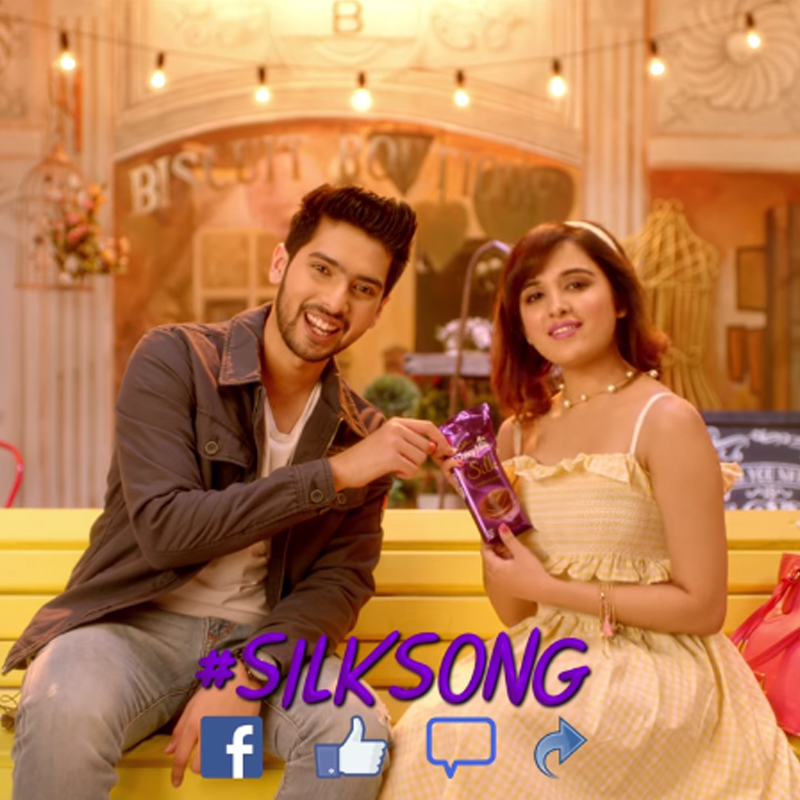
In India, Dairy Milk Silk has been one of the marquee products for the brand, which was launched in early 2010. Ever since then, the Silk jingle has probably been one of the most loved and recognised tunes in advertising and popular culture. Mondelez recently renovated its Cadbury Dairy Milk Silk making it curvier and with a fresh packaging. Now, the company has rolled out a new music video that showcases a refreshing rendition of the jingle by Bollywood singers Armaan Malik and YouTuber Shirley Setia.
O&M wanted to explore the digital medium to showcase the fresh new look of chocolate in an impactful manner. O&M Client services director Smita Padmanabhan says, “For Silk, the jingle is our biggest brand identity and for the first time this year we had a TVC where the protagonists were actually seen singing it on screen and that gave us the idea to get more people to sing the song they love.”
This festive season, it kept a low profile on mainstream media and instead took a risk in the digital medium with the first music video. Mondelez India director of marketing (chocolates) Prashant Peres mentions, “The key objective of this campaign was to try and make the jingle a part of the popular culture through an aspirational yet mainstream portrayal as digital is gradually becoming a lead medium for youth brands.”
Digital has shattered the invisible wall between brands and customers but it questions the optimal usage of advertisements. “While digital provides us with the medium to reach out and engage with consumers on a one-on-one basis, it is always a challenge to stand out in the clutter and grab their attention. As marketers we have to be on top of trends and emerging platforms, which pushes us to constantly innovate and adapt,” he adds.
When it comes to brand recall, some of Mondelez’s campaigns occupy the top shelf in the consumers’ mind. The iconic chocolate manufacturer has managed to pull the rabbit out of the hat every time it has wanted to draw attention to new brands. With digital on top priority to target consumers, we are sure the company will come up with another breakout campaign to call out to those with a sweet tooth.
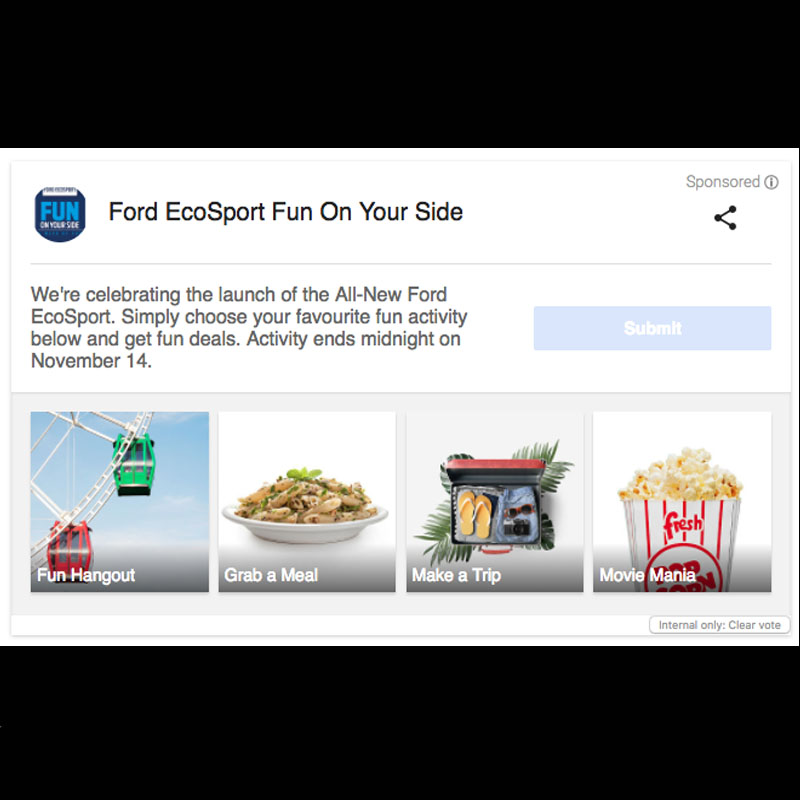
MUMBAI: Ford India has teamed up with Google to launch a first-of-its-kind digital campaign in the automobile space in India for its new Ecosport SUV car. Titled ‘Fun on Your Side’, the digital campaign aims to bring different aspects of ‘fun’ to life that customers can experience with the all-new EcoSport even when they search for it online.
Starting 9 November till 15 November, people searching for ‘Fun with EcoSport’ on Google search will be asked to choose their favourite fun activity such as movie mania, make a trip, grab a meal and fun hangout. After voting, consumers will need to click on a ‘Thank You’ link to get a chance to win vouchers related to the voted option, from Coupon Dunia.
Ford India vice president of marketing Rahul Gautam says, “We have worked with Google for the new campaign to ensure that the spirit of fun spreads beyond our dealership floors to everyone searching for it.”
Google India director sales Vikas Agnihotri says, “Research shows 89 per cent of car buyers’ decision making is influenced through digital and majority of their journey starts with Google search. The digital campaign for the launch of the new EcoSport combines strong intent cues from consumers with the innovative search voting feature to provide a fun-filled and memorable experience.”
Ford is one of India’s leading users of programmatic advertising in India, and the campaign for the all-new EcoSport further builds on this and will enable the teams to engage audiences across all offline and online touch points in an integrated manner.
Conceptualised by Global Team Blue, part of WPP Group, the campaign promotes the new Ford EcoSport and its core features of fun, style and technology across online, print and TV.
MUMBAI: The advertising world is a fiercely competitive place with brands waiting to pounce on an opportunity to grab as many eyeballs as they can. If you thought it is the survival of the fittest here, you could be wrong. Wit and smartness are needed for success. While some brands stick to creative storytelling, others resort to a more aggressive form of marketing, i.e., comparative advertising.
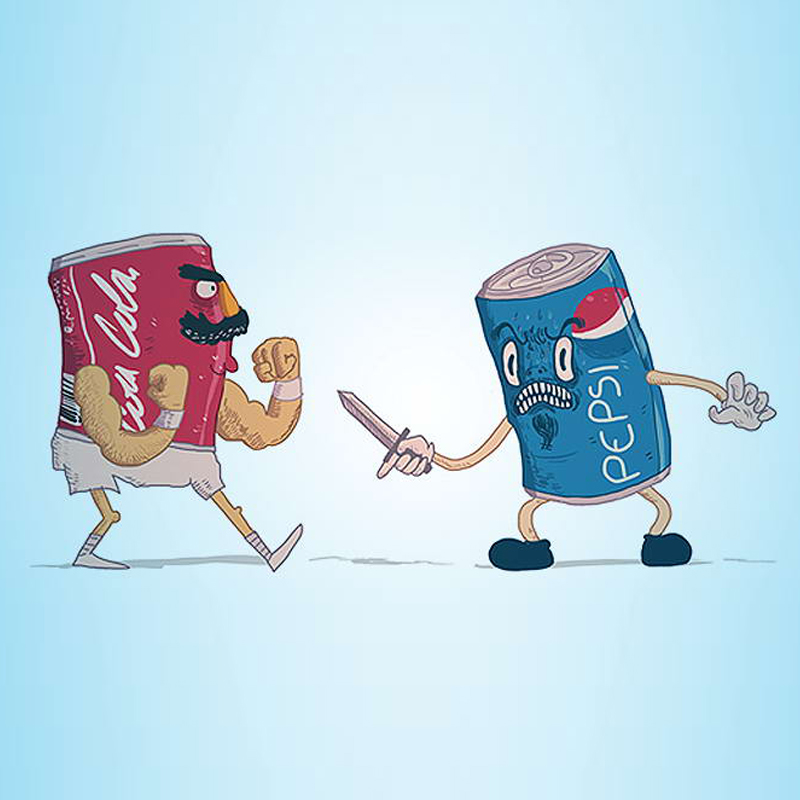
If you’ve noticed brands taking potshots at rivals through their advertisements, usually alluding that their products are inferior to its own, voila you’ve got yourself a case of comparative advertising or advertising war. Audiences can clearly comprehend the attack since in most cases they tend to name rivals.
Merely showing exaggerated claims of oneself don’t get categorised into comparison. Only when a brand degrades or insults another brand does it cross over to the territory of indulging in an ad war.
Mindshare India chief product officer M A Parthasarathy says that challenger brands tend to adopt the strategy of comparative advertising. “The success of such campaigns often depends on how tastefully or crassly is it executed. It works better when done occasionally or selectively, and not as the main communication from the brand.”
Some brands do that to show the superiority of their product, while others do it pull down their rivals. Glitch planning director Ramya Nagesh points out that brands opt for this kind of advertising solely for attention. “It gives consumers a look into what brands believe in the most about their products and their brand. In this crowded marketplace, it feels like a breath of fresh air when done right but can get stale really soon,” she adds.
The history of comparative advertising dates back to the beginning of the advertising world and ever since, brands have been mocking and taking a dig at each other. The latest incident is an ad created by Samsung Mobile that mocks Apple users. Teasingly titled ‘Growing Up,’ the video follows an Apple fan from his first iPhone in 2007 all the way up to 2017, when he finally decides to make the switch to Samsung Galaxy 8.
The ad has received mixed reviews where some found it funny and have applauded Samsung’s gut to mock Apple users while a certain set thought it was distasteful.
Though such ads are healthy for the marketing industry as long as they are done right, Publicis India managing director and chief creative officer Bobby Pawar notes that at times it is interesting to see such a face-off which is a tactic to get your name plastered in the news. With the right narrative, it can create a controlled controversy that gets people talking and even taking it in the right stride at times. “In the latest Samsung-Apple face-off, Apple is perceived as a thought leader brand whereas Samsung is trying to be the cheeky challenger,” he adds.
Though comparative advertising isn’t the norm of Indian advertising, some brands had the courage to take on their opponents. Indiantelevision.com brings to you a couple of comparative ads that may or not have resulted in higher sales but definitely created a higher brand-recall.
Rin v/s Tide:
Hindustan Unilever Ltd (HUL) launched its much controversial commercial for Rin in 2010, which made a direct jibe at P&G’s Tide detergent, and raised many eyebrows. The TVC made a no holds barred comparison between Rin and Tide, going on to claim that Tide is incompetent of fighting stains and providing whiteness like Rin.
Colgate v/s Pepsodent:
In this commercial, Pepsodent blatantly used Colgate’s name claiming 130 per cent better protection. Colgate took offence and filed a petition in the Delhi High Court, which was later rejected. The brands have ever since been taking a dig at each other time and again.
Amul ice-cream v/s Vadilal ice-cream:
Early this year, Gujarat Milk Marketing Federation Limited, which sells its products under the Amul brand created a campaign where it insinuated that others ice creams were made out of Vanaspati. HUL and Vadilal took Amul to court as the latter suggested its rivals are actually selling ‘frozen dessert’ in the name of ice-cream.
Times of India v/s The Hindu:
In the year 2012, Times of India launched its ‘Wake Up to The Times of India’ campaign to show Chennai how readers are being put to sleep by a boring news daily, which is also its main competitor in the southern market, The Hindu. The latter wasn’t easy on Times Of India either and came up with a brilliant advertisement to get back at it.
Patanjali v/s HUL and RB:
On 2 September this year, Patanjali launched its campaign that directly targetted HUL’s products like Lux, Lifebuoy and Pears along with Reckitt Benckiser’s (RB) Dettol. In the ad, Baba Ramdev was seen asking consumers to reject chemical based soaps and adopt natural and herbal soaps instead. HUL and RB took Patanjali to the High Court filing a defamation case and the ad was pulled out of TV channels and the internet after the court’s order.
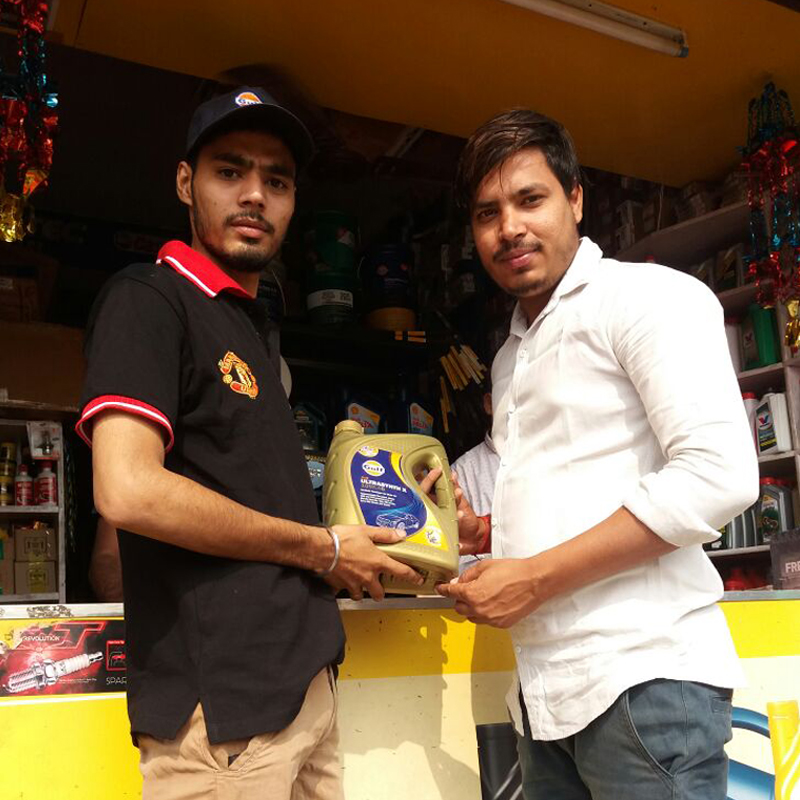
MUMBAI: Integrated marketing agency, Brand Street India has won the mandate to handle on-ground activities for Gulf Engine Oil, a Hinduja Group Indian Company. Brand Street India executed activities at multiple locations such as garages and retail stores in order to approach and inform customers about the most suitable car lubricant for their vehicle’s engine.
Currently, Gulf Engine Oil has a number of engine oil related products floating in the market. With the help of Brand Street India, the company aims to increase the effectiveness of its sales, along with creating a valuable consumer interaction and engagement to help build a positive brand image.
The campaign aims to educate consumers about the product that best suits the engine of their car along with explaining long-term benefits of the same. Some of the major products which it intends to promote are Ultrasynth X, 10W- 40, SW-30, Multi G Max, 20W-50, Formula GX, 5W-40, Super Diesel X-10, 15W-40, Multi G Max, 20W-40 and more.
Brand Street India is also handling inventory management, pre and post sales reports compression, mechanic meeting for sales improvement and consumer feedback for Gulf Engine oil. Furthermore, they are using this platform to identify future buyers even in the absence of recent intent in order to improve brand awareness as well. This campaign will be carried throughout the month of November 2017.
Brand Street India national head Surendra Singh says, “Gulf engine oil has a rich heritage of 100 years and a global recognition with millions of trusted consumers. In order to drive revenue growth for such a huge company, it is imperative that the sales team ensures personalised engagements with their prospects and customers. This is exactly what Brand Street India is delivering by driving this campaign. This is indeed a prestigious feather in Brand Street India’s cap.”
Rural Street senior manager Rajesh Dogra adds, “We at Brand Street India are proud to support and further build on our strong relationship with Gulf Engine Oil. We are confident that our association will help us showcase our strategic brilliance which will bring to light the true essence of not just one but both the brands.”
Brand Street India will also be holding these activities in association with a number of housing societies within the city. With special kiosks designed to promote Gulf Engine Oil, the present volunteers will share informative insights regarding engine oils with the residents of the society as well.
MUMBAI: Oops! Don’t jump the gun! That must be the lesson that state-owned airline Air India must have learned following the recent slugfest it got involved in on Twitter a couple of days ago. Air India – normally known to be sedate and a quiet operator – had fired a salvo at rival private carrier Indigo Airlines by posting two pictures which stated “We raise our hands only to say Namaste!” and “Unbeatable Service” on the evening of 7 November.
The two mischievous statements were targeted at Indigo which has been getting a lot of bad buzz and press thanks to a viral video (posted on 7 November) of one of its staffers manhandling and beating a customer. In the past few months, fliers have come out and bashed the airline for the poor quality of customer service. In a recent incident, it did not allow Indian badminton star PV Sindhu to bring her sports gear on board and forced her to have it included in the checked in luggage.
Needless to say the posts resulted in a lot of chuckles amongst Twitter users, something which is not known to be associated with the public sector airline. On most occasions, it is the butt of wise cracks and jokes for its service.
What forced the normally quiet airline to get into a round of fisticuffs? Well it could very well have had to do with the posting of a picture – purportedly by Jet Airways that stated “We beat our competition, not you” that went viral.
Seeing an opportunity of creating excitement amongst Twitterati, Air India too followed with its two posts later in the day.
To its chagrin, Jet Airways issued a clarification on its Twitter handle (236,000 followers) stating: “Jet Airways did not commission the creative being shared on social media platforms, in context of a recent event concerning another domestic airline. The creative does not reflect our philosophy and ethos and is in fact, in bad taste.”
Air India was thus left in a quandary? Was it acting in bad taste? Apparently, someone thought so as its posts were deleted this morning.
The deletions caused Twitterati to question Air India as to why was it backing off?
MUMBAI: Online men’s lifestyle brand, MensXP has launched its first ever brand campaign.
The multi-media campaign led by TV, print and digital hosts five films for TV and digital talks about different sections on the website like fashion, grooming, relationships, career and tech. These are light hearted humorous films, talking about the danger of making a fool of yourself, if you don’t stay updated with the trends in the men’s lifestyle space.
Times Internet CMO Pratik Mazumder says, “Our first campaign celebrates the man you chose to become as there is no one way manhood can be defined. Its codes are ever changing.”
Conceptualised and executed by From Here On communications (FHO) and Times Internet’s in-house creative team, the campaign’s insight was derived from the thought that masculinity today has moved away from its conventional definition. Being a good man is more important than just being a man, an alpha, macho, hero or a leader. Men today are choosing their own manifestation of manhood. It is driven by their desire to seek beauty, truth, wisdom, justice, being kind, honest, and true.
MensXP Founder and COO of Indiatimes lifestyle network Angad Bhatia said, “MensXP explores the codes of manhood and pursues the most interesting stories of and around men. It isn’t about redefining manhood but about giving manhood an expression, most relevant today.”
MUMBAI: The confectionary industry has emerged as one of the largest and well-developed food processing sectors of India. With international companies coming in and a stiff competition within Indian players to create a space for themselves, it is at an interesting juncture.
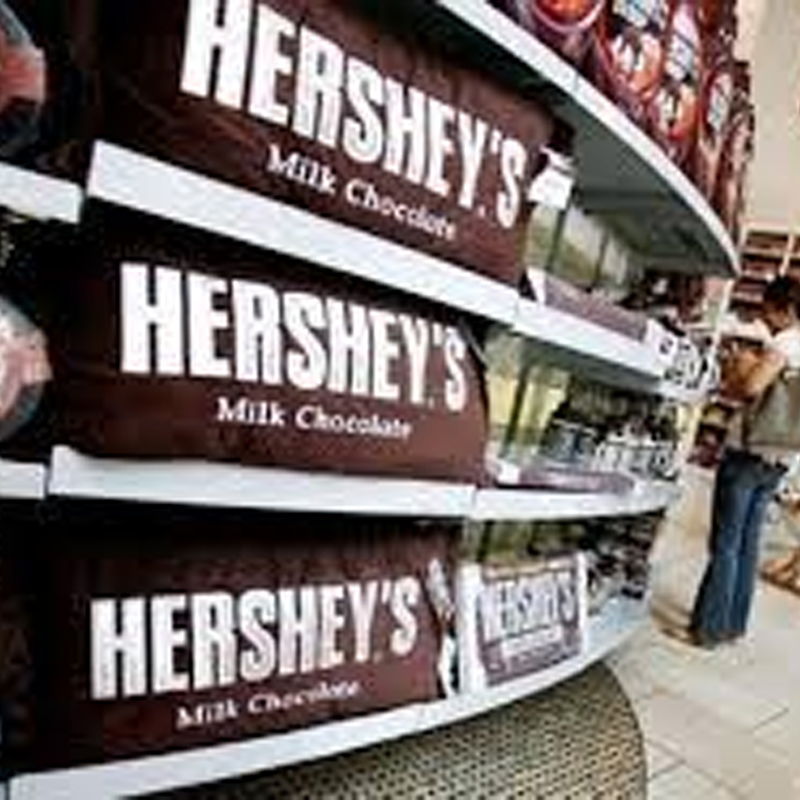
Amidst all this, US confectionary giant The Hershey Co has announced that it will invest $50 million in India over the next five years to focus on growing and expanding their presence in India. “India is one of our key International focus markets and we are investing to build this important business,” says Hershey India chairman and managing director Praveen Jakate.
India has emerged as the fastest growing market for the company, according to its recently announced its Q3 2017 global earnings and revenue. Hershey India recorded a strong double digit constant currency net sales growth, according to a statement from the company. As per the company’s Q3 2017 results, the constant currency net sales for Brazil in the third quarter increased by 3.3 per cent, while Mexico registered a net sales increased by 10 per cent. India outnumbered and recorded a net sales and growth of 16 per cent.
Hershey’s sells 11 brand in India, including Hershey’s chocolate syrup, milkshake and chocolate almond spreads, along with Sofit soya milk and Jumpin juice, which it acquired from an erstwhile joint venture with Godrej Industries.
The company plans to focus most of its investments now in brands owned by The Hershey Co. rather than in those brought from the joint venture, Jakate.
“Our transition of the Indian portfolio is enabling a higher margin business, and we are on track to expand gross margins here by 1,000 basis points in 2017,” says Hershey chief financial officer Patricia A Little.
In India, Hershey faces competition in the chocolate confectionary market from Mondelez, Mars, Snickers and Nestle.
Market research firm Euromonitor expects the Indian market to grow at an 8 per cent compounded annual growth rate to be worth Rs16,000 crore by 2021.
MUMBAI: Xiaomi Mobile has brought in Bollywood actress Katrina Kaif as the product endorser for its new Redmi Y series in India.
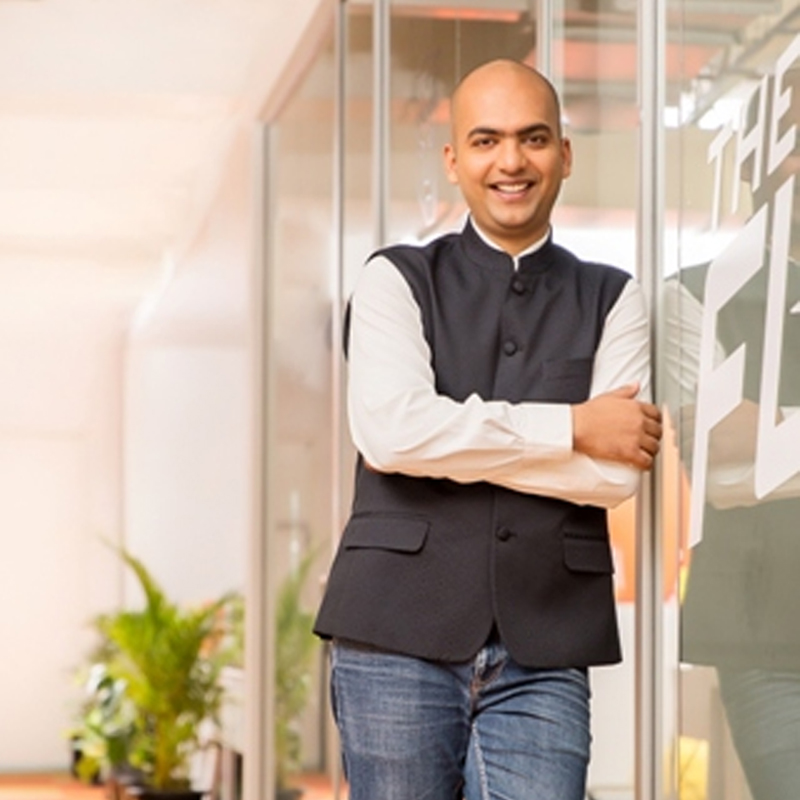
Xiaomi vice president and managing director Manu Jain said, “The Redmi Y series is designed for people who need a smartphone that can complement and enhance their everyday routine and lifestyle. Katrina is one of those individuals who work extremely hard to complement every situation she is a part of. ”
Actor Katrina Kaif said, “I am super pleased to be endorsing a product series which has been designed to enhance everyday routine and complement everyone’s lifestyle, as I personally believe in that philosophy. Xiaomi believes in providing high end technological innovation to everyone, and is the fastest growing smartphone brand in the world.”
Alongside the new series of phones, Xiaomi also unveiled the global version of MIUI 9, the latest upgrade to its popular Android-based operating system, which includes several new features designed for India.
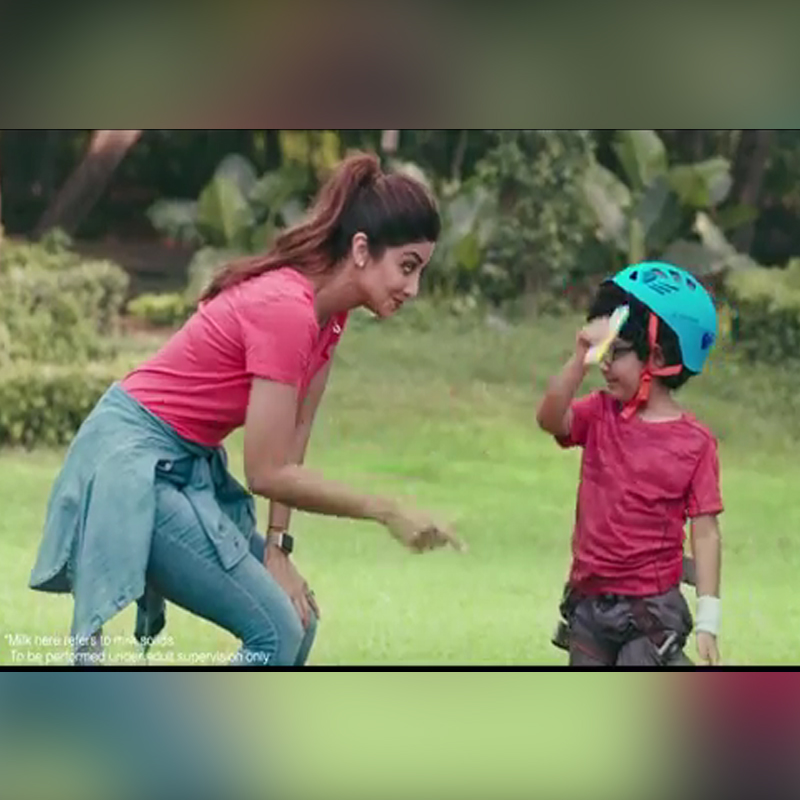
MUMBAI: Nestlé India recently re-launched the much loved Milkybar with more milk, less sugar. The new TVC featuring actor Shilpa Shetty reflects the brand’s ethos that a wholesome childhood is one where kids learn and grow playfully. The campaign revolves around the importance of encouraging kids to try new experiences that make them curious and confident for life.
Link to TVC
Nestlé India general manager of chocolate and confectionery Nikhil Chand said, “We are delighted to unveil the new TVC that presents Milkybar as a brand that supports parents who believe in the value of playing and learning through new experiences. Milkybar is a category-leading brand credited with many firsts.”
Shetty said, “This is an exciting and fun association for me. I have always loved Milkybar and being a mother myself, I am aware of the need for better and informed choices and more importantly, an encouraging parenting style that ensures children can play and learn life’s important lessons. I hope our moms and kids will have as much fun watching the ad as we had in making it.”