Category: Telecom

  • 43% data service users unhappy with telecom operators: survey

    43% data service users unhappy with telecom operators: survey

    KOLKATA: The recently concluded spectrum auction for the telecom industry saw 19 days of fierce bidding and telecom companies competing for spectrum to strengthen mobile data services. However a community poll conducted by a social networking platform LocalCircles, revealed that around 43 per cent of phone users in India are dissatisfied with the quality of data services while another 43 per cent have rated it as average.


    According to the study, around 53 per cent of the surveyed people said the quality of network coverage was average, while 27 per cent expressed discontent with the coverage.


    Another 53 per cent felt that the tariffs charged by the operators were expensive, while 38 per cent voted it as a “value for money” proposition.


    Of the people surveyed, 53 per cent put faith on the accuracy of data billing and other services charged by the operators, while 32 per cent did not vote in its favour.


    “Immediate efforts are needed by the telecom regulators and the operators to improve the voice and data service quality by reducing call drops, improving coverage and quality,” LocalCircles said.


    As per the study, a whopping 77 per cent of respondents said the central government and telecom regulatory authorities have “not done enough” to address issues faced by consumers and another 77 per cent said they want operators to bill them based on usage and the services opted for instead of generalised packages.


    “Net neutrality is something that a majority of citizens support and want the telecom regulator to ensure consumer interest is protected at all costs,” it added.


    The company also said that the telecom regulatory body’s regulations are “loose” and the Department of Telecom’s monitoring of compliance on licensing requirements are falling short of expectations.


    The survey was conducted across India with 20,000 citizens responding to six poll questions followed by a “detailed structured discussion.”

  • Telecom Italia & Rupert Murdoch’s Sky partner for Internet TV service

    Telecom Italia & Rupert Murdoch’s Sky partner for Internet TV service

    MUMBAI: Fibre-optic cable TV has landed in Italy as part of a strategic partnership between Telecom Italia and Rupert Murdoch’s Sky. The companies will be sharing their assets and their respective expertise to bring forth a key business project that will also boost ultra-broadband demand in Italy.


    With this partnership, the two companies take a crucial step forward towards “convergence” between media and TLC, as the deal makes way for the first “quadruple play” offer in Italy, integrating landline and mobile services, broadband and ultra-broadband connectivity and premium television content available “anytime and anywhere” on all Internet-connected devices.


    The excellence of content and the uniqueness of Sky’s viewing experience turn into drivers for spreading TIM’s ultra-broadband and, at the same time, the access to Telecom Italia’s latest generation networks allows Sky to benefit from a new distribution platform for its content and services offer.


    The initiative strengthens TIM’s strategy in distributing innovative services and confirms its role as technology enabler thanks to very high-speed networks, thus bringing more and more households closer to the very quality of content and the new modes to enjoy the Sky-branded viewing experience.


    Similarly, the agreement with Telecom Italia does carry a strategic meaning for Sky too, as it makes all its wide-ranging offer of programs and exclusive services available on broadband and on ultra-broadband networks as well thus extending pay TV scope to reach out, for example, those prospects who reside in the city centers of the many Italian art cities and cannot install the satellite dish and therefore access Italy’s best TV offer.


    The TIM Sky joint offer will be available for TIM’s private customers with a fibre-optic connection from 30 to 100 Mbit/s and 20 Mbit/s ADSL.


    With TIM’s broadband and ultra-broadband networks, Sky’s television offer and user experience will equal those available via satellite. An offering featuring more than 150 channels, with all the quality of HD (about 60 HD channels and one 3D channel) and with all the innovative features that make viewing experience unique, from Sky On Demand, the video-library with more than 2500 titles to be watched at any time, to Restart, the service enabling subs to restart a movie already on air from the very beginning. All the other My Sky HD features allowing customers to record their favorite programs, pause a live show or watch again whatever scene with the replay, will be active within the summer.


    For the first year, the TIM Sky offer will be proposed, as a promotion, starting from €14 per month for users already with fibre or ADSL connectivity and from €39 per month for a quadruple play package (internet landline and mobile, voice and TV content).


    Telecom Italia CEO Marco Patuano said, “Today, in Italy, with Sky, we are starting a new collaboration model between Telco and Media Companies that allows us to go to the market with a fully convergent offer. We are convinced that this strategic deal is an important driver for the development of the new ultra-broadband networks and of the innovative technologies that are at the core of our business plan featuring more than 5 billion euros investments for the three years period 2015-2017. We are particularly pleased with this partnership as it allows our customers to access exclusive and high quality content thanks to Telecom Italia’s technological expertise and Sky’s editorial richness.”


    “This partnership is an example of how two leading companies, that have always been investing in innovation, can join together to create something that until recently was not even possible in Italy, therefore boosting demand, so far only potential, for quality pay TV also through ultra-broadband. From now on Telecom Italia’s fibre will bring all the richness of content and the excellence of Sky’s viewing experience, with HD, on demand, Restart, My Sky features, into the houses of millions of Italian families who, for various reasons, could not install a dish. Sky is currently present on all the main distribution platforms and this agreement does carry a strong strategic value for us as it broadens Sky’s commercial prospects base. To understand its importance just think that in the UK almost 20% of households enjoy a pay TV offer through cable or broadband,” added Sky Italia CEO Andrea Zappia.

  • Telecom Ministry sets up committee to study net neutrality

    Telecom Ministry sets up committee to study net neutrality

    NEW DELHI: Even as the Telecom Regulatory Authority of India (TRAI) recently issued a Consultation Paper on over-the-top (OTT) services, the Telecom Ministry has set up a committee of its own to examine the whole issue of Internet usage in the country including the newly-highlighted debate on net neutrality.


    Telecom Ministry director (security) R Shakiya said that the committee was expected to finalise its recommendations towards the latter half of next month.


    Although there was no plan for the committee to give a hearing to stakeholders before finalising its report, he assured stakeholders present at a meet organised by ASSOCHAM that he would forward its request to the Minister in this regard.


    Meanwhile, he made it clear that OTT meant communication services like WhatsApp or WebChat and not sites related to e-governance. Similarly, internet governance is independent of net neutrality.


    He also said that Digital India was a delivery-oriented scheme and it would be erroneous to confuse it with Internet growth.


    Meanwhile, he added that India had asked the International Telegraphic Union (ITU) to conduct a study into how the traceability of the user can be brought in the present regulations.


    ASSOCHAM itself is also expected to form a paper on net neutrality.


    ASSOCHAM chairman for the National Council on Telecommunications T V Ramachandran, while holding that he was all for net neutrality and there was no reason for consumers to pay extra for services foisted on them, said telecom corporations have been discriminated against and wanted them to find ways to avoid this as far as net neutrality is concerned. 


    He cited a US Federal Communication Commission (FCC) statement, which said that these “…new service offerings, depending on how they are structured, could benefit consumers and competition.” The FCC, however, has ruled against a move that violated net neutrality principles.


    The net neutrality debate has arisen after Airtel launched a platform called Zero on which Internet companies could sign up to allow its users free-of-cost access.


    Other speakers included Pradeep Kumar Verma, who is a Scientist with the Department of Information Technology, and ASSOCHAM senior director Ajay Sharma among others.


    A representative of Asia Pacific Telecommunity (APT) wondered if TRAI, which sought views by 24 April, should interfere as net neutrality was more a matter of content than carriage and the regulator only dealt with carriage issues. He felt that the best body to deal with the issue was the Competition Commission of India (CCI).


    Meanwhile, in its paper on OTT, TRAI devoted one full chapter on net neutrality. It suggested that to ensure a thriving and neutral Internet, the issues that needed to be addressed are:


    i. The Internet must be kept open and neutral. Reachability between all endpoints connected to the Internet, without any form of restriction, must be maintained.


    ii. All data traffic should be treated on an equitable basis no matter its sender, recipient, type, or content. All forms of discriminatory traffic management, such as blocking or throttling should be prohibited.


    iii. Network service providers should refrain from any interference with internet users’ freedom to access content (including applications of their choice).


    iv. There should be restricted use of packet inspection software (including storage and re-use of associated data) to control traffic.


    v. Complete information on reasonable traffic management practices and justifications for the same must be accessible and available to the public. TSPs should be transparent and accountable to any changes in practices.


    vi. Non-neutral treatment of traffic for “voluntary” law enforcement purposes must be prohibited unless there is a legal basis for it.


    In view of this, TRAI sought to ask the stakeholders about their views on net-neutrality in the Indian context; what forms of discrimination or traffic management practices are reasonable and consistent with a pragmatic approach; what should or can be permitted; should the TSPs be mandated to publish various traffic management techniques used for different OTT applications; and how should the conducive and balanced environment be created such that TSPs are able to invest in network infrastructure and CAPs are able to innovate and grow. 

     

  • After Flipkart, Airtel responds to Net Neutrality controversy

    After Flipkart, Airtel responds to Net Neutrality controversy

    MUMBAI: Net neutrality activists and the Indian netizen’s valiant effort marked its first goal as after e-commerce giant Filpkart backed out from its deal with Airtel for Airtel Zero, the telecom tycoon has now issued an explanation on various controversies.


    Airtel, in its statement, said that it fully supports the concept of net neutrality. “There have been some misconceptions about our toll free data platform – Airtel Zero. It is a not a tariff proposition but is an open marketing platform that:


    * Allows any application or content provider to offer their service on a toll free basis to their customers who are on our network.


    * Such customers whether on a data pack or not will therefore be able to access these toll free services free of charge.


    * No site whether on the toll free platform or not under any circumstances is blocked, throttled or provided any form of preferential access.


    * The toll free platform is open to all content providers on a completely non discriminatory basis and operates on the same principle as 1-800 toll free voice services.”


    Airtel further said, “The statement made by Flipkart regarding its decision to not offer toll free data service to its customers is consistent with our stand that Airtel Zero is not a tariff proposition. It is merely an open platform for content providers to provide toll free data services. The platform remains open to all companies who want to offer these toll free data services to their customers on a completely non discriminatory basis.”


    As was reported earlier by Indiantelevision.com, Flipkart issued a statement saying that the company has always strongly believed in the concept of net neutrality. While it backed off from Airtel Zero, the company also said that it was committed to the larger cause of net neutrality in India.

  • AIB turns activist; ignites movement on net neutrality

    AIB turns activist; ignites movement on net neutrality

    MUMBAI: Not long ago stand-up comedy group All India Bakchod (AIB) was directly or indirectly labeled as ‘anti-socials’ because of the controversial roast they uploaded on social media platform, which was eventually pulled down. The same group has now made a sincere attempt to explain the complicated concept of “Net Neutrality” to the common man. And their attempt has been successful with the video going viral and how.


    Net neutrality is something that every taxpayer deserves but no one cares for. It’s often regarded as technical jargon. However, AIB’s “Save The Internet” video has changed the perception and now a lot of people are aware of the impending catastrophe.


    What is Net Neutrality?


    Net Neutrality means every user will have the right to access whichever website she or he wants to. There will be no infringement from anybody and certain websites won’t be given more bandwidth than others. Amazon or The Times Of India, Flipkart or Indiantelevision.com, every website will load at the same speed and that is exactly what Net Neutrality means. And that’s the problem telecom operators have.


    Where it started from:


    Indian telecom operators lobbied to The Telecom Regulatory Authority of India (TRAI) to change certain rules as per their convenience, which would have a direct impact on the consumer’s pocket. TRAI, in response to the telecos on 27 March, released a 118-page long consultation bulletin, which concluded by asking 20 questions. The last date to respond to that bulletin electronically is 24 April, 2015 while all the counter responses can be sent till 8 May, 2015.


    What all can change?


    No, telecom companies are not restricting any particular website so you can be rest assured that another ban is not coming into play. The demand is to access certain genres that users have to pay separately for. The question then arises: What are the users paying the initial fee for?


    The scenario that can emerge from the change is; to access Flipkart, Whatsapp, Facebook or any other established OTT service, one has to separately subscribe for it. The freedom to access any website independently will be infringed upon and the internet, which is probably the only free platform where one can express their opinion, will become a claustrophobic cozy club dominated by big names.


    Who all will face the impact?


    Not only users but the change will also vigorously affect all aspiring entrepreneurs and start-ups. It is easy for established ventures like Flipkart, which is supporting telecom operators, to pay the service providers and ask them to make their app freely available. However, that will leave an impact on the start-ups who don’t have the luxury of cracking a deal with telecom operators. The irony is that when the Prime Minister is delivering speeches in France and Germany about how easy it is to do business in India and sharing aspirations of making the country a global destination for investment, Indian e-commerce startups are on the verge of demolition.


    What did AIB do?


    The stand up comedians came up with a video (Save the Internet) explaining the entire concept of net neutrality. What was lost and diluted in TRAI’s 118 page long complicated bulletin was garnished in AIB’s nine-minute video. The important points were highlighted and the refreshing yet simple explanation that AIB members’ offered in the video added to the appeal and was lapped up by young and old alike. The Net Neutrality jargon thus became a national movement.


    What did AIB’s video do?


    AIB’s video conveys this message – “Internet is not a luxury but a utility.” The video ends with a link, which directs people to the net neutrality home page where all of TRAI’s 20 have been answered in detail. One can simply click to send an email with the pre-written answers or can edit as per their wish. At the time of filing this report, AIB’s video had received 1,132,453 views and more than 100,000 emails had been sent to TRAI through the http://www.netneutrality.in/ website.


    How to join the movement?


    One can be a part of the movement by logging on savetheinternet.in and forwarding the email to the regulatory authority. One can also sign this petition at:https://www.change.org/p/rsprasad-trai-don-t-allow-differential-pricing-… and share it with your friends or write directly to TRAI at advqos@trai.gov.in about their thoughts before 24 April, 2015.


    Conclusion:


    The AIB video witnessed unabated praise across all social media platforms from the common man and celebrities alike. It brought about the necessary awareness in India and made Net Neutrality a national issue. The Internet is a very important part of the civilized world and a major source of information, entertainment and social networking. Net Neutrality is a right of every Internet subscriber and cannot be infringed at any cost. While the issue has managed to become a major talking point, one only hopes that political parties don’t politicize the issue and turn it into vote bank propaganda because Internet without Net Neutrality is like bones without flesh.


  • Airtel seeks West Bengal govt permission for Wi-Fi hotspots in Kolkata

    Airtel seeks West Bengal govt permission for Wi-Fi hotspots in Kolkata

    KOLKATA: War for internet data market seems to intensify in Kolkata as telecom operator Bharti Airtel is in the process of seeking permission from the West Bengal government to create Wi-Fi hotspots across the city to push data usage.


    “We have sought permission from the state government to create hotspots across the city as we are also looking at Wi-Fi service to consumers,” Airtel CEO (Bengal & Odhisa) R S Negi said, on the sidelines of launching company’s 3G service in the Kolkata circle on its recently acquired The Universal Mobile Telecommunications System (UMTS) 900 Mhz spectrum.


    In February, Reliance Jio Infocomm Ltd, the company owned by Mukesh Ambani’s flagship Reliance Industries, rolled out a free 4G Wi-Fi service at Park Street, enabling Kolkata as the first metro city with a 4G-enabled high-speed internet service. The company last week said that four more areas of Kolkata will turn into Wi-Fi enabled zones by next month. The company, which is investing around Rs 3,300 crore to roll out 4G in Bengal, plans to offer the free service as part of a sampling experiment. The official commercial launch will take place later.


    Data is turning out to be major focus for the telecom companies, experts said.


    While Negi declined to give financial numbers, he said that half of the incremental revenue for Bharti Airtel comes from data services.


    He also informed that the company may use 3G or 4G network to fire the Wi-Fi service or in a combination of both depending on the situation.


    Airtel is already offering free Wi-Fi on two bus routes, as trial to this mode of service, since late last year.


    According to Negi, the new 3G service branded as Platinum 3G will offer better speed for consumers and better outdoor and indoor coverage, while adding that the company is not tweaking with the existing 3G tariff for consumers.


    However, the new 3G is only for Kolkata and not Rest of West Bengal (RoWB) circle. Kolkata is the second circle for 3G service based on UMTS 900 after Mumbai for Airtel.


    “With the launch of Platinum 3G, Airtel customers of Kolkata can browse the internet 122 per cent faster than any other 3G network, get 36 per cent better indoor coverage and enjoy extended battery life. Additionally, users can stream videos 144  per cent faster than the existing speed. Customers need not to pay extra to avail this superior connectivity and can enjoy Platinum 3G at the existing 3G tariffs,” he said.


    This 3G services in Kolkata on the 900 Mhz spectrum will offer better speed than when these services are offered on another bandwidth.


    The 3G network in Kolkata is likely to be managed by Nokia Networks, which already has the operations & maintenance mandate for its 2G and 4G networks in the city.


  • Airtel launches ‘Airtel Zero’

    Airtel launches ‘Airtel Zero’

    MUMBAI: Bharti Airtel, has announced the launch of ‘Airtel Zero’ – an open marketing platform that will allow customers to access mobile applications at zero data charges. Akin to the established concept of toll-free voice calling, ‘Airtel Zero’ will allow everyone from big marketers to small-time application developers to make parts or their entire mobile app free for customers – thus reviving interest of dormant customers, attracting new potential users and increasing retention. The platform will be a big win for customers as it will allow them to access their favourite mobile applications at no data charges, and also encourage them to try out new applications.


    “We are excited to launch ‘Airtel Zero’, which is an open and non-discriminatory marketing platform for all developers in India – irrespective of the size of their business. We believe that this platform is consistent with India’s Digital Inclusion agenda and also contributes to the government’s ‘Make in India’ vision by providing a platform to millions of small businesses to reach out to the end consumer,” said Srini Gopalan, Director – Consumer Business, Bharti Airtel (India).


    Specifically, ‘Airtel Zero’ can work as a highly efficient marketing mechanism for small developers or startup shops that face budget constraints towards driving promotions and app downloads. “The results of our pilot program indicate that ‘Airtel Zero’ can deliver the same results as traditional digital marketing channels at 1/3rdthe cost – thus underscoring the immense value it can deliver for developers across. Following an extremely successful pilot phase, we are seeing a lot of interest from businesses across the board (including several small startup firms), and expect a large number of applications to sign on. We invite all application developers to register their interest in ‘Airtel Zero’ and see the compelling reach it can deliver to Airtel’s 200 million plus customers across India” added Gopalan.


  • Airtel launches Platinum 3G in India; Mumbai first city for launch

    Airtel launches Platinum 3G in India; Mumbai first city for launch

    MUMBAI: Bharti Airtel is all set to enthral Mumbaikars with the launch of its Platinum 3G service. Winning the 900 MHz band in September 2013, Airtel will be using it to complement the existing 2100 Mhz resulting into greater speed and connectivity. 


    Being the first telecom operator in India to launch Platinum 3G, Airtel will offer the services of Platinum 3G at existing 3G tariff. Mumbai is the primary Indian city to experience the superior connectivity. The company has further plans to extend the services to Kolkata. 


    Airtel Platinum 3G is India’s best 3G network offering a variety of benefits. Till date, Airtel has 50 lakh subscribers in Mumbai and claims to be the only network that works on the Platinum band. Airtel customers in Mumbai can browse the Internet 34 per cent faster, get 30 per cent better indoor coverage and enjoy 16 per cent longer extended battery life. Additionally, users can stream videos 25 per cent faster than the existing speed.


    Bharati Airtel India Mumbai Maharashtra, Goa Gujarat Hub CEO Ashok Ganpathy said, “As a leader in the telecommunication space it is our endeavour at Airtel to consistently innovate and provide a seamless network to our customers. The launch of Platinum 3G is an integral part of this commitment to enhance customer satisfaction by providing superior connectivity on existing 3G tariffs. Considering this we would now like to invite data savvy customers in Mumbai to enjoy this world class experience.”


    Airtel signed a contract with data networking and telecom equipment company, Nokia Networks to enhance its 3G network in Mumbai. As part of the deal, a dual band, dual carrier 3G network has been set up at Mumbai, reframing 900 MHz to complement the city’s existing 3G network on 2100 MHz. This is expected to enable higher throughput and thus improved 3G services for Bharti Airtel’s customers.

  • Spectrum bid revenue up 37% from last time; Govt denies tariff increase

    Spectrum bid revenue up 37% from last time; Govt denies tariff increase

    NEW DELHI: Even as the government has allocated spectrum worth more than Rs 1.09 lakh crore, Telecom minister Ravi Shankar Prasad has said this will not mean any rise in mobile tariffs.


    Tariff impact after the auctions will not be more than 1.3 paise per minute for users,” he said. About the criticism over high spectrum prices, he said, “It is not correct to speculate that prices of mobile calls will increase. We have seen estimates and analyses.”


    The spectrum won would be with telecom companies for 20 years. Hence, the total bids of about Rs 1.1 lakh crore, if spread over 20 years, would lead to a payout of only Rs 5,300 crore a year for operators. The annual revenues, he said, of mobile companies in India collectively are roughly Rs 2 lakh crore.


    The successful bidders have to pay 33 per cent of the amount within 10 days of the result of the auction and the balance 67 per cent is to be paid by the TSPs over the next 12 years (of which there will be a moratorium of two years and and then ten equally).  


    Meanwhile, the Supreme Court permitted the government yesterday to declare the results of the bidding and also to commence work of allocation.


    However, the judges made it clear that this was subject to the final judgment in the bunch of petitions challenging the conditionalities in the notice inviting applications to join the e-auction process.


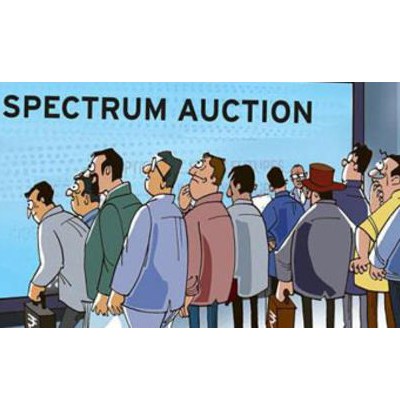
    The spectrum auction in 2100 MHz, which caters to 3G, 1800 MHz, 900 MHz, and 800 MHz band, which commenced on 4 March and ended on 25 March after 115 rounds over 19 days, has fetched over Rs 109,874 crore. However, approximately 11 – 12 per cent spectrum remained unsold.


    In all, 470.75 MHz has been put to auction in various local service areas. This compares with 390 MHz in November 2012 and 426 MHz in February 2014.


    There was robust activity in the all the spectrum bands and vibrant bidding. Prices have significantly increased in 50 of the 69 offerings with bid price being as high as 300 per cent over reserve price in some instances. Overall increases over estimated proceeds from auction is about 37 per cent.


    In November 2012, the total realization from auction of spectrum in 1800 MHz band was Rs 9407 crore and in February 2014 Rs 61,162 crore has been realized. 


    Since the Supreme Court has given the leave to proceed further, the provisional results are being declared. Of the eight participants in the auction, seven have been awarded spectrum.


    This is the first time that spectrum has been offered simultaneously in four bands. In previous auctions, different bands were auctioned sequentially. This auction design has enabled bidders to take informed decisions while placing bids and consider alternatives dynamically.


    Another noteworthy feature is that for the first time there is robust demand for 800 MHz band, which in previous auctions had seen very sluggish response.


    Some of the steps taken to enhance transparency as well as to remove barriers to participation included five MHz spectrum in 2100 MHz band released to increase availability of spectrum; in principle approval was received from Defence to release further 15 MHz in 2100 Mhz band to the telecoms sector; earnest money percentage was reduced to between 11-25 per cent, earlier in some instances it was over 40 per cent; taking into account suggestions and request from operators the ‘extension’ budget – that is the extra time allowance for bidding was increased from 240 minutes to 360 minutes.


    Orders on applicable Spectrum Usage Charges (SUC) were issued before the auction, which reduced the regulatory risk of the bidders and the modalities for liberalization of 800 MHz spectrum was notified.


    Transparent and clear rules for allocation of spectrum were notified for the first time. Earlier spectrum other than the contiguous spectrum was allotted randomly.


    The Department also took steps towards putting in place a roadmap for availability of spectrum by notifying the Defence Band and Defence Interest zone.

  • Spectrum auction ends with bid amount crossing Rs 1.09 lakh crore

    Spectrum auction ends with bid amount crossing Rs 1.09 lakh crore

     
    NEW DELHI: Around eleven per cent of the spectrum has remained unsold after the auction came to a close on 25 March with bid amounts touching a whopping Rs.109,874 crore.
     
     
    The auction lasted nineteen days with a total of 115 rounds.
     
     
    Communications and Information Technology sources told Indiantelevision.com that the entire spectrum could not be sold because of a slowdown in 2100 MHz band, which caters to 3G and a dip for 1800 MHz band. 
     
     
    The other bands up for auction were 900 MHz and 800 MHz, which saw robust action. A majority of service areas were auctioned at a premium over reserve price.
     
     
    The government had initially expected to reap around Rs 49,000 crore from the auction, though the Communications and IT Ministry sources had later predicted that it would get close to Rs 1 lakh crore.