Category: Telecom

  • Idea Cellular  to offer live TV, music services

    Idea Cellular to offer live TV, music services

    MUMBAI: It’s the charge of the telco brigade. First Airtel and Reliance Jio hared into the content space by announcing their Wynk, Wynk Video and Wynk Games and JioGames, JioCinema, JioTV, JioPlay, JioOnDemand services offering an array of video, music, game chat apps. Now it’s the turn of another telco major – the Aditya Birla group owned Idea Cellular – to do the same. In an investor presentation, the company says it is planning its own range of mobile digital services right from live television to videos to music to games to music to news/magazines to chat and even money transfers.

    First off the blocks will be Idea Game Spark (Q3 FY 2017), Idea Videos and Idea Music before the last quarter of FY 2017 (January-March 2017). Idea TV, Idea News/magazines, Idea storage and Idea chat will follow in FY 2018 (April 2017 onwards).

    In the presentation, Idea says it expects mobile data usage to sky rocket just like voice over mobile did in the growth phase of wireless telephony. About 1.1 billion Indians will get access to wireless broadband by 2019-2020 (250-300 million in March 2015), and the subscriber base of 3G/4G services is expected to rapidly swell from 130 million in March 2016 to 540 million by 2021. Idea expects data consumption per user to more than treble from the current 475 MB per month in the same period.

    In March 2016, it had 22.8 million wireless broadband subs each of whom consumed 642 MB of data per month. Idea explains that its broadband services today are available to 400 million Indians; it is targeting to expand that 500 million by March 2017. It’s on course to have nearly 100,000 data sites active in 17 circles by the end of FY-2017.

    With the launch of its digital content and other apps, mobile subscribers are likely to be spoiled for choice and competition is expected to hot up between Jio, Airtel, Vodafone and Idea. For television channels and content creators, however, it’s going to open up new worlds of opportunity.

  • Deutsche Telekom pushes LTE speed to 1.2Gbps with Huawei

    Deutsche Telekom pushes LTE speed to 1.2Gbps with Huawei

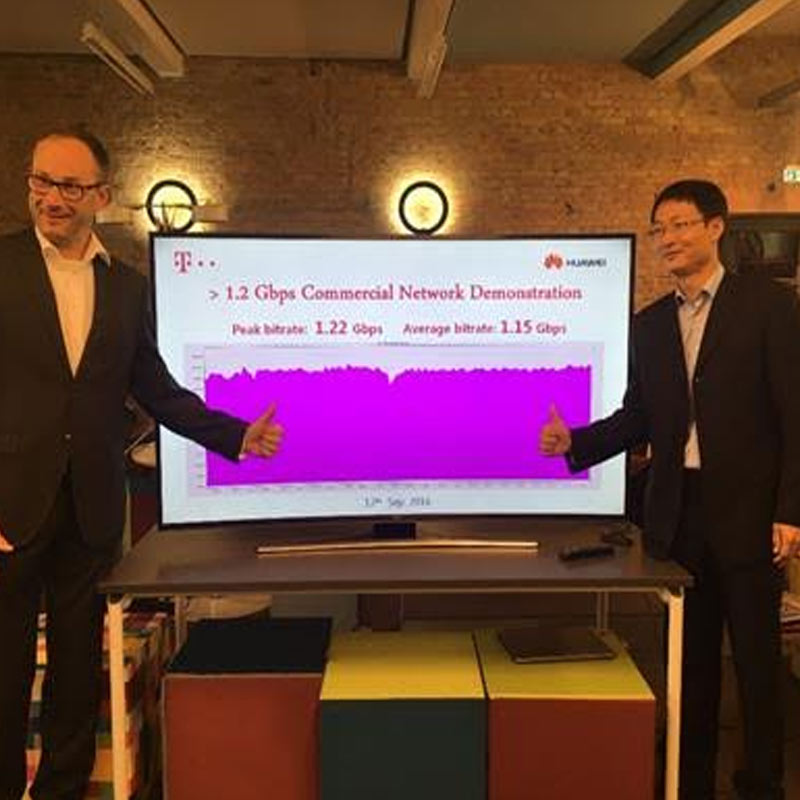
    NEW DELHI: Deutsche Telekom and Huawei have accelerated mobile data transfer in Berlin’s LTE network to more than 1.2 Gigabits per second (Gbps), achieving a technology mix of four sending and receiving channels (4×4 MIMO) and five carrier frequencies deployed live for the first time and proving LTE Advanced Pro (4.5G) gives the highest data speeds.

    Deutsche Telekom and Huawei used the latest evolutionary step of this technology – LTE Advanced Pro (4.5G) – with a conventional mobile base station which was bundled with a small cell solution; the data traffic flowed over five carrier frequencies instead of just one. This required one thing above all from both the transmitter station and the receiving devices: they have to support 4×4 MIMO (multiple input – multiple output) technology. If all these components are used, individual users can enjoy peak speeds of more than 1 Gbps. Wireless capacities in the equipped cells are also improved greatly for all users.

    The current move by Deutsche Telekom and Huawei represents the next step in a long-term innovation collaboration in the development of mobile communications technologies and the roll-out of Germany’s fastest LTE network.

    “User behavior is evolving rapidly on the way to a gigabit society.
    That’s why fast Internet access can’t be limited to just fixed lines and fiber optics – our customers also want the highest possible speeds,” said Deutsche Telekom AG Board Member for Europe and Technology Claudia Nemat.

    Huawei Deutsche Telekom executive Lin Baifeng said, “Together, we innovate for the advanced wireless technology and Huawei is happy to support Deutsche Telekom to prove the benefits of LTE Advanced Pro (4.5G), in real field application.”

  • Deutsche Telekom pushes LTE speed to 1.2Gbps with Huawei

    Deutsche Telekom pushes LTE speed to 1.2Gbps with Huawei

    NEW DELHI: Deutsche Telekom and Huawei have accelerated mobile data transfer in Berlin’s LTE network to more than 1.2 Gigabits per second (Gbps), achieving a technology mix of four sending and receiving channels (4×4 MIMO) and five carrier frequencies deployed live for the first time and proving LTE Advanced Pro (4.5G) gives the highest data speeds.

    Deutsche Telekom and Huawei used the latest evolutionary step of this technology – LTE Advanced Pro (4.5G) – with a conventional mobile base station which was bundled with a small cell solution; the data traffic flowed over five carrier frequencies instead of just one. This required one thing above all from both the transmitter station and the receiving devices: they have to support 4×4 MIMO (multiple input – multiple output) technology. If all these components are used, individual users can enjoy peak speeds of more than 1 Gbps. Wireless capacities in the equipped cells are also improved greatly for all users.

    The current move by Deutsche Telekom and Huawei represents the next step in a long-term innovation collaboration in the development of mobile communications technologies and the roll-out of Germany’s fastest LTE network.

    “User behavior is evolving rapidly on the way to a gigabit society.
    That’s why fast Internet access can’t be limited to just fixed lines and fiber optics – our customers also want the highest possible speeds,” said Deutsche Telekom AG Board Member for Europe and Technology Claudia Nemat.

    Huawei Deutsche Telekom executive Lin Baifeng said, “Together, we innovate for the advanced wireless technology and Huawei is happy to support Deutsche Telekom to prove the benefits of LTE Advanced Pro (4.5G), in real field application.”

  • Jio registers Airtel’s support, inadequate measures

    Jio registers Airtel’s support, inadequate measures

    MUMBAI: Reliance Jio, in a press release, has hailed Airtel’s decision to provide more points of interconnection but laments failing of calls between the two networks and alleged blockage of network portability.

    Reliance Jio Infocomm Limited (RJIL) has welcomed the decision of Bharti Airtel Limited (Airtel) of providing more points of interconnection (POI) to it, as was communicated in the bilateral discussions. However, the quantum of POIs proposed to be released by Airtel is substantially less than the estimated requirement.

    More than two crore calls are failing everyday between the two networks, which is far in excess of QoS parameters. It is unfortunate that TRAI’s intervention was required for Airtel to resume augmentation of POIs.

    Airtel has also insisted on certain unilateral deviations from the Interconnection Agreement with respect to installation of one-way E1s as against both-way E1s. Airtel allegedly continues to abuse its market dominance by imposing onerous conditions which will imminently hinder RJIL’s ability to efficiently utilize the additional E1s.

    Airtel has also been allegedly blocking the mobile number portability
    (“MNP”) facility for its subscribers who wish to subscribe to Jio services on baseless and unsubstantiated grounds, the release stated.

    RJIL hopes that Airtel will enhance the PoI’s sufficiently to meet its license obligation of QoS. Airtel must also immediately make available MNP to all its subscribers opting to port to RJIL.

    Reliance Jio Infocomm has built a world-class all-IP data strong future proof network with latest 4G LTE technology. It is the only network born as a Mobile Video Network from the ground up and supporting voice over LTE technology.

  • Jio registers Airtel’s support, inadequate measures

    Jio registers Airtel’s support, inadequate measures

    MUMBAI: Reliance Jio, in a press release, has hailed Airtel’s decision to provide more points of interconnection but laments failing of calls between the two networks and alleged blockage of network portability.

    Reliance Jio Infocomm Limited (RJIL) has welcomed the decision of Bharti Airtel Limited (Airtel) of providing more points of interconnection (POI) to it, as was communicated in the bilateral discussions. However, the quantum of POIs proposed to be released by Airtel is substantially less than the estimated requirement.

    More than two crore calls are failing everyday between the two networks, which is far in excess of QoS parameters. It is unfortunate that TRAI’s intervention was required for Airtel to resume augmentation of POIs.

    Airtel has also insisted on certain unilateral deviations from the Interconnection Agreement with respect to installation of one-way E1s as against both-way E1s. Airtel allegedly continues to abuse its market dominance by imposing onerous conditions which will imminently hinder RJIL’s ability to efficiently utilize the additional E1s.

    Airtel has also been allegedly blocking the mobile number portability
    (“MNP”) facility for its subscribers who wish to subscribe to Jio services on baseless and unsubstantiated grounds, the release stated.

    RJIL hopes that Airtel will enhance the PoI’s sufficiently to meet its license obligation of QoS. Airtel must also immediately make available MNP to all its subscribers opting to port to RJIL.

    Reliance Jio Infocomm has built a world-class all-IP data strong future proof network with latest 4G LTE technology. It is the only network born as a Mobile Video Network from the ground up and supporting voice over LTE technology.

  • Decongestion: Jio hails Airtel’s fair practice

    Decongestion: Jio hails Airtel’s fair practice

    MUMBAI: Reliance Jio has welcomed Airtel’s decision to provide moreB points of interconnection in line with fair business practices and Trai regulations. Bharti Airtel Limited has indicated its decision in its press statement.

    RJIL has been writing regularly to Airtel and other incumbent operators regarding its requirement for interconnection capacity over the last few months. Necessary details have been provided to Airtel from time to time, highlighting the urgency of the requirement and the impact on Quality of Service parameters. However, no action was taken over the last several weeks, resulting in non-compliance of Trai regulation on quality of service which mandates that POI congestion should not affect more than one call in every 200 calls made.

    The situation deteriorated significantly in the last few weeks, with over 75 calls failing out of every 100 call attempts. In last 10 days alone, over 22 crore calls on the Airtel network failed, while 52 crore calls failed cumulatively on the networks of the three incumbent operators viz. Airtel, Vodafone India Ltd and Idea Cellular Ltd.

    While RJIL has rolled out a state-of-the-art network, the benefits of superior voice technology have been denied to Indian customers due to the POI congestion. Indian customers have not been able to enjoy RJIL’s free voice offer as a result of such anti-competitive behaviour of incumbent operators.

    RJIL has been raising the issue of insufficient POIs as anti-competitive aimed at hindering the entry of a new operator. Such hurdles result in poor experience for RJIL customers who are trying to make calls to incumbent operators’ networks. “We have repeatedly appealed to the incumbent operators to create a fair and reciprocal framework of coopetition that is good for India and Indian customers,” RJIL stated.

    On the unsubstantiated apprehension regarding asymmetric voice traffic raised by Airtel, RJIL clarified that the voice traffic on its network is in line with industry trends and as expected for any new operator. When a new operator begins its operations, its customer base is understandably low and a large proportion of these are new numbers that are not yet in the address book with whom they communicate. Therefore, in the early days of operations of any new operator, there are more outgoing calls than incoming calls. Over time, as the customer base grows, this asymmetry reduces and the traffic becomes symmetric.

    RJIL’s outgoing traffic is less than two calls per customer per hour even during peak traffic period, which requires only a reasonable number of POIs. These calls are not to one operator but distributed over all the operators. Incumbent operators are describing such a modest call rate as a Tsunami of traffic from RJIL.

    Moreover, asymmetry of traffic has absolutely nothing to do with the number of POIs required, which is based on the total traffic in both directions and not just in one direction. The equipment required for POI are two-way trunks, which means that the same equipment is used for both directions. No additional equipment is needed for handling the calls coming from RJIL to the other operator. It is therefore in customer interest to have adequate interconnection capacity irrespective of direction of traffic.

    RJIL hoped that Airtel as well as other incumbent operators would enhance the PoIs sufficient to meet their license obligation of QoS with immediate effect and maintain these parameters on an ongoing basis.

  • Decongestion: Jio hails Airtel’s fair practice

    Decongestion: Jio hails Airtel’s fair practice

    MUMBAI: Reliance Jio has welcomed Airtel’s decision to provide moreB points of interconnection in line with fair business practices and Trai regulations. Bharti Airtel Limited has indicated its decision in its press statement.

    RJIL has been writing regularly to Airtel and other incumbent operators regarding its requirement for interconnection capacity over the last few months. Necessary details have been provided to Airtel from time to time, highlighting the urgency of the requirement and the impact on Quality of Service parameters. However, no action was taken over the last several weeks, resulting in non-compliance of Trai regulation on quality of service which mandates that POI congestion should not affect more than one call in every 200 calls made.

    The situation deteriorated significantly in the last few weeks, with over 75 calls failing out of every 100 call attempts. In last 10 days alone, over 22 crore calls on the Airtel network failed, while 52 crore calls failed cumulatively on the networks of the three incumbent operators viz. Airtel, Vodafone India Ltd and Idea Cellular Ltd.

    While RJIL has rolled out a state-of-the-art network, the benefits of superior voice technology have been denied to Indian customers due to the POI congestion. Indian customers have not been able to enjoy RJIL’s free voice offer as a result of such anti-competitive behaviour of incumbent operators.

    RJIL has been raising the issue of insufficient POIs as anti-competitive aimed at hindering the entry of a new operator. Such hurdles result in poor experience for RJIL customers who are trying to make calls to incumbent operators’ networks. “We have repeatedly appealed to the incumbent operators to create a fair and reciprocal framework of coopetition that is good for India and Indian customers,” RJIL stated.

    On the unsubstantiated apprehension regarding asymmetric voice traffic raised by Airtel, RJIL clarified that the voice traffic on its network is in line with industry trends and as expected for any new operator. When a new operator begins its operations, its customer base is understandably low and a large proportion of these are new numbers that are not yet in the address book with whom they communicate. Therefore, in the early days of operations of any new operator, there are more outgoing calls than incoming calls. Over time, as the customer base grows, this asymmetry reduces and the traffic becomes symmetric.

    RJIL’s outgoing traffic is less than two calls per customer per hour even during peak traffic period, which requires only a reasonable number of POIs. These calls are not to one operator but distributed over all the operators. Incumbent operators are describing such a modest call rate as a Tsunami of traffic from RJIL.

    Moreover, asymmetry of traffic has absolutely nothing to do with the number of POIs required, which is based on the total traffic in both directions and not just in one direction. The equipment required for POI are two-way trunks, which means that the same equipment is used for both directions. No additional equipment is needed for handling the calls coming from RJIL to the other operator. It is therefore in customer interest to have adequate interconnection capacity irrespective of direction of traffic.

    RJIL hoped that Airtel as well as other incumbent operators would enhance the PoIs sufficient to meet their license obligation of QoS with immediate effect and maintain these parameters on an ongoing basis.

  • How will Jio’s launch impact the digital ecosystem?

    How will Jio’s launch impact the digital ecosystem?

    MUMBAI: Jio’s launch last week has caused a stir in the telecommunications industry. Calls and messages on the new network are free while mobile data is 3 to 5 times cheaper compared to competitors. For Jio as a disruptor this is a reasonable strategy: Silicon Valley’s leading VC Peter Thiel has said that “[start-ups] have to be 10 times better than second best”.

    But in addition to rattling up the stock market, Jio’s strategy is likely to have a longer and beneficial impact on India’s digital ecosystem.

    Jio has thrown a glove to other mobile operators by slashing service costs for consumers. While Jio’s offering is only available to LTE customers, that is not relevant: consumers on 2G or 3G will ask their carrier, why do they need to pay 3x to 5x more for slower internet speeds? This is likely to create a pricing war between India’s mobile operators. Such price wars have been commonplace across the world, latest example being Singapore just a few months ago.

    As prices go down, more people will switch on their mobile data services for the first time. GSMA Intelligence estimates only 15% of people in India used mobile broadband in Q4 2015, while smartphone ownership would allow much higher rates already today. Cheaper data increases the share of smartphone users who use mobile data but also incentivizes feature phone owners to upgrade to a smartphone as the main benefit (online access) becomes affordable.

    It wouldn’t be an exaggeration to say that this would accelerate the progress of digital democracy or the vision of digital India by breaking the perception barrier among the bottom of the pyramid. “Data is for everybody” would be the new mantra.

    This will also spur the growth of affordable 4G devices and a multi-SIM environment; further reducing the customer loyalty towards the network. Customers will keep on switching for better price or data bandwidth.

    This in turn helps the digital ecosystem grow. While India’s own services like Ditto TV, Hooq and Gaana are already present in the market, a majority of global digital merchants do not have India in their sights yet. Beside few smartphone owners and lack of access to online payment methods, low mobile data penetration has been one of the key roadblocks.

    Globally, average Netflix users watch 133 hours of video per month which translates into roughly 133 gigabytes (GB)  of data consumed. The average Spotify user listens to 28 hours of music (34-35 GB data) per month. In Western markets a large portion of this content is consumed through landline internet, so such data volumes are not an issue. But for a mobile-first market like India, they have so far made such digital services inaccessible to a large part of the population.

    Reduced cost of data will then result in a bigger uptake of digital content services as users can consume more for less. Local providers will be able to increase their audience while international merchants like Netflix, Spotify, Apple and Amazon are going to reconsider their strategy for India in light of the changing ecosystem.

    With the challenges of mobile data considerably reduced, all other factors point to growth and make India one of the most attractive markets for global merchants.

    Another consequence of the data revolution is voice over IP services like Skype, Viber, and others will get more acceptance in the eco-system from the telecom operators; while this will create more opportunities for them we can see many home-grown companies ready to challenge their hegemonies. Obviously, for customers the more means the merrier.

    While the pricing war will create a temporary setback for carriers, in the long run everyone will benefit. Consumers get affordable internet and access to more digital content. Carriers will be able to increase user stickiness (by negotiating and offering exclusive deals and co-promotions with digital service providers) and average revenue per user (from both increased data consumption and from providing carrier billing for these services).

    (The author is the general manager of Fortumo India Mobile Payments. The views expressed are entirely his own and Indiantelevision.com does not subscribe to them)

  • How will Jio’s launch impact the digital ecosystem?

    How will Jio’s launch impact the digital ecosystem?

    MUMBAI: Jio’s launch last week has caused a stir in the telecommunications industry. Calls and messages on the new network are free while mobile data is 3 to 5 times cheaper compared to competitors. For Jio as a disruptor this is a reasonable strategy: Silicon Valley’s leading VC Peter Thiel has said that “[start-ups] have to be 10 times better than second best”.

    But in addition to rattling up the stock market, Jio’s strategy is likely to have a longer and beneficial impact on India’s digital ecosystem.

    Jio has thrown a glove to other mobile operators by slashing service costs for consumers. While Jio’s offering is only available to LTE customers, that is not relevant: consumers on 2G or 3G will ask their carrier, why do they need to pay 3x to 5x more for slower internet speeds? This is likely to create a pricing war between India’s mobile operators. Such price wars have been commonplace across the world, latest example being Singapore just a few months ago.

    As prices go down, more people will switch on their mobile data services for the first time. GSMA Intelligence estimates only 15% of people in India used mobile broadband in Q4 2015, while smartphone ownership would allow much higher rates already today. Cheaper data increases the share of smartphone users who use mobile data but also incentivizes feature phone owners to upgrade to a smartphone as the main benefit (online access) becomes affordable.

    It wouldn’t be an exaggeration to say that this would accelerate the progress of digital democracy or the vision of digital India by breaking the perception barrier among the bottom of the pyramid. “Data is for everybody” would be the new mantra.

    This will also spur the growth of affordable 4G devices and a multi-SIM environment; further reducing the customer loyalty towards the network. Customers will keep on switching for better price or data bandwidth.

    This in turn helps the digital ecosystem grow. While India’s own services like Ditto TV, Hooq and Gaana are already present in the market, a majority of global digital merchants do not have India in their sights yet. Beside few smartphone owners and lack of access to online payment methods, low mobile data penetration has been one of the key roadblocks.

    Globally, average Netflix users watch 133 hours of video per month which translates into roughly 133 gigabytes (GB)  of data consumed. The average Spotify user listens to 28 hours of music (34-35 GB data) per month. In Western markets a large portion of this content is consumed through landline internet, so such data volumes are not an issue. But for a mobile-first market like India, they have so far made such digital services inaccessible to a large part of the population.

    Reduced cost of data will then result in a bigger uptake of digital content services as users can consume more for less. Local providers will be able to increase their audience while international merchants like Netflix, Spotify, Apple and Amazon are going to reconsider their strategy for India in light of the changing ecosystem.

    With the challenges of mobile data considerably reduced, all other factors point to growth and make India one of the most attractive markets for global merchants.

    Another consequence of the data revolution is voice over IP services like Skype, Viber, and others will get more acceptance in the eco-system from the telecom operators; while this will create more opportunities for them we can see many home-grown companies ready to challenge their hegemonies. Obviously, for customers the more means the merrier.

    While the pricing war will create a temporary setback for carriers, in the long run everyone will benefit. Consumers get affordable internet and access to more digital content. Carriers will be able to increase user stickiness (by negotiating and offering exclusive deals and co-promotions with digital service providers) and average revenue per user (from both increased data consumption and from providing carrier billing for these services).

    (The author is the general manager of Fortumo India Mobile Payments. The views expressed are entirely his own and Indiantelevision.com does not subscribe to them)
  • Ambani talks about RIL’s media & entertainment empire

    Ambani talks about RIL’s media & entertainment empire

    MUMBAI: When one of India’s richest billionaires starts talking about what most consider as a small media & entertainment business, juxtaposing it against the Rs 300,000 crore he generates out of oil and gas, it’s a statement of how much it has come to mean to him.

    At the RIL AGM on 1 September chairman Mukesh Ambani outlined the scale of Reliance Industries Ltd’s (RIL’s) M&E business.

    “We own 58 channels the highest number by an Indian company and we are aggressively investing in it along with global leaders such as Viacom, CNBC, CNN Forbes, and A+E Networks,” he said with aplomb.

    11 of these channels are overseas but they are Indian and catering to the diaspora globally. Network18 contributes 21 of these in the form of news channels reaching out national and regional viewers, in 18 states and 11 languages. The entertainment and infotainment TV business it has set up in partnership with global majors such as Viacom and A+E has 26 channels.

    “Our television network reaches out to more than 500 million viewers every month, that is two out of every five Indians,” he explained. “Colors is amongst the top two channels in India, while Nick and MTV are top players in their genres.”

    He was pretty kicked up about the reach of online websites under the Network18 umbrella. “They attract over 27 million unique visitors every month which is the largest in India,” he exclaimed.

    He also spoke about the fact that online shopping and ticketing sites such as bookmyshow have got the highest traction in the country.