Category: Telecom

  • TDSAT grants permission to RCom to sell spectrum

    TDSAT grants permission to RCom to sell spectrum

    MUMBAI: Telecom Disputes Settlement and Appellate Tribunal (TDSAT) has given permission to Reliance Communications (RCom) to proceed with the sale of its spectrum. The telecom company would have to assure bank guarantees worth Rs 2900 crore as demanded by Department of Telecommunications (DoT).
    In its media release, the telecom company confirmed that it will be able to pay the Swedish multinational networking and telecommunications company Ericcsson its Rs 550 crore and the minority investors of Reliance Infratel (RITL) about Rs 230 crore, as agreed by the lenders.

    The official release stated, “Reliance Communications Ltd has been granted relief by the Telecom Disputes Settlement & Appellate Tribunal vide its Interim Order dated 1 October 2018, whereby TDSAT has stayed the demand of Bank Guarantee of Rs 2,900 Crore by the Department of Telecommunications”.
    “38 secured lenders of RCOM Group have already approved the sale of the above spectrum, and the proceeds thereof will be used for making payments to Ericsson India Private Ltd and to RITL Minority Investors, as per settlement terms,” continued the release.
    RCom even criticised the DoT for creating obstructions in the proceedings of the spectrum sale.

  • Bharti Airtel acquires AI start-up AuthMe

    Bharti Airtel acquires AI start-up AuthMe

    MUMBAI: Indian global telecommunications services company, Bharti Airtel, confirmed on Wednesday that it had acquired AuthMe ID Services. AuthMe is a Bengaluru based start-up company concentrating on Artificial Intelligence (AI).
    Bharti Airtel global CIO Harmeen Mehta said, “We are thrilled to bring on board a bunch of highly talented people who share our passion for building exciting digital solutions that benefit our customers”.
    The core team of the Bengaluru based start-up company will join the telecom chief as part of the ‘acquihire’ deal. The employees of AuthMe will become a part of Airtel X labs in Bengaluru. The negotiation amount has not been disclosed yet.

    Mehta looked full of promises as he said, “We are rapidly scaling up Airtel X Labs, our digital innovation factory, and these new solutions will accelerate our journey towards rolling out intuitive digital products, particularly in vernacular languages, for our 430 million plus customers.”
    With this, Airtel has also obtained the intellectual property rights for two flagship solutions Callup AI and Fintech OCR. Callup AI is a chat and voice assistant which uses AI to solve consumer queries through email, chat and phone calls. Fintech OCR is an overall Optical Character Recognition (OCR) pipeline built for financial documents. It is designed for handling KYC documents, bank/credit card/loan statements, mark sheets. It can also understand any language with standard fonts.

  • BSNL to launch 4G in Telangana; may partner Netflix

    BSNL to launch 4G in Telangana; may partner Netflix

    MUMBAI: According to an Economic Times report, BSNL Telangana Telecom Circle Chief General manager V Sundar informed that a project for 4G testing purposes in Telangana has been initiated. The project would be launched in Jadcherla town of Mahabubnagar district and Wyra town in Khammam district in November.

    BSNL is expecting to extend its 4G services all throughout the state by March 2019 after rolling out its services in these two districts of Telangana next month, stated a senior official.

    Even V Sundar confirmed the plans of expanding the company’s services by saying, “By March 2019, we expect to have 8-9 lakh new 4G customers.”

    Sundar also said that the state owned telecom is working to join hands with video service provider Netflix.

    With that, Sundar also briefed about the special tariff vouchers and offers that would be made available as part of its 18th foundation day and a partnership with Amazon for free Amazon Prime Video subscription for BSNL users.

  • Facebook to provide more video ad options for advertisers

    Facebook to provide more video ad options for advertisers

    For advertisers, social media giant Facebook has decided to come up with some more advertising options.
    Through a blog post, Facebook stated how they will now allow companies to advertise on premium video content through the In-Stream Reserve program.
    As per Facebook, the selected-content includes “the most engaging, highest quality publishers and creators”. This content will be shown to specific target groups verified by global information and measurement company Nielsen.

    Facebook explained how the In-Stream Reserve is a great option for premium online video and TV buyers, particularly those targeting younger, compact demographics and irregular TV viewers.
    As per Facebook, the in-stream video ads are fully watched 70 per cent of the time. The In-stream reserve categories allow an advertiser to select which topics they want their ads to run on, including sports, fashion/beauty and entertainment.
    The social media company will also let the advertisers to advertise on specific shows or for an exclusive advertiser for a single show. “These types of ads are being tested on,” said Facebook.
    “The ThruPlay program will only charge advertisers if their ad is watched to the end, or viewed for at least 15 seconds,” Facebook added.

  • Lack of uniform policy framework hampering 5G growth in India: Deloitte-CII report

    Lack of uniform policy framework hampering 5G growth in India: Deloitte-CII report

    MUMBAI: A Deloitte-CII report said that the growth of 5G connectivity in India lacks uniform policy framework and will stand as a challenge towards cellular mobile communications.
    “The current regulatory framework for deploying network infrastructure has always been one of the most contentious issues in the industry,” the report said. It also mentioned how the industry is also “crippling under margin pressure”.
    The report expressed “Right of Way” (RoW) and lack of a uniform policy framework as a huge barricade and obstacle to come over to for a positive 5G growth in India.
    Even though, in the year 2016, new RoW rules and methodised processes were introduced, the published report says, “Roadblocks have hampered implementation of the new rules”.
    The report also said how the government has released the National Digital Communication Policy (NDCP) after analysing and looking at the benefits of 5G connectivity. The Union Cabinet had approved the NDCP 2018 on 26 September with the goal to provide “broadband to all”.
    Replacing the National Telecom Policy 2012, NDCP targets to initiate a “comprehensive data protection regime for digital communications that safeguards the privacy, autonomy and choice of individuals and ensure India’s “digital sovereignty”.
    Related to investments on 5G connectivity, the Deloitte-CII report said, “While the investment for 5G would grow incrementally as advancements on existing 4G/LTE technology, with 5G spectrum and network densification needs, it is anticipated that industry might require an additional investment of $60-$70 billion to seamlessly implement 5G networks.”

  • Telcos may skip 5G spectrum auction due to high prices: Fitch Ratings

    Telcos may skip 5G spectrum auction due to high prices: Fitch Ratings

    MUMBAI: Credit rating agency, Fitch Ratings, stated that India’s new National Digital Communication Policy (NDCP) could manage to benefit the telecom sector by making it easier to meet continuous rising data demand and focusing on tax and fee duty on the manufactory.
    5G spectrum auctions could be skipped by the Indian telcos if prices are too high. The Indian telecommunication companies are likely to raise investment in 5G spectrum which directly depends on the 5G spectrum principal price. This can overextend the liabilities on balance sheets of these companies.
    Furthermore, Fitch also explained how private telcos are going to benefit and enlarge their broadband coverage funded by the universal service obligation fund.
    By initiating and creating two million Wi-Fi hotspots in rural areas and another one million in urban areas, the NDCP plans on connecting almost more than 600,000 villages to the digital network. Although, according to Fitch, there are going to be a few execution challenges but it will only lead to broadband adoption rate increasing and going higher.
    The research report also stated that telco costs and red tape could be cut by the NDCP’s plans to review and rationalise the sector’s tax structure and optimise future spectrum asset pricing.
    A Fitch statement read, “Indian telcos face heavy and multiple taxes – including licence fees, spectrum usage charges, and universal service fees on top of expensive spectrum assets. Meanwhile, intense competition has limited telcos’ pricing power. Overall, these pressures have stretched balance sheets”.

  • Modi says telcos must provide high level of consumer satisfaction

    Modi says telcos must provide high level of consumer satisfaction

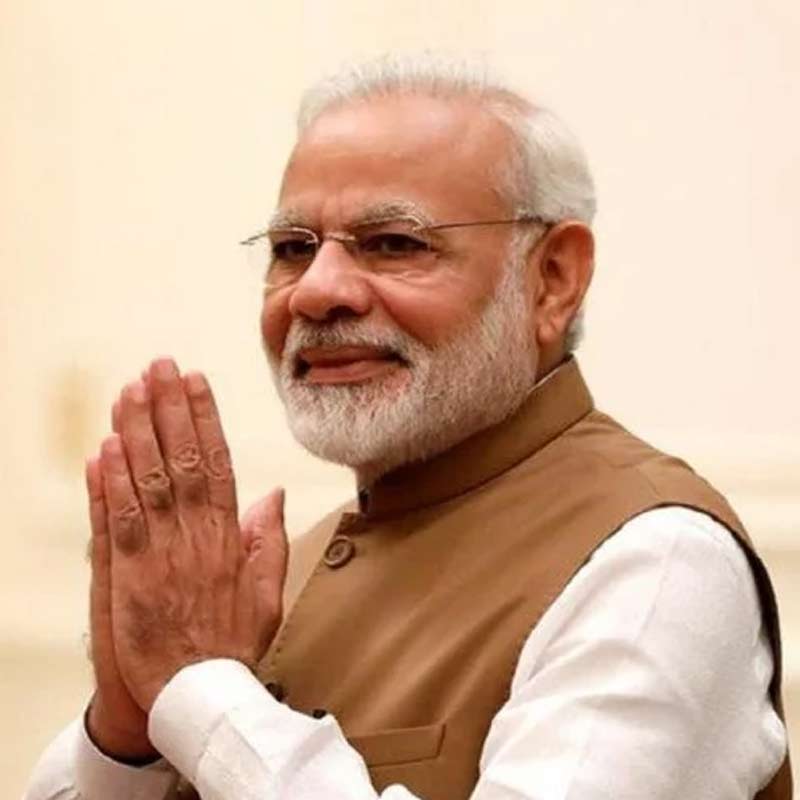
    UMBAI: Prime minister Narendra Modi said that telecom service providers must provide a high level of consumer satisfaction and their resolutions should be based on the latest technological solutions. Modi said this while presiding over the 29th meeting of ‘Pragati’ — the ICT-based, multi-modal platform for proactive governance and timely implementation.
    A statement from the PMO quoted Modi as saying, “The Prime Minister said that resolution of issues related to the telecom sector should be based on latest technological solutions. He emphasised that service providers must provide a high level of consumer satisfaction.”
    According to the reports, Modi reviewed the progress of eight important infrastructure projects in the railway, urban development, road, and power and coal sectors. These projects are spread over several states including Uttar Pradesh, Jammu and Kashmir, Haryana, Gujarat, Maharashtra, Karnataka, Jharkhand, Odisha and West Bengal
    Reviewing the Pradhan Mantri Khanij Kshetra Kalyan Yojana, Modi noted that “significant resources are now available to several mineral bearing districts” and directed the officials to utilise the funds in a way that they bring “ease of living” to the people of these districts.

  • COAI to review implications of SC judgement on Aadhar linkage with sim

    COAI to review implications of SC judgement on Aadhar linkage with sim

    MUMBAI: On Wednesday, the five judge bench of Supreme Court struck down Section 57 of the Aadhaar Act while upholding the constitutional validity of the scheme. It has led to a big no to compulsory linkage of mobile phone numbers to the unique identification number. In response to the verdict, Cellular Operators’ Association of India (COAI) Wednesday said it will examine and assess implications of the Supreme Court judgement.
    Section 57 of Aadhaar act permitted private entities like telecom companies and banks to use Aadhaar data.
    “We respect the Aadhaar verdict of the Supreme Court, the apex court of India. We are going to review the judgement and its implications. We shall await further orders and instructions from Department of Telecom,” COAI director general Rajan S Mathews said in a statement. He also added COAI member operators as will definitely comply with the law.
    Justice Chandrachud while reading out the judgement said linking Aadhaar with mobile poses threat to autonomy, dignity and privacy. He added though the aim might be legitimate but the means to achieve that aim cannot be lopsided. He also directed the telecom service providers to delete the data they had collected from users.
    As per an Economic Times report, a BSNL official said removing consumer data, if required, won’t be a huge problem as it is largely a software driven function. However, individual telco operators are awaiting a communication from the Department of Telecommunications (DoT).

  • Cabinet approves new telecom policy

    Cabinet approves new telecom policy

    MUMBAI: New telecom policy branded as the National Digital Communications Policy (http://www.indiantelevision.com/iworld/telecom/new-telecom-policy-may-go-to-cabinet-in-2-weeks-dots-sundararajan-180905) (NDCP) 2018 finally got an approval from the cabinet. The new policy aims to attract USD 100 billion in investment and create 40 lakh jobs in the sector by 2022, PTI reported.

    Providing broadband access to all, creating 40 lakh new jobs, and increasing India’s ranking in the global ICT Index to 50th spot- these are some of the key objectives of NDCP 2018.
    “We also expect GDP contribution of the telecom sector, which has been around six per cent, to grow to 8 per cent… and expect USD 100 billion investment to come in,” communication minister Manoj Sinha said.
    As communication systems have been going through rapid change globally in areas like 5G, Internet of Things and Machine to Machine Communication, Sinha said a “consumer-centric and application-driven policy” was needed to be brought in.
    The new policy(http://www.indiantelevision.com/iworld/telecom/comment-indias-ntp-2018-gets-digital-makeover-but-needs-complimentary-policies-180508) is focused on increasing high-speed broadband penetration, with use of modern technologies like 5G and optical fibres across the country at affordable rates.

  • FDI in telecom jumped 5X in 3 years

    FDI in telecom jumped 5X in 3 years

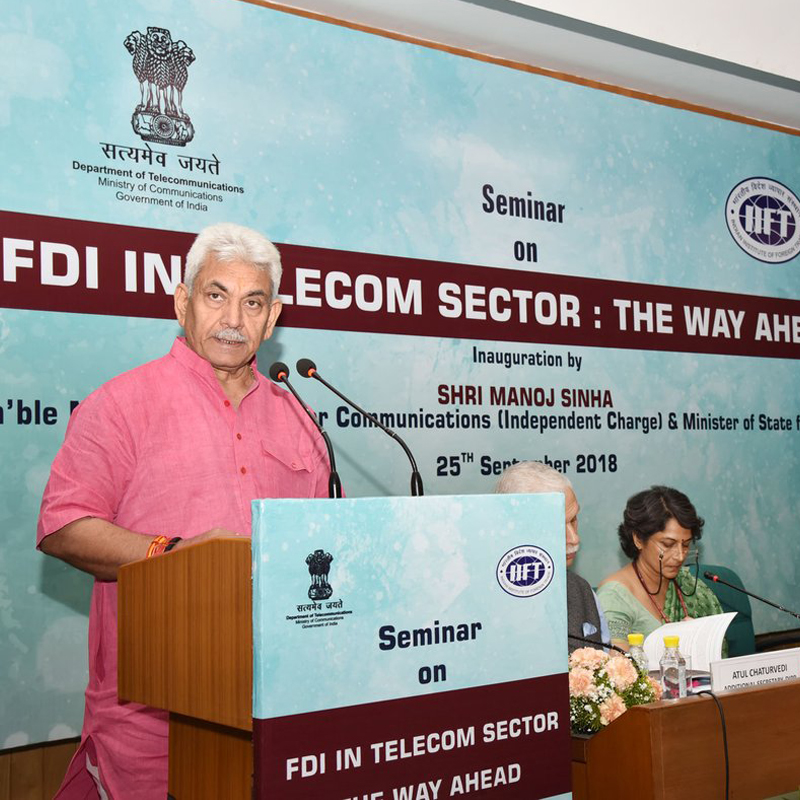
    MUMBAI: During the last three years, the Indian telecom sector has not only witnessed major disruptions but also nearly five times jump in foreign direct investment (FDI). While the amount of investment stood at $ 1.3 billion in 2015-16, it reached $ 6.2 billion in 2017-18, Communications minister Manoj Sinha said. The government is also looking at the funding of $100 billion for the draft National Digital Telecommunications Policy.
    “India needs massive investment in developing newer technologies which are accessible and affordable to the people and at the same time creates productive employment. For India to utilise its demographic dividend it is absolutely necessary to create semi-skilled jobs in short run, and the telecom sector will play an important role in creating those employment opportunities,” he added.
    The sector has also seen a few mergers, acquisitions in the same period. Highlighting that, Sinha said consolidation in the sector will strengthen it. He also calls international investors and telecom players to take part in the growth of the sector as Indian economy is back on the growth trajectory.
    He also added India already announced plans to launch commercial 5G networks by the year 2020. The 5G rollout will leave big opportunities for investing in the newer emerging technologies like AI, IoT, data analytics.
    Telecom secretary Aruna Sundararajan was also present at the occasion. She emphasised the fact that foreign investment is necessary to secure scientific, technical and industrial knowledge. The expert pointed out that the telecom sector has always been one of the core sectors attracting highest FDI inflows and overall this trend has been positive for the past two decades.
    “National Digital Communications Policy, 2018, will be the new platform for convergence of all the stakeholders, where we will be working with growth-oriented investment perspective, rather than with fiscal perspective alone,” she added.