Category: Telecom

  • ARPU target 200; Indian mobile subscribers trudge along at Rs 94.87

    ARPU target 200; Indian mobile subscribers trudge along at Rs 94.87

    Mumbai: Indian mobile subscribers consumed 11.76 Gb of data on average per month and generated an average revenue per user (ARPU) of Rs 94.87 at the end of December 2020, according to Telecom Regulatory Authority of India (TRAI).

    At a press conference earlier this month, Bharti Airtel chairman Sunil Mittal stressed the importance of hiking tariffs and bringing ARPUs to at least Rs 200 by the end of the financial year 2022, for the sustainable growth of the sector.

    ARPU per month has increased from Rs 74.88 in the year 2019 to Rs 94.87 in 2020 and minutes of usage has increased from 701 minutes to 759 minutes in the same period. ARPU for post-paid service customers decreased from Rs 259.02 to Rs 226.83 while for prepaid service customers, it increased from Rs 66.48 to Rs 88.37. The total gross revenue of the telecom sector has increased from Rs 2,43,702 crore to Rs 2,74,208 crore.

    Notably, revenues from data usage and calls have almost doubled. Revenue from data usage has increased from Rs 42.37 to Rs 81.81 whereas revenue from calls has grown from Rs 8.12 to Rs 17.72. Rental revenue has sharply declined from Rs 31.07 to Rs 0.95, as per TRAI.

    Mobile data usage has grown by 35.6 per cent year-on-year (YoY). The total revenue from wireless data usage increased from Rs 59,334 crore to Rs 113,156 crore with a yearly growth rate of 90.71 per cent. The ARPUs for wireless data usage alone increased from Rs 76.59 to Rs 128.61.

    Airtel reported ARPUs of Rs 121 at the end of December 2020 as per the company’s annual report. In their recent quarterly earnings report, the company disclosed that ARPUs had increased to Rs 146. On the other hand, Reliance Jio and Vodafone Idea reported ARPUs of Rs 138 and Rs 104, at the end of the fourth quarter for FY 2021.

    India’s ARPUs are the lowest in the world at $1.8 whereas countries like Brazil, China, EU and the US ARPUs stand at $4.6, $6.7, $12.1, and $37.8, respectively. Indian mobile customers consume more Gb of data than any of these countries (GSMA Intelligence Database, Sept 2020). While consumers get more benefits and value from unlimited voice and daily data allowances, compared to five years ago, India’s ARPUs are actually lower in comparison to historic trends.

    The ARPU erosion is due to telecom operators aggressively defending their subscriber base by selling heavily discounted voice plans with bundled data despite tremendous growth in the volume of voice and data usage in the last few years. There has been an industry-wide call to hike the floor prices which prevents telcos from undercutting each other across various services.

    Recently, the telecom players Jio, Airtel and Vodafone Idea took some solace as the government announced relief measures for the sector including a moratorium of four years on interest rates related to payment of AGR dues. It also announced 100 per cent foreign direct investment (FDI) in the sector and made it easier to get clearance for tower installation.

    India’s wireless internet subscribers grew by 10.52 per cent YoY and wired internet subscribers grew by 14.07 per cent. The number of wireless internet subscribers grew from 696.36 million to 769.64 million, where wired internet subscribers grew from 22.39 million to 25.54 million in December 2020.

    The total number of internet subscribers grew to 795.18 million, with Reliance Jio, Bharti Airtel, Vodafone Idea and BSNL having 51.6 per cent, 25.5 per cent, 17.3 per cent and 4.1 per cent of the market share, respectively.


  • Airtel unveils new prepaid plans bundled with Disney+ Hotstar benefits

    Airtel unveils new prepaid plans bundled with Disney+ Hotstar benefits

    Mumbai: Telecom major Bharti Airtel Ltd (Airtel) has unveiled its new prepaid mobile plans that come with high-speed data, unlimited calling, daily SMS benefits as well as one-year free access to streaming platform Disney+ Hotstar.

    “With Disney+ Hotstar subscription, users will get access to live coverage of major global sporting events, including the upcoming Indian Premier League (IPL) and T20 World Cup, exclusive specials series, film releases, and others,” said the telecom operator announcing the plans on Thursday.

    Airtel’s first new prepaid recharge plan starts at Rs 499 and offers 28 days validity along with unlimited calls to any network in India. Additionally, it offers 100 SMS per day along with three GB of data per day and one year mobile-only Disney+ Hotstar subscription, Apollo 24/7 Circle three months membership and free courses from Shaw Academy.

    Another new prepaid recharge plan of Rs 699 offers two GB per day data along with unlimited calls and 100 SMS per day with a validity period of 56 days. It also provides mobile-only Disney+ Hotstar subscription for a year, Apollo 24/7 Circle three months membership and free courses from Shaw Academy.

    The third new recharge plan is worth Rs 2798 which offers two GB per day data along with unlimited calls and 100 SMS per day for a validity period of 365 days. The plan also includes the same benefits as the Rs 699 prepaid plan.

    Airtel mentioned that all its postpaid plans of Rs 499 and above also offer one year of free mobile-only Disney+ Hotstar subscription.

    The company further said all the Airtel Xstream Fiber plans above Rs 999 contain a year of free Disney+ Hotstar ‘super’ subscription. Currently, Airtel’s Xstream Fiber has broadband plans with up to one Gbps speed, unlimited data, unlimited calling benefits.

    Moreover, all Airtel users also have the added benefit of directly purchasing the Disney+Hotstar subscription of their choice directly from Airtel shop with the convenience of either getting it added to their monthly postpaid bill or upfront payment via multiple payment modes, said the telecom company.

  • JioPhone Next rollout to commence before Diwali

    JioPhone Next rollout to commence before Diwali

    Mumbai: The launch of the much-awaited affordable smartphone, JioPhone Next being jointly designed by Jio and Google is in advanced trials and will commence before Diwali, the company announced on Friday.

    Jio said they have made considerable progress towards launching the made-for-India smartphone. The first-of-its-kind device features an optimised operating system based on Android and Play Store.

    “Both companies have begun testing JioPhone Next with a limited set of users for further refinement and are actively working to make it available more widely in time for the Diwali festive season. This additional time will also help mitigate the current industry-wide, global semiconductor shortages,” it said.

    The device and the operating system aims to offer “premium capabilities” that have until now been associated with more powerful smartphones, including voice-first features that enable people to consume content and navigate the phone in their own language, deliver a great camera experience and get the latest Android feature and security updates said the company.

    According to the company, the phone is also built with exciting features like the Google Assistant, automatic read-aloud and language translation for any on-screen text, a smart camera with India-centric filters and much more. “The companies remain committed to their vision of opening up new possibilities for millions of Indians, especially those who will experience the internet for the very first time,” it said in a media statement.

  • TSPs accountable for discriminatory MNP specific tariff offers: TRAI

    TSPs accountable for discriminatory MNP specific tariff offers: TRAI

    Mumbai: The Telecom Regulatory Authority of India (TRAI) has received complaints lodged by telecom service providers (TSPs) that rival TSPs are offering discriminatory tariff benefits to customers who want to switch telcos via mobile number portability (MNP).

    As per the Telecommunication Tariff Order (TTO), 1999, clause 10 on non-discrimination: No service provider shall, in any manner, discriminate between subscribers of the same class and such classification of the subscribers shall not be arbitrary.

    Provided that every classification between subscribers shall be based on intelligible eligibility criteria where such criteria shall have a rational nexus to the purpose of the said classification, it added.

    In 2011 letter, TRAI had clarified that: “The offering of differential tariffs to the subscribers porting from the network of other service provider is not valid and reasonable classification as the motive behind such classification is apparently to induce churn from the competitors’ network and which is discriminatory and contravenes the provisions of clause 10 of TTO, 1999.”

    “While TSPs have generally denied allegations of discriminatory MNP-specific tariff offers, in some cases, they have stated that their channel partners may have given some MNP specific benefits to the customers on their own without the consent and authorization of TSP”.

    Channel partners such as distributors, retailers and third-party apps are non-licensed entities that are appointed by TSPs for the purpose of offering telecom services. However, it remains the responsibility of the TSPs to adhere to regulatory provisions and guidelines with respect to tariff offerings.

    Considering all aspects and with the objective to ensure transparency, uniformity, and protection to its subscribers, TRAI has directed telecom services to ensure:

    1.     Only the tariffs reported to TRAI are offered through their channel partners, distributors, third-party apps etc.

    2.     All tariff orders comply with extant TRAI regulations/directions/orders issued in this regard as, where the TSPs name/brand is used for marketing/offering/selling products and services, the responsibility of ensuring compliance of TRAI’s regulatory guidelines/provisions shall remain with TSP.

    At the end of June, TRAI reported that telcos Reliance Jio and Bharti Airtel had added 5.4 million and 3.8 million mobile subscribers whereas Vodafone Idea has lost 4.2 million mobile subscribers.

  • TRAI releases recommendations to promote broadband connectivity

    TRAI releases recommendations to promote broadband connectivity

    Mumbai: The Telecom Regulatory Authority of India (TRAI) has released its recommendations on ‘Roadmap to Promote Broadband Connectivity and Enhanced Broadband Speed’.

    The Department of Telecommunications (DoT) as per the objectives of the National Digital Communications Policy 2018 sought recommendations of TRAI on issues relating to broadband speed and its categorisations, infrastructure creation, and promoting broadband connectivity.

    TRAI issued a consultation paper on 20 August seeking comments and counter comments from stakeholders. The DoT vide another reference letter dated 12 March sought consolidated and updated recommendations on the proliferation of fixed-line broadband services in the country. This included reference to additional issues relating to licence fee exemption and direct benefit to consumers. A supplementary consultation paper was issued on 19 May followed by an open house discussion.

    Based on inputs received by stakeholders and its own analysis, TRAI has finalised its recommendation shared below.

    1. Definition of broadband has been reviewed and the minimum download speed for broadband connectivity revised upward from the present 512 Kbps to 2 Mbps. Based on download speed, fixed broadband has been categorised into three different categories – basic, fast, and super-fast.

    2. To encourage lakhs of cable operators to provide broadband services, TRAI’s past recommendation on ‘Definition of Revenue Base (AGR) for the Reckoning of Licence Fee and Spectrum Usage Charges’ has been reiterated.

    3. To enhance mobile broadband speed in rural and remote areas by fiberisation of the cellular networks, backhaul connectivity on optical fiber using the BharatNet network with Service Level Agreements (SLA) should be made available to service providers.

    4. To incentivise investment in the last-mile linkage for fixed-line broadband, notify a skill development plan and an interest subvention scheme for cable operators registered as micro and small size companies.

    5. To enhance mobile broadband speed, the radio spectrum used for backhauling connectivity of cellular networks should be assigned to service providers on-demand and in a time-bound manner.

    6. Creation of national portal for RoW permissions to facilitate the expeditious rollout of telecom and other essential utilities infrastructure.

    7. Incentivise establishment of common ducts and posts for fiberisation of networks. In line with BharatNet Project, exempt RoW charges for the next five years of expeditious laying of common ducts and posts.

    8. A centrally sponsored scheme (CSS) to incentivise states/UTs for RoW reforms. Incentives to be linked to the net improvement in the Broadband Readiness Index (BRI) score of a state/UT.

    9. Mandates co-deployment of common ducts during the construction of any roadway, railway, and water and gas pipelines receiving public funding.

    10. To facilitate the sharing of passive infrastructure such as ducts, optical fibers, posts, etc., all the passive infrastructure available in the country should be mapped by each service provider and infrastructure provider using a Geographic Information System (GIS). The Telecom Engineering Center (TEC) should notify the standards for this purpose. Establishment of e-marketplace on a common GIS platform to facilitate leasing and trading of passive infrastructure.  

  • Mobile customer ARPUs to cross Rs 200 by end of the year: Sunil Mittal

    Mobile customer ARPUs to cross Rs 200 by end of the year: Sunil Mittal

    Mumbai: The board of Bharti Airtel on Sunday announced that it would raise Rs 21,000 crore through the issuance of equity shares available on a rights basis to eligible shareholders of the company. “This is the need of the hour for the company to accelerate from business as usual and capture a once-in-a-lifetime opportunity,” noted Bharti Airtel, chairman, Sunil Mittal.

    Mittal acknowledged that the company is loaded with extraordinary debt both from AGR and spectrum dues and they are raising capital not just to pay off the dues but also invest more in building 5G capability, gain market share in mobile services, grow FTTH business and expand data centre business. “In two-three years you will see Airtel become much more comfortable with the debt on its balance sheet,” he remarked.

    Mobile network expansion

    The company will continue to continue to upgrade spectrum which is the lifeline of the telecom industry and requires heavy capital commitment, said Mittal. The existing spectrum licenses need to be renewed in 2023 but their cost is marginal, he noted.

    “15 per cent of devices in India are 5G enabled and price points for 5G devices are coming down,”  he observed, adding that “The government should ensure that pricing of spectrum remains attractive so that the benefits can be passed down to the customer who may enjoy a robust 5G ecosystem.”

    According to Mittal the CapEx required to expand 4G capacity and upgrade existing capacity to 5G would not be very big. “We are largely done with our 4G capacity and only add extra capacity in high connectivity areas to cater to the surge in traffic. 5G capacities are huge and modular and upgrading to 5G in areas where there is higher traffic will be ideal,” he stated. 

    Sustainability in telco business

    While Airtel is positioned to capture the growth in the next two to three years, Mittal advocated that the economic model of the telecom business in the country needs to change and become viable for sustainable growth. 

    “We expect the government to respond with a lighter touch,” he said, noting that out of Rs 100 in revenues Rs 35 goes to the government in the form of levies.

    He said, “Indians are consuming 16 Gb of data on average per user every month and having an appropriate and decent return on capital is vital to the sustainability of the industry. We don’t see data consumption increasing exponentially from 16 Gb which is already a global record.”

    The company’s ARPUs stands at Rs 146 as reported in the last quarter results and “we need to quickly get it to Rs 200 and Rs 300 eventually,” he said.

    “At Rs 100, customers would be able to be on the network and be able to do a small amount of snacking, whereas at Rs 600-800 customers would be able to enjoy all benefits of data under the sun and it still would be the lowest tariffs in the world!” he said.

    In September 2016, when Reliance Jio was launched, the entire telco industry’s ARPUs dropped below Rs 100. “The industry has reached Rs 150 and soon is expected to cross the Rs 200 mark by the end of the year,” he noted.

    Broadband network expansion

    Regarding the growth of FTTH business, he said “millions of new homes and offices are enabled with FTTH broadband services and we have seen a lot of momentum in the last 12 months. Our last quarter results showed that the number of fixed broadband connections are rising exponentially.”

    The company’s home business segment added ~285,000 new customers during the last quarter to reach a 3.35 million customer base. Other than BSNL, Airtel has been in a rising position when it comes to broadband connectivity. Mittal said that CapEx allocation will be towards backhauling existing capacities and rolling out more fibre.

    Data centre business

    Regarding the data centre business, he said, “We have the right to win in this business as we know how to build data centres and have the domain expertise to run them efficiently. We have a significantly higher chance at success in this space than pureplay real estate players.”

    Nxtra Data Ltd, a wholly-owned subsidiary of Bharti Airtel is engaged in the data centre business and runs 10 large data centres and 120 edge data centres. Nxtra is building multiple large data centres across the country in Pune, Chennai, Mumbai and Kolkata to capture the significant growth opportunities in India. In July 2020, Carlyle announced that it would acquire a 25 per cent stake in Airtel’s data centre business at a valuation of $1.2 billion.

    DTH business

    Speaking about buying back its 20 per cent stake in Bharti Telemedia (D2H business) from Warburg Pincus, he said, “As we get wiser in hindsight, we realised that all our customer-facing businesses need to be in complete control of the mothership company Bharti Airtel. While infrastructure businesses like fibre and tower are different, all our go-to-market businesses need to be aligned as one. That’s why we’ve had tremendous success in the rollout of Airtel Black.”

    Digital business

    “It is difficult for companies from traditional backgrounds, even technology companies like ours to pick up on the digital momentum. It has taken Airtel four to five years to get to a point where we have got the right to call ourselves a digital company,” said Mittal. “In the coming quarters, we will talk a lot more about digital and our revenues coming from digital will also be fairly impressive.”

  • Jio, Airtel add millions of mobile subscribers in June: TRAI

    Jio, Airtel add millions of mobile subscribers in June: TRAI

    Mumbai: Reliance Jio and Bharti Airtel (including Tata Teleservices) added 5.4 million and 3.8 million mobile subscribers whereas Vodafone Idea lost 4.2 million subscribers, according to the latest subscription data shared by the Telecom Regulatory Authority of India (TRAI). Reliance Communications added 917 subscribers growing its subscriber base by 10 per cent, it showed.

    Total wireless subscribers increased from 1176.84 million to 1180.83 million at a monthly growth rate of 0.34 per cent. The number of active wireless subscribers stood at 984.79 million. Bharti Airtel had the maximum proportion of active subscribers at 343.71 million. Jio had 340.34 million and Vodafone Idea had 241.71 million active subscribers. Excluding Himachal Pradesh and Karnataka, all service areas showed growth in wireless subscribers for the period.

    The number of telephone subscribers increased from 1198.50 million to 1202.57 million. Urban telephone subscriptions increased from 661.18 million to 666.10 million. However, rural telephone subscriptions decreased from 537.52 million to 536.47 million. The overall teledensity increased from 87.84 per cent to 88.07 per cent. The wireless teledensity increased from 86.25 per cent to 86.48 per cent, the data showed.

    As per reports received from 440 operators in the month of June, the number of broadband subscribers increased from 780.27 million to 792.78 million. The top five service providers constituted 98.77 per cent market share of the total broadband subscribers. These service providers were Reliance Jio (439.91 million), Bharti Airtel (197.14 million), Vodafone Idea (121.42 million), BSNL (22.69 million), and Atria Convergence (1.91 million).

    The top five wired broadband service providers were BSNL (6.03 million), Bharti Airtel (3.37 million), Reliance Jio Infocomm (3.22 million), Atria Convergence Technologies (1.91 million), and Hathway Cable & Datacom (1.06 million).

    The top five wireless broadband subscribers were Reliance Jio Infocomm (436.69 million), Bharti Airtel (193.74 million), Vodafone Idea (121.41 million), BSNL (16.67 million), and Tikona Infinet (0.31 million).

    Wireline subscribers increased from 20.36 million to 21.66 million. The overall wireline teledensity increased from 1.49 per cent to 1.59 per cent. BSNL and MTNL held 48.72 per cent of the wireline market. BSNL added 1.1 million new wireline subscribers whereas Reliance Jio 0.1 million new wireline subscribers at the end of June.  

  • Vodafone Idea loses 12.3 million subscribers in Q1 FY22

    Vodafone Idea loses 12.3 million subscribers in Q1 FY22

    Mumbai: Vodafone Idea Ltd (VIL) revenue has been declined by 4.7 per cent quarter on quarter (QoQ) to Rs 91.5 billion at the end of the first quarter FY22. EBITDA for the quarter was Rs 37.1 billion, with EBITDA margins at 40.5 per cent vs 45.9 per cent in Q4 FY21. The CapEx spend for the quarter was Rs 9.4 billion vs Rs 15.4 billion in the previous quarter.

    The telecom company reported total gross debt (excluding lease liabilities and including interest accrued but not due) of Rs 1915.9 billion, as of 30 June. This includes deferred spectrum payment obligations of Rs 1060.1 billion and AGR liability of Rs 621.8 billion that are due to the government and debt from banks and financial institutions of Rs 234 billion. Cash and cash equivalents were Rs 9.2 billion and net debt stood at Rs 1906.7 billion.

    The company said its broadband site count stood at 447,114, lower compared to 452,650 in Q4 FY21 as it continues to actively shut down 3G sites. “Our 4G network covers over one billion Indians as of 30 June,” it added.

    The subscriber base has declined by 12.3 million and stands at 255.4 in this quarter vs 267.8 million in the previous quarter. The telco’s 4G base declined to 112.9 million vs 113.9 million in the previous quarter. The subscriber churn was 3.5 per cent in Q1 FY22 vs 3.0 in Q4 FY21. ARPU declined to Rs 104 vs Rs 107 in the previous quarter. The data volumes witnessed strong growth of 13.2 per cent quarter on quarter. Data usage per broadband subscriber surged to 14.6 GB/month vs 12.8 GB/month in the previous quarter.

    “The severe second wave of COVID-19 caused significant disruptions and slowdown in economic activities,” said VIL managing director and chief executive officer, Ravinder Takkar. “During these challenging times, VIL continued to serve its customers and community at large by providing seamless connectivity as well as maintaining superior quality of services.”

    “Vi GIGAnet’s superior network experience on both data and voice, is testified through top rankings in independent external reports. We continue to focus on executing our strategy to keep our customers ahead, and our cost optimisation plan remains on track to deliver the targeted savings. We are in active discussion with potential investors for fundraising, to achieve our strategic intent,” Takkar added.

  • Kumar Mangalam Birla steps down as non-executive chairman of Voda Idea

    Kumar Mangalam Birla steps down as non-executive chairman of Voda Idea

    Mumbai: Kumar Mangalam Birla has stepped down as non-executive director and non-executive chairman of Vodafone Idea, the company said on Wednesday.

    “The board of directors of Vodafone Idea, at its meeting held today, have accepted the request of Kumar Mangalam Birla to step down as non-executive director and non-executive chairman of the board with effect from close of business hours on 4 August 2021,” Vodafone Idea Ltd (VIL) said in a regulatory filing.

    The board has “unanimously” elected current non-executive director Himanshu Kapania as the non-executive chairman of the firm.

    Kapania is a telecom industry veteran with 25 years of experience, including significant board experience in telecom companies globally. He has also served on the Global GSMA Board for two years and was also chairman of the Cellular Operators Association of India (COAI) for two years.

    “Further, based on recommendation of Nomination and Remuneration Committee, the board has appointed Sushil Agarwal, a nominee of Aditya Birla Group, as an additional director (non-executive and non-independent) with effect from 4 August 2021,” VIL added.

  • Net mobile subscribers decline in May: TRAI

    Net mobile subscribers decline in May: TRAI

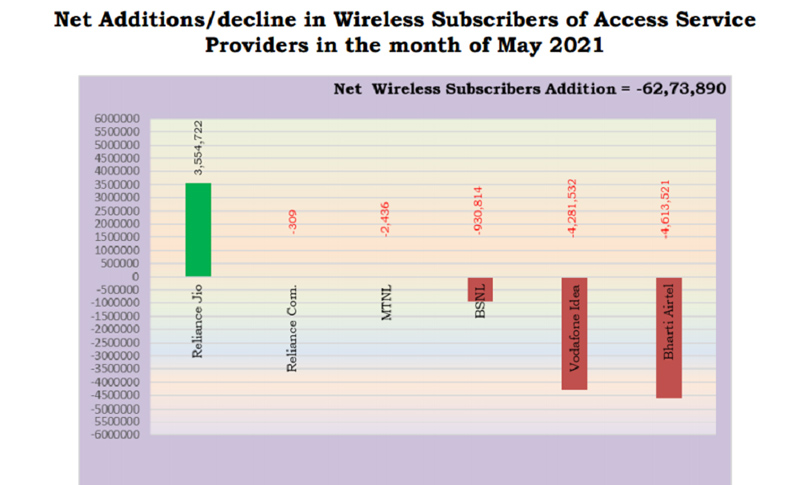
    Mumbai: India’s telecom market saw a 6.2 million net decline in mobile subscribers at the end of May, according to the latest monthly subscription data released by Telecom Regulatory Authority of India (TRAI).

    Reliance Jio was the only wireless access service provider that added 3.5 million mobile subscribers. Previous data shows that the telecom company added 4.7 million mobile subscribers in April.

    Bharti Airtel saw its mobile subscribers reduce by 4.6 million (including the subscribers of Tata Teleservices), the highest loss, followed closely by Vodafone Idea which lost 4.2 million customers. This is several multiples higher than the subscriber decline reported in April which stood at 0.51 million and 1.8 million for Bharti Airtel and Vodafone Idea, respectively.

    Similarly, the number of telephone subscribers came down from 1,203.47 million at the end of April to 1,198.50 million at the end of May, at a monthly decline rate of 0.41 per cent. TRAI had reported a monthly growth rate of 0.19 per cent and 1.12 per cent for telephone subscribers in the preceding months of April and March, respectively. Also, Urban and rural telephone monthly subscription decline rates for May stood at 0.47 per cent and 0.34 per cent, respectively.

    The overall tele-density in India decreased from 88.27 per cent at the end of April to 87.84 per cent at the end of May. The share of urban and rural subscribers out of total number of subscribers stood at 55.17 per cent and 44.83 per cent, respectively.

    As per reports received from 438 operators in May, the number of broadband subscribers decreased from 782.86 million at the end of April to 780.27 million at the end of May with a monthly decline rate of 0.33 per cent, according to TRAI data. While mobile subscribers and fixed wireless subscribers.

    (Wi-Fi, Wi-Max, Point to Point Radio & VSAT) saw monthly decline rates of 0.38 per cent and 2.45 per cent respectively, wired subscribers grew to 22.74 million from 22.42 million at a 1.43 per cent monthly growth rate.

    The top five service providers made up 98.80 per cent of the market share of the total broadband subscribers including wired and wireless at the end of May. These included Reliance Jio Infocomm (434.23 million), Bharti Airtel (192. 73 million), Vodafone Idea (119.64 million), BSNL (22.4 million) and Atria Convergence (1.87 million).