Category: Social Media

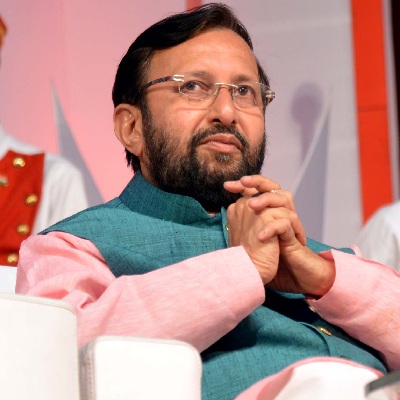
  • No plans to impose censorship or regulate social media: Javadekar

    No plans to impose censorship or regulate social media: Javadekar

    NEW DELHI: Information and Broadcasting Minister Prakash Javadekar has said that there were and are no plans to impose any censorship on social media or to regulate any programmes beamed through social media.

    The Minister told the Parliament that the Communication and Information Technology Ministry has given an assurance in this regard.

    Social media has become an important tool that is also being used by government departments to reach out to the people. Although he highlighted that section 69A of the Information Technology Act 2000 allows blocking of any videos or information affecting society in the interest of public order.


    Earlier in the month of May, Javadekar had urged all central Ministries to disseminate their policy initiatives through the Communication Hub under the existing New Media Wing of his Ministry.


    Firmly believing in prolific use of social media, the Minister wrote to his cabinet colleagues for utilising the hub as a one-stop place for social media outreach.

    In his letter, he said each Ministry or department may liaise with the New Media Wing which will cater to all its needs such as disseminating information through packaging and placing of content, wider reach through variety of tools and response management.


    He said the two-way interaction envisaged in this endeavour would provide a 360 degree communication approach to the government and hence, help in last man connectivity. 

    He said the directive was in adherence to the vision of Prime Minister Narendra Modi, who wanted to use the social media platforms extensively for transparency and better governance. 

  • Facebook joins COAI as associate member

    Facebook joins COAI as associate member

    NEW DELHI: The leading mobile communications association in India, Cellular Operators Association of India (COAI), has announced the induction of Facebook India Online Services as an associate member.


    COAI’s associate membership comprises companies that manufacture or support the functioning, promotion, research development and evolution of mobile communications services. The induction of the Mark Zuckerberg-led company in COAI will help it in getting a bigger platform to interact with the leading mobile operators.


    Facebook, public policy director – India and south Asia Ankhi Das said, “Over 85 per cent of the world’s population lives in areas with existing cellular coverage, yet only about 30 per cent of the total population accesses the internet. Affordability and awareness are significant barriers to internet adoption. Facebook believes that overcoming these barriers and connecting people has immense value, from empowering people to exercise their rights to freely express themselves, promoting transparency and democratic values and allowing people to access affordable data services in areas such as health care, education and information, which they otherwise cannot afford. Access = opportunity – creating more economic, social and political opportunities for everybody.”


    She further added, “Joining COAI as an associate member reflects our focus on mobile technologies, access and our continued desire to work in collaboration with the industry to increase connectivity. We look forward to playing an active role as a member.”


    Founded in 2004, the social media giant Facebook aimed to is to give people the power to share and make the world more open and connected. Facebook has more than 1.32 billion monthly active users globally, including over 100 million monthly active users in India.


    COAI’s other associate members include Alcatel Lucent India, Cisco Systems India, Ericsson India, IBM India, GTL Infrastructure, Huawei Technologies, Indus Towers, Intel Corporation, Nokia Solutions and Networks, Qualcomm India  and ZTE India.


    Commenting on the induction COAI director general Rajan S Mathews said, “We welcome Facebook India Online Services to the COAI family. Social networking, especially Facebook, has changed the way Indians work, play, communicate, socialise and do business. We believe this will further grow to become a crucial part of and influence the socio-economic culture in the country. We feel that Facebook’s active participation in COAI activities will result in mutual value addition and bring the much needed synergy of functioning between the service providers and the content/VAS players.”


    Having started as an association for mobile service providers, COAI, today, has members including cellular service providers, telecom infrastructure companies, and telecom equipment manufacturers; and still expanding to include other allied and critical stakeholders of the sector.

  • Twitter Amplify launches in India

    Twitter Amplify launches in India

    MUMBAI: It’s time for making money from Twitter. Starsports.com and Vodafone India have tied up with Twitter for its Twitter Amplify programme in India for the first time. Through the programme, the broadcaster and the brand will be tapping into growing social conversations around TV programmes especially live sports.


    Twitter Amplify allows broadcasters to publish their best content directly to Twitter and then monetise it with advertisers through sponsorship packages. Assisted by ‘promoted tweets’, it will amplify the reach of the video content distributed through companies’ Twitter accounts.


    Through the programme, starsports.com looks to enhance viewer experience across the web and mobile by offering high quality clips of sporting action directly to consumers engaged in conversations on Twitter around live matches. It says, “This is likely to lead to greater engagement around live sports in social media as well as create an opportunity for fans to consume the action without leaving the conversation.”


    Advertisers will be able to tap into social conversations on Twitter along with a multi screen audience engagement strategy to consume content wherever or whenever they want.


    “2014 is a great year for Twitter becoming the social soundtrack for television as 95 per cent of the public social conversation around TV is happening on Twitter today, especially for live sporting events. Broadcasters and brands know that Twitter is a natural TV companion that drives audience tune-in, engagement and affinity,” said Twitter India market director Rishi Jaitly.  “We look forward to working with cutting-edge broadcasters and advertisers, like Star Sports and Vodafone, who want to tap into a compelling second screen experience We are delighted that cricket fans can now enjoy TV highlights in real-time on Twitter,” he added.


    Star India head of digital business Ajit Mohan said, “We have built starsports.com as the most compelling destination for fans in India to follow sports on a mobile screen and the best platform for advertisers to reach an attractive audience on digital. This program is a new innovation for us to understand the possibilities of being present when the conversations are happening on Twitter.”


    Vodafone India chief commercial officer Vivek Mathur said, “As a brand we are always looking at innovative ways of driving brand engagement and conversations on social media. Cricket (and sports in general) is one of our identified passion points and one with which Vodafone has a huge association. We are very excited to be the pioneers in launching a new social innovation in India centered around Twitter and cricket.”


    Through this partnership, Twitter users will receive timely updates about their TV experience and remind them to tune in to the live cricket action and key sporting moments.

  • We remain focused on driving increased user growth: Dick Costolo

    We remain focused on driving increased user growth: Dick Costolo

    MUMBAI: Micro blogging site, Twitter has had an interesting second quarter. The company has announced its financial results for the second quarter ended 30 June 2014.

    In a company statement Twitter CEO Dick Costolo said, “Our strong financial and operating results for the second quarter show the continued momentum of our business.”

    “We remain focused on driving increased user growth and engagement, and by developing new product experiences, like the one we built around the World Cup, we believe we can extend Twitter’s appeal to an even broader audience,” he added.

    It can be noted that Twitter’s Q2 revenue was $312 million, up 124 per cent year-over-year. The company reported Q2 net loss of $145 million and non-GAAP net income of $15 million, Q2 GAAP EPS of ($0.24) and non-GAAP EPS of $0.02 and Q2 adjusted EBITDA of $54 million, representing an adjusted EBITDA margin of 17 per cent.

    According to a report by AP, San Francisco-based Twitter’s stock jumped 30 per cent to $50.01 in extended trading Tuesday.

    It can be noted that Twitter introduced new product experiences that were built around the World Cup, including real-time scoring, push notifications, event and match timelines, and a voting ballot feature. In addition, Twitter also launched new web profiles and the ability to send private messages within Vine.

    Twitter also launched a number of new advertiser tools including mobile app promotions, which allow mobile app developers to drive installs and engagements on Twitter, and website cards, which allow advertisers to easily surface website content within a Tweet and drive relevant traffic to any page of their site such as their home page, product page, or an important blog post.

    Twitter continued the international expansion of its advertising products, expanding state/region geo-targeting to help marketers meet local advertising objectives in additional countries including the UK, France, and Indonesia, among others, and launching its self service ad platform for small and medium sized businesses in Spain, Israel and South Africa.

    Twitter closed the acquisition of Gnip, a leading provider of social data, and entered into agreements to acquire several other companies including TapCommerce, a leader in mobile retargeting and re-engagement advertising, and SnappyTV, a platform for video editing and distribution.

    Second Quarter 2014 Financial Highlights

    Revenue: Revenue for the second quarter of 2014 totalled $312 million, an increase of 124 per cent compared to $139 million in the same period last year.

    • Advertising revenue totalled $277 million, an increase of 129 per cent year-over-year.

    • Mobile advertising revenue was 81 per cent of total advertising revenue.

    • Data licensing and other revenue totalled $35 million, an increase of 90per cent year-over-year.

    • International revenue totalled $102 million, an increase of 168 per cent year-over-year.

    • International revenue was 33 per cent of total revenue

    Net loss: GAAP net loss was $145 million for the second quarter of 2014 compared to a net loss of $42 million in the same period last year. Twitter’s GAAP net loss included $158 million of stock-based compensation expense.

    Adjusted EBITDA: Adjusted EBITDA was $54 million for the second quarter of 2014, an increase of 461 per cent compared to $10 million in the same period last year.

    Non-GAAP net income / loss: Non-GAAP net income was $15 million for the second quarter of 2014 compared to a Non-GAAP net loss of $16 million in the same period last year.

    EPS: Basic and diluted GAAP EPS was ($0.24) for the second quarter of 2014 compared to ($0.32) in the same period last year.

    Non-GAAP EPS: Non-GAAP EPS was $0.02 for the second quarter of 2014 compared to ($0.12) in the year ago period.

    Capital expenditures: Purchases of property and equipment for the second quarter of 2014 were $44 million. Additionally, $31 million of equipment was financed through capital leases during the second quarter of 2014.

    Cash, cash equivalents and marketable securities: As of 30 June 2014, cash, cash equivalents and marketable securities were approximately $2.1 billion, compared to $2.2 billion as of 31 March 2014.

    Way ahead!

    Twitter’s outlook for the third quarter of 2014 is as follows:

    Twitter’s outlook for the third quarter of 2014 is as follows:

    • Revenue is projected to be in the range of $330 million to $340 million.

    • Adjusted EBITDA is projected to be in the range of $40 million to $45 million.

    • Stock-based compensation expense is projected to be in the range of $180 million to $190 million excluding the impact of equity awards that may be granted in connection with potential future acquisitions.

    Twitter’s revised outlook for the full year of 2014 is as follows:

    • Revenue is projected to be in the range of $1,310 million to $1,330 million.

    • Adjusted EBITDA is projected to be in the range of $210 million to $230 million.

    • Capital expenditures are projected to be in the range of $330 million to $390 million.

    • Stock-based compensation expense is projected to be in the range of $640 million to $690 million excluding the impact of equity awards that may be granted in connection with potential future acquisitions.

    Click here to read the financial report
  • Two more Union Ministries join Twitter

    Two more Union Ministries join Twitter

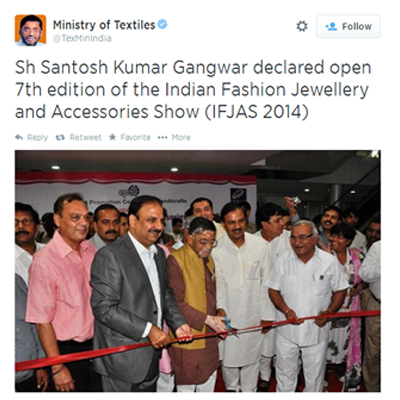
    MUMBAI:  Following up on the push by Prime Minister Narendra Modi, asking all his ministers to join twitter, two more union ministries debuted on the platform today.  The Ministry of Textiles and the Ministry of Health and Family Welfare will be tweeting from their handles; @MoHFW_INDIA  and @TexMinIndia


    Twitter has emerged as the platform of choice for the NDA government to communicate with the citizens of India with the PM leading the charge with his personal handle (@narendramodi), complimented by his office’s official handle (@PMOIndia), to share updates.


    The Prime Minister’s cabinet is flocking to twitter, with nearly 40 ministers and ministries already sharing daily updates with their followers about the goings on in their respective ministries.

    Earlier the Ministry of Railways (@RailMinIndia) and the Home Minister’s Office (@HMOIndia) had joined twitter, with the Railway Ministry even live tweeting the rail budget on their debut.

  • We had a good second quarter: Mark Zuckerberg

    We had a good second quarter: Mark Zuckerberg

    MUMBAI: Social networking site, Facebook has had a good second quarter. The company declared its financial results for the quarter ended 30 June 2014 on 23 July. Its founder and CEO Mark Zuckerberg said, “We had a good second quarter. Our community has continued to grow, and we see a lot of opportunity ahead as we connect the rest of the world.”


    Operational highlights


    Daily active users (DAUs) were 829 million on average for June 2014, an increase of 19 per cent year-over-year


    Mobile DAUs were 654 million on average for June 2014, an increase of 39 per cent year-over-year


    Monthly active users (MAUs) were 1.32 billion as of 30 June 2014, an increase of 14 per cent year-over-year


    Mobile MAUs were 1.07 billion as of 30 June 2014, an increase of 31 per cent year-over-year


    Financial Highlights


    Revenue: Revenue for the second quarter of 2014 totaled $2.91 billion, an increase of 61 per cent, compared with $1.81 billion in the second quarter of 2013. Excluding the impact of year-over-year changes in foreign exchange rates, revenue would have increased by 59 per cent. Revenue from advertising was $2.68 billion, a 67 per cent increase from the same quarter last year. Excluding the impact of year-over-year changes in foreign exchange rates, revenue from advertising would have increased by 65 per cent. Mobile advertising revenue represented approximately 62 per cent of advertising revenue for the second quarter of 2014, up from approximately 41 per cent of advertising revenue in the second quarter of 2013. Payments and other fees revenue was $234 million, a 9 per cent increase from the same quarter last year.


    Costs and expenses: GAAP costs and expenses for the second quarter of 2014 were $1.52 billion, an increase of 22 per cent from the second quarter of 2013. Excluding share-based compensation and related payroll tax expenses, non-GAAP costs and expenses were $1.2 billion in the second quarter of 2014, up 18 per cent compared to $1.02 billion for the second quarter of 2013.


    Income from operations: For the second quarter of 2014, GAAP income from operations was $1.39 billion, up 147 per cent compared to $562 million in the second quarter of 2013. Excluding share-based compensation and related payroll tax expenses, non-GAAP income from operations for the second quarter of 2014 was $1.71 billion, up 116 per cent compared to $794 million for the second quarter of 2013.


    Operating margin: GAAP operating margin was 48 per cent for the second quarter of 2014, compared to 31 per cent in the second quarter of 2013. Excluding share-based compensation and related payroll tax expenses, non-GAAP operating margin was 59 per cent for the second quarter of 2014, compared to 44 per cent for the second quarter of 2013.


    Provision for income taxes: GAAP income tax expense for the second quarter of 2014 was $595 million, representing a 43 per cent effective tax rate. Excluding share-based compensation and related payroll tax expenses, the non-GAAP effective tax rate would have been approximately 36 per cent.


    Net income and EPS: For the second quarter of 2014, GAAP net income was $791 million, up 138 per cent compared to $333 million for the second quarter of 2013. Excluding share-based compensation and related payroll tax expenses and income tax adjustments, non-GAAP net income for the second quarter of 2014 was $1.09 billion, up 124 per cent compared to $488 million for the second quarter of 2013.


    GAAP diluted EPS was $0.30 in the second quarter of 2014, up 131% compared to $0.13 in the second quarter of 2013. Excluding share-based compensation and related payroll tax expenses and income tax adjustments, non-GAAP diluted EPS for the second quarter of 2014 was $0.42, up 121 per cent compared to $0.19 in the second quarter of 2013.


    Capital expenditures: Capital expenditures for the second quarter of 2014 were $469 million.


    Cash and marketable securities: Cash and marketable securities were $13.96 billion at the end of the second quarter of 2014.


    Free cash flow: Free cash flow for the second quarter of 2014 was $872 million.


    Click here to read the financial report

  • Last word for Orkut before it retires!

    Last word for Orkut before it retires!

    MUMBAI: It was in 2004 when internet got one of its first social media network – Orkut. Google, the online media giant that had launched Orkut, picked up its business from then. With competitiveness creeping in the online space, the popularity of Orkut gradually fell. Thanks to Facebook and Twitter that has grabbed the attention of netizens during the course of time.

    After a decade, Google has decided to shut down the social networking site which got its user base from countries like India and Brazil. The company took the decision so that it could focus on its other social businesses such as Google+ and YouTube. Internet users will not be able to log on to their Orkut account post 30 September 2014.

    Indiantelevision.com goes down the memory lane with digital professionals and notes few things that will be missed about Orkut.

    Scraps, communities and profile views will always be remembered!

    Messages in the Orkut era were called scraps. Like-minded people could create communities. One could even see who all viewed his/her profile. The number of testimonials defined the popularity quotient.  

    Mindshift Interactive founder & CEO Zafar Rais recalls scrapping as a fun tool to interact with friends and the profile visits as a great way to know who’s keeping a check on your profile; a feature that is consistently famous on social networks, till date. 

    For ibs managing director Sabyasachi Mitter the site was our introduction to social media. “The funniest memory I have of Orkut is to login every day and see who has viewed my profile. And, then go across and see who they were. Some new friends were made that way. Also, to count the number of scraps and compare this with friends was something I remembering doing. The numerous discussions in groups and the sheer volume of conversations were fond memories,” he recalls. 

    Similarly, FoxyMoron creative head – north Kumar Abhishek who also belongs to the Orkut generation that looked forward to know who viewed his profile. “It was always exciting and fun to find a girl I may have liked or had a crush on in the list of those who viewed my profile,” he mentions.  

    According to BBDO Proximity India Digital creative leader Dinesh Swamy when Orkut began, it was one of its kind experiences. “It was ‘cool’ to be there. One memory which I can recall is that we created a group only for family members, just for gossiping.  We enjoyed that phase,  but by the time brands started leveraging, people lost interest in it and moved on to other social networking sites. I don’t remember when was the last time I scrapped,” says Swamy.

    Advertising wish list!

    There were a few brands that partnered with the social networking site for display ads. However, it can be noted that Google had pulled all AdSense ads from Orkut in 2007.

    If given a chance to endorse a brand on Orkut, Rais would have endorsed brands with a larger mass and youth appeal so anything within the FMCG to retail sector would have done exceptionally well. 

    “The one brand would have loved to have seen on Orkut is Oreo,” said Mitter. “If I had the chance to endorse a brand on Orkut, it would be Foster’s as a ‘daaaamn cold’ beer is best enjoyed with friends only,” adds Abhishek.

    Having said this, Orkut will always remain special for early Internet users!

    We will miss you Orkut.


  • Yahoo buys Flurry to scale up its mobile ad biz

    Yahoo buys Flurry to scale up its mobile ad biz

    MUMBAI: As internet and social media giants is speeding up to add specialised startups to boost their advertising business, Yahoo too is following the trend. Yahoo has announced that it has reached a definitive agreement to acquire Flurry, a mobile ad and analytics company.


    A statement issued by Yahoo mentioned, “Our agreement to acquire Flurry is a meaningful step for the company and reinforces Yahoo’s commitment to building and supporting useful, inspiring and beautiful mobile applications and monetization solutions. By joining Yahoo, Flurry will have resources to speed up the delivery of platforms that help developers build better apps, reach the right users, and explore new revenue opportunities. Together, the companies can make mobile experiences better through products that are more personalized and more inspiring.”


    Analytics are critical for all mobile developers to understand and optimise their applicationsThe combined scale of the two companies will accelerate revenue growth of developers and publishers across the mobile ecosystem.


    In addition, the joined offerings of Yahoo and Flurry will enable more effective mobile advertising solutions for brands seeking to reach their audiences and gain unique insights across desktop and mobile, and users will benefit from more personalized app experiences.


    As announced in Q2 earnings last week, Yahoo mobile usage is growing rapidly. Yahoo’s mobile display and search revenue each grew more than 100 per cent year-over-year. More than half Yahoo’s total monthly audience visits on a mobile device, and in Q2, over 450 million mobile monthly active users came to Yahoo, a 36 per cent increase year-over-year. The average Yahoo user now spends 86 per cent of his/her time on smartphones in apps


    “Yahoo’s growth in mobile traffic comes from great people and great products. Flurry’s success is the result of years of committed investment by a passionate team to create an indispensable platform for mobile developers. We want to harness our collective innovative spirit and bolster the mobile ecosystem by providing developers the analytics and monetization solutions to drive their success,” said Yahoo SVP advertising technology Scott Burke.


    “As part of Yahoo, Flurry will continue to serve the application developer community in the way we always have, only better. With Yahoo, we will have access to more resources to speed up the delivery of great products that can help app developers build better apps, reach the right users, and explore new revenue opportunities. Over the last six years we have accomplished a lot on our own, but with Yahoo we are in an even better position to achieve our joint goals,” mentioned Flurry president and CEO Simon Khalaf.

  • BigB to share fun facts and interesting trivia – #BachchanBol on Twitter every Wednesday

    BigB to share fun facts and interesting trivia – #BachchanBol on Twitter every Wednesday

    MUMBAI: Amitabh Bachchan is the most followed person on Twitter in India. He is known for his expressive Tweets on the platform and has been constantly engaging with his colleagues, family and fans on Twitter. Today, Amitabh Bachchan shared a Tweet about how he will be kicking off  #BachchanBol tomorrow for his Twitter Extended Family (TwFmXT). The actor will be sharing fun facts and interesting trivia every Wednesday on Twitter. This is an innovative way to connect with a wider audience and engage with them in a way; no one can do it better than Mr. Bachchan!

    https://twitter.com/SrBachchan/status/491467304438206464

    Stay tuned by following @SrBachchan on Twitter and join him in conversation for #BachchanBol every Wednesday.

  • Social Media-the stadium for 2014 World Cup

    Social Media-the stadium for 2014 World Cup

    MUMBAI: Brazil had a reason to cheer this FIFA World Cup season. While it lost the big title, it was still the hub of all the excitement related to the football extravaganza. What is interesting to note is that social media platforms like Facebook and Twitter became another venue where the action unfolded with an audience comprising global fans.


    The entire span of the World Cup saw a total of 672 million tweets being sent out: the highest number, Twitter has announced so far related to any event.


    Of the 672 million tweets, a bulk of the conversation was during the live matches. The semi-final between Brazil and Germany saw fans sending out more than 35.6 million tweets —setting a new Twitter record for a single event.


    The other top four matches were Germany versus Argentina with 32.1 million tweets. Next was Brazil versus Chile which garnered 16.4 million tweets followed by the match between Netherlands and Argentina receiving 14.2 million tweets. Finally it was the Brazil versus Colombia game which got 12.4 million tweets.


    Three of the top five most-tweeted moments occurred during Brazil’s 7-1 semi-final loss to Germany on 8 July, while the other two moments came in during the final match. The top five moments that generated the biggest peaks of Twitter conversation, measured in tweets per minute (TPM), during the entire tournament was Germany defeating Argentina to win the World Cup final with 6,18,725 TPM. Next was Germany’s Sami Khedira scoring a goal assisted by Mesut Ozil during the semi-final versus Brazil which got 5,80,166 TPM. Germany’s Mario Gotze scoring the winning goal of the World Cup on 13 July generated 5,56,499 TPM. Germany’s Toni Kroos scoring his second goal in the semi final against Brazil was fourth in line with 5,08,601 TPM. Finally, Toni Kroos scoring his third goal during the same semi-final match against Brazil garnered 4,97,425 TPM.


    The top 10 mentioned players in India during the WC were Lionel Messi, Luis Suarez, Cristiano Ronaldo, James Rodriguez, David Luiz, Robin Van Persie, Neymar Junior, Mesut Ozil, Pepe and Wayne Rooney.


    While Twitter was buzzing, Facebook wasn’t far behind. 350 million people joined the conversation during the entire span of the World Cup generating 3 billion interactions (posts, comments and likes).


    Brazil’s demolition by Germany spurred around 66 million people to create more than 200 million Facebook interactions in the semi final match. People thronged to the platform: 10.5 million people from the US in the final and host country Brazil with 10 million. Men in the age group of 18-24 posted on Facebook the most as compared to any other demographic. This was followed by men aged 24-34, women aged 18-24, women aged 24-34 and men aged 13-17.


    NeymarJr saw the most fan growth on his page since approximately 15 million fans ‘liked’ his page since the beginning of the World Cup.


    Meanwhile, to give  a perspective of the  fervor and excitement surrounding FIFA World Cup – Vdopia a leader in online and mobile video advertising recently released an info-graphic calling it ‘The ultimate multi-screen event’ after  examining the impact of online and mobile devices on fan interaction with the World Cup.


    The report found that fans across the Asia Pacific (APAC) region and India were following the FIFA on multiscreens like TV followed by mobiles and then laptops. The most significant trend the report noted was a paradigm shift in consumer’s video consumption behaviour termed as “multi-screen intake” or “platform agnostic” intake. Simplified, it means a typical consumer who was watching the match, checked FIFA updates and shared highlights of his favourite match on his mobile, updating them on Facebook, looking up for some information on their tablet or just sending an email – all during the same time.


    Some of the finds mentioned that the mobile has become the second most preferred medium in APAC after television with 80 per cent of the respondents looking at television+smartphones. It also said that 2,50,000 Indian unique viewers visited football sites everyday via their mobile. It says that the social buzz volumes in India were the highest between 8:00 pm to 4:00 am.


    The report further mentions that India saw one of the highest ever online sports audiences in May with 6.5 million viewers who watched 59.7 million sports related videos in May 2014.  The report appropriately sums up that the 2014 FIFA World Cup has been regarded as the ‘most social event ever.’